SUBSCRIBE TO OUR FREE NEWSLETTER
Daily news & progressive opinion—funded by the people, not the corporations—delivered straight to your inbox.
5
#000000
#FFFFFF
To donate by check, phone, or other method, see our More Ways to Give page.
Daily news & progressive opinion—funded by the people, not the corporations—delivered straight to your inbox.
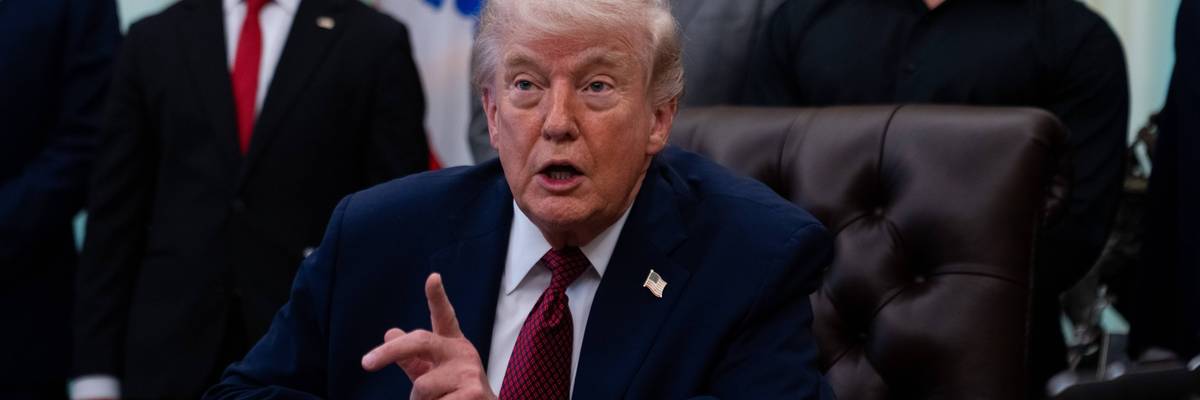
US President Donald Trump speaks in the Oval Office of the White House in Washington, DC on April 18, 2026.
"Trump’s repeated threats to destroy civilian infrastructure are not negotiation, they’re reckless escalations that endanger millions," said one group.
As Iran reversed course on reopening the Strait of Hormuz amid continued US and Israeli provocations, President Donald Trump renewed threats to destroy Iran and its civilian infrastructure, prompting calls on Monday for the US leader to stop threatening to commit war crimes—and for Americans to not normalize such criminal behavior.
Trump was embarrassed on the world stage after declaring Friday that it was "A GREAT AND BRILLIANT DAY FOR THE WORLD" because "Iran has agreed to never close the Strait of Hormuz again."
While Iran's government did agree to fully reopen the vital Mideast waterway—through which around 20% of the world's oil is shipped—on Friday, Trump's continued blockade of Iran's ports and rampant Israeli ceasefire violations in Lebanon led to Tehran shutting down the strait again and accusing the United States of "acts of piracy and maritime theft."
Iranian naval vessels subsequently opened fire on a pair of Indian-flagged ships attempting to travel through the strait Saturday, allegedly after giving at least one of them permission to transit the waterway.
The following day, US forces attacked and seized an Iranian-flagged cargo ship in the Gulf of Oman.
Two weeks after his genocidal threat to wipe out the "whole civilization" of Iran, Trump took to his Truth Social network on Sunday to renew vows to commit war crimes if the Iranian government does not sign a peace deal by Wednesday.
“If they don’t sign the deal, then the whole country is going to get blown up," the president said. “We’re offering a very fair and reasonable DEAL, and I hope they take it because, if they don’t, the United States is going to knock out every single Power Plant, and every single Bridge, in Iran. NO MORE MR. NICE GUY!”
Responding to Trump's post, the National Iranian American Council (NIAC) said Monday on social media: "Threats of war crimes cannot become normalized. Trump’s repeated threats to destroy civilian infrastructure are not negotiation, they’re reckless escalations that endanger millions."
"The president must abandon this pattern immediately and pursue a serious, lawful, diplomatic strategy grounded in legitimate de-escalation," NIAC added.
Threats to commit war crimes such as blowing up entire countries or destroying civilian infrastructure can, like the acts themselves, be illegal under international law.
"If you follow illegal orders to commit war crimes, you will be prosecuted by a future administration," Congressman Ted Lieu (D-Calif.)—who served in the Air Force Judge Advocate General’s Corps—said in a Sunday message to the US Joint Chiefs of Staff. "Bombing 'every single power plant, and every single bridge' would violate proportionality principle and cause excessive civilian harm, which is a war crime."
However, US Ambassador to the United Nations Mike Waltz on Sunday defended Trump's statements, citing American actions in World War II—which included waging the world's only nuclear war and carpet-bombing of German and Japanese cities that killed more people than the atomic bombs—to justify the president's threats.
Waltz also claimed that "the Iranian regime... and its terrorist proxies have a long history of actually deliberately hiding military infrastructure in hospitals, schools, neighborhoods, and other civilian assets," comments that came as Israeli forces continued their attacks on all of those civilian structures and more in Gaza and Lebanon. Iranians are also reeling from US and Israeli attacks, many of them on civilian infrastructure, that officials in Tehran and human rights groups say have killed as many as 1,700 noncombatantas, including hundreds of women and children.
Trump's continued blockade and renewed threats come as Pakistan on Monday pushed for a resumption of peace talks, with Pakistani officials saying Iran has signaled its willingness to send a delegation to Islamabad for negotiations. If Tehran agrees to new talks, Vice President JD Vance is expected to lead a US delegation to Pakistan whose members would likely include Mideast envoy Steve Witkoff and Trump son-in-law Jared Kushner.
Iranian officials have slammed the unreliability of the Trump administration—which has twice waged war on Iran right when deals were in sight, according to international mediators.
“Iranians do not submit to force,” Iranian President Masoud Pezeshkian said Monday.
Dear Common Dreams reader, It’s been nearly 30 years since I co-founded Common Dreams with my late wife, Lina Newhouser. We had the radical notion that journalism should serve the public good, not corporate profits. It was clear to us from the outset what it would take to build such a project. No paid advertisements. No corporate sponsors. No millionaire publisher telling us what to think or do. Many people said we wouldn't last a year, but we proved those doubters wrong. Together with a tremendous team of journalists and dedicated staff, we built an independent media outlet free from the constraints of profits and corporate control. Our mission has always been simple: To inform. To inspire. To ignite change for the common good. Building Common Dreams was not easy. Our survival was never guaranteed. When you take on the most powerful forces—Wall Street greed, fossil fuel industry destruction, Big Tech lobbyists, and uber-rich oligarchs who have spent billions upon billions rigging the economy and democracy in their favor—the only bulwark you have is supporters who believe in your work. But here’s the urgent message from me today. It's never been this bad out there. And it's never been this hard to keep us going. At the very moment Common Dreams is most needed, the threats we face are intensifying. We need your support now more than ever. We don't accept corporate advertising and never will. We don't have a paywall because we don't think people should be blocked from critical news based on their ability to pay. Everything we do is funded by the donations of readers like you. When everyone does the little they can afford, we are strong. But if that support retreats or dries up, so do we. Will you donate now to make sure Common Dreams not only survives but thrives? —Craig Brown, Co-founder |
As Iran reversed course on reopening the Strait of Hormuz amid continued US and Israeli provocations, President Donald Trump renewed threats to destroy Iran and its civilian infrastructure, prompting calls on Monday for the US leader to stop threatening to commit war crimes—and for Americans to not normalize such criminal behavior.
Trump was embarrassed on the world stage after declaring Friday that it was "A GREAT AND BRILLIANT DAY FOR THE WORLD" because "Iran has agreed to never close the Strait of Hormuz again."
While Iran's government did agree to fully reopen the vital Mideast waterway—through which around 20% of the world's oil is shipped—on Friday, Trump's continued blockade of Iran's ports and rampant Israeli ceasefire violations in Lebanon led to Tehran shutting down the strait again and accusing the United States of "acts of piracy and maritime theft."
Iranian naval vessels subsequently opened fire on a pair of Indian-flagged ships attempting to travel through the strait Saturday, allegedly after giving at least one of them permission to transit the waterway.
The following day, US forces attacked and seized an Iranian-flagged cargo ship in the Gulf of Oman.
Two weeks after his genocidal threat to wipe out the "whole civilization" of Iran, Trump took to his Truth Social network on Sunday to renew vows to commit war crimes if the Iranian government does not sign a peace deal by Wednesday.
“If they don’t sign the deal, then the whole country is going to get blown up," the president said. “We’re offering a very fair and reasonable DEAL, and I hope they take it because, if they don’t, the United States is going to knock out every single Power Plant, and every single Bridge, in Iran. NO MORE MR. NICE GUY!”
Responding to Trump's post, the National Iranian American Council (NIAC) said Monday on social media: "Threats of war crimes cannot become normalized. Trump’s repeated threats to destroy civilian infrastructure are not negotiation, they’re reckless escalations that endanger millions."
"The president must abandon this pattern immediately and pursue a serious, lawful, diplomatic strategy grounded in legitimate de-escalation," NIAC added.
Threats to commit war crimes such as blowing up entire countries or destroying civilian infrastructure can, like the acts themselves, be illegal under international law.
"If you follow illegal orders to commit war crimes, you will be prosecuted by a future administration," Congressman Ted Lieu (D-Calif.)—who served in the Air Force Judge Advocate General’s Corps—said in a Sunday message to the US Joint Chiefs of Staff. "Bombing 'every single power plant, and every single bridge' would violate proportionality principle and cause excessive civilian harm, which is a war crime."
However, US Ambassador to the United Nations Mike Waltz on Sunday defended Trump's statements, citing American actions in World War II—which included waging the world's only nuclear war and carpet-bombing of German and Japanese cities that killed more people than the atomic bombs—to justify the president's threats.
Waltz also claimed that "the Iranian regime... and its terrorist proxies have a long history of actually deliberately hiding military infrastructure in hospitals, schools, neighborhoods, and other civilian assets," comments that came as Israeli forces continued their attacks on all of those civilian structures and more in Gaza and Lebanon. Iranians are also reeling from US and Israeli attacks, many of them on civilian infrastructure, that officials in Tehran and human rights groups say have killed as many as 1,700 noncombatantas, including hundreds of women and children.
Trump's continued blockade and renewed threats come as Pakistan on Monday pushed for a resumption of peace talks, with Pakistani officials saying Iran has signaled its willingness to send a delegation to Islamabad for negotiations. If Tehran agrees to new talks, Vice President JD Vance is expected to lead a US delegation to Pakistan whose members would likely include Mideast envoy Steve Witkoff and Trump son-in-law Jared Kushner.
Iranian officials have slammed the unreliability of the Trump administration—which has twice waged war on Iran right when deals were in sight, according to international mediators.
“Iranians do not submit to force,” Iranian President Masoud Pezeshkian said Monday.
As Iran reversed course on reopening the Strait of Hormuz amid continued US and Israeli provocations, President Donald Trump renewed threats to destroy Iran and its civilian infrastructure, prompting calls on Monday for the US leader to stop threatening to commit war crimes—and for Americans to not normalize such criminal behavior.
Trump was embarrassed on the world stage after declaring Friday that it was "A GREAT AND BRILLIANT DAY FOR THE WORLD" because "Iran has agreed to never close the Strait of Hormuz again."
While Iran's government did agree to fully reopen the vital Mideast waterway—through which around 20% of the world's oil is shipped—on Friday, Trump's continued blockade of Iran's ports and rampant Israeli ceasefire violations in Lebanon led to Tehran shutting down the strait again and accusing the United States of "acts of piracy and maritime theft."
Iranian naval vessels subsequently opened fire on a pair of Indian-flagged ships attempting to travel through the strait Saturday, allegedly after giving at least one of them permission to transit the waterway.
The following day, US forces attacked and seized an Iranian-flagged cargo ship in the Gulf of Oman.
Two weeks after his genocidal threat to wipe out the "whole civilization" of Iran, Trump took to his Truth Social network on Sunday to renew vows to commit war crimes if the Iranian government does not sign a peace deal by Wednesday.
“If they don’t sign the deal, then the whole country is going to get blown up," the president said. “We’re offering a very fair and reasonable DEAL, and I hope they take it because, if they don’t, the United States is going to knock out every single Power Plant, and every single Bridge, in Iran. NO MORE MR. NICE GUY!”
Responding to Trump's post, the National Iranian American Council (NIAC) said Monday on social media: "Threats of war crimes cannot become normalized. Trump’s repeated threats to destroy civilian infrastructure are not negotiation, they’re reckless escalations that endanger millions."
"The president must abandon this pattern immediately and pursue a serious, lawful, diplomatic strategy grounded in legitimate de-escalation," NIAC added.
Threats to commit war crimes such as blowing up entire countries or destroying civilian infrastructure can, like the acts themselves, be illegal under international law.
"If you follow illegal orders to commit war crimes, you will be prosecuted by a future administration," Congressman Ted Lieu (D-Calif.)—who served in the Air Force Judge Advocate General’s Corps—said in a Sunday message to the US Joint Chiefs of Staff. "Bombing 'every single power plant, and every single bridge' would violate proportionality principle and cause excessive civilian harm, which is a war crime."
However, US Ambassador to the United Nations Mike Waltz on Sunday defended Trump's statements, citing American actions in World War II—which included waging the world's only nuclear war and carpet-bombing of German and Japanese cities that killed more people than the atomic bombs—to justify the president's threats.
Waltz also claimed that "the Iranian regime... and its terrorist proxies have a long history of actually deliberately hiding military infrastructure in hospitals, schools, neighborhoods, and other civilian assets," comments that came as Israeli forces continued their attacks on all of those civilian structures and more in Gaza and Lebanon. Iranians are also reeling from US and Israeli attacks, many of them on civilian infrastructure, that officials in Tehran and human rights groups say have killed as many as 1,700 noncombatantas, including hundreds of women and children.
Trump's continued blockade and renewed threats come as Pakistan on Monday pushed for a resumption of peace talks, with Pakistani officials saying Iran has signaled its willingness to send a delegation to Islamabad for negotiations. If Tehran agrees to new talks, Vice President JD Vance is expected to lead a US delegation to Pakistan whose members would likely include Mideast envoy Steve Witkoff and Trump son-in-law Jared Kushner.
Iranian officials have slammed the unreliability of the Trump administration—which has twice waged war on Iran right when deals were in sight, according to international mediators.
“Iranians do not submit to force,” Iranian President Masoud Pezeshkian said Monday.