

5
#000000
#FFFFFF
To donate by check, phone, or other method, see our More Ways to Give page.
Daily news & progressive opinion—funded by the people, not the corporations—delivered straight to your inbox.
When it comes to media, journalism, and the broader information landscape, there’s a strong practical need to be utopian right now—to give us hope but to also provide clarity as to what we should be fighting for.
The Trump 2.0 era has intensified a deeply entrenched pathology in the American media system: concentrated corporate ownership. During less perilous times, legitimate concerns about a few corporations capturing so much of our news and information have often been dismissed as conspiracy theories and paranoia. But Donald Trump and his coterie of plutocrats have made our media oligarchy problem acutely evident and impossible to ignore.
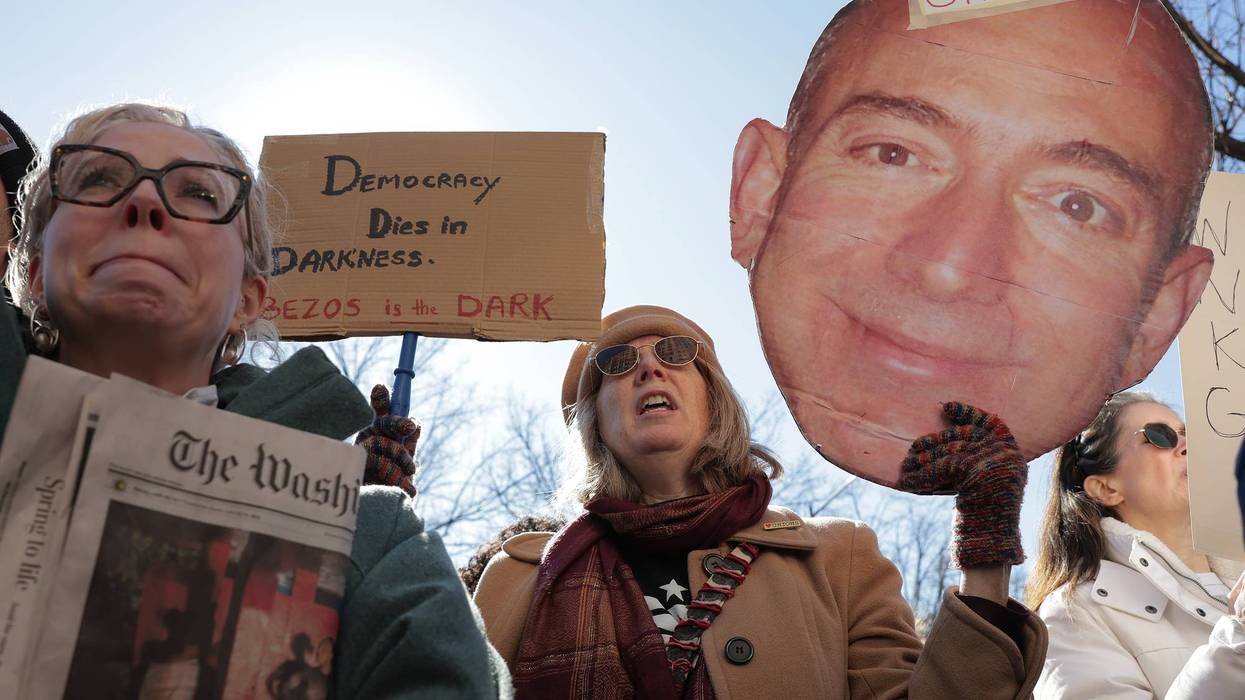
Constant controversies—from government and corporate censorship of television comedians like Jimmy Kimmel and Stephen Colbert to the algorithmic and editorial abuses of Elon Musk’s X and Jeff Bezos’s Washington Post—remind us why media ownership holds such high stakes for any semblance of democracy. Meanwhile, rightwing nepotistic dynasties like the Murdochs and the Ellisons hold inordinate influence over what millions of people can see, hear, and read in their daily media.
Our current media system is simply incompatible with democracy, making structural media reform an urgent priority. This includes unwinding previously approved and pending mergers—exhibit A being Paramount Skydance’s potential acquisition of Warner Bros. Discovery (which owns CNN and HBO, among other key holdings)—as well as trust-busting corporate media behemoths by forcing them to divest major components of their sprawling conglomerates.
Undoing the wreckage will take time, but we must lay the groundwork now to launch necessary structural reforms the moment we dethrone Trump and his ilk. This project requires a clear analytical framework for understanding exactly why such run-amok media concentration is bad for democracy, and why breaking up media conglomerates is both necessary and insufficient for reconstructing the media we need from the ground up.
Big corporate media mergers are bad for everyone other than those few who stand to profit. They’re harmful for media workers, consumers, local communities, First Amendment freedoms, and democracy writ large. Over the years, the dangers for democracy posed by media concentration have been borne out by empirical evidence. Research shows that media conglomeration can lead to less local news, more advertising, and shifts toward conservative political commentary, especially under the ownership of rightwing companies such as Sinclair.
According to basic democratic theory, ensuring diverse voices, viewpoints, and stories in our media requires a pluralistic range of media owners. However, the hypercommercialized, corporate-dominated US media system wasn’t devised to privilege democracy. In fact, given its weak public media system, oligopolistic media markets, and light public interest regulations—many of which eroded over time or simply were ignored (or weaponized under Trump)—the US media system is almost perfectly designed to not serve democracy.
Within this hypercommercialized media structure, despite many individual journalists’ courageous work to the contrary, profit imperatives too often trump democracy (bad pun intended). Capitalist logics undercut and skew democratic discourse by encouraging clickbait, excluding low-income communities, and degrading the quality of journalism. Capitalist incentive structures also lead to pronounced deficits through sheer cost cutting, and by treating news and information as commodities, not public services, and audiences as passive consumers, not engaged citizens.
Even during the best of times, media corporations often maximize profits by ruthlessly cutting corners and forcing their media workers to do more for less. Too often, costly services like high-quality journalism are dismantled while content that’s cheaply produced and easily replicated—like shouting heads across ubiquitous screens, endlessly capturing our attention for advertisers—gets amplified.
Media conglomeration only intensifies these commercial logics. For example, cost cutting typically accelerates immediately following big mergers when companies take on tremendous debt. New corporate ownership has subjected CBS to such restructuring and would likely do the same to CNN if the pending merger goes through, for which Paramount Skydance is reportedly incurring $79 billion in debt. To compensate, media corporations often combine newsrooms and lay off reporters—or eliminate journalism altogether in favor of opinion and commentary.
In addition to decimating jobs, managing such debt tends to result in outsourcing costs to audiences by raising prices, offering lower-quality programming, and providing less creative cultural fare. This outcome is especially detrimental given a media landscape already riddled with news deserts, in which scarce original journalism and local media content are being produced.
The debasement of our news and entertainment media is bad enough. But media conglomeration also creates private tyrannies wherein oligarchs command broad swaths of our media. Driven by perverse incentives, these media barons wield dangerous control over public discourse, warping how important issues get framed and what stories get told.
Conferring such political economic power onto a small elite is itself a severe democratic threat. Whether through lobbying, campaign contributions, or preferential press coverage of politicians in exchange for regulatory favors, these media oligarchs almost always develop corrupt relationships with those in government, undercutting the press’s much-vaunted “watchdog function” of holding the powerful to account.
Moreover, media consolidation is a structural precondition for authoritarianism. We saw such patterns play out under Hungary’s former Prime Minister Viktor Orbán, who demonstrated how authoritarians needn’t control newsrooms by gunpoint. Rather, they can rely on chummy oligarchs to discipline the media for them, resulting in news feeds and media channels saturated with government-approved talking points and propagandistic narratives that brook little dissent toward those in power.
It shouldn’t surprise us that billionaires are likely to deploy their media assets to advance their class interests. This is especially prevalent in the United States, given devalued media properties and extreme concentrations of wealth. To provide one stark example: Jeff Bezos bought The Washington Post in 2013 for less than half of what he would later pay for his super yacht.
In the final analysis, such concentrated corporate ownership—whereby a tiny elite commands so much power over our media—is antithetical to democratic society. Even if today’s villainous oligarchs had the hearts of angels, it’s far too much power for any individual to wield over our news media. Just as every billionaire is a policy failure, every billionaire-owned media outlet is a profound threat to our democracy.
How did the United States fall under this media oligarchy? Many of our contemporary media failures trace back to specific policies and political decisions. One such inflection point occurred during the 1930s and 1940s, when policymakers established a privatized and highly commercialized broadcast media system tempered by relatively weak public interest protections. The latter included what became known as the Fairness Doctrine, which President Ronald Reagan’s Federal Communications Commission (FCC) jettisoned in 1987.
The United States belatedly established a chronically underfunded public broadcasting system in the late 1960s. But after a period of modest progressive policymaking, we began rolling back media ownership restrictions and “deregulating” our media in the 1980s, leading up to the infamous Telecommunications Act of 1996, when media consolidation began to escalate. In many ways, our oligopolistic media landscape has only worsened since the merger mania of the Clinton-Bush neoliberal heyday.
Particularly alarming is the utter collapse of local journalism, in which more than 40 percent of our newspapers and three-quarters of our local journalists have vanished since the early 2000s. Meanwhile, FCC Chair Brendan Carr is a loyal apparatchik for bullying what’s left of our independent media into capitulation to Trump.
Combined with the federal defunding of our public media, few structural alternatives and countervailing forces can withstand a blasted media landscape dominated by profit imperatives and a handful of media moguls. What’s to be done?
Today we face a dangerous new terrain upon which an authoritarian government weaponizes a hypercommercialized corporate media system against democracy. Yet, the market libertarianism and policy failures over the decades that enabled media oligarchy weren’t inevitable or natural, nor must they be permanent. These were political choices, and politics are subject to human agency and change. But first we must denaturalize this hypercapitalistic system that turns our media against democracy.
To begin, we must recognize that our media pathologies run even deeper than bad billionaire media owners doing bad things. Ownership structures are only part of the problem—a key part, to be sure—downstream from the core root of our media polycrisis: capitalism. Confronting media monopolies requires us to reckon with the underlying conditions that made such concentration possible, specifically the hypercapitalist logics capturing our information and communication infrastructures from root to branch.
Indeed, our media’s systemic problems predate the recent spate of mergers under Trump. While today we must stop mega media mergers, tomorrow we must create an entirely new public media ecosystem in service to local communities. To combat the capitalist capture of the entire American media apparatus that produces various kinds of “market censorship” that would-be autocrats like Trump can exploit, we must create a non-capitalistic system—a truly public and independent media system—that’s owned and controlled by us all.
Fortunately, recent positive signs have already emerged at the state and local levels, ranging from contesting media mergers by state attorneys general to making public investments toward local journalism. Yet we must broaden our political imagination and plan for bold national policy interventions for the post-Trump moment. There’s a strong practical need to be utopian right now—to give us hope but to also provide clarity as to what we should be fighting for. We need a long-term vision firmly planted on our political horizons—we can dare to imagine a media system that privileges democracy over power and profit.
No one should be confused: cutting Social Security and Medicare benefits to reduce the deficit is not a moderate position. It’s one that attacks hundreds of millions of ordinary workers to avoid taxing the rich or reducing waste in our health care system.
An extreme position does not become less extreme just because someone can put forward one that’s even more extreme. Massacring 100 children doesn’t become a moderate position just because someone is advocating killing 200 children.
This is how we should view the line being pushed by “moderate” voices that we have to deal with the $40 trillion debt with both spending cuts and tax hikes. The reality is that, apart from the military and Homeland Security, there is little fat in spending to be cut, as even Elon Musk inadvertently acknowledged. Insofar as we have a deficit problem, the issue is on the tax side, as can be easily shown. The rich have been taking an ever-larger share of national income over the last half-century, and they don’t feel like paying taxes on their winnings.
The major media outlets, which are all controlled by rich people, are pretending to be moderate by saying that we need to both raise taxes and cut spending. But there is nothing moderate about saying that we have to cut programs like Social Security, Medicare, and Medicaid because Republicans have given big tax breaks to their campaign contributors.
Republicans pushed these tax cuts, knowing they would increase the deficit, but did not make any corresponding cuts in spending because the cuts would be incredibly unpopular. Now they are using their control over the media to insist that these cuts are now absolutely necessary to offset all the lost tax revenue from tax cuts put in place by Reagan, Bush II, and Trump.
The Jeff Bezos-owned Washington Post gave us a great example of this fake moderate position in its editorial, “To get the national debt under control, start with the retirement state.” The piece makes its case by taking the example of a two-earner couple, with average earnings of $100,000 a year. It shows that the couple, turning 65 in 2025, can expect lifetime Social Security benefits of $739k compared with tax contributions of just $597k. A couple with the same income retiring in 2045 can expect lifetime benefits of $987k compared to tax contributions of $735k.
After laying out this disparity for Social Security (it has a similar story for Medicare, which I’ll come to), it then makes an argument for reducing Social Security for high-income people. This is three-card Monte level deception.
If the idea is that we should reduce the benefits of high-income workers, honest people would look at the relative taxes and benefits for high-income workers. Social Security is explicitly designed to have a progressive payback structure, which means that relatively moderate-income workers, like the ones highlighted in the WaPo editorial, have higher paybacks relative to their taxes.
If the editors were interested in doing an apples- to-apples comparison, here’s what the picture would look like. (This is taken from the exact same source.)
As can be seen, high-income people pay considerably more in taxes than they get back in benefits. For a high-income woman retiring in 2025, the gap is $263k. For a high-income man, the gap is $336k. (The gap is larger for men than women because their life expectancy is shorter.) For a high-income woman retiring in 2045, the gap is $259k. For a high-income man, the gap is $346k.
If the point is to make an argument for reducing the benefits of high-income retirees, then show the taxes and benefits for high-income retirees. No one disputes that Social Security looks like a pretty good deal for more moderate-income retirees, but these people don’t typically have much income in retirement. I guess Jeff Bezos’ paper would have been too embarrassed to argue that we have to reduce the average monthly Social Security benefit of $2,071.
The Post’s editorial makes the push that while cutting Social Security, we should expect people to be more reliant on private 401(k)s. In addition to increasing risk, this is also enormously inefficient. Private 401(k)s cost more than 40 times as much to administer per dollar of benefits as Social Security. It is understandable that Mr. Bezos would be happy to see more money going to his rich friends in the financial industry, but most of us would rather see the money going to ordinary workers.
Medicare Benefits: Big Bucks to Hospitals and Drug Companies Are Not Benefits to Workers
The Post’s graphs do show a huge imbalance between the taxes paid out for Medicare and the cost of the benefits received. This is also deceptive.
In the United States, we pay almost twice as much per person for healthcare as the average for other wealthy countries. This is not because we get more or better healthcare. Our life expectancy ranks near the bottom for wealthy countries.
The big bucks for healthcare go to the income of drug companies, insurers, hospitals, medical equipment makers, and doctors. In each case, we pay two times as much, or more, than people in other wealthy countries. A paper that was not answerable to one of the richest people in the world would suggest bringing our payments in line with the rest of the world. But instead, the WaPo wants to beat up on the country’s retirees.
No one should be confused: cutting Social Security and Medicare benefits to reduce the deficit is not a moderate position. It’s one that attacks hundreds of millions of ordinary workers to avoid taxing the rich or reducing waste in our health care system. That is extreme, but the rich media owners pushing this position will do everything they can to convince us they are being fair and balanced.
"It's a bad idea to have our society run by people like this who are so far out of touch with reality that they are functionally insane," said one critic.
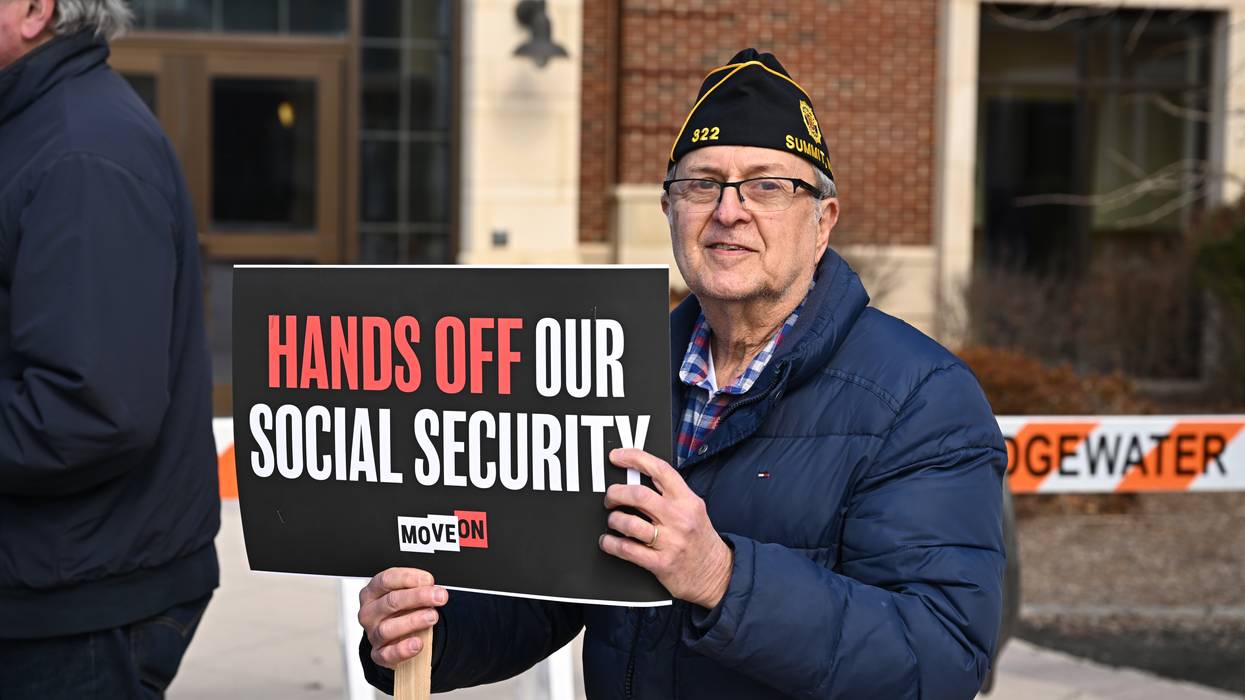
A top executive at one of the world's biggest artificial intelligence companies drew backlash on Tuesday for describing Social Security as "a kind of accounting fraud" that will have to be dismantled.
Dean Ball, head of strategic futures at OpenAI who previously worked in President Donald Trump's White House, wrote in a social media post that while Social Security may have once been a "reasonable affordance" to people who "were dealing with an economic depression and a world war," it was nonetheless "accounting fraud, whose debt is coming due and is coming due fast."
Ball concluded his post by informing younger generations of Americans that "unwinding the great fraud... is your job, whether you wish it to be or not."
Ball's attack on Social Security drew a swift rebuke from David Segal, a former Democratic Rhode Island State Representative and founder of Demand Progress, who observed that it undercut other AI executives' claims that their technology would create an era of unprecedented abundance.
"AI is gonna shoot productivity to the moon," wrote Segal, "oh and also society can't afford to pay old people $2,000 per month anymore starting today."
Author Lincoln Michel similarly spotted the contradiction between AI industry vows that the technology "is going to give us [universal basic income] and we'll never work again" and Ball's declaration that "our main mission is to destroy Social Security."
Henry Burke, senior researcher at the Revolving Door Project, argued that Ball's analysis of Social Security revealed the true priorities of Big Tech elites.
"It's notable that the Abundance guy turned OpenAI hack considers Social Security to be a 'fraud' that must be remedied," wrote Burke, "and not the reckless tax breaks successive Republican presidents have given away to the wealthy which have exploded the national debt."
Putting aside policy arguments, many critics pointed out that Ball's call to dismantle Social Security was a major political loser.
Polling analyst Lakshya Jain, citing survey data showing vast and bipartisan support for Social Security, informed Ball that his rhetoric about the program is optimal for "anyone who wants to unite the whole of America (against them)."
Josh Orton, president of We Demand Justice, marveled at the politically tone deaf messaging coming from an executive at a company whose own CEO has said that "my job is to help people destroy jobs" with AI.
"These AI guys are not just condescending elitists," wrote Orton, "they're tremendously stupid about politics. It's incredible."
Max Steele, senior communications director at gun safety advocacy group Everytown, made a similar observation.
"Is it possible these guys are doing a performance art piece on the worst possible PR run in recorded history?" Steele asked.
Journalist Jon Schwarz questioned why Big Tech companies have been allowed to amass so much economic and political power in the US if their executives want to destroy the country's most popular social insurance program.
"It's a bad idea," wrote Schwarz, "to have our society run by people like this who are so far out of touch with reality that they are functionally insane."
The Trump administration has over 10 times as many of these super-rich appointees as the Biden, Obama, and George W. Bush administrations.
President Donald Trump has created a government "of the rich, by the rich, for the rich."
That's what Sen. Bernie Sanders (I-Vt.) said on Monday following the release of a report demonstrating how the president has handed the reins of power over to the ultra-wealthy on an unprecedented scale.
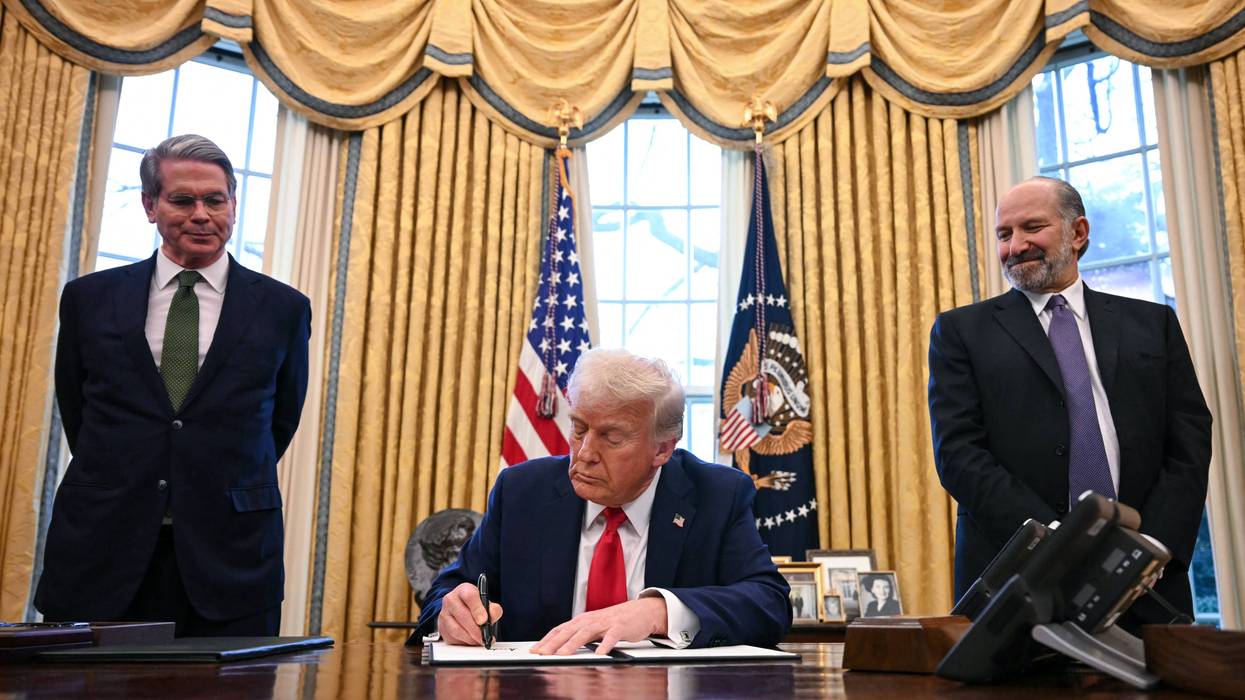
The analysis by the watchdog group Public Citizen found that 57 officials working for the Trump administration are worth over $100 million, while eight of them are worth a billion or more.
Seventeen of them are ambassadors, while the other 40 occupy senior posts, including over a third of Cabinet positions. More than half of them were donors to Trump’s 2024 presidential campaign, giving a combined $65 million in campaign contributions to him or his associated political committees.
The tally does not include Trump himself, who has seen his family's wealth explode by over $2 billion, mostly from his cryptocurrency venture, since returning to power. His net worth is now estimated by Forbes to be about $6.2 billion.
The ultra-rich officials include Education Secretary Linda McMahon, the wife of former World Wrestling Entertainment (WWE) CEO Vince McMahon, who has little experience working in education but is worth between $413 million and $1.3 billion and has spent over $20 million supporting Trump; Commerce Secretary Howard Lutnick, who is worth at least $723 million and spent over $9 million to back the president; and Treasury Secretary Scott Bessent, who spent about $1.15 million in 2024 supporting Trump.
The Trump administration has more than 10 times as many "ultra-millionaires" as previous administrations, the report found. The Biden administration had just five members with over $100 million; the Obama administration had three, and the George W. Bush administration had five.
"The enormous wealth of Trump administration officials raises questions about whether they are driven by their sweeping personal financial interests or the interests of the American public at large, which they have an obligation to serve," writes its author, Doug Pasternak, the head of Public Citizen's Trump Accountability Project.
Since returning to office in January 2025, Trump has not only employed the super-rich but has also enacted a slate of policies benefiting them.
The administration has facilitated what has been described as the largest upward transfer of wealth in US history, with over $1 trillion in tax cuts for the top 1% paid for by brutal cuts to programs that benefit the poorest Americans, like Medicaid and the Supplemental Nutrition Assistance Program (SNAP).
On top of this, he has gutted the Consumer Financial Protection Bureau, which protected Americans against abuse by powerful financial institutions, and enacted sweeping deregulation of cryptocurrencies. His Labor Department has systematically dismantled worker protections while he’s stripped collective bargaining rights from over 1 million federal employees.
The report also notes that many of Trump's wealthy appointees retain financial ties to companies or industries directly affected by the agencies they now control, creating significant potential conflicts of interest.
Lutnick's Commerce Department, for example, has a role in regulating the financial services firm Cantor Fitzgerald, which is now controlled by his sons and was chosen to handle a $1.5 billion stock offering tied to a mining company receiving federal support from the department. Deputy Defense Secretary Stephen Feinberg’s former firm, Cerberus, meanwhile, owns companies that have received at least $90 million in Pentagon investments and contracts.
"When the people holding the reins of government are drawn overwhelmingly from the ranks of the ultra-rich, it leads to misplaced incentives and corruption, and begs the question whose interests they are truly serving," said Lisa Gilbert, the co-president of Public Citizen.
The report points out the enormous chasm between the extraordinary wealth of the average Trump appointee and that of the Americans they represent, whose average annual salary is about $64,500.
"This disconnect," the report says, "has ripple effects throughout the government and across the entire nation."
In a June poll conducted by the Brennan Center for Justice, 62% of registered voters said corruption in US politics and government was “a very big problem.” More than two-thirds described Trump as corrupt, while over 4 in 5 said the Cabinet was.
"The breadth and depth of the economic divide we quantified in this report," Pasternak said, "should be deeply troubling to anyone concerned about the welfare of our democracy."
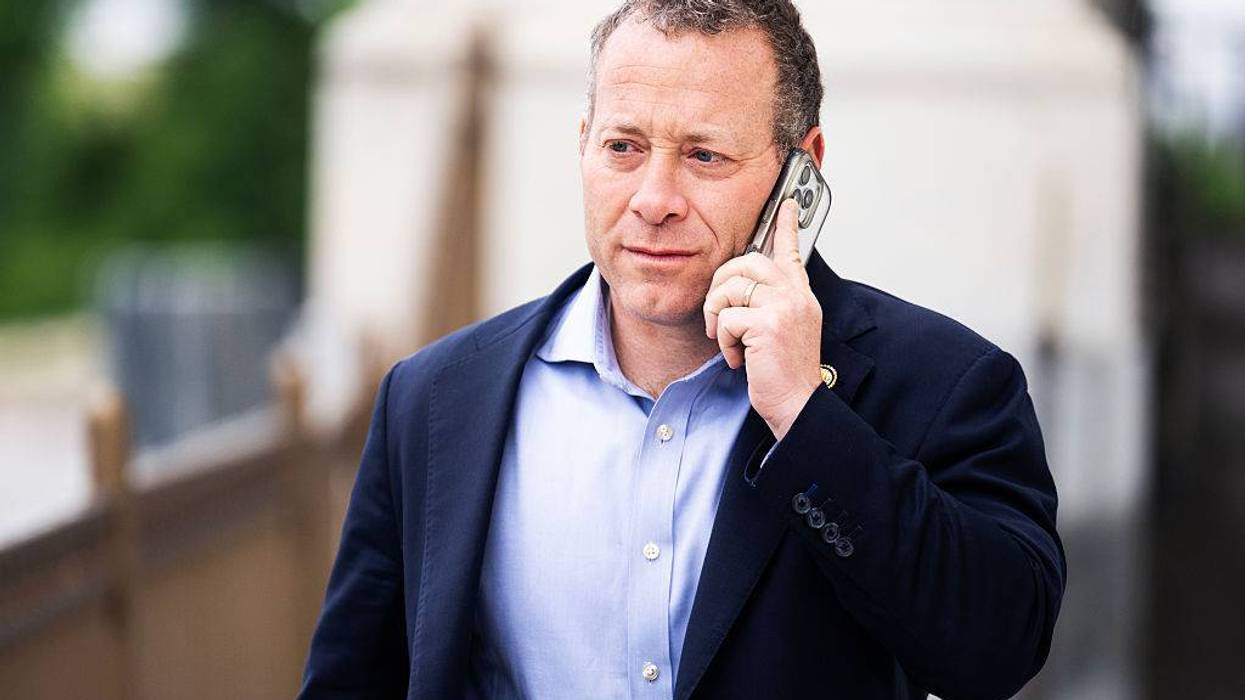
An investigation found that the anti-socialist group Promise to America has ties to a PAC funded by billionaires such as LinkedIn founder Reid Hoffman.
More than a dozen corporate Democrats last week responded to upstart progressive wins in primaries by pledging their support to a political manifesto called "Promise to America," which emphasizes support for capitalism, law enforcement, and "fiscal discipline."
A Thursday report published by Sludge about the Promise to America found that it "is closely tied to the Welcome Party, a group whose PAC has received more than half of its individual contributions from billionaires."
According to Sludge, the Promise to America appeared in public for the first time last month at Welcome Party's annual WelcomeFest conference, where it was signed by Reps. Tom Suozzi (D-NY) and Adam Gray (D-Calif.).
Other prominent Democrats who have signed the pledge include Reps. Josh Gottheimer (D-NJ), Vincente Gonzalez (D-Texas), and Don Davis (D-NC).
Although Sludge uncovered no evidence that Welcome Party is financially supporting the Promise to America, the manifesto's presence at the group's conference was notable given that billionaire donations account for more than 60% of the $10.8 million in donations that it has received over the last five years.
Major donors to the PAC include LinkedIn founder Reid Hoffman, who has donated a total of $1.8 million, and former 21st Century Fox CEO James Murdoch, who with his wife Kathryn has donated $2.5 million.
Other notable billionaires who have contributed to WelcomePAC include Bain Capital co-founder Joshua Bekenstein, former New York City Mayor Michael Bloomberg, and several members of the Walton family.
Sludge's investigation also found that "more billionaires may have donated to the Welcome Party’s two 'dark money' nonprofit arms, which do not disclose their donors publicly."
The Promise to America manifesto has drawn heavy criticism from progressives.
In a recent interview with political commentator Santita Jackson, Rep. Alexandria Ocasio-Cortez (D-NY) said that the corporate Democrats' pledge was a reactive document that lacked policy solutions to the problems facing Americans.
"Okay fine, if you’re against [democratic socialists], that’s okay. But what do you believe?" said Ocasio-Cortez. "And that I think is the core of the weaknesses from that wing at this moment. There’s no affirmative vision really coming from most places in the Democratic Party with the exception of democratic socialism."
Rep. Ro Khanna (D-Calif.) last week also challenged the corporate wing of the party in a speech on the floor of the US House of Representatives in which he defended the vision being laid out by progressive insurgents.
“The progressive movement is winning across the country, from the heart of New York to Michigan to Maine,” Khanna said. “The people are saying no to foreign wars and they’re saying no to genocide in Gaza. They’re saying no to the unfair and lopsided economy that has allowed a few people to hoard extreme wealth and power, and they’re saying yes to Medicare for All.”
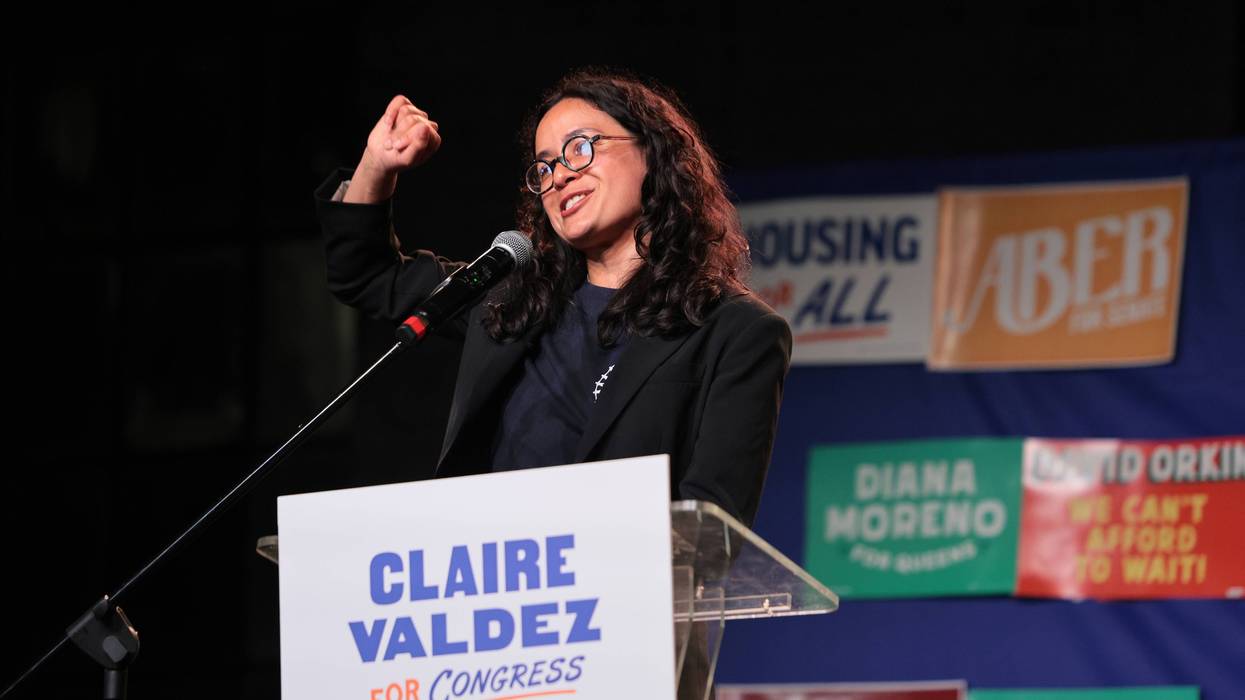
Tuesday's New York primary results are the latest sign that Americans are sick to death of a rigged economy and of billionaires buying their elections.
On Tuesday night, the establishment wing of the Democratic Party got a message it would prefer to pretend it didn’t hear. In New York, Mamdani-backed progressives swept the congressional primaries, ousting two sitting Democratic congressmen and taking an open seat in a single evening.
Former city comptroller Brad Lander beat Rep. Dan Goldman by more than 30 points. A 32-year-old democratic socialist named Darializa Avila Chevalier knocked off five-term Rep. Adriano Espaillat, the chair of the Congressional Hispanic Caucus, and state Assemblymember Claire Valdez won the seat Nydia Velázquez is vacating. House Minority Leader Hakeem Jeffries (a recipient of dark money and AIPAC money) campaigned hard against all three and watched all three win anyway.
As Sen. Bernie Sanders (I-Vt.) put it afterward, the message is pretty clear: Americans are sick to death of a rigged economy and of billionaires buying their elections.
The corporate press and just about every Republican in the country will tell you these candidates are “socialists,” and they’ll spit the word the way you’d say “arsonist.” A little history clears the fog.
This is what oligarchy looks like, and the people feeling it in their bank accounts, student loans, and their doctors’ offices understand it far better than the idiotic (or bought-off) Democratic National Committee consultants who keep telling Democrats to move to the “center.”
When a young public defender in upper Manhattan or a state assemblywoman in Brooklyn calls herself a democratic socialist today, she isn’t talking about Havana or the old Soviet Politburo (the way Republicans and much of the press want you to think). The three who won in New York ran on Medicare for All, affordable housing, stronger union protections, and an end to US military support for Israel’s assault on Gaza.
Strip away the scare word and what’s left is far more truly and anciently American than frightening: a country where a person who works 40 hours a week, no matter how complicated or how humble that work might be, can afford a home and a car, take the family on a vacation every year, put the kids through school and college, see a doctor without going bankrupt, and retire with dignity.
That’s the entire “radical” program that Republicans, corporate Democrats, and our billionaire oligarchs are so flipped out about.
Americans have wanted those things for a very long time. More than 120 years ago, Teddy Roosevelt stood up and called it the Square Deal: a fair shot for the worker, the consumer, and the “honest businessman” against the trusts and the railroad barons who’d swallowed the economy whole.
Franklin Roosevelt built the scaffolding of it with the New Deal, Lyndon Johnson finished the second story with the Great Society, and for about three decades we actually had it. The middle class in the postwar years grew faster and richer than any middle class in the history of the world. By 1980, it was two-thirds of us with a single paycheck (it’s about 41% now, and takes two paychecks to get there).
I grew up inside that promise. My father came home from the antifa war (aka WWII); got a job in a unionized tool-and-die shop in Michigan; and on that one paycheck he and my mother raised four boys, bought a house, kept a car in the driveway (new every three years), had a pension when he retired that let him travel the world, and never once feared that a hospital bill would take the whole thing down.
Nobody we knew was rich, but almost everybody we knew was secure. That security was the whole point, and it didn’t happen by accident. It happened because the country decided, through its government, to make it happen.
And then it was taken apart on purpose. As I lay out in The Hidden History of American the American Dream, the dismantling of that middle class wasn’t an unfortunate side effect of globalization or robots or some impersonal economic weather. It was a deliberate Republican neoliberal project that began with Ronald Reagan imitating Maggie Thatcher and following Heritage’s A Mandate for Leadership in 1981 and has been carried forward by both parties ever since.
The tools were straightforward. Going back to Taft-Hartley in 1947 and the spread of “right-to-work-for-less” laws, Republicans and their corporate funders handed states and giant companies the power to strangle unions, and a worker without a union is a worker without leverage.
They froze the federal minimum wage at $7.25 an hour, where it has sat untouched since 2009. America’s oligarchs fought, decade after decade, to keep the United States the only wealthy nation on Earth without national healthcare, herding us instead into the arms of insurance conglomerates and hospital and physician monopolies, more and more of them now owned by private equity firms that treat a sick patient as a line item to be squeezed.
The result, as the nonpartisan RAND Corporation recently calculated, is that roughly $79 trillion has been pumped upward from the bottom 90% of Americans into the money bins of the morbidly rich top 1% since Reagan, and the middle class has sunk below 50% of us and is hanging on—now requiring two paychecks—by its fingernails.
In that same span the share of national income going to the bottom 90% fell from about two-thirds to less than half, we’ve watched the largest upward transfer of wealth in the history of the American republic all the way back to George Washington, and every dollar of it was a choice some oligarch or his wholly-owned politician made.
The one fully socialized, fully government-run healthcare system we do have in this country, the Veterans Administration, works so well (it has the highest happiness-approval rating of any other healthcare system in America) precisely because it isn’t run for profit, which is exactly why the Republicans are now busy gutting it.
And during the George W. Bush years they took a run at Medicare itself, creating the Medicare Advantage scam through the 2003 Medicare Modernization Act and handing hundreds of billions of taxpayer dollars to private insurers to “manage” the care of our parents and grandparents.
We can see now how that’s going. A federal watchdog reported this month that the biggest for-profit insurers are denying pre-approval for post-hospital care at rates between 51-80%, with more than a third of those denials reversed the moment somebody appeals, which tells you the care should have been approved in the first place.
A Senate investigation found those same insurers overcharged taxpayers by $83 billion in a single year while denying sick seniors the rehabilitation they were promised. But the health insurance industry oligarchs made out like bandits; several are now billionaires or worth hundreds of millions.
And now the administration is importing that very same denial machinery into traditional Medicare through a “test” program in six states that literally pays contractors a bounty for every claim they refuse.
This is what oligarchy looks like, and the people feeling it in their bank accounts, student loans, and their doctors’ offices understand it far better than the idiotic (or bought-off) Democratic National Committee consultants who keep telling Democrats to move to the “center.”
Forty-five years of this has produced a country where, thanks to the Supreme Court’s corrupt Citizens United decision, with on-the-take Justice Clarence Thomas the deciding vote, billionaires can legally own politicians outright. And that’s exactly what they’re doing: Just look at the billions that flowed to President Donald Trump and the GOP in 2024 and ask yourself who that government really works for.
Oligarchy, as history teaches and as I write about at length in The Hidden History of American Oligarchy, is never a stable form of government. It’s a transitional stage because sooner or later ordinary people figure out they’ve been stripped of any real say, and they rebel.
When that moment comes—and, frankly, it’s here now in America—the oligarchs and the politicians they own face exactly two choices:
Donald Trump and the lickspittles who work for him have very plainly chosen the iron fist.
His Department of Justice (DOJ) is prosecuting anti-Immigration and Customs Enforcement protesters in Minnesota on conspiracy charges while the federal agents who shot and killed two American citizens during that same operation walk free, and a jury in Texas just handed protesters 50-100 years in prison on “terrorism” charges.
His DOJ even tried to drag Washington Post and Wall Street Journal reporters before a grand jury to force them to burn their sources, backing off only after the papers fought back in sealed court filings, an effort that can be reissued the instant he wants it back.
The blueprint for all of it, Project 2025, is the latest plan to drag America back to the dog-eat-dog, mostly poor and powerless country we were before Franklin D. Roosevelt, when the middle class was a sliver rather than a majority and the rich owned everything and made most of the decisions.
What the overpaid corporate Democratic Party consultants miss, and what Trump’s own pollsters figured out years ago, is the shape of the actual American electorate.
Political scientists who map voters find that the single largest bloc of white voters is neither “conservative” nor “liberal,” but both. As Trump’s former PR guy Anthony Scaramucci told us all a few months ago:
Trump told me something once that I haven’t forgotten. He said, "You Wall Street guys are imbeciles. You’re socially liberal and fiscally conservative. You know what MY base is? Socially conservative and fiscally liberal.”
A meaningful share of white voters (probably a bit over half, looking at Trump’s two successful elections) carry real prejudice—hate—against either non-whites, queer people, or both, which is precisely why Republicans run almost entirely on trans panic and on demonizing Black “welfare queens” and brown immigrants, because those are about the only issues left on which they’re aligned with that bloc.
On the economics, though, as Scaramucci and Trump noted, that same white voting bloc wants the FDR-Truman-Eisenhower-JFK-LBJ-Nixon-Ford-Carter-era middle class back, the secure one we had before Reagan started tearing it all down in 1981.
That’s why Republicans have to scream “socialism” at any candidate whose actual platform is “rent you can afford” and “a doctor you can see when you need to without going broke.” They can’t argue the economics (and their billionaire donors won’t let them even if they wanted to), so they change the subject to fear.
But the American people aren’t buying the GOP’s oligarchic bullshit anymore. The GOP got crushed in last year’s off-year elections on the simple issue of affordability—which I read as blowback against oligarchy—and Tuesday in New York the floor under corporate Dems who’re still singing the Reaganomics song gave way again.
And it isn’t only New York. Progressives took a House primary in Pennsylvania last month, swept races across Los Angeles and the District of Columbia, and on Tuesday night knocked off four incumbent state legislators in New York alone, while Bernie Sanders kept drawing the biggest crowds of his life on what he calls his Fighting Oligarchy Tour.
So we’re watching two parties move in opposite directions at once.
What these voters keep saying they want is fighters against neoliberalism, fascism, and a return to the New Deal and Great Society.
The Democratic base is trying hard to pull its party back toward its FDR and LBJ roots, away from the Clinton-era deals with Wall Street and the Davos set, away from Barack Obama’s bargain with the insurance giants, away from the bipartisan habit of bankrolling distant wars, including the weapons still flowing to Israel’s assault on Gaza, because people here can’t make rent, go to college, or see a specialist without a three-month wait and a homelessness-threatening bill.
Opposition to that war inside the Democratic coalition has gone lopsided, and the base has noticed that its leaders—mired in big money—missed the moral question entirely. What these voters keep saying they want is fighters against neoliberalism, fascism, and a return to the New Deal and Great Society.
The Republican Party, meanwhile, is bowing and scraping lower and lower to Trump, Project 2025, and their neofascist agenda.
Just look at the last two days: On Tuesday the Senate found the spine to pass a war powers resolution reining him in on Iran, and by Wednesday night, after Trump reportedly screamed at Sen. Bill Cassidy (R-La.) in a closed-door lunch, the Senate turned right around and reversed itself when Cassidy lost his spine and flipped his vote and Sen. Rand Paul (R-Ky.) ducked into a cowardly “present.”
November will tell us which direction the majority of Americans actually want to go, assuming Trump’s many efforts to rig the outcome don’t all succeed (and I’ll get into those efforts in detail in a future piece).
For now, though, we all should understand what these primaries and the wins that are shocking the Schumer-Jeffries crowd actually represent.
After 45 years in the wilderness, Americans are reaching back for the Square Deal that Teddy Roosevelt promised and the New Deal and Great Society that FDR and LBJ delivered, and no amount of red-baiting about Havana is going to talk them out of it.
We’ve been here before, and now at the end of the third of these 80-year cycles, Democrats must choose to kick the oligarchs out and let the people back in. We’ve done it before, and we can do it again, this time with Zoomers leading the way.
If any of this matters to you, don’t just nod and scroll. Call your senators and representative through the Capitol switchboard at 202-224-3121 and tell them where you stand on healthcare, on the minimum wage and free college, and on the right to protest.
Make sure you and everyone you know is registered and ready to vote in 2026 at vote.org, and find out who’s on your state and local ballot at openstates.org, because the people rigging the game are counting on you staying home.
And if this piece helped you see the pattern a little more clearly, share it, forward it, post it, and consider subscribing at hartmannreport.com so we can keep doing this work together.
Democracy, as Bernie used to say every Friday for 11 years on my radio program, isn’t a spectator sport, and the next three years are, I believe (if we all work hard enough), going to prove it.
Tag, you’re it!
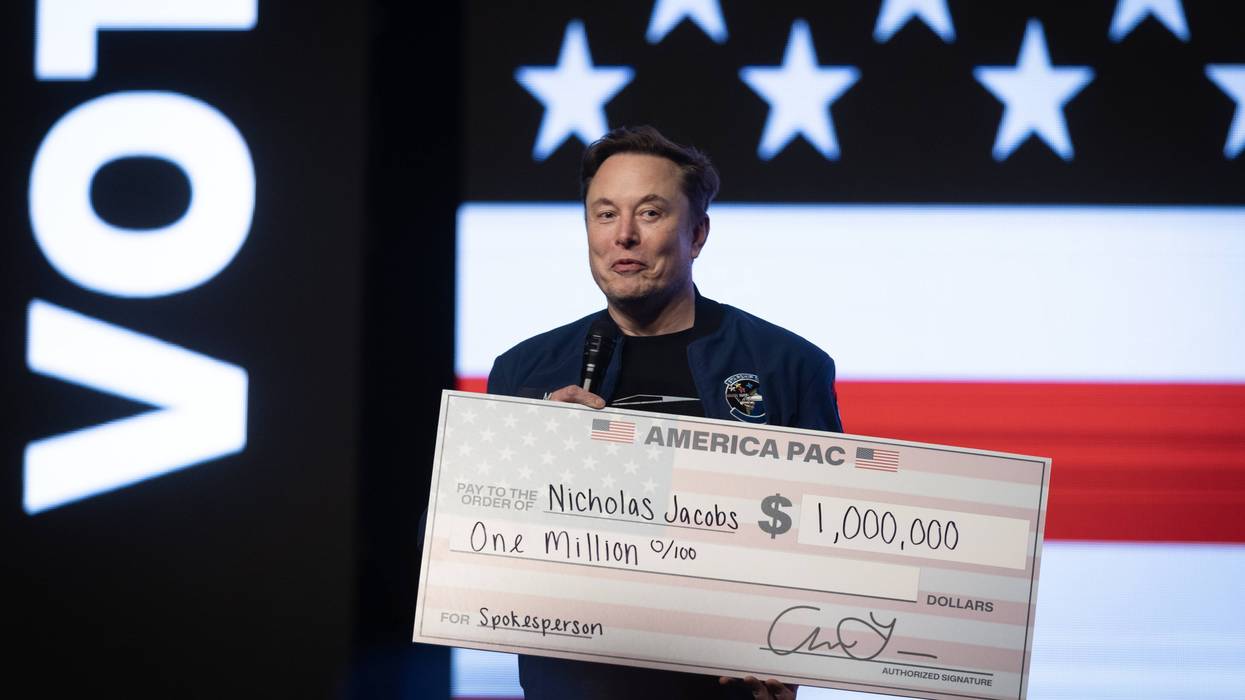
"It is time to break decisively with the perverse logic in which retirees, the poor, or immigrants are expected to balance the budget, while the rich are to be allowed to live tax-free in their own parallel society. "
SpaceX CEO Elon Musk became the world's first trillionaire last week, and now a prominent economist is warning that his unprecedented wealth poses a grave threat to human freedom in the US and across the globe.
In a column published by The Guardian on Tuesday, Paris School of Economics professor Gabriel Zucman argued that Musk's enormous fortune is fundamentally at odds with a democratic system of governance because it gives him "the power to stifle competition, the power to shape public discourse, the power to influence policymaking, the power to buy elections, the power to stall social progress," and much else.
Zucman noted that wealth concentration is even greater now than it was during the original Gilded Age, as the top 0.00001% now have fortunes large enough to "buy 14% of everything produced in a given year in the US."
The economist added that while Musk—whose infamous destruction of the US Agency for International Development is projected to kill millions of people in the coming years—makes a particularly compelling villain, trillionaires would be a major problem for democracy even if they were of a more benevolent variety.
"No one should want to live in a society where one single individual can be worth $1 trillion, no matter their personal virtues," Zucman emphasized. "Such levels invariably skew power, distort markets, and sap our democratic ideals."
The best solution to this crisis, Zucman said, is to "create an unavoidable minimum tax on their wealth" that will "make it impossible for the super-rich to pay less tax than middle-class workers—a matter of basic equality before the law."
"It is time to break decisively with the perverse logic in which retirees, the poor, or immigrants are expected to balance the budget," Zucman concluded, "while the rich are to be allowed to live tax-free in their own parallel society. There cannot be a law more lenient for the rich and powerful than for the rest of us. If ever there was a time to act, it is now."
Zucman's thoughts on extreme wealth and democracy were echoed by Nobel Prize-winning economist Paul Krugman, who on Tuesday published an essay on his Substack page where he likened President Donald Trump's White House cage-fighting matches to the kinds of spectacles put on by Roman emperors before noting ominous similarities between the US today and the Roman Empire.
"While the causes of the decline of republican government and Rome’s eventual transition to one-man rule were doubtless complex," Krugman wrote, "there is broad consensus among historians that a key factor was the emergence of extreme inequality. A handful of men became incredibly wealthy from the spoils of Rome’s eastern conquests, and their wealth and power eventually became too great for the rules of constitutional, republican government to contain. Sound uncomfortably familiar?"
Gautam Mukunda, a professor at the Yale School of Management, similarly warned that Musk's newly minted trillionaire status was bad news for American self-governance.
In a Monday column published by Bloomberg, Mukunda pointed to the vast sums of money being spent by billionaires in US elections, which he noted "dwarf what candidates can raise themselves."
And like Krugman, Mukunda saw disturbing parallels between the US today and Ancient Rome.
"Marcus Crassus was the richest man in ancient Rome," he explained. "So rich that, by Plutarch’s account, he thought no man truly wealthy unless he could pay an army from his own purse. He spent that fortune bankrolling Julius Caesar and building the triumvirate that sidelined the Senate and, in fact if not in name, overthrew the republic."

"Barbed wire cannot silence people," said one conservationist. "A protected landscape of global importance is under attack, and people are demanding an end to the devastation."
As President Donald Trump's son-in-law Jared Kushner moves forward with plans to build a luxury resort on one of the last untouched parts of the Mediterranean coast, thousands of Albanians have taken to the streets in protest.
On Tuesday evening, a throng gathered outside the office of Albanian Prime Minister Edi Rama in the capital Tirana, holding inflatable flamingos and signs reading "Nation is not for sale" and "I don't want Albania like Dubai," Reuters reported.
Kushner's investment firm, Affinity Partners, is seeking to build a €1.4 billion ($1.6 billion) resort on the uninhabited island of Sazan and around 10,000 hotel rooms and villas along a stretch of coastline near the protected wetland of Vjosa-Narta.
According to BirdLife International:
The area shelters over 70 endangered species and more than 200 bird species, including flamingos and Dalmatian pelicans. It sits on the Adriatic Flyway, a critical migration corridor for millions of birds traveling between Africa and Europe each year. The surrounding waters are among the last Mediterranean refuges for the Mediterranean monk seal, one of the world’s most endangered marine mammals, and a key nesting ground for the loggerhead sea turtle.
In February 2024, Albania's parliament amended its protected areas law to allow the development of luxury resorts. Just weeks later, Kushner announced plans to build in Albania, which spurred an investigation by anti-corruption prosecutors.
Kushner himself has not been accused of any wrongdoing, but protesters view the construction of the sprawling complex as a symbol of the country being sold out to powerful oligarchs without their consent.
"We have a protected area, but above all, our state has allowed construction work to continue without consultation and without transparency," said Klajdi Belo, an activist who attended a demonstration on Monday, told Euronews.
Activists have said bulldozers have begun tearing through the coastline and gravel has already been dumped on age-old sand dunes—damage that could take hundreds of years to repair. Meanwhile, a large barbed-wire fence has been erected, blocking public access to the beach.
Over the weekend, protesters assembled outside the barricades surrounding the development near the coastal village of Zvërnec.
"Don't defend the oligarchs!" one man was seen shouting into a megaphone. "Those are the citizens' properties!"
During these protests, a video captured an activist being dragged along the ground by a group of black-shirted security contractors.
"There is great public outrage over what is happening in Albania, but the spark was what happened in Zvërnec," said Arilda Lleshi, who said the man and others were there because they were "protesting against a fence that had been installed there illegally."
As activists have called for heavy machines to be removed from the protected area, Rama has said no amount of public backlash will lead him to abandon the project.
"Under no circumstances do we receive the stigma of being a country where investors are met with hostility," he said in a statement to Reuters. "There is absolutely no chance that the investment will stop as long as I am here."
Anouk Puymartin, head of policy for BirdLife Europe and Central Asia, said that it's not just the habitat of endangered species at stake, but the question of whether longstanding environmental protections can be shredded at the whim of the wealthy.
"Barbed wire cannot silence people. Thousands have taken to the streets of Tirana to defend Vjosa-Narta from destruction driven by private profit," Puymartin said. "A protected landscape of global importance is under attack, and people are demanding an end to the devastation."
Ivanka Trump, the US president's daughter and Kushner's wife, has come under scrutiny for her comments about the development project recently, which were blasted as "out of touch."
In a recent interview, the Trump heiress described being inspired to purchase the island of Sazan while vacationing there years ago: “We were on a friend’s boat, and we stopped for a swim. Effectively, that’s how we found it. We swam to the islands. We went on a hike, barefoot all the way, up to the top. And we were just captivated.”
She described the project of developing the island as part of an effort to "help realize its potential" and described it as "the culmination of all of my experience in real estate, all of my travel, a lot of reflection on how I want to live."
But Puymartin describes the project as an encroachment by private wealth onto land that was previously held for the benefit of everyone.
"Nature belongs to everyone, not a handful of investors," she said. "The horrendous situation in Vjosa-Narta shows why laws are crucial to protect both people and nature. But those protections mean little if governments fail to uphold them."
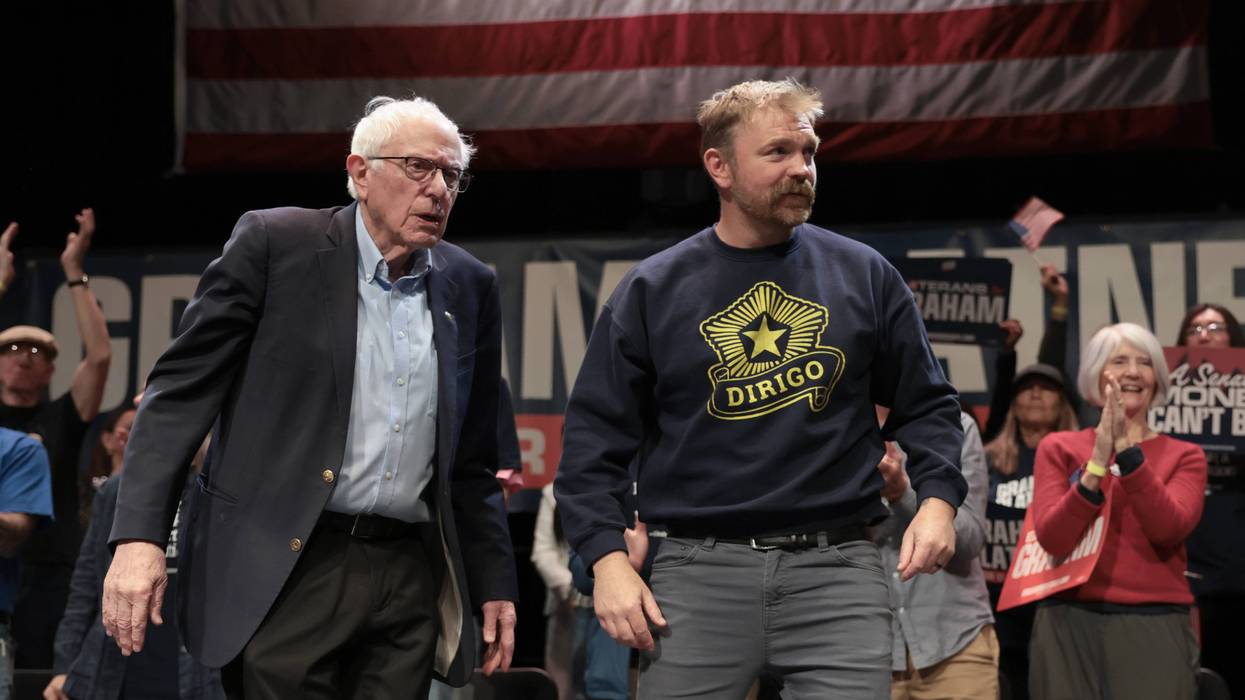
"It's fascinating that the more money that goes into our political system, the less we talk about actual politics."
The super PACs pouring money into the US Senate race in Maine are doing a great job of proving Graham Platner's point.
As new reporting on Monday detailed the flood of dark money targeting his campaign, the Democratic hopeful in recent days has put a spotlight on the super PACs, which he says have created a political system dominated by corporations and wealthy donors who want to distract from the serious issues and struggles faced by everyday voters and working families.
"I think it's very telling that a political system that has become controlled by money, controlled by the power of organized money, is also a political system that is trying to convince all of us down here that policy and discussions around what government can or cannot do is not what they want to talk about," Platner said during a conversation with Sen. Bernie Sanders (I-Vt.), a longtime critic of super PACs, posted to social media.
"It's fascinating that the more money that goes into our political system," he continued, "the less we talk about actual politics."
"I agree with Senator Sanders: Super PACs should be outlawed," said Platner.
On Monday, Sludge reported that a pair of shadowy nonprofits "with no public presence and no disclosed staff" have dumped at least $750,000 into a super PAC supporting Platner's opponent, the five-term incumbent Republican Sen. Susan Collins, according to Federal Election Commission (FEC) filings.
Condorcet Initiative Corp. has given $500,000 to Pine Tree Results PAC across two separate donations, including $250,000 on May 1 that was disclosed in a filing reported to the Federal Election Commission last week. Ardleigh Impact Corporation contributed an additional $250,000 in April.
The PAC has spent nearly $4 million on attack ads against Sen. Susan Collins’ Democratic challenger Graham Platner, according to FEC data.
The two nonprofits are both described as shell-like entities linked to the same address in Springfield, Virginia, belonging to Republican political consultant Staci Goede.
The groups are part of a much larger network and have poured a combined $9 million into GOP-aligned PACs since 2024, including in four competitive Senate races in this coming cycle.
Goede, meanwhile, is the treasurer or officer for at least nine different nonprofits "that span Republican Senate campaigns, pro-Israel donor pass-throughs, and issue advocacy groups," according to the report.
The Campaign Legal Center has filed a complaint against Ardleigh, arguing that the nonprofit, which contributed an astonishing $2.575 million across six federal committees in its first three months of existence, was being used as a straw donor to conceal the identities of one or more rich benefactors.
The source of the $750,000 aimed at Platner remains unknown. But the Pine Tree Results PAC is already known to have a slate of wealthy backers from the commanding heights of finance and tech, including Blackstone CEO Stephen Schwarzman, hedge fund founder Paul Singer, and Palantir CEO Alex Karp. The fund has also taken in contributions from an affiliate of the tobacco giant Altria and from the far-right news company Newsmax.
According to a FEC data, it has raised more than $16 million to help Collins ward off a challenger in 2026, which will almost certainly be Platner.
While the potential use of straw donors may present legal issues, the use of super PACs by wealthy backers to dump unlimited sums behind their preferred candidates is unquestionably legal under federal campaign finance law.
As of March, super PACs funded by crypto, artificial intelligence, pro-Israel donors, and outside groups had already spent more than $225 million trying to influence the 2026 election cycle, according to the Washington Post.
Platner has argued on the campaign trail that the unchecked ability of the wealthy to influence elections is a genesis point for the growing wealth gap between the rich and poor.
"The inequality we’re experiencing, it didn’t happen organically," he said at a recent campaign event. "We live in the outcome of policy written by establishment politicians who for 40 years have been doing the bidding of those who donate the most money to them."
The Pine Tree Results PAC had already spent nearly $4 million on ads attacking Platner as of May 20, according to FEC data. As Sludge's reporting notes, "Rather than engaging with policy, the ads are exclusively focused on personal attacks against Platner, digging up comments the candidate made online going back as far as 2013."
So far, attempts to mire Platner in personal scandal have done little to blunt the momentum of his populist campaign. A poll from the University of New Hampshire in late May showed him leading the incumbent by a nine-point margin among likely voters and other polls show similar advantages.
It can be expected that the PACs attacking Platner will make a meal out of recent reports from The Wall Street Journal and The New York Times that probe into the private details of his marriage.
But noting the failure of past attempts to drown Platner in controversy, Lever News founder David Sirota questioned in a piece on Monday if these sorts of "character" attacks even work in an age of politics defined by rapacious corporate greed and corruption.
He noted how Sen. Chris Murphy (D-Ct.) and Rep. Ro Khanna (D-Calif.) responded to recent questions from news outlets about whether Platner’s controversies mean he’s failed to “pass the character test.” Murphy responded that “character involves standing up to people who are bankrupting and corrupting this country,” while Khanna lauded Platner for “having the character to stand up against the war in Iran, against genocide, and against an unfair and lopsided economy.”
This response, Sirota said, hinted that the country could be entering a new political paradigm—"a reality in which many voters are so economically pulverized and politically disillusioned that they now define 'character' in a politician solely as whether or not they are single-mindedly focused on destroying oligarchy and ending corruption."
“It is, potentially, a new era in which voters who can’t afford anything and who feel totally ignored by their government have reimagined their entire definition of political 'character' on economic/anti-corruption terms—rather than on old definitions of personal moral rectitude,” he wrote. “In this potential new reality, the personal shortcomings of individual politicians—which often have little effect on voters’ actual lives—are less important and electorally salient than the policies those politicians support and oppose."
"And such a shift," he added, "would make sense in the current moment.”
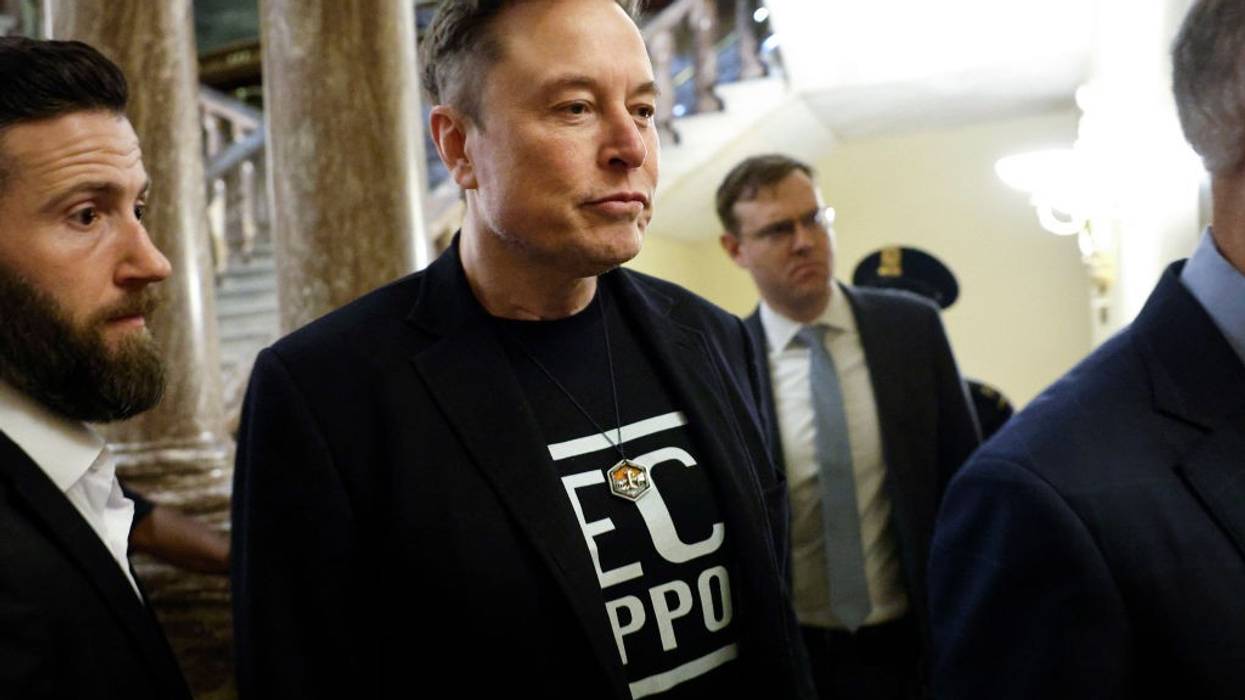
As the Trump-backed oligarch tries to grow even more wealthy and with longstanding rules changed to his benefit ahead of the SpaceX public offering, "retirees could take huge losses, while insiders cash out."
Billionaire Elon Musk has ambitions to become the world's first trillionaire when his company SpaceX makes what is expected to be the biggest initial public offering in history—and money unwittingly invested by ordinary Americans may help him get there.
Progressive media outlet More Perfect Union on Wednesday published a video detailing how the Nasdaq stock market exchange changed its own rules so that SpaceX can be immediately included in index funds without having to wait through the one-year "seasoning" period that used to be required for newly public companies.
The reason companies in the past had to wait a year to be included in index funds is that such funds contain a large chunk of Americans' retirement savings, and are thus supposed to be more averse to risk.
Watch the 12-minute video:
NEW: Elon Musk wants a SpaceX IPO valuing the company at upwards of $1.75 trillion.
To get there he got the rules changed so that index funds, with millions of Americans' retirement savings, are forced to buy in.
Retirees could take huge losses, while insiders cash out. pic.twitter.com/DviJEt0XAu
— More Perfect Union (@MorePerfectUS) May 27, 2026
This means that ordinary investors could see their money plunged into an unproven company while investors who have bankrolled Musk's previous ventures now rolled into SpaceX could cash out at inflated prices.
"Every piece of evidence we have is that the IPO is being engineered to rise very rapidly after it prices, and then fall very dramatically after that," George Pearkes, global macro strategist for Bespoke Investment Group, told More Perfect Union. "That is a recipe for retail investors, especially, to take large losses."
SpaceX is a particularly risky bet, Preakes added, given that it is seeking a $1.75 trillion valuation with its IPO. For a company that made only $19 billion in profits last fiscal year, critics say a valuation 54 times larger than its projected revenue multiple, a measure of its value based on expected future earnings, is a huge red flag.
"This combination of extreme size and this extreme multiple," Peakes said, "is completely unprecedented."
Pearkes isn't in the only expert concerned about the structure of the SpaceX IPO.
Writing at Seeking Alpha, independent equity researcher Julia Ostian similarly argued that the SpaceX IPO is structured using a "calculated mechanism that will feed the artificial demand generated by the forced index fund buyers," and thus at least initially send share values soaring beyond what the company's fundamentals would suggest, and giving insiders an opportunity to quickly cash out.
Ostian added that "it is clear who is the beneficiary here and who pays the price for this engineered system," and said that "the rich are getting richer openly, without hiding it or even without trying to pretend it’s something else."
As More Perfect Union emphasized, the entire IPO was orchestrated by Musk for maximum advantage to himself and his closest allies, but he needed regular Americans to put up the money for the scheme to work.
"He got the rules changed so that index funds, with millions of Americans' retirement savings, are forced to buy in," the outlet noted. "Retirees could take huge losses, while insiders cash out."