SUBSCRIBE TO OUR FREE NEWSLETTER
Daily news & progressive opinion—funded by the people, not the corporations—delivered straight to your inbox.
5
#000000
#FFFFFF
To donate by check, phone, or other method, see our More Ways to Give page.
Daily news & progressive opinion—funded by the people, not the corporations—delivered straight to your inbox.
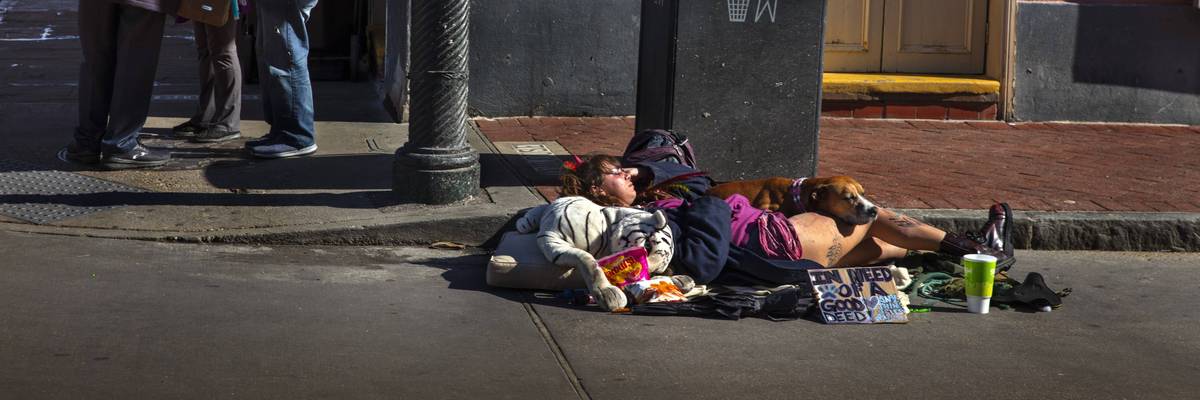
A homeless woman sleeping with a dog on the street on February 26, 2020, in New Orleans, Louisiana.
One homeless advocacy group said the bill, which would require homeless people to perform unpaid labor to pay for involuntary treatment, "evokes debtor’s prisons, convict leasing, and the ugliest day of Jim Crow."
The Louisiana House of Representatives voted this week to pass what the National Homelessness Law Center says is "one of the cruelest anti-homeless bills in the country."
Like many other anti-homeless bills being advanced around the country following a 2024 Supreme Court decision allowing states and cities to criminalize homelessness, House Bill 211, which passed by a vote of 70-28, makes unauthorized sleeping in public spaces a crime.
It is punishable by a fine of up to $500, imprisonment for up to six months, or both. Repeat offenders could face one to two years in prison with hard labor and a $1,000 fine.
The bill, which will now advance to the GOP-controlled state Senate, has been nicknamed the "Streets to Success Act" because, according to its sponsor, state Rep. Debbie Villio (R-79), the goal is not to jail homeless people but to "connect them to service providers."
Those who are convicted of sleeping outdoors could be given the option to avoid jail time by instead entering into a mandatory treatment program for at least 12 months. The bill authorizes local governments to set up semi-permanent camps in remote areas, where defendants would be required to stay and receive treatment.
The bill requires homeless defendants to pay “all or part of the cost of the treatment program to which he is assigned," a steep cost for many, as the average cost for residential drug and alcohol rehab treatment in Louisiana is more than $4,400 per week, according to the addiction referral service directory Addicted.org.
According to the bill, those who cannot afford this steep cost would be required to perform unpaid labor for the state or a local community center in lieu of payment.
Bill Quigley, director of the Gillis Long Poverty Law Center at Loyola University New Orleans, called the bill's entire premise "a farce."
"If people had the resources to pay for housing and physical and/or mental health services, they would not be on the street," he told Common Dreams.
He described it as a "cruel theater of the absurd" based on "the lie that people choose to be homeless." The law, he said, "assumes our communities have plenty of affordable apartments and lots of mental and physical health services available."
In reality, he said, these services are chronically underfunded, and the city would need to build about 55,000 more affordable rental units to provide enough housing for its rent-burdened population.
Though it is not uncommon for homeless people to struggle with mental health or substance use issues, increases in the cost of housing have been shown to have a direct relationship with increasing homelessness.
Homelessness in New Orleans dropped considerably in the years following the Covid-19 pandemic, when Congress provided permanent housing subsidies for those in need. But after those funds have dried up, homelessness in the city shot up higher than before the pandemic, a study by the homelessness nonprofit UNITY of Greater New Orleans found in 2024.
New Orleans City Councilmember Lesli Harris (D), who has opposed the bill, pointed to the success of the city's Home for Good program, which took a "Housing First" approach to homelessness, providing rental subsidies and allowing people to move straight from encampments into housing without requirements that they obtain treatment.
According to a May 2025 report, the program had moved 1,133 people off the streets and into supportive housing and allowed eight homeless encampments to close.
"Through our Home for Good program, we house an individual for roughly $21,844 per year. By comparison, jailing that same person costs an average of $51,000—and failing to act at all can cost up to $55,000 in emergency room visits and crisis rehousing," Harris said. "HB 211 would steer Louisiana toward the most expensive option while producing no lasting housing, no services, and no real path forward for the people involved."
Harris has also decried the bill's creation of what she called "internment camps" for treatment. The bill's text requires these facilities to be far away from downtown and other high-value neighborhoods, which she said separates those trying to rebuild their lives from work, public transit, and other critical services, and further isolates them from society.
Since the Supreme Court’s 2024 decision in Grants Pass v. Johnson, which allowed cities to enforce public-camping bans against unhoused people even when shelter is unavailable, around two dozen states and hundreds of municipalities have passed various measures criminalizing poverty.
The homeless advocacy group Housing Not Handcuffs points out that many of the bills were written by the Cicero Institute, a far-right think tank with heavy backing from billionaire tech investors that now has deep influence over the housing policy of President Donald Trump, who has taken a hacksaw to funding for public housing programs under the Department of Housing and Urban Development.
Housing Not Handcuffs said Louisiana's bill, which would almost certainly be signed by Republican Gov. Jeff Landry if passed by the state Senate, "is an extreme take on the already extreme copy-paste legislation" peddled by Cicero.
"This bill forces homeless people charged with a crime to make the false choice between jail or at least one year of forced treatment," the group said. "Louisiana has a long history—and present—of chain gangs, prison labor, and entrenched white supremacy. This bill clearly evokes debtor’s prisons, convict leasing, and the ugliest day of Jim Crow."
Dear Common Dreams reader, It’s been nearly 30 years since I co-founded Common Dreams with my late wife, Lina Newhouser. We had the radical notion that journalism should serve the public good, not corporate profits. It was clear to us from the outset what it would take to build such a project. No paid advertisements. No corporate sponsors. No millionaire publisher telling us what to think or do. Many people said we wouldn't last a year, but we proved those doubters wrong. Together with a tremendous team of journalists and dedicated staff, we built an independent media outlet free from the constraints of profits and corporate control. Our mission has always been simple: To inform. To inspire. To ignite change for the common good. Building Common Dreams was not easy. Our survival was never guaranteed. When you take on the most powerful forces—Wall Street greed, fossil fuel industry destruction, Big Tech lobbyists, and uber-rich oligarchs who have spent billions upon billions rigging the economy and democracy in their favor—the only bulwark you have is supporters who believe in your work. But here’s the urgent message from me today. It's never been this bad out there. And it's never been this hard to keep us going. At the very moment Common Dreams is most needed, the threats we face are intensifying. We need your support now more than ever. We don't accept corporate advertising and never will. We don't have a paywall because we don't think people should be blocked from critical news based on their ability to pay. Everything we do is funded by the donations of readers like you. When everyone does the little they can afford, we are strong. But if that support retreats or dries up, so do we. Will you donate now to make sure Common Dreams not only survives but thrives? —Craig Brown, Co-founder |
The Louisiana House of Representatives voted this week to pass what the National Homelessness Law Center says is "one of the cruelest anti-homeless bills in the country."
Like many other anti-homeless bills being advanced around the country following a 2024 Supreme Court decision allowing states and cities to criminalize homelessness, House Bill 211, which passed by a vote of 70-28, makes unauthorized sleeping in public spaces a crime.
It is punishable by a fine of up to $500, imprisonment for up to six months, or both. Repeat offenders could face one to two years in prison with hard labor and a $1,000 fine.
The bill, which will now advance to the GOP-controlled state Senate, has been nicknamed the "Streets to Success Act" because, according to its sponsor, state Rep. Debbie Villio (R-79), the goal is not to jail homeless people but to "connect them to service providers."
Those who are convicted of sleeping outdoors could be given the option to avoid jail time by instead entering into a mandatory treatment program for at least 12 months. The bill authorizes local governments to set up semi-permanent camps in remote areas, where defendants would be required to stay and receive treatment.
The bill requires homeless defendants to pay “all or part of the cost of the treatment program to which he is assigned," a steep cost for many, as the average cost for residential drug and alcohol rehab treatment in Louisiana is more than $4,400 per week, according to the addiction referral service directory Addicted.org.
According to the bill, those who cannot afford this steep cost would be required to perform unpaid labor for the state or a local community center in lieu of payment.
Bill Quigley, director of the Gillis Long Poverty Law Center at Loyola University New Orleans, called the bill's entire premise "a farce."
"If people had the resources to pay for housing and physical and/or mental health services, they would not be on the street," he told Common Dreams.
He described it as a "cruel theater of the absurd" based on "the lie that people choose to be homeless." The law, he said, "assumes our communities have plenty of affordable apartments and lots of mental and physical health services available."
In reality, he said, these services are chronically underfunded, and the city would need to build about 55,000 more affordable rental units to provide enough housing for its rent-burdened population.
Though it is not uncommon for homeless people to struggle with mental health or substance use issues, increases in the cost of housing have been shown to have a direct relationship with increasing homelessness.
Homelessness in New Orleans dropped considerably in the years following the Covid-19 pandemic, when Congress provided permanent housing subsidies for those in need. But after those funds have dried up, homelessness in the city shot up higher than before the pandemic, a study by the homelessness nonprofit UNITY of Greater New Orleans found in 2024.
New Orleans City Councilmember Lesli Harris (D), who has opposed the bill, pointed to the success of the city's Home for Good program, which took a "Housing First" approach to homelessness, providing rental subsidies and allowing people to move straight from encampments into housing without requirements that they obtain treatment.
According to a May 2025 report, the program had moved 1,133 people off the streets and into supportive housing and allowed eight homeless encampments to close.
"Through our Home for Good program, we house an individual for roughly $21,844 per year. By comparison, jailing that same person costs an average of $51,000—and failing to act at all can cost up to $55,000 in emergency room visits and crisis rehousing," Harris said. "HB 211 would steer Louisiana toward the most expensive option while producing no lasting housing, no services, and no real path forward for the people involved."
Harris has also decried the bill's creation of what she called "internment camps" for treatment. The bill's text requires these facilities to be far away from downtown and other high-value neighborhoods, which she said separates those trying to rebuild their lives from work, public transit, and other critical services, and further isolates them from society.
Since the Supreme Court’s 2024 decision in Grants Pass v. Johnson, which allowed cities to enforce public-camping bans against unhoused people even when shelter is unavailable, around two dozen states and hundreds of municipalities have passed various measures criminalizing poverty.
The homeless advocacy group Housing Not Handcuffs points out that many of the bills were written by the Cicero Institute, a far-right think tank with heavy backing from billionaire tech investors that now has deep influence over the housing policy of President Donald Trump, who has taken a hacksaw to funding for public housing programs under the Department of Housing and Urban Development.
Housing Not Handcuffs said Louisiana's bill, which would almost certainly be signed by Republican Gov. Jeff Landry if passed by the state Senate, "is an extreme take on the already extreme copy-paste legislation" peddled by Cicero.
"This bill forces homeless people charged with a crime to make the false choice between jail or at least one year of forced treatment," the group said. "Louisiana has a long history—and present—of chain gangs, prison labor, and entrenched white supremacy. This bill clearly evokes debtor’s prisons, convict leasing, and the ugliest day of Jim Crow."
The Louisiana House of Representatives voted this week to pass what the National Homelessness Law Center says is "one of the cruelest anti-homeless bills in the country."
Like many other anti-homeless bills being advanced around the country following a 2024 Supreme Court decision allowing states and cities to criminalize homelessness, House Bill 211, which passed by a vote of 70-28, makes unauthorized sleeping in public spaces a crime.
It is punishable by a fine of up to $500, imprisonment for up to six months, or both. Repeat offenders could face one to two years in prison with hard labor and a $1,000 fine.
The bill, which will now advance to the GOP-controlled state Senate, has been nicknamed the "Streets to Success Act" because, according to its sponsor, state Rep. Debbie Villio (R-79), the goal is not to jail homeless people but to "connect them to service providers."
Those who are convicted of sleeping outdoors could be given the option to avoid jail time by instead entering into a mandatory treatment program for at least 12 months. The bill authorizes local governments to set up semi-permanent camps in remote areas, where defendants would be required to stay and receive treatment.
The bill requires homeless defendants to pay “all or part of the cost of the treatment program to which he is assigned," a steep cost for many, as the average cost for residential drug and alcohol rehab treatment in Louisiana is more than $4,400 per week, according to the addiction referral service directory Addicted.org.
According to the bill, those who cannot afford this steep cost would be required to perform unpaid labor for the state or a local community center in lieu of payment.
Bill Quigley, director of the Gillis Long Poverty Law Center at Loyola University New Orleans, called the bill's entire premise "a farce."
"If people had the resources to pay for housing and physical and/or mental health services, they would not be on the street," he told Common Dreams.
He described it as a "cruel theater of the absurd" based on "the lie that people choose to be homeless." The law, he said, "assumes our communities have plenty of affordable apartments and lots of mental and physical health services available."
In reality, he said, these services are chronically underfunded, and the city would need to build about 55,000 more affordable rental units to provide enough housing for its rent-burdened population.
Though it is not uncommon for homeless people to struggle with mental health or substance use issues, increases in the cost of housing have been shown to have a direct relationship with increasing homelessness.
Homelessness in New Orleans dropped considerably in the years following the Covid-19 pandemic, when Congress provided permanent housing subsidies for those in need. But after those funds have dried up, homelessness in the city shot up higher than before the pandemic, a study by the homelessness nonprofit UNITY of Greater New Orleans found in 2024.
New Orleans City Councilmember Lesli Harris (D), who has opposed the bill, pointed to the success of the city's Home for Good program, which took a "Housing First" approach to homelessness, providing rental subsidies and allowing people to move straight from encampments into housing without requirements that they obtain treatment.
According to a May 2025 report, the program had moved 1,133 people off the streets and into supportive housing and allowed eight homeless encampments to close.
"Through our Home for Good program, we house an individual for roughly $21,844 per year. By comparison, jailing that same person costs an average of $51,000—and failing to act at all can cost up to $55,000 in emergency room visits and crisis rehousing," Harris said. "HB 211 would steer Louisiana toward the most expensive option while producing no lasting housing, no services, and no real path forward for the people involved."
Harris has also decried the bill's creation of what she called "internment camps" for treatment. The bill's text requires these facilities to be far away from downtown and other high-value neighborhoods, which she said separates those trying to rebuild their lives from work, public transit, and other critical services, and further isolates them from society.
Since the Supreme Court’s 2024 decision in Grants Pass v. Johnson, which allowed cities to enforce public-camping bans against unhoused people even when shelter is unavailable, around two dozen states and hundreds of municipalities have passed various measures criminalizing poverty.
The homeless advocacy group Housing Not Handcuffs points out that many of the bills were written by the Cicero Institute, a far-right think tank with heavy backing from billionaire tech investors that now has deep influence over the housing policy of President Donald Trump, who has taken a hacksaw to funding for public housing programs under the Department of Housing and Urban Development.
Housing Not Handcuffs said Louisiana's bill, which would almost certainly be signed by Republican Gov. Jeff Landry if passed by the state Senate, "is an extreme take on the already extreme copy-paste legislation" peddled by Cicero.
"This bill forces homeless people charged with a crime to make the false choice between jail or at least one year of forced treatment," the group said. "Louisiana has a long history—and present—of chain gangs, prison labor, and entrenched white supremacy. This bill clearly evokes debtor’s prisons, convict leasing, and the ugliest day of Jim Crow."