SUBSCRIBE TO OUR FREE NEWSLETTER
Daily news & progressive opinion—funded by the people, not the corporations—delivered straight to your inbox.
5
#000000
#FFFFFF
To donate by check, phone, or other method, see our More Ways to Give page.
Daily news & progressive opinion—funded by the people, not the corporations—delivered straight to your inbox.
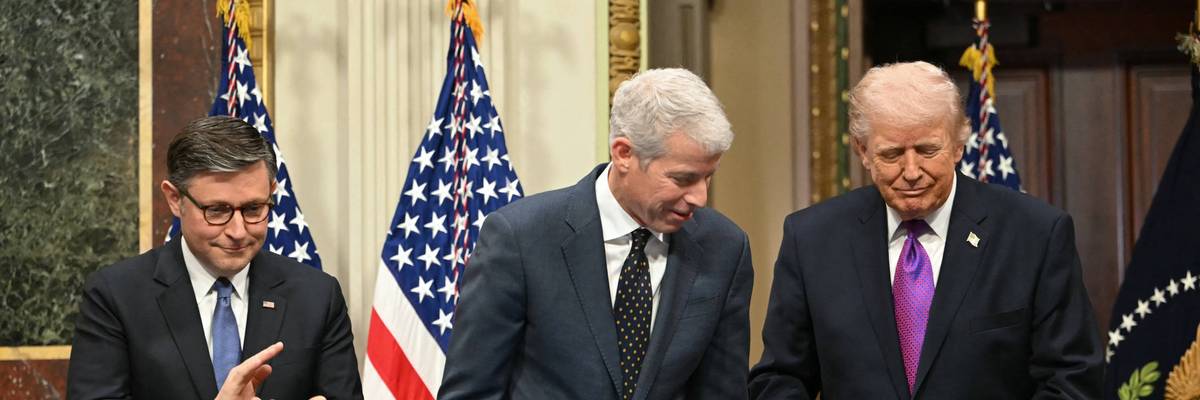
US Speaker of the House Mike Johnson, Energy Secretary Chris Wright, and President Donald Trump appear at an event in Washington, DC on March 4, 2026.
"Trump is abusing emergency authorities and wasting taxpayer resources through unprecedented abuse of the Defense Production Act to promote his politically favored fossil fuel projects."
US President Donald Trump on Monday invoked wartime authority in an effort to boost domestic fossil fuel production—with the help of taxpayer funding—as his administration faces growing political backlash over gas price spikes, driven by the illegal assault on Iran.
The five presidential memos Trump signed cite his executive powers under the Cold War-era Defense Production Act, which gives the president the ability to expand and accelerate production of key supplies. Critics accused Trump of abusing his emergency authority, once again, to give handouts to an industry profiting massively from the Iran war, which the president launched without congressional authorization.
"President Trump is abusing emergency authorities and wasting taxpayer resources through unprecedented abuse of the Defense Production Act to promote his politically favored fossil fuel projects at the expense of energy affordability and common sense," said Tyson Slocum, energy director at the consumer watchdog Public Citizen. "Today’s unjustified suite of executive orders is a wish list for the oil, gas, and coal industries, who are already enjoying record profits under Trump’s Energy Unaffordability Agenda."
“America is already—far and away—the world’s largest oil and gas producer, and the world’s largest petroleum and gas exporter," Slocum added. "Promoting more fossil fuel exports at a time when Trump has failed to deliver affordable, sustainable energy for American communities is just another example of the president’s incompetent, failed energy policies."
Trump's memos aim to bolster petroleum, coal, and liquefied natural gas production, asserting that the nation's "current inadequate and intermittent energy supply leaves us vulnerable to hostile foreign actors and poses an imminent and growing threat to the United States’ prosperity and national security."
"Action to expand the domestic petroleum production, refining, and logistics capacity is necessary to avert an industrial resource or critical technology item shortfall that would severely impair national defense capability," the memos state.
Trump signed the directives hours after he publicly disagreed with his own energy secretary's assessment of when Americans can expect to see relief at the gas pump, where they're paying over $4 per gallon on average nationwide. US Energy Secretary Chris Wright said Americans might not see significantly lower gas prices until next year; Trump claimed that assessment was "totally wrong,” even as economists warned of lasting impacts to US and global energy markets stemming from the Iran war.
The world's largest oil and gas giants have profited massively from war-induced price spikes, with the biggest beneficiaries—including US-based Chevron and ExxonMobil—banking over $30 million an hour in windfall gains during the first month of the conflict.
Trump's memos came days after a group of Republican lawmakers in the House and Senate introduced legislation aimed at shielding fossil fuel companies from legal action to hold them accountable for their central role in the climate emergency.
“Big Oil companies have raked in massive profits at the pump while lying to the American people about the catastrophic harm of their products, and now they want to deny Americans their rightful day in court and stick taxpayers with the bill for the mess they made," Richard Wiles, president of the Center for Climate Integrity, said in response to the bill. "If fossil fuel companies have done nothing wrong, why do they need immunity?"
Dear Common Dreams reader, It’s been nearly 30 years since I co-founded Common Dreams with my late wife, Lina Newhouser. We had the radical notion that journalism should serve the public good, not corporate profits. It was clear to us from the outset what it would take to build such a project. No paid advertisements. No corporate sponsors. No millionaire publisher telling us what to think or do. Many people said we wouldn't last a year, but we proved those doubters wrong. Together with a tremendous team of journalists and dedicated staff, we built an independent media outlet free from the constraints of profits and corporate control. Our mission has always been simple: To inform. To inspire. To ignite change for the common good. Building Common Dreams was not easy. Our survival was never guaranteed. When you take on the most powerful forces—Wall Street greed, fossil fuel industry destruction, Big Tech lobbyists, and uber-rich oligarchs who have spent billions upon billions rigging the economy and democracy in their favor—the only bulwark you have is supporters who believe in your work. But here’s the urgent message from me today. It's never been this bad out there. And it's never been this hard to keep us going. At the very moment Common Dreams is most needed, the threats we face are intensifying. We need your support now more than ever. We don't accept corporate advertising and never will. We don't have a paywall because we don't think people should be blocked from critical news based on their ability to pay. Everything we do is funded by the donations of readers like you. When everyone does the little they can afford, we are strong. But if that support retreats or dries up, so do we. Will you donate now to make sure Common Dreams not only survives but thrives? —Craig Brown, Co-founder |
US President Donald Trump on Monday invoked wartime authority in an effort to boost domestic fossil fuel production—with the help of taxpayer funding—as his administration faces growing political backlash over gas price spikes, driven by the illegal assault on Iran.
The five presidential memos Trump signed cite his executive powers under the Cold War-era Defense Production Act, which gives the president the ability to expand and accelerate production of key supplies. Critics accused Trump of abusing his emergency authority, once again, to give handouts to an industry profiting massively from the Iran war, which the president launched without congressional authorization.
"President Trump is abusing emergency authorities and wasting taxpayer resources through unprecedented abuse of the Defense Production Act to promote his politically favored fossil fuel projects at the expense of energy affordability and common sense," said Tyson Slocum, energy director at the consumer watchdog Public Citizen. "Today’s unjustified suite of executive orders is a wish list for the oil, gas, and coal industries, who are already enjoying record profits under Trump’s Energy Unaffordability Agenda."
“America is already—far and away—the world’s largest oil and gas producer, and the world’s largest petroleum and gas exporter," Slocum added. "Promoting more fossil fuel exports at a time when Trump has failed to deliver affordable, sustainable energy for American communities is just another example of the president’s incompetent, failed energy policies."
Trump's memos aim to bolster petroleum, coal, and liquefied natural gas production, asserting that the nation's "current inadequate and intermittent energy supply leaves us vulnerable to hostile foreign actors and poses an imminent and growing threat to the United States’ prosperity and national security."
"Action to expand the domestic petroleum production, refining, and logistics capacity is necessary to avert an industrial resource or critical technology item shortfall that would severely impair national defense capability," the memos state.
Trump signed the directives hours after he publicly disagreed with his own energy secretary's assessment of when Americans can expect to see relief at the gas pump, where they're paying over $4 per gallon on average nationwide. US Energy Secretary Chris Wright said Americans might not see significantly lower gas prices until next year; Trump claimed that assessment was "totally wrong,” even as economists warned of lasting impacts to US and global energy markets stemming from the Iran war.
The world's largest oil and gas giants have profited massively from war-induced price spikes, with the biggest beneficiaries—including US-based Chevron and ExxonMobil—banking over $30 million an hour in windfall gains during the first month of the conflict.
Trump's memos came days after a group of Republican lawmakers in the House and Senate introduced legislation aimed at shielding fossil fuel companies from legal action to hold them accountable for their central role in the climate emergency.
“Big Oil companies have raked in massive profits at the pump while lying to the American people about the catastrophic harm of their products, and now they want to deny Americans their rightful day in court and stick taxpayers with the bill for the mess they made," Richard Wiles, president of the Center for Climate Integrity, said in response to the bill. "If fossil fuel companies have done nothing wrong, why do they need immunity?"
US President Donald Trump on Monday invoked wartime authority in an effort to boost domestic fossil fuel production—with the help of taxpayer funding—as his administration faces growing political backlash over gas price spikes, driven by the illegal assault on Iran.
The five presidential memos Trump signed cite his executive powers under the Cold War-era Defense Production Act, which gives the president the ability to expand and accelerate production of key supplies. Critics accused Trump of abusing his emergency authority, once again, to give handouts to an industry profiting massively from the Iran war, which the president launched without congressional authorization.
"President Trump is abusing emergency authorities and wasting taxpayer resources through unprecedented abuse of the Defense Production Act to promote his politically favored fossil fuel projects at the expense of energy affordability and common sense," said Tyson Slocum, energy director at the consumer watchdog Public Citizen. "Today’s unjustified suite of executive orders is a wish list for the oil, gas, and coal industries, who are already enjoying record profits under Trump’s Energy Unaffordability Agenda."
“America is already—far and away—the world’s largest oil and gas producer, and the world’s largest petroleum and gas exporter," Slocum added. "Promoting more fossil fuel exports at a time when Trump has failed to deliver affordable, sustainable energy for American communities is just another example of the president’s incompetent, failed energy policies."
Trump's memos aim to bolster petroleum, coal, and liquefied natural gas production, asserting that the nation's "current inadequate and intermittent energy supply leaves us vulnerable to hostile foreign actors and poses an imminent and growing threat to the United States’ prosperity and national security."
"Action to expand the domestic petroleum production, refining, and logistics capacity is necessary to avert an industrial resource or critical technology item shortfall that would severely impair national defense capability," the memos state.
Trump signed the directives hours after he publicly disagreed with his own energy secretary's assessment of when Americans can expect to see relief at the gas pump, where they're paying over $4 per gallon on average nationwide. US Energy Secretary Chris Wright said Americans might not see significantly lower gas prices until next year; Trump claimed that assessment was "totally wrong,” even as economists warned of lasting impacts to US and global energy markets stemming from the Iran war.
The world's largest oil and gas giants have profited massively from war-induced price spikes, with the biggest beneficiaries—including US-based Chevron and ExxonMobil—banking over $30 million an hour in windfall gains during the first month of the conflict.
Trump's memos came days after a group of Republican lawmakers in the House and Senate introduced legislation aimed at shielding fossil fuel companies from legal action to hold them accountable for their central role in the climate emergency.
“Big Oil companies have raked in massive profits at the pump while lying to the American people about the catastrophic harm of their products, and now they want to deny Americans their rightful day in court and stick taxpayers with the bill for the mess they made," Richard Wiles, president of the Center for Climate Integrity, said in response to the bill. "If fossil fuel companies have done nothing wrong, why do they need immunity?"