

SUBSCRIBE TO OUR FREE NEWSLETTER
Daily news & progressive opinion—funded by the people, not the corporations—delivered straight to your inbox.
5
#000000
#FFFFFF
To donate by check, phone, or other method, see our More Ways to Give page.
Daily news & progressive opinion—funded by the people, not the corporations—delivered straight to your inbox.
"We've done this because there's no hope for the world, really," said one of the activists who participated.
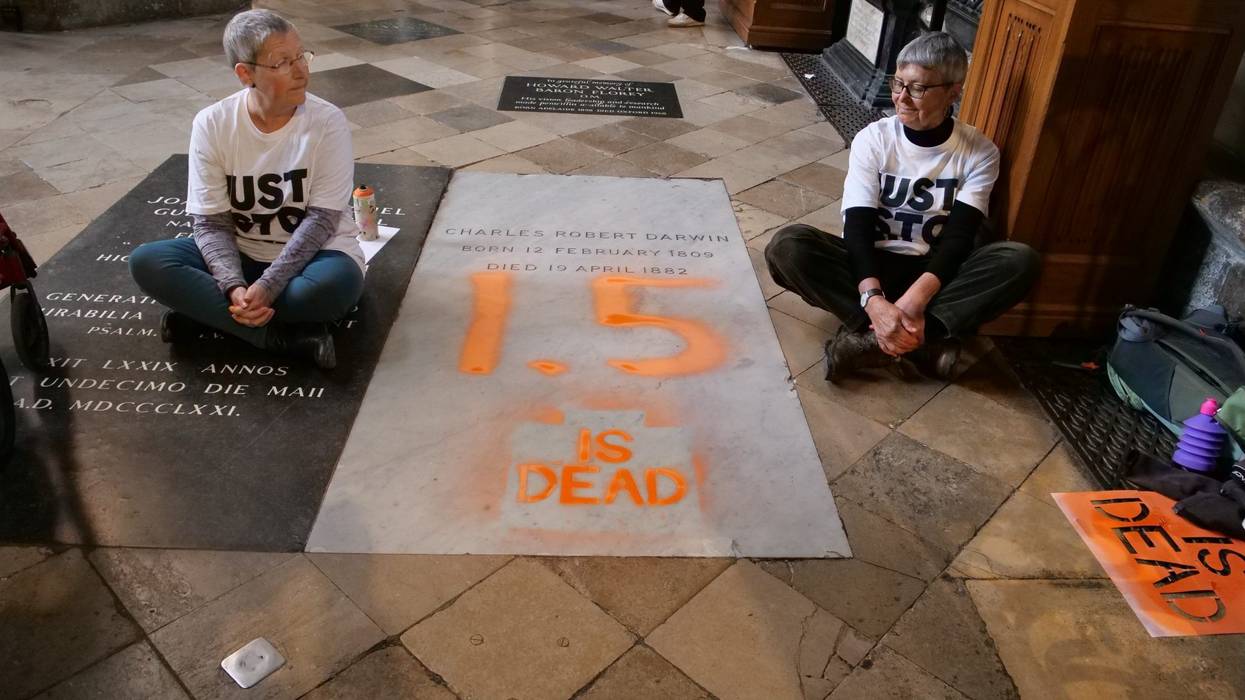
Two activists with the group Just Stop Oil on Monday used orange spray chalk paint to write "1.5 Is Dead" on the gravestone of Charles Darwin—the scientist most famous for developing the theory of evolution by natural selection.
In a statement released Monday, Just Stop Oil, a British group demanding an end to fossil fuel use, said that the action was taken in order to "demand that the U.K. government works with others to phase out the extraction and burning of fossil fuels by 2030."
The BBC reported that Met Police were called to the incident in Westminster Abbey in London and said two women were arrested on suspicion of causing criminal damage.
The message "1.5 Is Dead" is in reference to the news on Friday that 2024 was "the first year with an average temperature clearly exceeding 1.5°C above the pre-industrial level," according to the European Union's Copernicus Climate Change Service (C3S). 2024 was 1.60°C warmer than the pre-industrial level.
Signatories to the Paris climate agreement pledged to reduce their global greenhouse gas emissions with the aim of keeping global temperature rise this century to 1.5ºC, well below 2°C above preindustrial levels. According to the United Nations, going above 1.5ºC on an annual or monthly basis doesn't constitute failure to reach the agreement's goal, which refers to temperature rise over decades—however, "breaches of 1.5°C for a month or a year are early signs of getting perilously close to exceeding the long-term limit, and serve as clarion calls for increasing ambition and accelerating action in this critical decade."
The news comes as California is reeling from multi-day wildfires that have consumed tens of thousands of acres of Los Angeles County and killed over 20 people.
"We've done this because there's no hope for the world, really," said one of the activists who was arrested, Di Bligh. "We've done it on Darwin's grave specifically because he would be turning in that grave because of the sixth mass extinction taking place now," the activist said, according to the BBC.
The other protestor, Alyson Lee, said she did not think Darwin would be unhappy with their act of climate protest: "I believe he would approve because he was a good scientist and he would be following the science, and he would be as upset as us with the government for ignoring the science."
Two Just Stop Oil activists were arrested in England last summer after they sprayed an orange powder on the monoliths at Stonehenge. According to a statement released at the time from Just Stop Oil, the protestors "decorated" Stonehenge to demand that the U.K. government commit to "working with other governments to agree an equitable plan to end the extraction and burning of oil, gas, and coal by 2030."
The cause and effect linking industry to extinction ought to be the greatest horror story ever told. Our hands should be sweating as we shakily turn the pages.
If climate overheating is the biggest threat to life on Earth, one might expect that progressive platforms would be all over this issue. Of all the great crimes of capitalism—war, imperial conquest, siphoning pocket change from workers into bloated coffers of corporate wealth, shaking down ordinary people for a false promise of healthcare, buying up housing with private equity to spike rents, etc.—the baking of the biosphere stands out as an act of unprecedented, monstrous proportions.
Corporate greed, in its bureaucratic, industrial ability to divorce sentiment from institutional momentum, has entered a realm unique in the half billion year evolutionary history of multicellular life. Corporate humanity, armed with technology, has the ability to fast-track mass extinction. The oligarchs of our species have gained admittance to a dimension formerly restricted to geological processes. If implosion of the biosphere had always been a consequence of rare acts of volcanism—the caprice of plate tectonics unfolding across eons—we now can completely obliterate living systems on a dime.
Climate overheating is an epic story, and we have yet to figure out how to tell it.
Progressive media, thus, has every reason to be utterly riveted and obsessed with the climate—climate extinction is worse than war, worse than racism, worse than colonial expansion, worse than arbitrary police power, worse than union busting, worse than any corporate crimes short of nuclear war. Indeed, climate destruction might be thought of as the pure tincture of capitalism, the compressed essence of all forms of injustice. Climate, however, requires that people grasp a different order of magnitude to seriously address its lethal certainty. While police brutality, war, housing shortages, human rights abuses, and racism can possibly be addressed with reform, there is no wiggle room for climate's destructive trajectory. No series of incremental policy adjustments can placate Mother Nature and her planned revenge.
Climate remediation demands revolutionary change—there is no path forward to, as Jeremy Corbin words it, "turn the Titanic around," under our current political and economic systems. Climate overheating, unlike all the smaller threats plaguing our (and all other) species, requires an almost unimaginable shift in our institutions and ways of thinking—the transitions that might give the planet a hint of optimism have to take place globally within an international community hopelessly addicted to nationalism. A recent piece by Mark Wilson posted at the World Socialist Website (WSWS) encapsulates the gargantuan task—Wilson, referencing the suit by impoverished countries to access climate reparations via The World Court, states:
Whatever the verdict of this case, the major capitalist powers responsible for the climate crisis will continue to base their policies not on science, human rights, or environmental protection. Instead, the ruling elites and big business will make their calculations based on profit and on enriching themselves.
What is required by the working class globally is instead a break from the institutions that defend the capitalist system as it plunges the world into ecological devastation. The conscious political fight to abolish capitalism is the necessary strategic task to which all workers and young people must orient, as the only path to safeguard Earth and its living inhabitants.
As a regular reader of the WSWS, I generally find perspectives that are more pointedly directed toward revolution than incrementalism, but oddly, one has to look hard at WSWS offerings to find climate related analysis. I had to scroll through at least 30 pieces to find the above quote. That is not to begrudge the focus on international labor struggles, worker's rights, Gaza, and Marxist cultural perspectives, but the paucity of climate related reporting is not so much a failure of WSWS as it is a universal problem characteristic of progressive platforms in general.
A quick personal and anecdotal survey of five different online, leftist platforms reveals that fewer than 10% of pieces deal with climate, and only a tiny handful go into detail regarding the more nuanced debates around climate overheating mitigation. For example, the exploration of Degrowth—ubiquitous on niche environmental sites like Resilience—almost never receives detailed unpacking on more general online sites that promote leftist journalism. Unfortunately, we have a poorly informed public with a below threshold investment in civil disobedience, and little familiarity with the prevailing positions—largely emerging from academia—regarding the strategies that will be urgent and essential to transition from a political culture of runaway ecocide. Many have complained that the climate movement does not resonate with poor and working people. The massive mobilization needed to confront the sixth extinction depends on a well-informed public armed with the requisite narrative tools.
The problems confronting climate activism may be uniquely psychological. We don't see the same sort of immediate nexus that binds perpetrators and victims in the manner that a bloodied Gazan child can be traced to a conscious act of colonial expansion. The sort of violence manifest in the gratuitous burning of fossil fuels rather evades the scope of public understanding. We simply don't see the Central American refugee as a victim of corporate designs in the same way that we recognize a murdered Gazan child as a target of Israeli and U.S. military intent. Yet that connection is real and urgently needed to be framed for those who struggle to grasp the storyline. The cause and effect linking industry to extinction ought to be the greatest horror story ever told. Our hands should be sweating as we shakily turn the pages.
The murder of George Floyd pulled at our collective heartstrings. Tens of millions of people cringed at the specific, personal, intimate revelation of police violence. We oddly respond emotionally to a single act of injustice, yet numbly fail to resonate with the onrushing death of billions. Perhaps it is our job as writers to make climate crimes personal and immediate. Climate overheating is an epic story, and we have yet to figure out how to tell it. The enormous bridge linking the planet's greatest global catastrophe to the private suffering of real people may be nearly impossible for writers to span.
At the very least we can picture the suffering of Roger Hallam—sentenced to five years in prison for climate civil disobedience. Perhaps we can also appreciate that John Mark Rozendaal has been threatened with a seven-year sentence for playing a Bach Cello Suite outside of Citibank in NYC as part of the Summer of Heat protest. A man holding an umbrella above the cellist also risked Draconian retribution. Civil disobedience has often been energized by collective outrage toward state violence directed against those who stand up for human rights—think of Rosa Parks who became the iconic symbol of the civil rights movement.
All of the things that make journalism vivid and anxiously relevant ought to drive the climate narrative. The corporate world and their political puppets want nothing more than to see readers on leftist platforms bored with climate coverage.
Mass extinction will have far-reaching, potentially cataclysmic consequences for humankind
The words of United Nations Secretary General António Guterres couldn't have been starker:
"We are waging a war on nature. Ecosystems have become playthings of profit. Human activities are laying waste to once-thriving forests, jungles, farmland, oceans, rivers, seas and lakes. Our land, water and air are poisoned by chemicals and pesticides, and choked with plastics. The addiction to fossil fuels has thrown our climate into chaos. Unsustainable production and monstrous consumption habits are degrading our world. Humanity has become a weapon of mass extinction…with a million species at risk of disappearing forever."
Respecting and following the leadership of Indigenous communities is the first step towards making peace with Mother Nature, while we still can.
Guterres was opening the global summit of the Convention on Biological Diversity, or COP15 in UN parlance, which just wrapped up in Montreal. The convention was launched at the Rio Earth Summit in 1992, alongside the UN's better-known climate change negotiations.
The biodiversity convention is the best hope we have to stop what has been called the sixth extinction, as human activities extinguish tens of thousands of species every year, never to return. The previous five extinctions occurred from tens of millions to hundreds of millions of years ago. The most recent one happened 66 million years ago, when, scientists believe, a 6-mile-wide asteroid smashed into water off Mexico's Yucatan Peninsula. The impact caused massive tsunamis, acid rain and wildfires, then blanketed the atmosphere with sun-blocking dust, lowering temperatures worldwide and wiping out the dinosaurs.
We humans are now essentially doing to the planet what that asteroid did. As New Yorker writer Elizabeth Kolbert eloquently describes in her Pulitzer Prize-winning book, The Sixth Extinction, humans have evolved into a predator without equal. We overtake and destroy habitats with abandon, driving other species into permanent oblivion.
Key agreements forged last week in Montreal were signed by 196 nations. The U.S., along with the Vatican, didn't sign as neither is party to the Convention on Biological Diversity.
A central achievement of the Montreal negotiations was the "30x30" pledge to protect 30% of Earth's lands, oceans, coastal areas and inland waters by 2030. Also agreed to was the creation of a fund to help developing nations protect biodiversity, slated to reach $200 billion annually by 2030, while phasing down harmful subsidies by $500 billion per year. A requirement for the "full and active involvement" of indigenous peoples was also written into the text.
"It's absolutely impossible to create a biodiversity agreement without the inclusion of Indigenous rights, because 80% of remaining biodiversity is Indigenous lands and territories," Eriel Tchekwie Deranger, executive director of Indigenous Climate Action and member of the Athabasca Chipewyan First Nation said on the Democracy Now! news hour. "Some of the biggest challenges and risks that have come out of this COP is the fact that there aren't any real mechanisms with real teeth, similar to COP27 [the recent UN climate summit in Egypt], that actually protect our rights, our culture, and our ability to advance our rights to say yes and no to these types of agreements."
Eriel Deranger first appeared on Democracy Now! while in Copenagen in 2009, attending a different COP15–the 15th meeting of the UN climate change convention. She was delivering a basket to the Canadian embassy in advance of then-Canadian Prime Minister Stephen Harper's arrival for those pivotal climate negotiations:
"Inside the basket were copies of the treaties that are being violated by the Canada tar sands, and copies of the Kyoto Protocol, which he signed onto, as well as a copy of the Declaration on the Rights of Indigenous People, to remind him that there is something else that he needs to sign onto in order to really fully respect indigenous people's rights."
It was at that 2009 climate summit that wealthy nations pledged to create a $100 billion per year fund by 2020, to help poorer nations adapt to and mitigate climate change. To date, the fund has fallen far short of the pledge, and much of the money available is offered as loans, not grants. So activists like Eriel Deranger have reason to be skeptical of the $200 billion per year biodiversity pledge just made in Montreal.
"They're centering colonial economic ideals," Deranger said this week. "They're still giving national and colonial states the power to determine what Indigenous rights look like when they're implemented in these agreements, and how lands will be developed, undeveloped, protected…In Canada, we are committing to '30×30,' millions and millions of dollars for biodiversity protection, Indigenous protection and conservation areas, yet we are not talking about ending the expansion of the Alberta tar sands."
Mass extinction will have far-reaching, potentially cataclysmic consequences for humankind. António Guterres was right: we are waging a war on nature. Respecting and following the leadership of Indigenous communities is the first step towards making peace with Mother Nature, while we still can.
The world is burning up.
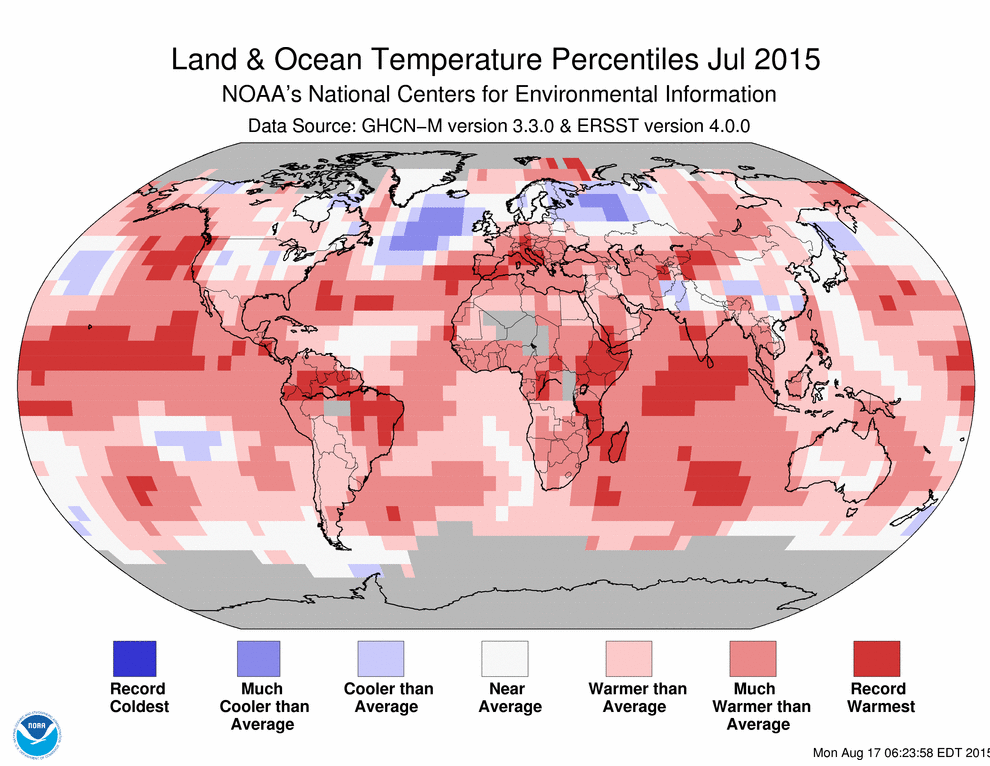
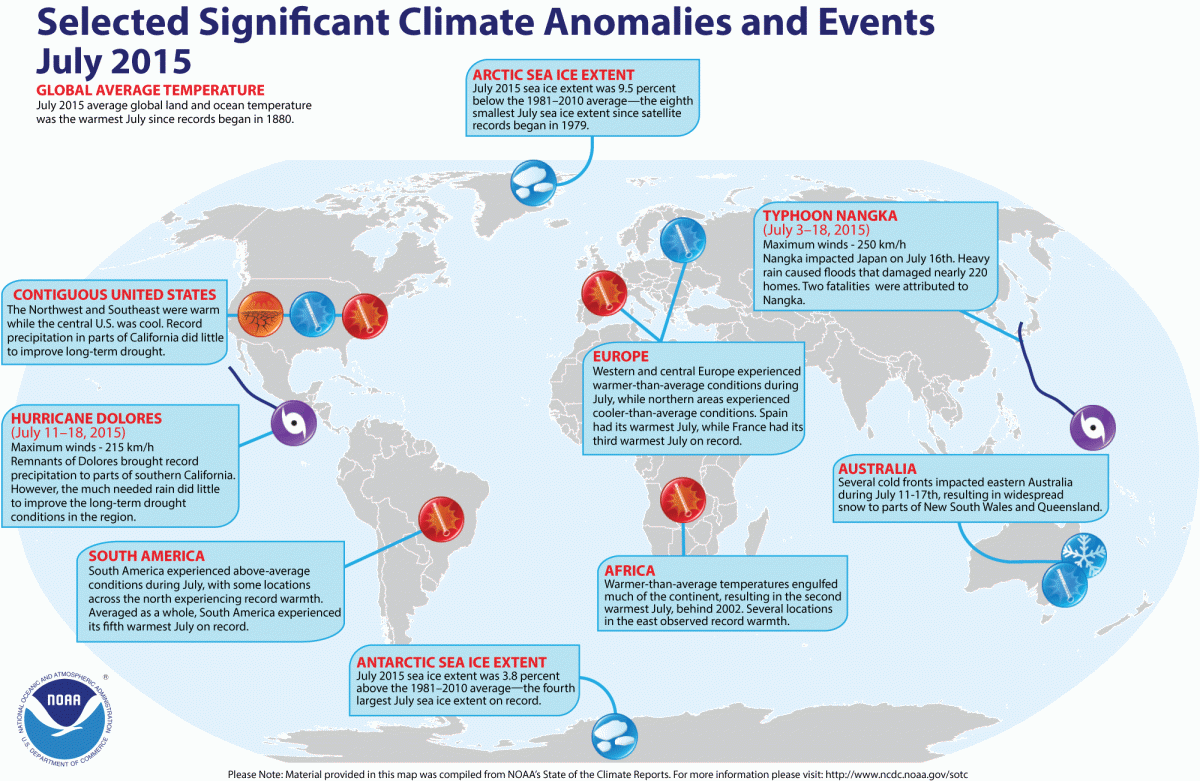
The previously available evidence supports that statement. On Thursday, the National Oceanic and Atmospheric Administration in the U.S. announced that July was the hottest month the planet has experienced since records began and that both land and ocean temperatures are on pace to make 2015 the hottest year ever recorded.
According to NOAA's latest figures, the July average temperature across global land and ocean surfaces was 1.46 degrees Fahrenheit (0.81 degrees Celsius) above the 20th-century average. As July consistently marks the warmest month of the year, NOAA said this most recent one now registers as having the all-time highest monthly temperature since records began in 1880, with an average global thermometer reading of 61.86 degrees Fahrenheit (16.61 degrees Celsius).
NOAA's temperature analysis follows similar findings by NASA and the Japan Meteorological Agency (JMA) published earlier this week, which also said July was a record-breaker regarding heat.
"The world is warming. It is continuing to warm. That is being shown repeatedly in our data," said Jake Crouch, a physical scientist at NOAA's National Centres for Environmental Information.
"Now that we are fairly certain that 2015 will be the warmest year on record," Crouch continued, "It is time to start looking at what the impacts of that are. What does that mean for people on the ground?"
At least for those who experienced perilous heat waves in places like Pakistan, India, Iran, and Egypt in recent weeks and months, they know those direct impacts of record temperatures can be deadly. Meanwhile, climate scientists have spent much of the year--with a unique eye on upcoming UN climate talks in Paris--warning that the collective impacts of increased temperatures on land and in the oceans are resulting in severe consequences for human civilization and the natural world.
More troubling than any one month, experts note, is the consistent and driving trend that has seen temperatures on a steady march upward since the beginning of the century. As Andrea Thompson at Climate Central reports:
After 2014 was declared the warmest year on record, a Climate Central analysis showed that 13 of the 15 warmest years in the books have occurred since 2000 and that the odds of that happening randomly without the boost of global warming was 1 in 27 million.
Even during recent years when a La Nina (the cold water counterpart to El Nino) has been in place, the year turned out warmer than El Nino years of earlier decades.
Global carbon dioxide levels have risen from a preindustrial level of about 280 parts per million to nearly 400 ppm today. In recent years, CO2 levels -- the primary greenhouse gas -- have spent longer and longer above the 400 ppm benchmark. They stayed above this point for about six months this year, twice the three months of last year. It is expected that within a few years, they will be permanently above 400 ppm.
The continued rise of CO2 levels will raise the planet's temperature by another 3degF to 9degF by the end of this century depending on when and if greenhouse gas emissions are curbed, scientists have calculated.
That means that some, future years are likely to continue to set records, even if there will still be year to year variations.
According to Eric Holthaus, who writes about climate change for Slate, the mounting evidence and rising temperatures are painting an increasingly scary picture of the future:
All this warmth on land is being driven by record-setting heat across large sections of the world's oceans. The NOAA report notes that the warmest 10 months of ocean temperatures on record have occurred in the last 16 months. This is mostly due to a near-record strength El Nino, but the current state of the global oceans has little historical precedent. Since it takes several months for the oceanic warmth of an El Nino to fully reach the atmosphere, 2016 will likely be warmer--perhaps much warmer--than 2015. And that poses grave implications for the world's ecosystems as well as humans.
We've recently entered a new point in the Earth's climate history. According to reconstructions using tree rings, corals, and ice cores, global temperatures are currently approaching--if not already past--the maximum temperatures commonly observed over the past 11,000 years (i.e., the time period in which humans developed agriculture), and flirting with levels not seen in more than 100,000 years.
But this is the scary part: The current level of carbon dioxide in the atmosphere is higher than at any point since humans first evolved millions of years ago. Since carbon dioxide emissions lead to warming, the fact that emissions are increasing means there's much more warming yet to come. What's more, carbon dioxide levels are increasing really quickly. The rate of change is faster than at any point in Earth's entire 4.5 billion year history, likely 10 times faster than during Earth's worst mass extinction--the "Great Dying"--in which more than 90 percent of ocean species perished. Our planet has simply never undergone the kind of stress we're currently putting on it. That stunning rate of change is one reason why surprising studies like the recent worse-than-the-worst-case-scenario study on sea level rise don't seem so far fetched.
Global capitalism is the 800-pound gorilla. The twin ecological and economic crises, militarism, the rise of the surveillance state, and a dysfunctional political system can all be traced to its normal operations.
We need a transformative politics from below that can challenge the fundamentals of capitalism instead of today's politics that is content to treat its symptoms. The problems we face are linked to each other and to the way a capitalist society operates. We must make an effort to understand its real character. The fundamental question of our time is whether we can go beyond a system that is ravaging the Earth and secure a future with dignity for life and respect for the planet.
What has capitalism done to us lately?
The best science tells us that this is a do-or-die moment.
We are now in the midst of the 6th mass extinction in the planetary history with 150 to 200 species going extinct every day, a pace 1,000 times greater than the 'natural' extinction rate. The Earth has been warming rapidly since the 1970s with the 10 warmest years on record all occurring since 1998. The planet has already warmed by 0.85 degree Celsius since the industrial revolution 150 years ago. An increase of 2deg Celsius is the limit of what the planet can take before major catastrophic consequences. Limiting global warming to 2degC requires reducing global emissions by 6% per year. However, global carbon emissions from fossil fuels increased by about 1.5 times between 1990 and 2008.
Capitalism has also led to explosive social inequalities. The global economic landscape is littered with rising concentration of wealth, debt, distress, and immiseration caused by the austerity-pushing elites.
Take the US. The richest 20 persons have as much wealth as the bottom 150 million. Since 1973, the hourly wages of workers have lagged behind worker productivity rates by more than 800%. It now takes the average family 47 years to make what a hedge fund manager makes in one hour. Just about a quarter of children under the age of 5 live in poverty. A majority of public school students are low-income. 85% of workers feel stress on the job.
Soon the only thing left of the American Dream will be a culture of hustling to survive.
Take the global society. The world's billionaires control $7 trillion, a sum 77 times the debt owed by Greece to the European banks. The richest 80 possess more than the combined wealth of the bottom 50% of the global population (3.5 billion people). By 2016 the richest 1% will own a greater share of the global wealth than the rest of us combined. The top 200 global corporations wield twice the economic power of the bottom 80% of the global population.
Instead of a global society capitalism is creating a global apartheid.
What's the nature of the beast?
Firstly, the "egotistical calculation" of commerce wins the day every time. Capital seeks maximum profitability as a matter of first priority. Evermore "accumulation of capital" is the system's bill of health; it is slowdowns or reversals that usher in crises and set off panic. Cancer-like hunger for endless growth is in the system's DNA and is what has set it on a tragic collision course with Nature, a finite category.
Secondly, capitalism treats human labor as a cost. It therefore opposes labor capturing a fair share of the total economic value that it creates. Since labor stands for the majority and capital for a tiny minority, it follows that classism and class warfare are built into its DNA, which explains why the "middle class" is shrinking and its gains are never secure.
Thirdly, private interests determine massive investments and make key decisions at the point of production guided by maximization of profits. That's why in the US the truck freight replaced the railroad freight, chemicals were used extensively in agriculture, public transport was gutted in favor of private cars, and big cars replaced small ones.
What should political action aim for today?
The political class has no good ideas about how to address the crises. One may even wonder whether it has a serious understanding of the system, or at least of ways to ameliorate its consequences. The range of solutions offered tends to be of a technical, legislative, or regulatory nature, promising at best temporary management of the deepening crises. The trajectory of the system, at any rate, precludes a return to its post-WWII regulatory phase.
It's left to us as a society to think about what the real character of the system is, where we are going, and how we are going to deal with the trajectory of the system -- and act accordingly. The critical task ahead is to build a transformative politics capable of steering the system away from its destructive path. Given the system's DNA, such a politics from below must include efforts to challenge the system's fundamentals, namely, its private mode of decision-making about investments and about what and how to produce. Furthermore, it behooves us to heed the late environmentalist Barry Commoner's insistence on the efficacy of a strategy of prevention over a failed one of control or capture of pollutants. At a lecture in 1991, Commoner remarked: "Environmental pollution is an incurable disease; it can only be prevented"; and he proceeded to refer to "a law," namely: "if you don't put a pollutant in the environment it won't be there."
What is nearly certain now is that without democratic control of wealth and social governance of the means of production, we will all be condemned to the labor of Sisyphus. Only we won't have to suffer for all eternity, as the degradation of life-enhancing natural and social systems will soon reach a point of no return.