

SUBSCRIBE TO OUR FREE NEWSLETTER
Daily news & progressive opinion—funded by the people, not the corporations—delivered straight to your inbox.
5
#000000
#FFFFFF
To donate by check, phone, or other method, see our More Ways to Give page.


Daily news & progressive opinion—funded by the people, not the corporations—delivered straight to your inbox.
Trump and his Republican allies have routinely targeted their political opponents and entire ethnic and religious groups with threats of deportation and denaturalization.
The US Department of Justice has referred hundreds of citizens for denaturalization, beginning what some fear will be a massive effort to strip Americans of their citizenship.
Months ago, it was reported that the Trump administration would seek to enlist the DOJ in its effort to revoke the citizenship of hundreds of people each month.
On Thursday, The New York Times reported that the effort to carry out what DOJ spokesperson Matthew Tragesser called "the highest volume of denaturalization referrals in history” had begun.
The paper reported that the DOJ had identified 384 foreign-born Americans whose citizenship it wants to take away and had assigned the cases to prosecutors in dozens of US attorneys' offices across the country.
President Donald Trump is trying to dramatically expand a process that Sameera Hafiz, policy director at the Immigrant Legal Resource Center, told the Houston Chronicle is typically reserved for "very rare extreme circumstances."
Federal law allows the government to ask courts to strip citizenship from those it can prove obtained it fraudulently. In some rare cases, people found to have committed egregious offenses like war crimes or the financing of terrorism have also been stripped of citizenship.
Between 2017 and the end of 2025, the federal government attempted to denaturalize just 120 citizens, less than a third of the number the Trump administration referred for denaturalization in just this first batch.
According to the Times, it is not clear why the 384 individuals referred to federal courts have been singled out. Tragesser said the administration was "laser focused on rooting out criminal aliens defrauding the naturalization process."
Aaron Reichlin-Melnick, a senior fellow at the American Immigration Council, said that these cases "are not exactly easy for the government to win," because "they have to go to a bench trial in front of a federal judge and prove material fraud."
But the DOJ has indicated that the range of people targeted for denaturalization could be much broader than just those found guilty of fraud.
The Trump administration's plans to pursue mass denaturalization first came to light last June when Assistant Attorney General Brett Shumate issued an internal memo calling on the DOJ's Civil Division to "prioritize and maximally pursue denaturalization proceedings in all cases permitted by law and supported by the evidence."
In addition to the fraudsters and human rights violators who have typically been subject to denaturalization, Shumate urged the department to go after those “who pose a potential danger to national security” and "any other cases... that the division determines to be sufficiently important to pursue," which suggested that much broader categories of people may be targeted.
"The way the memo suggests they're going to apply it is very broad and expansive, and it's shockingly dramatic because that's not the intention behind denaturalization," Hafiz said.
The Trump administration has frequently targeted protesters and activists, including those with legal status in the US, for deportation for expressing political opinions opposite those of the government.
Last year, hundreds of foreign-born students who participated in protests against US support for Israel had their visas stripped by the US State Department. Some—like Columbia student activist Mahmoud Khalil—were deemed a danger to "national security" based solely on their articulation of beliefs out of step with the Trump administration's foreign policy.
Trump and several members of the Republican Party have also called for the denaturalization of foreign-born political opponents, including the Somali-American Rep. Ilhan Omar (D-Minn.) and the Ugandan-American New York City Mayor Zohran Mamdani.
Earlier this week, Rep. Chip Roy (R-Texas) introduced legislation titled the "MAMDANI Act," which would deport and denaturalize any immigrant who "advocates for socialism, communism, Marxism, or Islamic fundamentalism.”
Rep. Andy Ogles (R-Tenn.), who has also pushed for the deportation of Mamdani, who is Muslim, recently said that non-Christians should not be allowed in America.
"We're not a melting pot," he said. "If you're building temples or mosques and undermining Christianity, you're not assimilating."
Trump, meanwhile, has expressed a desire to go after certain ethnic groups, particularly Somali-Americans, whom he has said have "low IQs" and described as "garbage". Most people of Somali descent living in the US are citizens, but Trump has said "I don't want them in the country" and said they should "go back where they came from."
Many Somali-American citizens were detained, often brutally, during US Immigration and Customs Enforcement's (ICE) massive operation in Minneapolis earlier this year.
Around the same time, the US Department of Homeland Security endorsed the idea of pursuing "100 million deportations," which would entail the removal of tens of millions of American citizens from the country, including many who were born in the United States. Ex-Border Patrol Commander Gregory Bovino, who oversaw Trump's mass deportation crusade for months, recently said he had a "master plan" to make this sweeping purge a reality.
Hafiz said the Trump administration's conduct has raised the possibility that the denaturalization push will be carried out in a "very broad and expansive way."
"That's very concerning," she said. "And we've seen in so many of the tactics that the Trump administration is using, what a slippery slope it is, how they say, 'This policy is to target one set of individuals,' and how that set of individuals just becomes broader as it's applied."
"Donald Trump and Stephen Miller want unfettered surveillance powers without any chance to enact protections, and Democrats must not give it to them," one campaigner warned.
A week after four Democrats helped Republicans pass a short-term extension of a controversial spying power with a dead-of-night vote in the US House of Representatives, Speaker Mike Johnson on Thursday released a bill that would renew the authority for three years—double the amount of time the Louisiana Republican and President Donald Trump were previously pushing.
As that bill text circulated, Demand Progress—one of the scores of civil society groups calling for privacy reforms to be included in any renewal of Section 702 of the Foreign Intelligence Surveillance Act (FISA)—took aim at those Democrats: Reps. Marie Gluesenkamp Perez (Wash.), Jared Golden (Maine), Josh Gottheimer (NJ), and Tom Suozzi (NY).
"Just like last time, Speaker Johnson's latest proposal lacks any meaningful privacy reforms, but this time, they're trying to renew FISA for three more years—twice as long as the Trump administration asked for," said Demand Progress senior policy adviser Hajar Hammado in a statement.
"Donald Trump and Stephen Miller want unfettered surveillance powers without any chance to enact protections, and Democrats must not give it to them," Hammado argued, referring to Trump's deputy chief of staff for policy and homeland security adviser.
"We need Reps. Gottheimer, Suozzi, Golden, and Gluesenkamp Perez to stand with the rest of Democrats and hold Donald Trump accountable," the campaigner emphasized. "A vote in support of this FISA bill, especially procedural votes to advance it, is both a vote to allow Donald Trump to continue invasive, warrantless surveillance of private American citizens, and to sabotage even the chance of protecting privacy."
FISA's Section 702 allows the US government to surveil electronic communications of noncitizens located outside the United States to acquire foreign intelligence information, without a warrant. However, it's been abused at least hundreds of thousands of times by the Federal Bureau of Investigation (FBI) alone—which has fueled calls for reforms, including closing the data broker loophole that agencies use to buy their way around the Fourth Amendment to the US Constitution.
"Speaker Johnson wants to pretend this bill is reform, but it's the same type of empty-calorie proposal that failed last week," warned Jake Laperruque, deputy director of Center for Democracy and Technology's Security and Surveillance Project. "There is nothing in this bill that would have prevented the abuses of FISA 702 we've already seen—snooping on lawmakers, protesters, and campaign donors—and there is nothing that would stop even worse abuses in the future."
"Members of Congress have a clear choice: They can support this proposal and give the FBI and other intelligence agencies a three-year blank check, or they can stand strong and demand real reforms to protect the American people," he said.
Elizabeth Goitein, co-director of the Brennan Center for Justice's Liberty and National Security Program, similarly stressed how the latest bill is "almost identical to the one that failed last week," explaining on social media that "the main 'reform' in Johnson's first proposal was a provision that merely restated existing law, under which the government may not 'target' Americans under Section 702 but may do so with a warrant or FISA Title I order."
"That provision was titled 'warrant requirement,' even though it imposed no new warrant requirement whatsoever. And it had zero relevance to the issue at the heart of the debate over Section 702, namely, backdoor searches," she noted. "Backdoor searches are not considered to be 'targeting' Americans for surveillance. Rather, they are searches of collected communications of foreign targets outside the United States for Americans' communications that were 'incidentally' swept in."
"Astonishingly, Johnson has chosen to feature this same do-nothing provision in his new proposal. This time, the drafters have dropped any pretense of creating new law and titled the provision 'Fourth Amendment Requirement for Targeting United States Persons,'" Goitein continued. "This is not a reform bill, and it's not a compromise. It's a straight reauthorization with eight pages of words that serve no serious purpose other than to try to convince members that it's NOT a straight reauthorization."
According to her: "House members didn't fall for it last week, and they shouldn't fall for it now. Speaker Johnson must allow the House to vote on the reforms that members and the American people are demanding, including a warrant requirement to access Americans' communications."
The GOP narrowly has the numbers to pass legislation with a party-line vote in the House, but some of the chamber's Republicans have joined in the calls for privacy reforms. Libertarian leaders, including Justin Amash, a former Republican congressman from Michigan, have forcefully spoken out against Johnson's efforts.
"House Republicans are spitting on the Constitution and spitting in all our faces," Amash said of the bill unveiled Thursday.
Calling out the House Permanent Select Committee on Intelligence, Senate Select Committee on Intelligence, and vast US Intelligence Community, Patrick Eddington, a senior fellow in homeland security and civil liberties at the libertarian Cato Institute, declared that "this is an HPSCI, SSCI, IC Trojan horse bill masquerading as something Fourth Amendment-compliant."
Senate Majority Leader John Thune (R-SD) "is threatening to take over negotiations if the House GOP can’t resolve differences quickly," according to Politico. In the upper chamber, Republicans need at least some Democratic support to pass a reauthorization bill.
"The American people are done grinding to get by while our tax dollars fund wars abroad and concentration camps at home."
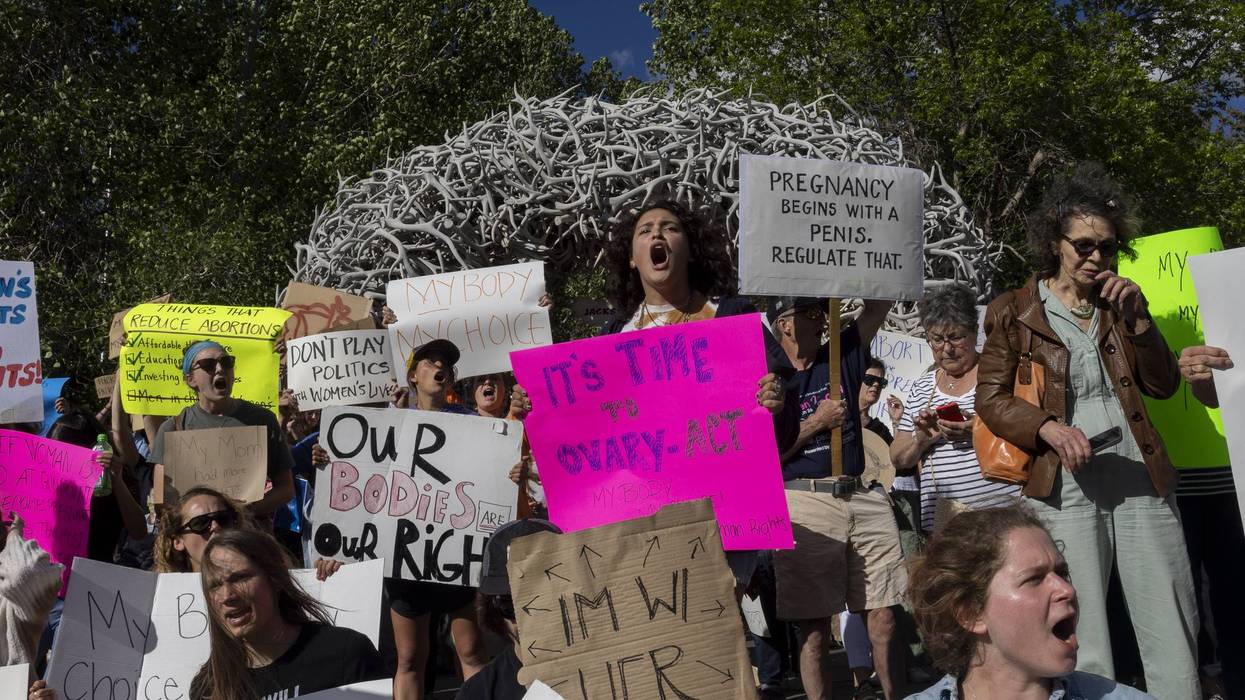
A broad coalition of organizations is banding together to stage thousands of planned May Day events across the US based around the theme of building an economy for "workers over billionaires."
May Day Strong, an initiative anchored by 500 labor and community organizations, is set to host more than 3,000 events throughout the country to demand higher taxes on the wealthiest Americans, an end to US Immigration Customs Enforcement (ICE) and the war with Iran, and an expansion of democracy over corporate rule.
Organizers of the events are asking participants to refrain from engaging in any economic activity on May 1, which means "no work, no school, no shopping." This particular action was inspired by the one-day general strike that residents of Minneapolis waged in January to protest against the occupy of their city by federal immigration enforcement officers.
Flagship demonstrations will be held in major US cities from coast to coast, with thousands of smaller events scheduled to take place in all 50 states.
Neidi Dominguez, executive director of Organized Power in Numbers, said the rallies are being organized to ensure "our tax dollars going to good jobs, schools, and housing, not to sending federal agents into our cities to attack our neighbors."
Rebecca Winter, executive director of Mass 50501, framed the events as a way for Americans to exert economic leverage to protest injustice.
"The American people are done grinding to get by while our tax dollars fund wars abroad and concentration camps at home,” said Winter. “We pay more for everything while those in power cash in. On May 1, we hit back with our wallets—no work, no school, no shopping. We the people are the economy, and we decide when it stops."
Greg Nammacher, president of Minnesota-based Service Employees International Union Local 26, drew on the Minneapolis experience to explain what the May Day protests are trying to achieve.
"In January in Minnesota this year we experienced the power when community and workers act together to defend our rights and shared values," Nammacher said. "This May Day is a chance for us locally, and nationally, to build on those lessons: We are ready to fight to protect our families and our cities from the billionaire agenda of division and hate."
Angelica Salas, executive director of the Coalition for Humane Immigrant Rights (CHIRLA), said the protests would also highlight inhumane US immigration policies and demand a pathway to citizenship for undocumented immigrants.
"On May Day, we rise because worker justice is immigrant justice," Salas said. "It's been 40 years since the last time this nation recognized the contributions of immigrants by approving a pathway to citizenship. And it's been 20 years since La Gran Marcha—when millions of people took to the streets to reject exclusion, racism, and criminalization of immigrant communities—and we are still facing the same forces, especially under the Trump administration."
Braxton Winston, president of the North Carolina State AFL-CIO, described the demonstrations as a good way to bring new people into the movement and strengthen future actions.
"Now is the time to build coalitions between unorganized workers, unions, and community members for mass actions to disrupt the well-organized, joint efforts of corporations and the White House to exploit American workers," Winston said. "The actions we take on International Workers Day are about building the political, social, community, and labor coalitions needed to disrupt the status quo. The power we flex this May Day will fuel our unwavering commitment to building a bigger, more effective, unified labor movement to win victories for working families."
“Across the country people are going bankrupt and dying prematurely because of lack of healthcare, but the US government has billions to spend on imperialist violence to enrich corporations," said one researcher.
As the basic needs of millions of Americans are sacrificed upon the altar of waning US global domination, an analysis unveiled Thursday revealss that the Trump administration has spent billions of dollars on illegal military aggression against Venezuela and civilian boats alleged without evidence to be smuggling drugs off the coast of Latin America.
The Costs of War Project at Brown University's Watson School of International and Public Affairs published an analysis by a pair of researchers who "found that spending on Operation Southern Spear and Operation Absolute Resolve in Venezuela, the Caribbean, and the Eastern Pacific cost at least $4.7 billion from August 1, 2025 to March 31, 2026."
The researchers—Hanna Homestead of the Institute for Policy Studies' National Priorities Project and Jennifer Kavanagh of the think tank Defense Priorities—also found that "costs will continue to mount as some naval assets and aircraft remain in the region and strikes continue."
"This estimate is only partial due to lack of information, and does not include long-term budgetary costs such as veterans benefits," an introduction to the analysis states.
BREAKING: Since August 2025, the U.S. has spent at least $4.7 billion on operations in Latin America and the Caribbean, including the operation to oust Maduro. [THREAD, 1/11]
[image or embed]
— The Costs of War Project (@costsofwar.bsky.social) April 23, 2026 at 8:41 AM
In addition to the financial burden, the analysis notes the human costs of enforcing the so-called "Donroe Doctrine."
"While not the topic of this paper, they are essential to note at the outset," the publication states. "The raid and capture of Venezuelan President Nicolás Maduro during Operation Absolute Resolve resulted in approximately 75 known fatalities. These include 32 Cuban personnel killed, at least 23 Venezuelan security officers killed, and at least two civilian deaths."
US strikes "against unarmed vessels in the Caribbean and Eastern Pacific between September 2, 2025 and March 31, 2026 have killed at least 163 people," the authors added. "In addition, at least one American service member died while deployed to the Caribbean in February 2026 when two US ships collided."
The toll from Trump's boat-bombing spree has since risen to more than 180 following additional reported strikes. Survivors of somemi bombings allege they were tortured by their US captors. The US military and Trump administration have provided no solid evidence to support their claims that the boats were transporting illicit narcotics.
Homestead and Kavanagh noted in their analysis that "to date, Congress has not authorized the use of force in the Caribbean or Eastern Pacific and the Pentagon has not provided information about costs of Venezuela-related operations, even as they continue to mount."
There have been more than 50 boat bombings since Trump launched his campaign last September. Relatives of people killed in or missing after the strikes insist their loved ones were fishers with no links to the drug trade, an assertion echoed by leaders in Venezuela, Colombia, and some Caribbean island nations.
Multiple war powers resolutions aimed at reining in Trump's ability to wage war on Venezuela or bomb boats on the high seas without congressional authorization have been rejected by the Republican-controlled Congress.
In addition to the bombing and invasion of Venezuela and the boat strikes, the Trump administration has deployed troops to Ecuador as part of a joint campaign against alleged drug gangs dubbed Operation Total Extermination. Trump has also ordered the military to plan an invasion to seize the Panama Canal, threatened to "take" Cuba, possibly attack Mexico and Colombia, invade and annex Greenland, and somehow make Canada the "51st state."
That's just in the Western Hemisphere. Overall, Trump has bombed seven countries around the world since returning to the White House and 10 nations over the course of his two terms—including Iran, where he launched an illegal war with Israel.
The Costs of War Project rose to prominence by tracking the human and financial price of the so-called US War on Terror, which since September 2001 has resulted in over 940,000 direct deaths, including at least 432,000 civilians, in five studied countries, at a monetary cost of around $8 trillion.
Homestead and Kavanagh wrote in their analysis that the $4.7 billion figure "is a conservative estimate, and the greatest costs may yet be to come," as "operations do not have a clear end date and are actively expanding."
"They carry significant human, financial, and strategic costs and risk," the researchers contended. "American taxpayers, who are increasingly unable to afford basic needs, have a right to know how their tax dollars are spent."
Homestead told The Intercept on Thursday that "across the country people are going bankrupt and dying prematurely because of lack of healthcare, but the US government has billions to spend on imperialist violence to enrich corporations—from Venezuela to Iran—without any regard for human rights, life, or rule of law."
“This situation illustrates why greater restraint on Pentagon spending—which primarily benefits private contractors—is so necessary," she added.
This, as Trump seeks a record $1.5 trillion allocation for military spending in the next federal budget—despite the national debt approaching a staggering $40 trillion—while proposing billions of dollars in cuts to vital social programs.