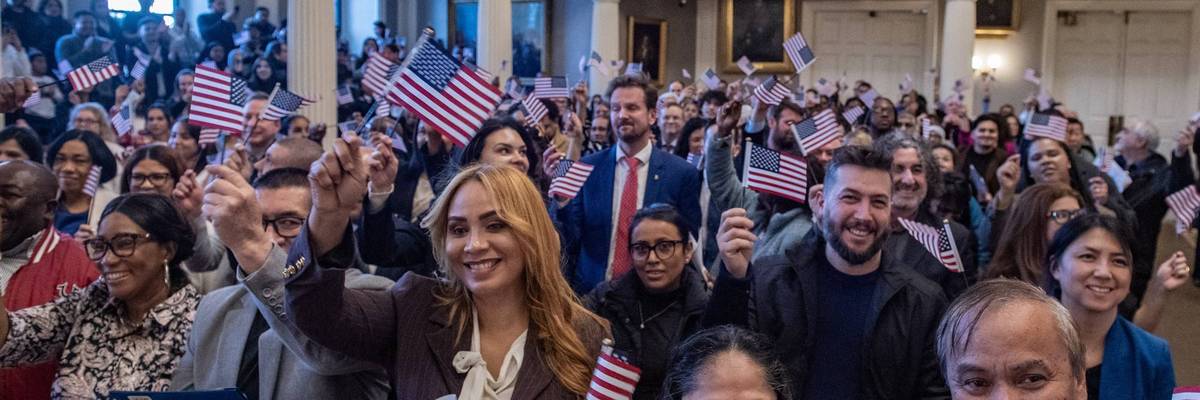
New citizens take the Pledge of Allegiance during a naturalization ceremony at Faneuil Hall in Boston, Massachusetts on January 8, 2026.
DOJ Denaturalization Referrals Spark Fear of 'Expansive' Effort to Strip Citizenship From Americans
Trump and his Republican allies have routinely targeted their political opponents and entire ethnic and religious groups with threats of deportation and denaturalization.
The US Department of Justice has referred hundreds of citizens for denaturalization, beginning what some fear will be a massive effort to strip Americans of their citizenship.
Months ago, it was reported that the Trump administration would seek to enlist the DOJ in its effort to revoke the citizenship of hundreds of people each month.
On Thursday, The New York Times reported that the effort to carry out what DOJ spokesperson Matthew Tragesser called "the highest volume of denaturalization referrals in history” had begun.
The paper reported that the DOJ had identified 384 foreign-born Americans whose citizenship it wants to take away and had assigned the cases to prosecutors in dozens of US attorneys' offices across the country.
President Donald Trump is trying to dramatically expand a process that Sameera Hafiz, policy director at the Immigrant Legal Resource Center, told the Houston Chronicle is typically reserved for "very rare extreme circumstances."
Federal law allows the government to ask courts to strip citizenship from those it can prove obtained it fraudulently. In some rare cases, people found to have committed egregious offenses like war crimes or the financing of terrorism have also been stripped of citizenship.
Between 2017 and the end of 2025, the federal government attempted to denaturalize just 120 citizens, less than a third of the number the Trump administration referred for denaturalization in just this first batch.
According to the Times, it is not clear why the 384 individuals referred to federal courts have been singled out. Tragesser said the administration was "laser focused on rooting out criminal aliens defrauding the naturalization process."
Aaron Reichlin-Melnick, a senior fellow at the American Immigration Council, said that these cases "are not exactly easy for the government to win," because "they have to go to a bench trial in front of a federal judge and prove material fraud."
But the DOJ has indicated that the range of people targeted for denaturalization could be much broader than just those found guilty of fraud.
The Trump administration's plans to pursue mass denaturalization first came to light last June when Assistant Attorney General Brett Shumate issued an internal memo calling on the DOJ's Civil Division to "prioritize and maximally pursue denaturalization proceedings in all cases permitted by law and supported by the evidence."
In addition to the fraudsters and human rights violators who have typically been subject to denaturalization, Shumate urged the department to go after those “who pose a potential danger to national security” and "any other cases... that the division determines to be sufficiently important to pursue," which suggested that much broader categories of people may be targeted.
"The way the memo suggests they're going to apply it is very broad and expansive, and it's shockingly dramatic because that's not the intention behind denaturalization," Hafiz said.
The Trump administration has frequently targeted protesters and activists, including those with legal status in the US, for deportation for expressing political opinions opposite those of the government.
Last year, hundreds of foreign-born students who participated in protests against US support for Israel had their visas stripped by the US State Department. Some—like Columbia student activist Mahmoud Khalil—were deemed a danger to "national security" based solely on their articulation of beliefs out of step with the Trump administration's foreign policy.
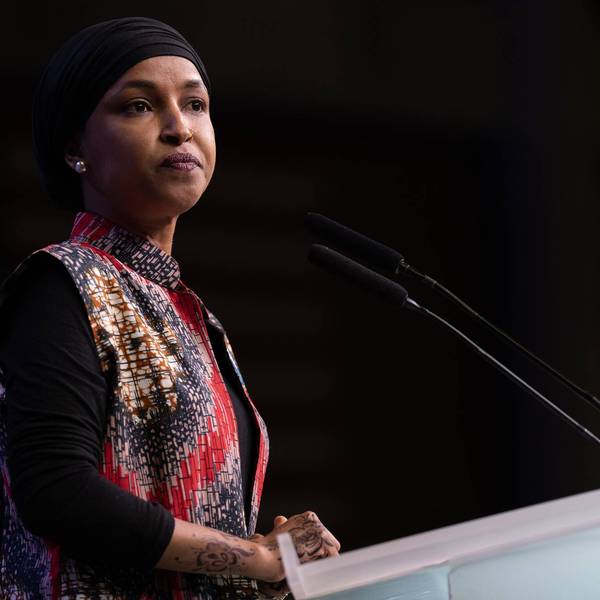
Trump and several members of the Republican Party have also called for the denaturalization of foreign-born political opponents, including the Somali-American Rep. Ilhan Omar (D-Minn.) and the Ugandan-American New York City Mayor Zohran Mamdani.
Earlier this week, Rep. Chip Roy (R-Texas) introduced legislation titled the "MAMDANI Act," which would deport and denaturalize any immigrant who "advocates for socialism, communism, Marxism, or Islamic fundamentalism.”
Rep. Andy Ogles (R-Tenn.), who has also pushed for the deportation of Mamdani, who is Muslim, recently said that non-Christians should not be allowed in America.
"We're not a melting pot," he said. "If you're building temples or mosques and undermining Christianity, you're not assimilating."
Trump, meanwhile, has expressed a desire to go after certain ethnic groups, particularly Somali-Americans, whom he has said have "low IQs" and described as "garbage". Most people of Somali descent living in the US are citizens, but Trump has said "I don't want them in the country" and said they should "go back where they came from."
Many Somali-American citizens were detained, often brutally, during US Immigration and Customs Enforcement's (ICE) massive operation in Minneapolis earlier this year.
Around the same time, the US Department of Homeland Security endorsed the idea of pursuing "100 million deportations," which would entail the removal of tens of millions of American citizens from the country, including many who were born in the United States. Ex-Border Patrol Commander Gregory Bovino, who oversaw Trump's mass deportation crusade for months, recently said he had a "master plan" to make this sweeping purge a reality.
Hafiz said the Trump administration's conduct has raised the possibility that the denaturalization push will be carried out in a "very broad and expansive way."
"That's very concerning," she said. "And we've seen in so many of the tactics that the Trump administration is using, what a slippery slope it is, how they say, 'This policy is to target one set of individuals,' and how that set of individuals just becomes broader as it's applied."
We are at a crossroads
This country and this world are at a monumental crossroads. In a few short weeks, US voters will have an opportunity to beat back the forces of fascism and confront the billionaires who are rigging the economy, our media system, and our democracy, making it increasingly impossible for ordinary people to get by. We’re not just talking about the election. We’re talking about what must be done once these fascist elements are vanquished from power. We need a bolder set of solutions than what either major party has so far been willing to offer and a working-class movement ready to fight like hell for it. Trump didn't emerge from nowhere. The conditions that fueled MAGA authoritarianism were created by decades of radical neoliberal economic policies and a corrupt political system dominated by corporate interests. They slashed taxes on the super-rich, promising that the benefits would trickle down. They said giveaways to the corporate titans would make life more affordable for the rest of us. It was all bullshit. And when a bitter, betrayed populace searches for someone to blame, right-wing demagogues have little trouble finding scapegoats. People know when they're being lied to, but you won't hear any of this from the corporate media. Only independent journalism—powered and funded by people who believe in building a better world—can deliver truly trustworthy daily news. Our Fall Campaign is underway, and we need your help. To power our newsroom through the rest of the year, we need to raise $125,000 by midnight on October 31. So if you share our vision, please contribute whatever you can to sustain our work. |
The US Department of Justice has referred hundreds of citizens for denaturalization, beginning what some fear will be a massive effort to strip Americans of their citizenship.
Months ago, it was reported that the Trump administration would seek to enlist the DOJ in its effort to revoke the citizenship of hundreds of people each month.
On Thursday, The New York Times reported that the effort to carry out what DOJ spokesperson Matthew Tragesser called "the highest volume of denaturalization referrals in history” had begun.
The paper reported that the DOJ had identified 384 foreign-born Americans whose citizenship it wants to take away and had assigned the cases to prosecutors in dozens of US attorneys' offices across the country.
President Donald Trump is trying to dramatically expand a process that Sameera Hafiz, policy director at the Immigrant Legal Resource Center, told the Houston Chronicle is typically reserved for "very rare extreme circumstances."
Federal law allows the government to ask courts to strip citizenship from those it can prove obtained it fraudulently. In some rare cases, people found to have committed egregious offenses like war crimes or the financing of terrorism have also been stripped of citizenship.
Between 2017 and the end of 2025, the federal government attempted to denaturalize just 120 citizens, less than a third of the number the Trump administration referred for denaturalization in just this first batch.
According to the Times, it is not clear why the 384 individuals referred to federal courts have been singled out. Tragesser said the administration was "laser focused on rooting out criminal aliens defrauding the naturalization process."
Aaron Reichlin-Melnick, a senior fellow at the American Immigration Council, said that these cases "are not exactly easy for the government to win," because "they have to go to a bench trial in front of a federal judge and prove material fraud."
But the DOJ has indicated that the range of people targeted for denaturalization could be much broader than just those found guilty of fraud.
The Trump administration's plans to pursue mass denaturalization first came to light last June when Assistant Attorney General Brett Shumate issued an internal memo calling on the DOJ's Civil Division to "prioritize and maximally pursue denaturalization proceedings in all cases permitted by law and supported by the evidence."
In addition to the fraudsters and human rights violators who have typically been subject to denaturalization, Shumate urged the department to go after those “who pose a potential danger to national security” and "any other cases... that the division determines to be sufficiently important to pursue," which suggested that much broader categories of people may be targeted.
"The way the memo suggests they're going to apply it is very broad and expansive, and it's shockingly dramatic because that's not the intention behind denaturalization," Hafiz said.
The Trump administration has frequently targeted protesters and activists, including those with legal status in the US, for deportation for expressing political opinions opposite those of the government.
Last year, hundreds of foreign-born students who participated in protests against US support for Israel had their visas stripped by the US State Department. Some—like Columbia student activist Mahmoud Khalil—were deemed a danger to "national security" based solely on their articulation of beliefs out of step with the Trump administration's foreign policy.
Trump and several members of the Republican Party have also called for the denaturalization of foreign-born political opponents, including the Somali-American Rep. Ilhan Omar (D-Minn.) and the Ugandan-American New York City Mayor Zohran Mamdani.
Earlier this week, Rep. Chip Roy (R-Texas) introduced legislation titled the "MAMDANI Act," which would deport and denaturalize any immigrant who "advocates for socialism, communism, Marxism, or Islamic fundamentalism.”
Rep. Andy Ogles (R-Tenn.), who has also pushed for the deportation of Mamdani, who is Muslim, recently said that non-Christians should not be allowed in America.
"We're not a melting pot," he said. "If you're building temples or mosques and undermining Christianity, you're not assimilating."
Trump, meanwhile, has expressed a desire to go after certain ethnic groups, particularly Somali-Americans, whom he has said have "low IQs" and described as "garbage". Most people of Somali descent living in the US are citizens, but Trump has said "I don't want them in the country" and said they should "go back where they came from."
Many Somali-American citizens were detained, often brutally, during US Immigration and Customs Enforcement's (ICE) massive operation in Minneapolis earlier this year.
Around the same time, the US Department of Homeland Security endorsed the idea of pursuing "100 million deportations," which would entail the removal of tens of millions of American citizens from the country, including many who were born in the United States. Ex-Border Patrol Commander Gregory Bovino, who oversaw Trump's mass deportation crusade for months, recently said he had a "master plan" to make this sweeping purge a reality.
Hafiz said the Trump administration's conduct has raised the possibility that the denaturalization push will be carried out in a "very broad and expansive way."
"That's very concerning," she said. "And we've seen in so many of the tactics that the Trump administration is using, what a slippery slope it is, how they say, 'This policy is to target one set of individuals,' and how that set of individuals just becomes broader as it's applied."
The US Department of Justice has referred hundreds of citizens for denaturalization, beginning what some fear will be a massive effort to strip Americans of their citizenship.
Months ago, it was reported that the Trump administration would seek to enlist the DOJ in its effort to revoke the citizenship of hundreds of people each month.
On Thursday, The New York Times reported that the effort to carry out what DOJ spokesperson Matthew Tragesser called "the highest volume of denaturalization referrals in history” had begun.
The paper reported that the DOJ had identified 384 foreign-born Americans whose citizenship it wants to take away and had assigned the cases to prosecutors in dozens of US attorneys' offices across the country.
President Donald Trump is trying to dramatically expand a process that Sameera Hafiz, policy director at the Immigrant Legal Resource Center, told the Houston Chronicle is typically reserved for "very rare extreme circumstances."
Federal law allows the government to ask courts to strip citizenship from those it can prove obtained it fraudulently. In some rare cases, people found to have committed egregious offenses like war crimes or the financing of terrorism have also been stripped of citizenship.
Between 2017 and the end of 2025, the federal government attempted to denaturalize just 120 citizens, less than a third of the number the Trump administration referred for denaturalization in just this first batch.
According to the Times, it is not clear why the 384 individuals referred to federal courts have been singled out. Tragesser said the administration was "laser focused on rooting out criminal aliens defrauding the naturalization process."
Aaron Reichlin-Melnick, a senior fellow at the American Immigration Council, said that these cases "are not exactly easy for the government to win," because "they have to go to a bench trial in front of a federal judge and prove material fraud."
But the DOJ has indicated that the range of people targeted for denaturalization could be much broader than just those found guilty of fraud.
The Trump administration's plans to pursue mass denaturalization first came to light last June when Assistant Attorney General Brett Shumate issued an internal memo calling on the DOJ's Civil Division to "prioritize and maximally pursue denaturalization proceedings in all cases permitted by law and supported by the evidence."
In addition to the fraudsters and human rights violators who have typically been subject to denaturalization, Shumate urged the department to go after those “who pose a potential danger to national security” and "any other cases... that the division determines to be sufficiently important to pursue," which suggested that much broader categories of people may be targeted.
"The way the memo suggests they're going to apply it is very broad and expansive, and it's shockingly dramatic because that's not the intention behind denaturalization," Hafiz said.
The Trump administration has frequently targeted protesters and activists, including those with legal status in the US, for deportation for expressing political opinions opposite those of the government.
Last year, hundreds of foreign-born students who participated in protests against US support for Israel had their visas stripped by the US State Department. Some—like Columbia student activist Mahmoud Khalil—were deemed a danger to "national security" based solely on their articulation of beliefs out of step with the Trump administration's foreign policy.
Trump and several members of the Republican Party have also called for the denaturalization of foreign-born political opponents, including the Somali-American Rep. Ilhan Omar (D-Minn.) and the Ugandan-American New York City Mayor Zohran Mamdani.
Earlier this week, Rep. Chip Roy (R-Texas) introduced legislation titled the "MAMDANI Act," which would deport and denaturalize any immigrant who "advocates for socialism, communism, Marxism, or Islamic fundamentalism.”
Rep. Andy Ogles (R-Tenn.), who has also pushed for the deportation of Mamdani, who is Muslim, recently said that non-Christians should not be allowed in America.
"We're not a melting pot," he said. "If you're building temples or mosques and undermining Christianity, you're not assimilating."
Trump, meanwhile, has expressed a desire to go after certain ethnic groups, particularly Somali-Americans, whom he has said have "low IQs" and described as "garbage". Most people of Somali descent living in the US are citizens, but Trump has said "I don't want them in the country" and said they should "go back where they came from."
Many Somali-American citizens were detained, often brutally, during US Immigration and Customs Enforcement's (ICE) massive operation in Minneapolis earlier this year.
Around the same time, the US Department of Homeland Security endorsed the idea of pursuing "100 million deportations," which would entail the removal of tens of millions of American citizens from the country, including many who were born in the United States. Ex-Border Patrol Commander Gregory Bovino, who oversaw Trump's mass deportation crusade for months, recently said he had a "master plan" to make this sweeping purge a reality.
Hafiz said the Trump administration's conduct has raised the possibility that the denaturalization push will be carried out in a "very broad and expansive way."
"That's very concerning," she said. "And we've seen in so many of the tactics that the Trump administration is using, what a slippery slope it is, how they say, 'This policy is to target one set of individuals,' and how that set of individuals just becomes broader as it's applied."