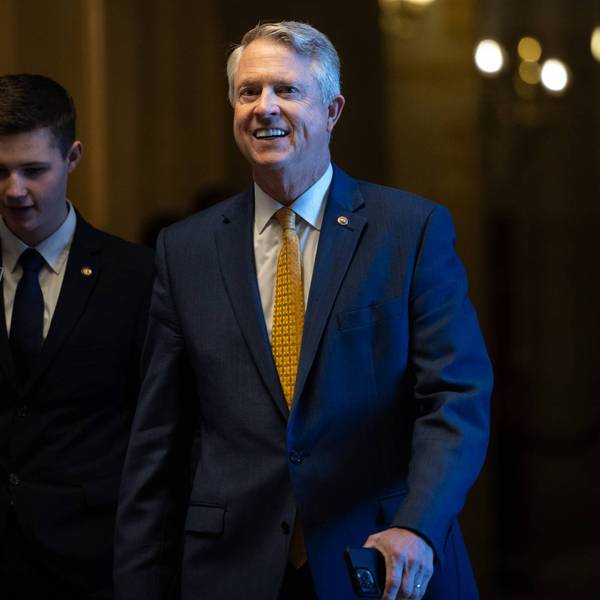


Federal Bureau of Investigation Director Kash Patel is seen in the US Capitol near a meeting on the Trump administration's use of the Foreign Intelligence Surveillance Act on March 18, 2026 in Washington, DC.
Key Democrats Under Pressure to Reject House GOP's New 3-Year FISA Extension
"Donald Trump and Stephen Miller want unfettered surveillance powers without any chance to enact protections, and Democrats must not give it to them," one campaigner warned.
A week after four Democrats helped Republicans pass a short-term extension of a controversial spying power with a dead-of-night vote in the US House of Representatives, Speaker Mike Johnson on Thursday released a bill that would renew the authority for three years—double the amount of time the Louisiana Republican and President Donald Trump were previously pushing.
As that bill text circulated, Demand Progress—one of the scores of civil society groups calling for privacy reforms to be included in any renewal of Section 702 of the Foreign Intelligence Surveillance Act (FISA)—took aim at those Democrats: Reps. Marie Gluesenkamp Perez (Wash.), Jared Golden (Maine), Josh Gottheimer (NJ), and Tom Suozzi (NY).
"Just like last time, Speaker Johnson's latest proposal lacks any meaningful privacy reforms, but this time, they're trying to renew FISA for three more years—twice as long as the Trump administration asked for," said Demand Progress senior policy adviser Hajar Hammado in a statement.
"Donald Trump and Stephen Miller want unfettered surveillance powers without any chance to enact protections, and Democrats must not give it to them," Hammado argued, referring to Trump's deputy chief of staff for policy and homeland security adviser.
"We need Reps. Gottheimer, Suozzi, Golden, and Gluesenkamp Perez to stand with the rest of Democrats and hold Donald Trump accountable," the campaigner emphasized. "A vote in support of this FISA bill, especially procedural votes to advance it, is both a vote to allow Donald Trump to continue invasive, warrantless surveillance of private American citizens, and to sabotage even the chance of protecting privacy."
FISA's Section 702 allows the US government to surveil electronic communications of noncitizens located outside the United States to acquire foreign intelligence information, without a warrant. However, it's been abused at least hundreds of thousands of times by the Federal Bureau of Investigation (FBI) alone—which has fueled calls for reforms, including closing the data broker loophole that agencies use to buy their way around the Fourth Amendment to the US Constitution.
"Speaker Johnson wants to pretend this bill is reform, but it's the same type of empty-calorie proposal that failed last week," warned Jake Laperruque, deputy director of Center for Democracy and Technology's Security and Surveillance Project. "There is nothing in this bill that would have prevented the abuses of FISA 702 we've already seen—snooping on lawmakers, protesters, and campaign donors—and there is nothing that would stop even worse abuses in the future."
"Members of Congress have a clear choice: They can support this proposal and give the FBI and other intelligence agencies a three-year blank check, or they can stand strong and demand real reforms to protect the American people," he said.
Elizabeth Goitein, co-director of the Brennan Center for Justice's Liberty and National Security Program, similarly stressed how the latest bill is "almost identical to the one that failed last week," explaining on social media that "the main 'reform' in Johnson's first proposal was a provision that merely restated existing law, under which the government may not 'target' Americans under Section 702 but may do so with a warrant or FISA Title I order."
"That provision was titled 'warrant requirement,' even though it imposed no new warrant requirement whatsoever. And it had zero relevance to the issue at the heart of the debate over Section 702, namely, backdoor searches," she noted. "Backdoor searches are not considered to be 'targeting' Americans for surveillance. Rather, they are searches of collected communications of foreign targets outside the United States for Americans' communications that were 'incidentally' swept in."
"Astonishingly, Johnson has chosen to feature this same do-nothing provision in his new proposal. This time, the drafters have dropped any pretense of creating new law and titled the provision 'Fourth Amendment Requirement for Targeting United States Persons,'" Goitein continued. "This is not a reform bill, and it's not a compromise. It's a straight reauthorization with eight pages of words that serve no serious purpose other than to try to convince members that it's NOT a straight reauthorization."
According to her: "House members didn't fall for it last week, and they shouldn't fall for it now. Speaker Johnson must allow the House to vote on the reforms that members and the American people are demanding, including a warrant requirement to access Americans' communications."
The GOP narrowly has the numbers to pass legislation with a party-line vote in the House, but some of the chamber's Republicans have joined in the calls for privacy reforms. Libertarian leaders, including Justin Amash, a former Republican congressman from Michigan, have forcefully spoken out against Johnson's efforts.
"House Republicans are spitting on the Constitution and spitting in all our faces," Amash said of the bill unveiled Thursday.
Calling out the House Permanent Select Committee on Intelligence, Senate Select Committee on Intelligence, and vast US Intelligence Community, Patrick Eddington, a senior fellow in homeland security and civil liberties at the libertarian Cato Institute, declared that "this is an HPSCI, SSCI, IC Trojan horse bill masquerading as something Fourth Amendment-compliant."
Senate Majority Leader John Thune (R-SD) "is threatening to take over negotiations if the House GOP can’t resolve differences quickly," according to Politico. In the upper chamber, Republicans need at least some Democratic support to pass a reauthorization bill.
We are at a crossroads
This country and this world are at a monumental crossroads. In a few short weeks, US voters will have an opportunity to beat back the forces of fascism and confront the billionaires who are rigging the economy, our media system, and our democracy, making it increasingly impossible for ordinary people to get by. We’re not just talking about the election. We’re talking about what must be done once these fascist elements are vanquished from power. We need a bolder set of solutions than what either major party has so far been willing to offer and a working-class movement ready to fight like hell for it. Trump didn't emerge from nowhere. The conditions that fueled MAGA authoritarianism were created by decades of radical neoliberal economic policies and a corrupt political system dominated by corporate interests. They slashed taxes on the super-rich, promising that the benefits would trickle down. They said giveaways to the corporate titans would make life more affordable for the rest of us. It was all bullshit. And when a bitter, betrayed populace searches for someone to blame, right-wing demagogues have little trouble finding scapegoats. People know when they're being lied to, but you won't hear any of this from the corporate media. Only independent journalism—powered and funded by people who believe in building a better world—can deliver truly trustworthy daily news. Our Fall Campaign is underway, and we need your help. To power our newsroom through the rest of the year, we need to raise $125,000 by midnight on October 31. So if you share our vision, please contribute whatever you can to sustain our work. |
A week after four Democrats helped Republicans pass a short-term extension of a controversial spying power with a dead-of-night vote in the US House of Representatives, Speaker Mike Johnson on Thursday released a bill that would renew the authority for three years—double the amount of time the Louisiana Republican and President Donald Trump were previously pushing.
As that bill text circulated, Demand Progress—one of the scores of civil society groups calling for privacy reforms to be included in any renewal of Section 702 of the Foreign Intelligence Surveillance Act (FISA)—took aim at those Democrats: Reps. Marie Gluesenkamp Perez (Wash.), Jared Golden (Maine), Josh Gottheimer (NJ), and Tom Suozzi (NY).
"Just like last time, Speaker Johnson's latest proposal lacks any meaningful privacy reforms, but this time, they're trying to renew FISA for three more years—twice as long as the Trump administration asked for," said Demand Progress senior policy adviser Hajar Hammado in a statement.
"Donald Trump and Stephen Miller want unfettered surveillance powers without any chance to enact protections, and Democrats must not give it to them," Hammado argued, referring to Trump's deputy chief of staff for policy and homeland security adviser.
"We need Reps. Gottheimer, Suozzi, Golden, and Gluesenkamp Perez to stand with the rest of Democrats and hold Donald Trump accountable," the campaigner emphasized. "A vote in support of this FISA bill, especially procedural votes to advance it, is both a vote to allow Donald Trump to continue invasive, warrantless surveillance of private American citizens, and to sabotage even the chance of protecting privacy."
FISA's Section 702 allows the US government to surveil electronic communications of noncitizens located outside the United States to acquire foreign intelligence information, without a warrant. However, it's been abused at least hundreds of thousands of times by the Federal Bureau of Investigation (FBI) alone—which has fueled calls for reforms, including closing the data broker loophole that agencies use to buy their way around the Fourth Amendment to the US Constitution.
"Speaker Johnson wants to pretend this bill is reform, but it's the same type of empty-calorie proposal that failed last week," warned Jake Laperruque, deputy director of Center for Democracy and Technology's Security and Surveillance Project. "There is nothing in this bill that would have prevented the abuses of FISA 702 we've already seen—snooping on lawmakers, protesters, and campaign donors—and there is nothing that would stop even worse abuses in the future."
"Members of Congress have a clear choice: They can support this proposal and give the FBI and other intelligence agencies a three-year blank check, or they can stand strong and demand real reforms to protect the American people," he said.
Elizabeth Goitein, co-director of the Brennan Center for Justice's Liberty and National Security Program, similarly stressed how the latest bill is "almost identical to the one that failed last week," explaining on social media that "the main 'reform' in Johnson's first proposal was a provision that merely restated existing law, under which the government may not 'target' Americans under Section 702 but may do so with a warrant or FISA Title I order."
"That provision was titled 'warrant requirement,' even though it imposed no new warrant requirement whatsoever. And it had zero relevance to the issue at the heart of the debate over Section 702, namely, backdoor searches," she noted. "Backdoor searches are not considered to be 'targeting' Americans for surveillance. Rather, they are searches of collected communications of foreign targets outside the United States for Americans' communications that were 'incidentally' swept in."
"Astonishingly, Johnson has chosen to feature this same do-nothing provision in his new proposal. This time, the drafters have dropped any pretense of creating new law and titled the provision 'Fourth Amendment Requirement for Targeting United States Persons,'" Goitein continued. "This is not a reform bill, and it's not a compromise. It's a straight reauthorization with eight pages of words that serve no serious purpose other than to try to convince members that it's NOT a straight reauthorization."
According to her: "House members didn't fall for it last week, and they shouldn't fall for it now. Speaker Johnson must allow the House to vote on the reforms that members and the American people are demanding, including a warrant requirement to access Americans' communications."
The GOP narrowly has the numbers to pass legislation with a party-line vote in the House, but some of the chamber's Republicans have joined in the calls for privacy reforms. Libertarian leaders, including Justin Amash, a former Republican congressman from Michigan, have forcefully spoken out against Johnson's efforts.
"House Republicans are spitting on the Constitution and spitting in all our faces," Amash said of the bill unveiled Thursday.
Calling out the House Permanent Select Committee on Intelligence, Senate Select Committee on Intelligence, and vast US Intelligence Community, Patrick Eddington, a senior fellow in homeland security and civil liberties at the libertarian Cato Institute, declared that "this is an HPSCI, SSCI, IC Trojan horse bill masquerading as something Fourth Amendment-compliant."
Senate Majority Leader John Thune (R-SD) "is threatening to take over negotiations if the House GOP can’t resolve differences quickly," according to Politico. In the upper chamber, Republicans need at least some Democratic support to pass a reauthorization bill.
- Rights and Tech Coalition Calls On Congress to End Warrantless Mass Surveillance ›
- 'Unforgivably Cynical': Top House Dem Ripped for Siding With Trump on Domestic Spying ›
- Rights Groups Cheer Senate Bill to Curb Warrantless Spying on Americans ›
- 'Chilling': Rights Advocates Blast FBI for Abusing Surveillance Tool 278,000+ Times ›
- In Dead of Night, Johnson Tries—But Fails—to Ram Through Domestic Spying Bill for Trump ›
- Trump Uses Correspondents' Dinner Shooting to Justify Expanding Spying Powers as Deadline Nears | Common Dreams ›
- 'Dangerous and Shameful': 42 House Democrats Help GOP Send Trump Spying Bill to Senate | Common Dreams ›
- Privacy Advocates Relieved Trump Allies 'Can't Get Their Warrantless FISA Reauthorization Across the Finish Line' | Common Dreams ›
- As Domestic Spying Renewal Stalls in Congress, Trump Pulls Plug on Pulte for DNI | Common Dreams ›