SUBSCRIBE TO OUR FREE NEWSLETTER
Daily news & progressive opinion—funded by the people, not the corporations—delivered straight to your inbox.
5
#000000
#FFFFFF
To donate by check, phone, or other method, see our More Ways to Give page.
Daily news & progressive opinion—funded by the people, not the corporations—delivered straight to your inbox.

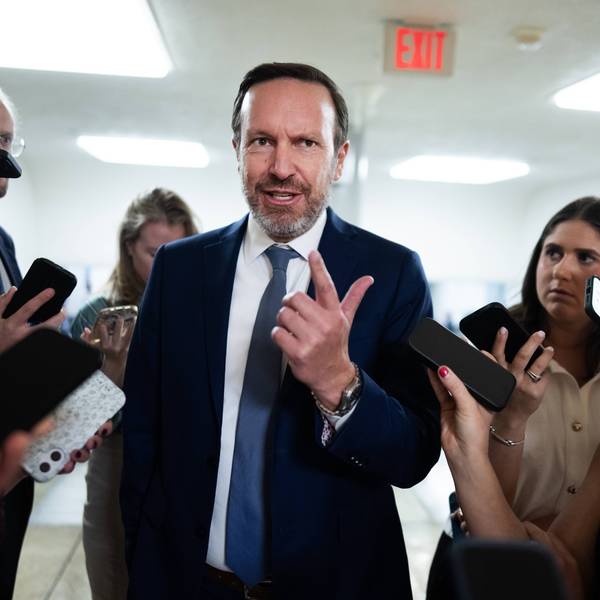
US Senators voted down a proposed war powers resolution blocking the Trump administration from waging war on Venezuela, on November 6, 2025 in Washington, DC.
"Shame on the Republicans who continue to shirk their duty and deny their constituents a voice," said one retired US Army general.
Senate Republicans on Thursday rejected a bipartisan war powers resolution aimed at stopping the Trump administration from continuing its bombing of alleged drug boats or attacking Venezuela without lawmakers' assent, as required by law.
US senators voted 51-49 against the measure introduced last month by Sens. Tim Kaine (D-Va.), Rand Paul (R-Ky.), and Adam Schiff (D-Calif.). Two Republicans—Paul and Sen. Lisa Murkowski of Alaska—joined Democrats and Independents in voting for the resolution.
"It's sad that only two Republicans voted in favor," Medea Benjamin, co-founder of the peace group CodePink, said on X following the vote. "So much for 'America First' and for upholding their constitutional authority by stopping the executive branch from taking illegal military actions."
Retired Maj. Gen. Paul Eaton, a senior adviser to the group VoteVets, said in a statement that President Donald Trump "is waging a war that he unilaterally declared and refuses to get approved by the American people via their representation in Congress."
"It isn't just criminal and unconstitutional, it betrays those who did fight on battlefields and spilled blood to preserve, protect, and defend the Constitution of the United States," Eaton added. "Shame on the Republicans who continue to shirk their duty and deny their constituents a voice."
VoteVets' MG Paul Eaton (Ret) blasts GOP Senators for rejecting Senator Tim Kaine's War Powers Resolution. He says Trump is waging a "criminal and unconstitutional" war and betraying the principle that Americans shouldn't die without having a say in the matter, through their elected representatives.
[image or embed]
— VoteVets (@votevets.org) November 6, 2025 at 3:06 PM
The War Powers Resolution was passed over then-President Richard Nixon's veto in 1973 to affirm and empower Congress to check the president’s war-making authority. The law requires the president to report any military action to Congress within 48 hours and requires congressional approval of troop deployments exceeding 60 days.
It's been 63 days since the first-known Trump-ordered the first strikes on alleged drug boats in the Caribbean Sea and Pacific Ocean. At least 67 people have been killed in 16 such reported strikes since September 2, according to the Trump administration, which argues that it does not need congressional approval for the attacks.
Speaking on the Senate floor ahead of Thursday's vote, Minority Leader Chuck Schumer (D-NY) said:
As we speak, America’s largest aircraft carrier, the Gerald Ford, is on its way to the Caribbean. It is part of the largest military buildup in our hemisphere that we’ve seen in decades. According to press reports, Donald Trump is considering military action on Venezuelan territory. But it also sounds like nobody really knows what the plan is, because like so many other things with Donald Trump, he keeps changing his mind. Who knows what he will do tomorrow?
Trump has also approved covert CIA action in Venezuela and has threatened to attack targets inside the oil-rich country. The government of Venezuelan President Nicolás Maduro recently claimed that his country’s security forces had captured a group of CIA-aligned mercenaries engaged in a “false-flag attack” against the nation.
Sen. Ed Markey (D-Mass.) said after Thursday's vote: “Today, I was proud to once again cast my vote for Senator Kaine’s war powers resolution. President Trump is acting against the Constitution by moving toward imminent attacks against Venezuela without congressional authorization. In doing so, he is risking endless military conflict with Venezuela and steamrolling over the right of every American to have a say in the use of US military force."
“Asserting Congress’s constitutional role in war is not some procedural detail; it is fundamental. Our government is based on checks and balances, and Congress’s authority to declare war is a core principle of what makes America a democracy," Markey added. "Going to war without consulting the people is what monarchies and dictatorships do. Strong democracies must be willing to debate these issues in the light of day.”
This country and this world are at a monumental crossroads. US voters have an opportunity to beat back the forces of fascism and confront the billionaires who are rigging the economy, our media system, and our democracy, making it increasingly impossible for ordinary people to get by. We’re not just talking about the election. We’re talking about what must be done once these fascist elements are vanquished from power. We need a bolder set of solutions than what either major party has so far been willing to offer and a working-class movement ready to fight like hell for it. Trump didn't emerge from nowhere. The conditions that fueled MAGA authoritarianism were created by decades of radical neoliberal economic policies and a corrupt political system dominated by corporate interests. They slashed taxes on the super-rich, promising that the benefits would trickle down. They said giveaways to the corporate titans would make life more affordable for the rest of us. It was all bullshit. And when a bitter, betrayed populace searches for someone to blame, right-wing demagogues have little trouble finding scapegoats. People know when they're being lied to, but you won't hear any of this from the corporate media. Only independent journalism—powered and funded by people who believe in building a better world—can deliver truly trustworthy daily news. If you share our vision, please contribute whatever you can to sustain our work. |
Senate Republicans on Thursday rejected a bipartisan war powers resolution aimed at stopping the Trump administration from continuing its bombing of alleged drug boats or attacking Venezuela without lawmakers' assent, as required by law.
US senators voted 51-49 against the measure introduced last month by Sens. Tim Kaine (D-Va.), Rand Paul (R-Ky.), and Adam Schiff (D-Calif.). Two Republicans—Paul and Sen. Lisa Murkowski of Alaska—joined Democrats and Independents in voting for the resolution.
"It's sad that only two Republicans voted in favor," Medea Benjamin, co-founder of the peace group CodePink, said on X following the vote. "So much for 'America First' and for upholding their constitutional authority by stopping the executive branch from taking illegal military actions."
Retired Maj. Gen. Paul Eaton, a senior adviser to the group VoteVets, said in a statement that President Donald Trump "is waging a war that he unilaterally declared and refuses to get approved by the American people via their representation in Congress."
"It isn't just criminal and unconstitutional, it betrays those who did fight on battlefields and spilled blood to preserve, protect, and defend the Constitution of the United States," Eaton added. "Shame on the Republicans who continue to shirk their duty and deny their constituents a voice."
VoteVets' MG Paul Eaton (Ret) blasts GOP Senators for rejecting Senator Tim Kaine's War Powers Resolution. He says Trump is waging a "criminal and unconstitutional" war and betraying the principle that Americans shouldn't die without having a say in the matter, through their elected representatives.
[image or embed]
— VoteVets (@votevets.org) November 6, 2025 at 3:06 PM
The War Powers Resolution was passed over then-President Richard Nixon's veto in 1973 to affirm and empower Congress to check the president’s war-making authority. The law requires the president to report any military action to Congress within 48 hours and requires congressional approval of troop deployments exceeding 60 days.
It's been 63 days since the first-known Trump-ordered the first strikes on alleged drug boats in the Caribbean Sea and Pacific Ocean. At least 67 people have been killed in 16 such reported strikes since September 2, according to the Trump administration, which argues that it does not need congressional approval for the attacks.
Speaking on the Senate floor ahead of Thursday's vote, Minority Leader Chuck Schumer (D-NY) said:
As we speak, America’s largest aircraft carrier, the Gerald Ford, is on its way to the Caribbean. It is part of the largest military buildup in our hemisphere that we’ve seen in decades. According to press reports, Donald Trump is considering military action on Venezuelan territory. But it also sounds like nobody really knows what the plan is, because like so many other things with Donald Trump, he keeps changing his mind. Who knows what he will do tomorrow?
Trump has also approved covert CIA action in Venezuela and has threatened to attack targets inside the oil-rich country. The government of Venezuelan President Nicolás Maduro recently claimed that his country’s security forces had captured a group of CIA-aligned mercenaries engaged in a “false-flag attack” against the nation.
Sen. Ed Markey (D-Mass.) said after Thursday's vote: “Today, I was proud to once again cast my vote for Senator Kaine’s war powers resolution. President Trump is acting against the Constitution by moving toward imminent attacks against Venezuela without congressional authorization. In doing so, he is risking endless military conflict with Venezuela and steamrolling over the right of every American to have a say in the use of US military force."
“Asserting Congress’s constitutional role in war is not some procedural detail; it is fundamental. Our government is based on checks and balances, and Congress’s authority to declare war is a core principle of what makes America a democracy," Markey added. "Going to war without consulting the people is what monarchies and dictatorships do. Strong democracies must be willing to debate these issues in the light of day.”