
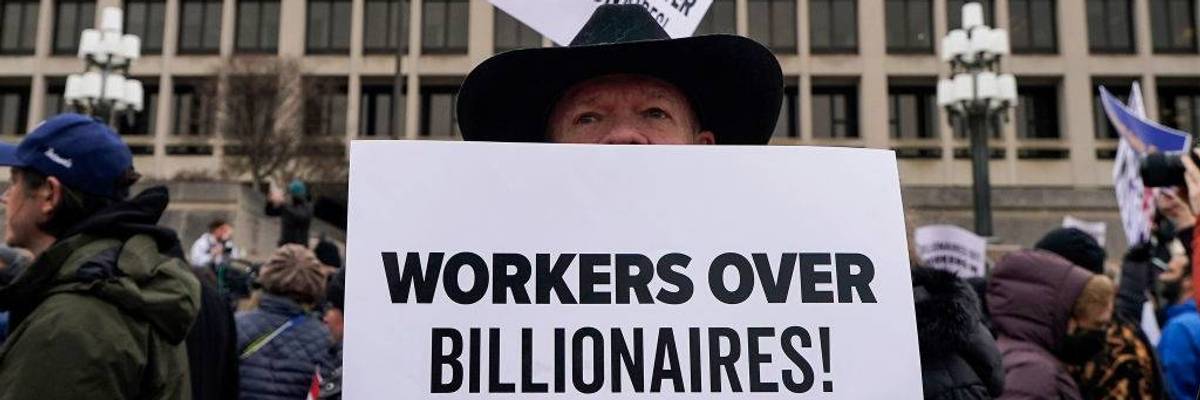
Workers and supporters protest against the Department of Government Efficiency in front of the US Department of Labor on February 5, 2025 in Washington, DC.
'Workers Over Billionaires': Over 3,000 Events Planned for May Day Across US
"The American people are done grinding to get by while our tax dollars fund wars abroad and concentration camps at home."
A broad coalition of organizations is banding together to stage thousands of planned May Day events across the US based around the theme of building an economy for "workers over billionaires."
May Day Strong, an initiative anchored by 500 labor and community organizations, is set to host more than 3,000 events throughout the country to demand higher taxes on the wealthiest Americans, an end to US Immigration Customs Enforcement (ICE) and the war with Iran, and an expansion of democracy over corporate rule.
Organizers of the events are asking participants to refrain from engaging in any economic activity on May 1, which means "no work, no school, no shopping." This particular action was inspired by the one-day general strike that residents of Minneapolis waged in January to protest against the occupy of their city by federal immigration enforcement officers.
Flagship demonstrations will be held in major US cities from coast to coast, with thousands of smaller events scheduled to take place in all 50 states.
Neidi Dominguez, executive director of Organized Power in Numbers, said the rallies are being organized to ensure "our tax dollars going to good jobs, schools, and housing, not to sending federal agents into our cities to attack our neighbors."
Rebecca Winter, executive director of Mass 50501, framed the events as a way for Americans to exert economic leverage to protest injustice.
"The American people are done grinding to get by while our tax dollars fund wars abroad and concentration camps at home,” said Winter. “We pay more for everything while those in power cash in. On May 1, we hit back with our wallets—no work, no school, no shopping. We the people are the economy, and we decide when it stops."
Greg Nammacher, president of Minnesota-based Service Employees International Union Local 26, drew on the Minneapolis experience to explain what the May Day protests are trying to achieve.
"In January in Minnesota this year we experienced the power when community and workers act together to defend our rights and shared values," Nammacher said. "This May Day is a chance for us locally, and nationally, to build on those lessons: We are ready to fight to protect our families and our cities from the billionaire agenda of division and hate."
Angelica Salas, executive director of the Coalition for Humane Immigrant Rights (CHIRLA), said the protests would also highlight inhumane US immigration policies and demand a pathway to citizenship for undocumented immigrants.
"On May Day, we rise because worker justice is immigrant justice," Salas said. "It's been 40 years since the last time this nation recognized the contributions of immigrants by approving a pathway to citizenship. And it's been 20 years since La Gran Marcha—when millions of people took to the streets to reject exclusion, racism, and criminalization of immigrant communities—and we are still facing the same forces, especially under the Trump administration."
Braxton Winston, president of the North Carolina State AFL-CIO, described the demonstrations as a good way to bring new people into the movement and strengthen future actions.
"Now is the time to build coalitions between unorganized workers, unions, and community members for mass actions to disrupt the well-organized, joint efforts of corporations and the White House to exploit American workers," Winston said. "The actions we take on International Workers Day are about building the political, social, community, and labor coalitions needed to disrupt the status quo. The power we flex this May Day will fuel our unwavering commitment to building a bigger, more effective, unified labor movement to win victories for working families."
We are at a crossroads
This country and this world are at a monumental crossroads. In a few short weeks, US voters will have an opportunity to beat back the forces of fascism and confront the billionaires who are rigging the economy, our media system, and our democracy, making it increasingly impossible for ordinary people to get by. We’re not just talking about the election. We’re talking about what must be done once these fascist elements are vanquished from power. We need a bolder set of solutions than what either major party has so far been willing to offer and a working-class movement ready to fight like hell for it. Trump didn't emerge from nowhere. The conditions that fueled MAGA authoritarianism were created by decades of radical neoliberal economic policies and a corrupt political system dominated by corporate interests. They slashed taxes on the super-rich, promising that the benefits would trickle down. They said giveaways to the corporate titans would make life more affordable for the rest of us. It was all bullshit. And when a bitter, betrayed populace searches for someone to blame, right-wing demagogues have little trouble finding scapegoats. People know when they're being lied to, but you won't hear any of this from the corporate media. Only independent journalism—powered and funded by people who believe in building a better world—can deliver truly trustworthy daily news. Our Fall Campaign is underway, and we need your help. To power our newsroom through the rest of the year, we need to raise $125,000 by midnight on October 31. So if you share our vision, please contribute whatever you can to sustain our work. |
A broad coalition of organizations is banding together to stage thousands of planned May Day events across the US based around the theme of building an economy for "workers over billionaires."
May Day Strong, an initiative anchored by 500 labor and community organizations, is set to host more than 3,000 events throughout the country to demand higher taxes on the wealthiest Americans, an end to US Immigration Customs Enforcement (ICE) and the war with Iran, and an expansion of democracy over corporate rule.
Organizers of the events are asking participants to refrain from engaging in any economic activity on May 1, which means "no work, no school, no shopping." This particular action was inspired by the one-day general strike that residents of Minneapolis waged in January to protest against the occupy of their city by federal immigration enforcement officers.
Flagship demonstrations will be held in major US cities from coast to coast, with thousands of smaller events scheduled to take place in all 50 states.
Neidi Dominguez, executive director of Organized Power in Numbers, said the rallies are being organized to ensure "our tax dollars going to good jobs, schools, and housing, not to sending federal agents into our cities to attack our neighbors."
Rebecca Winter, executive director of Mass 50501, framed the events as a way for Americans to exert economic leverage to protest injustice.
"The American people are done grinding to get by while our tax dollars fund wars abroad and concentration camps at home,” said Winter. “We pay more for everything while those in power cash in. On May 1, we hit back with our wallets—no work, no school, no shopping. We the people are the economy, and we decide when it stops."
Greg Nammacher, president of Minnesota-based Service Employees International Union Local 26, drew on the Minneapolis experience to explain what the May Day protests are trying to achieve.
"In January in Minnesota this year we experienced the power when community and workers act together to defend our rights and shared values," Nammacher said. "This May Day is a chance for us locally, and nationally, to build on those lessons: We are ready to fight to protect our families and our cities from the billionaire agenda of division and hate."
Angelica Salas, executive director of the Coalition for Humane Immigrant Rights (CHIRLA), said the protests would also highlight inhumane US immigration policies and demand a pathway to citizenship for undocumented immigrants.
"On May Day, we rise because worker justice is immigrant justice," Salas said. "It's been 40 years since the last time this nation recognized the contributions of immigrants by approving a pathway to citizenship. And it's been 20 years since La Gran Marcha—when millions of people took to the streets to reject exclusion, racism, and criminalization of immigrant communities—and we are still facing the same forces, especially under the Trump administration."
Braxton Winston, president of the North Carolina State AFL-CIO, described the demonstrations as a good way to bring new people into the movement and strengthen future actions.
"Now is the time to build coalitions between unorganized workers, unions, and community members for mass actions to disrupt the well-organized, joint efforts of corporations and the White House to exploit American workers," Winston said. "The actions we take on International Workers Day are about building the political, social, community, and labor coalitions needed to disrupt the status quo. The power we flex this May Day will fuel our unwavering commitment to building a bigger, more effective, unified labor movement to win victories for working families."
- Workers in 600+ US Cities to Protest 'Billionaire Takeover' on May Day ›
- May Day in Pictures: Workers Worldwide Demand Alternative to 'Billionaire Vision of the World' ›
- Nationwide May Day Protests Target Trump's 'Billionaire Agenda' ›
- Opinion | Join Me in the Streets This May Day | Common Dreams ›
- US Working Class Mobilizes Ahead of Nationwide 'May Day Strong' Rallies | Common Dreams ›
- Opinion | 'May Day Strong' Shows How Trumpism Changed the Game of Political Action | Common Dreams ›
- Opinion | May Day: Day One of a Mass Youth Uprising | Common Dreams ›
- Opinion | Why I'm Answering the May Day Call to Action By Running for Congress | Common Dreams ›
- May Day Demonstrations Worldwide Condemn US-Israeli War on Iran, Champion Workers | Common Dreams ›
A broad coalition of organizations is banding together to stage thousands of planned May Day events across the US based around the theme of building an economy for "workers over billionaires."
May Day Strong, an initiative anchored by 500 labor and community organizations, is set to host more than 3,000 events throughout the country to demand higher taxes on the wealthiest Americans, an end to US Immigration Customs Enforcement (ICE) and the war with Iran, and an expansion of democracy over corporate rule.
Organizers of the events are asking participants to refrain from engaging in any economic activity on May 1, which means "no work, no school, no shopping." This particular action was inspired by the one-day general strike that residents of Minneapolis waged in January to protest against the occupy of their city by federal immigration enforcement officers.
Flagship demonstrations will be held in major US cities from coast to coast, with thousands of smaller events scheduled to take place in all 50 states.
Neidi Dominguez, executive director of Organized Power in Numbers, said the rallies are being organized to ensure "our tax dollars going to good jobs, schools, and housing, not to sending federal agents into our cities to attack our neighbors."
Rebecca Winter, executive director of Mass 50501, framed the events as a way for Americans to exert economic leverage to protest injustice.
"The American people are done grinding to get by while our tax dollars fund wars abroad and concentration camps at home,” said Winter. “We pay more for everything while those in power cash in. On May 1, we hit back with our wallets—no work, no school, no shopping. We the people are the economy, and we decide when it stops."
Greg Nammacher, president of Minnesota-based Service Employees International Union Local 26, drew on the Minneapolis experience to explain what the May Day protests are trying to achieve.
"In January in Minnesota this year we experienced the power when community and workers act together to defend our rights and shared values," Nammacher said. "This May Day is a chance for us locally, and nationally, to build on those lessons: We are ready to fight to protect our families and our cities from the billionaire agenda of division and hate."
Angelica Salas, executive director of the Coalition for Humane Immigrant Rights (CHIRLA), said the protests would also highlight inhumane US immigration policies and demand a pathway to citizenship for undocumented immigrants.
"On May Day, we rise because worker justice is immigrant justice," Salas said. "It's been 40 years since the last time this nation recognized the contributions of immigrants by approving a pathway to citizenship. And it's been 20 years since La Gran Marcha—when millions of people took to the streets to reject exclusion, racism, and criminalization of immigrant communities—and we are still facing the same forces, especially under the Trump administration."
Braxton Winston, president of the North Carolina State AFL-CIO, described the demonstrations as a good way to bring new people into the movement and strengthen future actions.
"Now is the time to build coalitions between unorganized workers, unions, and community members for mass actions to disrupt the well-organized, joint efforts of corporations and the White House to exploit American workers," Winston said. "The actions we take on International Workers Day are about building the political, social, community, and labor coalitions needed to disrupt the status quo. The power we flex this May Day will fuel our unwavering commitment to building a bigger, more effective, unified labor movement to win victories for working families."
- Workers in 600+ US Cities to Protest 'Billionaire Takeover' on May Day ›
- May Day in Pictures: Workers Worldwide Demand Alternative to 'Billionaire Vision of the World' ›
- Nationwide May Day Protests Target Trump's 'Billionaire Agenda' ›
- Opinion | Join Me in the Streets This May Day | Common Dreams ›
- US Working Class Mobilizes Ahead of Nationwide 'May Day Strong' Rallies | Common Dreams ›
- Opinion | 'May Day Strong' Shows How Trumpism Changed the Game of Political Action | Common Dreams ›
- Opinion | May Day: Day One of a Mass Youth Uprising | Common Dreams ›
- Opinion | Why I'm Answering the May Day Call to Action By Running for Congress | Common Dreams ›
- May Day Demonstrations Worldwide Condemn US-Israeli War on Iran, Champion Workers | Common Dreams ›