SUBSCRIBE TO OUR FREE NEWSLETTER
Daily news & progressive opinion—funded by the people, not the corporations—delivered straight to your inbox.
5
#000000
#FFFFFF
To donate by check, phone, or other method, see our More Ways to Give page.
Daily news & progressive opinion—funded by the people, not the corporations—delivered straight to your inbox.
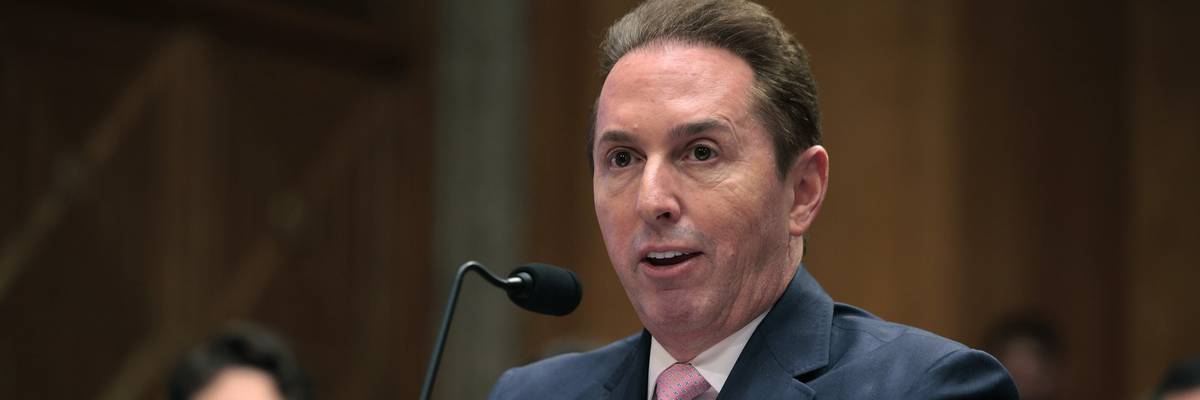
Troy Edgar testifies during his confirmation hearing for deputy homeland security secretary on February 25, 2025 in Washington, D.C. Homeland Security Secretary Kristi Noem briefly attended the confirmation hearing.
"This is one of the most chilling things I've heard a senior U.S. official say."
In an interview with one of the top officials at the U.S. Department of Homeland Security on Thursday, NPR's Michel Martin sought to gain clarity about the agency's reasoning for arresting former Columbia University student organizer Mahmoud Khalil last week—but Troy Edgar provided no supporting evidence of specific offenses committed by Khalil, who has not been charged with a crime, and suggested his mere participation in "pro-Palestinian activity" was sufficient to order his deportation.
Edgar, the deputy homeland security secretary, repeatedly alleged that Khalil was in the U.S. on a visa, despite Martin correcting him and clarifying that the Algerian citizen is a legal permanent resident of the country with a green card—until it was reportedly revoked under the Trump administration's "catch and revoke" program targeting international students who protest the government's pro-Israel policy.
The Trump administration has accused Khalil, who is of Palestinian descent, of leading "activities aligned to Hamas" and protests where pro-Hamas propaganda was distributed, but officials have provided no evidence that he's provided support to Hamas or other groups designated as terrorist organizations by the U.S. government.
A White House official this week told The Free Press that Khalil is not being accused of breaking any laws, but is rather "a threat to the foreign policy and national security interests of the United States," and Edgar's comments to Martin offered further evidence evidence that DHS is working to deport Khalil without accusing him of a crime.
"He is coming in to basically be a student that is not going to be supporting terrorism," said Edgar. "So, the issue is he was let into the country on this visa. He has been promoting this antisemitism activity at the university. And at this point, the State Department has revoked his visa for supporting a terrorist type organization."
But Edgar was unable to point to specific "terrorist activity" that Khalil was supporting when he helped lead Palestinian solidarity protests at Columbia, where students occupied a building and displayed a banner labeling it Hind's Hall in honor of a six-year-old girl who was killed by Israeli forces in Gaza and negotiated with administrators to end the school's investment in companies that benefit from Israel's policies in Palestine.
"How did he support Hamas? Exactly what did he do?" Martin pressed.
"Well, I think you can see it on TV, right?" Edgar replied. "This is somebody that we've invited and allowed the student to come into the country, and he's put himself in the middle of the process of basically pro-Palestinian activity."
Martin then repeatedly asked whether criticism of the U.S. government, which is the largest international funder of the Israeli military and has backed its assault on Gaza, and protesting are deportable offenses.
"Let me put it this way, Michel, imagine if he came in and filled out the form and said, 'I want a student visa.' They asked him, 'What are you going to do here?' And he says, 'I'm going to go and protest.' We would have never let him into the country," said Edgar. "I think if he would have declared he's a terrorist, we would have never let him in."
Will Creeley, legal director at the Foundation for Individual Rights and Expression (FIRE), called the interview "stunning" and said Edgar's "conflation of protest and terrorism stopped me cold."
The interview, said Washington Post columnist Shadi Hamid, serves as the latest confirmation from the Trump administration that "Mahmoud Khalil's arrest has no basis."
The interview was released the same day that more than 100 people were arrested at a sit-in led by Jewish Voice of Peace at Trump Tower in New York City, demanding Khalil's release. His arrest has sparked outcry from progressives in Congress, local lawmakers including New York mayoral candidate and state lawmaker Zohran Mamdani, legal experts, and the human rights group Amnesty International.
Dear Common Dreams reader, It’s been nearly 30 years since I co-founded Common Dreams with my late wife, Lina Newhouser. We had the radical notion that journalism should serve the public good, not corporate profits. It was clear to us from the outset what it would take to build such a project. No paid advertisements. No corporate sponsors. No millionaire publisher telling us what to think or do. Many people said we wouldn't last a year, but we proved those doubters wrong. Together with a tremendous team of journalists and dedicated staff, we built an independent media outlet free from the constraints of profits and corporate control. Our mission has always been simple: To inform. To inspire. To ignite change for the common good. Building Common Dreams was not easy. Our survival was never guaranteed. When you take on the most powerful forces—Wall Street greed, fossil fuel industry destruction, Big Tech lobbyists, and uber-rich oligarchs who have spent billions upon billions rigging the economy and democracy in their favor—the only bulwark you have is supporters who believe in your work. But here’s the urgent message from me today. It's never been this bad out there. And it's never been this hard to keep us going. At the very moment Common Dreams is most needed, the threats we face are intensifying. We need your support now more than ever. We don't accept corporate advertising and never will. We don't have a paywall because we don't think people should be blocked from critical news based on their ability to pay. Everything we do is funded by the donations of readers like you. When everyone does the little they can afford, we are strong. But if that support retreats or dries up, so do we. Will you donate now to make sure Common Dreams not only survives but thrives? —Craig Brown, Co-founder |
In an interview with one of the top officials at the U.S. Department of Homeland Security on Thursday, NPR's Michel Martin sought to gain clarity about the agency's reasoning for arresting former Columbia University student organizer Mahmoud Khalil last week—but Troy Edgar provided no supporting evidence of specific offenses committed by Khalil, who has not been charged with a crime, and suggested his mere participation in "pro-Palestinian activity" was sufficient to order his deportation.
Edgar, the deputy homeland security secretary, repeatedly alleged that Khalil was in the U.S. on a visa, despite Martin correcting him and clarifying that the Algerian citizen is a legal permanent resident of the country with a green card—until it was reportedly revoked under the Trump administration's "catch and revoke" program targeting international students who protest the government's pro-Israel policy.
The Trump administration has accused Khalil, who is of Palestinian descent, of leading "activities aligned to Hamas" and protests where pro-Hamas propaganda was distributed, but officials have provided no evidence that he's provided support to Hamas or other groups designated as terrorist organizations by the U.S. government.
A White House official this week told The Free Press that Khalil is not being accused of breaking any laws, but is rather "a threat to the foreign policy and national security interests of the United States," and Edgar's comments to Martin offered further evidence evidence that DHS is working to deport Khalil without accusing him of a crime.
"He is coming in to basically be a student that is not going to be supporting terrorism," said Edgar. "So, the issue is he was let into the country on this visa. He has been promoting this antisemitism activity at the university. And at this point, the State Department has revoked his visa for supporting a terrorist type organization."
But Edgar was unable to point to specific "terrorist activity" that Khalil was supporting when he helped lead Palestinian solidarity protests at Columbia, where students occupied a building and displayed a banner labeling it Hind's Hall in honor of a six-year-old girl who was killed by Israeli forces in Gaza and negotiated with administrators to end the school's investment in companies that benefit from Israel's policies in Palestine.
"How did he support Hamas? Exactly what did he do?" Martin pressed.
"Well, I think you can see it on TV, right?" Edgar replied. "This is somebody that we've invited and allowed the student to come into the country, and he's put himself in the middle of the process of basically pro-Palestinian activity."
Martin then repeatedly asked whether criticism of the U.S. government, which is the largest international funder of the Israeli military and has backed its assault on Gaza, and protesting are deportable offenses.
"Let me put it this way, Michel, imagine if he came in and filled out the form and said, 'I want a student visa.' They asked him, 'What are you going to do here?' And he says, 'I'm going to go and protest.' We would have never let him into the country," said Edgar. "I think if he would have declared he's a terrorist, we would have never let him in."
Will Creeley, legal director at the Foundation for Individual Rights and Expression (FIRE), called the interview "stunning" and said Edgar's "conflation of protest and terrorism stopped me cold."
The interview, said Washington Post columnist Shadi Hamid, serves as the latest confirmation from the Trump administration that "Mahmoud Khalil's arrest has no basis."
The interview was released the same day that more than 100 people were arrested at a sit-in led by Jewish Voice of Peace at Trump Tower in New York City, demanding Khalil's release. His arrest has sparked outcry from progressives in Congress, local lawmakers including New York mayoral candidate and state lawmaker Zohran Mamdani, legal experts, and the human rights group Amnesty International.
In an interview with one of the top officials at the U.S. Department of Homeland Security on Thursday, NPR's Michel Martin sought to gain clarity about the agency's reasoning for arresting former Columbia University student organizer Mahmoud Khalil last week—but Troy Edgar provided no supporting evidence of specific offenses committed by Khalil, who has not been charged with a crime, and suggested his mere participation in "pro-Palestinian activity" was sufficient to order his deportation.
Edgar, the deputy homeland security secretary, repeatedly alleged that Khalil was in the U.S. on a visa, despite Martin correcting him and clarifying that the Algerian citizen is a legal permanent resident of the country with a green card—until it was reportedly revoked under the Trump administration's "catch and revoke" program targeting international students who protest the government's pro-Israel policy.
The Trump administration has accused Khalil, who is of Palestinian descent, of leading "activities aligned to Hamas" and protests where pro-Hamas propaganda was distributed, but officials have provided no evidence that he's provided support to Hamas or other groups designated as terrorist organizations by the U.S. government.
A White House official this week told The Free Press that Khalil is not being accused of breaking any laws, but is rather "a threat to the foreign policy and national security interests of the United States," and Edgar's comments to Martin offered further evidence evidence that DHS is working to deport Khalil without accusing him of a crime.
"He is coming in to basically be a student that is not going to be supporting terrorism," said Edgar. "So, the issue is he was let into the country on this visa. He has been promoting this antisemitism activity at the university. And at this point, the State Department has revoked his visa for supporting a terrorist type organization."
But Edgar was unable to point to specific "terrorist activity" that Khalil was supporting when he helped lead Palestinian solidarity protests at Columbia, where students occupied a building and displayed a banner labeling it Hind's Hall in honor of a six-year-old girl who was killed by Israeli forces in Gaza and negotiated with administrators to end the school's investment in companies that benefit from Israel's policies in Palestine.
"How did he support Hamas? Exactly what did he do?" Martin pressed.
"Well, I think you can see it on TV, right?" Edgar replied. "This is somebody that we've invited and allowed the student to come into the country, and he's put himself in the middle of the process of basically pro-Palestinian activity."
Martin then repeatedly asked whether criticism of the U.S. government, which is the largest international funder of the Israeli military and has backed its assault on Gaza, and protesting are deportable offenses.
"Let me put it this way, Michel, imagine if he came in and filled out the form and said, 'I want a student visa.' They asked him, 'What are you going to do here?' And he says, 'I'm going to go and protest.' We would have never let him into the country," said Edgar. "I think if he would have declared he's a terrorist, we would have never let him in."
Will Creeley, legal director at the Foundation for Individual Rights and Expression (FIRE), called the interview "stunning" and said Edgar's "conflation of protest and terrorism stopped me cold."
The interview, said Washington Post columnist Shadi Hamid, serves as the latest confirmation from the Trump administration that "Mahmoud Khalil's arrest has no basis."
The interview was released the same day that more than 100 people were arrested at a sit-in led by Jewish Voice of Peace at Trump Tower in New York City, demanding Khalil's release. His arrest has sparked outcry from progressives in Congress, local lawmakers including New York mayoral candidate and state lawmaker Zohran Mamdani, legal experts, and the human rights group Amnesty International.