

SUBSCRIBE TO OUR FREE NEWSLETTER
Daily news & progressive opinion—funded by the people, not the corporations—delivered straight to your inbox.
5
#000000
#FFFFFF
To donate by check, phone, or other method, see our More Ways to Give page.
Daily news & progressive opinion—funded by the people, not the corporations—delivered straight to your inbox.
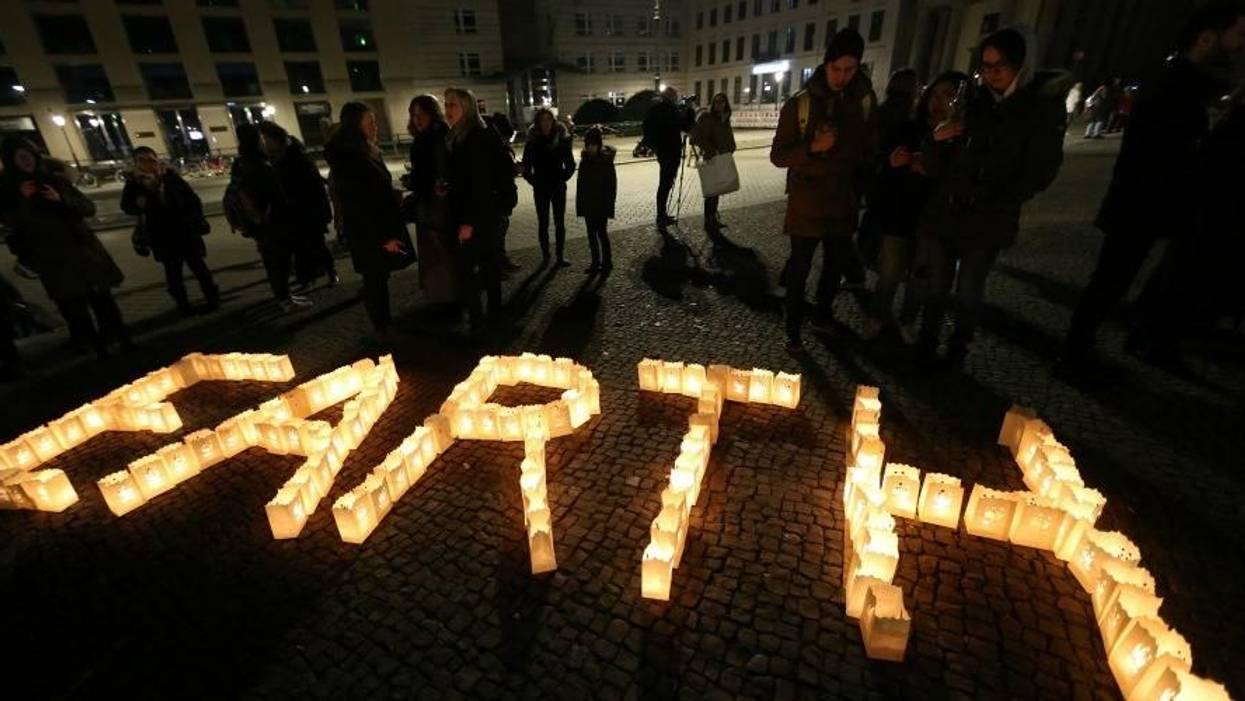
A group of four former United Nations climate chiefs say it's "unthinkable" for the world to continue its business-as-usual approach to climate action, warning that without ramped-up ambition, humanity is headed down a "road to hell."
The assessment is laid out in an article published on Thursday in the peer-reviewed journal Climate Policy.
"We cannot continue kicking the can down the road to climate safety."
--Michael Zammit Cutajar, former UNFCCC Executive Secretary"Drawing on hardening IPCC science and building on the foundations of the 1992 Convention, the last 30 years of international cooperation have established a clear understanding of the need to prevent dangerous climate change and an opportunity to do so," Michael Zammit Cutajar, founding Executive Secretary of UNFCCC, a role he served from 1991-2002, said in a statement.
"But," Zammit Cutajar added, "the ambition and effectiveness of governmental and corporate action to this end must shift quickly to another scale, beyond recognition, if we are to achieve global net zero emissions over the next 30 years."
"We cannot continue kicking the can down the road to climate safety," he said.
Zammit Cutajar, along with lead co-author Richard Kinley, Yvo de Boer, and Christiana Figueres--all of whom helped lead the UNFCCC over the last several decades--evaluated the past 30 years in terms of international climate negotiations, noting that the talks have unleashed "tensions exacerbated by strong economic interests in preserving the fossil-fuel-based economy."
Those efforts continue, they wrote, as meaningful action to address the global crisis "challenges complacent democracies to look beyond their electoral noses towards long-term planetary security."
While heaping praise on the multilateralism that brought about three global treaties--the United Nations Framework Convention on Climate Change in 1992, the Kyoto Protocol in 1997, and the Paris Agreement in 2015--the quartet lamented the "failure by governments to fully implement treaty obligations, exacerbated by the still inadequate response of the business community."
"At the national level," the authors wrote, "the Kyoto Protocol established legally-binding targets for developed countries while the Paris Agreement formalized the pledging of NDCs [nationally determined contributions] by all countries." Yet those NDCs "have been inconsistent with the action needed to meet the convention's objective and the Paris Agreement's mitigation goals."
Worthy of praise, they added, is the "changing [of] the narrative on climate change away from burden sharing to one of 'opportunity' and 'possibility'" in the years since the Paris deal was signed.
"The understanding has also taken root that a low-carbon, climate resilient economy is the only safe way to meet development imperatives, buttressed by the UN's Sustainable Development Goals (SDGs) adopted in the same year as the Paris Agreement," the former climate officials wrote.
The international negotiations' impact on raising climate ambition is clear, they wrote, but there remains "a very dark cloud hanging over the UNFCCC process... namely global CO2 emissions are more than 65% higher now than they were in 1990."
According to the authors, "the heart of the problem is the failure by states to implement their commitments, all too often paying only lip-service to what needs to be done, as well as the hesitation of too many in the business community to act on the policy signals being sent."
Laying out a set of recommendations, the authors said "it is unthinkable to continue at the pace of the last 30 years."
They called for action:
The article further issued a 2030 target, "in order to have a good chance of not exceeding the 1.5degC temperature increase threshold, [for] a halving of net CO2 emissions" and suggested "2050 as the target year for achieving global net zero emissions."
Channeling the phrase used in 1954 by then-UN Secretary-General Dag Hammarskjold, the former climate chiefs said that "before we can seriously contemplate climate change 'heaven,' we need to get off the current road to 'hell,' even if it is paved with good intentions."
The set of recommendations were released just two days before the five-year anniversary of the Paris climate agreement, and as leaders gather at the Pacific Islands Forum to issue fresh demands for decision climate action.
Speaking at the virtual summit, Fiji Prime Minister Frank Bainimaram said Friday, "We Pacific nations owe it to our people, and to humanity as a whole, to raise our voices more to demand that major emitters step up their climate actions and commitments."
"Without this, we will lose our homes, our way of life our wellbeing and livelihoods--it's past time to get serious," Bainimaram added. "We all signed the Paris agreement; now let's insist we put it to work."
The announcement by Donald Trump that that United States intends to ignore the non-binding Paris Climate Agreement, with the intention to renegotiate it to foist his America First policy on the rest of the world, should come as no surprise to anyone. What is surprising is who opposed the US withdrawal: Big business - including fossil fuel transnationals Exxon Mobil, Chevron, and BP, industrial agribusiness and agrochemical giants Monsanto, DuPont, and General Mills, and more, as well as the current Secretary of State (and former Exxon exec). If nothing else, this assortment of big-business boosters of the Paris Agreement tells us just how weak the agreement truly is at addressing the root causes of climate change.
Since Kyoto, the US has diluted every global climate proposal to the point of ineffectiveness, including the Copenhagen Accord in 2009 and the Paris Agreement itself. It was the US that insisted on making the deal based on non-binding pledges for voluntary emissions cuts (which collectively would still lead to a global temperature increase between 3-4degC above pre-industrial levels), on preventing the operating text of the agreement from including recognition of human rights and the rights of Indigenous Peoples, and on promoting many false solutions that will end up doing a great deal of harm (including so-called "carbon neutrality," which allows polluters to keep polluting by purchasing offsets).
These realities, combined with Trump's claims that the Paris Agreement would somehow be an unfair burden on the US, are particularly disturbing, embarrassing, and even enraging, given the responsibility that the US has as being the most historically responsible for the causes of climate change, and our continued role as one of the most significant contributors of greenhouse gas emissions in the world.
"By abandoning the Paris Agreement, this administration will further perpetuate environmental racism and climate injustice against Indigenous Peoples experiencing the worst effects of climate change across the globe...Backing out of this agreement continues a long history of broken promises and threatens the vital and sacred life cycles of Mother Earth." - Tom Goldtooth, Indigenous Environmental Network
It is clear that major transnational corporations played a large role in influencing the US's role in negotiating the Paris agreement. Indeed, Bloomberg news reports that Exxon and Conoco-Phillips supported the Paris agreement based on the argument that "The U.S. is better off with a seat at the table so it can influence global efforts to curb emissions that are largely produced by the fossil fuels they profit from."
At Grassroots International, we are reflecting on four key lessons and priorities for climate justice work going forward:
In the US, communities organized through the Climate Justice Alliance (CJA), Grassroots Global Justice Alliance (GGJ), Indigenous Environmental Network (IEN) and others are taking leadership to articulate Just Transition agendas at the local level, and they are winning! These agendas include pushing for an end to the extractive economy, and transitioning to regenerative, local, living, loving, linked economies. These economies include community land trusts, agroecology, local seed libraries, and other strategies to achieve food sovereignty They include expansion of public transit and community controlled renewable energy, along with protection of rivers and ecosystems.
These are the struggles that have won and will continue to win real reductions in greenhouse gas emissions, while building community resilience to the impacts of climate change. In fact, the same day that Trump announced pulling the US from the Paris Agreement, Asian Pacific Environmental Network (APEN) announced an amazing victory in Richmond, California - a historic cap on pollution from oil refineries, which will prevent Bay Area refineries from bringing Tar Sands or other extreme and heavy crudes to be processed.
It is clear that we are in a unique and critical moment in the history of the planet. Through our Climate Justice Initiative and beyond, Grassroots International is committed to continuing to prioritize our work to support and accompany climate justice struggles in the US, with GGJ, CJA, and others, and with our partners leading climate justice movements in the Global South.
"History will be the judge of what has happened in Cancun." These are the last lines of the Bolivian Government's press release yesterday about the outcome of the climate negotiations here in Cancun. The talks ended here today after two weeks of negotiations by a 192 governments. It is a deal that will be remembered by our future generations as one that killed the climate treaty, unless we radically change course.
"History will be the judge of what has happened in Cancun." These are the last lines of the Bolivian Government's press release yesterday about the outcome of the climate negotiations here in Cancun. The talks ended here today after two weeks of negotiations by a 192 governments. It is a deal that will be remembered by our future generations as one that killed the climate treaty, unless we radically change course.
Witnessing standing ovations and applause in the closing hours over negotiating texts that basically kill the Kyoto Protocol and make emissions reductions voluntary for all governments fills me with a profound sense of disillusionment (you can view the final plenaries here). Disillusionment at the utter lack of leadership exhibited by virtually every government except Bolivia and disillusionment at the role that many environmental and development groups played in legitimizing these governments' actions.
The compromise arrived at Cancun was a coup for the United States. The U.S. came in with nothing to offer in terms of binding commitments to reduce its greenhouse gas emissions and yet managed to effectively push for voluntary targets. The source of these targets is the "Copenhagen Accord" that President Obama negotiated by cornering a few key countries in a back room in the last hours of the climate negotiations a year ago.
"There is only one way to measure the success of a climate agreement, and that is based on whether or not it will effectively reduce emissions to prevent runaway climate change. This text clearly fails, as it could allow global temperatures to increase by more than 4 degrees, a level disastrous for humanity," says Bolivia.
Sadly, Bolivia was set up as the scapegoat at the meeting--portrayed as the only country standing in the way of multilateralism and progress on a climate deal. "The perfect is the enemy of the good," they said.
Manufacturing Consensus
This scapegoating is nothing new. I have witnessed it in the WTO where governments, under great pressure by powerful countries like the United States and the EU, are too afraid to speak out or too keen to be seen as constructive actors on the geopolitical theater. And theater it was last night--as country after country--applauded the President of the COP, for her "open and transparent" process and a successful outcome. Yet in reality, we all knew that the deal had been negotiated behind closed doors by a handful of countries. At times, there were 50 countries in a room somewhere in the conference complex.
But we did not know where and we did not know what they were negotiating. Civil society, unlike other UN negotiations, was not allowed in any of the drafting groups. And what governments drafted did not even seem to appear in the texts crafted by the Chairs of the two negotiating tracks of the climate talks.
In the closing hours of the COP, Bolivia made strong statements that it did not agree to the outcome and that there was no consensus. In the UN, all countries must agree and have "consensus" before a treaty or a deal is adopted. In Cancun, the deal was ceremoniously gaveled as agreed.
For civil society organizations, Cancun must be a wake up call for serious reflection. How have we been complicit in an outcome that has ultimately not respected the science of global warming? Worse still, some have applauded an outcome that lets industrialized countries off the hook from legally binding and mandatory targets to reduce GHGs--something they agreed to when they signed the Kyoto Protocol.
The 20th anniversary of the birth of the Climate Treaty is 2012 and the end of the first commitment period of the Kyoto Protocol. Let's ensure that by the time we get there, we have managed to shift the fundamental elements of what was agreed here in Cancun towards a much more accountable framework to address climate change.
Of all the explanations for Barack Obama's Nobel Peace Prize, the one that rang truest came from French President Nicolas Sarkozy. "It sets the seal on America's return to the heart of all the world's peoples." In other words, this was Europe's way of saying to America, "We love you again"--sort of like those weird "renewal of vows" ceremonies that couples have after surviving a rough patch.
Now that Europe and the United States are officially reunited, it seems worth asking: is this necessarily a good thing?
Of all the explanations for Barack Obama's Nobel Peace Prize, the one that rang truest came from French President Nicolas Sarkozy. "It sets the seal on America's return to the heart of all the world's peoples." In other words, this was Europe's way of saying to America, "We love you again"--sort of like those weird "renewal of vows" ceremonies that couples have after surviving a rough patch.
Now that Europe and the United States are officially reunited, it seems worth asking: is this necessarily a good thing? The Nobel Committee, which awarded the prize specifically for Obama's embrace of "multilateral diplomacy," is evidently convinced that US engagement on the world stage is a triumph for peace and justice. I'm not so sure. After nine months in office, Obama has a clear track record as a global player. Again and again, US negotiators have chosen not to strengthen international laws and protocols but rather to weaken them, often leading other rich countries in a race to the bottom.
Let's start where the stakes are highest: climate change. During the Bush years, European politicians distinguished themselves from the United States by expressing their unshakable commitment to the Kyoto Protocol. So while the United States increased its carbon emissions by 20 percent from 1990 levels, the European Union countries reduced theirs by 2 percent. Not stellar, but clearly a case where the EU's breakup with the United States carried tangible benefits for the planet.
Flash forward to the high-stakes climate negotiations that just wrapped up in Bangkok. The talks were supposed to lead to a deal in Copenhagen this December that significantly strengthens the Kyoto Protocol. Instead, the United States, the EU and the rest of the developed countries formed a unified bloc calling for Kyoto to be scrapped and replaced. Where Kyoto set clear and binding targets for emission reductions, the US plan would have each country decide how much to cut, then submit its plans to international monitoring (with nothing but wishful thinking to ensure that this all keeps the planet's temperature below catastrophic levels). And where Kyoto put the burden of responsibility squarely on the rich countries that created the climate crisis, the new plan treats all countries the same.
These kinds of weak proposals were not altogether surprising coming from the United States. What was shocking was the sudden unity of the rich world around this plan--including many countries that had previously sung the praises of Kyoto. And there were more betrayals: the EU, which had indicated it would spend $19 billion to $35 billion a year to help developing countries adapt to climate change, came to Bangkok with a much lower offer, one more in line with the US pledge of... nothing. Oxfam's Antonio Hill summed up the negotiations like this: "When the starting gun fired, it became a race to the bottom, with rich countries weakening existing commitments under the international framework."
This isn't the first time a much-celebrated return to the negotiating table has resulted in overturned tables, with hard-won international laws and conventions scattered on the floor. The United States played a similar role at the UN conference on racism in Geneva in April. After extracting all sorts of deletions from the negotiating text--no references to Israel or the Palestinians, nothing on slavery reparations, etc.--the Obama administration decided to boycott anyway, pointing to the fact that the new text "re- affirms" the document adopted in 2001 in Durban, South Africa.
It was a flimsy excuse, but there was some kind of logic to it, since the United States had never signed the original 2001 document. What made no sense was the wave of copycat withdrawals from around the rich world. Within forty-eight hours of the US announcement Italy, Australia, Germany, the Netherlands, New Zealand and Poland had pulled out. Unlike the United States, these governments had all signed the 2001 declaration, so they had no reason to object to a document that reaffirmed it. It didn't matter. As with the climate change negotiations, lining up behind Obama, with his impeccable reputation, was an easy way to avoid burdensome international obligations and look progressive at the same time--a service the United States was never able to provide during the Bush years.
The United States has had a similarly corrupting influence as a new member of the UN Human Rights Council. Its first big test was Judge Richard Goldstone's courageous report on Israel's Gaza onslaught, which found that war crimes had been committed by both the Israeli army and Hamas. Rather than prove its commitment to international law, the United States used its clout to smear the report as "deeply flawed" and to strong-arm the Palestinian Authority into withdrawing a supportive resolution. (The PA, which faced a furious backlash at home for caving in to US pressure, may introduce a new version.)
And then there are the G-20 summits, Obama's highest-profile multilateral engagements. When one was held in London in April, it seemed for a moment that there might be some kind of coordinated attempt to rein in transnational financial speculators and tax dodgers. Sarkozy even pledged to walk out of the summit if it failed to produce serious regulatory commitments. But the Obama administration had no interest in genuine multilateralism, advocating instead for countries to come up with their own plans (or not) and hope for the best--much like its reckless climate-change plan. Sarkozy, needless to say, did not walk anywhere but to the photo session to have his picture taken with Obama.
Of course, Obama has made some good moves on the world stage--not siding with the coup government in Honduras, supporting a UN Women's Agency... But a clear pattern has emerged: in areas where other wealthy nations were teetering between principled action and negligence, US interventions have tilted them toward negligence. If this is the new era of multilateralism, it is no prize.
This month's international meeting in Bali will set a framework that will attempt to prevent the impending disaster of global warming/climate change. There is now little doubt that greenhouse gases, such as carbon dioxide, are leading to significant changes in climate. Nor is there doubt that these changes will impose huge costs. The question is no longer whether we can afford to do something, but rather how to control emissions in an equitable and effective way.The Kyoto protocol was a major achievement, yet it left out 75% of the sources of emissions: the US, the largest polluter, refused to sign. (With Australia's new government now having signed the protocol, America is now the sole holdout among the advanced industrial countries.) No requirements were put on developing countries, yet within the not-too-distant future, they will contribute half or more of emissions. And nothing was done about deforestation, which is contributing almost as much to increases in greenhouse gas concentrations as the US.
The US and China are in a race to be the world's worst polluter; America has long won the contest, but in the next few years, China will claim that dubious honor. But Indonesia is number three, owing to its rapid deforestation.
One concrete action that should be taken at Bali is support for the initiative of the Rainforest Coalition, a group of developing countries that want help to maintain their forests. These countries are providing environmental services for which they have not been compensated. They need the resources, and the incentives, to maintain their forests. The global benefits of supporting them far outweigh the costs.
The timing of the conference is not propitious. George Bush, long a sceptic about global warming, and long committed to undermining multilateralism, remains America's president. His close connections with the oil industry make him loathe to force it to pay for its pollution.
Still, the Bali meeting's participants can agree on a few principles to guide future negotiations. These include, first, that solutions to global warming require the participation of all countries. Second, there can be no free riders, so trade sanctions - the only effective sanctions that the international community currently has - can and should be imposed on those not going along. Third, the problem of global warming is so vast that every instrument must be employed.
Better incentives must be part of the solution. But there is a raging controversy over whether the Kyoto protocol's cap-and-trade system or taxes work better. The problem with the Kyoto system is assigning caps that will be acceptable to developed and developing countries. Giving emission allowances is like giving away money - potentially hundreds of billions of dollars.
Kyoto's underlying principle - that countries that emitted more in 1990 are allowed to emit more in the future - is unacceptable to developing countries, as is granting greater emission rights to countries with a higher GDP. The only principle that has some ethical basis is equal emission rights per capita (with some adjustments - for instance, the US has already used up its share of the global atmosphere, so it should have fewer emission allowances). But adopting this principle would entail such huge payments from developed countries to developing countries, that, regrettably, the former are unlikely to accept it.
Economic efficiency requires that those who generate emissions pay the cost, and the simplest way of forcing them to do so is through a carbon tax. There could be an international agreement that every country would impose a carbon tax at an agreed rate (reflecting the global social cost). Indeed, it makes far more sense to tax bad things, like pollution, than to tax good things like work and savings. Such a tax would increase global efficiency.
Of course, polluting industries like the cap-and-trade system. While it provides them an incentive not to pollute, emission allowances offset much of what they would have to pay under a tax system. Some firms can even make money off the deal. Moreover, Europe has grown used to the concept of cap-and-trade, and many are loathe to try an alternative. Yet, no one has proposed an acceptable set of principles for assigning emission rights.
For some, this is not a concern. With developing countries standing to lose even more than developed countries if nothing is done about global warming, many believe they can be cajoled, threatened, or induced to be part of a global agreement. Developed countries need only figure out the minimum price they have to pay developing countries to go along.
But developing countries worry that a new global agreement on emissions, like so many other international agreements, will leave them in a disadvantageous position.
In the end, Realpolitik may rule. But the world today is different from the world of 25 years ago, or even 10 years ago. Flourishing democracies in many developing countries mean that their citizens demand fair treatment.
Principles do matter. The Bali meeting's participants should bear this in mind: global warming is too important to be held hostage to another attempt at squeezing the poor.
NASHVILLE -- We -- the human species -- have arrived at a moment of decision. It is unprecedented and even laughable for us to imagine that we could actually make a conscious choice as a species, but that is nevertheless the challenge that is before us.
Our home -- Earth -- is in danger. What is at risk of being destroyed is not the planet itself, but the conditions that have made it hospitable for human beings.
Without realizing the consequences of our actions, we have begun to put so much carbon dioxide into the thin shell of air surrounding our world that we have literally changed the heat balance between Earth and the Sun. If we don't stop doing this pretty quickly, the average temperature will increase to levels humans have never known and put an end to the favorable climate balance on which our civilization depends.
In the last 150 years, in an accelerating frenzy, we have been removing increasing quantities of carbon from the ground - mainly in the form of coal and oil - and burning it in ways that dump 70 million tons of CO2 every 24 hours into the Earth's atmosphere.
The concentrations of CO2 - having never risen above 300 parts per million for at least a million years - have been driven from 280 parts per million at the beginning of the coal boom to 383 parts per million this year.
As a direct result, many scientists are now warning that we are moving closer to several "tipping points" that could -- within 10 years -- make it impossible for us to avoid irretrievable damage to the planet's habitability for human civilization.
Just in the last few months, new studies have shown that the north polar ice cap -- which helps the planet cool itself -- is melting nearly three times faster than the most pessimistic computer models predicted. Unless we take action, summer ice could be completely gone in as little as 35 years. Similarly, at the other end of the planet, near the South Pole, scientists have found new evidence of snow melting in West Antarctica across an area as large as California.
This is not a political issue. This is a moral issue, one that affects the survival of human civilization. It is not a question of left versus right; it is a question of right versus wrong. Put simply, it is wrong to destroy the habitability of our planet and ruin the prospects of every generation that follows ours.
On Sept. 21, 1987, President Ronald Reagan said, "In our obsession with antagonisms of the moment, we often forget how much unites all the members of humanity. Perhaps we need some outside, universal threat to recognize this common bond. I occasionally think how quickly our differences would vanish if we were facing an alien threat from outside this world."
We -- all of us -- now face a universal threat. Though it is not from outside this world, it is nevertheless cosmic in scale.
Consider this tale of two planets. Earth and Venus are almost exactly the same size, and have almost exactly the same amount of carbon. The difference is that most of the carbon on Earth is in the ground -- having been deposited there by various forms of life over the last 600 million years -- and most of the carbon on Venus is in the atmosphere.
As a result, while the average temperature on Earth is a pleasant 59 degrees, the average temperature on Venus is 867 degrees. True, Venus is closer to the Sun than we are, but the fault is not in our star; Venus is three times hotter on average than Mercury, which is right next to the Sun. It's the carbon dioxide.
This threat also requires us, in Reagan's phrase, to unite in recognition of our common bond.
Next Saturday, on all seven continents, the Live Earth concert will ask for the attention of humankind to begin a three-year campaign to make everyone on our planet aware of how we can solve the climate crisis in time to avoid catastrophe. Individuals must be a part of the solution. In the words of Buckminster Fuller, "If the success or failure of this planet, and of human beings, depended on how I am and what I do, how would I be? What would I do?"
Live Earth will offer an answer to this question by asking everyone who attends or listens to the concerts to sign a personal pledge to take specific steps to combat climate change. (More details about the pledge are available at algore.com.)
But individual action will also have to shape and drive government action. Here Americans have a special responsibility. Throughout most of our short history, the United States and the American people have provided moral leadership for the world. Establishing the Bill of Rights, framing democracy in the Constitution, defeating fascism in World War II, toppling Communism and landing on the moon -- all were the result of American leadership.
Once again, Americans must come together and direct our government to take on a global challenge. American leadership is a precondition for success.
To this end, we should demand that the United States join an international treaty within the next two years that cuts global warming pollution by 90 percent in developed countries and by more than half worldwide in time for the next generation to inherit a healthy Earth.
This treaty would mark a new effort. I am proud of my role during the Clinton administration in negotiating the Kyoto protocol. But I believe that the protocol has been so demonized in the United States that it probably cannot be ratified here -- much in the way the Carter administration was prevented from winning ratification of an expanded strategic arms limitation treaty in 1979. Moreover, the negotiations will soon begin on a tougher climate treaty.
Therefore, just as President Reagan renamed and modified the SALT agreement (calling it Start), after belatedly recognizing the need for it, our next president must immediately focus on quickly concluding a new and even tougher climate change pact. We should aim to complete this global treaty by the end of 2009 - and not wait until 2012 as currently planned.
If by the beginning of 2009, the United States already has in place a domestic regime to reduce global warming pollution, I have no doubt that when we give industry a goal and the tools and flexibility to sharply reduce carbon emissions, we can complete and ratify a new treaty quickly. It is, after all, a planetary emergency.
A new treaty will still have differentiated commitments, of course; countries will be asked to meet different requirements based upon their historical share or contribution to the problem and their relative ability to carry the burden of change. This precedent is well established in international law, and there is no other way to do it.
There are some who will try to pervert this precedent and use xenophobia or nativist arguments to say that every country should be held to the same standard. But should countries with one-fifth our gross domestic product-- countries that contributed almost nothing in the past to the creation of this crisis- - really carry the same load as the United States? Are we so scared of this challenge that we cannot lead?
Our children have a right to hold us to a higher standard when their future -- indeed, the future of all human civilization -- is hanging in the balance. They deserve better than a government that censors the best scientific evidence and harasses honest scientists who try to warn us about looming catastrophe. They deserve better than politicians who sit on their hands and do nothing to confront the greatest challenge that humankind has ever faced -- even as the danger bears down on us.
We should focus instead on the opportunities that are part of this challenge. Certainly, there will be new jobs and new profits as corporations move aggressively to capture the enormous economic opportunities offered by a clean energy future.
But there's something even more precious to be gained if we do the right thing. The climate crisis offers us the chance to experience what few generations in history have had the privilege of experiencing: a generational mission; a compelling moral purpose; a shared cause; and the thrill of being forced by circumstances to put aside the pettiness and conflict of politics and to embrace a genuine moral and spiritual challenge.
Al Gore, vice president from 1993 to 2001, is the chairman of the Alliance for Climate Protection. He is the author, most recently, of "The Assault on Reason."
(c) 2007 Al Gore
MEXICO CITY - Large developing nations like China, India and Mexico should sign a new international treaty to curb climate change which must include economic penalties to clamp down on emissions of greenhouse gases, Nobel chemistry laureate Mario Molina said Wednesday.
The necessary changes can only be brought about through an agreement that "puts a cost on emissions" and includes large emerging countries like China, whose emissions will soon match those of the United States, said the Mexican scientist.
Molina gave his talk at the opening of the "Climate Change and the Media" seminar organized in Mexico by the United Nations Development Program (UNDP) and the Inter Press Service (IPS) news agency, as part of an agreement for disseminating information on the Millennium Development Goals (MDGs), which were adopted by the international community in 2000.
"Developing countries have the right to expand their economic growth, but not the way the industrialized world did things, by damaging the environment," said Molina. "If they do that, we will need another planet."
That is why a post-Kyoto accord is necessary, he said, referring to the 1997 Kyoto Protocol to the United Nations Framework Convention on Climate Change, in which industrialized nations agreed to specific targets for reducing greenhouse gas emissions.
Both developed nations and large emerging nations must sign this new accord, which should set binding targets and rules and include costs for those who fail to comply, argued Molina.
He lamented that the United States was not a signatory to the Kyoto Protocol, but welcomed the fact that the U.S. government had "finally" recognized that the phenomenon of climate change exists and that measures are needed to combat it.
The research carried out by Molina since the mid-1970s on clorofluorocarbons (CFCs) formed the basis of the Montreal Protocol, signed in 1987 with the aim of protecting the ozone layer by phasing out the production of a number of substances believed to be responsible for ozone depletion.
After the industrial revolution, the planet entered a new geological era, the Anthropocene, in which humans have come to rival nature in their impact on the global environment.The Montreal Protocol was the first major international environmental treaty, which according to Molina could serve as an example for the creation of a binding post-Kyoto agreement on climate change.
If emissions are not curtailed, global temperatures could rise by three degrees Celsius over the next few decades, which would lead to severe problems for humanity. According to Molina, the challenge is to adopt measures to keep the increase from exceeding 2.5 degrees.
Summing up the views of fellow scientists, he said that after the industrial revolution, the planet entered a new geological era, the Anthropocene, in which humans have come to rival nature in their impact on the global environment.
Over the past century, average temperatures have increased nearly one degree Celsius. But 75 percent of that rise has occurred in the last three decades alone. The growth rate of carbon dioxide concentration is today 200 times higher than at any other point in the last 650,000 years.
The WWF's Living Planet Report 2006 said humans' "ecological footprint" -- the demand people place on the natural world -- was 25 percent greater than the planet's ability to provide food and energy and recycle human waste.
"On current projections humanity will be using two planets' worth of natural resources by 2050 -- if those resources have not run out by then," the report added.
Molina urged the media to inform global society about what will happen to the planet if the current forms of generating energy are not modified, and if actions against climate change are not taken.
"The media play a very important role in this task," he said, after congratulating the UNDP and IPS for organizing the seminar, which was attended by journalists from several different Mexican states.
UNDP resident representative in Mexico, Thierry Lemaresquier, said that working with IPS is important for the U.N. agency "because we are in enormous need of intelligent and persevering support from the media on an issue (climate change) in which science, politics and personal views are mixed together."
Molina said pressure from society, fomented by the media, is essential to ensure the signing of new international climate change treaties that include large developing nations.
If the Chinese economy continues to grow at an annual rate of eight percent, in a couple of decades it will be consuming most of the available oil and global grain production will fall short, said the 1995 Nobel prize-winner.
China, as well as other emerging powers like India and Mexico, must adopt climate change commitments, he underlined.
Tackling the problem requires multiple measures, such as increasing the use of nuclear, wind and solar energy sources and improving energy efficiency in the transportation and building sectors, he said.
"We already have the technology to do that, we just have to make use of it," he said.
Enrique Left, director of the United Nations Environment Programme (UNEP) in Mexico, said the planet is in the midst of a "crisis of civilisation" because of the total disconnect between "the economy and nature."
Not only are specific measures needed to improve energy efficiency and prevent deforestation; what is needed is a new way of living, he argued.