SUBSCRIBE TO OUR FREE NEWSLETTER
Daily news & progressive opinion—funded by the people, not the corporations—delivered straight to your inbox.
5
#000000
#FFFFFF
To donate by check, phone, or other method, see our More Ways to Give page.
Daily news & progressive opinion—funded by the people, not the corporations—delivered straight to your inbox.
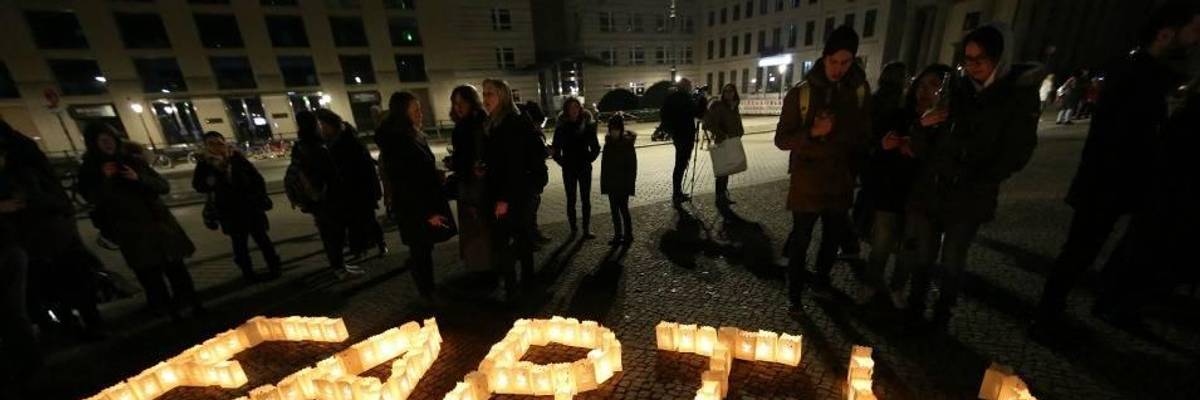
Participants attend Earth Hour 2018 in front of the Brandenburg Gate on March 24, 2018 in Berlin. (Photo: Adam Berry/Getty Images)
A group of four former United Nations climate chiefs say it's "unthinkable" for the world to continue its business-as-usual approach to climate action, warning that without ramped-up ambition, humanity is headed down a "road to hell."
The assessment is laid out in an article published on Thursday in the peer-reviewed journal Climate Policy.
"We cannot continue kicking the can down the road to climate safety."
--Michael Zammit Cutajar, former UNFCCC Executive Secretary"Drawing on hardening IPCC science and building on the foundations of the 1992 Convention, the last 30 years of international cooperation have established a clear understanding of the need to prevent dangerous climate change and an opportunity to do so," Michael Zammit Cutajar, founding Executive Secretary of UNFCCC, a role he served from 1991-2002, said in a statement.
"But," Zammit Cutajar added, "the ambition and effectiveness of governmental and corporate action to this end must shift quickly to another scale, beyond recognition, if we are to achieve global net zero emissions over the next 30 years."
"We cannot continue kicking the can down the road to climate safety," he said.
Zammit Cutajar, along with lead co-author Richard Kinley, Yvo de Boer, and Christiana Figueres--all of whom helped lead the UNFCCC over the last several decades--evaluated the past 30 years in terms of international climate negotiations, noting that the talks have unleashed "tensions exacerbated by strong economic interests in preserving the fossil-fuel-based economy."
Those efforts continue, they wrote, as meaningful action to address the global crisis "challenges complacent democracies to look beyond their electoral noses towards long-term planetary security."
While heaping praise on the multilateralism that brought about three global treaties--the United Nations Framework Convention on Climate Change in 1992, the Kyoto Protocol in 1997, and the Paris Agreement in 2015--the quartet lamented the "failure by governments to fully implement treaty obligations, exacerbated by the still inadequate response of the business community."
"At the national level," the authors wrote, "the Kyoto Protocol established legally-binding targets for developed countries while the Paris Agreement formalized the pledging of NDCs [nationally determined contributions] by all countries." Yet those NDCs "have been inconsistent with the action needed to meet the convention's objective and the Paris Agreement's mitigation goals."
Worthy of praise, they added, is the "changing [of] the narrative on climate change away from burden sharing to one of 'opportunity' and 'possibility'" in the years since the Paris deal was signed.
"The understanding has also taken root that a low-carbon, climate resilient economy is the only safe way to meet development imperatives, buttressed by the UN's Sustainable Development Goals (SDGs) adopted in the same year as the Paris Agreement," the former climate officials wrote.
The international negotiations' impact on raising climate ambition is clear, they wrote, but there remains "a very dark cloud hanging over the UNFCCC process... namely global CO2 emissions are more than 65% higher now than they were in 1990."
According to the authors, "the heart of the problem is the failure by states to implement their commitments, all too often paying only lip-service to what needs to be done, as well as the hesitation of too many in the business community to act on the policy signals being sent."
Laying out a set of recommendations, the authors said "it is unthinkable to continue at the pace of the last 30 years."
They called for action:
The article further issued a 2030 target, "in order to have a good chance of not exceeding the 1.5degC temperature increase threshold, [for] a halving of net CO2 emissions" and suggested "2050 as the target year for achieving global net zero emissions."
Channeling the phrase used in 1954 by then-UN Secretary-General Dag Hammarskjold, the former climate chiefs said that "before we can seriously contemplate climate change 'heaven,' we need to get off the current road to 'hell,' even if it is paved with good intentions."
The set of recommendations were released just two days before the five-year anniversary of the Paris climate agreement, and as leaders gather at the Pacific Islands Forum to issue fresh demands for decision climate action.
Speaking at the virtual summit, Fiji Prime Minister Frank Bainimaram said Friday, "We Pacific nations owe it to our people, and to humanity as a whole, to raise our voices more to demand that major emitters step up their climate actions and commitments."
"Without this, we will lose our homes, our way of life our wellbeing and livelihoods--it's past time to get serious," Bainimaram added. "We all signed the Paris agreement; now let's insist we put it to work."
Dear Common Dreams reader, It’s been nearly 30 years since I co-founded Common Dreams with my late wife, Lina Newhouser. We had the radical notion that journalism should serve the public good, not corporate profits. It was clear to us from the outset what it would take to build such a project. No paid advertisements. No corporate sponsors. No millionaire publisher telling us what to think or do. Many people said we wouldn't last a year, but we proved those doubters wrong. Together with a tremendous team of journalists and dedicated staff, we built an independent media outlet free from the constraints of profits and corporate control. Our mission has always been simple: To inform. To inspire. To ignite change for the common good. Building Common Dreams was not easy. Our survival was never guaranteed. When you take on the most powerful forces—Wall Street greed, fossil fuel industry destruction, Big Tech lobbyists, and uber-rich oligarchs who have spent billions upon billions rigging the economy and democracy in their favor—the only bulwark you have is supporters who believe in your work. But here’s the urgent message from me today. It's never been this bad out there. And it's never been this hard to keep us going. At the very moment Common Dreams is most needed, the threats we face are intensifying. We need your support now more than ever. We don't accept corporate advertising and never will. We don't have a paywall because we don't think people should be blocked from critical news based on their ability to pay. Everything we do is funded by the donations of readers like you. When everyone does the little they can afford, we are strong. But if that support retreats or dries up, so do we. Will you donate now to make sure Common Dreams not only survives but thrives? —Craig Brown, Co-founder |
A group of four former United Nations climate chiefs say it's "unthinkable" for the world to continue its business-as-usual approach to climate action, warning that without ramped-up ambition, humanity is headed down a "road to hell."
The assessment is laid out in an article published on Thursday in the peer-reviewed journal Climate Policy.
"We cannot continue kicking the can down the road to climate safety."
--Michael Zammit Cutajar, former UNFCCC Executive Secretary"Drawing on hardening IPCC science and building on the foundations of the 1992 Convention, the last 30 years of international cooperation have established a clear understanding of the need to prevent dangerous climate change and an opportunity to do so," Michael Zammit Cutajar, founding Executive Secretary of UNFCCC, a role he served from 1991-2002, said in a statement.
"But," Zammit Cutajar added, "the ambition and effectiveness of governmental and corporate action to this end must shift quickly to another scale, beyond recognition, if we are to achieve global net zero emissions over the next 30 years."
"We cannot continue kicking the can down the road to climate safety," he said.
Zammit Cutajar, along with lead co-author Richard Kinley, Yvo de Boer, and Christiana Figueres--all of whom helped lead the UNFCCC over the last several decades--evaluated the past 30 years in terms of international climate negotiations, noting that the talks have unleashed "tensions exacerbated by strong economic interests in preserving the fossil-fuel-based economy."
Those efforts continue, they wrote, as meaningful action to address the global crisis "challenges complacent democracies to look beyond their electoral noses towards long-term planetary security."
While heaping praise on the multilateralism that brought about three global treaties--the United Nations Framework Convention on Climate Change in 1992, the Kyoto Protocol in 1997, and the Paris Agreement in 2015--the quartet lamented the "failure by governments to fully implement treaty obligations, exacerbated by the still inadequate response of the business community."
"At the national level," the authors wrote, "the Kyoto Protocol established legally-binding targets for developed countries while the Paris Agreement formalized the pledging of NDCs [nationally determined contributions] by all countries." Yet those NDCs "have been inconsistent with the action needed to meet the convention's objective and the Paris Agreement's mitigation goals."
Worthy of praise, they added, is the "changing [of] the narrative on climate change away from burden sharing to one of 'opportunity' and 'possibility'" in the years since the Paris deal was signed.
"The understanding has also taken root that a low-carbon, climate resilient economy is the only safe way to meet development imperatives, buttressed by the UN's Sustainable Development Goals (SDGs) adopted in the same year as the Paris Agreement," the former climate officials wrote.
The international negotiations' impact on raising climate ambition is clear, they wrote, but there remains "a very dark cloud hanging over the UNFCCC process... namely global CO2 emissions are more than 65% higher now than they were in 1990."
According to the authors, "the heart of the problem is the failure by states to implement their commitments, all too often paying only lip-service to what needs to be done, as well as the hesitation of too many in the business community to act on the policy signals being sent."
Laying out a set of recommendations, the authors said "it is unthinkable to continue at the pace of the last 30 years."
They called for action:
The article further issued a 2030 target, "in order to have a good chance of not exceeding the 1.5degC temperature increase threshold, [for] a halving of net CO2 emissions" and suggested "2050 as the target year for achieving global net zero emissions."
Channeling the phrase used in 1954 by then-UN Secretary-General Dag Hammarskjold, the former climate chiefs said that "before we can seriously contemplate climate change 'heaven,' we need to get off the current road to 'hell,' even if it is paved with good intentions."
The set of recommendations were released just two days before the five-year anniversary of the Paris climate agreement, and as leaders gather at the Pacific Islands Forum to issue fresh demands for decision climate action.
Speaking at the virtual summit, Fiji Prime Minister Frank Bainimaram said Friday, "We Pacific nations owe it to our people, and to humanity as a whole, to raise our voices more to demand that major emitters step up their climate actions and commitments."
"Without this, we will lose our homes, our way of life our wellbeing and livelihoods--it's past time to get serious," Bainimaram added. "We all signed the Paris agreement; now let's insist we put it to work."
A group of four former United Nations climate chiefs say it's "unthinkable" for the world to continue its business-as-usual approach to climate action, warning that without ramped-up ambition, humanity is headed down a "road to hell."
The assessment is laid out in an article published on Thursday in the peer-reviewed journal Climate Policy.
"We cannot continue kicking the can down the road to climate safety."
--Michael Zammit Cutajar, former UNFCCC Executive Secretary"Drawing on hardening IPCC science and building on the foundations of the 1992 Convention, the last 30 years of international cooperation have established a clear understanding of the need to prevent dangerous climate change and an opportunity to do so," Michael Zammit Cutajar, founding Executive Secretary of UNFCCC, a role he served from 1991-2002, said in a statement.
"But," Zammit Cutajar added, "the ambition and effectiveness of governmental and corporate action to this end must shift quickly to another scale, beyond recognition, if we are to achieve global net zero emissions over the next 30 years."
"We cannot continue kicking the can down the road to climate safety," he said.
Zammit Cutajar, along with lead co-author Richard Kinley, Yvo de Boer, and Christiana Figueres--all of whom helped lead the UNFCCC over the last several decades--evaluated the past 30 years in terms of international climate negotiations, noting that the talks have unleashed "tensions exacerbated by strong economic interests in preserving the fossil-fuel-based economy."
Those efforts continue, they wrote, as meaningful action to address the global crisis "challenges complacent democracies to look beyond their electoral noses towards long-term planetary security."
While heaping praise on the multilateralism that brought about three global treaties--the United Nations Framework Convention on Climate Change in 1992, the Kyoto Protocol in 1997, and the Paris Agreement in 2015--the quartet lamented the "failure by governments to fully implement treaty obligations, exacerbated by the still inadequate response of the business community."
"At the national level," the authors wrote, "the Kyoto Protocol established legally-binding targets for developed countries while the Paris Agreement formalized the pledging of NDCs [nationally determined contributions] by all countries." Yet those NDCs "have been inconsistent with the action needed to meet the convention's objective and the Paris Agreement's mitigation goals."
Worthy of praise, they added, is the "changing [of] the narrative on climate change away from burden sharing to one of 'opportunity' and 'possibility'" in the years since the Paris deal was signed.
"The understanding has also taken root that a low-carbon, climate resilient economy is the only safe way to meet development imperatives, buttressed by the UN's Sustainable Development Goals (SDGs) adopted in the same year as the Paris Agreement," the former climate officials wrote.
The international negotiations' impact on raising climate ambition is clear, they wrote, but there remains "a very dark cloud hanging over the UNFCCC process... namely global CO2 emissions are more than 65% higher now than they were in 1990."
According to the authors, "the heart of the problem is the failure by states to implement their commitments, all too often paying only lip-service to what needs to be done, as well as the hesitation of too many in the business community to act on the policy signals being sent."
Laying out a set of recommendations, the authors said "it is unthinkable to continue at the pace of the last 30 years."
They called for action:
The article further issued a 2030 target, "in order to have a good chance of not exceeding the 1.5degC temperature increase threshold, [for] a halving of net CO2 emissions" and suggested "2050 as the target year for achieving global net zero emissions."
Channeling the phrase used in 1954 by then-UN Secretary-General Dag Hammarskjold, the former climate chiefs said that "before we can seriously contemplate climate change 'heaven,' we need to get off the current road to 'hell,' even if it is paved with good intentions."
The set of recommendations were released just two days before the five-year anniversary of the Paris climate agreement, and as leaders gather at the Pacific Islands Forum to issue fresh demands for decision climate action.
Speaking at the virtual summit, Fiji Prime Minister Frank Bainimaram said Friday, "We Pacific nations owe it to our people, and to humanity as a whole, to raise our voices more to demand that major emitters step up their climate actions and commitments."
"Without this, we will lose our homes, our way of life our wellbeing and livelihoods--it's past time to get serious," Bainimaram added. "We all signed the Paris agreement; now let's insist we put it to work."