SUBSCRIBE TO OUR FREE NEWSLETTER
Daily news & progressive opinion—funded by the people, not the corporations—delivered straight to your inbox.
5
#000000
#FFFFFF
To donate by check, phone, or other method, see our More Ways to Give page.


Daily news & progressive opinion—funded by the people, not the corporations—delivered straight to your inbox.
It’s probably better to think of the geological moment of human techno-transformation and population explosion as an event—like a global conflagration—rather than a durable new regime.
Early this month it was reported that members of the Subcommission on Quaternary Stratigraphy (which is part of the International Union of Geological Sciences), who had been tasked with adopting or rejecting a proposal to declare that we are in a new geological epoch called the Anthropocene, declined the motion. This comes after years of lobbying by many Earth scientists to formally acknowledge that humanity is in the process of changing the planet in ways that any future geologist would find obvious and undeniable.
My first reaction to the news was disappointment. I’ve been using the term “Anthropocene” for years, and had the impression that the main opposition to its formal adoption came from those who believe that humanity is incapable of changing Earth systems in ways that will make a difference for thousands or millions of years to come. Assuming that humans are too puny to alter the planet significantly is a mental pathway habitually trodden by climate change deniers, and it’s an excuse for doing nothing to avert a hellish future.
However, it turns out that the dispute among the roughly 20 scholars on the subcommission was mainly about whether humanity’s impact on Earth should be viewed as an event—like a mass extinction or an asteroid impact—or as the start of a new epoch. The majority favored the former; and, even though the legitimacy of their decision is being questioned, I think they’re right.
We’re still in the midst of the transitory event that is driving the end of the Holocene and the beginning of something else.
Ripples from human actions during the last few decades will spread far into the future. However, the consequences of the activities that are currently having profound impacts on the climate, oceans, and biota will limit those activities, so that humanity’s industrial growth-based economy driven by fossil fuels will be mostly if not entirely gone by the end of this century. There will likely be fewer people on the planet then, and they will have far less power per capita. Earth simply doesn’t have enough resources to enable a continuation of population growth and economic expansion for much longer before a decline commences. We will have the opportunity to shape that decline somewhat—to make it more beneficial by sharing the burden of contraction, or to make it more painful by fighting over what’s left—but the techno-optimist vision of a future of ever-increasing human potency is a mere fantasy, and a dangerous one at that.
So, it’s probably better to think of the geological moment (a couple of centuries at most) of human techno-transformation and population explosion as an event—like a global conflagration—rather than a durable new regime (geological epochs tend to be several million years in duration). The results of human overshoot will persist: If there are people around 10,000 or even a million years from now, they will be able to discern residue from the 20th and 21st centuries in the stratigraphy of lake beds around the world. That’s when the Earth’s climate changed; when toxic chemicals suddenly proliferated through atmosphere, soil, and waters; when glaciers melted; when radioactive particles were dispersed by atomic weapons tests; when untold numbers of animals and plants went extinct; and when ocean currents shifted.
The generations to come will inhabit a different world indeed. Earth’s new regime, once it has stabilized, will surely be classifiable as a new geological epoch—but currently it’s too soon to name it. We’re still in the midst of the transitory event that is driving the end of the Holocene and the beginning of something else.
Perhaps it’s this event that we should be naming. I hereby nominate “The Anthropic Unraveling” or “The Great Burning” as suitable candidates for the title.
The Anthropocene is classified as a geological "event" at this point—as are mass extinctions and rapid expansions of biodiversity.
The idea underpinning scientists' push to recognize the current time period as a new geological epoch called the Anthropocene dates back more than 100 years, but on Tuesday, a committee of experts voted down the proposal to officially declare a new age defined by human beings' impact on the Earth.
The panel, organized by the International Union of Geological Sciences (IUGS), was tasked with weighing whether the Holocene—the epoch that began at the close of the last ice age, more than 11,000 years ago—has ended, and if so, when precisely the Anthropocene began.
Another group, the Anthropocene Working Group (AWG), had previously posed that an Anthropocene—an epoch during which "the scale and character of human activities have become so great as to compete with natural geological and geophysical forces," as British geologist Robert Lionel Sherlock argued in 1922—began in the mid-20th century.
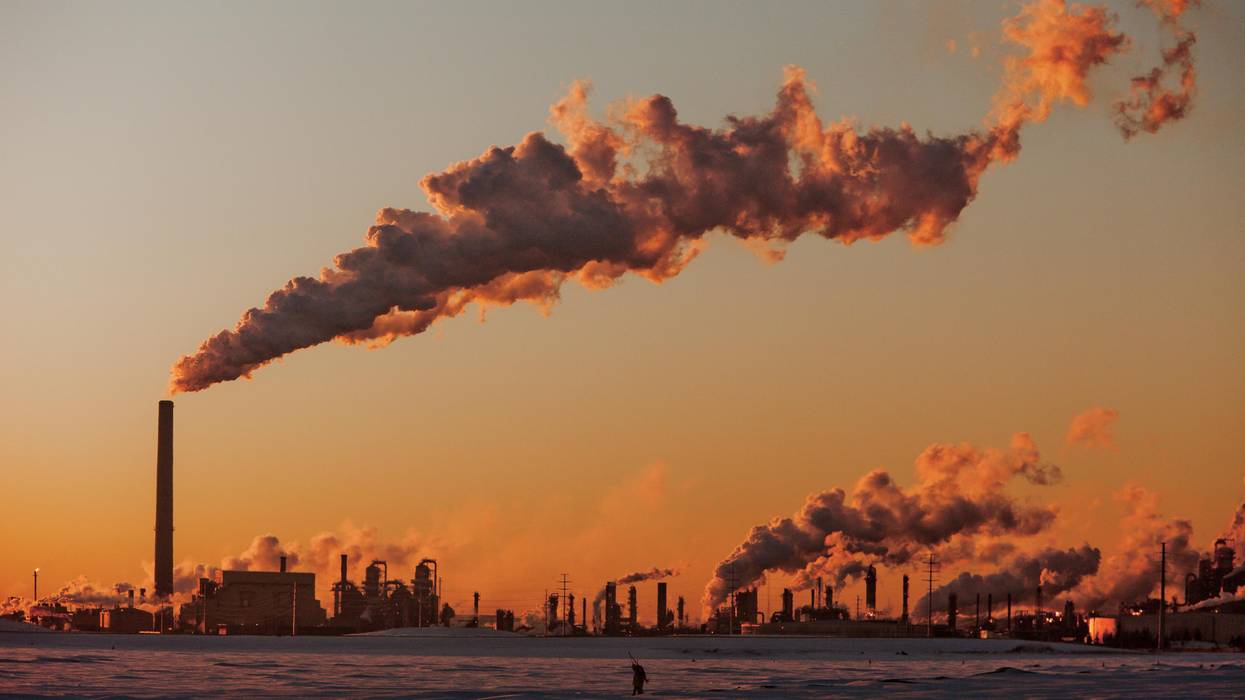
Around that period, the U.S. and other countries began testing nuclear weapons while fossil fuel production began ramping up significantly, intensifying planetary heating, ocean acidification, and other climate impacts.
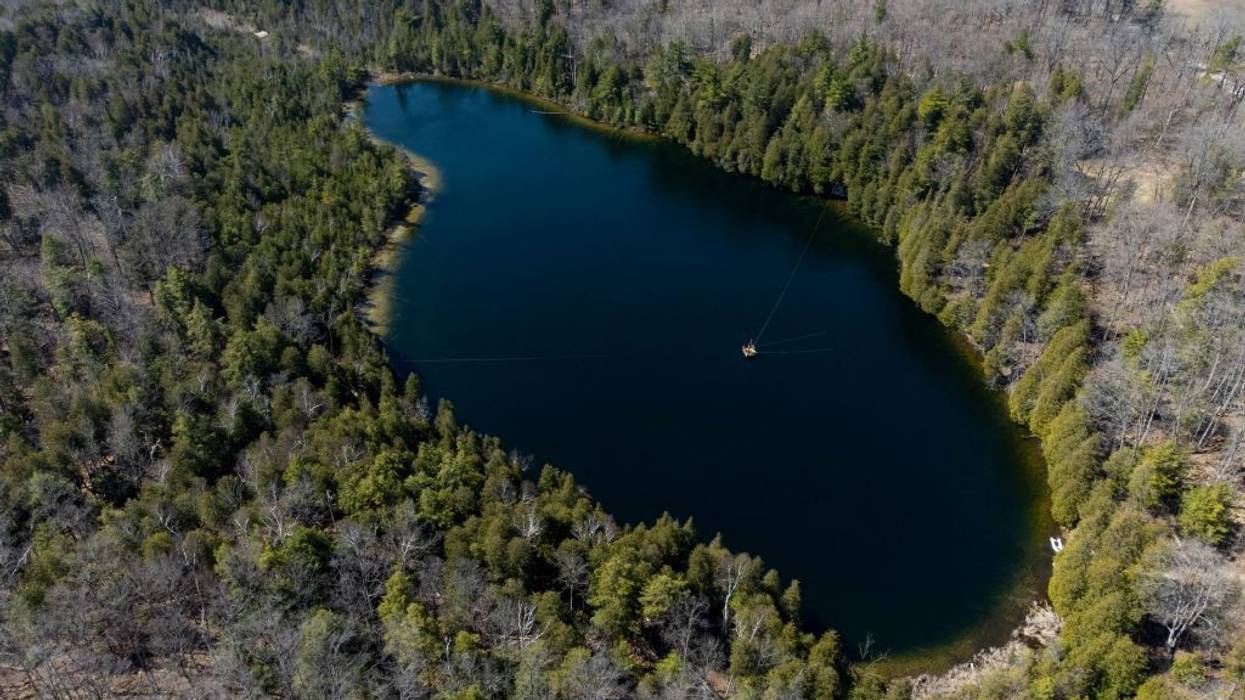
AWG presented geological evidence compiled at Crawford Lake in Canada, where radioactive isotopes dating back to the 1950s are embedded in the lake bed, to argue in favor of an Anthropocene that began decades ago.
Several members of the IUGS committee found that the time period proposed began too recently and "failed to capture the earlier impact of humans during, say, the development of farming or the onset of the Industrial Revolution," as Yale Environment 360 noted.
AWG members Simon Turner of University College London and Colin Waters of the University of Leicester told New Scientist Tuesday that the voting result was "very disappointing given the huge contribution by AWG to develop our case."
"All these lines of evidence indicate that the Anthropocene, though currently brief, is—we emphasize—of sufficient scale and importance to be represented on the Geological Time Scale," they said.
The academics who opposed recognizing a new geological epoch in the 12-4 vote are among the scientists who "prefer to describe the Anthropocene as an 'event,' not an 'epoch,'" The New York Times reported.
Geological "events" don't appear on the official Geological Time Scale, "yet many of the planet's most significant happenings are called events, including mass extinctions, rapid expansions of biodiversity, and the filling of Earth's skies with oxygen 2.1 to 2.4 billion years ago," according to the Times.
Michael Mann, director of the Center for Science, Sustainability, and the Media at University of Pennsylvania, called the disagreement over the terminology "a tempest in a teapot" that won't stop scientists from identifying the current time period as one in which humans are significantly and negatively impacting the planet.
While the scientific community is not yet labeling the current time period as a new epoch, committee member Jan Piotrowski of Aarhus University in Denmark told the Times, "Our impact is here to stay and to be recognizable in the future in the geological record."
"There is absolutely no question about this," Piotrowski said.
Lake Crawford in Ontario, Canada, has been chosen as the site with the sedimentary record that will be used as the dividing line between the Holocene and the Anthropocene.
Are we really living in the Anthropocene, the geological time marked by the global impact of human activity? And if so, when did it begin?
These are questions that the Anthropocene Working Group—established in 2009 by the International Commission on Stratigraphy to propose a definition of the concept and to estimate its potential as a unit of geologic time—is hoping to answer.
The group announced on July 11, 2023, that Lake Crawford in Ontario, Canada, had been chosen as the site with the sedimentary record that would be used to define the beginning of the Anthropocene.
Studies have concluded that the Anthropocene is significant on a geologic scale because of the rapidity and magnitude of recent human impacts on processes operating on the Earth’s surface.
What makes this site so special that it holds the dividing line between different geological epochs?
Since its formation, the Anthropocene Working Group has evaluated various types of physical, chemical, and biological evidence preserved in sediments and rocks, and it has published numerous scientific papers that have explored their nature and relevance.
These studies have concluded that the Anthropocene is significant on a geologic scale because of the rapidity and magnitude of recent human impacts on processes operating on the Earth’s surface. Many of these impacts have generated irreversible changes that exceed the small range of natural variability of the Holocene, which began 11,700 years ago.
In the geologic strata, the Anthropocene Working Group has identified a significant set of indicators that coincide with the so-called “Great Acceleration” of the mid-20th century, driven by an unprecedented increase in human population, energy consumption, industrialization, and globalization following the end of World War II. These include the following:
Over the years, the Anthropocene Working Group has mostly agreed that the Anthropocene is geologically real and should be formalized as an independent unit within the international scale of geologic time.
Its onset would be in the mid-20th century, in the 1950s, according to the global signals recorded in sediments since then.
The Anthropocene Working Group established that it is necessary to determine its place of reference by means of a material and temporal boundary called a Global Boundary Stratotype Section and Point, or GSSP—colloquially, a “golden spike.” This is the most widely accepted method for formalizing geologic units over the past 540 million years.

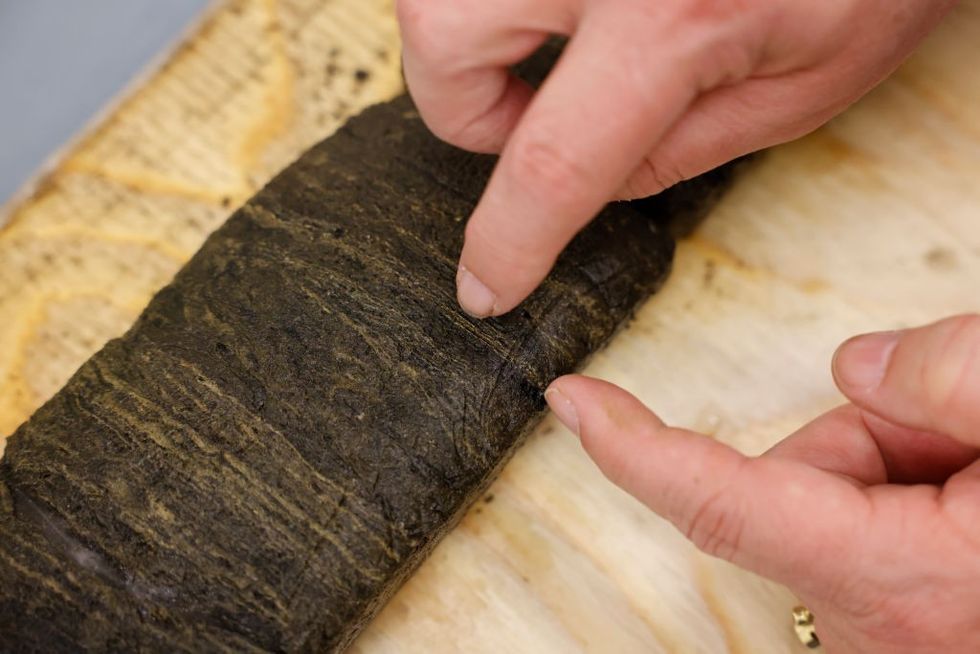
Professor Francine McCarthy of Brock University points to a section of a Crawford Lake core sample indicating the Anthropocene period at the Royal Ontario Museum in Toronto.
(Photo: Lance McMillan/Toronto Star via Getty Images)
Since 2019, a collaborative project between the Anthropocene Working Group and numerous research laboratories has been underway as part of an international initiative called Anthropocene Curriculum, promoted by the Haus der Kulturen der Welt and the Max Planck Institute for the History of Science, both in Germany.
Twelve detailed proposals were initially submitted for different geological sections that could host this GSSP, located on five continents and situated in eight different geological environments. All of them were published in 2023 in the scientific journal Anthropocene Review. These papers were the main source of information for the voting members of the Anthropocene Working Group during the selection process.
The Anthropocene Working Group finally reviewed nine reference sections in detail. Suitable candidates were those containing thin layers of sediment that could be analyzed from year to year and whose age could also be corroborated by the presence of radioactive elements to ensure a complete sedimentary record.
A “golden spike” requires the local presence of a physical marker that can be seen with the naked eye and at least one indicator signal, such as a geochemical change, that is found in sediments and rocks of the same age and across the globe.
The stratigraphic procedures established to decide on a GSSP are already standardized in geology and are common for the definition of any geological time. Thus, a “golden spike” requires the local presence of a physical marker that can be seen with the naked eye and at least one indicator signal, such as a geochemical change, that is found in sediments and rocks of the same age and across the globe.
Most of the proposals identified plutonium as the primary indicator and proposed the onset of the Anthropocene from an increase in the signal of this radioactive element.
Initial discussion on the strengths and weaknesses of each location began in October 2022, and the list was narrowed to three.
According to the results, the most relevant geological sections were located in Beppu Bay, Japan; Sihailongwan Lake, China; and Crawford Lake. After a detailed analysis of the nature of their plutonium signal and a new vote, the Chinese and Canadian lake sites were finalists.
In the end, Crawford Lake received 61% of the votes and was chosen as the site of the GSSP for the Anthropocene epoch.
It is very important not to confuse the start of human activity and the Anthropocene.
The sediment layers in the lake bed, west of Toronto, were originally investigated to demonstrate the region’s sporadic occupation by Native American peoples and subsequent colonization by Europeans. The new geological study has increased the number of indicators preserved in its various annual layers, which are formed by an alternation of pale calcite, deposited in summer, and dark organic laminae, accumulated in winter.
The layer proposed as a visual marker for the GSSP is 6.1 inches (15.6 centimeters) deep at the base of a calcite sheet deposited in the summer of 1950. It was selected because of the rapid increase in plutonium thereafter. This signal also coincides with an increase in carbonaceous particles and a major ecosystem change identified by a decline in elm pollen and a replacement in diatom species, a type of algae.
It is very important not to confuse the start of human activity and the Anthropocene. The Anthropocene does not include the initial impact of humans, which was regional and grew over time, but it is defined as a consequence of the planetary response to the enormous impact of the Great Acceleration.
The Anthropocene is part of geologic time. Formalizing it precisely will help determine its meaning and use in all sciences and other academic disciplines. The end of a relatively stable epoch in Earth’s history, the Holocene, will thus be recognized.
The world today is on the verge of a major food emergency, provoked in part by Russia's attack on Ukraine but more broadly by the damage heat from global warming is doing to crops worldwide. This is both a crisis and an opportunity.
Let's start with the basics. Food is the raw material that makes people. More food, more people; less food, fewer people.
Hundreds of millions have become climate refugees and radical weather is destabilizing governments around the world.
This is a basic law of nature. The insect-eating bird population around us, for example, is a fraction today of what it was 20 years ago because its food--the insect population--has been decimated by pesticides and loss of habitat (their food source), over the past few decades.
Pick any species and the law of nature is the same: more food produces population growth while less food shrinks population (often in brutal ways). It's why areas like desert and scrub that produce little food were, over the past millennia, lightly populated, whereas areas rich with food like forests and seacoasts carried large human populations.
Throughout our lifetimes (and the past four centuries) human population has steadily grown because we hadn't yet hit the new ceilings the agricultural and industrial revolutions gave us to produce and distribute food.
However, this halcyon era is coming to an end because of the climate crisis, provoked by 60 years of senior executives in the fossil fuel industry lying to us and buying off politicians while making trillions pouring their poisons into our atmosphere.
This should not shock us when it happens all around us and millions are starving and homeless, although it almost certainly will because most of the human race has lived for so long within the food abundance created by the widespread use of fossil fuels starting in the 19th century.
Humans reaching the limits of food's ability to sustain population is not a new story; it's as old as humanity itself.
As I wrote in Threshold: The Crisis of Western Culture, eight hundred years ago a group of Melanesians sailed to the islands they called Aotearoa and we now call New Zealand. When they first arrived, around the year AD 1200, humans had never before inhabited that island paradise.
Food was everywhere for the taking, particularly a large flightless family of birds called the moa (similar to ostriches). There were so many of the birds, and they were so easily approached, that the archeological record shows that during the first few hundred years of occupation the islanders didn't even need weapons.
No bows and arrows, no spears, no specialized weapons of any sort can be found in the archaeological record from those early times: the birds and many other large animals were so docile that people simply walked up and clubbed them to death with a stick or broke their necks.
A dozen different species of New Zealand moa birds, weighing from under fifty to over five hundred pounds each, provided meat and eggs well in excess of the food needs of the initial Melanesian explorers.
This abundance of food led to a golden age of peaceful human population expansion on New Zealand. The few dozen initial settlers became hundreds, then thousands, then tens of thousands, all feasting on the huge moa birds.
As their populations grew, the Maori killed the moa in huge numbers: in the Otago District, an ancient killing field was found at Waitaki containing more than ninety thousand moa skeletons. The bones suggest that the birds were clubbed or their necks were wrung.
While this is the largest moa boneyard, several other similar ancient sites have been discovered around New Zealand in the past few decades: as many as a million moa birds, representing hundreds of millions of pounds of meat, were killed by the early settlers, now known as the Maori (or "moa-eating") people.
The Maori population grew and over the next 300 years Maori people spread all across the 103,000 square miles of New Zealand. They lived in peace and harmony, convinced the gods had intentionally brought them to this island and thus showered them with its blessing of a seemingly unlimited supply of food.
But, as inevitably happens to cultures who think they can defy nature, the times of moa for the Maori came to an end. Their moa feast lasted for three to four hundred years but came to an abrupt end with the death of the last moa bird and thus the final and total extinction of all twelve Moa species.
The islanders then began eating other local animals, and in short order they exterminated or brought to the brink of extinction the huia, takahe, and kakapo, all birds ranging from the size of modern chickens down to the size of pigeons.
Along the coast, Maori people hunted the three-ton elephant seal to extinction within those first four hundred years, exterminated the half-ton sea lion (Phocartos hookeri), and from all but the most remote regions wiped out the three-hundred-pound New Zealand fur seal (Arctocephalus forsteri).
Turning to fish, the Maori soon endangered even the ubiquitous snappers, as the archeological record shows the fish skeletons and the hooks used to catch them declined in size rapidly over a hundred-year period following the extinction of the moa.
The easily killed large animals all exterminated, the Maori turned to what were considered famine foods by their seafaring ancestors: roots, tubers, frogs, ferns, rats, and small birds. Along with this change in their diet came a dramatic shift in Maori culture.
Around AD 1400--roughly four hundred years after their initial colonization of New Zealand--the Maori people began building fortresses and constructing tools for organized warfare. The forts, called pas in the Maori language, proliferated across the island.
We find new lands or new resources, exploit them mercilessly until they're exhausted, then fall back into famine and war until a new homeostatic culture/lifestyle is achieved.
The primary cultural values of Maori society shifted from cooperation to fighting and killing other humans for the scarce resources left on the island. The arts of war became elaborate, and each community spent enormous time and effort making their pa an impenetrable fortress. Shortly after birth, Maori boys were dedicated to the god of war.
Over the next two hundred years, the Maori's war-bent culture achieved an uneasy stability. They had moved from population explosion in the face of huge food resources to near-famine conditions, then to farming sweet potatoes in the lowland valleys and building forts for standing armies.
Dutch explorer Abel Tasman was the first European to reach New Zealand and encounter the Maori people, just weeks after he had mapped nearby Tasmania. On December 16, 1642, he wrote in his journal about his one and only encounter with the Maori.
He sent a small group of his men out in a cockboat to meet the natives. Without warning, the Maori attacked Tasman's sailors as soon as the boat was close to their canoes:
"In which fray three of the Zeehaen's men were left dead and a fourth owing to the heavy blows mortally wounded. The quartermaster and two sailors swam towards our ship and we sent our shallop to meet them, into which they got alive. After this monstrous happening, and detestable affair, the murderers left the cockboat drift, having taken one of our dead in their canoe and drowned another."
What Tasman discovered was that among the Maori protein was in such short supply that they had passed the last human cultural barrier to a food source: cannibalism.
Tasman watched helplessly as his one crewman taken alive by the Maori was beheaded on the beach. The Maori recovered the bodies of the others and roasted them. Horrified, Tasman named the cove Murderer's Bay and sailed away, never to return.
This story of humans wiping out the resources that sustain them has been repeated over and over again throughout human pre-history. It's far more the norm than the exception.
For the first few hundred thousand years of our history (more or less) modern humanity worldwide was limited to an estimated 5 million or so humans. As Daniel Quinn would say, we "lived in the hands of the gods," repeatedly booming and busting our own local populations as we spread to new territories, discovered new food supplies, and then depleted them.
Here in North America the arrival of humanity around 15,000 years ago coincided with a mass die-off of large, easily killed food animals including:
woolly mammoths
Columbian mammoths
American mastodons
three types of ground sloths
glyptodonts
giant armadillos
several species of horses
four species of pronghorn antelopes
three species of camels
giant deer
several species of oxen
giant bison
Scientists are still debating whether changes in climate or the human over-hunting "Pleistocene overkill" was most responsible for the extinction of so many animals in such a short period; odds are it was both, as this was toward the tail end of the Ice Age and the climate was rapidly changing.
As David J. Meltzer chronicles in his brilliant new book First Peoples in a New World: Populating Ice Age America, multiple DNA-identified groups of humans moved across North and South America over the following ten thousand years. Many of them simply vanished, their DNA gone forever, leaving not a single descendant to this day.
This boom-and-bust cycle has been the story of humanity since the first modern humans began migrating out of east Africa across that continent, up through the Middle East into Europe and Asia, and across the frozen Barents Straight to the Americas.
Periodic famine has been the norm for humanity throughout most of our history. We find new lands or new resources, exploit them mercilessly until they're exhausted, then fall back into famine and war until a new homeostatic culture/lifestyle is achieved.
It's the most logical explanation, some anthropologists argue, for why Native American societies placed such a high premium--reported in the era of first contact with Europeans in the 16th and 17th centuries--on sustainability. Their distant ancestors had wiped out local food supplies producing famine, inter-tribal conflict, and war.
Most of the subsequently-rebuilt cultures and systems of governance were intentionally designed to prevent a repeat of those traumatic experiences. The most well-known of those is the Iroquois Confederacy that Ben Franklin so admired.
Which brings us to today.
While the agricultural revolution increased the world's population--because farming is so much more efficient at producing food than hunting and gathering or even pastoralism--we'd still only reached a bit over a half-billion people worldwide when Europeans first arrived in North America.
The subsequent industrial revolution--powered by fossil fuels created by hundreds of millions of years of photosynthesis (fossil fuels are simply fossilized plants)--dramatically ramped up our ability to grow and transport food.
Thus, we hit 1 billion people in 1800, 2 billion in 1930, 3 billion in 1960, 4 billion in 1974, 5 billion in 1986, 6 billion by the turn of the century, and today are on the verge of 8 billion people.
Fossil fuels were turned into fertilizers, pesticides, and herbicides to grow more food on the same amount of land. They power our planting and harvesting machines, allowing a single person to do a job that previously would have required hundreds, each driving a horse or ox.
In 1820, for example, 72 percent of the American workforce were farmers. By 1850, because of the Cotton Gin and new plowing technologies, that number fell to 64 percent of the American workforce. In 1920, as gasoline- and diesel-powered internal combustion engines began showing up on farms, only 30 percent of us worked on farms. Today, farmers are fewer than 2 percent of us.
And, like the Moa birds, the era of cheap fossil fuels and a stable climate that enabled 2 percent of us to feed the other 98 percent is drawing to a close. Fossil fuels are getting harder to find and more expensive to produce, while climate change is reducing crop yields, melting glaciers that are the source of irrigating rivers, and drying up above-ground reservoirs.
Will humanity prevail over the forces of greed and destruction and help salvage our biosphere while reinventing our culture and world?
We are stumbling--seemingly oblivious--into the bared teeth of the Anthropocene, a new geological epoch driven by humanity itself. We are walking straight into it and pretending it's not here.
And it's changing how we live, how we govern ourselves, and the nature of relations between nations.
Already, hundreds of millions have become climate refugees and radical weather is destabilizing governments around the world: the Arab Spring, for example, started because the desert across north Tunisia and Syria had moved south and wheat farms were turned into scrub-land, causing the price of that staple food to explode.
A Tunisian falafel street-vendor lit himself on fire in protest, triggering uprisings across the region. The Arab Spring and its subsequent democratic collapse in Egypt and now Tunisia are harbingers of things to come in other parts of the world.
The growth of a food supply parallels the growth of a population. It's one of the few laws of nature that has always applied to humans, even though we ignore it or pretend it doesn't exist.
The agricultural and industrial revolutions, by increasing the available food supply, exploded the world's human population. Over the last two hundred years, advances in medical science and hygiene have additionally reduced the death rate while a whole variety of technologies have increased our food output.
But, like the Maori, we're approaching the end of the free ride. Food, energy, and housing are starting to get very expensive; most of the world has already leaped into this maelstrom.
This isn't run-of-the-mill inflation: it's what happens to an economy when a basic commodity--in this case, the most basic commodity, food--becomes scarce.
The entire GOP refuses to even discuss climate change, while they and Joe Manchin stuff their pockets with fossil fuel money. Meanwhile, the end-stage crisis that's been building ever since the fossil fuel companies learned this was coming and started aggressively lying to us about it--while funding the Reagan Revolution--has arrived.
What happened to the Maori, or Native American communities who overhunted 10,000 years ago, was local. This is now planet-wide. There's no place left to go and start over.
If you thought it was a disgusting spectacle to see the Bundy family stealing federal lands and water at gunpoint, you ain't seen nothing yet. Water wars between states and regions are just around the corner, and soon large parts of America will begin to lose population as their water supplies vanish.
Will we, like the ancient Maori, devolve into an authoritarian and war-based society? Or will we, like the Iroquois, Hopi, and Wendat people, make a conscious decision to live within our means, stop destroying our environment, and fine-tune our governmental systems to meet the needs of all of our citizens?
We are not without resources, and it's always a mistake to bet against human ingenuity. On the other hand, we are facing an unprecedented level of avarice mobilized by billionaires and corporations with more power and wealth than the world has ever seen.
Will they win, and, in the process, set human civilization back millennia? Or will humanity prevail over the forces of greed and destruction and help salvage our biosphere while reinventing our culture and world?
The hour is late, but, scientists tell us, not too late. Our fate--and that of the planet--is still in our hands.
This article was first published on The Hartmann Report.
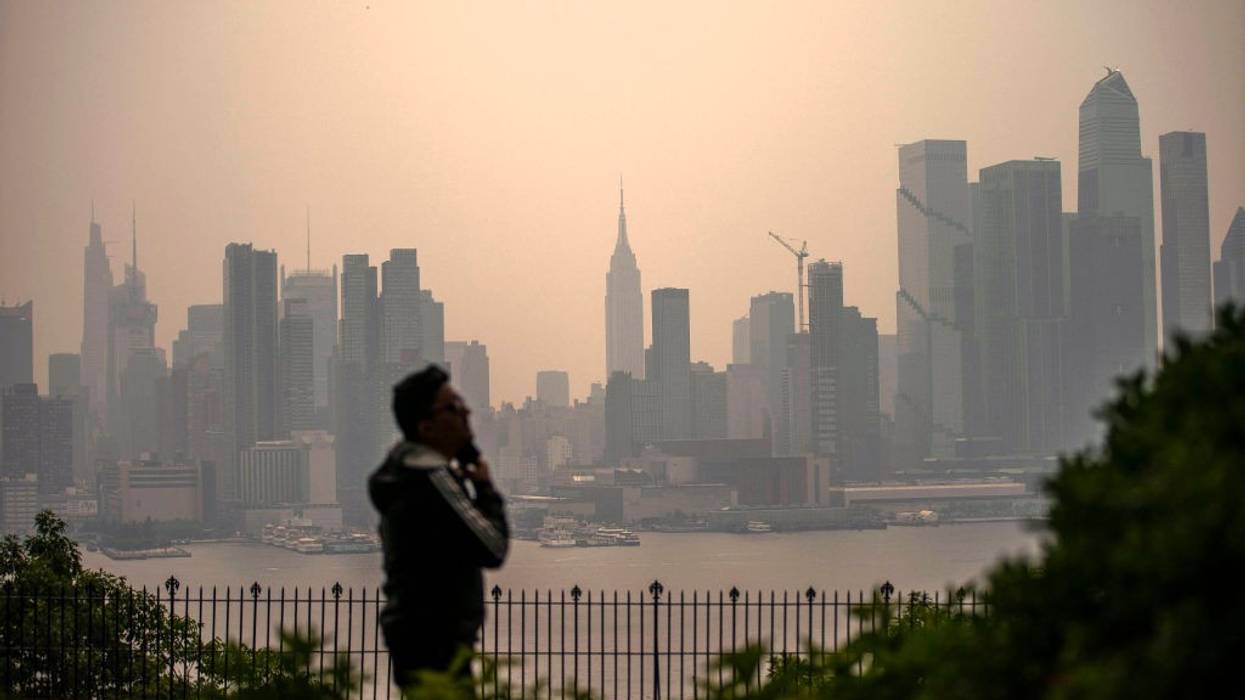
The past week has seen record-breaking heat waves across Europe. Wildfires have ripped through Spain, Portugal and France. London's fire brigade experienced its busiest day since World War II. The U.K. saw its hottest day on record of 104.54 Fahrenheit. In China, more than a dozen cities issued the "highest possible heat warning" this weekend with over 900 million people in China enduring a scorching heat wave along with severe flooding and landslides across large swathes of southern China. Dozens of people have died. Millions of Chinese have been displaced. Economic losses run into the billions of yuan. Droughts, which have destroyed crops, killed livestock and forced many to flee their homes, are creating a potential famine in the Horn of Africa. More than 100 million people in the United States are under heat alerts in more than two dozen states from temperatures in the mid-to-upper 90s and low 100s. Wildfires have destroyed thousands of acres in California. More than 73 percent of New Mexico is suffering from an "extreme" or "severe" drought. Thousands of people had to flee from a fast-moving brush fire near Yosemite National Park on Saturday and 2,000 homes and businesses lost power.
The global ruling class has forfeited its legitimacy and credibility. It must be replaced.
It is not as if we were not warned. It is not as if we lacked scientific evidence. It is not as if we could not see the steady ecological degeneration and species extinction. And yet, we did not act. The result will be mass death with victims dwarfing the murderous rampages of fascism, Stalinism and Mao Zedong's China combined. The desperate response is to burn more coal, especially with the soaring cost of natural gas and oil, and extend the life of nuclear power plants to sustain the economy and produce cool air. It is a self-defeating response. Joe Biden has approved more new oil drilling permits than Donald Trump. Once the power outages begin, as in India, the heat waves will exact a grim toll.
"Half of humanity is in the danger zone, from floods, droughts, extreme storms and wildfires," U.N Secretary General Antonio Guterres told ministers from 40 countries meeting to discuss the climate crisis on July 18. "No nation is immune. Yet we continue to feed our fossil fuel addiction."
"We have a choice," he added. "Collective action or collective suicide."
The Anthropocene Age - the age of humans, which has caused extinctions of plant and animal species and the pollution of the soil, air and oceans - is accelerating. Sea levels are rising three times faster than predicted. The arctic ice is vanishing at rates that were unforeseen. Even if we stop carbon emissions today - we have already reached 419 parts per million - carbon dioxide concentrations will continue to climb to as high as 550 ppm because of heat trapped in the oceans. Global temperatures, even in the most optimistic of scenarios, will rise for at least another century. This assumes we confront this crisis. The earth is becoming inhospitable to most life.
The average global temperature has risen by about 1.1 Celsius (1.9 degrees Fahrenheit) since 1880. We are approaching a tipping point of 2 degrees Celsius when the biosphere will become so degraded nothing can save us.
The ruling class for decades denied the reality of the climate crisis or acknowledged the crisis and did nothing. We sleepwalked into catastrophe. Record heat waves. Monster droughts. Shifts in rainfall patterns. Declining crop yields. The melting of the polar ice caps and glaciers resulting in sea level rise. Flooding. Wildfires. Pandemics. The breakdown of supply chains. Mass migrations. Expanding deserts. The acidification of the oceans that extinguishes sea life, the food source for billions of people. Feedback loops will see one environmental catastrophe worsen another environmental catastrophe. The breakdown will be nonlinear. These are the harbingers of the future.
Social coercion and the rule of law will disintegrate. This is taking place in many parts of the global south. A ruthless security and surveillance apparatus, along with heavily militarized police, will turn industrial nations into climate fortresses to keep out refugees and prevent uprisings by an increasingly desperate public. The ruling oligarchs will retreat to protected compounds where they will have access to services and amenities, including food, water and medical care, denied to the rest of us.
Voting, lobbying, petitioning, donating to environmental lobby groups, divestment campaigns and protesting to force the global ruling class to address the climate catastrophe proved no more effective than scrofula victims' superstitious appeals to Henry VIII to cure them with a royal touch. In 1900 the burning of fossil fuel - mostly coal - produced about 2 billion tons of carbon dioxide a year. That number had risen threefold by 1950. Today the level is 20 times higher than the 1900 figure. During the last 60 years the increase in CO2 was an estimated 100 times faster than what the earth experienced during the transition from the last ice age.
The last time the earth's temperature rose 4 degrees Celsius, the polar ice caps did not exist and the seas were hundreds of feet above their current levels.
You can watch my two-part interview with Roger Hallam, the co-founder of the resistance group Extinction Rebellion, on the climate emergency here and here.
There are three mathematical models for the future: a massive die-off of perhaps 70 percent of the human population and then an uneasy stabilization; extinction of humans and most other species; an immediate and radical reconfiguration of human society to protect the biosphere. This third scenario is dependent on an immediate halt to the production and consumption of fossil fuels, converting to a plant-based diet to end the animal agriculture industry - almost as large a contributor to greenhouse gasses as the fossil fuel industry - greening the deserts and restoring rainforests.
We knew for decades what harnessing a hundred million years of sunlight stored in the form of coal and petroleum would do to the climate. As early as the 1930s British engineer Guy Stewart Callendar suggested that increased CO2 was warming the planet. In the late 1970s into the 1980s, scientists at companies such as Exxon and Shell determined that the burning of fossil fuels was contributing to rising global temperature.
"[T]here is concern among some scientific groups that once the effects are measurable, they might not be reversible and little could be done to correct the situation in the short term," a 1982 internal briefing for Exxon's management noted.
NASA's Dr. James Hansen told the U.S. Senate in 1988 that the buildup of CO2 and other gasses were behind the rise in heat.
But by 1989 Exxon, Shell and other fossil fuel corporations decided the risks to their profits from major curbs in fossil fuel extraction and consumption was unacceptable. They invested in heavy lobbying and funding of faux research and propaganda campaigns to discredit the science on the climate emergency.
Christian Parenti in his book Tropic of Chaos: Climate Change and the New Geography of Violence quotes from "The Age of Consequences: The Foreign Policy and National Security Implications of Global Climate Change," a 2007 report produced by the Center for Strategic and International Studies and the Center for a New American Security. R. James Woolsey, former director of the Central Intelligence Agency, writes in the report's final section:
In a world that sees two meter sea level rise, with continued flooding ahead, it will take extraordinary effort for the United States, or indeed any country, to look beyond its own salvation. All of the ways in which human beings have dealt with natural disasters in the past...could come together in one conflagration: rage at government's inability to deal with the abrupt and unpredictable crises; religious fervor, perhaps even a dramatic rise in millennial end-of-day cults; hostility and violence towards migrants and minority groups, at a time of demographic change and increased global migration; intra-and interstate conflict over resources, particularly food and fresh water. Altruism and generosity would likely be blunted.
The profits from fossil fuels, and the lifestyle the burning of fossil fuels afforded to the privileged on the planet, overroad a rational response. The failure is homicidal.
Clive Hamilton in his Requiem for a Species: Why We Resist the Truth About Climate Change describes a dark relief that comes from accepting that "catastrophic climate change is virtually certain."
"But accepting intellectually is not the same as accepting emotionally the possibility that the world as we know it is headed for a horrible end," Hamilton writes. "It's the same with our own deaths; we all 'accept' that we will die, but it is only when death is imminent that we confront the true meaning of our mortality."
Environmental campaigners, from The Sierra Club to 350.org, woefully misread the global ruling class, believing they could be pressured or convinced to carry out the seismic reconfigurations to halt the descent into a climate hell. These environmental organizations believed in empowering people through hope, even if the hope was based on a lie. They were unable or unwilling to speak the truth. These climate "Pollyannas," as Hamilton calls them, "adopt the same tactic as doom-mongers, but in reverse. Instead of taking a very small risk of disaster and exaggerating it, they take a very high risk of disaster and minimize it."
Humans have inhabited cities and states for 6,000 years, "a mere 0.2 percent of the two and a half million years since our first ancestor sharpened a stone," the anthropologist Ronald Wright notes in A Short History of Progress. The myriad of civilizations built over these 6,000 years have all decayed and collapsed, most through a thoughtless depletion of the natural resources that sustained them.
The latest iteration of global civilization was dominated by Europeans, who used industrial warfare and genocide to control much of the planet. Europeans and Euro-Americans launched a 500-year-long global rampage of conquering, plundering, looting, exploiting and polluting the earth - as well as killing the indigenous communities, the caretakers of the environment for thousands of years - that stood in the way. The mania for ceaseless economic expansion and exploitation, accelerated by the Industrial Revolution two and a half centuries ago, has become a curse, a death sentence.
Anthropologists, including Joseph Tainter in The Collapse of Complex Societies, Charles L. Redman in Human Impact on Ancient Environments and Ronald Wright in A Short History of Progress, have laid out the familiar patterns that lead to systems breakdown. Civilizations, as Tainter writes, are "fragile, impermanent things." Collapse, he writes, "is a recurrent feature of human societies."
This time the whole planet will go down. There will, with this final collapse, be no new lands left to exploit, no new peoples to subjugate or new civilizations to replace the old. We will have used up the world's resources, leaving the planet as desolate as the final days of a denuded Easter Island.
Collapse comes throughout human history to complex societies not long after they reach their period of greatest magnificence and prosperity.
"One of the most pathetic aspects of human history is that every civilization expresses itself most pretentiously, compounds its partial and universal values most convincingly, and claims immortality for its finite existence at the very moment when the decay which leads to death has already begun," the theologian Reinhold Niebuhr writes in Beyond Tragedy: Essays on the Christian Interpretation of Tragedy.
The very things that cause societies to prosper in the short run, especially new ways to exploit the environment such as the invention of irrigation or use of fossil fuels, lead to disaster in the long run. This is what Wright calls the "progress trap."
"We have set in motion an industrial machine of such complexity and such dependence on expansion," Wright notes, "that we do not know how to make do with less or move to a steady state in terms of our demands on nature."
The U.S. military, intent on dominating the globe, is the single largest institutional emitter of greenhouse gasses, according to a report from Brown University. This is the same military that has designated global warming a "threat multiplier" and "an accelerant of instability or conflict."
The powerlessness many will feel in the face of ecological and economic chaos will unleash further collective delusions, such as fundamentalist beliefs in a god or gods who will come back to earth and save us. The Christian right provides a haven for this magical thinking. Crisis cults spread rapidly among Native American societies in the later part of the 19th century as the buffalo herds and the remaining tribes faced extermination. The Ghost Dance held out the hope that all the horrors of white civilization--the railroads, the murderous cavalry units, the timber merchants, the mine speculators, the hated tribal agencies, the barbed wire, the machine guns, even the white man himself--would disappear. Our psychological hard wiring is no different.
The greatest existential crisis of our time is to at once be willing to accept the bleakness before us and resist. The global ruling class has forfeited its legitimacy and credibility. It must be replaced. This will require sustained mass civil disobedience, such as those mounted by Extinction Rebellion, to drive the global rulers from power. Once the rulers see us as a real threat they will become vicious, even barbaric, in their efforts to cling to their positions of privilege and power. We may not succeed in halting the death march, but let those who come after us, especially our children, say we tried.
Snow began falling on December 24th, big fluffy flakes that made lace on mittens before melting. Within hours it had coated the ashes, the brick chimneys that the flames had left behind, and the jagged remains of roofs strewn across my burned-out town. White mounds soon softened the look of charred cars that are everywhere, while even the scorched trees that stretch to the hilltops were coated in a forgiving winter wonder.
Here's the only good news: climate change is a problem with a solution. We humans created it, which means it's solvable. That, however, would require societal and political will of a kind we simply haven't seen yet.
Any moisture would have been welcome. Over the seven months since the Dixie fire destroyed Greenville and several other rural communities in California's northern Sierra Nevada mountains, the drought that led to the flaming disaster had only deepened. October brought brief, drenching rains, but November and December were dry again. Soil that should have been moist was as desiccated as the air, while the humidity hovered just above single digits. We watched bulldozers move the dilapidated walls--what had not long ago been homes--into gigantic dump trucks in a haze of grime. Even the trees that survived had a withered look. Now, it was snowing--for Christmas! We greeted it with hearts as wide as the open mouths of kids savoring falling flakes.
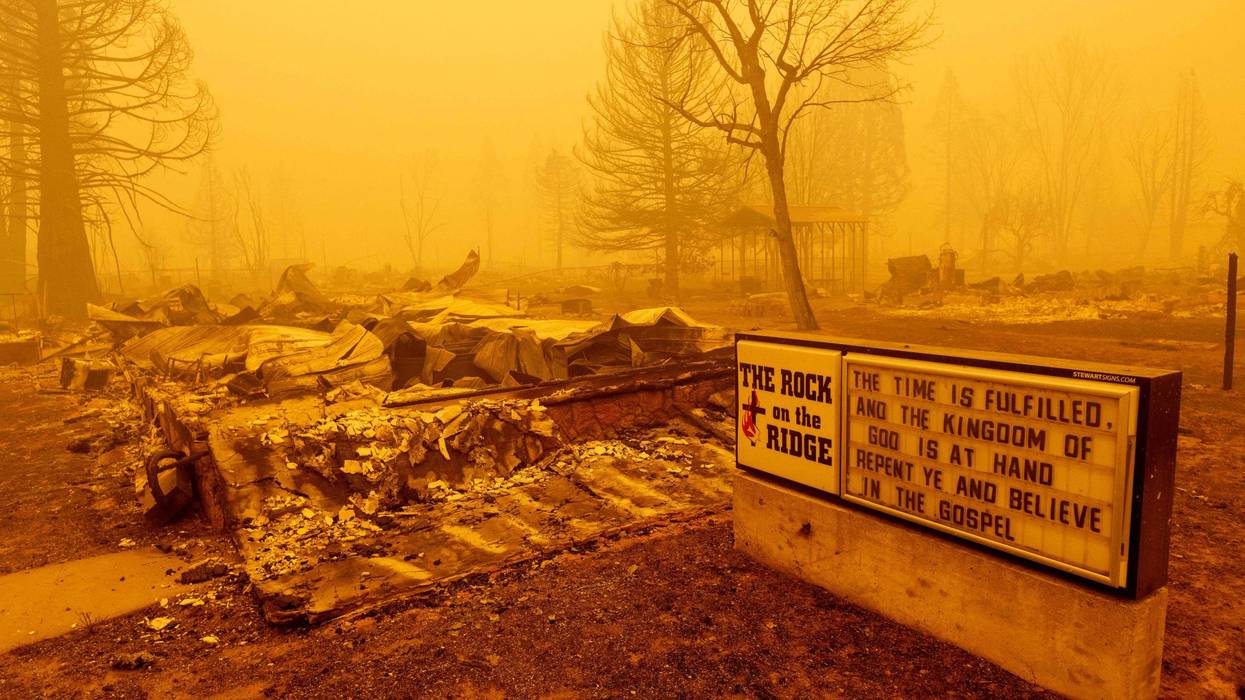
Greenville, my adopted town of 46 years, had been devastated by a climate-change disaster. Sparked by the negligence of Pacific Gas & Electric (PG&E), the Dixie fire scorched nearly one million acres, the distance, if you care to measure, from Philadelphia to New York City. On August 4th, a pyrocumulus cloud collapsed on the ridge above the tarnished old Gold Rush community where I worked, erupting into red-hot embers that fell over a several square-mile area. Trees were transformed into towering torches. Flames roared down the nearby mountain, racing through overcrowded forests left bone dry (after a century of ill-advised fire suppression) by a third year of drought. It took less than 45 minutes for that inferno to raze the historic 160-year-old downtown, including my journalism office on the second floor of the oldest building around. About 800 homes went up in flames. Over the next four months, we gathered in grief in twos and threes in the post offices and shops of neighboring towns, soothing one another.
Now, it was Christmas and snowing! We relaxed and rejoiced amid the ruins.
Little did we know that, driven by our overheated planet, we were about to be whiplashed from drought to deluge. Hotter days and hotter nights have corkscrewed our weather patterns into spiraling extremes, leaving entire regions around the world jerked from the hottest temperatures they've known to the coldest, from devastating fires to disastrous floods. This is uncharted territory and, scientists say, an all-too-grim preview of the future we're creating for ourselves.
By the fourth day of non-stop snow our euphoria had waned. Electricity was flickering on and off. The Internet was mostly off. We shoveled our steps and then the paths to our cars, only to find them covered all over again. Driveways were challenging and roads treacherous (if open at all). Snow was piling up across the Sierra Nevada, the gigantic tilted block of granite that lies along the state line with Nevada.
At Lake Tahoe, 75 miles to the south, 18 feet of snow was dumped on luxury second homes, collapsing decks, and taxing municipal snow-removal crews gone soft after years of mild winters. Highway 80, the main route over the mountains, was closed for three days by storms that made December the third snowiest month on record and the snowiest December ever. Those storms catapulted the state's precipitation to 258% of its average for that point in the year. California water officials were giddy with expectation, predicting that our three-year-old drought would be broken.
Then, of course, it ended. Precipitation of any kind simply stopped. January clocked in as the driest ever for some parts of the state, as well as most of Nevada, Utah, and western Colorado. Last month was the driest February in 128 years, according to a multi-agency partnership monitoring drought. And here's the truth of it: if we keep letting greenhouse gases increase in the atmosphere from the burning of fossil fuels, we better get used to this sort of seesaw experience. Scientists say that, by century's end, such abrupt transitions between wet and dry will increase by another 25% in northern California and possibly double that in southern California.
Weather Whiplash
While California may be a poster child for extreme weather events, they are occurring almost everywhere. Such wild swings from tinder-dry to inundation are known as climate or weather whiplash. What causes them is a matter of scientific speculation and the subject of much cutting-edge research, says Daniel Swain, a climate scientist at the Institute of the Environment and Sustainability at the University of California, Los Angeles. Some scientists cite a connection between the polar vortex, a wall of wind that circles the Arctic, and jet streams, the bands of strong winds that generally blow from west to east. As the Arctic warms--at as much as triple the average global rate--it seems to be destabilizing those jet streams and so, according to a study published in Environmental Research, provoking abnormal and extreme weather across the planet.
Swain thinks we should imagine it as a colossal tug of war involving complex atmospheric dynamics over the Pacific Ocean. Yes, he says, the world is definitely getting warmer as greenhouse-gas concentrations rise. That, in turn, means wet times will generally be wetter and dry times drier, especially in California. He's also found emerging evidence, as he told me, of what he calls "a relatively weird" regional effect: the loss of Arctic sea ice might actually be counteracting the drying effect of the expanding subtropical zone, keeping California from becoming more arid still in a warming world.
People in my community know local weather and the land. Ranchers, loggers, and firefighters, they understand storms and seasons, soil, water, and trees in an up close and personal way. I've found my place among them over these years, writing about their work and their love of the landscape we share. We here in Greenville may not know anything about what the intersection of the polar vortex and jet streams or atmospheric dynamics are doing to our world, but we certainly know when our environment is off kilter. Being jerked from the drought that provoked the Dixie fire to that historic snowfall and back again has left us with little doubt: something with the weather is seriously bonkers.
The unexpected uncertainty of weather we once took for granted is spawning anxieties that add to the trauma of living through a town-destroying fire. Instead of one disaster and done, weather whiplash threatens us with disaster after disaster. Having somehow survived fire, we've been thrust into a deeply uncertain future. The forests we turned to for hiking, fishing, and birdsong no longer promise solace. The natural world that welcomed and kept us in this valley ringed by mountains has become unreliable. What can we trust?
A Is for Anthropocene
When it comes to weather whiplash, Australia is exhibit A for Anthropocene, the current geological epoch dominated by the human impact on the environment. Storms have been pounding that island nation's southeast coast since late February, earning the moniker "rain bombs" for their severity. In just two days, the town of Doon Doon in New South Wales received 42 inches of rain, roughly Washington, D.C.'s annual precipitation. Flooding has killed 22 people so far, prompting Prime Minister Scott Morrison to declare a national emergency. This round of extreme wet weather follows the catastrophic bushfires of 2020 that killed 28 people and more than a billion animals, while scorching an area nearly the size of Connecticut in a fashion never before seen.
Worse yet, as we in California have discovered, the recovery time for communities between such climate disasters is shrinking. Simon Bradshaw, a researcher at the Australian Climate Council, summed things up simply enough: "New South Wales was hit hard by the 2019-20 Black Summer bushfires and now it is in the grips of another climate-driven disaster."
Then there's Texas. During the last decade that state has reeled from one of the most significant droughts since the 1950s to a series of deluges that have rivaled any period of flooding Texas has ever experienced. Rainfall in 2011 was 25 inches below average, forcing mandatory water restrictions. Meteorologist Jeff Lindner called the heat in Houston that August a 10,000-year event. Over the 2011 Labor Day weekend, vegetation primed by that drought combined with 40 mile-per-hour winds to produce the Bastrop fire, the single most devastating wildfire in that state's history. It burned more than 35,000 acres and around 1,600 homes, while the Tricounty fire incinerated over 19,000 acres and 100 homes.
Then the weather seesawed. By the time Hurricane Harvey made landfall at Port Aransas on August 27, 2017, the area had rocketed from drought to deluge. Rainfall for the year was nearly 30 inches above the annual average. Netherland, a city on the Gulf of Mexico, recorded more than 60 inches. The devastation Harvey wreaked affected an estimated 13 million people and included at least 107 deaths, nearly 135,000 homes damaged or destroyed (one third of the total number in four counties), and up to a million wrecked cars.
Governor Greg Abbott, a veteran climate-change denier who has threatened to sue President Biden over policies addressing the crisis, conceded that something was changing dramatically. "We need to recognize that this is going to be a new normal. A new and different normal for the entire region," he said.
Even when such weather swings don't create disasters, they have tangible consequences. Across the American Midwest, for instance, weather whiplash is driving a decline in municipal water quality. After excessive flooding followed a drought in 2012, researchers at the University of Kansas noticed a nitrogen spike in surface waters in the area. In dry times, the nitrogen fertilizer that farmers put in their fields doesn't go into the plants it's intended to enrich. A 2017 study found that the nitrogen stays in the soil, which acts like a sponge, holding it in place. "But as soon as you wet it," Amy Burgin, one of its authors, points out, "like when you wring a sponge, the nitrogen can flood into the rivers."
Such increasingly high nitrate levels in drinking water forced the Des Moines Water Works to construct a $4.1 million nitrate removal plant that costs $7,000 a day to operate. As weather whiplash becomes ever more the norm, scientists expect surface-water nitrate spikes to occur throughout the agricultural Midwest.
Elsewhere, the changing patterns of various kinds of wildlife are only exacerbating the problems caused by weird weather. In eastern Oregon, for instance, widespread drought followed by deep snow has caused elk to move out of the hills to feed on the haystacks that are ranchers' paychecks. Conflicts between wildlife and humans are already common enough, but climate scientists expect them to increase as droughts, floods, and fires push animals off their normal ranges and into agricultural areas.
Who Drives the Climate Train?
As I've learned all too personally, climate disasters are profoundly destabilizing. They can wrench communities from their roots and turn them upside down. They are also profoundly unjust. Those with the fewest resources and least responsible for the climate crisis are going to continue to bear the brunt of its impact.
And here's the only good news: climate change is a problem with a solution. We humans created it, which means it's solvable. That, however, would require societal and political will of a kind we simply haven't seen yet. And that's the bad news. We haven't mustered anything close to enough determination to halt the relentless increases in temperature driving the weather that's whiplashing us ever more violently. As United Nations Secretary General Antonio Guterres put it, a recent report by the Intergovernmental Panel on Climate Change is "a damning indictment of failed climate leadership... that reveals how people and the planet are getting clobbered by climate change."
Swain, the UCLA climate scientist, put it this way: "We're on a train going faster and faster down the tracks with perfectly functional brakes. But the drivers, for whatever reasons, are choosing not to engage the brakes."
One of the great ironies of experiencing climate-change disaster may be that we are both its victims and its drivers. We could, at least theoretically, apply the brakes of the locomotive. In our fury over the forces of destruction beyond our control--the flames that incinerate and the floods that inundate our lives--perhaps we'll find the political will and guts to bring meaningful change, at least on a very small scale right here in my town of Greenville.
In its charred devastation, we could now choose solar power over fossil fuels. (And if so, who would blame us for feeling smug about shunning PG&E?) We could choose community gardens over imported produce. All that, however, remains a distant future for a place with a single grocery store, a gas station, and little else. But if we must spend the rest of our lives healing, we can at least invest them in empowering one another and our community in a new way. We have so little left to lose.
Geologists have classified most epochs in Earth's history according to fossils, radiometric dating and composition of the strata. The widely endorsed label for our current era, the Anthropocene, describes the extent to which our collective human footprint is changing the planet. It's a proposed "geological epoch dating from the commencement of significant human impact on Earth's geology and ecosystems."
Although life on Earth has undergone vast changes over millions of years, never before has one species been the cause.
It's not a surprise to hear that humanity's impact is negative overall, as evidenced by global climate change, biodiversity loss and species extinction. Although life on Earth has undergone vast changes over millions of years, never before has one species been the cause.
Happily, in response to our negative impacts, many humans are engaged in repairing historical and ongoing ecological damage. Alongside our long list of negative impacts, examples of positive effects abound.
Actions that degrade and repair the planet's ecosystems do not amount to a zero-sum game, though. At any moment places are being destroyed and restored, but they're not the same places, and the actions don't happen in equal measure. We haven't repaired nearly as much as we've degraded and destroyed. (In fact, most restoration initiatives are pet projects of the very industries damaging the land.)
It's unrealistic to imagine that human lives, coupled with our many wants and needs, could ever be benign for the planet. But no one is arguing for this. Ecologists around the world are making the case for societies to change the systems that oversee development and resource extraction so that ecosystem functionality--which supports all life--can be maintained or restored.
Figuring out and upholding thresholds to ensure ecosystem health is not easy. Much thought has gone into determining goals to tip the scales in nature's favour, so that initiatives to heal the planet will outweigh activities that further degrade it, and ecosystem health can be restored where it's been lost.
Some scientists have argued that "nature needs half"--that half the planet's natural areas should be protected to maintain the processes that support human and non-human well-being. Considering we're just one of around 10 million animal species, and many areas we grudgingly yield are covered with rock, ice and snow, that's not a lot.
Last year, a group of international conservationists released a paper that advanced benchmarks to achieve a "nature positive" world. The goals are to reach zero net loss of nature after 2020, damage less than we repair by 2030 (become "net positive") and achieve "full recovery" by 2050.
Full recovery could mean many things. The Convention on Biological Diversity links it to ecosystem services maintenance: "By 2050, biodiversity is valued, conserved, restored and wisely used, maintaining ecosystem services, sustaining a healthy planet and delivering benefits essential for all people."
Our federal government is responsive to these targets and has made commitments to achieve them. However, it has not come up with a plan that outlines how these goals will be assessed and reported, nor defined what full recovery would look like in the Canadian context.
But there's wind in the sails; the UN has even declared this the "decade on restoration."
Our marks on the planet don't have to be permanent. They were put down by us and can be taken up or out by us too. We can apply the same ingenuity we used to construct the infrastructure we've imposed on the world around us to reconfigure it. Roads that fragment wildlife can be pulled out and replanted with vegetation; dams that block fish can be torn down.
As the editors of the essay collection Arts of Living on a Damaged Planet write, acts of restoration give us an opportunity to explore the question, "How can we repurpose the tools of modernity against the terrors of Progress to make visible the other worlds it has ignored and damaged?"
Our impacts on the planet are ongoing. One way of looking at the Anthropocene is to recognize that we are continually shaping the world with every development and restoration plan. Restoration initiatives give us the chance to hold the ground, literally, until, as Barry Lopez wrote in his book Horizon, "industrial expansion ends and begins to show signs of drawdown" and the scales tip back toward the health of lands and waters and the life they support.
Too often climate change is reduced to quantification of greenhouse glasses or melting ice caps. These indicators of climate change are important to verify the existence of the problem, but they are less constructive in helping us understand where the problem of climate change comes from. Understanding the source of climate change means moving beyond the source of GHGs and looking into the power relations that drive capitalist growth.
The first step to understanding climate change is understanding how power operates in the history of capitalist civilization.
We know climate change because we have a science to understand it. Many people are familiar with the standard natural science narratives, narratives that are divorced from society. Fewer people are familiar with the social science explanations of climate change, even fewer still incorporate notions of power into the explanation. The first step to understanding climate change is understanding how power operates in the history of capitalist civilization.
Most climate change scholarship treats society as a black box or explains the problem as one of homogenous humanity. Take for example the idea of the Anthropocene where humanity is treated as something of a plague, entirely disconnected from nature. In this line of thought, humanity itself is the problem. But this line of thinking ignores histories of power dynamics within humanity and between humanity and nature. It fails to acknowledge the contributions of the liberal arts to understanding power.
The Anthropocene line of thought suffers from a capitalist ideology that reduces relations of power and production to simplistic human activities. The construction of humanity as distinct from nature allows such an idea as the Anthropocene to proliferate. In this understanding of the world, people are not animals nor are they part of ecological systems. Instead, a small part of humanity represented by European colonizers transmogrifies into the quintessential representation of humanity (as the culmination of evolutionary processes), dominating over nature as God on earth while those who have been colonized are ejected from historical consideration along with their decidedly not Anthropocene knowledge and management of nature.
William Cronon documents the changing relationship of European colonizers to nature in the historical expansion of what is today the United States. Cronon illustrates the ideological transformations that situated white men as a stand-in for God, dominating over nature and able to control nature through science, itself a socially constructed norm for objectivity. The historical separation of a small segment of humanity from nature while simultaneously relegating that vast majority of humanity in an in-between state--neither sufficiently human nor sufficiently nature--means that today that more-or-less small segment of humanity controls the science and therefore how we conceptualize the problem of climate change. This conceptualization constructs humanity as the problem.
But humanity is not an undifferentiated whole. Only a small part of humanity, associated with Euro-colonizers, managed to colonize the world and dominate over an abstract nature that included the vast majority of its peoples. The reduction of most of the world's populations into non-humanity or nature began with the debates at Valladolid in the 16th century. It was during these debates that the indigenous peoples of the Americas were first identified as "savage" and in need of civilizing through Christianization. Said Christianization was used as a justification of land dispossession and occupation. Taking control of the land and enslaving (or virtually enslaving) the working classes served the purpose of extracting untold amounts of wealth for the colonizers. Revisiting old sites of natural resource extraction as technological innovations capitalize on new resources such as lithium is a recurrent process that propels the capitalist world economy. The solution cannot lie exclusively in so-called sustainable technological innovation.
When you understand that more than half of the world's humanity was deemed less than human and their civilization and cultural existence was erased from the historical record, it is difficult to comprehend the idea of the Anthropocene.
The economic imperative of accumulation and profit did not and does not operate independently of social processes. Not only was the material wealth extracted from nature that propelled capitalism forward largely lost in the 16th century, the knowledge of entire civilizations was intentionally destroyed and repressed. The written Mayan language system was burned in Diego de Landa's fires. Knowledge documented in the Incan quipu communication system was destroyed. What more was lost with the razing of entire civilizations in the Americas?
When you understand that more than half of the world's humanity was deemed less than human and their civilization and cultural existence were erased from the historical record, it is difficult to comprehend the idea of the Anthropocene. Yet the Anthropocene argument serves a purpose. It allows the wealthier countries to eschew responsibility by imposing their will on the places and peoples their enterprises have underdeveloped. It allows people in power to focus political attention on shorter showers and abandoning plastic straws as solutions to climate change. This is despite the fact that the engine of capitalism is growth for the sake of growth.
As Edward Abbey wrote: growth for the sake of growth is the ideology of the cancer cell. Our planet cannot handle an eternal growth model. We live in a finite system and capitalist innovation can only take us so far. Eventually, we run out of resources. Climate appears to be the limit. This past year has seen the most extreme temperatures on record and extreme weather events are more common than ever. Carbon dioxide levels, the primary measure of climate change, are the highest they have ever been measured. As climate expert Peter Gleick wrote on Twitter, the last time carbon levels were this high humans did not exist.
We need to cultivate in society an appreciation for dynamics of power in the relationship between capitalism and the rest of us, people and nature. There are insights to be gained from an understanding of how power factors in relations of humanity-in-nature throughout capitalist history. Social inequalities are environmental inequalities, those inequalities are an accumulation of wealth and privilege for a small number of people who benefit from a history of oppression. The wealthy need to better understand how sexism and racism operate as social structures in the same way they intuitively understand the economy. It takes more effort, but by learning about and addressing our personal role in inequalities we can realize a more just and equitable society which in turn will address climate change.
Climate change is an outcome of our current social organization. It threatens all of humanity. Altering our current social organization offers the possibility of creating a society-in-nature where all life is valued.
Humanity's transgression of ecological limits has caused widespread damage, including a climate emergency, catastrophic loss of biodiversity, and extensive degradation of soils around the world. Earth abuse is also at the root of the Covid-19 pandemic and the grim likelihood that new pathogens will continue to emerge from other animal species to infect humans.
Cultivation, deforestation, mining, livestock raising, and other activities degrade and destroy wildlife habitat, leaving animals no choice but to move closer to humans, potentially bringing pathogens along with them. Suburban sprawl and tourism (especially "eco-tourism") also bring humans and wildlife closer together. Hunting involves the most intimate contact with wild animals; indeed, the prevailing hypothesis is that the hunting of horseshoe bats probably kicked off the chain of events that led to the current coronavirus pandemic.
When ecosystems are disturbed or encroached upon, novel zoonotic viruses can move from wildlife into domestic animals and from there into humans.
Humans have lived with domestic animals for millennia, and our bodies may have learned how to deal with the pathogens passed back and forth. But when ecosystems are disturbed or encroached upon, novel zoonotic viruses can move from wildlife into domestic animals and from there into humans. There is strong circumstantial evidence that the 1918-19 influenza pandemic, which killed more than 675,000 Americans and as many as 50 million worldwide, began with the flu virus jumping from swine into humans in Haskell County, Kansas, moving on to what is now Fort Riley with new army recruits, and from there reaching the battlefields of World War 1.
The horrific wildfires that were ignited across Southeast Asia for land-clearing in 1997-98, combined with a regional drought, killed off many fruit-bearing trees in the forests of Malaysia. Fleeing the dead forests, fruit bats found sustenance in domestic orchards, bringing with them the Nipah virus. Swine being raised within the orchards became infected through the bats' virus-laden droppings and passed the virus on to the people who handled them. Nipah brings high mortality among both hogs and human population, killing approximately 50 percent of the people it infects.
We saw during the past year that once the new coronavirus gained a foothold in our species, the modern human propensity for long-distance travel quickly turned local outbreaks into a pandemic. Air conditioning, another technology with severe climate effects, was also implicated in Covid-19 outbreaks. Summertime, a season in which respiratory viruses typically wane, instead saw dramatic infection peaks throughout the Sun Belt as people escaped the heat and gathered in tightly enclosed, air-conditioned spaces.
Vacation cruises, which should have been banned decades ago given their exploitation of workers and heavy effect on the oceans and atmosphere, hosted some of the worst early outbreaks. The industrial meat industry, despoiler of soils and water, prolific emitter of greenhouse gases, also turned out to be an efficient viral incubator.
In some cases, greenhouse warming itself creates conditions for spread of zoonotic infection. In East and North Africa, for example, droughts have become more frequent and intense thanks to climate change. Many pastoralists have responded by replacing their cattle herds with camels, which, famously, can survive for long stretches of time without access to water. As a result, much larger numbers of camels are now in close contact with humans in the region. Worryingly, the coronavirus that causes Middle East respiratory syndrome is circulating in dromedary camel populations in several countries in the region.
MERS originated in bats, has become endemic in camels, and then over the past decade has repeatedly made the jump from camels into humans. It does not spread as readily from person to person as the Covid-19 virus, but it is orders of magnitude more deadly. Of approximately 2,500 people who have been infected by the MERS virus since 2012, one-third have died. As droughts worsen, farmers and herders take their camels on increasingly long journeys in search of forage. Trips often extend for days, and, without fuel for fire building, the herders often must sleep close to the camels for warmth. For want of fire and water, they also may sustain themselves by drinking the camels' milk raw. All of this increases the risk of virus transmission.
We may wriggle out from under the Covid-19 pandemic by year's end, but we won't be in the clear. It is likely that we will continue to encounter novel coronaviruses. Never before the year 2000 were coronaviruses known to emerge from bats into human populations and cause highly lethal disease in humans. In the two decades since, however, there have been three such events, involving SARS-CoV-1, which caused the 2002-2004 "severe acute respiratory syndrome" (SARS) pandemic; MERS-CoV, which causes MERS; and SARS-CoV-2, the cause of Covid-19.
In a 2020 article in the journal Cell, David Morens and Anthony Fauci--yes, that Dr. Fauci--wrote that as we continue disrupting the ecosphere, pathogens are finding their way into human populations with increasing frequency: "The COVID-19 pandemic is yet another reminder, added to the rapidly growing archive of historical reminders, that in a human-dominated world, in which our human activities represent aggressive, damaging, and unbalanced interactions with nature, we will increasingly provoke new disease emergences. We remain at risk for the foreseeable future. COVID-19 is among the most vivid wake-up calls in over a century. It should force us to begin to think in earnest and collectively about living in more thoughtful and creative harmony with nature, even as we plan for nature's inevitable, and always unexpected, surprises."
Our encroachment on the ecosphere has opened a Pandora's box. In addition to the viruses causing SARS, MERS, and Covid-19, some of the other bat coronaviruses studied so far have all the necessary pathogenic tools for attacking humans, and they have been shown to infect and sicken laboratory mice. According to a paper authored by a national group of ten researchers in the field, there are "enormous groups of bat coronaviruses distributed globally," and many, like SARS-CoV-2, are "functionally preadapted" to infecting humans. That preadaptation may be related to similarities among bats, minks, cats, humans, and some other mammalian species in our lung-cell membranes' susceptibility to entry by this group of viruses.
There's more. Since 2017, another coronavirus--emerging, like the Covid-19 and SARS viruses, from horseshoe bats--has been triggering deadly outbreaks among piglets in China. In the laboratory, the new bug appears to have the genetic potential to infect human airway and intestinal cells. Three different coronaviruses that cause severe disease in cattle, horses, and swine are closely related to another virus that has long been causing the common cold in humans. These livestock viruses may acquire, through genetic exchange, the ability to infect us.
Scientists are becoming increasingly concerned about the propensity of different coronavirus strains to engage in recombination, that is, to swap blocks of genetic code with one another. Reportedly, the code for shaping the "spike" protein that allows the virus to enter host cells is especially prone to recombination, raising concerns that code for versions of the spike that can serve as "keys" for opening human cells to infection could pass from human pathogens like the Covid-19 or common-cold viruses into livestock viruses. The latter might thereby acquire the ability to infect the people who work around them. In researchers' words, "[C]oronaviruses can change rapidly, drastically, and unpredictably via recombination with both known and unknown lineages."
The ten scientists who warned that coronaviruses are functionally preadapted to the human body further stressed that their data "reaffirm what has long been obvious: that future coronavirus transmissions into humans are not only possible, but likely. Scientists knew this years ago and raised appropriate alarm. Our prolonged deafness now exacts a tragic price."
What's good for the ecosphere is good for human health, and we are not helpless victims. Escaping ecological catastrophe and reducing the frequency of pandemics that might be lurking in the decades ahead is well within our capability, but it will require assiduous respect for ecological limits and great restraint in our interactions with nature.
This article was originally published by The Land Institute's Land Report.
The defining conflict of the 20th century was the conflict between capital and work. With the turn of the century the gender conflict came to the fore, paving the way for feminism to break the public-private boundary and show how the system is carried on the broad shoulders of women and their caregiving. Today, all signs suggest that the conflict set to erupt in the 21st century is between capital and biosphere - a conflict which exposes the physical limits of growth and the mass species extinction that characterises our era, the Anthropocene. Previous conflicts have not disappeared; on the contrary, they have worsened, but they now exist in a world where humankind is testing the limits of the very space in which we live.
The fire, as Greta Thunberg puts it, is spreading through the house. As temperatures continue to break records, the meagre results of international climate action reveal a disconnect between most of the world's governments and science.
The Covid-19 crisis is evidence that collapse on a global scale is possible. It has become clear that we are intricately connected at a global level, beyond the limits of our immediate communities and countries.
The Covid-19 crisis could see the climate agenda pushed even further to the margins. The unprecedented measures taken over the past year have been justified by arguments that they are necessary to respond to a "real" emergency such as the pandemic. These arguments distinguish between what is deemed an emergency (stopping the spread of the virus) and what is deemed an ominous forewarning (the environmental crisis). Climate change thus becomes an intangible phenomenon that affects the planet rather than a tangible emergency that harms individuals. This obscures the very real impacts of climate change on people's lives: flooded homes and neighbourhoods; extreme heat and cold endured by the most vulnerable; and a lack of protection in the face of biodiversity loss. Moreover, climate change and species loss is closely linked with the context in which pandemics flourishand therefore the vulnerability of humankind.
The Covid-19 crisis is evidence that collapse on a global scale is possible. It has become clear that we are intricately connected at a global level, beyond the limits of our immediate communities and countries. The pandemic has brought about an irreversible change of outlook. For decades, resource allocation has been oriented towards increasing market efficiency; basic rights such as healthcare have been commodified; competitiveness has taken precedence over cooperation. In a world where collapse is possible, prevention must be front and centre when it comes to devising and implementing public policies aimed at combatting climate change and building resilience. Rugged individualism will no longer wash.
The push to ensure that public interests, the decommodification of fundamental rights, and cooperation prevail demands a new eco-social agenda that aims to be hegemonic. This agenda should focus on three key aspects: biodiversity, the local, and energy transition.
In a post-Covid world, policy that protects and promotes biodiversity must become a priority. The ongoing mass destruction of species has until now been low down governments' agendas. Today, biodiversity loss and health can be clearly linked. As part of this planet, humanity's greatest guarantee of survival is the preservation of ecosystem services which provide essential benefits for human health.
To give one example: a debate in Barcelona in recent years has centred around the possible expansion of the airport and its impact on nearby protected areas, in particular the Llobregat Delta. The expansion threatened to affect a reservoir of biodiversity in this area, and completely overlooked the importance of nearby agricultural land. Today, the best strategy for any metropolitan area is to have spaces dedicated to the protection of biodiversity and farmland to encourage local production.
This leads us to the second vital component of a new eco-social agenda: the local. This can be broken down into two fundamental aspects. The first involves the care economy, and increasing the value - both in social and economic terms - attached to the everyday labour of caring for others which is so often carried out by women. The pandemic has laid bare how care work - often poorly paid or simply unpaid - forms the foundations of life. Recognising the value of this work and reassessing salaries to acknowledge what market logic is yet to comprehend is a key part of an eco-social strategy.
The second aspect relates to localised supply and value chains. The health crisis has exposed the vulnerability of societies dependent on goods that, despite being relatively simple to produce, are only manufactured thousands of miles away. The fact that face masks had to be shipped to Europe from China highlights the fragility of current models of production and consumption. The trend that began in the 1980s in countries such as the United Kingdom of phasing out domestic agriculture to replace it with cheaper products grown elsewhere ceases to make sense.
Globalised, hyper-connected economies have feet of clay; this crisis has evidenced the need for a rethink. Spain's service industry will suffer enormously in a world in which tourism holds less weight, and the country must be able to counteract this dependency by tilting its economy towards more local production chains that can internalise the cost of transporting goods.
The third pillar of the eco-social agenda is energy. Not only because energy is a way to tackle the challenge of climate change, but because it is a starting point from which to rethink the production model. Throughout history, energy has been a means to gain power and control. Today, there is no reason why control over energy sources should remain in the hands of a few corporations instead of being more widely distributed. Moving towards a new energy model would reduce Spain's energy dependence, which, at 74 per cent, stands well above the EU average (60 per cent). In Catalonia, the figure reaches 90 per cent due to the low penetration of renewable energies.
Today, unlike after the 2008 financial crisis, the cheapest energy by far comes from renewable sources. In the case of solar power, prices have dropped drastically in recent years. A new energy model based on decarbonisation could also help redistribute wealth and create a production and industrial framework with savings, efficiency, renewable generation, and demand management.
In many ways, this new energy agenda is about changing habits. The best kind of energy is energy saved, and now is the moment to double down on saving and efficiency policies to ensure that positive changes linked to reduced energy consumption that have emerged during the pandemic are maintained, for example remote working. Energy transition will hinge on the transformation of mobility, with greater emphasis on working from home, walking, cycling, public transport and ride sharing - in that order. This means moving from a culture of vehicle ownership to a culture of shared services. Air quality as a primary public health issue affecting cities today only makes this shift more urgent. The urban agenda is one of the most complex in the political arena, but nothing is more important when it comes improving quality of life and instigating a real energy transition.
The energy agenda also presents an opportunity for depopulated parts of rural Spain (read more the rural-urban divide in Spain) known as Espana vaciada ("emptied Spain"). These regions have the potential to offer more than beautiful scenery - they can also offer economic activity, production, and industry. Electricity generation stimulates employment, which in turn brings increased investment in the region and development. The expansion of renewable energy should be carried out in a progressive way, with generation models that reward investments made by local energy communities. At a time when the service industry is at risk of regressing dramatically, the energy agenda can be part of a move towards the re-industrialisation of Spain.
However, we must be aware of the limitations posed by the scarcity of the rare minerals needed to manufacture these technologies, as well as the limits to growth on a finite planet. There can be no technocratic illusion: the social model must change, and sustainability will not be achieved without political friction. A new energy model alone is not enough, though it would represent a significant breakthrough.
Every global challenge requires a degree of global governance, and there is much work to be done in this respect. Under the Trump administration the US was out of the picture, resulting in a lack of global leadership. Meanwhile, the EU has failed to make an appearance. The election of President Joe Biden may be more conducive to an environmental agenda but the number of voters who remained loyal to Trump shows that his administration was the political expression of a social bloc that is alive and kicking.
This century will be the century of climate change, where all conflicts will centre around the conflict between capital and biosphere. The question is no longer whether this will alter the foundations upon which policies and politics have been built, but when.
Despite such a gloomy outlook, the emergence of regional and continental leaders capable of establishing a more definitive agenda is of prime importance. The EU has the potential to be such a leader. High levels of energy dependence in Europe force the EU institutions to devise much more decisive policy than in other regions. In turn, the need to find new sectors for development makes the environmental agenda - and energy in particular - a determining factor in changing the production model.
After 2008, the European Union was caught up in its Calvinist austerity policies. In the wake of the current crisis, austerity policies may still make a return, a possibility which applies to Southern Europe as well as Central and Northern Europe. Moving forward, greenwashed solutions pose another threat. The challenge will be to ensure that investment is channeled into the recovery of public interests and social cohesion, responding to both present and future needs - in other words, following a green logic. Reviving Europe's economy demands an economic plan that works towards socio-ecological transformation.
The path ahead presents risks but also opportunities. To take advantage of these, the Greens will need the support of forces not yet on board and to build hegemony. Tackling climate change will necessarily involve acting not alone but with others. The way out is collective; that is to say, political. The environmental transition will filter through the entire social structure, from the collective imagination to legislation, through every budget of different administrations.
This century will be the century of climate change, where all conflicts will centre around the conflict between capital and biosphere. The question is no longer whether this will alter the foundations upon which policies and politics have been built, but when. The impacts of climate change will be felt widely and deeply, exacerbating tensions across a broad range of issues from migration to wealth distribution to gender inequalities. It remains to be seen whether the political agenda and emerging proposals will be up to the challenge, or whether they will blindly continue down a path of self-destruction. A modern, democratic society is one that knows how to anticipate future problems. A weak society is one that drags its feet before a challenge. For Catalonia and many other places in Europe that are particularly vulnerable to climate impacts, there is much at stake.