

SUBSCRIBE TO OUR FREE NEWSLETTER
Daily news & progressive opinion—funded by the people, not the corporations—delivered straight to your inbox.
5
#000000
#FFFFFF
To donate by check, phone, or other method, see our More Ways to Give page.
Daily news & progressive opinion—funded by the people, not the corporations—delivered straight to your inbox.
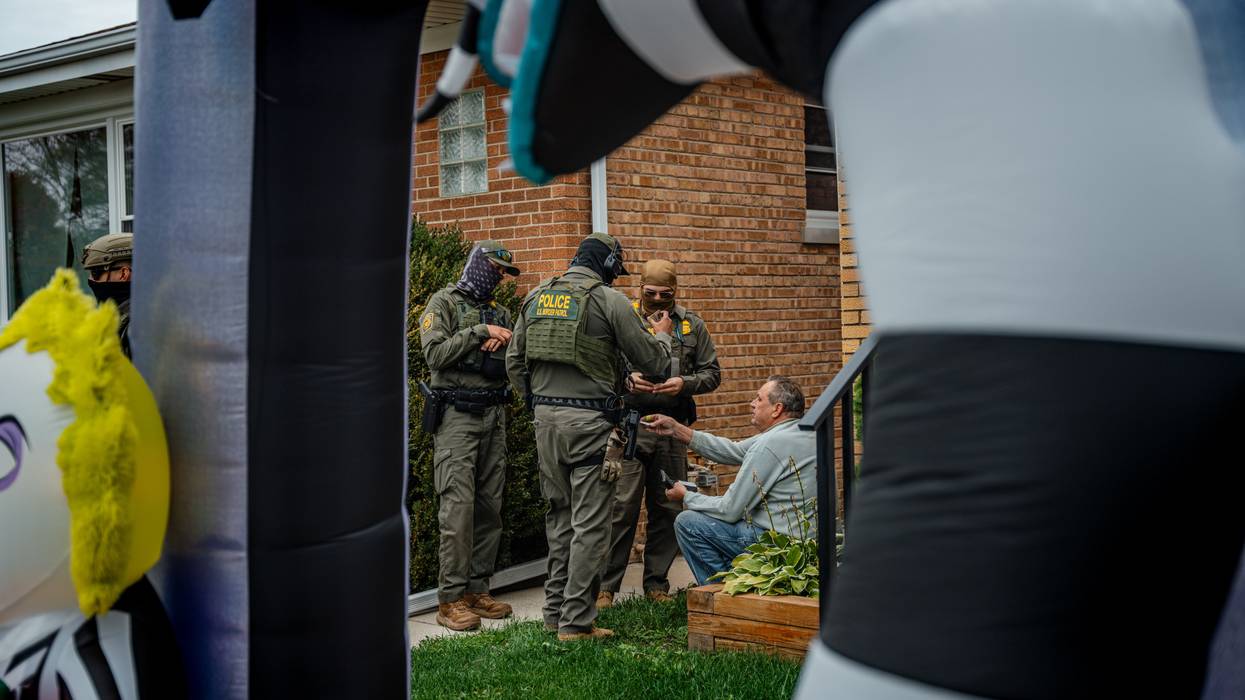
Chicago is hundreds of miles from Canada and 1,500 miles from Mexico, but US Customs and Border Patrol turned my peaceful suburb upside down on Halloween.
It can’t happen here.
I live in a quiet, affluent suburb just north of Chicago. Our house is on a brick street, surrounded by well-maintained homes with manicured lawns.
On Halloween day, leaves from 100-year-old oak and maple trees were turning yellow, amber, red, and orange. Landscapers with lawnmowers, leaf blowers, and rakes had begun annual fall cleanups. The setting resembled a Normal Rockwell painting.
As an attorney, I’m trained to make distinctions. A legal precedent that otherwise seems problematic can become irrelevant if the advocate can persuade the court to distinguish it. “The facts of that case are distinguishable from this one, your Honor” is every litigator’s rhetorical tool.
But that skill is fraught with dangerous traps. Distinctions in the service of selective perception and confirmation bias can facilitate complacency.
I’ve followed President Donald Trump’s deployment of the military on America’s streets. I watched the Los Angeles mobilization. The chaos and violence was and is disturbing, to say the least. But California is distinguishable from Chicago. For starters, it’s 2,000 miles away.
That can’t happen here.
When Trump sent troops into Washington, DC, that was distinguishable too. DC is a special situation where the federal government has unique powers.
Portland? Again, it’s thousands of miles away.
That can’t happen here. Besides, I had faith that the courts would keep Trump’s troops from running amok.
Before Trump moved his fight to Chicago, he posted ominously: “I love the smell of deportations in the morning… Chicago is about to find out why it’s called the Department of WAR.”
He wasn’t kidding. Three weeks later, a Black Hawk helicopter circled overhead as hundreds of armed officers raided an apartment building below. The assault occurred about 25 miles from my home. But the South Shore area is a world away from my north suburban life.
That can’t happen here.
Chicago is hundreds of miles from Canada and 1,500 miles from Mexico, but US Customs and Border Protection (CBP, or Border Patrol) turned my peaceful suburb upside down on Halloween.
Clear, sunny skies and a temperature in the mid-50s were perfect for the season. Soon the youngest trick-or-treaters, dressed in costumes that they had carefully selected or made, would emerge from elementary schools and descend on the neighborhood. Parents escorting their kids past spooky lawn displays would remain on the sidewalk as their children summoned the courage to ring the bell or knock on the door and say, “Trick or treat!”
But this Halloween, Nextdoor—a community engagement and communication site that usually includes information on gas leaks, water main breaks, traffic jams, and lost pets—had two disturbing videos of events a few blocks from my home.
The first victim was Hispanic—a 30-something delivery driver for Target. A resident with a smartphone started filming as she came upon the scene. Parked at the curb was the driver’s old maroon minivan. In the middle of the street alongside the van was a grey Chevrolet Tahoe with California license plates. The delivery driver’s doors and rear of the van were open, revealing his yet-to-be delivered packages.
For what’s now happening on the streets of America, the 21st-century adaptation should be: “If you see something, pull out your smartphone and film it. Then post it—everywhere you can.”
Two soldiers in military fatigues with CBP patches on their sleeves stood next to him. A third soldier who had been behind the wheel of the Tahoe joined the scene as the resident stopped her car to continue filming. The men were equipped for battle: masks covering everything but their eyes, helmets, body armor, and holstered sidearms. The driver provided some sort of identification card and waited nervously while one of the soldiers analyzed it.
“Are you ICE?’ the resident asked.
“Border Patrol, ma’am,” one of the soldiers answered.
“How do you sleep at night?”
“Great,” he answered as one of his colleagues nodded vigorously. “Just doin’ our job, ma’am.”
“Why are you here?” she inquired.
“We’re everywhere, ma’am.”
A few minutes later, one of the soldiers returned the driver’s identification card to him and shook his hand, saying, “Here you go, man. You’re all set, man.”
As the second soldier shook the driver’s hand, the first soldier turned to the camera and said, “Did you get that ma’am?”
He thought that he somehow deserved praise for the manner in which he had forcibly interrupted a citizen’s delivery route for no reason other than the color of the man’s skin and the sorry state of his van.
The two soldiers returned to their cars. As they drove away, the delivery driver turned to the camera, smiled, and said, “Thank you. Thank you. I appreciate it.”
He was one of the lucky ones. The government doesn’t track the number of US citizens it has held in detention facilities. So Pro Publica investigated and found that Immigration agents have held more than 170 American citizens, including nearly 20 children: “They’ve been kicked, dragged, and detained for days.”
The victim of the second Halloween episode in my suburb wasn’t as fortunate as the Target delivery driver. A resident’s video of that encounter showed a landscaper running down the street as three soldiers chased him. The video didn’t reveal what happened next.
Nextdoor videos and the Chicago Tribune documented other Halloween arrests in the nearby suburb of Evanston. In one videotaped incident, three soldiers detained two landscapers. A third landscaper was released after insisting that he was an American citizen—but only after they put him in handcuffs.
A witness who recorded a different incident in Evanston said, “They had yanked his shoes off, they were shoving him on the ground multiple times. It got to the level where they punched him. They kicked him. They slammed his head on the ground.” A video seemed to corroborate that account.
As word of the Border Patrol’s activities spread throughout the community, schools implemented a “soft” lockdown—closed campus, no outdoor recess, all Halloween festivities moved inside. The community had to protect innocent children from the trauma that its own government was inflicting on all of us.
Trump branded his Chicago deportation surge “Operation Midway Blitz.” It’s apt. “Blitz” is not only a football term, but also shorthand for Hitler’s early surprise attacks on neighboring countries at the start of World War II. Trump is “blitzing” his own country—and ours.
What can one person do? After 9/11, the ubiquitous catchphrase was: “If you see something, say something.”
For what’s now happening on the streets of America, the 21st-century adaptation should be: “If you see something, pull out your smartphone and film it. Then post it—everywhere you can.”
Observing an experiment changes it. The CBP soldiers who detained the Target delivery driver knew they were being filmed. So did the guys who handcuffed a landscaper before eventually letting him go. Perhaps those outcomes would have been the same without the scrutiny of a camera, but with more than 170 “mistaken” federal abductions, there’s no way to know for sure.
There are no longer any meaningful distinctions.
It can happen here. It is happening now. It’s happening to US citizens. And if it can happen in my peaceful suburb, it can happen where you live too.

Advocates on Saturday urged Congress to pass immigration reforms after at least nine migrants drowned while attempting to cross the swollen Rio Grande from Mexico into Texas earlier this week.
"Our border policies continue to kill."
According to reports, 37 migrants were rescued while trying to ford the surging river near Eagle Pass on Thursday, while eight other people are missing. U.S. Customs and Border Protection (CBP) spokesperson Rick Pauza said in a statement that federal and local authorities continue to search for possible survivors.
CBP said that U.S. authorities arrested 53 migrants at the scene, while their Mexican counterparts apprehended 39 others.
"My heart goes out to the families that have lost loved ones during their tragic journey to the U.S.," tweeted Rep. Jesus "Chuy" Garcia (D-Ill.) in response to the drownings. "This is an unfortunate reminder that we must prioritize our immigration laws along with the socio-economic policies that fuel displacement and migration."
Ieva Jusionyte, a professor of international security and anthropology at Brown University's Watson Institute, wrote that "our border policies continue to kill."
"Hardened borders are deadly," concurred Ruthie Epstein, a former deputy director of immigration policy at the ACLU.
The National Immigration Forum, a Washington, D.C.-based advocacy group, tweeted, "This heartbreaking tragedy highlights once again the need for Congress to act and pass immigration reforms."
"Congress must act quickly to pass solutions that bring compassion and security to our border, in the names of human lives and human dignity," the group added.
According to The New York Times:
The fire chief in Eagle Pass, Manuel Mello, said fierce currents had swept a number of migrants downstream as they attempted to cross about a mile south of the international bridge. Drownings have become an everyday occurrence in that section of the border, typically as many as one a day, and sometimes more, said the chief, a 58-year-old Eagle Pass native.
About two months ago, he said, 12 bodies were recovered on the same day--six by the Mexican authorities and six by U.S. rescue officials--after another large group tried to cross into the United States.
More recently, two boys, one 3 years old and the other 3 months old, slipped from the grasp of an uncle as they were attempting to cross, he said. The older boy drowned, and the infant was rushed to a San Antonio hospital in critical condition.
Belying Republican claims that President Joe Biden's "open border" policies are to blame for tragedies like the Eagle Pass drownings and the fatal asphyxiation of 53 people in a tractor-trailer near San Antonio in June, a Reuters investigation published earlier this year noted that "migrants have increasingly turned to riskier methods of entering the U.S. as enforcement policies along the border have strengthened."
Related Content

According to the Reuters report, there have been more than 1,000 border fatalities during Biden's tenure, both on land and in the river.
"The Rio Grande is treacherous unless you know the safe crossing points," said Mondoweiss editor James North. "Migrants should be able to cross at ports of entry and request asylum."
Aaron Reichlin-Melnick, director of policy at the advocacy group American Immigration Council, noted that "migrants who try to go to the Eagle Pass port of entry and seek asylum have been completely turned away since March 2020, and largely turned away since April 2018."
"With the ports of entry shut except in limited circumstances, desperate people feel like they have no other options," he added.
In May, a federal judge issued an injunction blocking the Biden administration from lifting Title 42, a public health order first invoked during the Trump administration and used by both presidents to deport around two million asylum-seekers under the pretext of the Covid-19 pandemic.
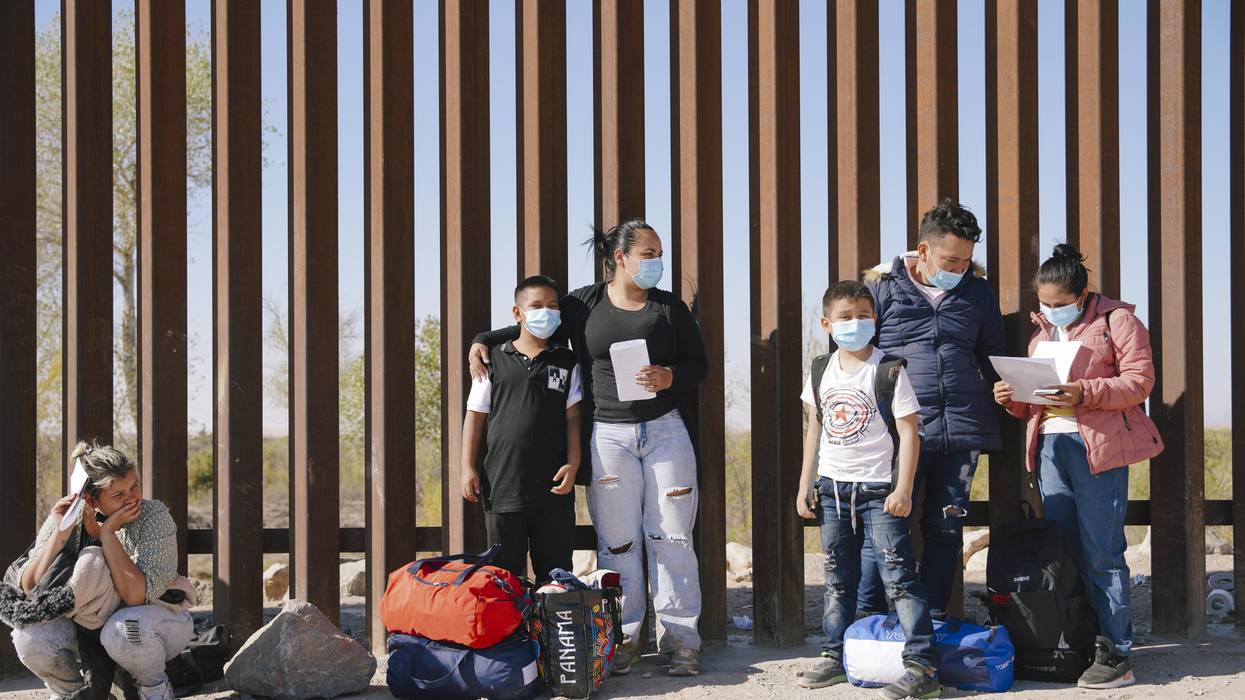
First, it was the Customs and Border Protection (CBP) vehicles speeding along on the road in front of our campsite. Then it was the Border Patrol's all-terrain vehicles moving swiftly on a ridge above us. I was about 10 miles north of the border with Mexico, near Pena Blanca Lake in southern Arizona, camping with my six-year-old son and some other families. Like fire trucks racing to a blaze, the Border Patrol mobilization around me was growing so large I could only imagine an emergency situation developing.
While the Biden administration has ditched the racist justifications that went with it, its officials continue to zealously promote the building of a border-wall system that's increasingly profitable and ever more like something out of a science-fiction movie.
I started climbing to get a better look and soon found myself alone on a golden hill dotted with alligator junipers and mesquite. Brilliant vermilion flycatchers fluttered between the branches. The road, though, was Border Patrol all the way. Atop the hill opposite mine stood a surveillance tower. Since it loomed over our campsite, I'd been looking at it all weekend. It felt strangely like part of French philosopher Michel Foucault's panopticon--in other words, I wasn't sure whether I was being watched or not. But I suspected I was.
After all, that tower's cameras could see for seven miles at night and its ground-sweeping radar operated in a 13-mile radius, a capability, one Border Patrol officer told me in 2019, worth "100 agents." In the term of the trade, the technology was a "force multiplier." I had first seen that tower freshly built in 2015 after CBP awarded a hefty contract to the Israeli company Elbit Systems. In other words, on top of that hill, I wasn't just watching some unknown event developing; I was also in the middle of the border-industrial complex.
During Donald Trump's years in office, the media focused largely on the former president's fixation with the giant border wall he was trying to have built, a xenophobic symbol so filled with racism that it was far easier to find people offended by it than towers like this one. From where I stood, the closest stretch of border wall was 10 miles to the south in Nogales, a structure made of 20-foot-high steel bollards and covered with coiled razor wire. (That stretch of wall, in fact, had been built long before Trump took office.)
What I was now witnessing, however, could be called Biden's wall. I'm speaking about a modern, high-tech border barrier of a different sort, an increasingly autonomous surveillance apparatus fueled by "public-private partnerships." The technology for this "virtual wall" had been in the works for years, but the Biden administration has focused on it as if it were a humane alternative to Trump's project.
In reality, for the Border Patrol, the "border-wall system," as it's called, is equal parts barrier, technology, and personnel. While the Biden administration has ditched the racist justifications that went with it, its officials continue to zealously promote the building of a border-wall system that's increasingly profitable and ever more like something out of a science-fiction movie.
As March ended, one week before my camping trip, I saw it up close and personal at the annual Border Security Expo in San Antonio, Texas.
"Robots That Feel the World"
The golden chrome robotic dog trotted right up to me on the blue carpet at the convention center hall. At my feet, it looked up as if it were a real dog expecting me to lean over and pet it. According to the Department of Homeland Security's Science and Technology Directorate, this "dog" will someday patrol our southern border. Its vendor was undoubtedly trying to be cute when he made the dog move its butt back and forth as if wagging its tail (in reality, two thin, black antennae). Behind the vendor was a large sign with the company's name in giant letters: Ghost Robotics. Below that was "Robots That Feel the World," a company slogan right out of the dystopian imagination.
According to its organizers, this was the most well-attended Border Security Expo in its 15-year history. About 200 companies crowded the hall, trying to lure officials from CBP, U.S. Immigration and Customs Enforcement, border sheriffs' departments, and international border forces into buying their technologies, sensors, robots, detectors, and guns. As I stood staring at that surreal dog, behind me the company Teledyne Flir was showing off its video surveillance system: a giant retractable mast sitting in the bed of a black pickup truck. On the side of the truck were the words "Any Threat. Anywhere."
Another company, Saxon Aerospace (its slogan: "Actionable Intelligence, Anytime, Anywhere"), had a slick, white, medium-sized drone on display. One vendor assured me that the drone market had simply exploded in recent years. "Do you know why?" I asked. His reply: "It's like when a dog eats blood and gets carnivorous."
Elsewhere, the red Verizon Frontline mobile command-and-control truck looked like it could keep perfect company with any Border Patrol all-terrain vehicle unit; while Dell, the Texas-based computer firm, displayed its own frontline mobile vehicle, promising that "whether you're providing critical citizen services, innovating for the next generation, or securing the nation, we bring the right technology... and far-reaching vision to help guide your journey."
And don't forget 3M, which has moved well beyond its most famous product, Scotch tape, to provide "rugged and reliable equipment across DoD [Department of Defense], DoJ [Department of Justice], DHS [Department of Homeland Security], and U.S. state and local agencies." Top defense contractors like Airbus (with a shiny black helicopter on display in the center of the expo hall) were also present, along with top border contractors like General Dynamics, Lockheed Martin, and Elbit Systems.
Just the day before the expo opened, the Biden administration put out its fiscal year 2023 budget, which proposed $97.3 billion for the DHS, that agency's largest in its two-decade history. The Customs and Border Protection part of that, $17.5 billion, would similarly be the most money that agency has ever received, nearly $1.5 billion more than last year. Although Immigration and Customs Enforcement received just a marginal increase, it will still get $8.5 billion. Combine just those two and that $26 billion would be the highest sum ever dedicated to border and immigration enforcement, significantly more than the $20 billion that the Trump administration started out with in 2017. As DHS secretary Alejandro Mayorkas put it, such a budget will help secure our "values." (And in an ironic sense, at least, how true that is!)
"Notably," Mayorkas added, "the budget makes smart investments in technology to keep our borders secure and includes funding that will allow us to process asylum claims more efficiently as we build a safe, orderly, and humane immigration system."
What Mayorkas didn't mention was that his border plans involve ever more contracts doled out to private industry. That's been the case since 9/11 when money began to pour into border and immigration enforcement, especially after the creation of the Department of Homeland Security in 2002. With ever-growing budgets, the process of privatizing the oversight of our southern border increased significantly during the administration of President George W. Bush. (The first Border Security Expo was, tellingly enough, in 2005.) The process, however, soared in the Obama era. During the first four years of his presidency, 60,405 contracts (including a massive $766 million to weapons-maker Lockheed Martin) were issued to the tune of $15 billion. From 2013 to 2016, another 81,500 contracts were issued for a total of $13.2 billion.
In other words, despite his wall, it's a misconception to think that Donald Trump stood alone in his urge to crack down on migration at the border. It's true, however, that his administration did up the ante by issuing 87,293 border-protection contracts totaling $20.9 billion. For Biden, the tally so far is 10,612 contracts for $8 billion. If he keeps up that pace, he could rack up nearly $24 billion in contracts by the end of his first term, which would leave Trump's numbers and those of every other recent president in the dust.
If so, the contracts of the Trump and Biden administrations would total nearly $45 billion, slightly surpassing the $44.3 billion spent on border and immigration enforcement from 1980 to 2002. In the media, border and immigration issues are normally framed in terms of a partisan divide between Democrats and Republicans. While there is certainly some truth to that, there are a surprising number of ways in which both parties have reached a kind of grim border consensus.
As Maryland Democratic Congressman Dutch Ruppersberger, a member of the House appropriations committee, said ever so beamingly on a screen at that Expo conference, "I have literally put my money where my mouth is, championing funding for fencing, additional Border Patrol agents, and state-of-the-art surveillance equipment." And as Clint McDonald, a member of the Border Sheriff's Association, said at its opening panel, the border is "not a red issue, it's not a blue issue. It's a red, white, and blue issue."
When I asked the Ghost Robotics vendor if his robo-dog had a name, he replied that his daughter "likes to call it Tank." He then added, "We let our customers name them as they get them." While we were chatting, a prospective customer asked, "What about weapons mountable?" (That is, could buyers weaponize that dog?) The vendor immediately assured him that they were already working with other companies to make that happen.
Later, when I asked Border Patrol Chief Raul Ortiz about the surveillance dogs, he downplayed their significance, stressing the media hype around them, and saying that no robo-dogs were yet deployed anywhere on the border. Nonetheless, it was hard not to wander that hall and think, This, much more than a wall, could be our border future. In fact, if the "big, beautiful" wall was the emblem of Donald Trump's border policy, then for the Biden moment, think robo-dogs.
Border Security Is Not a "Pipe Dream"
The night before I stood on that hill in Arizona, I had heard people passing through the campsite where my son and I were sleeping in a tent. Their footsteps were soft and I felt no fear, no danger. That people were coming through should hardly have been a surprise. Enforcement at our southern border has been designed to push such border-crossing migrants into just the sort of desert lands we were camping in, often under the cover of night.
The remains of at least 8,000 people have been found in those landscapes since the mid-1990s and many more undoubtedly died since thousands of families continue to search for lost loved ones who disappeared in the borderlands.
The remains of at least 8,000 people have been found in those landscapes since the mid-1990s and many more undoubtedly died since thousands of families continue to search for lost loved ones who disappeared in the borderlands. Those soft footsteps I heard could have been from asylum seekers fleeing violence in their lands or facing the disaster of accelerating climate change--wilted crops and flooded fields--or economic dispossession in countries where foreign corporations and local oligarchies rule the day. Or all of that combined.
For years, I've been talking to migrants who crossed isolated and hazardous parts of the Arizona desert to bypass the walls and guns of the Border Patrol.
I thought of them when, on the last day of that Border Security Expo, I watched Palmer Luckey, the CEO of Anduril, a new border surveillance company, step up to the podium to introduce a panel on "The Digital Transformation of the Border." The 20-something Luckey, already worth $700 million, had floppy brown hair and wore a Hawaiian shirt, cargo shorts, and flip-flops. He told the audience of border industry and Homeland Security officials that he was wearing shades because of recent laser surgery, not an urge to look cool.
He did look cool, though, as if he were at the beach. And he does represent the next generation of border tech. Since 2020, his company has received nearly $100 million in contracts from Customs and Border Protection.
His introduction to the panel, which sounded to me more like a pitch for financing, offered a glimpse of how the border-industrial complex now works. It was like listening to a rehearsal for the lobbying appearances he and his company would undoubtedly make in Congress for the 2023 budget. In 2021, Anduril spent $930,000 lobbying on issues that mattered to its executives. It also gifted political candidates with nearly $2 million in campaign contributions.
Luckey's message was: fund me and you'll create a "durable industrial base," while ensuring that border security will not be a "pipe dream." Indeed, in his vision, the new border-surveillance infrastructure he represents will instead be an autonomous "pipeline," delivering endlessly actionable information and intelligence directly to the cell phones of Border Patrol agents.
I was thinking about his pitch again as I stood atop that hill watching the border apparatus quickly mobilize. I was, in fact, looking at yet another Border Patrol vehicle driving by when I suddenly heard a mechanical buzzing overhead that made me think a drone might be nearby. At our southern border, the CBP not only operates the sizeable Predator Bs (once used in U.S. military and CIA operations abroad), but small and medium-sized drones.
I could see nothing in the sky, but something was certainly happening. It was as if I were at the Expo again, but now it was real life. I was, in fact, in the middle of the very surveillance-infrastructure pipeline Luckey had described, where towers talk to each other, signal to drones, to the all-terrain vehicle unit, and to roving Border Patrol cars.
Then the buzzing sound abruptly stopped as a CBP helicopter lifted into the air, its loud propellers roaring.
The Real Crisis
After that dramatic helicopter exit, I wondered if there was indeed a border emergency and finally decided to get in my car and see what I could find out, leaving my son with our friends. As I rounded a corner, I came across Border Patrol agents and vehicles at the side of the road with a large group of people who, I assumed, were migrants. About four individuals had already been put in the back of a green-striped Border Patrol pickup truck, handcuffed and arrested. They had the tired look I knew so well of people who had walked an entire night in an unknown, hazardous landscape, had failed, and were now about to be deported. The agents of the ATV detail were lounging around in their green jumpsuits as their quads idled, as if this were all in a day's (or night's) work, which indeed it was.
I remembered then hearing those footsteps as my son slept soundly and thought: The border is not in crisis. That's impossible. The border's inanimate. It's the people walking through the desert--the ones who crept past us and those in the back of that truck or soon to be put in other trucks like it, arrested so far from home--who are actually in crisis. And it's a crisis almost beyond the ability of anyone who hasn't been displaced to imagine. Otherwise, why would they be here in the first place?
The ongoing border-crisis story is another example of what Uruguayan writer Eduardo Galeano once would have called an "upside down" world, so twisted in its telling that the victim becomes the victimizer and the oppressor, the oppressed. If only there were a way we could turn that story--and how so many in this country think about it--right-side up.
As I was mulling all of that over, I suddenly noticed the omnipresent "eye" of the Elbit Systems tower "staring" at me again. Its superpower cameras were catching the whole scene. Perhaps its radar had detected this group to begin with. After all, the company's website says, "From the darkest of nights to the thickest of brush, our border solutions help predict, detect, identify, and classify items of interest." Not people, mind you, but the handcuffed "items of interest" in the back of that truck.
As I watched the scene unfold, I remembered a moment at that Expo when a man from the Rio Grande Valley asked a panel of Department of Homeland Security officials a rare and pointed question. Gesturing toward the hall where all the companies were hawking their wares, he wondered why, if there was so much money to be made in border security, "would you even want a solution?"
The long uncomfortable silence that followed told me all I needed to know about the real border crisis in this country.

A leading U.S. drug policy reform advocate on Thursday welcomed the inclusion of harm reduction policies in President Joe Biden's inaugural National Drug Control Strategy, a plan that comes amid a record surge in fentanyl-driven overdose deaths.
"We must embrace the evidence-based public health approaches we know work and save lives."
"We applaud the Biden-Harris administration for taking the historic step--to support access and funding for harm reduction services and reduce barriers to lifesaving medications," Grant Smith, deputy director of the Office of National Affairs at the Drug Policy Alliance, said in a statement. "Despite over one million lives lost to drug overdose over the last 20-plus years, this is the first time an administration has included harm reduction in the National Drug Control Strategy."
"The administration should continue to focus on its promise of equity by decreasing racial disparities in drug policy and the overdose crisis," Smith asserted.
"From 2020 until now, Black people have experienced a 48.8% increase in overdose mortality, Hispanic or Latino people experienced a 40.1% increase, and American Indians and Alaska Natives experienced the highest increase in overdose mortality of all ethnic groups" he noted. "This cannot continue."
Citing the "heartbreaking toll" of 106,854 U.S. overdose deaths over the past year, the White House said its 2022 National Drug Control Strategy "focuses on two critical drivers of the epidemic: untreated addiction and drug trafficking."
In addition to addressing untreated addiction for people at risk of overdose, the administration's plan "calls for greater access to harm reduction interventions including naloxone, drug test strips, and syringe services programs."
Naloxone--sold under the brand name Narcan--is an opioid blocker than can rapidly reverse the life-threatening effects of an overdose. Testing strips detect fentanyl--a powerful synthetic opioid added to various drugs to increase their potency--but are outlawed as paraphernalia in many states.
Dr. Rahul Gupta, director of the White House Office of National Drug Control Policy, told NPR that "the most important action we can take to save lives, right now, is to have naloxone in the hands of everyone who needs it without fear or judgment."
"The most important action we can take to save lives, right now, is to have naloxone in the hands of everyone who needs it without fear or judgment."
Biden's strategy "directs federal agencies to integrate harm reduction into the U.S system of care to save lives and increase access to treatment." It also calls for "collaboration on harm reduction between public health and public safety officials, and changes in state laws and policies to support the expansion of harm reduction efforts across the country."
The strategy's anti-trafficking elements include a proposed $300 million increase--"one of the largest ever"--in U.S. Customs and Border Protection funding, as well as " efforts to strengthen domestic law enforcement cooperation."
While the White House says the plan aims to "advance racial equity in the investigation, arrest, and sentencing for drug-related offenses," Smith expressed disappointment in the administration's perpetuation of the failed War on Drugs.
"Criminalization approaches only saddle mostly Black, Hispanic, and Indigenous people with criminal legal records and often incarceration, which increases their risk for infectious diseases, overdose, and death," he said. "Prioritizing federal spending on public health rather than enforcement and interdiction is the best path forward."
Smith contended that with so U.S. overdose deaths and a crisis that costs the nation's economy more than $1 trillion annually, "we must embrace the evidence-based public health approaches we know work and save lives."
"But," he stressed, "it must be done outside of the harmful apparatus of the drug war to be effective and provide the kind of racial equity this administration has long promised."

A group of Haitian asylum-seekers and their advocates on Monday filed a class-action lawsuit against President Joe Biden, Homeland Security Secretary Alejandro Mayorkas, and numerous U.S. agencies and officials alleging physical abuse, racism, unlawful expulsion, and other "inhumane" mistreatment at the hands of immigration authorities.
"By deporting me and other asylum-seekers, President Biden has condemned us to death."
The federal lawsuit, which was filed by the San Diego-based Haitian Bridge Alliance and Innovation Law Lab on behalf of 11 asylum-seekers, alleges that U.S. government violated the plaintiffs' statutory and constitutional rights during their detention at a U.S. Customs and Border Protection (CBP) encampment in the border city of Del Rio, Texas in September 2021.
"I'm struck that a country I believe could provide safety and protection for me would absolutely humiliate me and others this way," said plaintiff 'Paul Doe.' "By deporting me and other asylum-seekers, President Biden has condemned us to death."
The lawsuit takes aim at Title 42, a section of the Public Health Safety Act first invoked by the Trump administration as the Covid-19 pandemic began in March 2020 that has been continued--and extended--by the Biden administration, which has deported hundreds of thousands of migrants under the law.
The suit calls Biden's embrace of Title 42 "consistent with the United States' long history of anti-Haitian and anti-Black immigration policies," as "racism and white supremacy motivated the earliest U.S. immigration policies and have continued to shape immigration laws through the present."
"U.S. officials' abuse of Haitians... did not stop with the Title 42 process," the lawsuit asserts. "Despite President Biden's promises to restore dignity and compassion to the U.S. asylum system, senior White House and Department of Homeland Security officials developed a 'Haitian Deterrence Policy' to apply the Title 42 process in a way that subjected Haitian asylum-seekers in Del Rio to deplorable conditions while in government custody, was deliberately indifferent to humanitarian concerns, and focused on expelling Haitian asylum-seekers as quickly as possible."
Plaintiffs Mirard Joseph and Madeleine Prospere and their one-year-old daughter arrived in Del Rio in September to legally seek asylum. According to the lawsuit, the family experienced "extreme hunger" because the CBP encampment where they were held provided insufficient food. Joseph said he was forced to cross the Rio Grande River back into Cuidad Acuna, Mexico to purchase food.
The suit states that as he was returning to the camp, "U.S.officials on horseback chased and lashed Mirard, and tried to force him back to Mexico."
Photos of a mounted U.S. Border Patrol agent wielding his reins like a whip against Mirard sparked worldwide outrage and condemnation, including from Biden, who vowed that "people will pay" for the incident. Several plaintiffs in the lawsuit said they "saw officers on horseback using reins as whips against people in the river."
Related Content

Days later, Mirard, Prospere, and their daughter were taken to a detention facility. According to the lawsuit, the adults "were shackled and--without being told where they were going--expelled with their young child to Haiti. They never received an opportunity to seek asylum or explain why they feared returning to Haiti... Madeleine has been forced to separate from their family to take their young daughter to Chile for medical care that was unavailable in Haiti for the illnesses she developed in the CBP encampment. They plan to return to the United States to seek asylum."
"Instead of providing asylum-seekers and refugees the legal protection afforded under the law, the U.S. government treated them with contempt, anti-Black prejudice, and summarily expelled them."
Guerline Jozef, co-founder and executive director of Haitian Bridge Alliance, said in a statement that "the stories I heard coming out of the Del Rio encampment will forever haunt me: mothers with newborns denied basic necessities such as shelter and medical care, children being fed nothing or only bread, and outright derision and discrimination from U.S. authorities."
"The world watched as Black asylum-seekers were abused and dehumanized by men on horseback," she continued. "As a Black Haitian-American woman descendant of enslaved people in the Americas, I cannot disconnect this treatment of Black bodies in Del Rio from the historical treatment of Black bodies in the United States."
"Instead of providing asylum-seekers and refugees the legal protection afforded under the law, the U.S. government treated them with contempt, anti-Black prejudice, and summarily expelled them without any due process after they suffered and bore witness to CBP abuse in Del Rio," Jozef added. "Immigration is a Black issue."
Tess Hellgren, deputy legal director of Innovation Law Lab, said that "the U.S. immigration system has punished Black migrants and the people of Haiti time and time again. With this lawsuit, we say no to white supremacy in the immigration system. We say no to the violence, the discrimination, the expulsion, and the cruelty. We stand with Haitian Bridge Alliance and the Haitian people harmed by U.S. immigration enforcement."
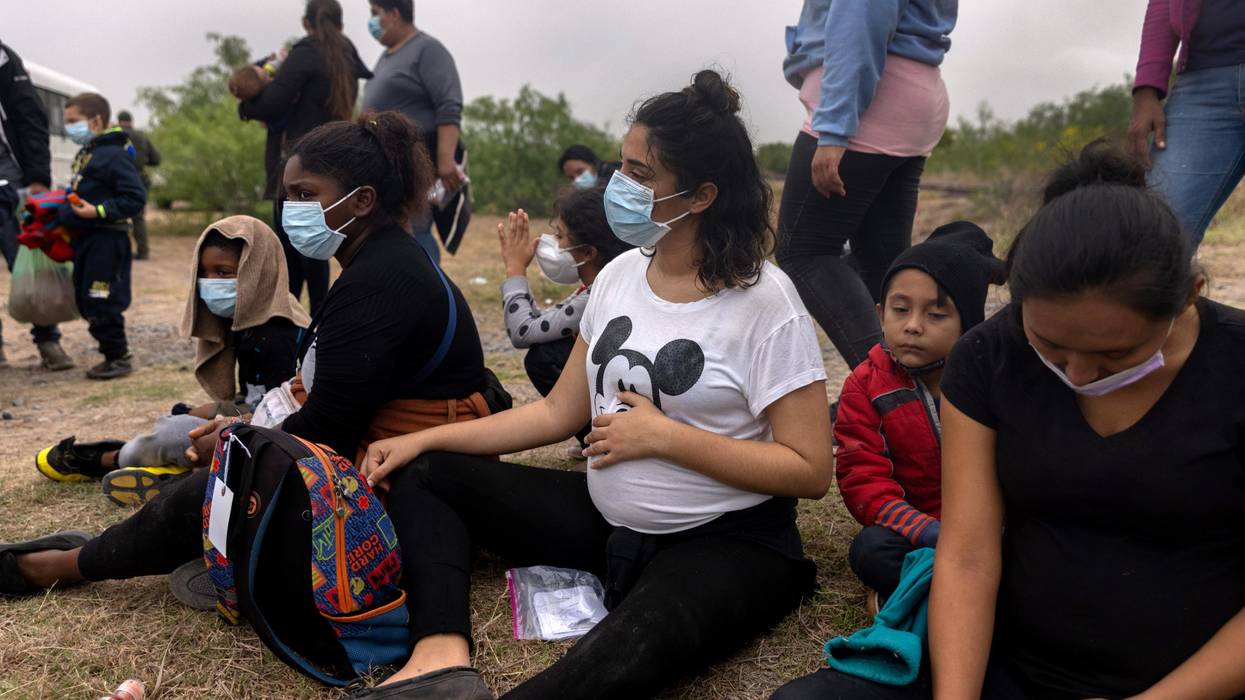
Recently, U.S. Customs and Border Protection (CBP) issued new guidance requiring baby bassinets and "snacks" to be available to infants and people who are pregnant, postpartum, or nursing in CBP detention. Neither are of comfort in hieleras--freezing cold, overcrowded holding cells notorious for their harsh conditions. And none of the added features included in the new policy can compensate for the physical and emotional strain of CBP detention conditions on people who are pregnant, postpartum, or nursing their newborns.
Our demand in response is simple: CBP must stop detaining pregnant, postpartum, and nursing people altogether by prioritizing their prompt release to their networks of care in the United States.
Though highly anticipated, CBP's guidance falls embarrassingly short and will do little to address the well-documented pattern of mistreatment of pregnant people in the agency's custody. The new guidance demonstrates that instead of moving away from detaining these uniquely vulnerable populations altogether, CBP is attempting to double down on unnecessary and dangerous detention practices.
In January 2020, the ACLU of San Diego & Imperial Counties (ACLU-SDIC) and the ACLU of Texas filed a complaint with the U.S. Department of Homeland Security's Office of the Inspector General (OIG) calling for an immediate review of mistreatment of pregnant people detained in CBP facilities. Such mistreatment regularly imperiled the viability of pregnancies, even sometimes resulting in miscarriage. Nancy, one mother interviewed by the ACLU-SDIC, reported:
"...that the food she received was spoiled and served cold; she could not bring herself to eat it ... [she] had been taken into custody in wet and mud-covered clothing, [and] was neither permitted a change of clothing nor provided a chance to shower for the duration of her detention."
In April 2020, ACLU-SDIC filed a subsequent complaint on behalf of a pregnant woman who suffered mistreatment at the Chula Vista Border Patrol Station. After arresting her for routine processing, instead of facilitating her immediate access to critical medical care, CBP officers subjected her to a "rough ride" to a Border Patrol station, "jerk[ing] the steering wheel and slamm[ing] on the brakes." Her experience only deteriorated inside the station, where she was forced to give birth while holding onto a trash can for support. The woman reported:
"Her husband heard the baby's cries and, desperate to ensure the safety of his newborn child, lowered his wife's pants and reached for the baby's head, which was protruding out of her body. A Border Patrol agent and multiple medical staff also reached for the baby, some without gloves, and the baby was born. Although joyous about the birth of her child, [she] felt humiliated after realizing she had been surrounded by about 20 strangers, including multiple CBP agents and other unknown detained men, while she gave birth."
The woman was finally taken to a hospital after she gave birth. After she was discharged, however, Border Patrol forced her to return to the Chula Vista Border Patrol Station for a night of postpartum detention together with her newborn baby.
In response to the complaint on behalf of the woman who gave birth at the Chula Vista Border Patrol Station, the OIG issued a report in July 2021 finding a number of deficiencies in the manner in which CBP and Border Patrol respond to in-custody births. The OIG recommended that CBP "expedite releases because holding U.S. citizen newborns at Border Patrol stations poses health, safety, and legal concerns." Eleven senators wrote to Homeland Security Secretary Alejandro Mayorkas urging DHS to adopt a policy similar to one that Immigration and Customs Enforcement (ICE) adopted earlier this year, which states that "[g]enerally, ICE should not detain, arrest, or take into custody" people who are "known to be pregnant, postpartum, and/or nursing." Instead of heeding the senators' recommendations and following ICE's lead on this issue, CBP has chosen a path of further detention, entrenching a practice that jeopardizes the safety and well-being of people like the ACLU-SDIC's client and her newborn baby.
Among other things, CBP's new guidance purports to improve access to medical care and basic items like snacks, liquids, and diapers in hieleras; conditions under which parents can nurse and change diapers in hieleras; and documentation of childbirths in hieleras. But it fails to address the fundamental problem that CBP detention in hieleras threatens the health and dignity of pregnant, postpartum, and nursing people and their newborns, and that a humane alternative exists. The risks of CBP detention that the new guidance purports to mitigate, including limited access to medical care, inadequate care for infants, and inconsistent documentation of in-custody births, could be prevented altogether if CBP instead prioritized the prompt release of people who are pregnant, postpartum, or nursing. This would avoid the possibility of in-custody births of U.S. citizen babies and alleviate the need to accommodate postpartum and nursing parents.
The July 2021 OIG report included images of the ACLU-SDIC's client laying down on a concrete bench in a hielera with her newborn U.S. citizen baby wrapped in an aluminum blanket for warmth. CBP's response to this disturbing image was to suggest adding a bassinet for the baby and to offer snacks and milk.
Our demand in response is simple: CBP must stop detaining pregnant, postpartum, and nursing people altogether by prioritizing their prompt release to their networks of care in the United States, so that these individuals may pursue their immigration cases in safe and humane conditions.
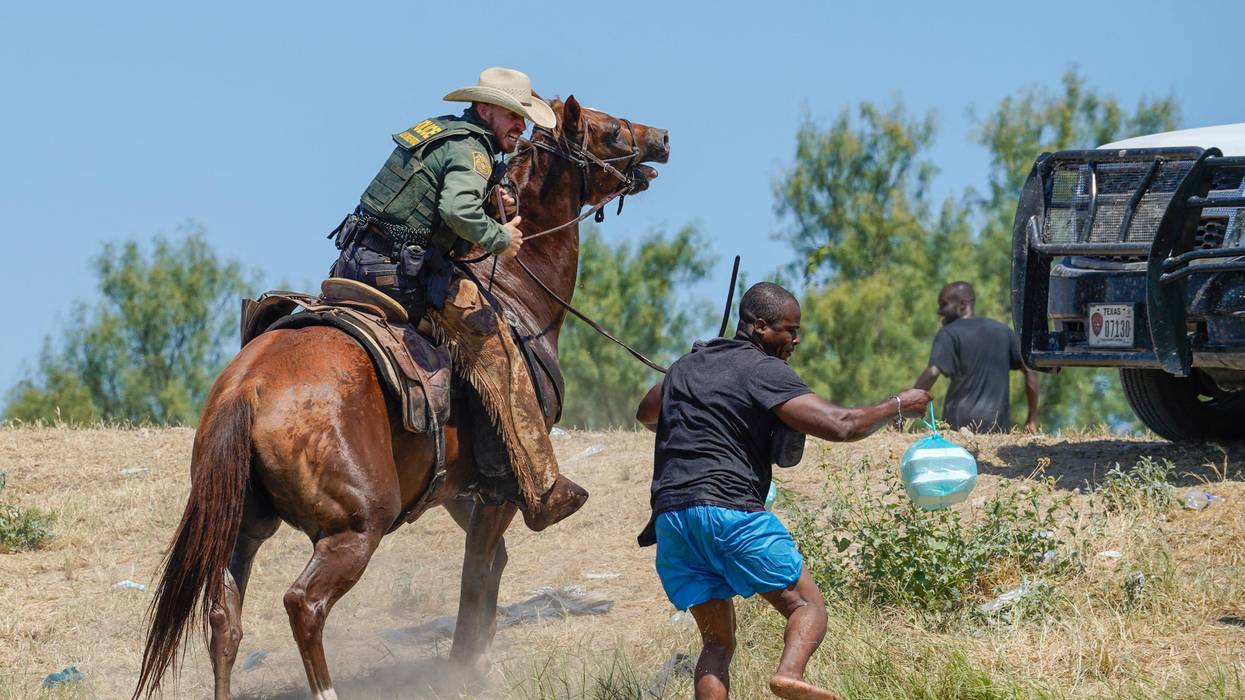
Ghastly images and videos this week showed Border Patrol agents on horses, using their reins aggressively to intimidate Haitians, including small children, on the riverbank in Del Rio, Texas.
Unfortunately, any observer of Border Patrol can tell you that its mistreatment of migrants is far from an isolated incident. Such cruelty warrants a congressional investigation--not only into the specific actions in Del Rio but, more importantly, into systemic problems within Border Patrol that allow such abusive conduct with seeming impunity.
Border Patrol's long record of failure to confront wrongdoing within its ranks is what perpetuates recurring abuses.
The Department of Homeland Security has promised an investigation and deployed oversight personnel on site in Del Rio "full-time." But that announcement came only after Homeland Security Secretary Alejandro Mayorkas initially brushed off reports of agents' actions, accusing reporters of "assuming facts that have not yet been determined."
There is little reason to have confidence in the department's willingness to hold its agents accountable, given unfulfilled past pledges to investigate Border Patrol abuses. Those inquiries have most often resulted in zero accountability and frequently disappear from sight without public resolution.
Reports on internal investigations based on CBP's own records found that it took no action in 96% of 1,255 cases of alleged Border Patrol misconduct between January 2012 and October 2015.
Based on this abysmal track record, Congress should be skeptical of any DHS internal review and conduct an independent investigation of Border Patrol's Del Rio disgrace. The department has consistently failed to punish civil rights abuses or, worse, is unwilling to do so. Even its staff doesn't trust the culture. A 2019 inspector general report found that 47% of CBP employees surveyed at the nation's largest law enforcement agency did not believe officials at all levels were held accountable for their conduct.
Major accountability-first reforms must transform Homeland Security, including the proper use of body-worn cameras, which CBP announced six weeks ago (but no border agent apparently wore in Del Rio). Until then, the Biden administration should assign the Department of Justice to lead in investigating and punishing Homeland Security civil rights violations.
According to CALFIRE, 2020 was the largest wildfire season in California's modern history, with 4.1 million acres set ablaze. Now, in 2021, we are in the middle of the third driest year on record with water restrictions likely to come later this...
Accountability efforts should also avoid another familiar CBP smokescreen: blaming a few "bad apples," training flaws or policy gaps to mitigate agents' inexcusable violence. No doubt there are lots of agents who behave professionally and deplore misconduct, but that is despite a toxic culture that has shown again and again that it valorizes brutality over human rights in controlling the border.
When the Border Patrol's tactical unit deployed to Portland in 2020 and was infamously recorded spiriting a protester away in an unmarked van, Americans experienced the Border Patrol's reputation for brutality that dates to the 1920s. CBP's own former deputy assistant commissioner for internal affairs has described a widespread self-perception by agents that they are "members of a 'paramilitary organization' and soldiers 'on the front line' of a war against criminal organizations and terrorism." He said "many agents asserted that CBP's mission was to protect the border at all costs, even at the expense of human life."
Aside from prompt, transparent investigation and discipline of agents involved, Border Patrol leadership at all levels must be held to account as well. Border Patrol Chief Raul Ortiz's decision to deploy agents on horseback led directly to the confrontations with migrant families. The Biden administration appointed Ortiz without explaining how a 29-year veteran of the Border Patrol could be a needed change agent for a deeply flawed and entrenched culture. Indeed, before taking office, Ortiz said he did not plan to make any drastic changes.
It shouldn't be a surprise, then, that--despite his new role as head of the Border Patrol, responsible for setting accountability standards--Ortiz reflexively defended the agents he had recently led as chief of the Del Rio sector. He claimed their actions were most likely just an attempt to control the horses.
Border Patrol's long record of failure to confront wrongdoing within its ranks is what perpetuates recurring abuses. No one should be taken in by the Homeland Security crisis-management playbook. Unless Congress investigates Border Patrol and forces reforms, we will get yet another whitewash.

Over the next few weeks, the Senate is expected to confirm Ed Gonzalez, the former elected sheriff of Texas' Harris County, as the next Immigration and Customs Enforcement (ICE) director. In his confirmation hearing, Gonzalez committed to continuing the 287(g) program, which turns local law enforcement into a gateway to deportation and deepens collaboration between ICE and local police, despite Harris County ending this program under his leadership in 2016.
In spite of national outcry to defund law enforcement agencies and overwhelming evidence that ICE and CBP are fundamentally flawed, Sheriff Gonzalez's testimony and President Biden's FY 2022 budget requesting $8.4B for ICE and $16.3B for CBP make it clear that the Biden administration intends to perpetuate racial discrimination and strip immigrant communities of their safety and dignity.
We must urgently overhaul our immigration system, starting with defunding ICE and CBP and investing in the resources that matter most to our communities. Our organizations, Detention Watch Network and United We Dream, lead the Defund Hate Campaign, a coalition committed to divesting from ICE and CBP while calling for our tax dollars to be invested in strengthening communities.
ICE and CBP are deeply embedded within the US prison industrial complex, which continues to deprive people of their liberty, upholds inhumane and abusive living conditions and perpetuates a culture of violence that has devastating and sometimes fatal consequences. The American Immigration Lawyers Association reported six deaths in CBP custody in 2021 thus far, three deaths by Border Patrol and four deaths in ICE detention centers.
These tragedies only scratch the surface of the pain and trauma inflicted by ICE and CBP. This data does not account for the people who died after ICE intentionally released them without any form of medical support while they were severely ill or the immeasurable danger migrants are faced with after being turned away by Border Patrol and denied their right to seek asylum and safety in the U.S. In his confirmation hearings, Gonzalez offered no plan to address these systemic abuse and human rights violations within ICE.
Our policing and incarceration system is broken beyond repair. No amount of money can change that our country's systems of policing, including ICE and CBP, is rooted in white supremacy and white nationalism.
The tragic events over the past year, from George Floyd to Ma'Khia Bryant, have brought unprecedented focus on how law enforcement at all levels upholds white supremacy. We cannot defund ICE and CBP without defunding the police. Stripping these institutions of funding is key to dismantling our country's racist policing infrastructure and protecting our families, friends and communities. Programs like 278(g) allow local law enforcement and ICE to explicitly work together to advance oppression, and law enforcement and ICE share the same jails, prisons and detention centers. Government contracts allow ICE to use spaces in local jails, and many ICE detention centers were previously jails or prisons. In 2019, seven Louisiana jails were turned into privately run immigrant detention facilities after a statewide criminal justice overhaul reduced the prison population.
President Biden's continued funding of ICE and CBP violates the promises he made to our communities and allows white nationalism to deepen as Black and brown people in our communities continue to be disproportionately targeted, detained, deported, and killed. This is the legacy the Biden administration is choosing to chart. Sheriff Gonzalez has made it clear in his Senate confirmation hearings that his commitment is not to reforming ICE but to allowing this cycle of abuse to continue.
Since the creation of ICE in 2003, the agency's budget and mandate have grown exponentially while continuing to inflict harm on our communities. Instead of criminalizing immigrants, our leaders must end immigration detention, cooperation between law enforcement and immigration agencies and create a system that restores humanity.
The Biden administration was given the opportunity to rebuild trust and deliver justice to the families who have been ripped apart by our criminal legal system, ICE and CBP. As the number of people in ICE detention has increased at an alarming rate since the start of the Biden administration, nearly doubling in mid-July, and as the Senate works to confirm an ICE director committed to maintaining the status quo, it is clear they have failed. In order to begin the long journey toward racial justice in this country, we must defund the systems that perpetuate violence and hate. The safety and health of our communities depend on it.

Social and environmental justice advocates welcomed a federal judge's ruling Monday that two U.S. agencies broke the law by not conducting an analysis of potential ecological harms associated with increased militarization along the U.S.-Mexico border.
Monday's ruling (pdf) found that officials at both the U.S. Department of Homeland Security (DHS) and U.S. Customs and Border Protection (CBP) violated the National Environmental Policy Act by failing to prepare an updated and detailed environmental impact statement for the U.S.-Mexico border enforcement program.
The court's decision stems from a 2017 lawsuit filed by U.S. Rep. Raul Grijalva (D-Ariz.) and the Center for Biological Diversity.
"This is a win for wildlife and communities along the border, where the government has behaved as if the laws don't apply," Brian Segee, endangered species legal director at the Center for Biological Diversity, said in response to the court's decision. "This victory follows years of federal officials neglecting the environment and the health and well-being of borderland communities."
While DHS and CBP officials argued that enforcement along the U.S.-Mexico border had not changed in the two decades since the agencies last submitted an environmental impact statement, the judge wrote that there are numerous "examples of expanding federal action in the form of border enforcement activity."
The Center for Biological Diversity noted Monday in a statement that the 2001 review, which "was supposed to be updated every five years, but never has been... identified potential harm from border wall construction and other enforcement operations to wildlife and endangered species across four states from the Pacific Ocean to the Gulf of Mexico."
"We hope the Biden administration takes a long overdue look at the wanton environmental destruction from border militarization."
--Brian Segee, Center for Biological Diversity
According to the Center, U.S. security operations along the southern border have escalated over the past 20 years, including "off-road vehicle patrols, installation of high-intensity lighting, construction of base camps and checkpoints, wall construction, and other activities."
Under the Trump administration, the group noted, federal agencies also "ramped up wall construction by waiving dozens of laws protecting the environment, public health, and safety."
"Also since 2001, scientific understanding has advanced significantly regarding the potential harm from border walls and other border enforcement activities on wildlife and endangered species, including jaguars, ocelots, Mexican gray wolves, and cactus ferruginous pygmy owls," the organization said.
Furthermore, "beyond jeopardizing wildlife, endangered species, and public lands, ongoing border militarization damages human rights, civil liberties, native lands, local businesses, and international relations," added the Center. "Border militarization and the border wall impede the natural migrations of people and wildlife that are essential to healthy diversity."
Although the court ruled that federal officials did not violate the Endangered Species Act, the judge wrote that there were "undisputed statements of fact which demonstrate that there was a large number of new or revised critical habitat designations for threatened or endangered species within the southern border enforcement corridor since 2001."
Those designations by the U.S. Fish and Wildlife Service, the judge added, "constitute triggering events for which Defendants should have contemporaneously considered and evaluated the need for supplemental environmental analysis."
In response, Segee of the Center for Biological Diversity said that "we're disappointed the court stopped short of ordering a new environmental impact statement, but we hope the Biden administration takes a long overdue look at the wanton environmental destruction from border militarization."

Still wet from the river and held outdoors under the Anzalduas International Bridge overnight, the mother of a 6 year old pleaded with Border Patrol agents to help her sick child and others. "They're not going to die," replied one agent, according to a report by the Los Angeles Times.
But children have died in Border Patrol custody. And conditions at Border Patrol's Anzalduas Bridge "Temporary Outdoor Processing Site" (TOPS)--a stretch of gravel and grass patches under an international highway in Texas' Rio Grande Valley--risk the health and safety of the migrants who are detained there. That's why we're calling on the Biden administration to immediately close the site and implement oversight measures to ensure Border Patrol no longer holds anyone under such inhumane conditions.
The Biden administration must reject the inhumanity of Trump-era practices and close the Anzalduas Bridge site.
Border Patrol began holding migrants at this outdoor site buried deep on federal property and out of public view on Jan. 23, 2021. It has detained migrants, including families with children, under the Anzalduas Bridge ever since--except for the multiple times when the site, located in a flood plain, has been evacuated due to weather conditions.
In late June 2021, we joined a brief official tour of the Anzalduas TOPS, during which Border Patrol representatives described the site as being used exclusively to hold families with children under 7 years old. Though we were not allowed to speak with those detained there, what we observed was deeply concerning.
The temperature was in the 90s. For the dozens of children and adults detained outdoors in the heat, only a fan and a set of overhead sprinklers provided plainly inadequate cooling. At a meeting in May, a Border Patrol representative justified holding families in the South Texas summer heat by egregiously claiming that the conditions are preferable to many migrants, who Border Patrol described as "not used to air conditioning."
In addition to having no basic temperature controls, the TOPS has a bare-bones structure that lacks other minimal protections. Families are funneled through a series of outdoor areas surrounded by plastic fencing. We observed them being held in an area with hard benches and gravel as the only places to rest or sleep.
Border Patrol told us there is no medical staff on site beyond emergency medical personnel, and the nearest paved road to get to medical aid is a five to 10 minute drive away. Border Patrol has even given us conflicting answers about what, if any, detention standards apply to the site. This is particularly troubling since detention standards mandate a "reasonable and comfortable" temperature for those detained--contrary to the very design of the TOPS.
Just last week in the Rio Grande Valley, we interviewed recently released families with small children who reported that thousands of people were being held at the site. Every family reported spending two or three days under the bridge. Mothers shared that Border Patrol denied their pleas for medical care for sick children and that they experienced miserable conditions in high temperatures.
The TOPS has also been shrouded in secrecy. There are no telephones for migrants, and, like all Border Patrol facilities, no in-person visits are allowed. As pictures of a make-shift outdoor site began to surface earlier this year showing families with small children sleeping on the ground in corral-like holding areas, we filed a Freedom of Information Act (FOIA) request seeking details. We wanted to know how long people were being held outdoors and how Border Patrol was ensuring the safety of those in custody. Over four months later, the agency still hasn't responded to our FOIA request.
Subsequent reporting and our own interviews confirmed that families were being held outdoors under the bridge for multiple days, without adequate access to medical care, subjected to verbal abuse by Border Patrol agents, and suffering from first cold springtime and then hot summer temperatures.
Border Patrol said on our tour in June that families were held on the site for six to eight hours before being released to local shelters. But the agency also indicated that no one was released from the facility between 10 p.m. and 6 a.m.--indicating families may in fact be held longer.
This is unfortunately not the first time we have witnessed Border Patrol hold migrants in wholly inhumane conditions outdoors. At least twice the Trump administration held children and adults in similar disgraceful outdoor conditions--once underneath a bridge in El Paso, Texas, and once in a Border Patrol parking lot in McAllen, Texas.
The Biden administration must reject the inhumanity of Trump-era practices and close the Anzalduas Bridge site. Border Patrol has demonstrated that it simply cannot hold people in appropriate conditions at this site. Border Patrol's willingness to detain families with very young children in such a place reflects the agency's systemic failures to provide humane detention conditions. Border Patrol's lack of transparency is also deeply concerning and shows the need for outside access to the facilities where it holds migrants.
The administration should also take steps to remove Border Patrol from the detention business altogether. With the agency's long track record of abuse, the Biden administration cannot allow conditions like those under the Anzalduas Bridge to persist. We demand better.