SUBSCRIBE TO OUR FREE NEWSLETTER
Daily news & progressive opinion—funded by the people, not the corporations—delivered straight to your inbox.
5
#000000
#FFFFFF
To donate by check, phone, or other method, see our More Ways to Give page.
Daily news & progressive opinion—funded by the people, not the corporations—delivered straight to your inbox.
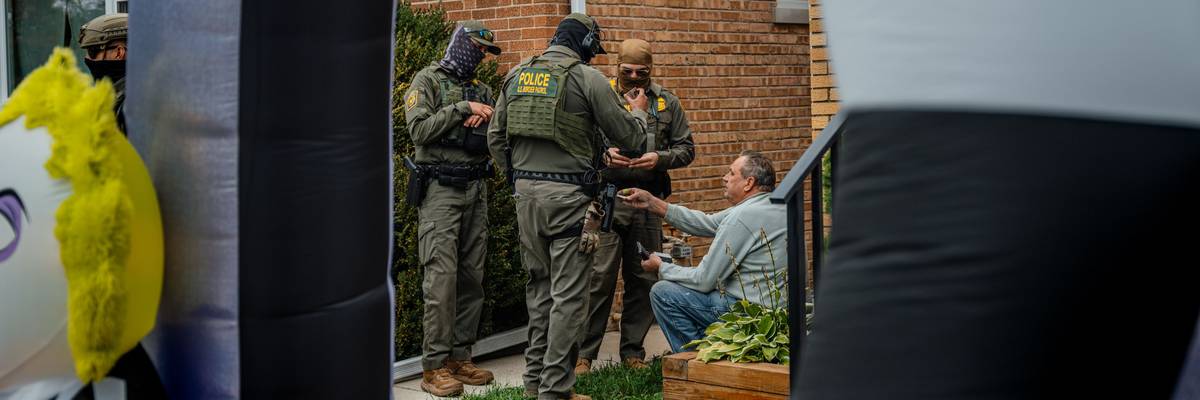
Federal agents, including Chief Patrol Agent Gregory Bovino of the El Centro Sector for US Customs and Border Protection, detain two men working on a home in the Edison Park neighborhood on October 31, 2025, in Chicago, Illinois.
Chicago is hundreds of miles from Canada and 1,500 miles from Mexico, but US Customs and Border Patrol turned my peaceful suburb upside down on Halloween.
It can’t happen here.
I live in a quiet, affluent suburb just north of Chicago. Our house is on a brick street, surrounded by well-maintained homes with manicured lawns.
On Halloween day, leaves from 100-year-old oak and maple trees were turning yellow, amber, red, and orange. Landscapers with lawnmowers, leaf blowers, and rakes had begun annual fall cleanups. The setting resembled a Normal Rockwell painting.
As an attorney, I’m trained to make distinctions. A legal precedent that otherwise seems problematic can become irrelevant if the advocate can persuade the court to distinguish it. “The facts of that case are distinguishable from this one, your Honor” is every litigator’s rhetorical tool.
But that skill is fraught with dangerous traps. Distinctions in the service of selective perception and confirmation bias can facilitate complacency.
I’ve followed President Donald Trump’s deployment of the military on America’s streets. I watched the Los Angeles mobilization. The chaos and violence was and is disturbing, to say the least. But California is distinguishable from Chicago. For starters, it’s 2,000 miles away.
That can’t happen here.
When Trump sent troops into Washington, DC, that was distinguishable too. DC is a special situation where the federal government has unique powers.
Portland? Again, it’s thousands of miles away.
That can’t happen here. Besides, I had faith that the courts would keep Trump’s troops from running amok.
Before Trump moved his fight to Chicago, he posted ominously: “I love the smell of deportations in the morning… Chicago is about to find out why it’s called the Department of WAR.”
He wasn’t kidding. Three weeks later, a Black Hawk helicopter circled overhead as hundreds of armed officers raided an apartment building below. The assault occurred about 25 miles from my home. But the South Shore area is a world away from my north suburban life.
That can’t happen here.
Chicago is hundreds of miles from Canada and 1,500 miles from Mexico, but US Customs and Border Protection (CBP, or Border Patrol) turned my peaceful suburb upside down on Halloween.
Clear, sunny skies and a temperature in the mid-50s were perfect for the season. Soon the youngest trick-or-treaters, dressed in costumes that they had carefully selected or made, would emerge from elementary schools and descend on the neighborhood. Parents escorting their kids past spooky lawn displays would remain on the sidewalk as their children summoned the courage to ring the bell or knock on the door and say, “Trick or treat!”
But this Halloween, Nextdoor—a community engagement and communication site that usually includes information on gas leaks, water main breaks, traffic jams, and lost pets—had two disturbing videos of events a few blocks from my home.
The first victim was Hispanic—a 30-something delivery driver for Target. A resident with a smartphone started filming as she came upon the scene. Parked at the curb was the driver’s old maroon minivan. In the middle of the street alongside the van was a grey Chevrolet Tahoe with California license plates. The delivery driver’s doors and rear of the van were open, revealing his yet-to-be delivered packages.
For what’s now happening on the streets of America, the 21st-century adaptation should be: “If you see something, pull out your smartphone and film it. Then post it—everywhere you can.”
Two soldiers in military fatigues with CBP patches on their sleeves stood next to him. A third soldier who had been behind the wheel of the Tahoe joined the scene as the resident stopped her car to continue filming. The men were equipped for battle: masks covering everything but their eyes, helmets, body armor, and holstered sidearms. The driver provided some sort of identification card and waited nervously while one of the soldiers analyzed it.
“Are you ICE?’ the resident asked.
“Border Patrol, ma’am,” one of the soldiers answered.
“How do you sleep at night?”
“Great,” he answered as one of his colleagues nodded vigorously. “Just doin’ our job, ma’am.”
“Why are you here?” she inquired.
“We’re everywhere, ma’am.”
A few minutes later, one of the soldiers returned the driver’s identification card to him and shook his hand, saying, “Here you go, man. You’re all set, man.”
As the second soldier shook the driver’s hand, the first soldier turned to the camera and said, “Did you get that ma’am?”
He thought that he somehow deserved praise for the manner in which he had forcibly interrupted a citizen’s delivery route for no reason other than the color of the man’s skin and the sorry state of his van.
The two soldiers returned to their cars. As they drove away, the delivery driver turned to the camera, smiled, and said, “Thank you. Thank you. I appreciate it.”
He was one of the lucky ones. The government doesn’t track the number of US citizens it has held in detention facilities. So Pro Publica investigated and found that Immigration agents have held more than 170 American citizens, including nearly 20 children: “They’ve been kicked, dragged, and detained for days.”
The victim of the second Halloween episode in my suburb wasn’t as fortunate as the Target delivery driver. A resident’s video of that encounter showed a landscaper running down the street as three soldiers chased him. The video didn’t reveal what happened next.
Nextdoor videos and the Chicago Tribune documented other Halloween arrests in the nearby suburb of Evanston. In one videotaped incident, three soldiers detained two landscapers. A third landscaper was released after insisting that he was an American citizen—but only after they put him in handcuffs.
A witness who recorded a different incident in Evanston said, “They had yanked his shoes off, they were shoving him on the ground multiple times. It got to the level where they punched him. They kicked him. They slammed his head on the ground.” A video seemed to corroborate that account.
As word of the Border Patrol’s activities spread throughout the community, schools implemented a “soft” lockdown—closed campus, no outdoor recess, all Halloween festivities moved inside. The community had to protect innocent children from the trauma that its own government was inflicting on all of us.
Trump branded his Chicago deportation surge “Operation Midway Blitz.” It’s apt. “Blitz” is not only a football term, but also shorthand for Hitler’s early surprise attacks on neighboring countries at the start of World War II. Trump is “blitzing” his own country—and ours.
What can one person do? After 9/11, the ubiquitous catchphrase was: “If you see something, say something.”
For what’s now happening on the streets of America, the 21st-century adaptation should be: “If you see something, pull out your smartphone and film it. Then post it—everywhere you can.”
Observing an experiment changes it. The CBP soldiers who detained the Target delivery driver knew they were being filmed. So did the guys who handcuffed a landscaper before eventually letting him go. Perhaps those outcomes would have been the same without the scrutiny of a camera, but with more than 170 “mistaken” federal abductions, there’s no way to know for sure.
There are no longer any meaningful distinctions.
It can happen here. It is happening now. It’s happening to US citizens. And if it can happen in my peaceful suburb, it can happen where you live too.
Dear Common Dreams reader, It’s been nearly 30 years since I co-founded Common Dreams with my late wife, Lina Newhouser. We had the radical notion that journalism should serve the public good, not corporate profits. It was clear to us from the outset what it would take to build such a project. No paid advertisements. No corporate sponsors. No millionaire publisher telling us what to think or do. Many people said we wouldn't last a year, but we proved those doubters wrong. Together with a tremendous team of journalists and dedicated staff, we built an independent media outlet free from the constraints of profits and corporate control. Our mission has always been simple: To inform. To inspire. To ignite change for the common good. Building Common Dreams was not easy. Our survival was never guaranteed. When you take on the most powerful forces—Wall Street greed, fossil fuel industry destruction, Big Tech lobbyists, and uber-rich oligarchs who have spent billions upon billions rigging the economy and democracy in their favor—the only bulwark you have is supporters who believe in your work. But here’s the urgent message from me today. It's never been this bad out there. And it's never been this hard to keep us going. At the very moment Common Dreams is most needed, the threats we face are intensifying. We need your support now more than ever. We don't accept corporate advertising and never will. We don't have a paywall because we don't think people should be blocked from critical news based on their ability to pay. Everything we do is funded by the donations of readers like you. When everyone does the little they can afford, we are strong. But if that support retreats or dries up, so do we. Will you donate now to make sure Common Dreams not only survives but thrives? —Craig Brown, Co-founder |
It can’t happen here.
I live in a quiet, affluent suburb just north of Chicago. Our house is on a brick street, surrounded by well-maintained homes with manicured lawns.
On Halloween day, leaves from 100-year-old oak and maple trees were turning yellow, amber, red, and orange. Landscapers with lawnmowers, leaf blowers, and rakes had begun annual fall cleanups. The setting resembled a Normal Rockwell painting.
As an attorney, I’m trained to make distinctions. A legal precedent that otherwise seems problematic can become irrelevant if the advocate can persuade the court to distinguish it. “The facts of that case are distinguishable from this one, your Honor” is every litigator’s rhetorical tool.
But that skill is fraught with dangerous traps. Distinctions in the service of selective perception and confirmation bias can facilitate complacency.
I’ve followed President Donald Trump’s deployment of the military on America’s streets. I watched the Los Angeles mobilization. The chaos and violence was and is disturbing, to say the least. But California is distinguishable from Chicago. For starters, it’s 2,000 miles away.
That can’t happen here.
When Trump sent troops into Washington, DC, that was distinguishable too. DC is a special situation where the federal government has unique powers.
Portland? Again, it’s thousands of miles away.
That can’t happen here. Besides, I had faith that the courts would keep Trump’s troops from running amok.
Before Trump moved his fight to Chicago, he posted ominously: “I love the smell of deportations in the morning… Chicago is about to find out why it’s called the Department of WAR.”
He wasn’t kidding. Three weeks later, a Black Hawk helicopter circled overhead as hundreds of armed officers raided an apartment building below. The assault occurred about 25 miles from my home. But the South Shore area is a world away from my north suburban life.
That can’t happen here.
Chicago is hundreds of miles from Canada and 1,500 miles from Mexico, but US Customs and Border Protection (CBP, or Border Patrol) turned my peaceful suburb upside down on Halloween.
Clear, sunny skies and a temperature in the mid-50s were perfect for the season. Soon the youngest trick-or-treaters, dressed in costumes that they had carefully selected or made, would emerge from elementary schools and descend on the neighborhood. Parents escorting their kids past spooky lawn displays would remain on the sidewalk as their children summoned the courage to ring the bell or knock on the door and say, “Trick or treat!”
But this Halloween, Nextdoor—a community engagement and communication site that usually includes information on gas leaks, water main breaks, traffic jams, and lost pets—had two disturbing videos of events a few blocks from my home.
The first victim was Hispanic—a 30-something delivery driver for Target. A resident with a smartphone started filming as she came upon the scene. Parked at the curb was the driver’s old maroon minivan. In the middle of the street alongside the van was a grey Chevrolet Tahoe with California license plates. The delivery driver’s doors and rear of the van were open, revealing his yet-to-be delivered packages.
For what’s now happening on the streets of America, the 21st-century adaptation should be: “If you see something, pull out your smartphone and film it. Then post it—everywhere you can.”
Two soldiers in military fatigues with CBP patches on their sleeves stood next to him. A third soldier who had been behind the wheel of the Tahoe joined the scene as the resident stopped her car to continue filming. The men were equipped for battle: masks covering everything but their eyes, helmets, body armor, and holstered sidearms. The driver provided some sort of identification card and waited nervously while one of the soldiers analyzed it.
“Are you ICE?’ the resident asked.
“Border Patrol, ma’am,” one of the soldiers answered.
“How do you sleep at night?”
“Great,” he answered as one of his colleagues nodded vigorously. “Just doin’ our job, ma’am.”
“Why are you here?” she inquired.
“We’re everywhere, ma’am.”
A few minutes later, one of the soldiers returned the driver’s identification card to him and shook his hand, saying, “Here you go, man. You’re all set, man.”
As the second soldier shook the driver’s hand, the first soldier turned to the camera and said, “Did you get that ma’am?”
He thought that he somehow deserved praise for the manner in which he had forcibly interrupted a citizen’s delivery route for no reason other than the color of the man’s skin and the sorry state of his van.
The two soldiers returned to their cars. As they drove away, the delivery driver turned to the camera, smiled, and said, “Thank you. Thank you. I appreciate it.”
He was one of the lucky ones. The government doesn’t track the number of US citizens it has held in detention facilities. So Pro Publica investigated and found that Immigration agents have held more than 170 American citizens, including nearly 20 children: “They’ve been kicked, dragged, and detained for days.”
The victim of the second Halloween episode in my suburb wasn’t as fortunate as the Target delivery driver. A resident’s video of that encounter showed a landscaper running down the street as three soldiers chased him. The video didn’t reveal what happened next.
Nextdoor videos and the Chicago Tribune documented other Halloween arrests in the nearby suburb of Evanston. In one videotaped incident, three soldiers detained two landscapers. A third landscaper was released after insisting that he was an American citizen—but only after they put him in handcuffs.
A witness who recorded a different incident in Evanston said, “They had yanked his shoes off, they were shoving him on the ground multiple times. It got to the level where they punched him. They kicked him. They slammed his head on the ground.” A video seemed to corroborate that account.
As word of the Border Patrol’s activities spread throughout the community, schools implemented a “soft” lockdown—closed campus, no outdoor recess, all Halloween festivities moved inside. The community had to protect innocent children from the trauma that its own government was inflicting on all of us.
Trump branded his Chicago deportation surge “Operation Midway Blitz.” It’s apt. “Blitz” is not only a football term, but also shorthand for Hitler’s early surprise attacks on neighboring countries at the start of World War II. Trump is “blitzing” his own country—and ours.
What can one person do? After 9/11, the ubiquitous catchphrase was: “If you see something, say something.”
For what’s now happening on the streets of America, the 21st-century adaptation should be: “If you see something, pull out your smartphone and film it. Then post it—everywhere you can.”
Observing an experiment changes it. The CBP soldiers who detained the Target delivery driver knew they were being filmed. So did the guys who handcuffed a landscaper before eventually letting him go. Perhaps those outcomes would have been the same without the scrutiny of a camera, but with more than 170 “mistaken” federal abductions, there’s no way to know for sure.
There are no longer any meaningful distinctions.
It can happen here. It is happening now. It’s happening to US citizens. And if it can happen in my peaceful suburb, it can happen where you live too.
It can’t happen here.
I live in a quiet, affluent suburb just north of Chicago. Our house is on a brick street, surrounded by well-maintained homes with manicured lawns.
On Halloween day, leaves from 100-year-old oak and maple trees were turning yellow, amber, red, and orange. Landscapers with lawnmowers, leaf blowers, and rakes had begun annual fall cleanups. The setting resembled a Normal Rockwell painting.
As an attorney, I’m trained to make distinctions. A legal precedent that otherwise seems problematic can become irrelevant if the advocate can persuade the court to distinguish it. “The facts of that case are distinguishable from this one, your Honor” is every litigator’s rhetorical tool.
But that skill is fraught with dangerous traps. Distinctions in the service of selective perception and confirmation bias can facilitate complacency.
I’ve followed President Donald Trump’s deployment of the military on America’s streets. I watched the Los Angeles mobilization. The chaos and violence was and is disturbing, to say the least. But California is distinguishable from Chicago. For starters, it’s 2,000 miles away.
That can’t happen here.
When Trump sent troops into Washington, DC, that was distinguishable too. DC is a special situation where the federal government has unique powers.
Portland? Again, it’s thousands of miles away.
That can’t happen here. Besides, I had faith that the courts would keep Trump’s troops from running amok.
Before Trump moved his fight to Chicago, he posted ominously: “I love the smell of deportations in the morning… Chicago is about to find out why it’s called the Department of WAR.”
He wasn’t kidding. Three weeks later, a Black Hawk helicopter circled overhead as hundreds of armed officers raided an apartment building below. The assault occurred about 25 miles from my home. But the South Shore area is a world away from my north suburban life.
That can’t happen here.
Chicago is hundreds of miles from Canada and 1,500 miles from Mexico, but US Customs and Border Protection (CBP, or Border Patrol) turned my peaceful suburb upside down on Halloween.
Clear, sunny skies and a temperature in the mid-50s were perfect for the season. Soon the youngest trick-or-treaters, dressed in costumes that they had carefully selected or made, would emerge from elementary schools and descend on the neighborhood. Parents escorting their kids past spooky lawn displays would remain on the sidewalk as their children summoned the courage to ring the bell or knock on the door and say, “Trick or treat!”
But this Halloween, Nextdoor—a community engagement and communication site that usually includes information on gas leaks, water main breaks, traffic jams, and lost pets—had two disturbing videos of events a few blocks from my home.
The first victim was Hispanic—a 30-something delivery driver for Target. A resident with a smartphone started filming as she came upon the scene. Parked at the curb was the driver’s old maroon minivan. In the middle of the street alongside the van was a grey Chevrolet Tahoe with California license plates. The delivery driver’s doors and rear of the van were open, revealing his yet-to-be delivered packages.
For what’s now happening on the streets of America, the 21st-century adaptation should be: “If you see something, pull out your smartphone and film it. Then post it—everywhere you can.”
Two soldiers in military fatigues with CBP patches on their sleeves stood next to him. A third soldier who had been behind the wheel of the Tahoe joined the scene as the resident stopped her car to continue filming. The men were equipped for battle: masks covering everything but their eyes, helmets, body armor, and holstered sidearms. The driver provided some sort of identification card and waited nervously while one of the soldiers analyzed it.
“Are you ICE?’ the resident asked.
“Border Patrol, ma’am,” one of the soldiers answered.
“How do you sleep at night?”
“Great,” he answered as one of his colleagues nodded vigorously. “Just doin’ our job, ma’am.”
“Why are you here?” she inquired.
“We’re everywhere, ma’am.”
A few minutes later, one of the soldiers returned the driver’s identification card to him and shook his hand, saying, “Here you go, man. You’re all set, man.”
As the second soldier shook the driver’s hand, the first soldier turned to the camera and said, “Did you get that ma’am?”
He thought that he somehow deserved praise for the manner in which he had forcibly interrupted a citizen’s delivery route for no reason other than the color of the man’s skin and the sorry state of his van.
The two soldiers returned to their cars. As they drove away, the delivery driver turned to the camera, smiled, and said, “Thank you. Thank you. I appreciate it.”
He was one of the lucky ones. The government doesn’t track the number of US citizens it has held in detention facilities. So Pro Publica investigated and found that Immigration agents have held more than 170 American citizens, including nearly 20 children: “They’ve been kicked, dragged, and detained for days.”
The victim of the second Halloween episode in my suburb wasn’t as fortunate as the Target delivery driver. A resident’s video of that encounter showed a landscaper running down the street as three soldiers chased him. The video didn’t reveal what happened next.
Nextdoor videos and the Chicago Tribune documented other Halloween arrests in the nearby suburb of Evanston. In one videotaped incident, three soldiers detained two landscapers. A third landscaper was released after insisting that he was an American citizen—but only after they put him in handcuffs.
A witness who recorded a different incident in Evanston said, “They had yanked his shoes off, they were shoving him on the ground multiple times. It got to the level where they punched him. They kicked him. They slammed his head on the ground.” A video seemed to corroborate that account.
As word of the Border Patrol’s activities spread throughout the community, schools implemented a “soft” lockdown—closed campus, no outdoor recess, all Halloween festivities moved inside. The community had to protect innocent children from the trauma that its own government was inflicting on all of us.
Trump branded his Chicago deportation surge “Operation Midway Blitz.” It’s apt. “Blitz” is not only a football term, but also shorthand for Hitler’s early surprise attacks on neighboring countries at the start of World War II. Trump is “blitzing” his own country—and ours.
What can one person do? After 9/11, the ubiquitous catchphrase was: “If you see something, say something.”
For what’s now happening on the streets of America, the 21st-century adaptation should be: “If you see something, pull out your smartphone and film it. Then post it—everywhere you can.”
Observing an experiment changes it. The CBP soldiers who detained the Target delivery driver knew they were being filmed. So did the guys who handcuffed a landscaper before eventually letting him go. Perhaps those outcomes would have been the same without the scrutiny of a camera, but with more than 170 “mistaken” federal abductions, there’s no way to know for sure.
There are no longer any meaningful distinctions.
It can happen here. It is happening now. It’s happening to US citizens. And if it can happen in my peaceful suburb, it can happen where you live too.