

SUBSCRIBE TO OUR FREE NEWSLETTER
Daily news & progressive opinion—funded by the people, not the corporations—delivered straight to your inbox.
5
#000000
#FFFFFF
To donate by check, phone, or other method, see our More Ways to Give page.
Daily news & progressive opinion—funded by the people, not the corporations—delivered straight to your inbox.
The coalition noted that Dr. Casey Means does not have an active medical license and "has expressed misinformed and conspiratorial thinking on matters of public health."
In a Friday letter to senators, 32 consumer, health, and other advocacy groups argued that Dr. Casey Means, President Donald Trump's proposed surgeon general, "is not a serious nominee and is wholly unqualified to serve as a lead U.S. public health official."
Trump initially chose Dr. Janette Nesheiwat, a Fox News contributor and medical director of an urgent care network, for the post. However, amid scrutiny of how Nesheiwat portrayed her credentials, the president announced Means as his new pick in a May social media post, touting her commitment to the administration's "Make America Healthy Again" (MAHA) agenda.
"Casey has impeccable 'MAHA' credentials, and will work closely with our wonderful Secretary of Health and Human Services, Robert F. Kennedy Jr., to ensure a successful implementation of our Agenda in order to reverse the Chronic Disease Epidemic, and ensure Great Health, in the future, for ALL Americans," Trump said. "Her academic achievements, together with her life's work, are absolutely outstanding. Dr. Casey Means has the potential to be one of the finest Surgeon Generals in United States History. Congratulations to Casey! Secretary Kennedy looks forward to working with Dr. Janette Nesheiwat in another capacity at HHS."
While Means has a medical degree from the Stanford School of Medicine, "her Oregon medical license has been inactive since 2019," according to Newsweek reporting cited in the Friday letter. The coalition highlighted that Means "dropped out of her surgical residency before completing it," and "states that it was after leaving traditional medical practice that she began to 'understand the real reasons why people get sick' and properly treat them."
"The range of unscientific ideas, wellness products, and conspiratorial claims that Means is associated with makes her a less-than-ideal candidate."
"Colleagues from her residency have criticized her for wrongly perpetuating the idea that modern medicine is a conspiracy to keep people sick," the groups wrote. "Indeed, in her blog posts and interviews as a wellness influencer, Means has expressed misinformed and conspiratorial thinking on matters of public health. She has called birth control pills a 'disrespect of life.'"
Means has "declined to distance herself from anti-vaccine positions espoused" by Kennedy, the letter notes. She has also "refused to say if she thinks vaccines are effective, and has even expressed skepticism about the hepatitis B vaccination for babies."
The letter also warns of "potential conflicts of interest," explaining that "she founded and is the chief medical officer of Levels, a membership-based continuous glucose monitoring technology company. If she does not step down from this role and divest from the company, she will likely be engaging directly on matters as surgeon general from which she stands to personally profit."
One of the surgeon general's primary responsibilities is leading the U.S. Public Health Service Commissioned Corps, which is made up of thousands of civil servants—including many "subject matter experts who have already been wrongfully terminated by the Trump administration and by directives from Secretary Kennedy," the letter says. Means "may be out of her depth" in this role, as "she has little to no managerial experience in the context of government agencies or scientific research."
The other fundamental responsibility of the job is educating the public about the best available science and issuing public health advisories. According to the letter, "The range of unscientific ideas, wellness products, and conspiratorial claims that Means is associated with makes her a less-than-ideal candidate to serve in a role that requires being a credible health communicator for the country and upholding sound science."
"These are seriously disqualifying characteristics for the surgeon general of the U.S. and the Trump administration should immediately rescind Means' nomination for this position," the coalition concluded. "If they do not, and her confirmation proceeds to the Senate floor, senators must vote no."
The coalition is co-led by Public Citizen and the Center for Science in the Public Interest. Other members include AFL-CIO, Autistic Self Advocacy Network, Doctors for America, Healthy Schools Campaign, Labor Campaign for Single Payer, MomsRising, National Nurses United, and Progressive Democrats of America.
The U.S. Senate, which is narrowly controlled by Republicans, hasn't yet formally rejected any Trump nominees, though Vice President JD Vance broke a tie to confirm Defense Secretary Pete Hegseth, and over 20 nominations have been withdrawn, according to a tracker maintained by the Partnership for Public Service and The Washington Post.

"At long last, the FDA is ending the regulatory paradox of Red 3 being illegal for use in lipstick, but perfectly legal to feed to children in the form of candy," said one advocate.
It's been used to color everything from candy to soft drinks to even watermelon—but after decades of knowing that it causes cancer, the U.S. Food and Drug Administration is finally banning erythrosine, popularly known as Red Dye No. 3, in foods and beverages.
Red Dye No. 3—commonly used to color maraschino cherries, fruit cocktails, toaster pastries, sodas, seasonal candies, cough syrups, and many other orally consumed products—has been known to cause cancer in animals since the 1980s. It has been banned in cosmetics since 1990. Manufacturers have until January 2027 to remove the toxic additive from products subject to the ban.
"This is exactly the action we need to see from the FDA."
"Because the FDA failed to uphold its legal obligation to fully ban cancer-causing additives, Red 3 remained permitted in foods, supplements, and oral drugs more than 34 years later," the Center for Science in the Public Interest said in a statement Wednesday. "That changed on January 16, 2025, thanks to a color additive petition filed by CSPI in 2022."
CSPI called the ban "a win for public health."
"At long last, the FDA is ending the regulatory paradox of Red 3 being illegal for use in lipstick, but perfectly legal to feed to children in the form of candy," Dr. Peter Lurie, president of the Center for Science in the Public Interest, said in a statement. "The primary purpose of food dyes is to make candy, drinks, and other processed foods more attractive. When the function is purely aesthetic, why accept any cancer risk?"
In addition to CSPI, numerous other groups and activists including the Center for Food Safety, Environmental Working Group (EWG), and Food & Water Watch (FWW) had petitioned the FDA for the ban.
"We wouldn't be celebrating this historic decision today without the relentless leadership of public health champions like Michael Jacobson and others who took up this fight decades ago on behalf of consumers," EWG president and co-founder Ken Cook said in a statement hailing the ban. "We all owe a debt of gratitude to Michael and the other early leaders who pushed the FDA to remove toxic chemical ingredients from the nation's food supply."
FWW senior food policy analyst Rebecca Wolf said that "this move by the FDA is long overdue, but represents a step in the right direction for consumer safety from harmful, cancer-causing chemicals."
"This is exactly the action we need to see from the FDA," Wolf added. "If the incoming FDA is serious about food safety and system reform, they should build on this win by endorsing scientifically sound policies and regulatory changes that Food & Water Watch has supported for years. These include ending the GRAS loophole that companies use to pollute our food system, removing antibiotics from animal feed, and supporting a ban on harmful chemicals in food."
International Agency for Research on Cancer listings do not say anything about how much of a substance a person must consume to be at risk, but they can be hugely influential.
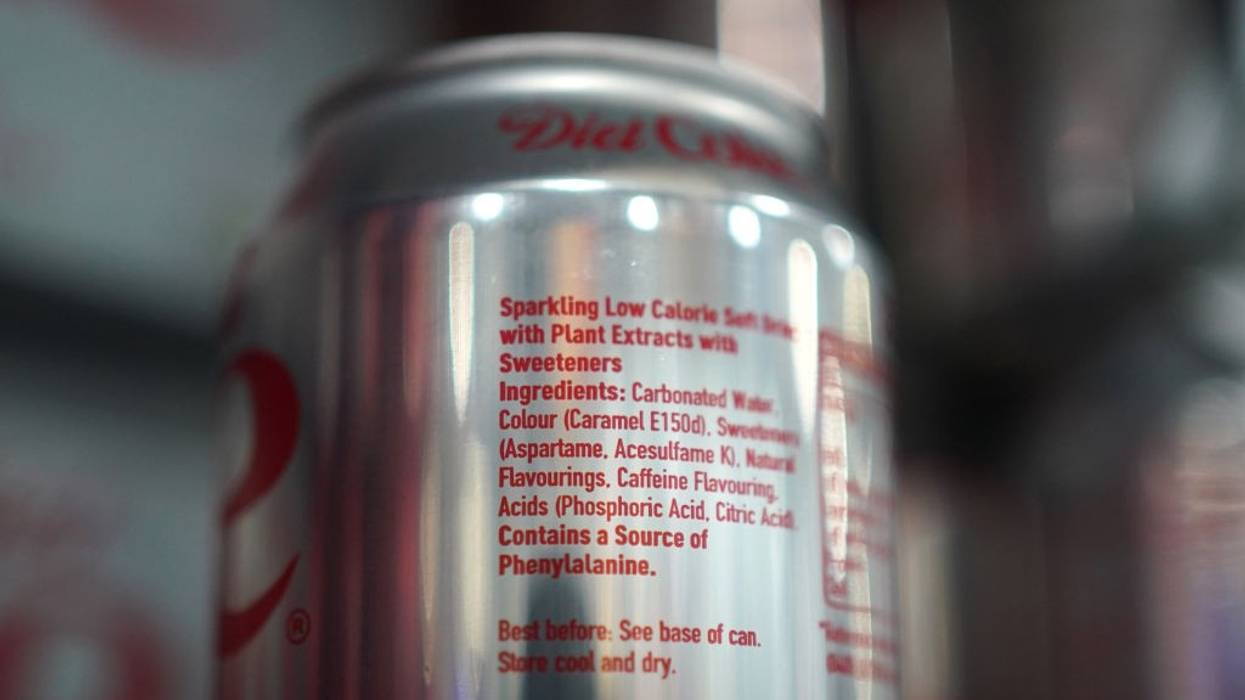
A World Health Organization' agency will list the widely used artificial sweetener aspartame as "possibly carcinogenic to humans" July 14, Reuters reported, citing two sources familiar with the situation.
International Agency for Research on Cancer (IARC) listings do not say anything about how much of a substance a person must consume to be at risk, but they can be hugely influential. The body's 2015 determination that glyphosate was "probably carcinogenic to humans" has helped plaintiffs to win lawsuits and appeals against Bayer claiming that use of its glyphosate-containing herbicides caused their cancer.
"We have to wait until July 14 and see how it determines the assessment and in which group it encompasses it," Rafael Urrialde de Andrés, who sits on the board of directors of the Spanish Society of Nutrition and is a professor at the Faculty of Biological Sciences of the Complutense University of Madrid and the Faculty of Pharmacy of the San Pablo-CEU University, said in a statement. "From then on, the food safety agencies and authorities will have to determine whether to reevaluate, ban it, or maintain authorization and under what conditions."
"CSPI has long recommended that consumers avoid aspartame because of studies showing the sweetener caused cancer in animals."
Aspartame is a popular artificial sweetener used in products from Diet Coke to Mars chewing gum. Around 95% of carbonated drinks and 90% of teas that use artificial sweeteners use aspartame, according to The Washington Post.
It has been deemed safe in more than 90 countries including the U.S., and the Food and Drug Administration (FDA) has affirmed its safety five different times. However, there have been calls from scientists to reevaluate the chemical based on a series of Italian studies finding it caused tumors in rats, and the Center for Science in the Public Interest (CSPI) has aspartame on its list of chemicals to avoid.
"CSPI has long recommended that consumers avoid aspartame because of studies showing the sweetener caused cancer in animals," the group tweeted in response to the Reuters story.
The IARC lists exposures as either possibly carcinogenic, probably carcinogenic, or carcinogenic to humans, with the ranking dependent on the strength and extent of the evidence. Experts point out that the IARC is assessing whether foods or chemicals represent potential hazards.
"This means that the IARC experts do not assess whether, in practice, a substance or exposure presents a cancer risk to people," Kevin McConway, emeritus professor of applied statistics at Open University, explained. "Instead they assess whether it would ever be capable of presenting a risk, under any circumstances, even if the only harmful circumstances are really, really unlikely to occur."
Because of this, the body has been criticized for causing unnecessary worry with its listings, such as its warnings that eating red meat and working overnight were probably carcinogenic, and that mobile phones were possibly carcinogenic, The Guardian reported.
That said, another World Health Organization (WHO) body is also scheduled to present a ruling on aspartame July 14 that could provide greater clarity. The Joint WHO and Food and Agriculture Organization's Expert Committee on Food Additives (JECFA), which sets dosage recommendations, is reviewing aspartame from June 27 to July 6, according to The Washington Post. It had previously set the safe level at 40 milligrams per kilogram of body weight per day, McConway said.
"To consume over that limit would require a very large daily consumption of Diet Coke or similar drinks," McConway added. "On 14 July, JECFA may change that risk assessment, or they may not."
Industry groups are already pushing back against a potential change in aspartame's status.
"IARC is not a food safety body and their review of aspartame is not scientifically comprehensive and is based heavily on widely discredited research," Frances Hunt-Wood, the secretary general of the International Sweeteners Association said, as Reuters reported.
Kate Loatman, the executive director of the International Council of Beverages Associations, said that public health bodies should be "deeply concerned" by the "leaked opinion" that she said "could needlessly mislead consumers into consuming more sugar rather than choosing safe no-and low-sugar options."
Even before the Reuters leak, industry and national regulatory bodies were concerned with the news that IARC and JECFA were reviewing aspartame at all, The Washington Post reported.
"There is a broad consensus in the scientific and regulatory community that aspartame is safe. It's a conclusion reached time and time again by food safety agencies around the world," Kevin Keane, American Beverage Association interim chief executive, told the Post last week. "The fact that food safety agencies worldwide, including the FDA, continue to find aspartame safe makes us confident in the safety of our products. And people all over the world should be, too."
The FDA also sent a letter to WHO in August 2022 advising against having two subcommittees consider aspartame.
"In our opinion, a concurrent review of aspartame by both IARC and JECFA would be detrimental to the scientific process and should not occur," Mara Burr, director of the Office of Multilateral Relations in the Department of Health and Human Services' Office of Global Affairs, wrote in the letter.
Burr argued that the review should be conducted by JECFA alone.
"They seem to be worrying in advance of the most authoritative review of the safety of this product," CSPI director Peter Lurie told The Washington Post. "But even if FDA chose to ignore what WHO has to say, the IARC pronouncement would still have a lot of pull in the rest of the world."
The annual Academy Awards GALA, viewed by one billion people worldwide, is scheduled for the evening of March 2, 2014. Motion pictures and the people who act in and produce them are center stage. Apart from the documentaries, this is a glittering evening of "make-believe" and "make business."

Now suppose our country had another Academy Awards GALA for citizen heroes - those tiny numbers of Americans who are working successfully full-time in nonprofit groups to advance access to justice, general operations of our faltering democratic society, and the health, safety, and economic well-being of all citizens.
This must sound unexciting in comparison with the intensity of the world of film. Until you see what these unsung people do in your local communities, your state, and your country. Then let's see if you think what my choice of civic heroes do every day isn't exciting. They are selected because they work in groups associated either directly or indirectly with me over the course of several decades.
1. Clarence Ditlow, director of the Center for Auto Safety and an engineer and lawyer. Mr. Ditlow has forced the auto companies to recall millions of defective motor vehicles, has brought auto companies to justice on many occasions in courts of law, and puts out volumes of information to inform elected representatives and the public about the need for stronger federal regulation of the resisting auto industry.
2. James Love, director of Knowledge Ecology International. As a mere high school graduate, he stunned specialists with the brilliance of his written analysis of energy subjects in Alaska. Mr. Love has been on the move all over the world challenging the tax-subsidized, highly profitable drug companies to stop gouging millions of patient-victims with "pay or die" marketing schemes. Big Pharma endured a rare defeat when Mr. Love convinced Ministers of Health and Dr. Yusuf Hamied, head of India's CIPLA Pharmaceutical, in 2001 to break the $10,000 per patient per year drug treatment for AIDS and bring the cost down to $300 per year (https://fireintheblood.com).
3. Dr. Michael F. Jacobson was a young PhD student in biochemistry at MIT when I interviewed him for a position with us. I told him we were looking for long-termers. He nodded. Nearly forty-five years later, Dr. Jacobson, having started the Center for Science in the Public Interest, has done more than anyone to document and brightly publicize enjoyable nutritional diets with less salt, sugar and fat. His Center knows how to communicate. Nutrition Action goes to 90,000 subscribers. He sends messages to your stomach in order to stimulate your mind.
4. Al Fritsch, another scientist PhD, joined us at the same time as did Michael Jacobson. He didn't spend much time in Washington before he returned to his home region of Appalachia where he started the Appalachia Center for Science in the Public Interest. Applied science and technology, as if people mattered most, was his credo. He pioneered simple, old and new ways - for example, to preserve the land and forest, make the drinking water safe, and grow more food - that he conveyed to local people of all ages who then became community scientists innovating themselves.
5. Lois M. Gibbs started as a mother and housewife until she saw what the chemicals seeping through the ground of their middle-income housing project in Niagara Falls were doing to residents, especially children. She then became unstoppable, moving from protesting for a cleanup to starting the Center for Health, Environment and Justice in 1981 with chapters and activists all over the country taking on and often winning the battle against the silent violence of reckless industries.
6. Dr. Sidney M. Wolfe founded with me the Health Research Group of Public Citizen. Do you want to see what a small group of half a dozen people can accomplish in getting rid of hundreds of prescription and over the counter drugs "that don't work?" Or do you want to learn how Dr. Wolfe has kept the Food and Drug Administration's feet to the fire and held many doctors accountable to professional standards? Or how about investigating scores of harmful conditions bred by the avarice or incompetence of the medical/hospital/drug industry complex (https://www.citizen.org/healthletter)?
7. Joan Claybrook, went from heading our immense Congress project, that issued magazine-sized profiles of every member of Congress going for re-election in 1972, to running the National Highway Traffic Safety Administration (NHTSA) for President Jimmy Carter, and then to the presidency of Public Citizen for nearly thirty years without missing a beat. The auto companies called her "the Dragon Lady." A fixture on Capitol Hill, she roared down the corridors on behalf of safety protections for millions of Americans.
8. Karen Ferguson started, a few years out of Harvard Law School, with my help the Pension Rights Center (PRC) in 1976. Karen and her staff dedicated themselves completely to being a watchdog of Congress, the Department of Labor, and a myriad of corporations, proposing legislative and regulatory changes and responding to the growing crisis of declining or looted traditional pensions for millions of workers. One of the biggest economic injustices in our economy is the loss or shredding of defined benefit pensions which either aren't being replaced or are replaced by exploitable 401(k)s. Trillions of dollars and millions of families are affected - luckily, the PRC and Ms. Ferguson are there year in and year out.
9. Robert C. Fellmeth in 1970 brought hundreds of eager law students from Harvard and other law schools to work with us. In a short time he authored or co-authored three large books, then went to California to become a prosecutor, then combined a career as law professor, litigator and leading public advocate for children through his Children's Advocacy Institute. No one can ever outwork or out-produce Fellmeth. His example has prompted his associates to coin the word "Fellmethian." His emphasis on children - protection, legislation, lawsuits, exposes, and a unique annual California Children's Budget only provide a glimmer of this creative civic giant's prodigious successes.
10. Robert G. Vaughn, when in his mid-twenties, chose our project on the federal civil servants. His work became a book titled The Spoiled System (1975). Over forty years later he teaches at American University Washington College of Law in Washington, D.C., is an expert on civil servant law and is the world's leading authority on whistle-blowing in dozens of countries (see The Successes and Failures of Whistleblower Laws, Edward Elgar, 2012). He has inspired hundreds of law students in treating law as justice and practicing along that pathway.
11. John Richard, has worked with us since 1978 becoming a peerless networker and adviser for citizen groups, their leaders and staff on all kinds of subjects. In his thirty-five years, he has participated in more gatherings and action meetings on more topics than anyone. This has nourished the wisdom of his assistance to scores of civic advocates who seek his help. Mr. Richard avoids taking any credit but his daily low-key pushing forward of the train of justice speaks for itself.
These people of significance, and many more stalwarts who labor in the vineyards of a better life for all Americans, receive far less public attention than cartoon characters, misbehaving entertainers and athletes, and carousing politicians.
The more difficult, despairing, and overburdened are the livelihoods of millions of hard-pressed Americans, the more they spend time becoming spectators of mass entertainment and sports as a distraction and relief from their painful and desperate situations.
A drama-filled activist award night for civic courage and creativity will inspire millions of viewers to try their hand at operating the levers of power for the good of our society. And what is more dramatic than real life struggles and successes for justice against the bullies, the greedhounds and the authoritarians who presently make up the few who rule the many?
Dare it be said that the more people immerse themselves in learning about these heroics, the more compelling will be their civic interest and passion. Certainly there is more meaning to their daily lives than watching "make-believe" or someone putting a ball in a hoop or into the ground.
Where is the enlightened billionaire who can launch such a televised national activist awards evening for the greatest work of humans on Earth - which is advancing justice?
In the summer of 2010, Robert DuBois and Aaron Zueck headed out on a 100 day bike trip across the country to document the thriving local foods movement. In the YouTube video of this "potluck across America," the two seem genuinely passionate about farmers and healthy food--and the movement they're documenting. As the screen goes black, a voiceover says: "Every time you drink Pepsi you support the Pepsi Refresh project.
In the summer of 2010, Robert DuBois and Aaron Zueck headed out on a 100 day bike trip across the country to document the thriving local foods movement. In the YouTube video of this "potluck across America," the two seem genuinely passionate about farmers and healthy food--and the movement they're documenting. As the screen goes black, a voiceover says: "Every time you drink Pepsi you support the Pepsi Refresh project. Every Pepsi refreshes the world."
What's one of the world's biggest soda companies got to do with a local foods bike trek? Turns out Aaron and Robert had gotten enough votes on Pepsi's website to earn $5,000 from the company's Pepsi Refresh campaign. In return, the two gave the multinational corporation the right to use their story to burnish their brand.
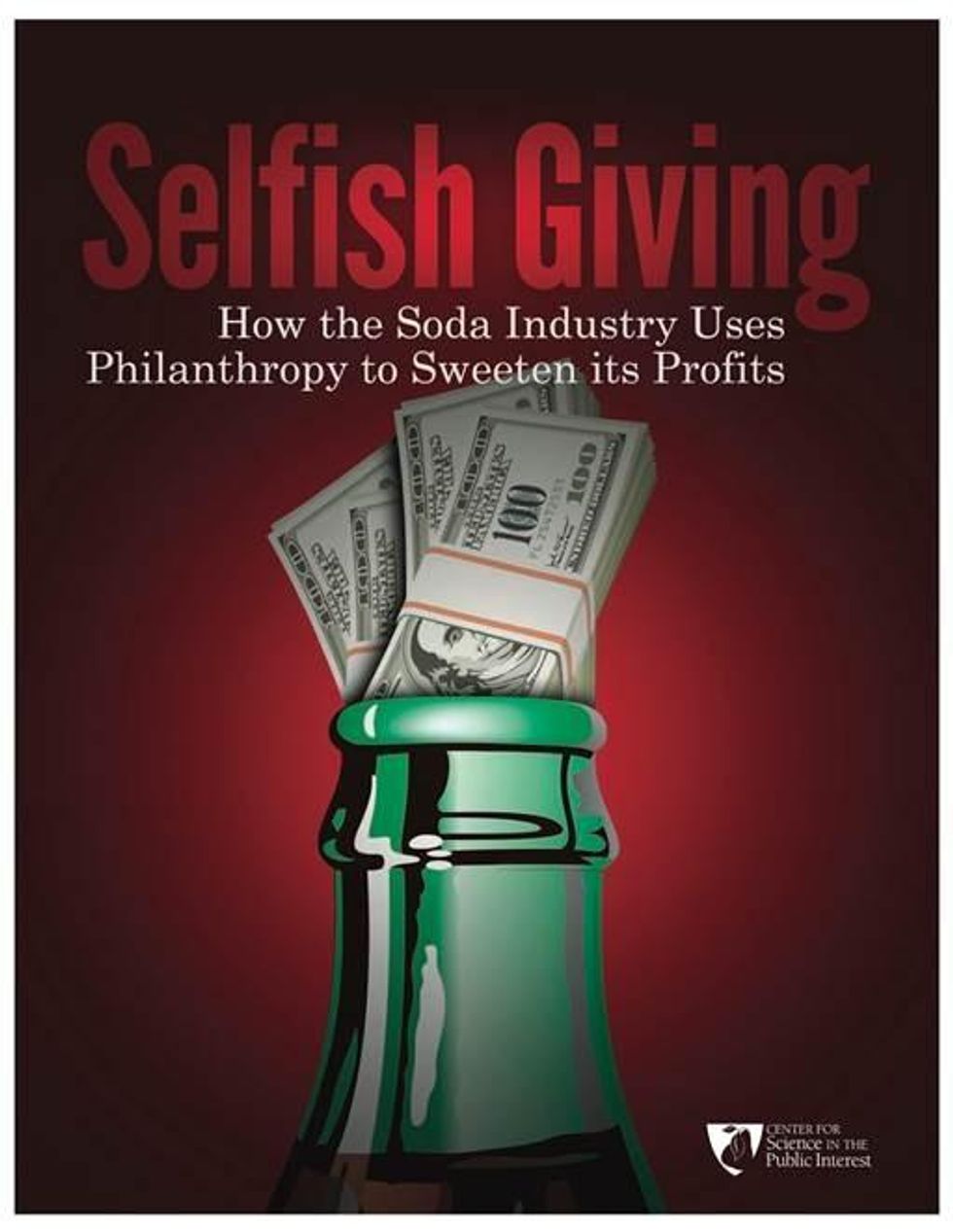
Launched in 2010, Pepsi Refresh was a brilliant new marketing strategy that drew millions to the company's Web site to "vote" on community-based projects to win grants between $5,000 and $50,000. It's one of the best examples of a new corporate PR strategy that hides marketing beneath the cover of philanthropy. In a fabulous new report "Selfish Giving: How the Soda Industry Uses Philanthropy to Sweeten Its Profits," researchers at the Center for Science in the Public Interest call it "philanthro-marketing."
I remember that summer of 2010 being bombarded with pleas from friends and colleagues to vote for worthy projects in the running for Pepsi Refresh, projects like Aaron and Robert's. At the time, I heard few people being publicly critical of Pepsi Refresh. In fact, one community activist from the Bronx even described Pepsi Refresh as "democracy in action."
But what was Pepsi Refresh really? It was a cleverly structured marketing campaign that drew people close to the brand while bringing heavy traffic to the company's Web site--you could vote once a day, but as many times as you wanted. Thousands of projects jockeyed for grants; only 32 were given every month. And while $50,000, even $5,000, is a significant contribution to a community project, it's a tiny fraction of the company's marketing budget. (Each month about $1 million was given away; consider that the CEO of Pepsi herself brought home $1.3 million a month).
As the CSPI report makes clear, this isn't charity. "PepsiCo's annual contributions to human sustainability programs, $2.3 million in 2011," the authors write, "were... dwarfed by the company's $60 million sponsorship of just one television show--The X Factor."
My Coke Rewards is Coca-Cola's equivalent. Through purchases of Coke products, consumers earn points to redeem for prizes. The program has developed an interface specifically for schools and Parent-Teacher Associations across the country bill My Coke Rewards as a great fundraising tool for schools.
Like this Chicago-area PTA that encouraged participation in My Coke Rewards: Our school has "joined the My Coke Rewards program," said the PTA's Web site. "That means by drinking Coca-Cola products your family can get My Coke Rewards points and donate them to help our school."
Nevermind the questionable practice of aligning with a company whose products are linked to the obesity crisis. Or, that as far as fundraising goes, it's not such a great bang for your buck. We did the math: To earn just one physical activity pack for your school, you'd need to buy 55,440 cans of Coke, which would cost $11,550. Seems like there's a more effective way to get your school 350 bucks worth of jump ropes, balls, cones, and basic gym supplies.
In tough economic times, communities are particularly vulnerable to getting co-opted by programs like My Coke Rewards or Pepsi Refresh where they become de facto marketers for the companies. But as the CSPI report makes clear: Public policy solutions could garner as much or more revenue without sacrificing our power, and handing over goodwill, to the companies whose products--like Coke and Pepsi--are at the center of our healthcare crisis.
Soda taxes, for instance, could be a powerful mechanism for raising much-needed public funds, especially for health promotion and physical activity programs for youth, CSPI notes. In fact, the report claims that one proposed soda tax in Philadelphia could have raised $77 million a year for the city, with $20 million specifically earmarked for obesity prevention programs.
But the food industry fought hard against Philadelphia's proposed tax, as they have everywhere such taxes have been proposed. And in 2011, after the city's Mayor proposed the two-cent-per-ounce excise tax on sugary drinks, Philadelphia's City Council rejected it. "Perhaps to celebrate the demise of the tax bill or to inoculate against a future tax proposal," said CSPI. "In 2011 the beverage industry funneled a $10 million donation to CHOP by creating a new non-profit organization, the Foundation for a Healthy America."
Back in 2010 at the height of the Pepsi Refresh campaign, the executive director of a girls club in New York City publicly drew her line in the sand, in a blog called "Pimping for Pepsi? I'd Rather Sell Cupcakes!" "It feels so schizophrenic," she wrote, "to promote products and ideas we spend our working days challenging." She's right: I urge you to read CSPI's whole report here and then let's get back to the work of challenging companies that are making our communities sick.
Our founding fathers, white-maleness aside, did get a few things right. One of them was the concept of "separation of powers," to ensure a system of checks and balances among the three branches of government: executive, legislative, and judicial. But a dangerous provision snuck into the budget bill passed last week in Congress upends that system. Without any hearings on the matter, the Senate included language that would require the U.S. Department of Agriculture to essentially ignore any court ruling that would otherwise halt the planting of new genetically-engineered crops. Here is how Capital Press explains it:
The rider pertains to transgenic crops that have been deregulated by the USDA but then had that approval overturned by a judge -- a scenario that has occurred with genetically engineered alfalfa and sugar beets.
In such a situation, the agency "shall" immediately issue permits or a partial deregulation order that would temporarily allow farmers to continue growing and selling the crop until USDA is done re-evaluating its environmental effects, according to the rider.
Why is this such a big deal? The court system is often our last hope, with Congress, the White House, and regulatory agencies deep inside industry's pocket. Several legal challenges have resulted in court decisions overturning USDA's approval of new GMO crops, for example, sugar beets.
So the biotech industry, unable to make its case to a judge, figured why not just rewrite the Constitution instead, with the help of a Democratic Senate led by Senator Barbara Mikulski, chair of the Senate Agriculture Committee. Despite Montana Senator Jon Tester's best attempts to stop the so-called biotech rider, the measure was pushed through. (Industry had tried to get a similar measure passed more than once last year.) Tester minced no words, in a recent article in POLITICO about this and other industry power grabs such as weakening small farmer protections:
These provisions are giveaways, pure and simple, and will be a boon worth millions of dollars to a handful of the biggest corporations in this country. They deserve no place in this bill. We simply have got to do better on both policy and process.
If President Obama signs the budget deal with this provision, it could have long-lasting and serious consequences. This list of pending petitions to USDA to approve genetically-engineered crops includes new versions of corn, soybean, canola, and cotton. Once these crops get planted, it will be too late to do much about it. That's why groups such as the Center for Food Safety file lawsuits when USDA turns a blind eye to the potentially harmful environmental consequences of these unique crops.
Here is how Andrew Kimbrell, executive director of the Center for Food Safety, described the situation:
In this hidden backroom deal, Senator Mikulski turned her back on consumer, environmental, and farmer protection in favor of corporate welfare for biotech companies such as Monsanto. This abuse of power is not the kind of leadership the public has come to expect from Senator Mikulski or the Democrat Majority in the Senate.
The biotech industry, with the help of Congress, is attempting an end-run of the judicial system. Since judges can't get be bought off, just go to your friends in Congress instead.
Unfortunately, most of the mainstream media have not picked up on this unprecedented Big Biotech power grab, and in the case of NPR, has even spread misinformation about the rider's effects:
But a closer look at the language of the provision suggests it may not be granting the USDA any powers it doesn't already have.
"It's not clear that this provision radically changes the powers USDA has under the law," Greg Jaffe, director of the Biotechnology Project at the Center for Science in the Public Interest, tells The Salt.
This interpretation was echoed, unsurprisingly, by the biotech industry, in Capital Express:
"It doesn't require the USDA to do anything it wouldn't otherwise have the authority to do," said Karen Batra, communications director for the Biotechnology Industry Organization. "The language is there to protect farmers who have already made planting decisions."
But as Kimbrell of the Center for Food Safety explains, the new language makes what is currently discretionary or optional on USDA's part, mandatory, a huge difference:
The word "shall" forces the USDA to continue allowing biotech crop cultivation even if its commercialization was overturned. They've taken away the discretion of the secretary of agriculture. Its real not-so-hidden purpose is to take away the ability to effectively vacate the approval of a crop that's been approved illegally.
If there is any good news, it's that the continuing resolution the provision hitched a ride on is only valid for six months. But industry seems confident it can make the workaround permanent. Likely what will follow is a protracted court battle over the policy's constitutionality; remember that whole separation of powers thing? Still, any such legal challenge will likely take years to be resolved. Even USDA thinks the provision is unconstititional. Secretary Vilsack's office told POLITICO that he has asked the Office of General Council to review the language, "as it appears to pre-empt judicial review of a deregulatory action which may make the provision unenforceable."
Meanwhile, the grassroots movement continues to grow to demand labeling of foods containing genetically-engineered ingredients. While important, we cannot let labeling distract us from pro-biotech policies at the other end of production. The fewer GMO crops that are allowed to be planted in the first place, the fewer end-products containing GMOs.
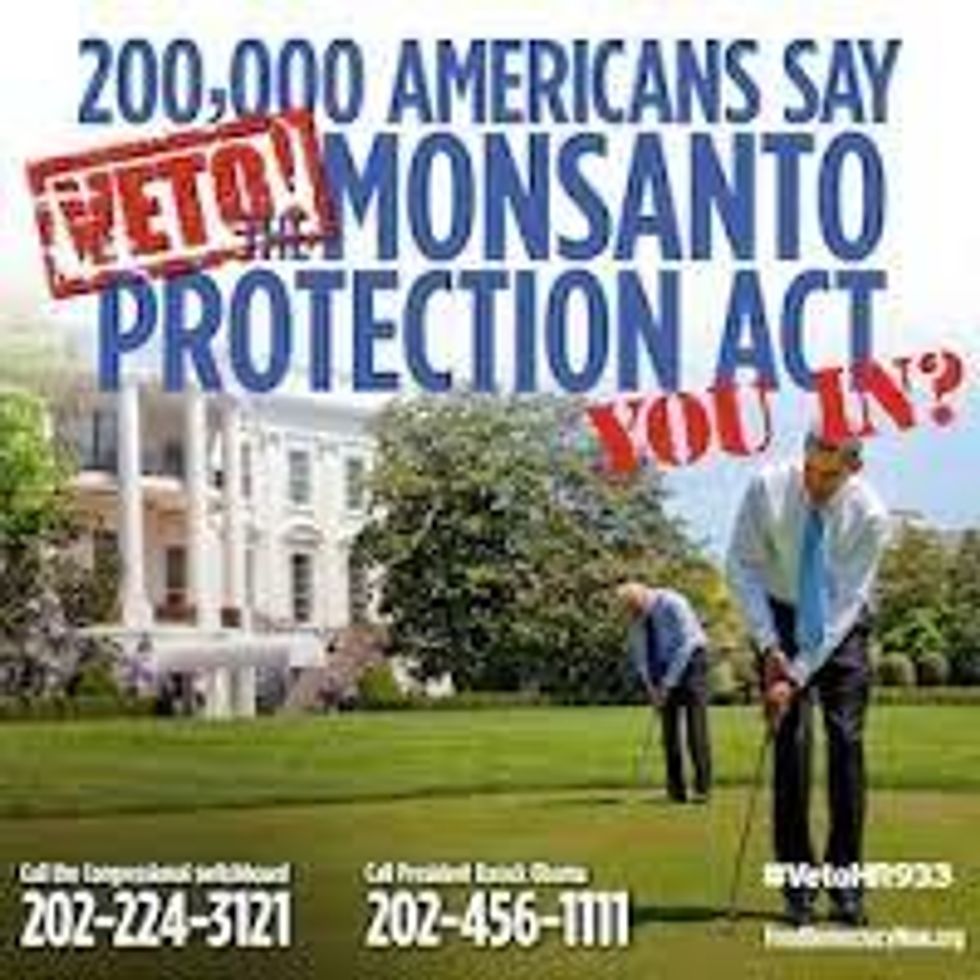
But it's not too late. You can still demand that President Obama refuse to sign the budget bill into law unless the biotech rider (aka Monsanto Protection Act) is removed. Food Democracy Now! has already gathered more than 175,000 signatures demanding Obama do the right thing. From that organization's action alert:
By sneaking Section 735 into a federal appropriations bills, Monsanto has successfully planted a dangerous provision in U.S. law that strips judges of their constitutional mandate to protect American's health and the environment while opening up the floodgates for the planting of new, untested genetically engineered crops.
Even if their new GMO crops are ultimately proven to be harmful to human health or the environment, Section 735 allows them to be planted the minute the USDA approves them!
Even more alarming, currently 13 new crops are awaiting approval at the USDA and AquaBounty's GMO salmon is on the verge of being approved by the FDA. This new provision opens the door wide open for these approvals.
If the biotech industry can so easily override our court system, which is our last resort in stopping these dangerous crops from being planted, we will have no place left to turn. And Monsanto will have completed its hostile takeover of the U.S. government.
Take action now by calling and emailing the White House here.
UPDATE: More 'Corporate Welfare': Obama Signs 'Monsanto Protection Act' Into Law
A friend and I once tricked his kids on St. Patrick's Day. Maybe "tricked" is too strong of a word for what we did: The festive green pasta we served was spinach fettuccine, but we didn't admit that it contained traces of the vegetable.
The pasta didn't taste at all of spinach. The kids, no doubt, assumed it contained a much more "acceptable" ingredient: artificial food dye. And the meal was eaten without complaints. Afterward, I 'fessed up, gleeful to prove to the kids that vegetables can sometimes taste good.

We pulled the same stunt at the little one's birthday party, using a few drops of beet juice to dye the cake frosting pink. That secret had to be kept under wraps because even some grown-ups at the party would have avoided the cake had they known. They were much happier assuming the frosting was made with a food dye derived from a petroleum product.
St. Patrick's Day is the day of green food -- and I don't mean salad. Green food dyes are added to everything from bagels to beer. For years now, the Center for Science in the Public Interest has warned us that these dyes pose "a rainbow of risks." At the top of their list of concerns is cancer. Several commonly used and legal food dyes have been linked to it in tests on lab animals.
Even more commonly cited concerns are hyperactivity and behavioral problems in children. Years ago, one of my friends found that his stepson was extremely sensitive to these food dyes. After removing the dyes from his stepson's diet, the little boy's behavior improved. It was like night and day. After that, every now and then, the little one would act up and his parents would find out he'd had a popsicle or other artificially colorful snack at a friend's house.
Of course, not all kids are so sensitive. But imagine your child attending school with someone else who is. How much attention will your child receive if the teacher is trying to deal with an off-the-wall classmate who ate Froot Loops for breakfast?
Sometimes, the chemicals in our lives are there to serve a purpose. Sometimes, the chemicals we use might be harmful, but there are no safer alternatives. For example, I'm not sure what effects the pharmaceuticals I take every day for my migraines have on my body. But I'm positive that living with daily migraines is worse.
Artificial food dyes serve no purpose (although a 5-year-old who wants a birthday cake with pink frosting might disagree) and we have safe alternatives. A few years ago, the British banned artificial food dyes for these reasons. A McDonald's strawberry sundae in London is red because it contains strawberries. Imagine that! Over here, it's dyed red with artificial food coloring.
You know what that means? All of the world's largest food companies that sell the same products in both the UK and the United States already know how to make their products without food dyes. And, apparently, the cost of making the switch did not put them out of business or tank their profits.
Why must Americans continue to face risks from artificial food dyes while the British play it safe? Let's follow their lead on this one.
Sugar. That's what's behind the increasing worldwide numbers of type 2 diabetes, according to a study published Wednesday in the online journal PLOS ONE.
The study's authors write:
Our results show that sugar availability is a significant statistical determinant of diabetes prevalence rates worldwide.
...we identified that sugar availability appears to be uniquely correlated to diabetes prevalence independent of overweight and obesity prevalence rates, unlike other food types and total consumption, and independent of other changes in economic and social change such as urbanization, aging, changes to household income, sedentary lifestyles and tobacco or alcohol use.
Michael F. Jacobson, Executive Director of the Center for Science in the Public Interest (CSPI), called the study "another brick in the wall of evidence that excess sugar consumption is a major threat to public health."
Rob Lustig, one of the study's authors and a pediatric endocrinologist at the University of California, San Francisco, told New York Times food columnist Mark Bittman, "You could not enact a real-world study that would be more conclusive than this one."
Just how much sugar is the average person in the U.S. consuming? CSPI has noted:
Americans, on average, consume between 18 and 23 teaspoons--about 300 to 400 calories worth--of added sugars per day. Teens and young adults consume half again more than the average. About one-fifth of adolescents aged 12 to 18 consume at least 25 percent of their calories from added sugars, according to the government's 2007-2008 National Health and Nutrition Examination Survey. About 14 million people of all ages consume more than one-third of their calories in the form of added sugars.
The study found that intaking the amount of sugar in just a can of soda per day was associated with increased diabetes prevalence by 1.1%.
Bittman writes of the study:
This is as good (or bad) as it gets, the closest thing to causation and a smoking gun that we will see. (To prove "scientific" causality you'd have to completely control the diets of thousands of people for decades. It's as technically impossible as "proving" climate change or football-related head injuries or, for that matter, tobacco-caused cancers.) And just as tobacco companies fought, ignored, lied and obfuscated in the '60s (and, indeed, through the '90s), the pushers of sugar will do the same now.
Read the full study here.
Recent reports of secret meetings among industry reps and the Food and Drug Adminstration over GMO labeling piqued my interest, mostly because this critical aspect was missing: any effort to label GE foods at the federal level could bring the current grassroots movement to a grinding halt by preventing any stronger local laws from ever being enacted. But I am getting ahead of myself.
Recent reports of secret meetings among industry reps and the Food and Drug Adminstration over GMO labeling piqued my interest, mostly because this critical aspect was missing: any effort to label GE foods at the federal level could bring the current grassroots movement to a grinding halt by preventing any
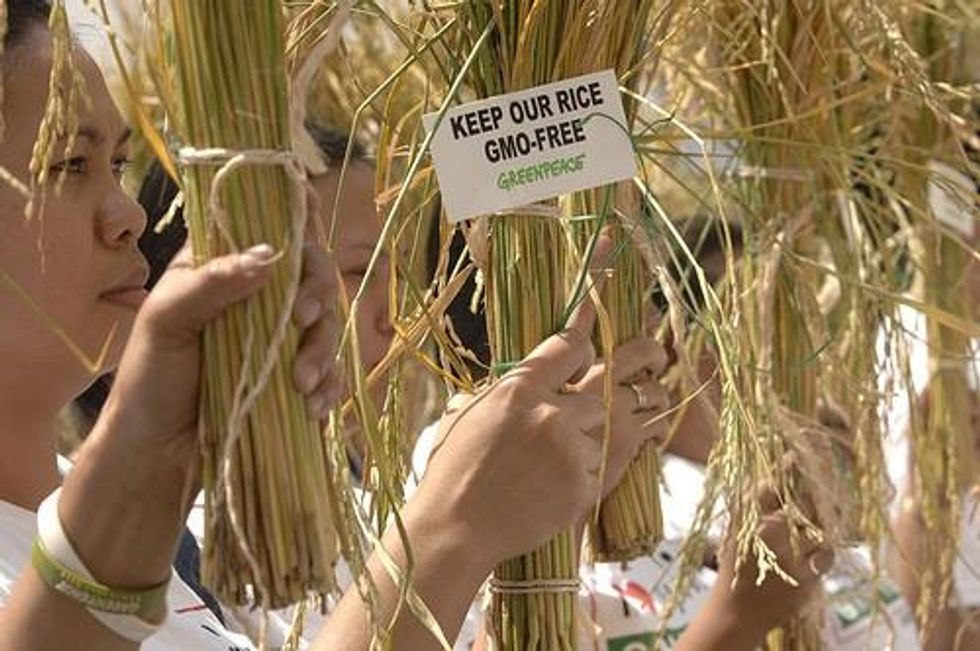
Last month, Ronnie Cummins, director of the Organic Consumers Association and one of the leaders of the GMO labeling effort, recently published an article about how "representatives of Wal-Mart, General Mills, Pepsi-Frito Lay, Mars, Coca-Cola and others" met with the FDA on January 11 "to lobby for a mandatory federal GMO labeling law."
The story was then picked up by Tom Laskawy at Grist, who reported that at the meeting, a Walmart representative said the retail giant would no longer oppose GMO labeling and that "[o]ther food company executives agreed, saying that the fight had become too expensive, especially given the prospect of more state-level initiatives."
The story kicked into high-gear when the New York Times' Stephanie Strom covered it last week, adding a few new details, such as the meeting being attended by "20 major food companies" as well as two GMO labeling advocates: Gary Hirshberg, co-chair of the Just Label It federal campaign, and Charles Benbrook, professor at Washington State University. The Times story gave the impression that the meeting is something to celebrate. After all, if Walmart comes to the table, that's a big deal.
But missing from both of these accounts is the ominous potential downside of federal GMO labeling: a sneaky legal concept known as preemption. Most advocates don't find out about it before it's too late.
Preemption simply means that a higher law trumps a lower law: so federal trumps state, and state trumps local. But in practice, it's industry's way of ensuring uniformity and stopping grassroots efforts. How I do know this? From years of experience of seeing it happen in various public health issues. It's such a huge problem that the Robert Wood Johnson Foundation funded an entire project called "Preemption and Movement Building in Public Health" to educate advocates about how to handle it.
Here is the pattern: a grassroots effort builds over time to enact local or state laws (such as gun control, indoor-smoking laws, or restricting alcohol sales), and industry fights these efforts for years, until they can no longer win. At that point, industry lobbyists turn around and either get their own weak bill passed, or work with advocates to pass a compromise version. In exchange, this law will preempt or prevent any state or city from passing a different or stronger law. Forever.
No industry likes to deal with 50 different state laws, or even a handful of expensive state-level battles. We recently saw this exact scenario play out in the food movement, with menu labeling in chain restaurants. For decades, the restaurant industry successfully fought federal efforts to require calorie counts and other basic nutrition information on menus. Then over the last few years, numerous states and cities started enacting their own laws, much to industry's dismay. Enter the compromise struck between the leading proponent of menu labeling, the Center for Science in the Public Interest, and the restaurant industry: federally-required menu labeling for calories only, in exchange for all state and local laws being preempted, past and future. (See this document labeled "compromise endorsements" for the bill's supporters, which include the Grocery Manufacturers Association, a leader of the No on Prop 37 campaign on GMO labeling in California.)
Now, almost three years after passage, we still don't have federal menu labeling as the final regulations are stalled at FDA, while certain industry members fight it. We also no longer see states or cities taking up the issue, figuring the feds took care of it. See what I mean about stopping a grassroots movement in its tracks? Public health lawyer Mark Pertschuk noted: "the rapidly growing grassroots movement for meaningful menu labeling may never recover." He also cites the irony of this 2009 memo from President Obama opposing preemption in all federal rule-making. The memo correctly notes: "Throughout our history, state and local governments have frequently protected health, safety, and the environment more aggressively than has the national government."
Amen to that. I am not opposed to federal labeling on GMO food. I agree this is where the problem must ultimately be solved. However, any federal standard must set a floor and not a ceiling, and not hand preemption over to industry. The role of the federal government is to set minimum standards, while still allowing states to go further. This, however, is not the end-game that Walmart et al. have in mind.
I asked Dave Murphy, founder of Food Democracy Now! and leader of the grassroots GMO labeling efforts about this issue. He told me it was a huge concern among movement leaders: "Ultimately the conversation represents a seismic shift in where we were four years ago on GMO labeling. But we know that anything coming out of Washington D.C. will be a weaker standard, which would not be good for either farmers or consumers. The goal is to make sure that a federal law doesn't undermine state efforts."
As Cummins noted about the meeting: "We should be wary of any compromise deal at the federal level, one that would preempt the passage of meaningful state GMO labeling laws that have real teeth."
Very wary indeed.
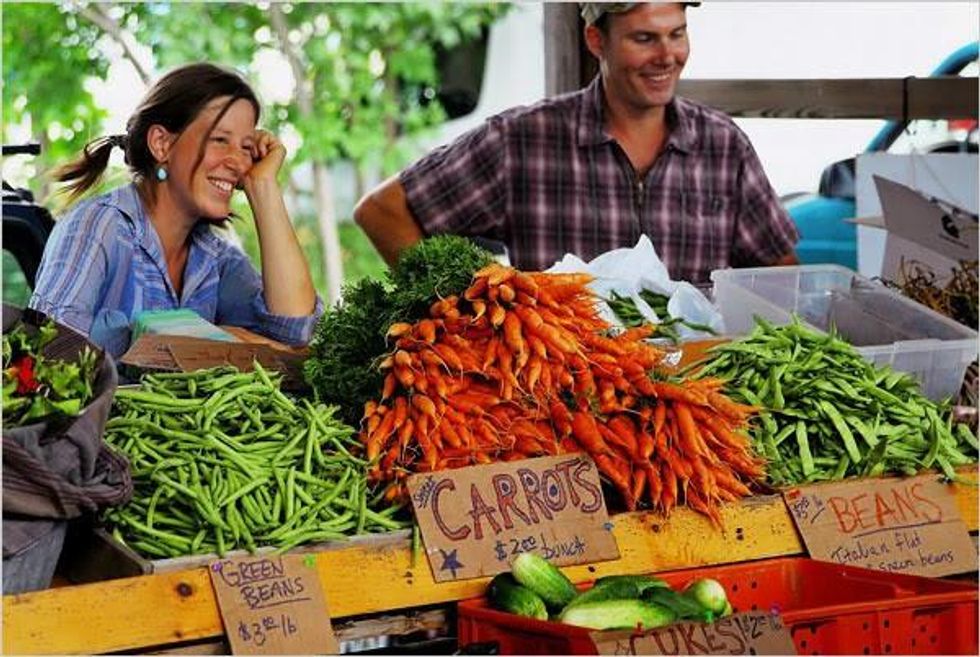
The letter comes just days ahead of an expected Senate vote on the 2012 Farm Bill and was initiated by the Environmental Working Group's Kari Hamerschlag and authors Anna Lappe and Dan Imhoff. All the signatories expressed frustration with the draft of the bill that came out of the Senate Agriculture Committee earlier this year. It says the committee's proposal is "seriously out of step with the nation's priorities and what the American public expects and wants from our food and farm policy."
"Investing in healthy food, healthy diets and critical nutrition programs for millions of struggling families across the country should be the priority as Congress writes the next farm bill," said Marion Nestle, the Paulette Goddard Professor in the Department of Nutrition at New York University. "Not more subsidies that send billions of scarce federal funds to the bank accounts of Big Food producers."
"We need a farm bill that supports farmers, rural communities, and those who are hungry, not a bill that gives unlimited subsidies to the biggest commodity producers while at the same time cutting programs for the neediest among us." --Anne Lappe
"We need a farm bill that supports farmers, rural communities, and those who are hungry, not a bill that gives unlimited subsidies to the biggest commodity producers while at the same time cutting programs for the neediest among us," said Lappe, author of Diet for a Hot Planet and cofounder of the Small Planet Institute. "We stand with the millions of Americans who share this common sense perspective."
The full letter follows:
Dear Member of Congress,
With the 2008 farm bill due to expire in a matter of months, the Senate Agriculture Committee approved legislation in April to steer the next five years of national food and agriculture policy. We applaud the positive steps that the proposed bill takes under Senator Debbie Stabenow's leadership, including incentives for fruit and vegetable purchases, scaling up local production and distribution of healthy foods and bolstering marketing and research support for fruit, nut and vegetable farmers.
Unfortunately, the Senate bill falls far short of the reforms needed to come to grips with the nation's critical food and farming challenges. It is also seriously out of step with the nation's priorities and what the American public expects and wants from our food and farm policy. In a national poll last year, 78 percent said making nutritious and healthy foods more affordable and accessible should be a top priority in the farm bill. Members of the U.S. Council of Mayors and the National League of Cities have both echoed this sentiment in recent statements calling for a healthy food and farm bill.
Although the committee proposal includes important reforms to the commodity title, we are deeply concerned that it would continue to give away subsidies worth tens of billions of taxpayer dollars to the largest commodity crop growers, insurance companies, and agribusinesses even as it drastically underfunds programs to promote the health and food security of all Americans, invest in beginning and disadvantaged farmers, revitalize local food economies and protect natural resources. We strongly object to any cuts in food assistance during such dire times for so many Americans. These critical shortcomings must be addressed when the bill goes to the Senate floor.
As written, the bill would spend billions to guarantee income for the most profitable farm businesses in the country. This would come primarily in the form of unlimited crop insurance premium subsidies to industrial-scale growers who can well afford to pay more of their risk management costs. Crop insurance programs must be reformed to work better for diversified and organic farmers and to ensure comprehensive payment caps or income eligibility requirements. Otherwise, this so called "safety net" becomes an extravagant entitlement for affluent landowners and insurance companies.
In addition, the proposed $9 billion-a-year crop insurance program comes with minimal societal obligations. Growers collecting hundreds of thousands of dollars in insurance premium subsidies should at least be required to take simple measures to protect wetlands, grassland and soil. Instead, the unlimited subsidies will encourage growers to plow up fragile areas and intensify fencerow-to-fencerow cultivation of environmentally sensitive land, erasing decades of conservation gains.
Most of the benefits from these programs would flow to the producers of five big commodity crops (corn, soy, cotton, rice and wheat). Meanwhile, millions of consumers lack access to affordable fruits and vegetables, with the result that the diets of fewer than five percent of adults meet the USDA's daily nutrition guidelines. Partly as a result, one in three young people is expected to develop diabetes and the diet-related health care costs of diabetes, cancer, coronary heart disease and stroke are rising precipitously, reaching an estimated $70 billion a year.
It doesn't have to be this way. The Government Accountability Office has identified modest reforms to crop insurance subsidies that could save as much as $2 billion a year. Half could come from payment limits that affect just four percent of the growers in the program. Congress should use these savings to provide full funding for conservation and nutrition assistance programs and strengthen initiatives that support local and healthy food, organic agriculture and beginning and disadvantaged farmers. These investments could save billions in the long run by protecting valuable water and soil resources, creating jobs and supporting foods necessary for a healthy and balanced diet.
When it is your turn to vote, we urge you to stand up for local and healthy food and nutrition programs and to support equitable and fiscally responsible amendments that will protect and enhance public health and the environment while maintaining a reasonable safety net for the farmers who grow our food. More than ever before, the public demands this. Come November, they will be giving their votes to members of Congress who supported a healthy food and farm bill that puts the interests of taxpayers, citizens and the vast majority of America's farmers first and foremost.
Our nation was built on the principles of protecting our greatest legacy: the land on which we grow our food and feed our families. Stand with us to protect not only farmers, without whom we would all go hungry, but to enact a food and farm bill that fairly and judiciously serves the interests of all Americans.
Sincerely,
| Leigh Adcock | Executive Director, Women, Food and Agriculture Network |
| Will Allen | Farmer, Founder, CEO of Growing Power |
| Dan Barber | Executive Chef and Co-owner Blue Hill and Blue Hill at Stone Barns |
| Neal D. Barnard, MD | President, Physicians Committee for Responsible Medicine |
| Sung e Bai | Director of National Programs, Slow Food USA |
| Mario Batali | Chef, Author, Entrepreneur |
| Fedele Bauccio | CEO, Bon Appetit Management Company |
| Jo Ann Baumgartner | Wild Farm Alliance |
| Rick Bayless | Chef, Frontera Grill and Topolobampo |
| David Beckmann | President, Bread for the World |
Andy Bellatti | Andy Bellatti, MS, RD, Andy Bellatti Nutrition |
| Wendell Berry | Lane's Landing Farm |
| Haven Bourque | Founder, HavenBMedia |
| Tom Colicchio | Craft Restaurants |
| Christopher Cook | Author of Diet for a Dead Planet: Big Business and the Coming Food Crisis |
| Ken Cook | President, Environmental Working Group |
| Ann Cooper | Chef and Founder, Food Family Farming Foundation |
| Ronnie Cummins | Organic Consumers Association |
| Laurie David | Author, Family Dinner |
| Michael R. Dimock | President, Roots of Change |
| Christopher Elam | Executive Director, INFORM |
| Maria Echeveste | Senior fellow, Center for American Progress (for affiliation purposes only) |
| Andy Fisher | Co-founder and founding Executive Director, Community Food Security Coalition |
| Chef Kurt Michael Friese | Owner, Devotay Restaurant & Bar and Publisher, Edible Iowa River Valley |
| Joan Dye Gussow | Grower, Author, Professor Emerita Teachers College, Columbia University |
| Melinda Hemmelgarn, MS, RD | Food Sleuth Radio |
| Gary Hirshberg | Co-founder and Chairman, Stonyfield |
| Mark Hyman, MD | Chairman, The Institute for Functional Medicine |
| John Ikerd | Professor Emeritus of Agricultural Economics |
| Dan Imhoff | Author, Food Fight: The Citizen's Guide to the Next Food and Farm Bill |
| Wes Jackson | President, The Land Institute |
| Kristi Jacobson | Catalyst Films |
| Michael Jacobson | Executive Director, Center for Science in the Public Interest |
| Robert Kenner | Director, Food Inc. |
| Navina Khanna | Co-Founder and Field Director, Live Real |
| Andrew Kimbrell | Executive Director, Center for Food Safety |
| Fred Kirschenmann | Author, Cultivating an Ecological Conscience: Essays From a Farmer Philosopher |
| Melissa Kogut | Executive Director, Chefs Collaborative |
| Anna Lappe | Author, Diet for a Hot Planet, Cofounder, Small Planet Institute |
| Robert S. Lawrence, MD | Center for a Livable Future, Professor, Johns Hopkins University |
| Kelle Louaillier | Executive Director, Corporate Accountability International |
| Bill McKibben | Author, Deep Economy |
| Liz McMullan | Executive Director, Jamie Oliver Food Foundation |
| Craig McNamara | President Sierra Orchards and Center for Land-Based Learning |
| Carolyn Mugar | Founder and Director of Farm Aid |
| Frances Moore Lappe | Cofounder, Small Planet Institute |
| Dave Murphy and Lisa Stokke | Food Democracy Now! |
| Rev. J. Herbert Nelson, II | Director for Public Witness, Presbyterian Church |
| Marion Nestle | Professor, NYU and Author, Food Politics |
| Y. Armando Nieto | Executive Director, California Food and Justice Coalition |
| Nicolette Hahn Niman | Rancher, Author, Attorney |
| Denise O'Brien | Co-founder, Women, Food and Agriculture Network; organic farmer |
| Robyn O'Brien | Executive Director, AllergyKids Foundation |
| Michael Pollan | Professor, UC Berkeley School of Journalism |
| Nora Pouillon | Chef, Author, Owner of Restaurant Nora |
| LaDonna Redmond | Food Justice Advocate and Food and Community Fellow |
| John Robbins | Author, Diet For A New America, The Food Revolution, and No Happy Cows |
| Ocean Robbins | Host, Food Revolution Network |
| Ricardo Salvador | Union of Concerned Scientists |
| Eric Schlosser | Author, Fast Food Nation |
| Lori Silverbush | Silverbush Productions |
| Matthew Scully | Author, Dominion |
| George L. Siemon | CEO, Organic Valley |
| Michele Simon | President, Eat Drink Politics |
| Jim Slama | President, FamilyFarmed.org |
| Naomi Starkman | Founder, Editor-in-chief, Civil Eats |
| Anim Steel | Real Food Challenge |
| Josh Viertel | Former President, Slow Food USA |
| David Wallinga, MD | Institute for Agriculture and Trade Policy |
| Alice Waters | Owner of Chez Panisse Restaurant |
| Andrew Weil, MD | Founder and Director, Arizona Center for Integrative Medicine |
| Tom and Denesse Willey | T&D Willey Farms |
| Paul Willis | Founder/Manager Niman Ranch Pork Company |
| Mark Winne | Mark Winne Associates |