
SUBSCRIBE TO OUR FREE NEWSLETTER
Daily news & progressive opinion—funded by the people, not the corporations—delivered straight to your inbox.
5
#000000
#FFFFFF
To donate by check, phone, or other method, see our More Ways to Give page.


Daily news & progressive opinion—funded by the people, not the corporations—delivered straight to your inbox.
"These past three years should act as a warning for future pandemics," said former U.N. Secretary-General Ban Ki-moon. "We need a return to genuine cooperation between nations in our preparation and response to global threats."
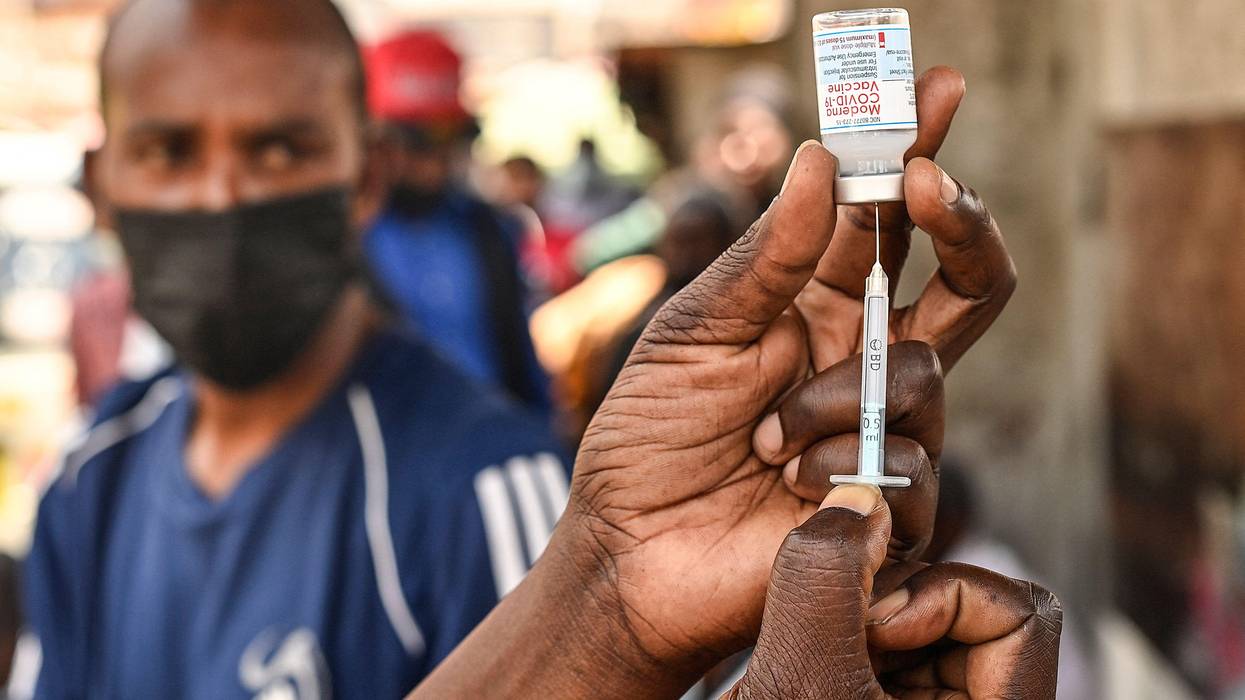
Around 200 current and former world leaders, Nobel laureates, health and faith leaders, and activists this week marked the third anniversary of the World Health Organization's Covid-19 pandemic declaration by taking aim at the "vaccine apartheid" that according to one advocacy group was responsible for one death every 24 seconds during the outbreak's first year alone.
A letter led by the People's Vaccine Alliance notes that three years have passed since "the World Health Organization (WHO) first characterized Covid-19 as a pandemic" on March 11, 2020 and implores governments to "never again" allow nationalism and capitalist greed to supersede human needs."
"We have seen extraordinary feats of scientific innovation and an enormous mobilization of public resources to develop effective vaccines, tests, and treatments," the letter continues. "But we have also seen a global response held back by profiteering and nationalism."
The signers asserted:
We are hopeful that an end to the acute stage of the Covid-19 pandemic may be in sight. Thus, the world is at a critical juncture. Decisions made now will determine how the world prepares for and responds to future global health crises. World leaders must reflect on mistakes made in responding to the Covid-19 pandemic so that they are never repeated.
There are decades of publicly funded research behind Covid-19 vaccines, treatments, and tests. Governments have poured taxpayer money by the billions into research, development, and advance orders, reducing the risks for pharmaceutical companies. These are the people's vaccines, the people's tests, and the people's treatments. Yet, a handful of pharmaceutical companies has been allowed to exploit these public goods to fuel extraordinary profits, increasing prices in the Global North while refusing to share technology and knowledge with capable researchers and producers in the Global South.
"Instead of rolling out vaccines, tests, and treatments based on need, pharmaceutical companies maximized their profits by selling doses first to the richest countries with the deepest pockets," the letter adds. "Billions of people in low- and middle-income countries, including frontline workers and the clinically vulnerable, were sent to the back of the line."
These inequities, the alliance said, resulted in over 1.3 million preventable deaths—one every 24 seconds—in the pandemic's first year alone. Even today, as the pandemic enters its fourth year, much of the Global South lacks adequate access to Covid-19 testing and treatments.
The letter's signatories urge world leaders to take immediate action to:
"In the AIDS pandemic, pharmaceutical monopolies have resulted in an appalling number of unnecessary deaths—and it has been the same story with Covid-19," lamented Winnie Byanyima, executive director of UNAIDS and co-chair of the People's Vaccine Alliance.
"It was only the production of inexpensive generics in developing countries that made the first generation of HIV medicines available and affordable to people in the [Global] South," she added. "But governments still have not learned that lesson. Unless they break the monopolies that prevent people from accessing medical products, humanity will sleepwalk unprepared into the next pandemic."
East Timorese President José Manuel Ramos-Horta, who also signed the letter, said that "in the Covid-19 pandemic, those of us in low and middle-income countries were pushed to the back of the line for vaccines and denied access to the benefits of new technologies."
"Three years on, we must say 'never again' to this injustice that has undermined the safety of people in every country," he added. "Steps that we take today can hasten global access to vaccines, medicines, and tests in the next pandemic, with regional hubs researching, developing, and manufacturing medical products for everyone, everywhere."
Former United Nations Secretary-General Ban Ki-moon asserted:
The great tragedy of the Covid-19 pandemic has been the failure of multilateralism and the absence of solidarity between the Global North and Global South. These past three years should act as a warning for future pandemics. We need a return to genuine cooperation between nations in our preparation and response to global threats. That requires a pandemic accord rooted in equity and human rights, which places the needs of humanity above the commercial interests of a handful of companies.
Independent Panel for Pandemic Preparedness and Response co-chair Helen Clark—who served as New Zealand's prime minister from 1999 to 2008—noted that "publicly funded science contributed a lot to the phenomenal success of Covid-19 vaccines."
"Yet, that public investment did not lead to vaccines being treated as global common goods," Clark continued. "Rather, nationalism and profiteering around vaccines resulted in a catastrophic moral and public health failure which denied equitable access to all."
"We need to fix the glaring gaps in pandemic preparedness and response today," she added, "so that people in all countries can be protected when a pandemic threat emerges."
More than 1,000 world leaders, celebrities, and other societal figures have signed a letter calling for an end to the "disastrous" drug war ahead of an upcoming United Nations summit to discuss the organization's nearly two-decade-long campaign against narcotics.
"Humankind cannot afford a 21st-century drug policy as ineffective and counterproductive as the last century's," reads the letter, organized by the Drug Policy Alliance (DPA), a drug reform advocacy group.
The signatories, which include Sens. Bernie Sanders (I-Vt.) and Elizabeth Warren (D-Mass.) as well as the former presidents and prime ministers of Mexico, Colombia, and the Netherlands, among others, are urging UN Secretary General Ban Ki-moon to usher in "real drug reform policy," one grounded in "science, compassion, health and human rights."
It is published ahead of the UN General Assembly Special Session on Drugs, which is scheduled to take place next week in New York, and follows similar condemnations of the drug war by health experts and former Latin American heads of state.
The letter reads:
The drug control regime that emerged during the last century has proven disastrous to global health, security, and human rights. Focused overwhelmingly on criminalization and punishment, it created a vast illicit market that has enriched criminal organizations, corrupted governments, triggered explosive violence, distorted economic markets, and undermined basic moral values.
Governments devoted disproportionate resources to repression at the expense of efforts to better the human condition. Tens of millions of people, mostly poor and racial and ethnic minorities, were incarcerated, mostly for low-level and non-violent drug law violations, with little if any benefit to public security.
As DPA executive director Ethan Nadelmann said on Thursday, "The influence and diversity of the leaders who signed this letter is unprecedented."
"Never before have so many respected voices joined together in calling for fundamental reform of drug control policies--in particular limiting 'the role of criminalization and criminal justice...to the extent truly required to protect health and safety'," Nadelmann said.
The General Assembly will meet from April 19-21 in the first summit of its kind since 1998, and was bumped up two years ahead of schedule after requests from Mexico, Guatemala, and Colombia, which are on the frontlines of the so-called War on Drugs. The Mexican Supreme Court ruled in a landmark decision last November that individuals have the constitutional right to grow and distribute marijuana for personal use, a nonbinding opinion that nonetheless opens the door to legalization.
The letter also criticizes the UN for failing to follow through on Secretary Ban's call last year for governments to "conduct a wide-ranging and open debate that considers all options."
"We were encouraged last year, Mr. Secretary General, when you urged governments to use the UNGASS opportunity 'to conduct a wide-ranging and open debate that considers all options.' This, by and large, has not happened--at least within the confines of the United Nations," the letter states. "Your leadership is now required to ensure that the seeds of reform are nourished, not discarded, and that the stage is set for real reform of global drug control policy."
As Nadelmann said, "We've come a long way since 1998, with a growing number of countries rejecting drug war rhetoric and policies." That also includes Portugal's decriminalization of all drug possession and landmark legislation in various U.S. states that legalized recreational marijuana use.
"But the progress achieved to date pales besides the reforms still required," Nadelmann said.
Other signatories to the letter include Sens. Cory Booker (D-N.J.) and Jeff Merkley (D-Ore.); dozens of former justice and health ministers; celebrities such as Jane Fonda, Woody Harrelson, and Rita Marley; business moguls and philanthropists like Warren Buffett, Richard Branson, and George Soros; and noted figures including Angela Davis, Gloria Steinem, and Black Lives Matter co-founder Alicia Garza.
UN Secretary-General Ban Ki-moon has caved in to pressure from Israel and the United States and taken the Israeli military off an official list of serious violators of children's rights, in this year's report on children in armed conflict.
In doing so, Ban rejected an official recommendation from his own Special Representative for Children and Armed Conflict Leila Zerrougui and numerous human rights organizations and child rights defenders.
Ban's act is particularly egregious since the report found that the number of children killed in the occupied West Bank and Gaza Strip in 2014, at 557, was the third highest only after Iraq and Afghanistan and ahead of Syria.
"The annual report and its annex, or children's 'list of shame,' has been a strong evidence-based accountability tool proven to help increase protections for children in armed conflict situations. There is ample evidence on persistent grave violations committed by Israeli forces since at least 2006 that should have triggered listing," Parker added.
"The secretary-general's decision to place politics above justice and accountability for Palestinian children has provided Israeli forces with tacit approval to continue committing grave violations against children with impunity," Parker said.
The top UN official's decision will be greeted with relief by the Obama administration, Israel and others concerned with ensuring such Israeli impunity.
Obama pressure
"The draft 2015 report prepared by the Secretary-General's Special Representative for Children and Armed Conflict, Leila Zerrougui, recommended adding Israel and Hamas to the annexed list of parties - the so-called 'list of shame' - due to their repeated violations against children," Human Rights Watch (HRW) said in a statement on 4 June.
Human Rights Watch called on Ban to "list all countries and armed groups that have repeatedly committed these violations, and resist reported pressure from Israel and the United States to remove Israel from the draft list."
But that pressure proved irresistible to Ban. Foreign Policy reported last week that the Obama administration had made a concerted effort to pressure him to drop Israel from the list for cynical political reasons.
According to an unnamed UN official quoted by Foreign Policy, the Obama administration was concerned about false accusations that "the White House is anti-Israel," as the US completes sensitive negotiations over Iran's civilian nuclear energy program.
False balance
Human Rights Watch supported calls on Ban to list Hamas as well as Israel, but this appears to have been a maneuver to look "balanced" and avoid baseless accusations of anti-Israel bias frequently leveled at the organization.
Sources familiar with the final report have told The Electronic Intifada that Hamas is not on the list either.
But the violations attributed to Palestinian armed groups, including the death of one Israeli child last summer due to a rocket fired from Gaza, can hardly be compared in scope to the systematic mass killings with impunity of Palestinian children in the Gaza Strip and West Bank by Israeli occupation forces.
Since Hamas and other Palestinian armed resistance groups are already under international sanctions and arms embargoes and listed by various countries as "terrorist organizations," adding Hamas to the list would have meant little.
It is Israel whose violations continue not only with impunity but with assistance from the predominantly European and North American governments that arm it.
DCI-Palestine documented the killings of at least 547 Palestinian children during last summer's Israeli assault on Gaza.
Human Rights Watch cites as part of Israel's record the "unlawful killing of children" in the occupied West Bank, including Nadim Nuwara and Muhammad Abu al-Thahir, both 17, shot dead by snipers on 15 May 2014.
In April, a board of inquiry set up by Ban found that Israel killed and injured hundreds of Palestinians in seven attacks on United Nations-run schools in the Gaza Strip last summer.
Sabotage
In March, there was an outcry among Palestinian and international human rights advocates when it was revealed that UN officials appeared to be trying to sabotage the evidence-based process that leads to a recommendation of listing, after threats from Israel.
Palestinian organizations called on the mid-level UN officials accused of interfering with the process to resign.
This led to assurances from Special Representative Zerrougui that the decision-making process was still underway and indeed, after gathering all the evidence, Zerrougui did recommend that Israel be listed.
Such a recommendation comes after UN bodies collect evidence in collaboration with human rights organizations, according to specific criteria mandated in UN Security Council Resolution 1612.
But despite the months-long nonpolitical and evidence-based process, the final decision was always in Ban's hands.
Partner in Israel's crimes
There was much at stake for Israel and indeed for Ban if he had gone with the evidence instead of submitting to political pressure.
"Inclusion of a party on the secretary general's list triggers increased response from the UN and potential Security Council sanctions, such as arms embargoes, travel bans, and asset freezes," Human Rights Watch notes.
"For a country or armed group to be removed from the list, the UN must verify that the party has ended the abuses after carrying out an action plan negotiated with the UN."
Ban has a long history of using his office to ensure that Israel escapes accountability except for the mildest verbal censures that are almost always "balanced" with criticism of those who live under Israeli occupation.
At the height of last summer's Israeli attack on Gaza, 129 organizations and distinguished individuals wrote to the secretary-general, condemning him for "your biased statements, your failure to act, and the inappropriate justification of Israel's violations of international humanitarian law, which amount to war crimes."
Ban's record, they said, made him a "partner" in Israel's crimes. His latest craven decision will only cement that well-earned reputation.
While Israel will celebrate victory in the short-term, the long-term impact will likely be to further discredit the UN as a mechanism for accountability and convince more people of the need for direct popular pressure on Israel in the form of boycott, divestment and sanctions (BDS).
Historic crowds gathered in New York City this week for the People's Climate March to demand drastic action in the face of the ever worsening climate crisis. But at Tuesday's Climate Summit at the United Nations headquarters, heads of state--most notably President Barack Obama--did not come close to heeding the urgent calls for concrete action, say climate justice campaigners.
The summit was convened by UN Secretary-General Ban Ki-moon to showcase "government, finance, business, and civil society" solutions to the climate crisis, according to a UN announcement. Politicians, corporations, and token civil society groups were invited to participate, while social movement organizations were excluded from the summit. Perhaps the most notable thing about this year's meeting, which follows a similar gathering in Copenhagen in 2009, was the large role played by corporations in the day's events and plenaries. Justin Gillis pointing out in the New York Times that "companies are playing a larger role than at any such gathering in the past."
By contrast, numerous heads of state did not attend the summit, including Canadian Prime Minister Stephen Harper, Australian Prime Minister Tony Abbott, Chinese President Xi Jinping, Indian Prime Minister Narendra Modi, and Russian President Vladimir Putin.
But at an event billed as an opportunity for corporations and politicians to announce voluntary climate commitments, those who did show were short on concrete and binding action steps.
President Barack Obama gave a speech to the UN that was heavy on passionate rhetoric. "The alarm bells keep ringing. Our citizens keep marching. We cannot pretend we do not hear them. We have to answer the call," he declared. However, his address provided few details on how these intentions translate into action and did not address the critical question of new U.S. emissions targets. Furthermore, Obama made no mention of sending money to developing countries dealing with the impacts of climate change. Obama's announcement of an executive order to consider climate change in international development programs was met with caution due to the Obama administration's continued support of the fossil fuel industry.
"We're being exploited, assaulted on an everyday basis, by industry that surrounds our community," said Yudith Nieto of Texas Environmental Justice Advocacy Services, based in Houston, Texas. "We don't get any support from our representatives. We have to put our two cents in and let them know that we are here."
"So far, the Obama administration continues to allow the fossil fuel industry to undermine efforts to address climate change by mining and drilling for coal, oil, and gas from our public lands and waters, unlocking huge quantities of carbon pollution," said Greenpeace USA Executive Director Annie Leonard in a press statement.
Obama's announcement of an Oil and Gas Methane Partnership, which is a corporate alliance led by extractive industries and not beholden to binding commitments, was slammed by critics. "President Obama's executive order today, that hinges on the voluntary initiative, the Oil and Gas Methane Partnership, is more evidence that his administration is not serious about reducing methane emissions from the oil and gas sector," said Wenonah Hauter, Executive Director of Food and Water Watch. "One does not solve the greatest environmental crisis in our lifetime with half measures and by running interference for the petroleum industry."
At the meeting, UN Secretary General Ban Ki-Moon called for emissions cuts, declaring, "By the end of this century we must be carbon neutral." Furthermore, he lauded the numerous corporations, including those from oil, gas, and coal extraction industries, for voluntary, non-binding commitments they made at the summit.
As Steven Mufson points out in the Washington Post, countries all over the world are blowing past their emissions targets, and in the United States, greenhouse gas emissions are back on the rise.
Responding to Ki-Moon's declaration, the Climate Justice Alliance warned in a press statement: "On the surface this appears good. In reality, it is thinly veiled language for the promotion of market-based and destructive public-private partnership initiatives such as REDD+, Climate-Smart Agriculture and the Sustainable Energy for All Initiative--which will further exploit human and natural resources to expand the profits of the world's most wealthy."
During the UN summit, the Climate Justice Alliance, which represents 35 organizations of communities directly impacted by climate change, attempted deliver to the meeting a coalition statement which reads, "We demand that world leaders support and move money to our community-led priorities and local infrastructure needs to build sustainable community economies, energy democracy, zero waste, food justice, public transit and affordable housing--pathways that can create millions of long-term jobs and put our communities back to work."
But the network was denied entry to the summit, so leaders instead read the statement outside of the UN headquarters.
"Those within the UN Climate Summit need to start thinking about ways to change people's relationship to the earth, ways to change the definition of prosperity and well-being to something that's not about money for a few people, but for a good livelihood for everybody," said Jihan Gearon of Black Mesa Water Coalition on the Navajo Nation.
"World leaders continue not to listen," reads a Climate Justice Alliance statement. "They'll take their photo opportunities in the street, but refuse entrance into the actual halls of power."