SUBSCRIBE TO OUR FREE NEWSLETTER
Daily news & progressive opinion—funded by the people, not the corporations—delivered straight to your inbox.
5
#000000
#FFFFFF
To donate by check, phone, or other method, see our More Ways to Give page.


Daily news & progressive opinion—funded by the people, not the corporations—delivered straight to your inbox.
"We must question why Bavarian Nordic refuses to adjust its unconscionable approach to pricing and access," wrote the director of Public Citizen's Access to Medicines program.
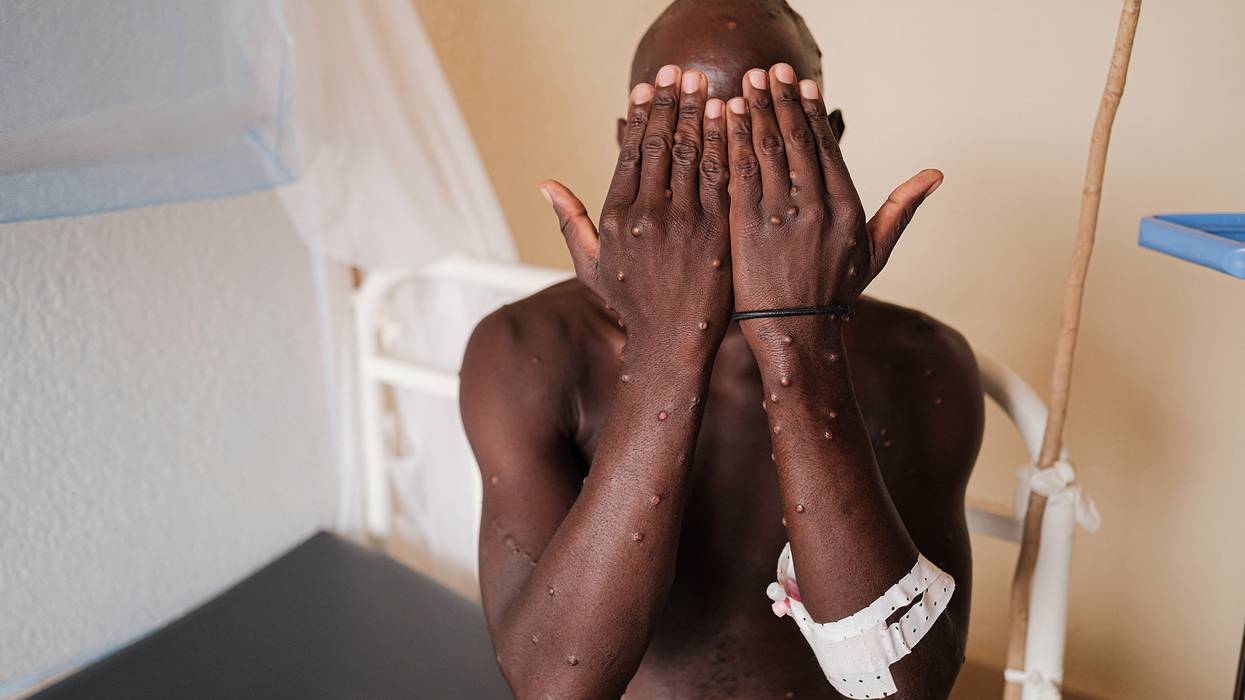
A U.S.-based watchdog group on Friday called out what it described as the "profiteering approach" taken by one of the only companies in the world with an approved vaccine for mpox, an infectious disease whose rapid spread in the Democratic Republic of Congo prompted the World Health Organization to declare a global emergency earlier this month.
Peter Maybarduk, the director of Public Citizen's Access to Medicines program, wrote a letter to the Danish pharmaceutical giant Bavarian Nordic expressing deep concern that the company "may be exploiting the latest global health crisis, putting profits over people."
A spokesperson for Bavarian Nordic, the maker of the mpox vaccine Jynneos, told STAT in a recent interview that the firm doesn't "tend to talk about price," a lack of transparency that set off alarm bells amid a pressing international crisis. Mpox has spread to the DRC's neighboring countries, and Thailand and Sweden each recently reported a case.
Maybarduk elaborated on his concerns:
In 2022, the Pan American Health Organization (PAHO) resolved to procure mpox vaccines despite Bavarian Nordic’s refusal to provide a single low price for all PAHO Member States. Consequently, the vaccine costs much more than any of the other vaccines available through the Revolving Fund, PAHO's bulk vaccine purchaser. In negotiations with manufacturers, the Revolving Fund usually seeks to obtain a supplier's lowest available price to ensure that all PAHO Member States can access affordable vaccines, regardless of size or level of development.
Given Bavarian Nordic's troubling approach to pricing with PAHO then, we remain concerned about pricing implications now for group procurement by Africa CDC and multilateral purchasers such as Gavi, as well as wider ramifications for the global public health response.
"While many actors have roles to play in ensuring a coordinated international effort to contain the spread of mpox, including how best to make use of vaccines," Maybarduk added, "we must question why Bavarian Nordic refuses to adjust its unconscionable approach to pricing and access."
The WHO's emergency declaration and the lack of vaccine access in the countries most affected by mpox has sparked concerns of a repeat of the vaccine apartheid that undermined the global response to Covid-19, with deadly consequences.
Lawrence Gostin, Sam Halabi, and Alexandra Finch, experts at the O'Neill Institute for National and Global Health Law at Georgetown University, wrote in a New York Times op-ed earlier this week that "we shouldn't discount the pandemic potential of mpox."
"Africa CDC has estimated that it needs 10 million doses to stop the current outbreak. But as was the case with the Covid vaccines, mpox vaccines are in the hands of the world's richest countries and companies," the experts wrote. "An agreement between Africa CDC, the European Union, and Bavarian Nordic has already been reached for the procurement and rapid distribution of about 200,000 doses, but many more are needed. The United States has said it will donate 50,000 doses to Congo from its stockpile. But this still leaves Africa nowhere near the 10 million doses needed."
"Bavarian Nordic says that by the end of this year it could manufacture two million more doses, and then eight million doses next year, if purchase orders are made," they added. "But there is no clear commitment to make these doses affordable for African countries."
We urgently need global rules and international cooperation to prevent, prepare for, and respond to the next dangerous infectious disease.
This week, World Health Organization member states meeting at the World Health Assembly are widely expected to extend negotiations for a new pandemic treaty after talks collapsed last Friday.
The political blowback and disinformation campaign against the treaty have been fierce.
Reps. Jim Jordan (R-Ohio) and Thomas Massie (R-Ky.) claimed the “WHO agreement may contravene the First Amendment.” It doesn’t. Twenty-four governors wrote to President Joe Biden raising constitutional concerns, none of which hold water.
The concentration of global vaccine manufacturing capacity in rich countries drives inequities.
More about disinformation later. What’s most important is that the risk of the next pandemic looms—just witness the spread of H5N1 avian influenza among dairy cattle and farm workers. We urgently need to shore up international rules to prevent, prepare for, and respond to the next pandemic.
The pandemic agreement would, in essence, strike a global social bargain.
The Biden administrationwants a transparent exchange of scientific information in real-time, including surveillance data, notification of dangerous outbreaks, and sharing pathogen samples and their genomic sequences. Global rules on scientific exchange can help curb outbreaks at their source and detect dangerous variants. More importantly, these data are the lifeblood needed to develop lifesaving diagnostics, vaccines, and treatments rapidly.
This global social bargain also requires equitable allocation of medical products made possible by scientific sharing. And without equity, the Global South rightly won’t sign on.
We think of equity as a matter of ethics, and it is. But it is also the most effective way to stop the international spread of novel diseases before they become pandemics. Equity is central to rebuilding trust between the West and the Global South, which was shattered during Covid-19.
The concentration of global vaccine manufacturing capacity in rich countries drives inequities. As we saw with Covid-19, high-income countries pre-purchased vaccines from pharmaceutical companies, causing serious international vaccine shortages.
Building manufacturing capacity in low- and middle-income countries like Brazil, India, and South Africa would remove bottlenecks in global supply. But this will require sharing intellectual property, dedicated financing, and transferring technology from powerful multinational pharmaceutical companies.
The pandemic treaty would also address the “upstream drivers” of pandemics. Biodiversity loss, climate change, and chemical pollutionall contribute to the emergence of novel diseases. Up to 75% of new or emerging infectious diseases result from “spillovers” from animals to humans. Zoonotic spillovers have caused most global health emergencies, like SARS, Ebola, mpox, and most likely Covid-19.
A “one health” approach ensures that governments take action at the interfaces between human, animal, and environmental health. This could mean global rules on deforestation, intense farming of animals, overuse of antibiotics, and the trade in wild animals, including wet markets.
But all these global public goods are at risk from a worldwide disinformation campaign aimed at derailing the treaty. False claims include the loss of U.S. sovereignty to craft public health policies. Yet, the draft treaty expressly affirms national sovereignty. Also, the WHO director-general does not have the power to require lockdowns or issue mandates for masks or vaccinations.
This year, more than 64 countries are holding elections. Elections in the United States pose a particularly virulent risk to the success of diplomatic negotiations. Recall that then President Donald Trump withdrew the U.S. from WHO, only to be reversed by Biden. There’s little doubt that a future Trump administration would torpedo WHO negotiations.
The next pandemic is percolating somewhere—whether in dairy cows here in the United States, in a cave in southern China replete with bats, or through the work of nefarious actors using novel technologies like synthetic biology to recreate or enhance dangerous viruses like smallpox.
More than 1 million Americans lost their lives to Covid-19. The next pandemic could be much worse. We urgently need global rules and international cooperation to prevent, prepare for, and respond to the next dangerous infectious disease.
"Handing exclusive rights to publicly-funded vaccines and medicines to just a few companies simply does not work—for rich countries or poorer ones," said an adviser to the People's Vaccine Alliance.
Vaccine equity campaigners on Monday condemned European Union nations for hoarding Covid-19 vaccine doses at the expense of low-income countries after a new Politico analysis estimated that the bloc's members have thrown out at least €4 billion—roughly $4.4 billion—worth of the lifesaving shots.
That equates to around 215 million coronavirus vaccine doses—very likely an undercount, given that Politico wasn't able to obtain waste numbers from every E.U. member country.
"Calculations based on available data show that E.U. countries have discarded an average of 0.7 jabs for every member of their population," the outlet reported. "Top of the scale is Estonia, which binned more than one dose per inhabitant, followed closely by Germany, which also threw away the largest raw volume of jabs."
Piotr Kolczyński, E.U. health policy adviser at the People's Vaccine Alliance and Oxfam International, said in a statement that the new analysis is "further proof that the E.U. wasted millions of its Covid-19 vaccines, hoarded early in the pandemic, as it locked poorer countries out of access."
"The appalling waste in the world's pandemic response was disastrous," said Kolczyński. "Handing exclusive rights to publicly-funded vaccines and medicines to just a few companies simply does not work—for rich countries or poorer ones."
Politico attributed much of the waste to the E.U.'s massive 2021 deal with Pfizer and BioNTech, which agreed to sell 1.1 billion doses of their mRNA jab to members of the bloc as low-income countries struggled to obtain shots for their populations.
"Despite considering a significant reform to reign in pharmaceutical waste and profiteering within its borders, the EU fails to support similar efforts on the global stage."
E.U. members—Germany in particular—pushed back aggressively against the India and South Africa-led call for a Covid-19 vaccine patent waiver, which proponents said would have lifted key barriers to expanding vaccine manufacturing and access. Germany alone has wasted 83 million vaccine doses, according to Politico.
The pharmaceutical industry, for its part, lobbied aggressively to preserve its monopoly control over vaccine recipes and production, focusing significant attention on the European Commission.
With the global health emergency formally over, countries are currently negotiating the terms of a pandemic agreement that would govern how the international community responds to the next global crisis.
Reuters reported in September that "governments remain divided, failing to agree on some of the basics needed to strengthen health systems worldwide."
"Those basics, all issues that hindered a coordinated global response to the Covid-19 outbreak, include the sharing of information, costs, and vaccines," Reuters added. "The divisions arose anew in June, when the European Union negotiated new agreements with pharmaceutical companies to reserve vaccines for future pandemics. The agreements led critics to accuse the bloc of 'vaccine apartheid.'"
Last month, 18 members of the European Parliament wrote to the Council of the European Union and the European Commission expressing "concerns about the E.U.'s negotiating position."
"It proposes to continue relying solely on voluntary measures in the deployment of key public health interventions, such as the transfer of technology, know-how and 'trade secrets,' or the removal of intellectual property barriers," the lawmakers wrote. "In the meantime, the E.U. avoids specific commitments for equitable access to pandemic products."
As the People's Vaccine Alliance noted Monday, the E.U.'s latest proposed text "suggests removing transparency and equity measures."
"Despite considering a significant reform to reign in pharmaceutical waste and profiteering within its borders, the E.U. fails to support similar efforts on the global stage," said Kolczyński. "It is one rule for the E.U. and another for everyone else."
"Should people in America and around the world be allowed to get sicker and sometimes die because they cannot afford the outrageous and arbitrary prices that the pharmaceutical industry demands?" asked the Vermont Independent.
Sen. Bernie Sanders on Wednesday denounced Moderna's proposal to more than quadruple the price of the Covid-19 vaccine it co-developed with billions of dollars in public funding—along with mRNA technology co-invented by government scientists—as an example of Big Pharma's "unacceptable corporate greed."
At a hearing held by the Senate Committee on Health, Education, Labor, and Pensions (HELP), the Vermont Independent reiterated his widely shared belief that the purpose of medical advancements should be to save as many lives as possible, not make executives "obscenely rich."
Sanders, who chairs the panel, invited Moderna CEO Stéphane Bancel to testify at a hearing titled "Taxpayers Paid Billions For It: So Why Would Moderna Consider Quadrupling the Price of the Covid Vaccine?"
In his opening statement, Sanders stressed that scientists at the National Institutes of Health (NIH) and other federal agencies "worked with Moderna to research, develop, and distribute the Covid vaccine that so many of our people have effectively used."
"While Moderna may wish to rewrite history," Sanders continued, "this vaccine would not exist without NIH's partnership and expertise and the substantial investment of the taxpayers of this country. As a matter of public record, U.S. taxpayers spent $12 billion on the research, development, and procurement of the NIH-Moderna Covid vaccine."
"For that huge investment," added the progressive lawmaker, Moderna is "thanking the taxpayers of America by proposing to quadruple the price of the Covid vaccine to as much as $130 once the government stockpile runs out—at a time when it costs just $2.85 to manufacture that vaccine."
"Moderna has already made $21 billion in profits off of the Covid vaccine during the pandemic and four of Moderna's executives and investors collectively became more than $10 billion wealthier as a result of the massive taxpayer investment into that corporation," said Sanders. "Mr. Bancel literally became a billionaire overnight and is now worth $4.7 billion."
"Do we not need to change the current culture of greed into a culture which understands that science and medical breakthroughs should work for ordinary people, and not just enrich large corporations and CEOs?"
In the words of the senator, "This type of profiteering and excessive CEO compensation is exactly what the American people are sick and tired of."
In response to a letter Sanders sent to Bancel following Moderna's January announcement of its planned price hike, the corporation vowed to make Covid-19 vaccines and boosters "available at no cost for the vast majority of people in the United States." Last month, after Bancel agreed to testify at Wednesday's hearing, Moderna said that when the federal government's public health emergency declaration expires in May, "Covid-19 vaccines will continue to be available at no cost for insured people," while the company's patient assistance program "will provide Covid-19 vaccines at no cost" to uninsured or underinsured people.
"That is good news," Sanders said Wednesday. "The bad news is that most patient assistance programs are poorly designed and are extremely difficult, if not impossible, for patients to access," he added, urging Moderna "to reconsider their decision to quadruple the price of this vaccine and not raise the price at all."
"Our committee looks forward to working with Moderna to develop a program that allows every American to continue to receive the Covid vaccine for free without the need to file complicated forms or paperwork, answer personal questions, or wait for hours on end at the pharmacy," said Sanders. "In other words, let us truly make this vaccine available for free to all Americans."
But when asked by Sanders if Moderna will charge the U.S. government less for the NIH-Moderna Covid-19 vaccine, Bancel refused to commit, citing so-called "complexity."
"You have money for stock buybacks by the billions, and you guys became billionaires," Sanders responded. "That doesn't seem too complex to me."
In a video shared Tuesday, Senate HELP Committee senior health counsel Zain Rizvi further detailed how Moderna has tried to suppress evidence of the U.S. public's massive contributions to the NIH-Moderna Covid-19 vaccine while refusing to share the recipe with South African scientists who are working with the World Health Organization to boost global supply.
The refusal of Moderna and other pharmaceutical corporations to transfer publicly funded technology to qualified generic manufacturers has contributed to global Covid-19 vaccine apartheid, needlessly prolonging and worsening the pandemic.
Although Covid-19 jabs have been credited with preventing roughly 20 million deaths worldwide in 2021 alone, researchers estimate that 1.3 million additional lives could have been saved in the first year of the vaccine rollout had shots been distributed equitably. As a result of unequal access to lifesaving Covid-19 vaccines—made worse by corporate-friendly trade rules that protect Big Pharma's intellectual property monopolies and lead to artificial scarcity—one person suffered an avoidable death from the disease every 24 seconds in 2021.
"Moderna has taken a publicly funded vaccine, built on decades of publicly funded research, and used it to maximize their own profits at the expense of public health," Julia Kosgei, policy co-lead for the People's Vaccine Alliance, said Wednesday in a statement. "It's long past time for Stéphane Bancel to be held to account."
"Today's hearing must be the beginning of a conversation about how governments can place public health needs before private profit. That means requiring companies that profit from publicly funded research to share new technologies with the world."
Citing the corporation's latest earnings report, Kosgei noted that "Moderna is spending as much on buybacks and dividends as it is on research and development." She called it "plainly ludicrous to suggest that this is the best way to ensure everyone has access to effective vaccines and medicines."
"This should be a moment of reckoning for Big Pharma," said Kosgei. "Today's hearing must be the beginning of a conversation about how governments can place public health needs before private profit. That means requiring companies that profit from publicly funded research to share new technologies with the world."
Like Kosgei, Rizvi stressed that Moderna's behavior is not unique and called for far-reaching action "to put an end to the greed of the pharmaceutical industry."
That's also precisely what Sanders did during his opening remarks:
In the pharmaceutical industry today we are looking at an unprecedented level of corporate greed—and that is certainly true with Moderna. Today, while 37% of the American people could not afford the prescription drugs their doctors prescribe, 10 major pharmaceutical companies made over $100 billion dollars in profits in 2021—a 137% increase from the previous year. In these corporations, the 50 top executives made over $1.9 billion in total compensation in 2021 and are in line to receive billions more in golden parachutes once they leave their companies. In other words, Americans die because they cannot afford the outrageous cost of prescription drugs, while the drug companies make huge profits.
Further, while many Americans don't know this, the taxpayers of this country have spent many tens of billions of dollars over the past decade to research and develop life-saving medicine. Yet, despite that huge investment, and the vitally important work done by NIH scientists, the citizens of the United States pay far more for prescription drugs than do the people of any other country, in some cases, as much as 10 times more. Unbelievably, there are important drugs on the market today that literally cost hundreds of thousands of dollars.
"What does a lifesaving drug mean for a person who cannot afford to buy that drug?" Sanders asked. "Should people in America and around the world be allowed to get sicker and sometimes die because they cannot afford the outrageous and arbitrary prices that the pharmaceutical industry demands?"
"Do we not need to change the current culture of greed into a culture which understands that science and medical breakthroughs should work for ordinary people, and not just enrich large corporations and CEOs?" he continued.
Sanders urged people "to remember the contributions of great scientists like Dr. Jonas Salk who, in the 1950s, invented the vaccine for polio. Salk's work saved millions of lives and prevented millions more from being paralyzed."
According to the progressive lawmaker: "It has been estimated that if Dr. Salk had chosen to patent the polio vaccine he would have made billions of dollars. But he did not. When asked who owns the patent to this vaccine Dr. Salk said: 'Well, the people, I would say. There is no patent. Could you patent the sun?' What Dr. Salk understood was that the purpose of the vaccine he invented was to save lives, not to make himself obscenely rich."
Salk was not alone, as Sanders explained:
In 1928, Alexander Fleming, a scientist from Scotland, discovered penicillin at St. Mary's hospital in London. Fleming's discovery of penicillin changed the medical world and saved millions of lives.
When Fleming was asked about his role, he did not talk about the outrageous fortune he could have made through his discovery. Instead, he said: "I did not invent penicillin. Nature did that. I only discovered it by accident." He refused to make obscene profits from his discovery.
In 1921, Dr. Frederick Banting along with two other scientists at the University of Toronto invented insulin—an issue we're hearing a lot about today. When Dr. Banting was asked why he wouldn't patent insulin and why he sold the rights to insulin for just $1 he replied: “Insulin does not belong to me. It belongs to the world.”
It has been estimated that Dr. Banting's invention saved some 300 million lives. Once again, a great scientist made it clear that his purpose in life was to ease suffering and save human lives, not to make billions for himself.
"In this moment of excessive corporate greed," said Sanders, "the moral vision of these great scientists is something that we might learn from."
"These past three years should act as a warning for future pandemics," said former U.N. Secretary-General Ban Ki-moon. "We need a return to genuine cooperation between nations in our preparation and response to global threats."
Around 200 current and former world leaders, Nobel laureates, health and faith leaders, and activists this week marked the third anniversary of the World Health Organization's Covid-19 pandemic declaration by taking aim at the "vaccine apartheid" that according to one advocacy group was responsible for one death every 24 seconds during the outbreak's first year alone.
A letter led by the People's Vaccine Alliance notes that three years have passed since "the World Health Organization (WHO) first characterized Covid-19 as a pandemic" on March 11, 2020 and implores governments to "never again" allow nationalism and capitalist greed to supersede human needs."
"We have seen extraordinary feats of scientific innovation and an enormous mobilization of public resources to develop effective vaccines, tests, and treatments," the letter continues. "But we have also seen a global response held back by profiteering and nationalism."
The signers asserted:
We are hopeful that an end to the acute stage of the Covid-19 pandemic may be in sight. Thus, the world is at a critical juncture. Decisions made now will determine how the world prepares for and responds to future global health crises. World leaders must reflect on mistakes made in responding to the Covid-19 pandemic so that they are never repeated.
There are decades of publicly funded research behind Covid-19 vaccines, treatments, and tests. Governments have poured taxpayer money by the billions into research, development, and advance orders, reducing the risks for pharmaceutical companies. These are the people's vaccines, the people's tests, and the people's treatments. Yet, a handful of pharmaceutical companies has been allowed to exploit these public goods to fuel extraordinary profits, increasing prices in the Global North while refusing to share technology and knowledge with capable researchers and producers in the Global South.
"Instead of rolling out vaccines, tests, and treatments based on need, pharmaceutical companies maximized their profits by selling doses first to the richest countries with the deepest pockets," the letter adds. "Billions of people in low- and middle-income countries, including frontline workers and the clinically vulnerable, were sent to the back of the line."
These inequities, the alliance said, resulted in over 1.3 million preventable deaths—one every 24 seconds—in the pandemic's first year alone. Even today, as the pandemic enters its fourth year, much of the Global South lacks adequate access to Covid-19 testing and treatments.
The letter's signatories urge world leaders to take immediate action to:
"In the AIDS pandemic, pharmaceutical monopolies have resulted in an appalling number of unnecessary deaths—and it has been the same story with Covid-19," lamented Winnie Byanyima, executive director of UNAIDS and co-chair of the People's Vaccine Alliance.
"It was only the production of inexpensive generics in developing countries that made the first generation of HIV medicines available and affordable to people in the [Global] South," she added. "But governments still have not learned that lesson. Unless they break the monopolies that prevent people from accessing medical products, humanity will sleepwalk unprepared into the next pandemic."
East Timorese President José Manuel Ramos-Horta, who also signed the letter, said that "in the Covid-19 pandemic, those of us in low and middle-income countries were pushed to the back of the line for vaccines and denied access to the benefits of new technologies."
"Three years on, we must say 'never again' to this injustice that has undermined the safety of people in every country," he added. "Steps that we take today can hasten global access to vaccines, medicines, and tests in the next pandemic, with regional hubs researching, developing, and manufacturing medical products for everyone, everywhere."
Former United Nations Secretary-General Ban Ki-moon asserted:
The great tragedy of the Covid-19 pandemic has been the failure of multilateralism and the absence of solidarity between the Global North and Global South. These past three years should act as a warning for future pandemics. We need a return to genuine cooperation between nations in our preparation and response to global threats. That requires a pandemic accord rooted in equity and human rights, which places the needs of humanity above the commercial interests of a handful of companies.
Independent Panel for Pandemic Preparedness and Response co-chair Helen Clark—who served as New Zealand's prime minister from 1999 to 2008—noted that "publicly funded science contributed a lot to the phenomenal success of Covid-19 vaccines."
"Yet, that public investment did not lead to vaccines being treated as global common goods," Clark continued. "Rather, nationalism and profiteering around vaccines resulted in a catastrophic moral and public health failure which denied equitable access to all."
"We need to fix the glaring gaps in pandemic preparedness and response today," she added, "so that people in all countries can be protected when a pandemic threat emerges."