SUBSCRIBE TO OUR FREE NEWSLETTER
Daily news & progressive opinion—funded by the people, not the corporations—delivered straight to your inbox.
5
#000000
#FFFFFF
To donate by check, phone, or other method, see our More Ways to Give page.


Daily news & progressive opinion—funded by the people, not the corporations—delivered straight to your inbox.
'He hated Black people,' the sheriff said
A racist white man killed three black people in a racially motivated attack then killed himself in Jacksonville, Florida.
The man, identified by local media as 21-year-old Ryan Palmeter, entered a Dollar General store and opened fire with an AR-15 assault rifle.
Sheriff T K Waters said three blacks - two men and a woman - were killed by the gunman, who wore body armor and left manifestos of his “disgusting ideology of hate.” The gunman had swastikas drawn on his AR-15-style rifle
“This shooting was racially motivated, and he hated Black people,” Sheriff Waters said.
"He targeted a certain group of people and that's Black people. That's what he said he wanted to kill. And that's very clear," Sheriff Waters said. The manifestos made it clear: “He wanted to kill n******,” the sheriff said.
The attack happened less than a mile from the historically black Edwards Waters University.
The shooter first went to the university campus, where he was asked to identify himself by a security officer, the university said in a statement. When he refused, he was asked to leave.
"The individual returned to their car and left campus without incident," the statement added.
Ryan Palmeter lived with his parents in nearby Oakleaf and was a registered Republican, according to Florida voting records.
Mass shootings have become commonplace in the U.S., with more than 469 so far in 2023, according to the Gun Violence Archive.
The video's recirculation comes days after the second deadliest mass shooting in the U.S. this year.
As the U.S. remains on track for a record number of mass killings in 2023, an FBI training video instructing people on how to survive a shooting has gone viral this week.
The video, which the FBI first shared on YouTube in September 2020, is making the rounds on Twitter and TikTok, with posters expressing a mix of incredulity and outrage at the state of U.S. gun control.
"TW: Violence. If you ever need to travel to Purgeland, United [States] of Idiocracy, follow [these] instructions," Rafael Contreras Rodríguez tweeted from Auckland, New Zealand Monday.
The video's message to anyone caught up in a mass shooting is there are three options: "Run, hide, or fight."
"In this FBI training video, customers at a bar are caught in an active shooter event," the FBI's description reads. "By employing the run, hide, and fight tactics, as well as knowing the basics of rendering first aid to others, they are prepared, empowered, and able to survive the attack."
The video includes tips such as, "Running makes you harder to hit... and improves your chances of survival," and, "If we control the weapon, we control the shooter."
"This has to be one of the most disturbing videos I have seen in recent years."
Ultimately, the FBI advises people to run for an exit if possible, hide if there is no safe escape route, and fight only as a last resort.
For those who do choose to fight, the FBI reminds viewers: "You're fighting for your life. Don't fight fair!"
While the video is more than two years old, it is sparking a new wave of reactions days after the second deadliest mass shooting in the U.S. this year. On Saturday, Mauricio Garcia opened fire with an AR-15-style gun on the Allen Premium Outlets mall in Allen, Texas, killing eight, as CNN reported.
"This has to be one of the most disturbing videos I have seen in recent years," Ephraim Gopin tweeted Tuesday. "I am without words. The craziest thing? It was made by THE FBI! The fact that they felt the need to get this out to the public is insane. Sad."
User Kat Abu shared the video under the two words, "broken country."
"I am from Australia—can someone please explain if this is parody or not?" Stu Mac responded.
"It's not," Abu tweeted back.
The video's recirculation comes as the U.S. is on track to reach a record number of mass killings in 2023. A mass killing is defined as an incident in which four or more people—excluding the perpetrator—are killed. According to Gun Violence Archive figures, the U.S. has seen 21 mass killings so far this year, a rate of more than one per week. If this rate continues,The Guardian reported, the country could see 60 by the end of the year.
Another database of mass killings from USA TODAY, Northeastern University, and The Associated Press puts the number of mass killings for 2023 at 22, the most so early in the year since the database was launched in 2006.
A mass killing does not have to be carried out by guns, but this year, firearms were "almost exclusively" to blame, the AP said.
This year has also seen a high number of public mass shootings, such as the bloodbath at the Texas mall. In a typical year, there will be six such massacres, but the Allen, Texas, shooting marked the sixth so far for 2023, Northeastern University professor James Alan Fox told USA TODAY.
"Those are the kinds of events that make headlines, scare people, and make them look around when they go into a supermarket or retail store," Fox said.
There have also been 208 mass shootings—an incident in which four or more people excluding the perpetrator are killed or injured by firearms—this year, according to the Gun Violence Archive. This is the highest for this point in the year since 2016.
California and Texas have witnessed the largest number of these shootings at 17 each. In Texas, which has the most registered guns of any state in the nation, Democratic politicians expressed frustration at gun laws that have only gotten laxer in the state.
"I'm just so tired and hurt and devastated by the continuing mass shootings in this state and in this nation… Eight innocent people are dead—dead by gunfire. Guns again," Rep. Sheila Jackson Lee (D-Texas) said in a video shared on Twitter in response to Saturday's shooting. "Of course, I offer my prayers and concerns for those families who are struggling with the loss of their loved ones. But I also ask the question: 'When are we going to confront the real cause?' And that is a proliferation of guns, guns, guns."
Fox told USA TODAY that the number of mass killings in the U.S. began to rise in 2019, and he attributed their recent increase to an uptick in gun sales as well as the mental and financial strain of the coronavirus pandemic and political polarization. And he thinks these numbers are unlikely to decrease without a significant change.
"Will things go back to a more average level we saw a decade ago? Maybe," Fox said. "But given the condition of America and the weaponry that's available, I wouldn't bet on it."
"There is no reason to refer to the five victims—including a child—as 'illegal immigrants.' For Greg Abbott and the GOP, the cruelty is the point."
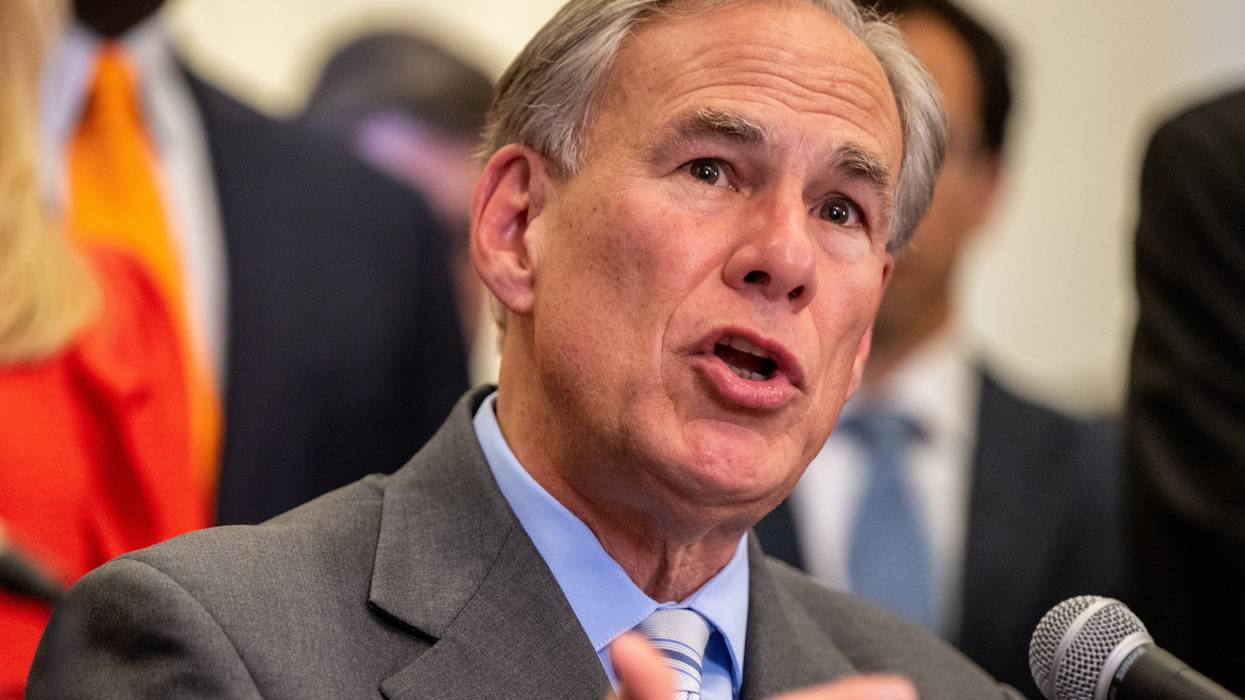
Republican Texas Gov. Greg Abbott sparked widespread outrage Sunday by derogatorily—and incorrectly—referring to five people killed in a Liberty County mass shooting two days earlier as "illegal immigrants."
On Friday evening, a drunk man allegedly shot and killed five people, including an 8-year-old boy, in a Cleveland home after residents asked him to stop shooting his AR-15-style rifle into the air. The gunman then fled the scene of the massacre and has been on the run ever since.
Police identified those killed as Sonia Argentina Guzman, 25; Diana Velazquez Alvarado, 21; Julisa Molina Rivera, 31; Jose Jonathan Casarez, 18; and Daniel Enrique Laso, 8. All were shot in the head or neck. According toKTRK, two of the slain women were found laying atop three children who were covered in blood but physically unharmed.
"This shooting has nothing to do with immigration status and much to do with your policies."
On Sunday, Abbott offered a $50,000 reward for information leading to the capture of the suspect, identified as 38-year-old Francisco Oropeza. While the governor said that "our hearts go out to the families and loved ones of the five victims that were taken in this senseless act of violence," he drew nationwide rebuke for referring to the murdered people as "illegal immigrants."
It is believed that all five victims—and Oropeza—are from Honduras. While four of the victims are believed to be undocumented, Velazquez Alvarado's widower said the woman was a permanent U.S. resident and shared a photo of her green card with immigrant rights activist Carlos Eduardo Espina. Abbott's mischaracterization of all five as "illegal immigrants" drew an "added context" disclaimer from Twitter.
"Five human beings lost their lives and Greg Abbott insists on labeling them 'illegal immigrants,'" tweeted former San Antonio mayor and U.S. Housing and Urban Development Secretary Julián Castro.
Democratic strategist Sawyer Hackett, a former senior adviser to Castro, wrote on Twitter that "Greg Abbott is so morally bankrupt that he has to make the senseless murder of five people with an AR-15 about 'illegal immigration.'"
"Forty-eight hours after this massacre and this is the craven hackery he comes up with," Hackett added.
The advocacy group Voto Latino asserted that "there is no reason to refer to the five victims—including a child—as 'illegal immigrants.' For Greg Abbott and the GOP, the cruelty is the point."
Abbott, who is currently in his third term as governor, has been criticized for his tough-on-migrants policies, which include increased border militarization and—like his counterparts in Arizona and Florida—for busing migrants to cities and states with sanctuary policies.
Responding to Abbott's Sunday statement, attorney and political commentator Olayemi Olurin tweeted that "the dehumanization here is otherworldly."
"Even in their deaths he can't see undocumented immigrants as human beings," Olurin said of Abbott. "He couldn't think of anything to call a family who'd been murdered but illegal immigrants."
The Immigrant Legal Resource Center (ILRC), a San Francisco-based advocacy group, said in a Twitter thread that "public figures like Abbott leverage their status by using social media to amplify language painting a specific narrative intended to alter the way you view and treat the people around you. The victims here were your neighbors. They were your friends. They were your colleagues."
"When we read things like that statement from Abbott and his social media team we are confronted with a choice," ILRC added. "Do we want to live in a world where people are... granted their dignity and humanity even in the face of unimaginable tragedy? Or do we want—this?"
Pictures convey reality in a way that words cannot. One of these days, the parents of children murdered in a school shooting may make the same decision Mamie Till did of her son Emmett in 1955.
And now we have another mass school shooting, this time in Tennessee with three 9-year-old girls dead as well as 3 adults. Immediately followed by another pathetic Republican congressman claiming that Congress can’t do a thing.
A community is grieving, schoolkids across America are terrified, and after 130 mass shootings in the first 87 days of this year — 33 of them in schools and colleges — you’d think average Americans would finally understand the horrors of the gun violence Republicans in Congress and on the Supreme Court have inflicted on us.
This is a phenomenon as systemic and unique to the United States today as Jim Crow was in the 1950s. The gun control movement needs to learn from the Civil Rights movement.
Back in 1955, young Black people like 14-year-old Emmett Till were routinely murdered by white people all over America, usually with no consequence whatsoever.
Emmett Till was kidnapped by two Mississippi white men, brutally tortured, murdered, and his mangled body was thrown into the Tallahatchie River. (And the white men who did it, and the white woman who set it off with a lie, never suffered any consequence.)
His mother, Mamie Bradley, made the extraordinarily brave decision to show her child’s mutilated face with an open-coffin funeral in their hometown of Chicago.
Jet magazine ran a picture you can see here of Emmett, which went viral, invigorating the Civil Rights movement as it horrified the nation. As President Biden said last month, honoring the release of the new movie Till:
“JET magazine, the Chicago Defender and other Black newspapers were unflinching and brave in sharing the story of Emmett Till and searing it into the nation’s consciousness.”
That picture made real the horrors of white violence against Black people in America for those who were unfamiliar, or just unwilling, to confront it.
We’ve all heard about Newtown and Stoneman Douglas and Las Vegas, but have you ever seen pictures of the bodies mutilated by the .223 caliber bullets that semi-automatic assault weapons like the AR15 fire?
The odds are pretty close to zero; most Americans have no idea the kind of damage such weapons of war can do to people, particularly children.
But we need to learn.
In the 1980s, egged on by partisans in the Reagan administration, America’s antiabortion movement begin the practice of holding up graphic, bloody pictures of aborted fetuses as part of their demonstrations and vigils.
Their literature and magazines, and even some of their advertisements, often carry or allude to these graphic images.
Those in the movement will tell you that the decision to use these kinds of pictures was a turning point, when “abortion became real“ for many Americans, and even advocates of a woman’s right to choose an abortion started using phrases like “legal, safe, and rare.“
Similarly, when the Pulitzer Prize-winning photo of 9-year-old “Napalm Girl” Phan Thị Kim Phúc running naked down a rural Vietnamese road after napalm caught her clothes on fire was published in 1972, it helped finally turned the tide on the Vietnam War.
Showing pictures in American media of the result of a mass shooter’s slaughter would be a controversial challenge.
There are legitimate concerns about sensationalizing violence, about morbid curiosity, about warping young minds and triggering PTSD for survivors of violence.
And yet, pictures convey reality in a way that words cannot. One of these days, the parents of children murdered in a school shooting may make the same decision Mamie Till did in 1955.
America’s era of mass shootings kicked off on August 1, 1966 when Charles Whitman murdered his mother and then climbed to the top of the clock tower at the University of Texas and begin shooting.
The vast majority of our mass killings, however, began during the Reagan/Bush administrations following the 1984 San Ysidro, California McDonald’s massacre, the Edmond, Oklahoma Post Office shooting of 1986, and the Luby’s Cafeteria massacre in Killeen, Texas in 1991.
We’ve become familiar with the names of the places, and sometimes the dates, but the horror and pain of the torn and exploded bodies has escaped us.
It’s time for America to confront the reality of gun violence. And all my years working in the advertising business tell me that a graphic portrayal of the consequences of their products is the greatest fear of America’s weapons manufacturers and the NRA.
We did it with tobacco and drunk driving back in the day, showing pictures of people missing half their jaw or mangled and bloody car wreckage, and it worked.
And now there’s a student-led movement asking states to put a check-box on driver’s licenses with the line:
“In the event that I die from gun violence please publicize the photo of my death. #MyLastShot.”
This isn’t, however, something that should just be tossed off, or thrown up on a webpage.
Leadership from multiple venues in American journalism — print, television, web-based publications — should get together and decide what photos to release, how to release them, and under what circumstances it could be done to provide maximum impact and minimum trauma.
But Americans must understand what’s really going on.
A decade ago, President Obama put then-VP Joe Biden in charge of his gun task force, and Joe Biden saw the pictures from school shootings back then.
Here’s how The New York Times quoted then-Vice President Biden:
“‘Jill and I are devastated. The feeling — I just can’t imagine how the families are feeling,’ he said, at times struggling to find the right words.”
Obama himself, after seeing the photos, broke into tears on national television.
And we appear to be tiptoeing up to the edge of doing exactly this. Yesterday’s Washington Post featured an article about what happens when people are shot by assault weapons and included this commentary:
“A Texas Ranger speaks of bullets that ‘disintegrated’ a toddler’s skull.
“This explains the lead poisoning that plagues survivors of the shooting in Sutherland Springs, Tex.; David Colbath, 61, can scarcely stand or use his hands without pain, and 25-year-old Morgan Workman probably can’t have a baby. It explains the evisceration of small bodies such as that of Noah Pozner, 6, murdered at Sandy Hook Elementary, and Peter Wang, 15, killed at Marjory Stoneman Douglas High. The Post examined the way bullets broke inside of them — obliterating Noah’s jaw and Peter’s skull, filling their chests with blood and leaving behind gaping exit wounds.”
But we need to go the next step and show the actual pictures for this truth about the horror of gun violence to become widely known. Doing this will take leadership.
And, of course, there must be a Mamie Bradley: a parent, spouse or other relation willing to allow the photos of their loved one to be used in this way.
In 1996 there was a horrific slaughter in Tasmania, Australia, by a shooter using an AR15-style weapon, culminating a series of mass shootings that had plagued that nation for over a decade.
While the Australian media generally didn’t publish the photos, they were widely circulated.
As a result the Australian public was so repulsed that within a year semi-automatic weapons in civilian hands were outlawed altogether, strict gun control measures were put into place, and a gun-buyback program went into effect that voluntarily took over 700,000 weapons out of circulation.
And that was with John Howard as Prime Minister — a conservative who was as hard-right as Ronald Reagan!
In the first years after the laws took place, firearms-related deaths in Australia fell by well over 40%, with suicides dropping by 77%. There have only been two mass killings in the 27 years since then.
The year 1996 was Australia’s Emmett Till moment.
America needs ours.
The Washington Post exposé has been described as "the most powerful article you will read this week" and "one of the most important pieces of journalism ever produced."
On Monday morning, The Washington Post published a series of 3D animations to show "how bullets from an AR-15 blow the body apart."
A few hours later, a 28-year-old shooter armed with two assault rifles and a handgun killed six people at a private Christian school in Nashville.
In the wake of that massacre—the 129th mass shooting in the United States in 2023—the Post's exposé has received sustained attention, with one person calling it "the most powerful article you will read this week" and another characterizing it as "one of the most important pieces of journalism ever produced."
Noting that the lethal wounds caused by AR-15s "are rarely seen" by the public, the newspaper demonstrated "the trajectory of two different hypothetical gunshots to the chest—one from an AR-15 and another from a typical handgun—to explain the greater severity of the damage caused by the AR-15."
Then, after obtaining permission from the parents of two school shooting victims, a team of visual reporters created 3D models to depict how bullets fired from "many mass killers' weapon of choice" obliterated their children's bodies.
Noah Ponzer was one of the 26 people who were killed by an AR-15-wielding gunman at Sandy Hook Elementary School in Newtown, Connecticut on December 14, 2012. The 6-year-old was shot three times.
"Noah's wounds were not survivable," the Post reported, citing 2019 court testimony from Wayne Carver, who was the state's chief medical examiner at the time.
Peter Wang was one of 17 people murdered when an attacker armed with an AR-15 opened fire at Marjory Stoneman Douglas High School in Parkland, Florida on February 14, 2018. The 15-year-old was shot 13 times.
As the Post reported: "The combined energy of those bullets created exit wounds so 'gaping' that the autopsy described his head as 'deformed.' Blood and brain splatter were found on his upper body and the walls. That degree of destruction, according to medical experts, is possible only with a high-velocity weapon."
"This is the trauma witnessed by first responders—but rarely, if ever, seen by the public or the policymakers who write gun laws," the newspaper noted.
Instead, many GOP lawmakers glorify assault rifles, including U.S. Rep. Andy Ogles (R-Tenn.), whose congressional district is home to the Nashville school where Monday's deadly shooting took place.
Another right-wing member of Tennessee's congressional delegation—Republican Rep. Tim Burchett—baldly stated that "we're not gonna fix it" just hours after the shooting.
There are more guns than people in the United States. Due to National Rifle Association-bankrolled Republicans' opposition to meaningful gun safety laws—bolstered by a 2022 ruling handed down by the U.S. Supreme Court's reactionary majority—it is relatively easy for people to purchase firearms in many states.
Two years ago, Tennessee became one of several states that allow most adults to carry handguns without a permit.
There have been thousands of mass shootings since Noah and more than two dozen other individuals suffered gruesome deaths at Sandy Hook, including last year's slaughter at Robb Elementary School in Uvalde, Texas, among hundreds of others. Research shows that U.S. states with weaker gun control laws and higher rates of gun ownership have higher rates of mass shootings.
Research also shows that gun regulations with high levels of public support, including bans on assault weapons and high-capacity magazines, help reduce the number and severity of fatal mass shootings.
Guns recently became the leading cause of death among children and teens in the United States. A study published last year found that roughly 26,000 kids could still be alive today if the U.S. had the same gun mortality rate as Canada.
"Most Americans are shocked and disgusted by the idea of manufacturing semiautomatic assault rifles designed for grade schoolers," said one gun control advocate.
An Illinois-based gunmaker came under fire again Tuesday for rebranding a semi-automatic rifle for children inspired by the AR-15 that's so commonly used in U.S. mass shootings.
A year ago, WEE1 Tactical—maker of the lightweight JR-15 assault-style rifle that "operates just like mom and dad's gun"—sparked outrage with marketing featuring pacifier-sucking baby skulls with gunsights for eye sockets. The gun made headlines again in 2022 after Rep. Marjorie Taylor Greene (R-Ga.) tweeted that students at Robb Elementary School in Uvalde, Texas "needed JR-15s to defend themselves" against a gunman who killed 19 children and two staff members with an AR-15-style rifle.
Since then, WEE1 Tactical has shifted its branding strategy. The baby skulls are gone; now the JR-15 represents "a great American tradition," a "small piece of American freedom," and "American family values."
Josh Sugarmann, executive director of the Violence Policy Center and author of a 2016 study on the firearms industry's gun-grooming of American children, led criticism of the JR-15 rebrand.
"WEE1 Tactical has adopted this supposedly kinder, gentler marketing approach because it knows from experience that most Americans are shocked and disgusted by the idea of manufacturing semi-automatic assault rifles designed for grade schoolers," Sugarmann said in a statement. "The company's persistence in selling assault rifles for children makes clear the need for continued vigilance by parents and communities as well as legislative action."
WEE1 Tactical is displaying the JR-15 at SHOT Show 2023, a major National Shooting Sports Foundation trade show that opened Tuesday at the Venetian Expo and Caesars Forum in Las Vegas. That's about three miles from where a man armed with 24 guns including 14 AR-15-type rifles massacred 60 people at a 2017 country music festival on the Las Vegas Strip in the deadliest mass shooting in U.S. history.
The JR-15 is not an AR-15, the civilian version of the M16 and its more modern offshoot, the M4 carbine, used by the U.S. military since the Vietnam War era. Instead of the NATO-standard 5.56 mm bullets fired by the AR-15, the JR-15 uses .22 caliber rounds which, while still potentially deadly, are much smaller, far less powerful, and commonly associated with a youth's first hunting or sporting rifle.
However, gun control advocates note that children made up nearly 1,700 of the more than 44,000 people killed with guns in the United States last year. Earlier this month, a 6-year-old brought a gun to his elementary school in Newport News, Virginia and allegedly shot his teacher during an altercation.
"Call me crazy but just weeks after a 6-year-old shot his teacher I don't think it's a great idea to be releasing a kids version of the AR-15," tweeted David Hogg, co-founder of March for Our Lives and a survivor of the 2018 massacre at Marjory Stoneman Douglas High School massacre in Parkland, Florida, in which the gunman used an AR-15-style rifle to murder 14 students and three staff.
In California, state Assemblymember Phil Ting (D-19) last year introduced a bill that would ban the marketing of guns to children.
Last year, the Kaiser Family Foundation published a study showing that roughly 26,000 U.S. children would still be alive if the country had the same child gun death rate as Canada.
Does one man’s freedom force the rest of us to watch their country turn into a John Wayne movie?
It was the guacamole’s fault!
That’s the guy’s defense, anyway — that plus his right to carry four handguns, an AR-15 and a 12-guage shotgun into a supermarket in Atlanta. Oh yeah, and he was wearing body armor. This was in March 2021, barely a week after an actual mass shooting at several massage parlors in Atlanta, in which eight people were killed. And it was only two days after a mass shooting at a grocery store in Boulder, Colorado, where ten people were killed.
When another customer saw the guy in the store’s bathroom, with the AR-15 propped against a wall, and alerted store personnel to the presence of a possible mass murderer, the panic was certainly understandable. The store was evacuated, police came, the gun carrier was arrested. But, as the New York Times asked in a story about the incident nearly two years later: Did he break the law?
When I read this paradoxical story the other day — about how the arrestee hadn’t actually committed a crime and was not convicted of any wrongdoing — the psychological stratosphere broke open for me. Who are we . . . as a nation, as a planet, as an evolving species? Here’s the thing about paradox: You can’t simply shoot it, blow it apart, then move on. You have to swallow it whole. You have to transcend it.
What is freedom — in this case, the freedom to be armed and, you know, able to defend yourself? Does one man’s freedom force the rest of us to watch their country turn into a John Wayne movie?
The Times story informs us that the defense attorney told the court his client “had acquired the guns and the body armor . . . because he had felt threatened by someone in his neighborhood. On the day of his arrest, he had hoped to take his guns to a nearby shooting range but first had to run some errands, which included a stop at the grocery store.”
And, oh yeah, he didn’t have a car, which is why he had lugged the guns — handguns in his jacket pockets, the rifle and shotgun in a guitar case — into the store. While he was in the men’s room, he “had taken out some of the weapons, including the rifle, to clean them after discovering that some guacamole he had bought had caused a mess inside the bag.”
And there you have it. A normal American situation. Well, sure, as the Times points out: “All but three states allow for the open carry of handguns, long guns or both, and in many there is little the police can do.”
Hence, the paradox. Of course, there’s one small detail the Times story omits. The police dilemma can suddenly disappear if the person legally carrying a gun happens to be black, as the Philando Castile case demonstrated back in 2016.
Castile, a black man who was licensed to carry a handgun, was driving with his girlfriend and her 4-year-old daughter in a suburb near Saint Paul, Minnesota, when his car was pulled over. Castile explained to the officer that he was legally carrying a handgun, but as he was trying to pull out his driver’s license, the officer shot him seven times, killing him. The officer was later arrested and charged with manslaughter, but was acquitted.
So the paradox expands: weapons, force, fear, dehumanization and . . . racism.
“This is the American paradox in full blossom.” So I wrote last year, pondering the endless question. “The more people there are carrying guns, especially in public places, the more dangerous it is simply to be out and about; and the more dangerous it is to be out in public, the more credibility Second Amendment aficionados have when they claim they are only safe if they’re carrying a weapon.”
Except they aren’t safe at all — they’re just swimming in the chaos, clinging to a belief that their guns make them safe. But such a belief is crucial. I understand the need to believe one is safe. When I moved to Chicago from rural Michigan — my God, almost half a century ago, in search of a career in journalism — I wasn’t sure how I’d fare in the dangerous big city. But I was a peacenik, not a gun guy. Here’s what I decided: I’ll look everyone in the eye. I will not be afraid.
That is to say, I gave myself agency. And this is what worked — the fact that I felt empowered. And I didn’t care what neighborhood I was in. The white-person mantra was: Stay out of such-and-such neighborhood . . . Cabrini-Green or whatever. You know, neighborhoods of color, a.k.a., ghettos. Don’t go there! I paid no attention to that, and the whole city became mine.
I’m not saying life has been perfect — free of trouble. I was once mugged by three teens in hoodies, a few blocks from my house. Life is what it is. The world is full of thorns and potholes. No one is fully safe, forever and ever.
And the paradox doesn’t go away. How much force is necessary to get what we want? Historian Timothy Snyder, in a recent interview with Rachel Maddow reflecting on the Jan. 8 attack on the Brazilian capital by supporters of defeated president Jair Bolsonaro (and its similarity to the Jan. 6, 2021 attack on the U.S. capital by Trump supporters), said:
“When you trash the place, you’re showing, symbolically, that institutions don’t matter. What matters is force. What matters is will. You disrespect an institution . . . a strongman should be running the country. You humiliate the institution, then you get the strongman.”
And the strongman may kill his enemies, but he can’t kill the paradox.
Following yet another horrific school massacre--in which the lives of numerous children, teachers, and their families in Uvalde, Texas were destroyed by an 18-year-old wielding a pair of AR-15s--legal experts are warning that the U.S. Supreme Court's right-wing majority is likely to soon make the nation's gun violence crisis even worse.
At issue is the high court's looming decision in New York State Rifle & Pistol Association v. Bruen.
"The next-day ramifications of striking down this gun law would be greater than the next-day ramifications for any other Second Amendment case that the Supreme Court has decided."
The court's reactionary justices, most of whom were appointed by Republican presidents who lost the popular vote, are "potentially poised to take down one of the nation's oldest and most restrictive gun-control laws this summer," the Washington Post reported last week. That could "unravel laws across the nation restricting who can carry guns in public," further increasing the presence of firearms in a country that has more guns--now the leading cause of death among children in the U.S.--than people.
"The Supreme Court's conservative supermajority is about to dramatically expand the scope of the Second Amendment and prohibit us from protecting our communities by enacting gun safety laws through the democratic process," journalist Mark Joseph Stern warned soon after Tuesday's killing spree at Robb Elementary School.
That atrocity was one of more than 3,500 mass shootings in the U.S. since 26 people, including 20 kids under the age of seven, were slaughtered at Sandy Hook Elementary School in Newtown, Connecticut in late 2012. Less than a week ago, an 18-year-old white supremacist murdered 10 Black people at a Buffalo supermarket.
As journalist Joe Patrice noted earlier this week when writing about New York State Rifle & Pistol Association v. Bruen, "Oral argument made clear that the majority of the Supreme Court will yet again obliterate even the mildest of gun regulations in service of its gun lobby masters."
"Despite knowing exactly how this is going to turn out, the Supreme Court is likely to sit on this opinion now," wrote Patrice. "We could have seen it as early as Tuesday, but the conservative majority that brands itself as 'just calling balls and strikes' is sufficiently cowardly that it won't risk declaring a concealed carry free-for-all one week after a school massacre."
The Post-Standard, a Syracuse-based newspaper, recently explained how the most consequential Second Amendment case in over a decade started after a pair of applications for concealed carry permits were denied in upstate New York:
A lawsuit filed by two Rensselaer County men challenges the state's requirement that gun owners must have a justifiable reason--referred to as "proper cause"--to get a concealed carry permit. Permit applicants must now state why they have a need to carry a gun in public. For example, it could be because they have been threatened or their job places them in danger.
The Rensselaer County men are making the case that applicants should not have to give a reason for why they want to carry a concealed gun in public. They argue they have that right under the Second Amendment.
In a brief for the court, the U.S. Justice Department wrote that "the Second Amendment protects an individual right to keep and bear arms, but that right is not absolute."
Journalist Jay Michaelson, meanwhile, shed light on the right's "preposterous misreading of the Second Amendment, funded largely by gun manufacturers," in a Rolling Stone essay published this week:
Contrary to what you may have been led to believe, until 2008, no federal court had held that the Second Amendment conveyed a right to own a gun. On the contrary, the Supreme Court clearly said that it didn't.
[...]
And what had once been a fringe view rejected by the Supreme Court--that the Second Amendment gave individuals a right to own guns--gradually became Republican Party gospel when the fringe took over the party. Former Chief Justice Warren Burger (a conservative appointed by Richard Nixon) described it as "a fraud on the American public."
When the high court hands down its decision in New York State Rifle & Pistol Association v. Bruen, the right-wing majority will pretend that "it is applying neutral historical and factual principles, when it will in truth be distorting the history and original meaning of constitutional language to achieve a partisan political outcome that is disfavored by vast majorities of Americans," Stern and Dahlia Lithwick wrote this week in Slate. "That is because what majorities of Americans actually want doesn't matter to them."
The high court's decision will reverberate far beyond New York. Seven other states--including California, Connecticut, Deleware, Hawaii, Maryland, Massachusetts, and New Jersey--plus Washington, D.C. and several big cities have similar laws restricting concealed carry permits. The eight states have a combined population of 80 million people, roughly one-fourth of the national total.
The Post-Standard noted that the court's decision comes in the wake of "40 years of state-level legislative rollbacks of concealed carry regulation in the United States. Since 1981, the number of states with a law similar to New York has decreased by more than two-thirds, according to a review of state-level gun laws by SUNY Cortland professor Robert J. Spitzer."
Eric Ruben, a Second Amendment expert and assistant law professor at Southern Methodist University, told the newspaper that "the next-day ramifications of striking down this gun law would be greater than the next-day ramifications for any other Second Amendment case that the Supreme Court has decided."
Highlighting the broad implications of the case for gun regulations in general, Susan Liebell, a professor at St. Joseph's University, predicted that "we will see more states' laws struck down."
According to The Post-Standard:
She and Ruben said striking down the law could invite legal challenges to New York's SAFE Act, which broadened the definition of assault weapons, required background checks for ammunition sales, forced gun owners to report when their guns were lost or stolen within a day, and required mental health professionals to report patients to police if they believe the patient is likely to harm others.
Ruben said other laws that could come under attack place restrictions on magazine capacity, impose zoning requirements for shooting ranges, and limit the possession of firearms by those who have been deemed mentally ill or have past convictions.
As Lithwick and Stern pointed out, "The court may not actually be able to find a politically convenient moment to hand down this opinion; between a Buffalo gun massacre, Orange County church murders, and a massacre of Texas schoolchildren on Tuesday, it's clear that there will always be another mass shooting immediately before, or on, Supreme Court opinion days."
"The justices themselves won't face the lethal consequences of their own Second Amendment rulings," Lithwick and Stern wrote. "Justice Antonin Scalia's reasoning from D.C. v. Heller preemptively upholding 'laws forbidding the carrying of firearms' in 'government buildings' will stand, although it represented dicta and not official doctrine. And Republican senators won't face the lethal consequences of their failures to act after Columbine, after Sandy Hook, after Parkland, and after today."
The pair continued: "The judiciary will uphold the prohibition on guns in the halls of the Congress and the Supreme Court. Indeed, the NRA just announced that guns will be banned during Donald Trump's speech at Friday's NRA conference."
"We know what is required to fix this mess," wrote Lithwick and Stern. "End the filibuster. Expand the Supreme Court. Admit new states. Shift political power away from the rural whites who hold a disproportionate amount of it and toward the multiracial urban centers that make up a majority of the country. Create the truly representative democracy that people have been denied for far too long."
"Until then, we will be at the mercy of conservative jurists and lawmakers making choices that kill us and our families," they added. "That they can still exempt themselves from these ravages isn't a coincidence. It's both evidence of the crime and proof that, as long as they're in charge, the killing will never stop."