SUBSCRIBE TO OUR FREE NEWSLETTER
Daily news & progressive opinion—funded by the people, not the corporations—delivered straight to your inbox.
5
#000000
#FFFFFF
To donate by check, phone, or other method, see our More Ways to Give page.
Daily news & progressive opinion—funded by the people, not the corporations—delivered straight to your inbox.
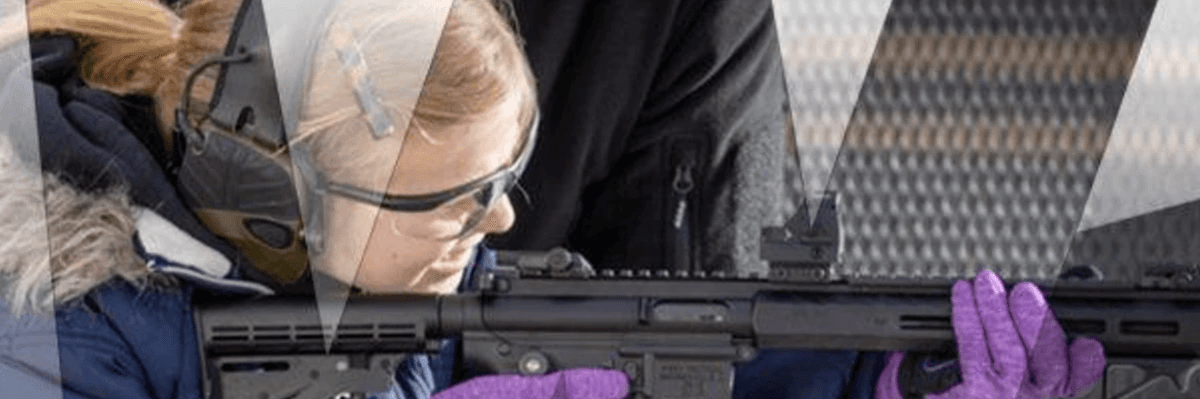
In marketing material for gunmaker WEE1 Tactical, a girl holds a JR-15, a rifle for children inspired by the AR-15. (Image: WEE1 Tactical)
"Most Americans are shocked and disgusted by the idea of manufacturing semiautomatic assault rifles designed for grade schoolers," said one gun control advocate.
An Illinois-based gunmaker came under fire again Tuesday for rebranding a semi-automatic rifle for children inspired by the AR-15 that's so commonly used in U.S. mass shootings.
A year ago, WEE1 Tactical—maker of the lightweight JR-15 assault-style rifle that "operates just like mom and dad's gun"—sparked outrage with marketing featuring pacifier-sucking baby skulls with gunsights for eye sockets. The gun made headlines again in 2022 after Rep. Marjorie Taylor Greene (R-Ga.) tweeted that students at Robb Elementary School in Uvalde, Texas "needed JR-15s to defend themselves" against a gunman who killed 19 children and two staff members with an AR-15-style rifle.
Since then, WEE1 Tactical has shifted its branding strategy. The baby skulls are gone; now the JR-15 represents "a great American tradition," a "small piece of American freedom," and "American family values."
Josh Sugarmann, executive director of the Violence Policy Center and author of a 2016 study on the firearms industry's gun-grooming of American children, led criticism of the JR-15 rebrand.
"WEE1 Tactical has adopted this supposedly kinder, gentler marketing approach because it knows from experience that most Americans are shocked and disgusted by the idea of manufacturing semi-automatic assault rifles designed for grade schoolers," Sugarmann said in a statement. "The company's persistence in selling assault rifles for children makes clear the need for continued vigilance by parents and communities as well as legislative action."
WEE1 Tactical is displaying the JR-15 at SHOT Show 2023, a major National Shooting Sports Foundation trade show that opened Tuesday at the Venetian Expo and Caesars Forum in Las Vegas. That's about three miles from where a man armed with 24 guns including 14 AR-15-type rifles massacred 60 people at a 2017 country music festival on the Las Vegas Strip in the deadliest mass shooting in U.S. history.
The JR-15 is not an AR-15, the civilian version of the M16 and its more modern offshoot, the M4 carbine, used by the U.S. military since the Vietnam War era. Instead of the NATO-standard 5.56 mm bullets fired by the AR-15, the JR-15 uses .22 caliber rounds which, while still potentially deadly, are much smaller, far less powerful, and commonly associated with a youth's first hunting or sporting rifle.
However, gun control advocates note that children made up nearly 1,700 of the more than 44,000 people killed with guns in the United States last year. Earlier this month, a 6-year-old brought a gun to his elementary school in Newport News, Virginia and allegedly shot his teacher during an altercation.
"Call me crazy but just weeks after a 6-year-old shot his teacher I don't think it's a great idea to be releasing a kids version of the AR-15," tweeted David Hogg, co-founder of March for Our Lives and a survivor of the 2018 massacre at Marjory Stoneman Douglas High School massacre in Parkland, Florida, in which the gunman used an AR-15-style rifle to murder 14 students and three staff.
In California, state Assemblymember Phil Ting (D-19) last year introduced a bill that would ban the marketing of guns to children.
Last year, the Kaiser Family Foundation published a study showing that roughly 26,000 U.S. children would still be alive if the country had the same child gun death rate as Canada.
Dear Common Dreams reader, It’s been nearly 30 years since I co-founded Common Dreams with my late wife, Lina Newhouser. We had the radical notion that journalism should serve the public good, not corporate profits. It was clear to us from the outset what it would take to build such a project. No paid advertisements. No corporate sponsors. No millionaire publisher telling us what to think or do. Many people said we wouldn't last a year, but we proved those doubters wrong. Together with a tremendous team of journalists and dedicated staff, we built an independent media outlet free from the constraints of profits and corporate control. Our mission has always been simple: To inform. To inspire. To ignite change for the common good. Building Common Dreams was not easy. Our survival was never guaranteed. When you take on the most powerful forces—Wall Street greed, fossil fuel industry destruction, Big Tech lobbyists, and uber-rich oligarchs who have spent billions upon billions rigging the economy and democracy in their favor—the only bulwark you have is supporters who believe in your work. But here’s the urgent message from me today. It's never been this bad out there. And it's never been this hard to keep us going. At the very moment Common Dreams is most needed, the threats we face are intensifying. We need your support now more than ever. We don't accept corporate advertising and never will. We don't have a paywall because we don't think people should be blocked from critical news based on their ability to pay. Everything we do is funded by the donations of readers like you. When everyone does the little they can afford, we are strong. But if that support retreats or dries up, so do we. Will you donate now to make sure Common Dreams not only survives but thrives? —Craig Brown, Co-founder |
An Illinois-based gunmaker came under fire again Tuesday for rebranding a semi-automatic rifle for children inspired by the AR-15 that's so commonly used in U.S. mass shootings.
A year ago, WEE1 Tactical—maker of the lightweight JR-15 assault-style rifle that "operates just like mom and dad's gun"—sparked outrage with marketing featuring pacifier-sucking baby skulls with gunsights for eye sockets. The gun made headlines again in 2022 after Rep. Marjorie Taylor Greene (R-Ga.) tweeted that students at Robb Elementary School in Uvalde, Texas "needed JR-15s to defend themselves" against a gunman who killed 19 children and two staff members with an AR-15-style rifle.
Since then, WEE1 Tactical has shifted its branding strategy. The baby skulls are gone; now the JR-15 represents "a great American tradition," a "small piece of American freedom," and "American family values."
Josh Sugarmann, executive director of the Violence Policy Center and author of a 2016 study on the firearms industry's gun-grooming of American children, led criticism of the JR-15 rebrand.
"WEE1 Tactical has adopted this supposedly kinder, gentler marketing approach because it knows from experience that most Americans are shocked and disgusted by the idea of manufacturing semi-automatic assault rifles designed for grade schoolers," Sugarmann said in a statement. "The company's persistence in selling assault rifles for children makes clear the need for continued vigilance by parents and communities as well as legislative action."
WEE1 Tactical is displaying the JR-15 at SHOT Show 2023, a major National Shooting Sports Foundation trade show that opened Tuesday at the Venetian Expo and Caesars Forum in Las Vegas. That's about three miles from where a man armed with 24 guns including 14 AR-15-type rifles massacred 60 people at a 2017 country music festival on the Las Vegas Strip in the deadliest mass shooting in U.S. history.
The JR-15 is not an AR-15, the civilian version of the M16 and its more modern offshoot, the M4 carbine, used by the U.S. military since the Vietnam War era. Instead of the NATO-standard 5.56 mm bullets fired by the AR-15, the JR-15 uses .22 caliber rounds which, while still potentially deadly, are much smaller, far less powerful, and commonly associated with a youth's first hunting or sporting rifle.
However, gun control advocates note that children made up nearly 1,700 of the more than 44,000 people killed with guns in the United States last year. Earlier this month, a 6-year-old brought a gun to his elementary school in Newport News, Virginia and allegedly shot his teacher during an altercation.
"Call me crazy but just weeks after a 6-year-old shot his teacher I don't think it's a great idea to be releasing a kids version of the AR-15," tweeted David Hogg, co-founder of March for Our Lives and a survivor of the 2018 massacre at Marjory Stoneman Douglas High School massacre in Parkland, Florida, in which the gunman used an AR-15-style rifle to murder 14 students and three staff.
In California, state Assemblymember Phil Ting (D-19) last year introduced a bill that would ban the marketing of guns to children.
Last year, the Kaiser Family Foundation published a study showing that roughly 26,000 U.S. children would still be alive if the country had the same child gun death rate as Canada.
An Illinois-based gunmaker came under fire again Tuesday for rebranding a semi-automatic rifle for children inspired by the AR-15 that's so commonly used in U.S. mass shootings.
A year ago, WEE1 Tactical—maker of the lightweight JR-15 assault-style rifle that "operates just like mom and dad's gun"—sparked outrage with marketing featuring pacifier-sucking baby skulls with gunsights for eye sockets. The gun made headlines again in 2022 after Rep. Marjorie Taylor Greene (R-Ga.) tweeted that students at Robb Elementary School in Uvalde, Texas "needed JR-15s to defend themselves" against a gunman who killed 19 children and two staff members with an AR-15-style rifle.
Since then, WEE1 Tactical has shifted its branding strategy. The baby skulls are gone; now the JR-15 represents "a great American tradition," a "small piece of American freedom," and "American family values."
Josh Sugarmann, executive director of the Violence Policy Center and author of a 2016 study on the firearms industry's gun-grooming of American children, led criticism of the JR-15 rebrand.
"WEE1 Tactical has adopted this supposedly kinder, gentler marketing approach because it knows from experience that most Americans are shocked and disgusted by the idea of manufacturing semi-automatic assault rifles designed for grade schoolers," Sugarmann said in a statement. "The company's persistence in selling assault rifles for children makes clear the need for continued vigilance by parents and communities as well as legislative action."
WEE1 Tactical is displaying the JR-15 at SHOT Show 2023, a major National Shooting Sports Foundation trade show that opened Tuesday at the Venetian Expo and Caesars Forum in Las Vegas. That's about three miles from where a man armed with 24 guns including 14 AR-15-type rifles massacred 60 people at a 2017 country music festival on the Las Vegas Strip in the deadliest mass shooting in U.S. history.
The JR-15 is not an AR-15, the civilian version of the M16 and its more modern offshoot, the M4 carbine, used by the U.S. military since the Vietnam War era. Instead of the NATO-standard 5.56 mm bullets fired by the AR-15, the JR-15 uses .22 caliber rounds which, while still potentially deadly, are much smaller, far less powerful, and commonly associated with a youth's first hunting or sporting rifle.
However, gun control advocates note that children made up nearly 1,700 of the more than 44,000 people killed with guns in the United States last year. Earlier this month, a 6-year-old brought a gun to his elementary school in Newport News, Virginia and allegedly shot his teacher during an altercation.
"Call me crazy but just weeks after a 6-year-old shot his teacher I don't think it's a great idea to be releasing a kids version of the AR-15," tweeted David Hogg, co-founder of March for Our Lives and a survivor of the 2018 massacre at Marjory Stoneman Douglas High School massacre in Parkland, Florida, in which the gunman used an AR-15-style rifle to murder 14 students and three staff.
In California, state Assemblymember Phil Ting (D-19) last year introduced a bill that would ban the marketing of guns to children.
Last year, the Kaiser Family Foundation published a study showing that roughly 26,000 U.S. children would still be alive if the country had the same child gun death rate as Canada.