SUBSCRIBE TO OUR FREE NEWSLETTER
Daily news & progressive opinion—funded by the people, not the corporations—delivered straight to your inbox.
5
#000000
#FFFFFF
To donate by check, phone, or other method, see our More Ways to Give page.
Daily news & progressive opinion—funded by the people, not the corporations—delivered straight to your inbox.
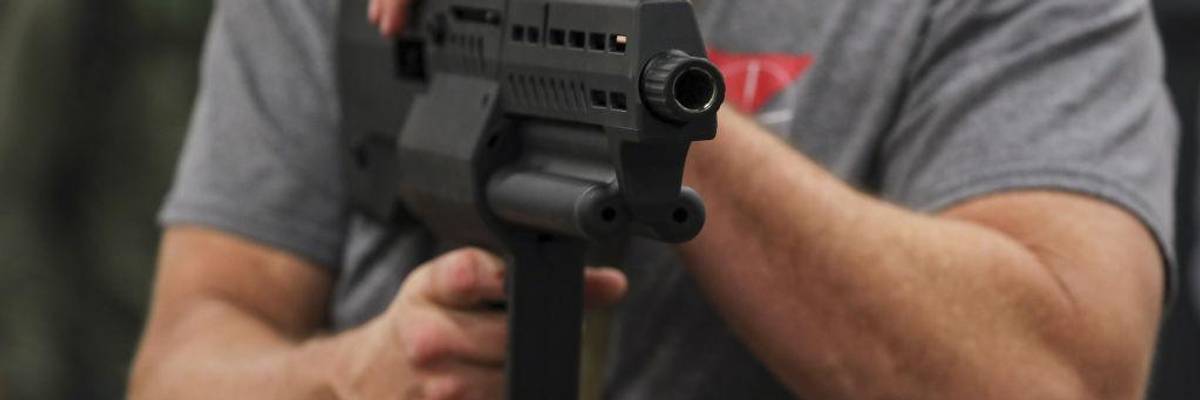
The Nation's Gun Show expo held at the Dulles Expo Center in Chantilly, Virginia, United States on December 30, 2022.
Does one man’s freedom force the rest of us to watch their country turn into a John Wayne movie?
It was the guacamole’s fault!
That’s the guy’s defense, anyway — that plus his right to carry four handguns, an AR-15 and a 12-guage shotgun into a supermarket in Atlanta. Oh yeah, and he was wearing body armor. This was in March 2021, barely a week after an actual mass shooting at several massage parlors in Atlanta, in which eight people were killed. And it was only two days after a mass shooting at a grocery store in Boulder, Colorado, where ten people were killed.
When another customer saw the guy in the store’s bathroom, with the AR-15 propped against a wall, and alerted store personnel to the presence of a possible mass murderer, the panic was certainly understandable. The store was evacuated, police came, the gun carrier was arrested. But, as the New York Times asked in a story about the incident nearly two years later: Did he break the law?
When I read this paradoxical story the other day — about how the arrestee hadn’t actually committed a crime and was not convicted of any wrongdoing — the psychological stratosphere broke open for me. Who are we . . . as a nation, as a planet, as an evolving species? Here’s the thing about paradox: You can’t simply shoot it, blow it apart, then move on. You have to swallow it whole. You have to transcend it.
What is freedom — in this case, the freedom to be armed and, you know, able to defend yourself? Does one man’s freedom force the rest of us to watch their country turn into a John Wayne movie?
The Times story informs us that the defense attorney told the court his client “had acquired the guns and the body armor . . . because he had felt threatened by someone in his neighborhood. On the day of his arrest, he had hoped to take his guns to a nearby shooting range but first had to run some errands, which included a stop at the grocery store.”
And, oh yeah, he didn’t have a car, which is why he had lugged the guns — handguns in his jacket pockets, the rifle and shotgun in a guitar case — into the store. While he was in the men’s room, he “had taken out some of the weapons, including the rifle, to clean them after discovering that some guacamole he had bought had caused a mess inside the bag.”
And there you have it. A normal American situation. Well, sure, as the Times points out: “All but three states allow for the open carry of handguns, long guns or both, and in many there is little the police can do.”
Hence, the paradox. Of course, there’s one small detail the Times story omits. The police dilemma can suddenly disappear if the person legally carrying a gun happens to be black, as the Philando Castile case demonstrated back in 2016.
Castile, a black man who was licensed to carry a handgun, was driving with his girlfriend and her 4-year-old daughter in a suburb near Saint Paul, Minnesota, when his car was pulled over. Castile explained to the officer that he was legally carrying a handgun, but as he was trying to pull out his driver’s license, the officer shot him seven times, killing him. The officer was later arrested and charged with manslaughter, but was acquitted.
So the paradox expands: weapons, force, fear, dehumanization and . . . racism.
“This is the American paradox in full blossom.” So I wrote last year, pondering the endless question. “The more people there are carrying guns, especially in public places, the more dangerous it is simply to be out and about; and the more dangerous it is to be out in public, the more credibility Second Amendment aficionados have when they claim they are only safe if they’re carrying a weapon.”
Except they aren’t safe at all — they’re just swimming in the chaos, clinging to a belief that their guns make them safe. But such a belief is crucial. I understand the need to believe one is safe. When I moved to Chicago from rural Michigan — my God, almost half a century ago, in search of a career in journalism — I wasn’t sure how I’d fare in the dangerous big city. But I was a peacenik, not a gun guy. Here’s what I decided: I’ll look everyone in the eye. I will not be afraid.
That is to say, I gave myself agency. And this is what worked — the fact that I felt empowered. And I didn’t care what neighborhood I was in. The white-person mantra was: Stay out of such-and-such neighborhood . . . Cabrini-Green or whatever. You know, neighborhoods of color, a.k.a., ghettos. Don’t go there! I paid no attention to that, and the whole city became mine.
I’m not saying life has been perfect — free of trouble. I was once mugged by three teens in hoodies, a few blocks from my house. Life is what it is. The world is full of thorns and potholes. No one is fully safe, forever and ever.
And the paradox doesn’t go away. How much force is necessary to get what we want? Historian Timothy Snyder, in a recent interview with Rachel Maddow reflecting on the Jan. 8 attack on the Brazilian capital by supporters of defeated president Jair Bolsonaro (and its similarity to the Jan. 6, 2021 attack on the U.S. capital by Trump supporters), said:
“When you trash the place, you’re showing, symbolically, that institutions don’t matter. What matters is force. What matters is will. You disrespect an institution . . . a strongman should be running the country. You humiliate the institution, then you get the strongman.”
And the strongman may kill his enemies, but he can’t kill the paradox.
Dear Common Dreams reader, It’s been nearly 30 years since I co-founded Common Dreams with my late wife, Lina Newhouser. We had the radical notion that journalism should serve the public good, not corporate profits. It was clear to us from the outset what it would take to build such a project. No paid advertisements. No corporate sponsors. No millionaire publisher telling us what to think or do. Many people said we wouldn't last a year, but we proved those doubters wrong. Together with a tremendous team of journalists and dedicated staff, we built an independent media outlet free from the constraints of profits and corporate control. Our mission has always been simple: To inform. To inspire. To ignite change for the common good. Building Common Dreams was not easy. Our survival was never guaranteed. When you take on the most powerful forces—Wall Street greed, fossil fuel industry destruction, Big Tech lobbyists, and uber-rich oligarchs who have spent billions upon billions rigging the economy and democracy in their favor—the only bulwark you have is supporters who believe in your work. But here’s the urgent message from me today. It's never been this bad out there. And it's never been this hard to keep us going. At the very moment Common Dreams is most needed, the threats we face are intensifying. We need your support now more than ever. We don't accept corporate advertising and never will. We don't have a paywall because we don't think people should be blocked from critical news based on their ability to pay. Everything we do is funded by the donations of readers like you. When everyone does the little they can afford, we are strong. But if that support retreats or dries up, so do we. Will you donate now to make sure Common Dreams not only survives but thrives? —Craig Brown, Co-founder |
It was the guacamole’s fault!
That’s the guy’s defense, anyway — that plus his right to carry four handguns, an AR-15 and a 12-guage shotgun into a supermarket in Atlanta. Oh yeah, and he was wearing body armor. This was in March 2021, barely a week after an actual mass shooting at several massage parlors in Atlanta, in which eight people were killed. And it was only two days after a mass shooting at a grocery store in Boulder, Colorado, where ten people were killed.
When another customer saw the guy in the store’s bathroom, with the AR-15 propped against a wall, and alerted store personnel to the presence of a possible mass murderer, the panic was certainly understandable. The store was evacuated, police came, the gun carrier was arrested. But, as the New York Times asked in a story about the incident nearly two years later: Did he break the law?
When I read this paradoxical story the other day — about how the arrestee hadn’t actually committed a crime and was not convicted of any wrongdoing — the psychological stratosphere broke open for me. Who are we . . . as a nation, as a planet, as an evolving species? Here’s the thing about paradox: You can’t simply shoot it, blow it apart, then move on. You have to swallow it whole. You have to transcend it.
What is freedom — in this case, the freedom to be armed and, you know, able to defend yourself? Does one man’s freedom force the rest of us to watch their country turn into a John Wayne movie?
The Times story informs us that the defense attorney told the court his client “had acquired the guns and the body armor . . . because he had felt threatened by someone in his neighborhood. On the day of his arrest, he had hoped to take his guns to a nearby shooting range but first had to run some errands, which included a stop at the grocery store.”
And, oh yeah, he didn’t have a car, which is why he had lugged the guns — handguns in his jacket pockets, the rifle and shotgun in a guitar case — into the store. While he was in the men’s room, he “had taken out some of the weapons, including the rifle, to clean them after discovering that some guacamole he had bought had caused a mess inside the bag.”
And there you have it. A normal American situation. Well, sure, as the Times points out: “All but three states allow for the open carry of handguns, long guns or both, and in many there is little the police can do.”
Hence, the paradox. Of course, there’s one small detail the Times story omits. The police dilemma can suddenly disappear if the person legally carrying a gun happens to be black, as the Philando Castile case demonstrated back in 2016.
Castile, a black man who was licensed to carry a handgun, was driving with his girlfriend and her 4-year-old daughter in a suburb near Saint Paul, Minnesota, when his car was pulled over. Castile explained to the officer that he was legally carrying a handgun, but as he was trying to pull out his driver’s license, the officer shot him seven times, killing him. The officer was later arrested and charged with manslaughter, but was acquitted.
So the paradox expands: weapons, force, fear, dehumanization and . . . racism.
“This is the American paradox in full blossom.” So I wrote last year, pondering the endless question. “The more people there are carrying guns, especially in public places, the more dangerous it is simply to be out and about; and the more dangerous it is to be out in public, the more credibility Second Amendment aficionados have when they claim they are only safe if they’re carrying a weapon.”
Except they aren’t safe at all — they’re just swimming in the chaos, clinging to a belief that their guns make them safe. But such a belief is crucial. I understand the need to believe one is safe. When I moved to Chicago from rural Michigan — my God, almost half a century ago, in search of a career in journalism — I wasn’t sure how I’d fare in the dangerous big city. But I was a peacenik, not a gun guy. Here’s what I decided: I’ll look everyone in the eye. I will not be afraid.
That is to say, I gave myself agency. And this is what worked — the fact that I felt empowered. And I didn’t care what neighborhood I was in. The white-person mantra was: Stay out of such-and-such neighborhood . . . Cabrini-Green or whatever. You know, neighborhoods of color, a.k.a., ghettos. Don’t go there! I paid no attention to that, and the whole city became mine.
I’m not saying life has been perfect — free of trouble. I was once mugged by three teens in hoodies, a few blocks from my house. Life is what it is. The world is full of thorns and potholes. No one is fully safe, forever and ever.
And the paradox doesn’t go away. How much force is necessary to get what we want? Historian Timothy Snyder, in a recent interview with Rachel Maddow reflecting on the Jan. 8 attack on the Brazilian capital by supporters of defeated president Jair Bolsonaro (and its similarity to the Jan. 6, 2021 attack on the U.S. capital by Trump supporters), said:
“When you trash the place, you’re showing, symbolically, that institutions don’t matter. What matters is force. What matters is will. You disrespect an institution . . . a strongman should be running the country. You humiliate the institution, then you get the strongman.”
And the strongman may kill his enemies, but he can’t kill the paradox.
It was the guacamole’s fault!
That’s the guy’s defense, anyway — that plus his right to carry four handguns, an AR-15 and a 12-guage shotgun into a supermarket in Atlanta. Oh yeah, and he was wearing body armor. This was in March 2021, barely a week after an actual mass shooting at several massage parlors in Atlanta, in which eight people were killed. And it was only two days after a mass shooting at a grocery store in Boulder, Colorado, where ten people were killed.
When another customer saw the guy in the store’s bathroom, with the AR-15 propped against a wall, and alerted store personnel to the presence of a possible mass murderer, the panic was certainly understandable. The store was evacuated, police came, the gun carrier was arrested. But, as the New York Times asked in a story about the incident nearly two years later: Did he break the law?
When I read this paradoxical story the other day — about how the arrestee hadn’t actually committed a crime and was not convicted of any wrongdoing — the psychological stratosphere broke open for me. Who are we . . . as a nation, as a planet, as an evolving species? Here’s the thing about paradox: You can’t simply shoot it, blow it apart, then move on. You have to swallow it whole. You have to transcend it.
What is freedom — in this case, the freedom to be armed and, you know, able to defend yourself? Does one man’s freedom force the rest of us to watch their country turn into a John Wayne movie?
The Times story informs us that the defense attorney told the court his client “had acquired the guns and the body armor . . . because he had felt threatened by someone in his neighborhood. On the day of his arrest, he had hoped to take his guns to a nearby shooting range but first had to run some errands, which included a stop at the grocery store.”
And, oh yeah, he didn’t have a car, which is why he had lugged the guns — handguns in his jacket pockets, the rifle and shotgun in a guitar case — into the store. While he was in the men’s room, he “had taken out some of the weapons, including the rifle, to clean them after discovering that some guacamole he had bought had caused a mess inside the bag.”
And there you have it. A normal American situation. Well, sure, as the Times points out: “All but three states allow for the open carry of handguns, long guns or both, and in many there is little the police can do.”
Hence, the paradox. Of course, there’s one small detail the Times story omits. The police dilemma can suddenly disappear if the person legally carrying a gun happens to be black, as the Philando Castile case demonstrated back in 2016.
Castile, a black man who was licensed to carry a handgun, was driving with his girlfriend and her 4-year-old daughter in a suburb near Saint Paul, Minnesota, when his car was pulled over. Castile explained to the officer that he was legally carrying a handgun, but as he was trying to pull out his driver’s license, the officer shot him seven times, killing him. The officer was later arrested and charged with manslaughter, but was acquitted.
So the paradox expands: weapons, force, fear, dehumanization and . . . racism.
“This is the American paradox in full blossom.” So I wrote last year, pondering the endless question. “The more people there are carrying guns, especially in public places, the more dangerous it is simply to be out and about; and the more dangerous it is to be out in public, the more credibility Second Amendment aficionados have when they claim they are only safe if they’re carrying a weapon.”
Except they aren’t safe at all — they’re just swimming in the chaos, clinging to a belief that their guns make them safe. But such a belief is crucial. I understand the need to believe one is safe. When I moved to Chicago from rural Michigan — my God, almost half a century ago, in search of a career in journalism — I wasn’t sure how I’d fare in the dangerous big city. But I was a peacenik, not a gun guy. Here’s what I decided: I’ll look everyone in the eye. I will not be afraid.
That is to say, I gave myself agency. And this is what worked — the fact that I felt empowered. And I didn’t care what neighborhood I was in. The white-person mantra was: Stay out of such-and-such neighborhood . . . Cabrini-Green or whatever. You know, neighborhoods of color, a.k.a., ghettos. Don’t go there! I paid no attention to that, and the whole city became mine.
I’m not saying life has been perfect — free of trouble. I was once mugged by three teens in hoodies, a few blocks from my house. Life is what it is. The world is full of thorns and potholes. No one is fully safe, forever and ever.
And the paradox doesn’t go away. How much force is necessary to get what we want? Historian Timothy Snyder, in a recent interview with Rachel Maddow reflecting on the Jan. 8 attack on the Brazilian capital by supporters of defeated president Jair Bolsonaro (and its similarity to the Jan. 6, 2021 attack on the U.S. capital by Trump supporters), said:
“When you trash the place, you’re showing, symbolically, that institutions don’t matter. What matters is force. What matters is will. You disrespect an institution . . . a strongman should be running the country. You humiliate the institution, then you get the strongman.”
And the strongman may kill his enemies, but he can’t kill the paradox.