SUBSCRIBE TO OUR FREE NEWSLETTER
Daily news & progressive opinion—funded by the people, not the corporations—delivered straight to your inbox.
5
#000000
#FFFFFF
To donate by check, phone, or other method, see our More Ways to Give page.


Daily news & progressive opinion—funded by the people, not the corporations—delivered straight to your inbox.
Madison Donzis | madison@unbendablemedia.com
Nearly 325 farming, beekeeping, farmworker, religious, food safety, and conservation advocacy groups today urged the U.S. Department of Justice to conduct a thorough investigation into the proposed mergers of the world's largest agrochemical and seed companies. Groups urged Jeff Sessions, the new Attorney General, to enjoin the mergers of Dow Chemical with DuPont, Monsanto with Bayer AG, and Syngenta with ChemChina on the grounds that they will drive up food and farming costs, threaten global food security, curtail innovation, threaten the health of farmworkers, and limit farmer choice. This letter comes on the heels of the Senate's vote to confirm Senator Sessions to be the head of the Department of Justice. The letter was also delivered today to members of Congress and state attorneys general.
The letter points to the adverse and wide-ranging consequences of these mergers stating that, "Conglomerates of such massive scale, breadth and reach, such as those proposed by these mergers, pose a real risk to our economy, to our agricultural sector, to public health, to food security, to the environment and to the general health of the agricultural and food business climate. Dominance of this magnitude can pose both domestic and international consequences that would be irreversible, once set in motion."
Farmers and their allies across the country implored the new Attorney General to block the merger.
"Farmers across the country know that these mergers will result in fewer options and higher prices for the inputs we rely on. Already, a third of what a farmer makes for a corn harvest goes to pay for the seed alone; in the end there is nothing left for the farm family. We've seen what happens when too few companies control too much of the market, and these mergers would only make a bad situation worse," said Mike Weaver, president, Organization for Competitive Markets.
"The decline in the quality of plant breeding for conventional varieties and the corresponding increase in the use of crop chemicals will continue, as the merged companies narrow their interests yet further to a few number of products likely to bring in the greatest profit for those biotech companies. The past two decades have shown us that herbicide-resistant GMO seeds have been the favorite for companies like Monsanto, Dow and Syngenta because they boost the sale of pesticides, "said Aaron Lehman, a grain farmer and president of Iowa Farmers Union.
"These agrichemical company mergers would be harmful for our environment, farmers and the American public," said Tiffany Finck-Haynes, food futures campaigner, Friends of the Earth. "We call on Sessions to put the interests of the American people, workers and farmers above the interests of mega corporations and conduct an independent review process free of political interference."
"These mergers will hurt honey bees and native pollinators by making it harder for farmers to secure diverse seeds that are not coated in bee-killing pesticides or engineered to withstand multiple doses of herbicide applications," said Michele Colopy, program director, Pollinator Stewardship Council, a national group that representing beekeepers and beekeeping organizations. "This merger makes it harder for farmers to gain access to the seeds they need to farm more sustainably. Seeds produced by a pesticide company may be engineered to cope with the pesticides, but honey bees cannot take increased pesticide exposure."
"These mergers pose an ever greater threat to the health, livelihoods and human rights of farmworkers who are on the front lines of toxic agricultural chemical exposure," said Jeannie Economos, Pesticide Safety and Environmental Health Project Coordinator, Farmworker Association of Florida. "These proposed mergers only puts more power and influence on the side of agribusiness, which contributes to but does nothing to pay for the health impacts on families of the chemicals they produce. People should not pay with their health and lives for the profits of these mega-corporations."
"The concentrated corporate control of seed markets threatens farmers' traditional practices of developing, saving and exchanging locally-adapted seed in the United States and around the world, practices that support the biological diversity and ecological resilience critical to addressing local and global food needs," said farmer Denise O'Brien, founder of Women's Food and Agriculture Network and Pesticide Action Network (PAN) North America board vice-president.
If all three deals were to close, the newly created companies would control nearly 70 percent of the world's pesticide market, more than 61 percent of commercial seed sales and 80 percent of the U.S. corn-seed market.
"A Bayer AG-Monsanto company would control 70 percent of the Southeast cottonseed market, which would increase the price by over 18 percent. Soy and corn prices would also rise, putting farmers' livelihoods at risk even more," said Mississippi farmer Ben Burkett, National Family Farm Coalition president and Federation of Southern Cooperatives representative.
Members of the Senate Judiciary Committee questioned Senator Sessions about his views on these mergers and his approach to anti-trust matters during his confirmation hearings. His answers were evasive and vague.
Groups expressed concern during the confirmation process that Senator Sessions would allow politics to interfere with the review of these mergers; especially given Donald Trump's meeting with Bayer and Monsanto Executives in January and Trump's appointment of Dow CEO Andrew Liveris to lead the American Manufacturers Council in December.
“I left behind me thousands of Palestinian prisoners—children, women, and men," said Saif Abu Keshek after he and Thiago Ávila were released by Israel without charges.
As the final two Global Sumud Flotilla members violently abducted at sea by Israeli forces last month made their way home following their release without charge, one of the activists said Sunday that the world must remember the thousands of Palestinians imprisoned by Israel.
Saif Abu Keshek and Thiago Ávila—whom Israel accused of having links to Hamas, without providing evidence—were seized in international waters off the coast of Greece during the night of April 29-30. They were among the roughly 175 people aboard the flotilla, which was attempting to break the decadeslong Israeli blockade of Gaza and deliver humanitarian aid to its people amid an ongoing genocide.
After suffering abuse that allegedly included broken ribs, noses, and other injuries, all of the flotilla members except Abu Keshek and Ávila were released. The pair was taken to Israel for further interrogation. Israel twice extended their detention for further interrogation, which, according to their legal representatives, included physical and psychological abuse amounting to torture. The men reportedly went on a hunger strike to protest their detention.
United Nations officials, Brazil, and Spain all called for the pair's release. Brazilian President Luiz Inácio Lula da Silva condemned their detention as "a serious affront to international law."
As Abu Keshek—a Spanish-Swedish national of Palestinian origin—arrived in Greece on Sunday following his deportation from Israel, he implored the world to remember the suffering of Palestinians imprisoned for their physical and intellectual resistance to Israeli oppression.
"I left behind me thousands of Palestinian prisoners—children, women, and men," he said in Athens. "I am sure that the treatment I faced does not compare to the suffering they are going through, the testimonies we hear of their torture, of their violation on a daily basis. We have to continue mobilizing. We cannot forget the Palestinian prisoners.”
Ávila, meanwhile, transited through Egypt en route to his native Brazil after his deportation. He is expected to arrive in São Paulo on Monday afternoon. Ávila's mother, Teresa Regina de Ávila e Silva, died while he was held in Israel.
Global Sumud Flotilla issued a statement following the activists' release, which it called "a victory over Israel’s attempts to criminalize the flotilla movement and smear international solidarity with Palestine as 'terrorism.'"
"If Israel had any evidence to support its outrageous accusations that the flotilla was affiliated with Hamas or engaged in unlawful activity, Thiago and Saif would not be released without charges," the statement says. "Their release further exposes these claims for what they are: politically motivated propaganda aimed at justifying violence against civilian flotilla participants and suppressing growing global resistance to Israel’s genocide and settler-colonial violence."
"However, their release underscores a painful reality: Thiago and Saif had governments, diplomatic channels, and international visibility advocating for them," Global Sumud Flotilla stressed. "Millions of Palestinians living under brutal Israeli occupation have no such political protection. More than 10,000 Palestinians remain imprisoned in Israeli dungeons and torture camps, subjected to starvation, abuse, isolation, medical neglect, sexual assault, and other cruel and degrading treatment, without international intervention or accountability."
Other Palestine defenders also used the activists' release to draw attention to the plight of Palestinians imprisoned by Israel.
"We insist that the global mobilization for the release of Saif and Thiago must not stop but must instead grow for the liberation of all Palestinian prisoners jailed by the Zionist regime," said Samidoun, also known as the Palestinian Prisoner Solidarity Network, "as well as Lebanese and Arab prisoners detained in its prisons, as well as the Palestinian prisoners and the prisoners for Palestine held in imperialist prisons around the world."
"It's hard sometimes in our current political climate to imagine, but I think it's more important than ever for us to be imagining, because families cannot continue to be squeezed like this," said one advocate.
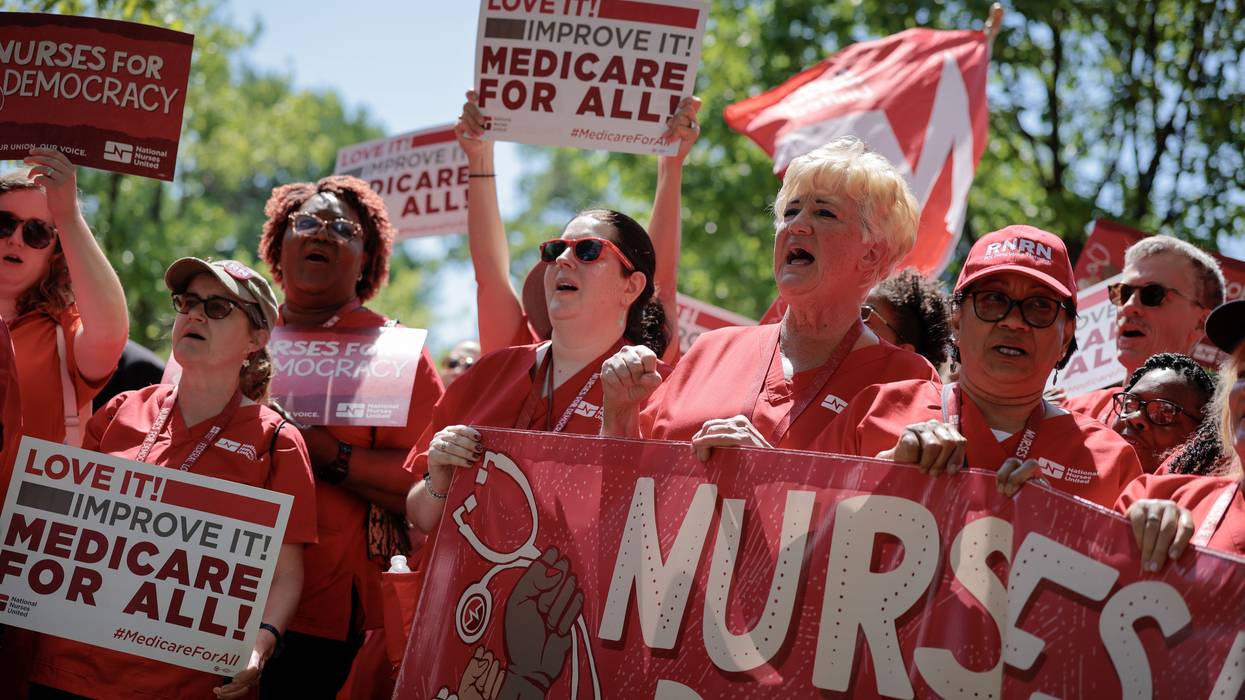
With the Trump administration announcing changes to federal childcare programs on Monday that advocates said would worsen the affordability crisis, the grassroots organizing group Community Change Action said President Donald Trump's attacks on the industry have made the push for a universal care system more urgent than ever as thousands of providers and parents joined the "Day Without Childcare" nationwide action.
"As families face a worsening affordability crisis and childcare costs are outpacing rent, providers have been shouldering the burden," said Community Change Action. "We can’t wait a second longer to create the universal childcare system we deserve—one that actually works, lifts the burden off of families and providers, and invests in our youngest generation to give them the strongest start possible."
The group said families and daycare providers are participating in at least 75 actions, including one-day center closures, across 28 states in its fifth annual Day Without Childcare (DWOCC)—an event that it said would "launch the nationwide campaign that will win universal childcare."
Events planned for Monday include a rally at the New Jersey Statehouse in Trenton; a gathering of childcare providers and parents during working hours in Yakima, Washington; lobbying visits to state representatives in California; and an early closure of People's Day Care in Gary, Indiana in solidarity with programs that have had to shut down "due to Indiana's choice to not fund early care and learning."
According to Meredith Loomis Quinlan, childcare lead for Community Change Action, more than 3,000 parents and providers around the country had committed to going on strike for the day.
In January, the Trump administration initiated a funding freeze targeting all states in what it said was a response to "fraud that appears to be rampant in Minnesota and across the country." The attack came after a right-wing influencer posted a video of a Somali-owned daycare center in Minnesota and accused its owners of fraud at the behest of Republican lawmakers. A small number of members of the state's Somali community were charged with defrauding the state's social services system.
The White House later said it would slash $10 billion in childcare funding for five Democratic-led states—an attempt that was blocked by a federal court last month.
And as families joined childcare providers and advocates on Monday to demand universal care with fair wages for providers, Trump was announcing changes to the federal Child Care and Development Fund (CCDF) that officials said would put "parents back in charge"—but would actually eliminate a 2024 rule that capped childcare copayments at 7% of household income for low-income families, according to analysts.
Loomis Quinlan told Common Dreams that the changes to CCDF will also require that "direct services be provided through grants or contracts and [will pay] childcare providers in advance for their services," as well as "requiring payment based on enrollment rather than actual attendance."
"Every one of those things is a direct attack on our childcare system," said Loomis Quinlan. "And they're trying to frame it as advancements. But it is absolutely not that. These rules are... not going to make childcare more affordable. They're not going to make sure that childcare providers are paid on time with consistency."
The administration's cuts and regulatory changes have come as families across the US are already facing rising grocery prices linked to the president's tariff policies, gas prices have surpassed $4.50 per gallon due to the US-Israeli war on Iran, and the White House's policies have worsened the already existing housing affordability crisis.
A report by Care.com found in 2024 that the average US family with young children was spending 24% of their income on childcare.
"Having this really big childcare bill for families is just untenable," Loomis Quinlan said. "And on the flip side, we know that the childcare providers are not making much in take-home pay, averaging around $14 an hour. And so they also aren't able to make ends meet."
Community Change Action emphasized that while attacking childcare centers' ability to keep their doors open, the Trump administration is also taking direct aim at many providers, more than 20% of whom are immigrants, through its mass deportation agenda. In Chicago last November, federal agents raided a daycare center and arrested a teacher in what one angry parent called an act of "domestic terrorism."
"We’ve had our funds frozen, violent armed ICE agents show up at our childrens’ safe spaces and our places of work, and our Black and Brown communities scapegoated," said the group, referring to US Immigration and Customs Enforcement. "It’s time to take bold, sustained action that starts with this year’s DWOCC."
Loomis Quinlan said that while the Trump administration is waging war on the childcare sector, progressive leaders like New York City Democratic Mayor Zohran Mamdani are making strides toward securing a universal childcare program for all families in the US. Mamdani joined forces with New York Gov. Kathy Hochul, also a Democrat, to fund a universal childcare program for the city earlier this year.
"We really feel like it's a moment to be clear about what families and providers need, which is a universal childcare program in this country," she told Common Dreams. "We need more investment, not less. Deregulating isn't the answer. The changes to the programs announced today by the Trump administration are not the answer. What we need, what we're organizing for today, is universal childcare."
Under the universal program proposed by the group, childcare providers would be paid "a wage that enables their own families to thrive, receive healthcare, paid leave, retirement, and other benefits, and be compensated on par with educators in their state’s K-12 system." It would also invest public resources to cover the true cost of care and professional development of the workforce, and protect against corporate profiteering.
Progressive US Sen. Bernie Sanders (I-Vt.) has long advocated for a universal program, which he's said should be funded by taxing the wealth of the top 0.1% richest Americans.
Loomis Quinlan emphasized that once a publicly funded universal childcare system is a reality, "it's going to be so evident that this is something we always should have had in this country."
"Can you imagine what it felt like when we were setting up the K-12 public education system in this country?" she said. "People probably thought that this was just 'pie in the sky.' And here we are, we have a great public education system in this country."
"It's hard sometimes in our current political climate to imagine, but I think it's more important than ever for us to be imagining, because families cannot continue to be squeezed like this," said Loomis Quinlan. "We need to start envisioning what it really looks like for our country to set families and kids up to prosper and thrive."
One human rights lawyer said the centrist Pennsylvania governor was trying to stop Rabb because he's "anti-genocide, anti-AIPAC, pro-universal healthcare, and pro-labor."
Pennsylvania Gov. Josh Shapiro is working behind the scenes to derail progressive state representative Chris Rabb in his bid for a seat representing the state's 3rd Congressional District in the US House—reportedly putting his thumb on the scale to drag pediatric surgeon Dr. Ala Stanford, the Israel lobby’s preferred candidate, over the finish line.
Axios reported this weekend that the Democratic governor, who has sought to punish boycotts and other activism against Israel, was seeking to quietly influence the race to defeat Rabb, who has been an outspoken supporter of Palestinian rights on the campaign trail and a critic of Shapiro’s centrist stances.
Rabb has called for an arms embargo against Israel amid the genocide in Gaza and endorsed the right of return for Palestinian refugees. But he's also pressured Shapiro to end what he says is "state collaboration" with US Immigration and Customs Enforcement (ICE).
While still considered an underdog in the three-way primary, which takes place on May 19, Rabb has gained steam in recent weeks with key endorsements from progressive leaders, most notably Rep. Alexandria Ocasio-Cortez (D-NY), who has raised funds and plans to visit Philadelphia to campaign with him on Friday, days before voters head to the polls.
Shapiro has not publicly weighed in on the race and has not endorsed a candidate. But according to Axios, he and his team "privately told allies that he disapproves of Rabb and has taken steps to block his path, according to three people familiar with the discussions."
The report continued:
Shapiro has privately advised Philadelphia's building trades unions to avoid inadvertently helping Rabb, the lone progressive in the race, by attacking one of his center-left opponents, two of our sources told us.
The sources said Shapiro suggested that the building trades, which are backing another candidate, Sharif Street, avoid running negative ads against a third contender, Ala Stanford.
Street and Stanford are seen as traditional Democrats who share similar voters.
Stanford led the race with 28% of the vote, ahead of Rabb’s 23%, in a poll conducted in April by the 314 Action Fund, a super PAC backing Stanford.
However, that very PAC has proven a liability for Stanford in the stretch run of the campaign. Last month, Drop Site News revealed that 314 Action Fund had acted as a shell organization for the American Israel Public Affairs Committee (AIPAC) and had covertly received $500,000 from the lobbying group, which Democratic voters have come to overwhelmingly view as toxic.
The revelation has proven a public relations disaster for Stanford, who had said she “did not accept money from AIPAC” back in March. When confronted by voters about her views on the conflict, she has struggled to answer their questions and has faced heavy criticism for her statements that accusing Israel of "genocide," an opinion held by many leading human rights organizations and UN experts, is "hurtful" to Jewish people in the same way that using a racial slur is hurtful to Black people.
Amid other embarrassments, including her failure to explain her plan to "abolish" ICE and her rollout of what was described as a "comedically amateurish" policy platform on social media, Stanford dropped out of an April 29 debate just hours before it was set to take place, citing unspecified “misogynistic attacks and lies from both of my opponents.”
There have not been any public opinion polls on the race since Stanford's crash. But PoliticsPA.com now gives Street a 61% chance of winning, Rabb a 33% chance, and Stanford a distant 5% chance, citing prediction markets.
Axios suggested that Shapiro's primary goal is to prevent the votes from splitting between the two centrists, thereby allowing Rabb to win. But the piece suggests that Stanford is Shapiro's preferred horse.
Stanford has the backing of PA-03’s outgoing occupant, Rep. Dwight Evans (D), who is described as a close ally of Shapiro. Street is also described as having a “strained relationship” with Shapiro, who backed his rival in a 2022 struggle for leadership of the Pennsylvania Democratic Party.
Shapiro's push to blunt Rabb's momentum casts Philadelphia as yet another battleground in the broader war over the Democratic Party's identity, especially surrounding support for Israel, but also with other issues like immigration and healthcare, where leadership is out of step with voters' demands.
" Josh Shapiro is trying to derail the congressional run of Democratic PA State Rep Chris Rabb because Rabb is anti-genocide, anti-AIPAC, pro-universal healthcare, and pro-labor," said human rights lawyer Qasim Rashid.
Will Bunch, a columnist for The Philadelphia Inquirer, said the governor's effort to defeat Rabb was “one more reminder that Josh Shapiro is who we thought he was.”