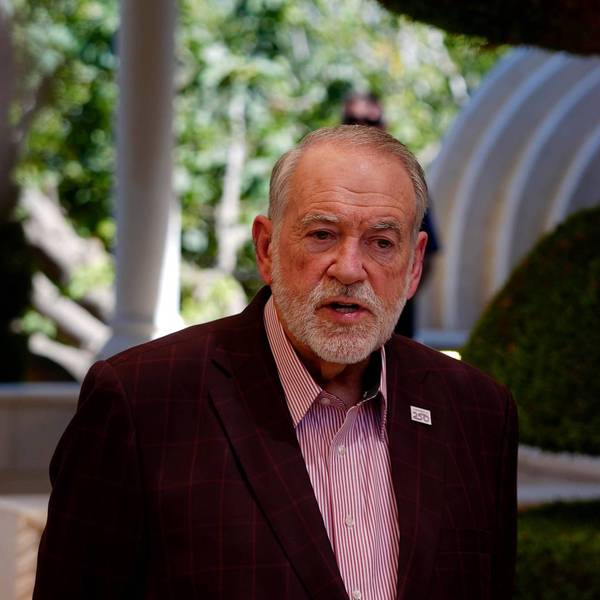

Dr. Ala Stanford, a pediatric surgeon and candidate for Pennsylvania's 3rd congressional district, speaks with voters in a campaign photo posted on February 26, 2026.
Dem Candidate for Philly House Seat Caught Hiding Over $500K in Secret AIPAC Funds
Ala Stanford, who's running for Pennsylvania's 3rd district, has repeatedly claimed that using the term genocide to describe Israel's actions in Gaza is "hurtful" to those accused, even tantamount to using the "N-word."
As the Israel lobby's influence grows overwhelmingly toxic among Democratic voters, the current frontrunner for one of America's bluest congressional districts has been caught trying to hide financial backing from the American Israel Public Affairs Committee.
The Philadelphia pediatric surgeon, Dr. Ala Stanford, who is running for the open seat in Pennsylvania's 3rd congressional district, has denied receiving any funds from AIPAC.
"That's not me... I did not accept money from AIPAC," Stanford said at an event in late March when confronted about previous reporting that the super political action committee (PAC) supporting her, the 314 Action Fund, had acted as a secret pass-through for AIPAC in previous elections.
But following a new report published by Drop Site News on Thursday, co-founder Ryan Grim said, "We now know this is a flat-out lie."
Using federal campaign filings, Grim and Capitol Hill correspondent Julian Andreone reported that AIPAC has been secretly directing money to back Stanford's campaign using the 314 Action Fund, which has spent more than $2.6 million supporting the candidate.
The PAC is billed as a fund to support “pro-science” candidates and recruits doctors to run for federal office. But its most recent monthly report revealed a $500,000 donation from the Kimbark Foundation, whose only other donation was another $500,000 to the EDW Action Fund, which has also been used as an AIPAC shell organization.
In 2024, AIPAC used EDW—which describes itself as an organization to elect pro-choice candidates—to secretly give money to a another pediatrician, Dr. Maxine Dexter, who is now a US representative for Oregon's 3rd district, helping her oust her rival, Susheela Jayapal, the older sister of Rep. Pramila Jayapal (D-Wash.), who has a similar record for supporting Palestinian rights amid Israel's genocide in Gaza.
In the first quarter of 2026, Stanford also received more than $27,000 from major AIPAC donors via the group Democracy Engine, which The Guardian has described as "a donation platform that allows unpopular PACs to obscure their donations" and which has been used by AIPAC to fundraise against incumbents like former Rep. Cori Bush (D-Mo.) and Jamal Bowman (D-NY).
That AIPAC would drop big money to back Stanford becomes less surprising given her opponent, Pennsylvania state Rep. Chris Rabb (D-200), who has called for an arms embargo against Israel and the right of return for Palestinian refugees.
According to a recent poll commissioned by the 314 Action Fund, Stanford leads the race with about 28% support compared with 23% for Rabb.
However, Rabb netted a major endorsement on Thursday from Rep. Alexandria Ocasio-Cortez (D-NY), one of the nation's most prominent progressive politicians and a potential 2028 presidential contender. He has racked up others from Justice Democrats and the Democratic Socialists of America, and other Democratic lawmakers, including Reps. Jamie Raskin (Md.) and Ro Khanna (Calif.).
While Rabb has condemned politicians who refuse to refer to Israel's destruction of Gaza and killing of more than 75,000 Palestinians as a "genocide"—a position shared by the vast majority of Democratic voters—Stanford has suggested that belief is tantamount to hate speech.
“I know when you use the G-word how hurtful it is to a group of people,” she said in a March interview with The Philadelphia Inquirer. “It’s like someone saying the N-word around me. I don’t want to hear that. And every time you shout that from the rooftops, how many people are you hurting?”
After those comments were met with backlash, she has struggled to respond when asked to clarify her beliefs on the topic. When voters pressed her to use the word "genocide" during a candidate forum earlier this week, her answer appeared to leave many dissatisfied.
A voter asked if Israel's actions in Gaza constituted genocide. Stanford stood in silence for around 30 seconds before deflecting to an anecdote about her work during the Covid-19 pandemic. "I don't owe anybody anything," she said.
She then responded, "I can say genocide if you'd like me to say it," not naming Israel specifically. When the voter asked her if Israel's actions constituted one, he was told to "be quiet" by another attendee. When the voter responded, Stanford asked him, “Can you please be respectful for her?”
“I am someone who took an oath to do no harm, so when I made the statement, I made it because for those who have been a victim of genocide, whose families are still suffering, it’s hurtful to them,” Stanford said, seeming to mean victims other than those in Gaza. “For Israelis who have been accused of committing it, it’s hurtful for them,” she continued.
After the comments prompted angry reactions from the crowd, Stanford shouted, "Excuse me! Excuse me!" before saying, "All I have ever done is to give. It's selfless." She then said she apologized if she "hurt" the voters who confronted her.
Erik Polyak, the executive director of 314 Action, did not answer specific questions about its support from AIPAC when asked by Drop Site, instead generally emphasizing its general mission to "elect doctors and scientists."
Polyak noted that the group had opposed AIPAC's preferred candidate, Laura Fine, in last month's race for Illinois' 9th congressional district in Chicago, instead backing the somewhat more Israel-critical Daniel Biss, who narrowly defeated the Palestinian-American Kat Abughazaleh for the Democratic nomination.
In that race and others in Chicago, AIPAC used nearly identical tactics to those deployed in Philadelphia. It funneled $1.5 million through the group Elect Chicago Women to fund attack ads against Biss, and used another shadow group, the Chicago Progressive Partnership, to fund ads boosting another marginal left-wing candidate, Bushra Amiwala, which helped splinter the progressive bloc supporting Abughazaleh.
Similar tactics were less successful last week in New Jersey, where Analilia Mejía, a former aide to Sen. Bernie Sanders (I-Vt.), clinched the Democratic nomination despite her primary opponent pulling in $350,000 from an AIPAC donor who had also bankrolled the effort to oust Jayapal.
As both Democratic and Republican candidates increasingly seek to prove their anti-establishment credibility by swearing off donations from AIPAC and other lobbying groups, Grim said that it'll be difficult for voters to take them seriously unless the parties adopt rules requiring greater transparency.
"One thing Democrats and Republicans, through the [Democratic National Committee] and [Republican National Committee], could actually do, if they don't want to ban AIPAC spending in primaries altogether, is say, fine: AIPAC can spend just like anybody else, but like everybody else, they have to do it through their regular super PAC and be transparent about it," he said. "Then let voters decide."
He called on party leaders to “stop making voters play forensic detective and chase money from some dark money foundation to a PAC to another PAC with all of them using names that have nothing to do with AIPAC or Israel, only to learn after the election that it was actually AIPAC money.”
We are at a crossroads
This country and this world are at a monumental crossroads. In a few short weeks, US voters will have an opportunity to beat back the forces of fascism and confront the billionaires who are rigging the economy, our media system, and our democracy, making it increasingly impossible for ordinary people to get by. We’re not just talking about the election. We’re talking about what must be done once these fascist elements are vanquished from power. We need a bolder set of solutions than what either major party has so far been willing to offer and a working-class movement ready to fight like hell for it. Trump didn't emerge from nowhere. The conditions that fueled MAGA authoritarianism were created by decades of radical neoliberal economic policies and a corrupt political system dominated by corporate interests. They slashed taxes on the super-rich, promising that the benefits would trickle down. They said giveaways to the corporate titans would make life more affordable for the rest of us. It was all bullshit. And when a bitter, betrayed populace searches for someone to blame, right-wing demagogues have little trouble finding scapegoats. People know when they're being lied to, but you won't hear any of this from the corporate media. Only independent journalism—powered and funded by people who believe in building a better world—can deliver truly trustworthy daily news. Our Fall Campaign is underway, and we need your help. To power our newsroom through the rest of the year, we need to raise $125,000 by midnight on October 31. So if you share our vision, please contribute whatever you can to sustain our work. |
As the Israel lobby's influence grows overwhelmingly toxic among Democratic voters, the current frontrunner for one of America's bluest congressional districts has been caught trying to hide financial backing from the American Israel Public Affairs Committee.
The Philadelphia pediatric surgeon, Dr. Ala Stanford, who is running for the open seat in Pennsylvania's 3rd congressional district, has denied receiving any funds from AIPAC.
"That's not me... I did not accept money from AIPAC," Stanford said at an event in late March when confronted about previous reporting that the super political action committee (PAC) supporting her, the 314 Action Fund, had acted as a secret pass-through for AIPAC in previous elections.
But following a new report published by Drop Site News on Thursday, co-founder Ryan Grim said, "We now know this is a flat-out lie."
Using federal campaign filings, Grim and Capitol Hill correspondent Julian Andreone reported that AIPAC has been secretly directing money to back Stanford's campaign using the 314 Action Fund, which has spent more than $2.6 million supporting the candidate.
The PAC is billed as a fund to support “pro-science” candidates and recruits doctors to run for federal office. But its most recent monthly report revealed a $500,000 donation from the Kimbark Foundation, whose only other donation was another $500,000 to the EDW Action Fund, which has also been used as an AIPAC shell organization.
In 2024, AIPAC used EDW—which describes itself as an organization to elect pro-choice candidates—to secretly give money to a another pediatrician, Dr. Maxine Dexter, who is now a US representative for Oregon's 3rd district, helping her oust her rival, Susheela Jayapal, the older sister of Rep. Pramila Jayapal (D-Wash.), who has a similar record for supporting Palestinian rights amid Israel's genocide in Gaza.
In the first quarter of 2026, Stanford also received more than $27,000 from major AIPAC donors via the group Democracy Engine, which The Guardian has described as "a donation platform that allows unpopular PACs to obscure their donations" and which has been used by AIPAC to fundraise against incumbents like former Rep. Cori Bush (D-Mo.) and Jamal Bowman (D-NY).
That AIPAC would drop big money to back Stanford becomes less surprising given her opponent, Pennsylvania state Rep. Chris Rabb (D-200), who has called for an arms embargo against Israel and the right of return for Palestinian refugees.
According to a recent poll commissioned by the 314 Action Fund, Stanford leads the race with about 28% support compared with 23% for Rabb.
However, Rabb netted a major endorsement on Thursday from Rep. Alexandria Ocasio-Cortez (D-NY), one of the nation's most prominent progressive politicians and a potential 2028 presidential contender. He has racked up others from Justice Democrats and the Democratic Socialists of America, and other Democratic lawmakers, including Reps. Jamie Raskin (Md.) and Ro Khanna (Calif.).
While Rabb has condemned politicians who refuse to refer to Israel's destruction of Gaza and killing of more than 75,000 Palestinians as a "genocide"—a position shared by the vast majority of Democratic voters—Stanford has suggested that belief is tantamount to hate speech.
“I know when you use the G-word how hurtful it is to a group of people,” she said in a March interview with The Philadelphia Inquirer. “It’s like someone saying the N-word around me. I don’t want to hear that. And every time you shout that from the rooftops, how many people are you hurting?”
After those comments were met with backlash, she has struggled to respond when asked to clarify her beliefs on the topic. When voters pressed her to use the word "genocide" during a candidate forum earlier this week, her answer appeared to leave many dissatisfied.
A voter asked if Israel's actions in Gaza constituted genocide. Stanford stood in silence for around 30 seconds before deflecting to an anecdote about her work during the Covid-19 pandemic. "I don't owe anybody anything," she said.
She then responded, "I can say genocide if you'd like me to say it," not naming Israel specifically. When the voter asked her if Israel's actions constituted one, he was told to "be quiet" by another attendee. When the voter responded, Stanford asked him, “Can you please be respectful for her?”
“I am someone who took an oath to do no harm, so when I made the statement, I made it because for those who have been a victim of genocide, whose families are still suffering, it’s hurtful to them,” Stanford said, seeming to mean victims other than those in Gaza. “For Israelis who have been accused of committing it, it’s hurtful for them,” she continued.
After the comments prompted angry reactions from the crowd, Stanford shouted, "Excuse me! Excuse me!" before saying, "All I have ever done is to give. It's selfless." She then said she apologized if she "hurt" the voters who confronted her.
Erik Polyak, the executive director of 314 Action, did not answer specific questions about its support from AIPAC when asked by Drop Site, instead generally emphasizing its general mission to "elect doctors and scientists."
Polyak noted that the group had opposed AIPAC's preferred candidate, Laura Fine, in last month's race for Illinois' 9th congressional district in Chicago, instead backing the somewhat more Israel-critical Daniel Biss, who narrowly defeated the Palestinian-American Kat Abughazaleh for the Democratic nomination.
In that race and others in Chicago, AIPAC used nearly identical tactics to those deployed in Philadelphia. It funneled $1.5 million through the group Elect Chicago Women to fund attack ads against Biss, and used another shadow group, the Chicago Progressive Partnership, to fund ads boosting another marginal left-wing candidate, Bushra Amiwala, which helped splinter the progressive bloc supporting Abughazaleh.
Similar tactics were less successful last week in New Jersey, where Analilia Mejía, a former aide to Sen. Bernie Sanders (I-Vt.), clinched the Democratic nomination despite her primary opponent pulling in $350,000 from an AIPAC donor who had also bankrolled the effort to oust Jayapal.
As both Democratic and Republican candidates increasingly seek to prove their anti-establishment credibility by swearing off donations from AIPAC and other lobbying groups, Grim said that it'll be difficult for voters to take them seriously unless the parties adopt rules requiring greater transparency.
"One thing Democrats and Republicans, through the [Democratic National Committee] and [Republican National Committee], could actually do, if they don't want to ban AIPAC spending in primaries altogether, is say, fine: AIPAC can spend just like anybody else, but like everybody else, they have to do it through their regular super PAC and be transparent about it," he said. "Then let voters decide."
He called on party leaders to “stop making voters play forensic detective and chase money from some dark money foundation to a PAC to another PAC with all of them using names that have nothing to do with AIPAC or Israel, only to learn after the election that it was actually AIPAC money.”
- Is AIPAC Losing Its Grip on Democrats? ›
- 'Price of Defending Apartheid': AIPAC Set to Spend $100 Million Against Squad ›
- While Distancing from AIPAC, Most 2028 Democratic Hopefuls Are Still Embracing Israel ›
- Nearly Half of Dems in Competitive Primary Districts Say They 'Could Never' Support a Candidate Backed by AIPAC ›
- 'AIPAC Getting Desperate’: Pro-Israel Super PAC Tries to Splinter Left Vote in Illinois House Primary ›
As the Israel lobby's influence grows overwhelmingly toxic among Democratic voters, the current frontrunner for one of America's bluest congressional districts has been caught trying to hide financial backing from the American Israel Public Affairs Committee.
The Philadelphia pediatric surgeon, Dr. Ala Stanford, who is running for the open seat in Pennsylvania's 3rd congressional district, has denied receiving any funds from AIPAC.
"That's not me... I did not accept money from AIPAC," Stanford said at an event in late March when confronted about previous reporting that the super political action committee (PAC) supporting her, the 314 Action Fund, had acted as a secret pass-through for AIPAC in previous elections.
But following a new report published by Drop Site News on Thursday, co-founder Ryan Grim said, "We now know this is a flat-out lie."
Using federal campaign filings, Grim and Capitol Hill correspondent Julian Andreone reported that AIPAC has been secretly directing money to back Stanford's campaign using the 314 Action Fund, which has spent more than $2.6 million supporting the candidate.
The PAC is billed as a fund to support “pro-science” candidates and recruits doctors to run for federal office. But its most recent monthly report revealed a $500,000 donation from the Kimbark Foundation, whose only other donation was another $500,000 to the EDW Action Fund, which has also been used as an AIPAC shell organization.
In 2024, AIPAC used EDW—which describes itself as an organization to elect pro-choice candidates—to secretly give money to a another pediatrician, Dr. Maxine Dexter, who is now a US representative for Oregon's 3rd district, helping her oust her rival, Susheela Jayapal, the older sister of Rep. Pramila Jayapal (D-Wash.), who has a similar record for supporting Palestinian rights amid Israel's genocide in Gaza.
In the first quarter of 2026, Stanford also received more than $27,000 from major AIPAC donors via the group Democracy Engine, which The Guardian has described as "a donation platform that allows unpopular PACs to obscure their donations" and which has been used by AIPAC to fundraise against incumbents like former Rep. Cori Bush (D-Mo.) and Jamal Bowman (D-NY).
That AIPAC would drop big money to back Stanford becomes less surprising given her opponent, Pennsylvania state Rep. Chris Rabb (D-200), who has called for an arms embargo against Israel and the right of return for Palestinian refugees.
According to a recent poll commissioned by the 314 Action Fund, Stanford leads the race with about 28% support compared with 23% for Rabb.
However, Rabb netted a major endorsement on Thursday from Rep. Alexandria Ocasio-Cortez (D-NY), one of the nation's most prominent progressive politicians and a potential 2028 presidential contender. He has racked up others from Justice Democrats and the Democratic Socialists of America, and other Democratic lawmakers, including Reps. Jamie Raskin (Md.) and Ro Khanna (Calif.).
While Rabb has condemned politicians who refuse to refer to Israel's destruction of Gaza and killing of more than 75,000 Palestinians as a "genocide"—a position shared by the vast majority of Democratic voters—Stanford has suggested that belief is tantamount to hate speech.
“I know when you use the G-word how hurtful it is to a group of people,” she said in a March interview with The Philadelphia Inquirer. “It’s like someone saying the N-word around me. I don’t want to hear that. And every time you shout that from the rooftops, how many people are you hurting?”
After those comments were met with backlash, she has struggled to respond when asked to clarify her beliefs on the topic. When voters pressed her to use the word "genocide" during a candidate forum earlier this week, her answer appeared to leave many dissatisfied.
A voter asked if Israel's actions in Gaza constituted genocide. Stanford stood in silence for around 30 seconds before deflecting to an anecdote about her work during the Covid-19 pandemic. "I don't owe anybody anything," she said.
She then responded, "I can say genocide if you'd like me to say it," not naming Israel specifically. When the voter asked her if Israel's actions constituted one, he was told to "be quiet" by another attendee. When the voter responded, Stanford asked him, “Can you please be respectful for her?”
“I am someone who took an oath to do no harm, so when I made the statement, I made it because for those who have been a victim of genocide, whose families are still suffering, it’s hurtful to them,” Stanford said, seeming to mean victims other than those in Gaza. “For Israelis who have been accused of committing it, it’s hurtful for them,” she continued.
After the comments prompted angry reactions from the crowd, Stanford shouted, "Excuse me! Excuse me!" before saying, "All I have ever done is to give. It's selfless." She then said she apologized if she "hurt" the voters who confronted her.
Erik Polyak, the executive director of 314 Action, did not answer specific questions about its support from AIPAC when asked by Drop Site, instead generally emphasizing its general mission to "elect doctors and scientists."
Polyak noted that the group had opposed AIPAC's preferred candidate, Laura Fine, in last month's race for Illinois' 9th congressional district in Chicago, instead backing the somewhat more Israel-critical Daniel Biss, who narrowly defeated the Palestinian-American Kat Abughazaleh for the Democratic nomination.
In that race and others in Chicago, AIPAC used nearly identical tactics to those deployed in Philadelphia. It funneled $1.5 million through the group Elect Chicago Women to fund attack ads against Biss, and used another shadow group, the Chicago Progressive Partnership, to fund ads boosting another marginal left-wing candidate, Bushra Amiwala, which helped splinter the progressive bloc supporting Abughazaleh.
Similar tactics were less successful last week in New Jersey, where Analilia Mejía, a former aide to Sen. Bernie Sanders (I-Vt.), clinched the Democratic nomination despite her primary opponent pulling in $350,000 from an AIPAC donor who had also bankrolled the effort to oust Jayapal.
As both Democratic and Republican candidates increasingly seek to prove their anti-establishment credibility by swearing off donations from AIPAC and other lobbying groups, Grim said that it'll be difficult for voters to take them seriously unless the parties adopt rules requiring greater transparency.
"One thing Democrats and Republicans, through the [Democratic National Committee] and [Republican National Committee], could actually do, if they don't want to ban AIPAC spending in primaries altogether, is say, fine: AIPAC can spend just like anybody else, but like everybody else, they have to do it through their regular super PAC and be transparent about it," he said. "Then let voters decide."
He called on party leaders to “stop making voters play forensic detective and chase money from some dark money foundation to a PAC to another PAC with all of them using names that have nothing to do with AIPAC or Israel, only to learn after the election that it was actually AIPAC money.”
- Is AIPAC Losing Its Grip on Democrats? ›
- 'Price of Defending Apartheid': AIPAC Set to Spend $100 Million Against Squad ›
- While Distancing from AIPAC, Most 2028 Democratic Hopefuls Are Still Embracing Israel ›
- Nearly Half of Dems in Competitive Primary Districts Say They 'Could Never' Support a Candidate Backed by AIPAC ›
- 'AIPAC Getting Desperate’: Pro-Israel Super PAC Tries to Splinter Left Vote in Illinois House Primary ›