SUBSCRIBE TO OUR FREE NEWSLETTER
Daily news & progressive opinion—funded by the people, not the corporations—delivered straight to your inbox.
5
#000000
#FFFFFF
To donate by check, phone, or other method, see our More Ways to Give page.
Daily news & progressive opinion—funded by the people, not the corporations—delivered straight to your inbox.
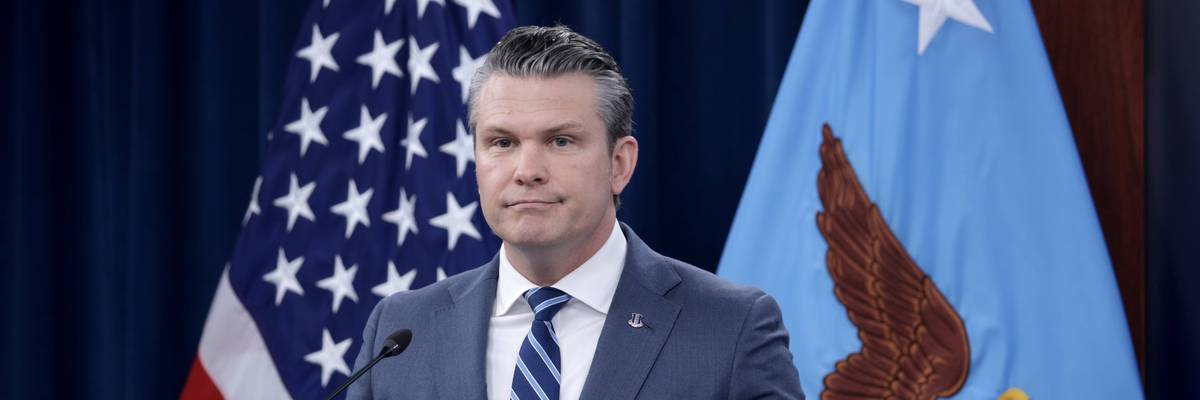
US Secretary of Defense Pete Hegseth speaks during a press briefing at the Pentagon on April 16, 2026 in Arlington, Virginia.
"War is hell. And hell comes with a hefty price tag," said University of Michigan professor Justin Wolfers.
University of Michigan professor Justin Wolfers on Friday joined a growing number of economists and other critics casting down on what he called "the Pentagon's lowball $25 billion estimate" for the cost of President Donald Trump's illegal war on Iran.
While testifying before Congress last week alongside US Secretary of Defense Pete Hegseth, Pentagon comptroller Jules "Jay" Hurst offered the $25 billion figure. However, experts have responded with raised eyebrows. Stephen Semler, a senior fellow at the Center for International Policy, estimated that the government spent at least $71.8 billion during the first two months of the war, or around $1.2 billion each day.
Although Trump told Congress last Friday—a key deadline under the War Powers Act—that his assault on Iran had been "terminated," citing the ceasefire deal reached a month ago after his genocidal threat, the administration has maintained its naval blockade and on Thursday bombed what it claimed were "Iranian military facilities responsible for attacking US forces."
The cost isn't just measured in billions of taxpayer dollars spent on a war that doesn't make us safer. It's measured in economic losses such as high prices working families see at the gas pump. The human toll can't be ignored. www.nytimes.com/2026/05/08/o...
[image or embed]
— Randi Weingarten 🖇️📚✊🇺🇸 (@rweingarten.bsky.social) May 8, 2026 at 2:41 PM
As the threat of more US bombings of Iran loomed, Wolfers wrote Friday in a New York Times opinion piece that "the Pentagon's stated number reflects only a narrow accounting of the tab that Operation Epic Fury is running up. It's the price of the more than 2,000 Tomahawk and Patriot missiles already fired, the warplanes already flown and in some cases lost, and the rest of the gear already chewed through. It does not measure the true cost of the war—including the human toll."
"Since the start of the war, oil markets have been disrupted, consumer confidence has cratered, the global economy is groaning, and military budgets are growing," the economist continued. "The toll from this upheaval must be counted in lives disrupted, jobs lost, companies shut down (see: Spirit Airlines), and the income and output sacrificed. The less easily quantified costs—death, disability, and mental health—could become much more dramatic should President Trump send troops into Iran, which still can't be ruled out."
As David Dayen, executive editor of The American Prospect, detailed Friday, the war seemingly hasn't achieved any of Trump and Israeli Prime Minister Benjamin Netanyahu's shifting objectives:
The US and Israel said they wanted to eradicate Iran's nuclear program and change its regime. The regime is now composed of more hard-liners than before, and Iran's nuclear capability has not budged since last summer. Now the two sides are negotiating the opening of the Strait of Hormuz, which was open before the conflict, and the terms of Iran's nuclear program, which they were negotiating before the conflict. Moreover, the compromise being contemplated involves Iran pausing uranium enrichment in exchange for the US lifting sanctions and unfreezing Iranian funds. That sounds suspiciously like the deal President Obama struck in 2015 that Trump ripped up when he took office, complete with the "bags of cash" sent to Iran that Trump flipped out over back then.
All this war has done is killed thousands of people, opened a new front for Israel in Lebanon, damaged most US military sites and most energy production facilities in the region, led to oil spills that are visible from space, created a shipping bottleneck that will take at least a year to fix, raised domestic gas prices to a record for this time of year, cost American consumers $34.3 billion and counting, ended the life of one US airline with more likely to come, and led us down an imminent path to physical shortages of critical commodities like oil, including in the United States.
I have never in my life seen a war that achieved literally none of its objectives while directly causing this many devastating costs, and I lived through Iraq and Afghanistan.
The Washington Post reported Thursday that the Central Intelligence Agency has privately warned the Trump administration that "Iran can survive the US naval blockade for at least three to four months before facing more severe economic hardship," and its "analysis might even be underestimating Iran's economic resilience if Tehran is able to smuggle oil via overland routes."
The reporting heightened concerns about how long the war may drag on. The International Monetary Fund warned last month that a prolonged conflict could cause a global recession.
Already, the war has "pushed the Federal Reserve Bank into a corner," and "Wall Street is worried, despite the market touching new highs," Wolfers wrote Friday. "My estimate—based on the movement of oil prices, along with the S&P 500—is that stocks are about 5% lower than they otherwise would be, suggesting that the war has wiped about $3 trillion off the value of these companies."
The economist also cited recent research showing that elevated "geopolitical risk leads to lower investment and employment."
Shortly after launching the war in February, the White House signaled it would need $200 billion for the operation. However, it is now seeking a $1.5 trillion defense budget for the next fiscal year—which Hegseth tried to frame as a fiscally responsible plan that puts "the American taxpayer first" in a widely ridiculed video this week. Wolfers highlighted that the budget request is "a roughly 40% boost over this year. That's a massive $600 billion increase, or roughly $4,000 per household."
Like Dayen, Wolfers also pointed to the Iraq War, which economists Linda Bilmes and Joseph Stiglitz estimated cost the US around $3 trillion, after factoring in expenses such as "lifetime medical care and disability benefits for veterans, and the higher recruitment and retention costs that follow a bloody war—all compounded by a rising interest bill."
"The best any economist can do right now is get the order of magnitude right, and my math suggests the Iran war will cost hundreds of billions of dollars, and very possibly trillions," Wolfers concluded. "War is hell. And hell comes with a hefty price tag."
Dear Common Dreams reader, It’s been nearly 30 years since I co-founded Common Dreams with my late wife, Lina Newhouser. We had the radical notion that journalism should serve the public good, not corporate profits. It was clear to us from the outset what it would take to build such a project. No paid advertisements. No corporate sponsors. No millionaire publisher telling us what to think or do. Many people said we wouldn't last a year, but we proved those doubters wrong. Together with a tremendous team of journalists and dedicated staff, we built an independent media outlet free from the constraints of profits and corporate control. Our mission has always been simple: To inform. To inspire. To ignite change for the common good. Building Common Dreams was not easy. Our survival was never guaranteed. When you take on the most powerful forces—Wall Street greed, fossil fuel industry destruction, Big Tech lobbyists, and uber-rich oligarchs who have spent billions upon billions rigging the economy and democracy in their favor—the only bulwark you have is supporters who believe in your work. But here’s the urgent message from me today. It's never been this bad out there. And it's never been this hard to keep us going. At the very moment Common Dreams is most needed, the threats we face are intensifying. We need your support now more than ever. We don't accept corporate advertising and never will. We don't have a paywall because we don't think people should be blocked from critical news based on their ability to pay. Everything we do is funded by the donations of readers like you. When everyone does the little they can afford, we are strong. But if that support retreats or dries up, so do we. Will you donate now to make sure Common Dreams not only survives but thrives? —Craig Brown, Co-founder |
University of Michigan professor Justin Wolfers on Friday joined a growing number of economists and other critics casting down on what he called "the Pentagon's lowball $25 billion estimate" for the cost of President Donald Trump's illegal war on Iran.
While testifying before Congress last week alongside US Secretary of Defense Pete Hegseth, Pentagon comptroller Jules "Jay" Hurst offered the $25 billion figure. However, experts have responded with raised eyebrows. Stephen Semler, a senior fellow at the Center for International Policy, estimated that the government spent at least $71.8 billion during the first two months of the war, or around $1.2 billion each day.
Although Trump told Congress last Friday—a key deadline under the War Powers Act—that his assault on Iran had been "terminated," citing the ceasefire deal reached a month ago after his genocidal threat, the administration has maintained its naval blockade and on Thursday bombed what it claimed were "Iranian military facilities responsible for attacking US forces."
The cost isn't just measured in billions of taxpayer dollars spent on a war that doesn't make us safer. It's measured in economic losses such as high prices working families see at the gas pump. The human toll can't be ignored. www.nytimes.com/2026/05/08/o...
[image or embed]
— Randi Weingarten 🖇️📚✊🇺🇸 (@rweingarten.bsky.social) May 8, 2026 at 2:41 PM
As the threat of more US bombings of Iran loomed, Wolfers wrote Friday in a New York Times opinion piece that "the Pentagon's stated number reflects only a narrow accounting of the tab that Operation Epic Fury is running up. It's the price of the more than 2,000 Tomahawk and Patriot missiles already fired, the warplanes already flown and in some cases lost, and the rest of the gear already chewed through. It does not measure the true cost of the war—including the human toll."
"Since the start of the war, oil markets have been disrupted, consumer confidence has cratered, the global economy is groaning, and military budgets are growing," the economist continued. "The toll from this upheaval must be counted in lives disrupted, jobs lost, companies shut down (see: Spirit Airlines), and the income and output sacrificed. The less easily quantified costs—death, disability, and mental health—could become much more dramatic should President Trump send troops into Iran, which still can't be ruled out."
As David Dayen, executive editor of The American Prospect, detailed Friday, the war seemingly hasn't achieved any of Trump and Israeli Prime Minister Benjamin Netanyahu's shifting objectives:
The US and Israel said they wanted to eradicate Iran's nuclear program and change its regime. The regime is now composed of more hard-liners than before, and Iran's nuclear capability has not budged since last summer. Now the two sides are negotiating the opening of the Strait of Hormuz, which was open before the conflict, and the terms of Iran's nuclear program, which they were negotiating before the conflict. Moreover, the compromise being contemplated involves Iran pausing uranium enrichment in exchange for the US lifting sanctions and unfreezing Iranian funds. That sounds suspiciously like the deal President Obama struck in 2015 that Trump ripped up when he took office, complete with the "bags of cash" sent to Iran that Trump flipped out over back then.
All this war has done is killed thousands of people, opened a new front for Israel in Lebanon, damaged most US military sites and most energy production facilities in the region, led to oil spills that are visible from space, created a shipping bottleneck that will take at least a year to fix, raised domestic gas prices to a record for this time of year, cost American consumers $34.3 billion and counting, ended the life of one US airline with more likely to come, and led us down an imminent path to physical shortages of critical commodities like oil, including in the United States.
I have never in my life seen a war that achieved literally none of its objectives while directly causing this many devastating costs, and I lived through Iraq and Afghanistan.
The Washington Post reported Thursday that the Central Intelligence Agency has privately warned the Trump administration that "Iran can survive the US naval blockade for at least three to four months before facing more severe economic hardship," and its "analysis might even be underestimating Iran's economic resilience if Tehran is able to smuggle oil via overland routes."
The reporting heightened concerns about how long the war may drag on. The International Monetary Fund warned last month that a prolonged conflict could cause a global recession.
Already, the war has "pushed the Federal Reserve Bank into a corner," and "Wall Street is worried, despite the market touching new highs," Wolfers wrote Friday. "My estimate—based on the movement of oil prices, along with the S&P 500—is that stocks are about 5% lower than they otherwise would be, suggesting that the war has wiped about $3 trillion off the value of these companies."
The economist also cited recent research showing that elevated "geopolitical risk leads to lower investment and employment."
Shortly after launching the war in February, the White House signaled it would need $200 billion for the operation. However, it is now seeking a $1.5 trillion defense budget for the next fiscal year—which Hegseth tried to frame as a fiscally responsible plan that puts "the American taxpayer first" in a widely ridiculed video this week. Wolfers highlighted that the budget request is "a roughly 40% boost over this year. That's a massive $600 billion increase, or roughly $4,000 per household."
Like Dayen, Wolfers also pointed to the Iraq War, which economists Linda Bilmes and Joseph Stiglitz estimated cost the US around $3 trillion, after factoring in expenses such as "lifetime medical care and disability benefits for veterans, and the higher recruitment and retention costs that follow a bloody war—all compounded by a rising interest bill."
"The best any economist can do right now is get the order of magnitude right, and my math suggests the Iran war will cost hundreds of billions of dollars, and very possibly trillions," Wolfers concluded. "War is hell. And hell comes with a hefty price tag."
University of Michigan professor Justin Wolfers on Friday joined a growing number of economists and other critics casting down on what he called "the Pentagon's lowball $25 billion estimate" for the cost of President Donald Trump's illegal war on Iran.
While testifying before Congress last week alongside US Secretary of Defense Pete Hegseth, Pentagon comptroller Jules "Jay" Hurst offered the $25 billion figure. However, experts have responded with raised eyebrows. Stephen Semler, a senior fellow at the Center for International Policy, estimated that the government spent at least $71.8 billion during the first two months of the war, or around $1.2 billion each day.
Although Trump told Congress last Friday—a key deadline under the War Powers Act—that his assault on Iran had been "terminated," citing the ceasefire deal reached a month ago after his genocidal threat, the administration has maintained its naval blockade and on Thursday bombed what it claimed were "Iranian military facilities responsible for attacking US forces."
The cost isn't just measured in billions of taxpayer dollars spent on a war that doesn't make us safer. It's measured in economic losses such as high prices working families see at the gas pump. The human toll can't be ignored. www.nytimes.com/2026/05/08/o...
[image or embed]
— Randi Weingarten 🖇️📚✊🇺🇸 (@rweingarten.bsky.social) May 8, 2026 at 2:41 PM
As the threat of more US bombings of Iran loomed, Wolfers wrote Friday in a New York Times opinion piece that "the Pentagon's stated number reflects only a narrow accounting of the tab that Operation Epic Fury is running up. It's the price of the more than 2,000 Tomahawk and Patriot missiles already fired, the warplanes already flown and in some cases lost, and the rest of the gear already chewed through. It does not measure the true cost of the war—including the human toll."
"Since the start of the war, oil markets have been disrupted, consumer confidence has cratered, the global economy is groaning, and military budgets are growing," the economist continued. "The toll from this upheaval must be counted in lives disrupted, jobs lost, companies shut down (see: Spirit Airlines), and the income and output sacrificed. The less easily quantified costs—death, disability, and mental health—could become much more dramatic should President Trump send troops into Iran, which still can't be ruled out."
As David Dayen, executive editor of The American Prospect, detailed Friday, the war seemingly hasn't achieved any of Trump and Israeli Prime Minister Benjamin Netanyahu's shifting objectives:
The US and Israel said they wanted to eradicate Iran's nuclear program and change its regime. The regime is now composed of more hard-liners than before, and Iran's nuclear capability has not budged since last summer. Now the two sides are negotiating the opening of the Strait of Hormuz, which was open before the conflict, and the terms of Iran's nuclear program, which they were negotiating before the conflict. Moreover, the compromise being contemplated involves Iran pausing uranium enrichment in exchange for the US lifting sanctions and unfreezing Iranian funds. That sounds suspiciously like the deal President Obama struck in 2015 that Trump ripped up when he took office, complete with the "bags of cash" sent to Iran that Trump flipped out over back then.
All this war has done is killed thousands of people, opened a new front for Israel in Lebanon, damaged most US military sites and most energy production facilities in the region, led to oil spills that are visible from space, created a shipping bottleneck that will take at least a year to fix, raised domestic gas prices to a record for this time of year, cost American consumers $34.3 billion and counting, ended the life of one US airline with more likely to come, and led us down an imminent path to physical shortages of critical commodities like oil, including in the United States.
I have never in my life seen a war that achieved literally none of its objectives while directly causing this many devastating costs, and I lived through Iraq and Afghanistan.
The Washington Post reported Thursday that the Central Intelligence Agency has privately warned the Trump administration that "Iran can survive the US naval blockade for at least three to four months before facing more severe economic hardship," and its "analysis might even be underestimating Iran's economic resilience if Tehran is able to smuggle oil via overland routes."
The reporting heightened concerns about how long the war may drag on. The International Monetary Fund warned last month that a prolonged conflict could cause a global recession.
Already, the war has "pushed the Federal Reserve Bank into a corner," and "Wall Street is worried, despite the market touching new highs," Wolfers wrote Friday. "My estimate—based on the movement of oil prices, along with the S&P 500—is that stocks are about 5% lower than they otherwise would be, suggesting that the war has wiped about $3 trillion off the value of these companies."
The economist also cited recent research showing that elevated "geopolitical risk leads to lower investment and employment."
Shortly after launching the war in February, the White House signaled it would need $200 billion for the operation. However, it is now seeking a $1.5 trillion defense budget for the next fiscal year—which Hegseth tried to frame as a fiscally responsible plan that puts "the American taxpayer first" in a widely ridiculed video this week. Wolfers highlighted that the budget request is "a roughly 40% boost over this year. That's a massive $600 billion increase, or roughly $4,000 per household."
Like Dayen, Wolfers also pointed to the Iraq War, which economists Linda Bilmes and Joseph Stiglitz estimated cost the US around $3 trillion, after factoring in expenses such as "lifetime medical care and disability benefits for veterans, and the higher recruitment and retention costs that follow a bloody war—all compounded by a rising interest bill."
"The best any economist can do right now is get the order of magnitude right, and my math suggests the Iran war will cost hundreds of billions of dollars, and very possibly trillions," Wolfers concluded. "War is hell. And hell comes with a hefty price tag."