

SUBSCRIBE TO OUR FREE NEWSLETTER
Daily news & progressive opinion—funded by the people, not the corporations—delivered straight to your inbox.
5
#000000
#FFFFFF
To donate by check, phone, or other method, see our More Ways to Give page.
Daily news & progressive opinion—funded by the people, not the corporations—delivered straight to your inbox.
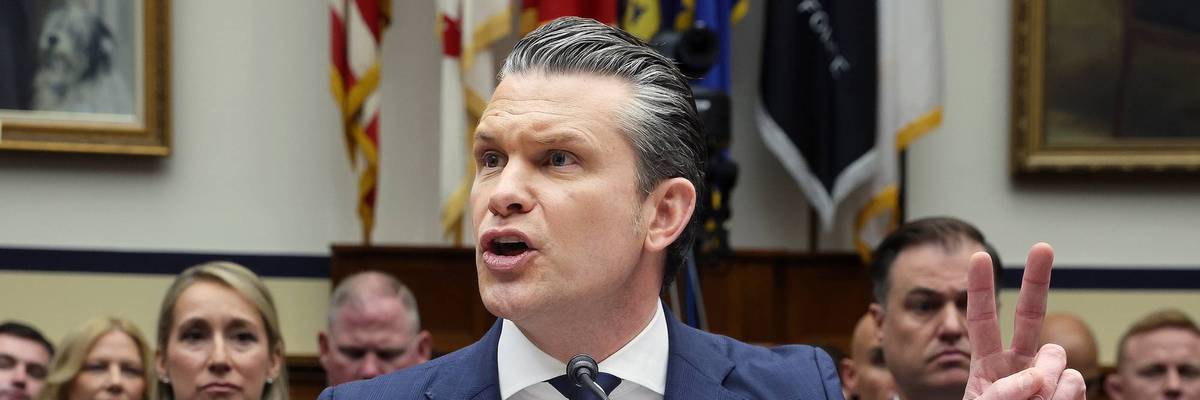
US Secretary of Defense Pete Hegseth testifies before the House Armed Services Committee on April 29, 2026 in Washington, DC.
White House officials "just straight up fabricated shit," said the Democratic senator from Connecticut.
Just hours before the Trump administration conducted what it claimed were "self-defense strikes" against "Iranian military facilities," The Washington Post reported Thursday that the Central Intelligence Agency concluded that "Iran can survive the US naval blockade for at least three to four months before facing more severe economic hardship."
Citing four unnamed officials familiar with the analysis, the newspaper highlighted that "the CIA analysis might even be underestimating Iran's economic resilience if Tehran is able to smuggle oil via overland routes."
Militarily, "Iran retains about 75% of its prewar inventories of mobile launchers and about 70% of its prewar stockpiles of missiles," the Post added. "There is evidence that the regime has been able to recover and reopen almost all of its underground storage facilities, repair some damaged missiles, and even assemble some new missiles that were nearly complete when the war began."
Drop Site News' Murtaza Hussain responded that if this assessment along with a previous one from the Center for Strategic and International Studies about "remaining US munitions and interceptor capacity are even approximately correct, it goes a long way to explaining why Trump seems so eager to end the war whereas the Iranians have either dug in or escalated their negotiating positions. The missile math of continuing the conflict would be much more favorable to the Iranians, especially if the war continued for a significant time."
"Prior to the war, interceptor capacity compared to the size of the Iranian missile stockpile seemed like the most rationally incontrovertible reason to avoid fighting such a conflict, even for people who found it politically desirable," he added. "This also might explain why the US and Israel pivoted towards the end to threatening countervalue strikes against civilian targets if attempts to destroy the underground missile cities by air were ineffective."
The Post's reporting came one month into a fragile ceasefire and starkly contrasts the recent framing of conditions in Iran from President Donald Trump and others in his administration, including Defense Secretary Pete Hesgeth.
Sen. Chris Murphy (D-Conn.) responded to the Post's reporting by quoting Hegseth, who said in March that "never before has a modern, capable military, which Iran used to have, been so quickly destroyed and made combat ineffective."
Murphy declared: "They lied through their teeth. Just straight up fabricated shit."
Still, White House spokesperson Anna Kelly stuck to the administration's framing in a Thursday statement to the Post.
"During Operation Epic Fury, Iran was crushed militarily," Kelly said. "Now, they are being strangled economically by Operation Economic Fury and losing $500 million per day thanks to the United States military's successful blockade of Iranian ports. The Iranian regime knows full well their current reality is not sustainable, and President Trump holds all the cards as negotiators work to make a deal."
Meanwhile, some experts were unsurprised that the CIA privately delivered a "sober" assessment contradicting the administration's public commentary on the conflict—which it now claims is no longer an active "war," seemingly to dodge a key congressional deadline.
"Nice to know that a confidential CIA analysis is confirming what close observers of the Iranian economy have been saying publicly for weeks! Intelligent policymakers rely on intelligence. But Trump jeopardized diplomacy by instigating a blockade that was never going to work," said Esfandyar Batmanghelidj, an adjunct professor at Johns Hopkins University's School of Advanced International Studies in Europe and founder of the think tank Bourse & Bazaar Foundation.
Sharing the reporting on social media, Jennifer Kavanagh, a senior fellow and director of military analysis at the think tank Defense Priorities, wrote: "As I argued a week into the U.S. blockade, Iran can hold out for months without economic collapse. The costs for the US and the world are increasingly unsustainable, however."
Earlier this week, Stephen Semler, a senior fellow at the Center for International Policy, estimated that the US government spent $71.8 billion on the Iran War during its first 60 days, an average of $1.2 billion daily. The International Monetary Fund warned last month that the conflict could cause a global recession.
Last Friday, Trump responded to the War Powers Act's 60-day deadline by claiming to Congress that his war—which already violated US and international law—had been "terminated." The White House said at the time that no fire had been exchanged since April 7, when a ceasefire deal was reached just hours after the president issued a genocidal threat against the Iranian people.
However, on Thursday evening, United States Central Command announced that Iran "launched multiple missiles, drones, and small boats" at American warships. CENTCOM added that it "eliminated inbound threats and targeted Iranian military facilities responsible for attacking US forces, including missile and drone launch sites; command and control locations; and intelligence, surveillance, and reconnaissance nodes."
Dear Common Dreams reader, It’s been nearly 30 years since I co-founded Common Dreams with my late wife, Lina Newhouser. We had the radical notion that journalism should serve the public good, not corporate profits. It was clear to us from the outset what it would take to build such a project. No paid advertisements. No corporate sponsors. No millionaire publisher telling us what to think or do. Many people said we wouldn't last a year, but we proved those doubters wrong. Together with a tremendous team of journalists and dedicated staff, we built an independent media outlet free from the constraints of profits and corporate control. Our mission has always been simple: To inform. To inspire. To ignite change for the common good. Building Common Dreams was not easy. Our survival was never guaranteed. When you take on the most powerful forces—Wall Street greed, fossil fuel industry destruction, Big Tech lobbyists, and uber-rich oligarchs who have spent billions upon billions rigging the economy and democracy in their favor—the only bulwark you have is supporters who believe in your work. But here’s the urgent message from me today. It's never been this bad out there. And it's never been this hard to keep us going. At the very moment Common Dreams is most needed, the threats we face are intensifying. We need your support now more than ever. We don't accept corporate advertising and never will. We don't have a paywall because we don't think people should be blocked from critical news based on their ability to pay. Everything we do is funded by the donations of readers like you. When everyone does the little they can afford, we are strong. But if that support retreats or dries up, so do we. Will you donate now to make sure Common Dreams not only survives but thrives? —Craig Brown, Co-founder |
Just hours before the Trump administration conducted what it claimed were "self-defense strikes" against "Iranian military facilities," The Washington Post reported Thursday that the Central Intelligence Agency concluded that "Iran can survive the US naval blockade for at least three to four months before facing more severe economic hardship."
Citing four unnamed officials familiar with the analysis, the newspaper highlighted that "the CIA analysis might even be underestimating Iran's economic resilience if Tehran is able to smuggle oil via overland routes."
Militarily, "Iran retains about 75% of its prewar inventories of mobile launchers and about 70% of its prewar stockpiles of missiles," the Post added. "There is evidence that the regime has been able to recover and reopen almost all of its underground storage facilities, repair some damaged missiles, and even assemble some new missiles that were nearly complete when the war began."
Drop Site News' Murtaza Hussain responded that if this assessment along with a previous one from the Center for Strategic and International Studies about "remaining US munitions and interceptor capacity are even approximately correct, it goes a long way to explaining why Trump seems so eager to end the war whereas the Iranians have either dug in or escalated their negotiating positions. The missile math of continuing the conflict would be much more favorable to the Iranians, especially if the war continued for a significant time."
"Prior to the war, interceptor capacity compared to the size of the Iranian missile stockpile seemed like the most rationally incontrovertible reason to avoid fighting such a conflict, even for people who found it politically desirable," he added. "This also might explain why the US and Israel pivoted towards the end to threatening countervalue strikes against civilian targets if attempts to destroy the underground missile cities by air were ineffective."
The Post's reporting came one month into a fragile ceasefire and starkly contrasts the recent framing of conditions in Iran from President Donald Trump and others in his administration, including Defense Secretary Pete Hesgeth.
Sen. Chris Murphy (D-Conn.) responded to the Post's reporting by quoting Hegseth, who said in March that "never before has a modern, capable military, which Iran used to have, been so quickly destroyed and made combat ineffective."
Murphy declared: "They lied through their teeth. Just straight up fabricated shit."
Still, White House spokesperson Anna Kelly stuck to the administration's framing in a Thursday statement to the Post.
"During Operation Epic Fury, Iran was crushed militarily," Kelly said. "Now, they are being strangled economically by Operation Economic Fury and losing $500 million per day thanks to the United States military's successful blockade of Iranian ports. The Iranian regime knows full well their current reality is not sustainable, and President Trump holds all the cards as negotiators work to make a deal."
Meanwhile, some experts were unsurprised that the CIA privately delivered a "sober" assessment contradicting the administration's public commentary on the conflict—which it now claims is no longer an active "war," seemingly to dodge a key congressional deadline.
"Nice to know that a confidential CIA analysis is confirming what close observers of the Iranian economy have been saying publicly for weeks! Intelligent policymakers rely on intelligence. But Trump jeopardized diplomacy by instigating a blockade that was never going to work," said Esfandyar Batmanghelidj, an adjunct professor at Johns Hopkins University's School of Advanced International Studies in Europe and founder of the think tank Bourse & Bazaar Foundation.
Sharing the reporting on social media, Jennifer Kavanagh, a senior fellow and director of military analysis at the think tank Defense Priorities, wrote: "As I argued a week into the U.S. blockade, Iran can hold out for months without economic collapse. The costs for the US and the world are increasingly unsustainable, however."
Earlier this week, Stephen Semler, a senior fellow at the Center for International Policy, estimated that the US government spent $71.8 billion on the Iran War during its first 60 days, an average of $1.2 billion daily. The International Monetary Fund warned last month that the conflict could cause a global recession.
Last Friday, Trump responded to the War Powers Act's 60-day deadline by claiming to Congress that his war—which already violated US and international law—had been "terminated." The White House said at the time that no fire had been exchanged since April 7, when a ceasefire deal was reached just hours after the president issued a genocidal threat against the Iranian people.
However, on Thursday evening, United States Central Command announced that Iran "launched multiple missiles, drones, and small boats" at American warships. CENTCOM added that it "eliminated inbound threats and targeted Iranian military facilities responsible for attacking US forces, including missile and drone launch sites; command and control locations; and intelligence, surveillance, and reconnaissance nodes."
Just hours before the Trump administration conducted what it claimed were "self-defense strikes" against "Iranian military facilities," The Washington Post reported Thursday that the Central Intelligence Agency concluded that "Iran can survive the US naval blockade for at least three to four months before facing more severe economic hardship."
Citing four unnamed officials familiar with the analysis, the newspaper highlighted that "the CIA analysis might even be underestimating Iran's economic resilience if Tehran is able to smuggle oil via overland routes."
Militarily, "Iran retains about 75% of its prewar inventories of mobile launchers and about 70% of its prewar stockpiles of missiles," the Post added. "There is evidence that the regime has been able to recover and reopen almost all of its underground storage facilities, repair some damaged missiles, and even assemble some new missiles that were nearly complete when the war began."
Drop Site News' Murtaza Hussain responded that if this assessment along with a previous one from the Center for Strategic and International Studies about "remaining US munitions and interceptor capacity are even approximately correct, it goes a long way to explaining why Trump seems so eager to end the war whereas the Iranians have either dug in or escalated their negotiating positions. The missile math of continuing the conflict would be much more favorable to the Iranians, especially if the war continued for a significant time."
"Prior to the war, interceptor capacity compared to the size of the Iranian missile stockpile seemed like the most rationally incontrovertible reason to avoid fighting such a conflict, even for people who found it politically desirable," he added. "This also might explain why the US and Israel pivoted towards the end to threatening countervalue strikes against civilian targets if attempts to destroy the underground missile cities by air were ineffective."
The Post's reporting came one month into a fragile ceasefire and starkly contrasts the recent framing of conditions in Iran from President Donald Trump and others in his administration, including Defense Secretary Pete Hesgeth.
Sen. Chris Murphy (D-Conn.) responded to the Post's reporting by quoting Hegseth, who said in March that "never before has a modern, capable military, which Iran used to have, been so quickly destroyed and made combat ineffective."
Murphy declared: "They lied through their teeth. Just straight up fabricated shit."
Still, White House spokesperson Anna Kelly stuck to the administration's framing in a Thursday statement to the Post.
"During Operation Epic Fury, Iran was crushed militarily," Kelly said. "Now, they are being strangled economically by Operation Economic Fury and losing $500 million per day thanks to the United States military's successful blockade of Iranian ports. The Iranian regime knows full well their current reality is not sustainable, and President Trump holds all the cards as negotiators work to make a deal."
Meanwhile, some experts were unsurprised that the CIA privately delivered a "sober" assessment contradicting the administration's public commentary on the conflict—which it now claims is no longer an active "war," seemingly to dodge a key congressional deadline.
"Nice to know that a confidential CIA analysis is confirming what close observers of the Iranian economy have been saying publicly for weeks! Intelligent policymakers rely on intelligence. But Trump jeopardized diplomacy by instigating a blockade that was never going to work," said Esfandyar Batmanghelidj, an adjunct professor at Johns Hopkins University's School of Advanced International Studies in Europe and founder of the think tank Bourse & Bazaar Foundation.
Sharing the reporting on social media, Jennifer Kavanagh, a senior fellow and director of military analysis at the think tank Defense Priorities, wrote: "As I argued a week into the U.S. blockade, Iran can hold out for months without economic collapse. The costs for the US and the world are increasingly unsustainable, however."
Earlier this week, Stephen Semler, a senior fellow at the Center for International Policy, estimated that the US government spent $71.8 billion on the Iran War during its first 60 days, an average of $1.2 billion daily. The International Monetary Fund warned last month that the conflict could cause a global recession.
Last Friday, Trump responded to the War Powers Act's 60-day deadline by claiming to Congress that his war—which already violated US and international law—had been "terminated." The White House said at the time that no fire had been exchanged since April 7, when a ceasefire deal was reached just hours after the president issued a genocidal threat against the Iranian people.
However, on Thursday evening, United States Central Command announced that Iran "launched multiple missiles, drones, and small boats" at American warships. CENTCOM added that it "eliminated inbound threats and targeted Iranian military facilities responsible for attacking US forces, including missile and drone launch sites; command and control locations; and intelligence, surveillance, and reconnaissance nodes."

