SUBSCRIBE TO OUR FREE NEWSLETTER
Daily news & progressive opinion—funded by the people, not the corporations—delivered straight to your inbox.
5
#000000
#FFFFFF
To donate by check, phone, or other method, see our More Ways to Give page.
Daily news & progressive opinion—funded by the people, not the corporations—delivered straight to your inbox.
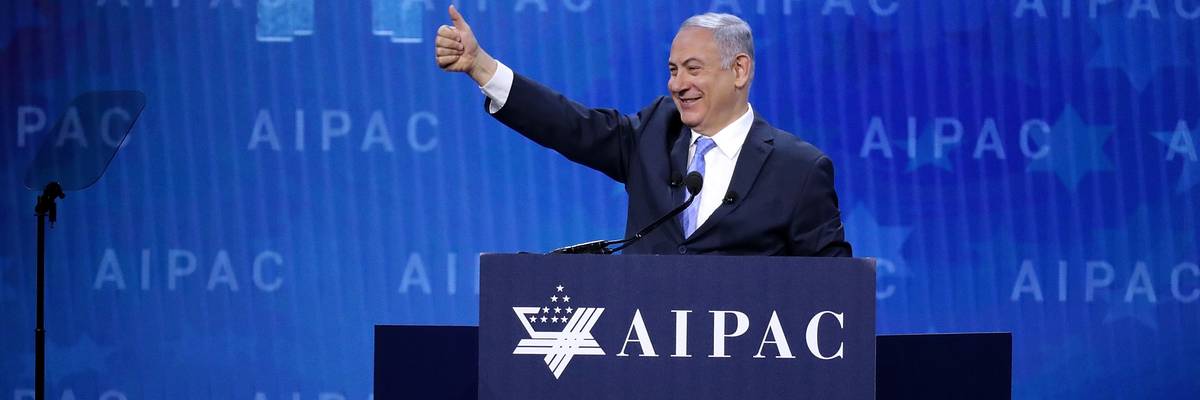
Israeli Prime Minister Benjamin Netanyahu addresses the American Israel Public Affairs Committee's annual policy conference at the Washington Convention Center March 6, 2018 in Washington, DC.
The bulk of the Democrats mapping a path to the White House for 2028 are dodging profound questions about human rights and US policy toward Israel.
After decades of bipartisan deference to the American Israel Public Affairs Committee (AIPAC), the likely contenders for the next Democratic presidential nomination have been distancing themselves from the powerful organization. The shift is significant. But disavowing AIPAC has become a box-checking exercise, useful for politicians who remain firm supporters of Israel.
Polling last month found that registered Democrats—by a margin of 67-17 percent—were more sympathetic toward Palestinians than Israelis. For elected officials on automatic pilot for Israel, such numbers are a big jolt. In response, the evident quest is to satisfy the majority of Democratic voters who have negative views of Israel, while at the same time not angering its supporters.
While AIPAC and perhaps other pro-Israel groups must now cope with being shunned by many Democratic politicians, the implications for US policy toward Israel are another matter. The Times of Israel reports that “none of the potential 2028 Democratic Party candidates has embraced AIPAC,” but the ultimate goal of such organizations is to prevent federal officeholders from impeding the massive pipeline of American weapons to Israel or fracturing the US-Israel military alliance.
“It’s not just avoiding AIPAC money,” Congressman Ro Khanna told me. “It’s the guts to take them on with clear policy.” Khanna has stressed that “what matters more is the clarity of calling what happened a genocide and stopping military sales to Israel used to kill civilians in Gaza and Lebanon.”
As vocal opponents of US arms shipments to Israel, Khanna and Senator Chris Van Hollen are unusual in the field of expected Democratic presidential candidates. That’s why the CEO of the Anti-Defamation League, Jonathan Greenblatt, singled them out for denunciation last month at the ADL’s national conference, complete with the timeworn technique of insinuating antisemitism.
In sharp contrast to confronting the immorality of arming Israel’s genocidal policies, simply promising not to take AIPAC money is easy. As if to show how valueless such a pledge can be, Kentucky governor Andy Beshear stuck like glue to standard pro-Israel talking points during a national interview this spring. Along the way, he refused to call what Israel has done in Gaza “genocide,” complaining “that’s becoming one of those new litmus tests that we said we would never do as a party again.”
(Khanna replied with a pointed tweet saying: “Yes, standing up for human rights is the most basic litmus test. Our party needs a new moral direction.”)
The governor getting the most attention for 2028, California’s Gavin Newsom, has offered assurances that he will never take AIPAC money. In an early March interview, he seemed to compare Israel to an “apartheid state”—but later emphatically backtracked, expressing regret over using the word “apartheid” and declaring: “I revere the state of Israel. I’m proud to support the state of Israel.” That expression of reverence came more than three weeks after Israel had initiated its current wars on Iran and Lebanon.
Another governor eyeing the Oval Office who has vowed not to take AIPAC funding is Gov. Josh Shapiro of Pennsylvania. He became controversial during the intense carnage of the Israeli war on Gaza when he called for a crackdown on peaceful campus protests.
Others with long pro-Israel records who are often named as potential 2028 candidates have maintained tactful silences when asked about whether they’d accept support from AIPAC, including Vice President Kamala Harris, Senators Mark Kelly and Raphael Warnock, Governors Wes Moore of Maryland and Gretchen Whitmer of Michigan, and former Transportation Secretary Pete Buttigieg.
This spring began with a round of high-profile interviews with Senator Cory Booker as apparent groundwork for a presidential campaign. Booker was still receiving donations bundled by AIPAC at the end of 2025, but he cut off funding from the group this year. “I don’t believe we should be accepting any PAC money at all from anybody,” Booker said. He has a long history of courting AIPAC.
Now New Jersey’s senior senator, Booker “frequently ingratiated himself at the AIPAC conferences by professing his unquestioned loyalty to Israel,” the Washington Report on Middle East Affairs noted three years ago. “For example, on March 2, 2020, Booker, a member of the Senate Foreign Relations Committee, reassured the AIPAC throng of the ‘unshakeable bond’ between the United States and Israel, an ‘indispensable ally’ that the United States would continue to ‘fully support ensuring that they have the means and resources’ that Washington annually provides.”
Routinely, those who’ve backed away from AIPAC sound notes of partisanship rather than morality. Another prominent Democrat likely to make a run for president, Illinois governor JB Pritzker, attributes his alienation from AIPAC not to its resolute backing of an apartheid state and its deadly treatment of Palestinians along with others in the region, but instead to its alignment with the GOP. “It became an organization that was supporting Donald Trump and people who follow Donald Trump,” Pritzker explained to the Associated Press in March. “AIPAC really is not an organization that I think today I would want any part of.”
As Axios pointed out, “Pritzker has tried to walk a fine line – breaking with AIPAC over its affiliation with Trump rather than Israeli actions.” A spokesperson for Pritzker underscored the point, saying that he broke away from AIPAC when it “became a pro-Trump organization.”
Changes in the direction of windsocks show how the political winds are blowing, and there’s no reason to believe that the change in views of Israel among the Democratic electorate is merely temporary. But scrutiny should be applied to how top Democrats are framing their disenchantment with the Israel lobby without challenging the alliance between the US and Israel or decrying the colossal damage it has been doing to human lives.
Four of the senators now reportedly serious about a 2028 presidential run – Booker, Ruben Gallego, Mark Kelly and Raphael Warnock – voted to support sending $8.8 billion worth of weapons to Israel last year. They now say they’ll reject AIPAC money, without any sign of interest in voting to block such shipments in the future.
While distancing from AIPAC, the bulk of the Democrats mapping a path to the White House are dodging profound questions about human rights and US policy toward Israel. A favorite technique is to blame Israel’s prime minister Benjamin Netanyahu rather than Israel, as though they can be separated after he has been in power for more than 15 of the last 17 years.
And so it was when former Chicago mayor and longtime corporate-Democrat power broker Rahm Emanuel declared in late March that he and AIPAC had nothing to do with each other: “I worked for a two-state solution in my whole public life as adviser to President Clinton, as a congressman and as President Obama’s chief of staff…. I have a long fraught and publicly known antagonistic relationship with Prime Minister Netanyahu for his hostility and attempts to undermine that goal.”
Notably absent from media coverage of the recent public splits between AIPAC and Democratic politicians has been any mention of kindred organizations like Democratic Majority for Israel, a virtual spinoff from AIPAC which has worked in parallel to swing elections ever since its founding in 2019. “The new group says it’s independent and distinct from AIPAC,” the Forward newspaper reported at the time—but out of DMFI’s 15 board members, 11 “have either worked or volunteered for [AIPAC], donated to it or spoken at its events.”
During the last seven years, DMFI has wielded electoral power in its own right while targeting key races. The group spent $6.2 million in the latest election cycle, deftly intervening in races (without mentioning Israel in attack ads) to defeat candidates deemed too critical of Israel and overly sympathetic to the rights of Palestinians.
From the outset, DMFI received a political benediction that reflects how fully Israel-right-or-wrong politics saturate the fabric of Democratic Party leadership. “I look forward to working with the Democratic Majority for Israel as it advances the unbreakable US-Israel bond into the future,” said Representative Hakeem Jeffries, now the Democratic leader in the House.
Despite all of its awesome clout in American politics, AIPAC has been more a symptom than a cause of what ails US policy in the Middle East. “The unbreakable US-Israel bond” continues to take a horrific toll as the US-Israel military alliance rampages through the region. Among leaders in Washington, much deeper changes will be needed than giving up money from AIPAC.
Dear Common Dreams reader, It’s been nearly 30 years since I co-founded Common Dreams with my late wife, Lina Newhouser. We had the radical notion that journalism should serve the public good, not corporate profits. It was clear to us from the outset what it would take to build such a project. No paid advertisements. No corporate sponsors. No millionaire publisher telling us what to think or do. Many people said we wouldn't last a year, but we proved those doubters wrong. Together with a tremendous team of journalists and dedicated staff, we built an independent media outlet free from the constraints of profits and corporate control. Our mission has always been simple: To inform. To inspire. To ignite change for the common good. Building Common Dreams was not easy. Our survival was never guaranteed. When you take on the most powerful forces—Wall Street greed, fossil fuel industry destruction, Big Tech lobbyists, and uber-rich oligarchs who have spent billions upon billions rigging the economy and democracy in their favor—the only bulwark you have is supporters who believe in your work. But here’s the urgent message from me today. It's never been this bad out there. And it's never been this hard to keep us going. At the very moment Common Dreams is most needed, the threats we face are intensifying. We need your support now more than ever. We don't accept corporate advertising and never will. We don't have a paywall because we don't think people should be blocked from critical news based on their ability to pay. Everything we do is funded by the donations of readers like you. When everyone does the little they can afford, we are strong. But if that support retreats or dries up, so do we. Will you donate now to make sure Common Dreams not only survives but thrives? —Craig Brown, Co-founder |
Norman Solomon is the national director of RootsAction.org and executive director of the Institute for Public Accuracy. The paperback edition of his latest book, War Made Invisible: How America Hides the Human Toll of Its Military Machine, includes an afterword about the Gaza war.
After decades of bipartisan deference to the American Israel Public Affairs Committee (AIPAC), the likely contenders for the next Democratic presidential nomination have been distancing themselves from the powerful organization. The shift is significant. But disavowing AIPAC has become a box-checking exercise, useful for politicians who remain firm supporters of Israel.
Polling last month found that registered Democrats—by a margin of 67-17 percent—were more sympathetic toward Palestinians than Israelis. For elected officials on automatic pilot for Israel, such numbers are a big jolt. In response, the evident quest is to satisfy the majority of Democratic voters who have negative views of Israel, while at the same time not angering its supporters.
While AIPAC and perhaps other pro-Israel groups must now cope with being shunned by many Democratic politicians, the implications for US policy toward Israel are another matter. The Times of Israel reports that “none of the potential 2028 Democratic Party candidates has embraced AIPAC,” but the ultimate goal of such organizations is to prevent federal officeholders from impeding the massive pipeline of American weapons to Israel or fracturing the US-Israel military alliance.
“It’s not just avoiding AIPAC money,” Congressman Ro Khanna told me. “It’s the guts to take them on with clear policy.” Khanna has stressed that “what matters more is the clarity of calling what happened a genocide and stopping military sales to Israel used to kill civilians in Gaza and Lebanon.”
As vocal opponents of US arms shipments to Israel, Khanna and Senator Chris Van Hollen are unusual in the field of expected Democratic presidential candidates. That’s why the CEO of the Anti-Defamation League, Jonathan Greenblatt, singled them out for denunciation last month at the ADL’s national conference, complete with the timeworn technique of insinuating antisemitism.
In sharp contrast to confronting the immorality of arming Israel’s genocidal policies, simply promising not to take AIPAC money is easy. As if to show how valueless such a pledge can be, Kentucky governor Andy Beshear stuck like glue to standard pro-Israel talking points during a national interview this spring. Along the way, he refused to call what Israel has done in Gaza “genocide,” complaining “that’s becoming one of those new litmus tests that we said we would never do as a party again.”
(Khanna replied with a pointed tweet saying: “Yes, standing up for human rights is the most basic litmus test. Our party needs a new moral direction.”)
The governor getting the most attention for 2028, California’s Gavin Newsom, has offered assurances that he will never take AIPAC money. In an early March interview, he seemed to compare Israel to an “apartheid state”—but later emphatically backtracked, expressing regret over using the word “apartheid” and declaring: “I revere the state of Israel. I’m proud to support the state of Israel.” That expression of reverence came more than three weeks after Israel had initiated its current wars on Iran and Lebanon.
Another governor eyeing the Oval Office who has vowed not to take AIPAC funding is Gov. Josh Shapiro of Pennsylvania. He became controversial during the intense carnage of the Israeli war on Gaza when he called for a crackdown on peaceful campus protests.
Others with long pro-Israel records who are often named as potential 2028 candidates have maintained tactful silences when asked about whether they’d accept support from AIPAC, including Vice President Kamala Harris, Senators Mark Kelly and Raphael Warnock, Governors Wes Moore of Maryland and Gretchen Whitmer of Michigan, and former Transportation Secretary Pete Buttigieg.
This spring began with a round of high-profile interviews with Senator Cory Booker as apparent groundwork for a presidential campaign. Booker was still receiving donations bundled by AIPAC at the end of 2025, but he cut off funding from the group this year. “I don’t believe we should be accepting any PAC money at all from anybody,” Booker said. He has a long history of courting AIPAC.
Now New Jersey’s senior senator, Booker “frequently ingratiated himself at the AIPAC conferences by professing his unquestioned loyalty to Israel,” the Washington Report on Middle East Affairs noted three years ago. “For example, on March 2, 2020, Booker, a member of the Senate Foreign Relations Committee, reassured the AIPAC throng of the ‘unshakeable bond’ between the United States and Israel, an ‘indispensable ally’ that the United States would continue to ‘fully support ensuring that they have the means and resources’ that Washington annually provides.”
Routinely, those who’ve backed away from AIPAC sound notes of partisanship rather than morality. Another prominent Democrat likely to make a run for president, Illinois governor JB Pritzker, attributes his alienation from AIPAC not to its resolute backing of an apartheid state and its deadly treatment of Palestinians along with others in the region, but instead to its alignment with the GOP. “It became an organization that was supporting Donald Trump and people who follow Donald Trump,” Pritzker explained to the Associated Press in March. “AIPAC really is not an organization that I think today I would want any part of.”
As Axios pointed out, “Pritzker has tried to walk a fine line – breaking with AIPAC over its affiliation with Trump rather than Israeli actions.” A spokesperson for Pritzker underscored the point, saying that he broke away from AIPAC when it “became a pro-Trump organization.”
Changes in the direction of windsocks show how the political winds are blowing, and there’s no reason to believe that the change in views of Israel among the Democratic electorate is merely temporary. But scrutiny should be applied to how top Democrats are framing their disenchantment with the Israel lobby without challenging the alliance between the US and Israel or decrying the colossal damage it has been doing to human lives.
Four of the senators now reportedly serious about a 2028 presidential run – Booker, Ruben Gallego, Mark Kelly and Raphael Warnock – voted to support sending $8.8 billion worth of weapons to Israel last year. They now say they’ll reject AIPAC money, without any sign of interest in voting to block such shipments in the future.
While distancing from AIPAC, the bulk of the Democrats mapping a path to the White House are dodging profound questions about human rights and US policy toward Israel. A favorite technique is to blame Israel’s prime minister Benjamin Netanyahu rather than Israel, as though they can be separated after he has been in power for more than 15 of the last 17 years.
And so it was when former Chicago mayor and longtime corporate-Democrat power broker Rahm Emanuel declared in late March that he and AIPAC had nothing to do with each other: “I worked for a two-state solution in my whole public life as adviser to President Clinton, as a congressman and as President Obama’s chief of staff…. I have a long fraught and publicly known antagonistic relationship with Prime Minister Netanyahu for his hostility and attempts to undermine that goal.”
Notably absent from media coverage of the recent public splits between AIPAC and Democratic politicians has been any mention of kindred organizations like Democratic Majority for Israel, a virtual spinoff from AIPAC which has worked in parallel to swing elections ever since its founding in 2019. “The new group says it’s independent and distinct from AIPAC,” the Forward newspaper reported at the time—but out of DMFI’s 15 board members, 11 “have either worked or volunteered for [AIPAC], donated to it or spoken at its events.”
During the last seven years, DMFI has wielded electoral power in its own right while targeting key races. The group spent $6.2 million in the latest election cycle, deftly intervening in races (without mentioning Israel in attack ads) to defeat candidates deemed too critical of Israel and overly sympathetic to the rights of Palestinians.
From the outset, DMFI received a political benediction that reflects how fully Israel-right-or-wrong politics saturate the fabric of Democratic Party leadership. “I look forward to working with the Democratic Majority for Israel as it advances the unbreakable US-Israel bond into the future,” said Representative Hakeem Jeffries, now the Democratic leader in the House.
Despite all of its awesome clout in American politics, AIPAC has been more a symptom than a cause of what ails US policy in the Middle East. “The unbreakable US-Israel bond” continues to take a horrific toll as the US-Israel military alliance rampages through the region. Among leaders in Washington, much deeper changes will be needed than giving up money from AIPAC.
Norman Solomon is the national director of RootsAction.org and executive director of the Institute for Public Accuracy. The paperback edition of his latest book, War Made Invisible: How America Hides the Human Toll of Its Military Machine, includes an afterword about the Gaza war.
After decades of bipartisan deference to the American Israel Public Affairs Committee (AIPAC), the likely contenders for the next Democratic presidential nomination have been distancing themselves from the powerful organization. The shift is significant. But disavowing AIPAC has become a box-checking exercise, useful for politicians who remain firm supporters of Israel.
Polling last month found that registered Democrats—by a margin of 67-17 percent—were more sympathetic toward Palestinians than Israelis. For elected officials on automatic pilot for Israel, such numbers are a big jolt. In response, the evident quest is to satisfy the majority of Democratic voters who have negative views of Israel, while at the same time not angering its supporters.
While AIPAC and perhaps other pro-Israel groups must now cope with being shunned by many Democratic politicians, the implications for US policy toward Israel are another matter. The Times of Israel reports that “none of the potential 2028 Democratic Party candidates has embraced AIPAC,” but the ultimate goal of such organizations is to prevent federal officeholders from impeding the massive pipeline of American weapons to Israel or fracturing the US-Israel military alliance.
“It’s not just avoiding AIPAC money,” Congressman Ro Khanna told me. “It’s the guts to take them on with clear policy.” Khanna has stressed that “what matters more is the clarity of calling what happened a genocide and stopping military sales to Israel used to kill civilians in Gaza and Lebanon.”
As vocal opponents of US arms shipments to Israel, Khanna and Senator Chris Van Hollen are unusual in the field of expected Democratic presidential candidates. That’s why the CEO of the Anti-Defamation League, Jonathan Greenblatt, singled them out for denunciation last month at the ADL’s national conference, complete with the timeworn technique of insinuating antisemitism.
In sharp contrast to confronting the immorality of arming Israel’s genocidal policies, simply promising not to take AIPAC money is easy. As if to show how valueless such a pledge can be, Kentucky governor Andy Beshear stuck like glue to standard pro-Israel talking points during a national interview this spring. Along the way, he refused to call what Israel has done in Gaza “genocide,” complaining “that’s becoming one of those new litmus tests that we said we would never do as a party again.”
(Khanna replied with a pointed tweet saying: “Yes, standing up for human rights is the most basic litmus test. Our party needs a new moral direction.”)
The governor getting the most attention for 2028, California’s Gavin Newsom, has offered assurances that he will never take AIPAC money. In an early March interview, he seemed to compare Israel to an “apartheid state”—but later emphatically backtracked, expressing regret over using the word “apartheid” and declaring: “I revere the state of Israel. I’m proud to support the state of Israel.” That expression of reverence came more than three weeks after Israel had initiated its current wars on Iran and Lebanon.
Another governor eyeing the Oval Office who has vowed not to take AIPAC funding is Gov. Josh Shapiro of Pennsylvania. He became controversial during the intense carnage of the Israeli war on Gaza when he called for a crackdown on peaceful campus protests.
Others with long pro-Israel records who are often named as potential 2028 candidates have maintained tactful silences when asked about whether they’d accept support from AIPAC, including Vice President Kamala Harris, Senators Mark Kelly and Raphael Warnock, Governors Wes Moore of Maryland and Gretchen Whitmer of Michigan, and former Transportation Secretary Pete Buttigieg.
This spring began with a round of high-profile interviews with Senator Cory Booker as apparent groundwork for a presidential campaign. Booker was still receiving donations bundled by AIPAC at the end of 2025, but he cut off funding from the group this year. “I don’t believe we should be accepting any PAC money at all from anybody,” Booker said. He has a long history of courting AIPAC.
Now New Jersey’s senior senator, Booker “frequently ingratiated himself at the AIPAC conferences by professing his unquestioned loyalty to Israel,” the Washington Report on Middle East Affairs noted three years ago. “For example, on March 2, 2020, Booker, a member of the Senate Foreign Relations Committee, reassured the AIPAC throng of the ‘unshakeable bond’ between the United States and Israel, an ‘indispensable ally’ that the United States would continue to ‘fully support ensuring that they have the means and resources’ that Washington annually provides.”
Routinely, those who’ve backed away from AIPAC sound notes of partisanship rather than morality. Another prominent Democrat likely to make a run for president, Illinois governor JB Pritzker, attributes his alienation from AIPAC not to its resolute backing of an apartheid state and its deadly treatment of Palestinians along with others in the region, but instead to its alignment with the GOP. “It became an organization that was supporting Donald Trump and people who follow Donald Trump,” Pritzker explained to the Associated Press in March. “AIPAC really is not an organization that I think today I would want any part of.”
As Axios pointed out, “Pritzker has tried to walk a fine line – breaking with AIPAC over its affiliation with Trump rather than Israeli actions.” A spokesperson for Pritzker underscored the point, saying that he broke away from AIPAC when it “became a pro-Trump organization.”
Changes in the direction of windsocks show how the political winds are blowing, and there’s no reason to believe that the change in views of Israel among the Democratic electorate is merely temporary. But scrutiny should be applied to how top Democrats are framing their disenchantment with the Israel lobby without challenging the alliance between the US and Israel or decrying the colossal damage it has been doing to human lives.
Four of the senators now reportedly serious about a 2028 presidential run – Booker, Ruben Gallego, Mark Kelly and Raphael Warnock – voted to support sending $8.8 billion worth of weapons to Israel last year. They now say they’ll reject AIPAC money, without any sign of interest in voting to block such shipments in the future.
While distancing from AIPAC, the bulk of the Democrats mapping a path to the White House are dodging profound questions about human rights and US policy toward Israel. A favorite technique is to blame Israel’s prime minister Benjamin Netanyahu rather than Israel, as though they can be separated after he has been in power for more than 15 of the last 17 years.
And so it was when former Chicago mayor and longtime corporate-Democrat power broker Rahm Emanuel declared in late March that he and AIPAC had nothing to do with each other: “I worked for a two-state solution in my whole public life as adviser to President Clinton, as a congressman and as President Obama’s chief of staff…. I have a long fraught and publicly known antagonistic relationship with Prime Minister Netanyahu for his hostility and attempts to undermine that goal.”
Notably absent from media coverage of the recent public splits between AIPAC and Democratic politicians has been any mention of kindred organizations like Democratic Majority for Israel, a virtual spinoff from AIPAC which has worked in parallel to swing elections ever since its founding in 2019. “The new group says it’s independent and distinct from AIPAC,” the Forward newspaper reported at the time—but out of DMFI’s 15 board members, 11 “have either worked or volunteered for [AIPAC], donated to it or spoken at its events.”
During the last seven years, DMFI has wielded electoral power in its own right while targeting key races. The group spent $6.2 million in the latest election cycle, deftly intervening in races (without mentioning Israel in attack ads) to defeat candidates deemed too critical of Israel and overly sympathetic to the rights of Palestinians.
From the outset, DMFI received a political benediction that reflects how fully Israel-right-or-wrong politics saturate the fabric of Democratic Party leadership. “I look forward to working with the Democratic Majority for Israel as it advances the unbreakable US-Israel bond into the future,” said Representative Hakeem Jeffries, now the Democratic leader in the House.
Despite all of its awesome clout in American politics, AIPAC has been more a symptom than a cause of what ails US policy in the Middle East. “The unbreakable US-Israel bond” continues to take a horrific toll as the US-Israel military alliance rampages through the region. Among leaders in Washington, much deeper changes will be needed than giving up money from AIPAC.