
SUBSCRIBE TO OUR FREE NEWSLETTER
Daily news & progressive opinion—funded by the people, not the corporations—delivered straight to your inbox.
5
#000000
#FFFFFF
To donate by check, phone, or other method, see our More Ways to Give page.


Daily news & progressive opinion—funded by the people, not the corporations—delivered straight to your inbox.
"They have a mindset of a master sitting somewhere out there overseas and believing to be totally safe and secure, thinking that not only Ukrainians, but also... Europeans would be willing to do the dirty work and die for them."
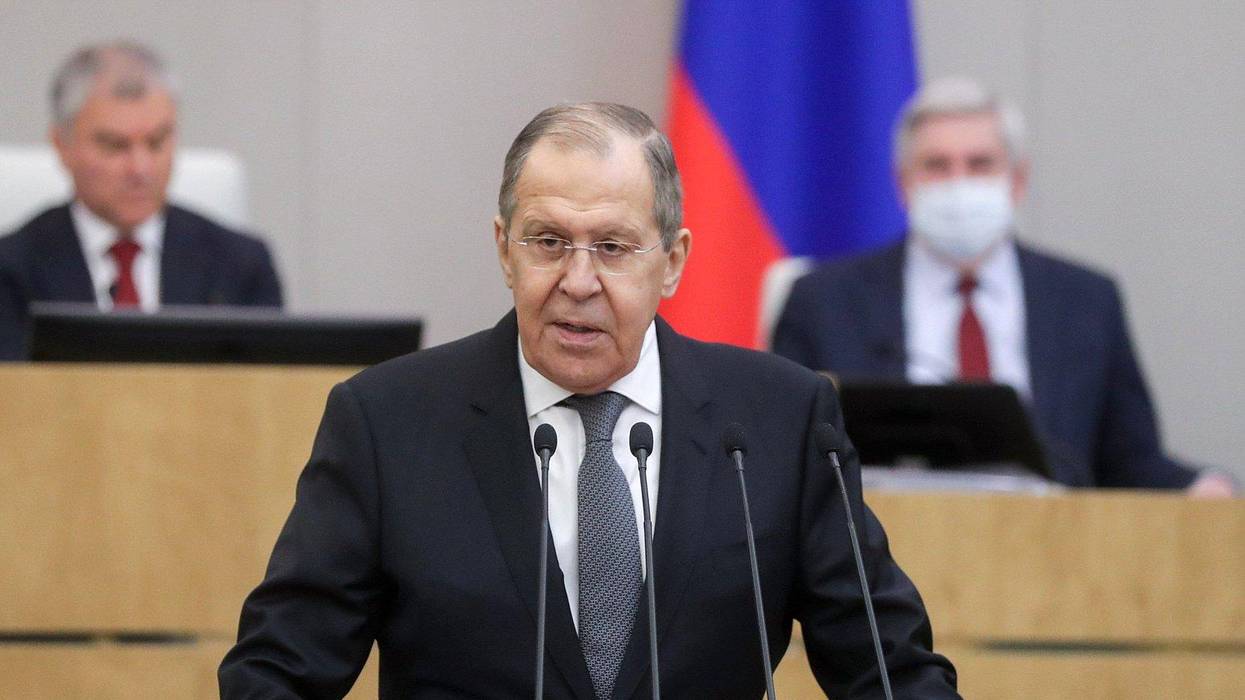
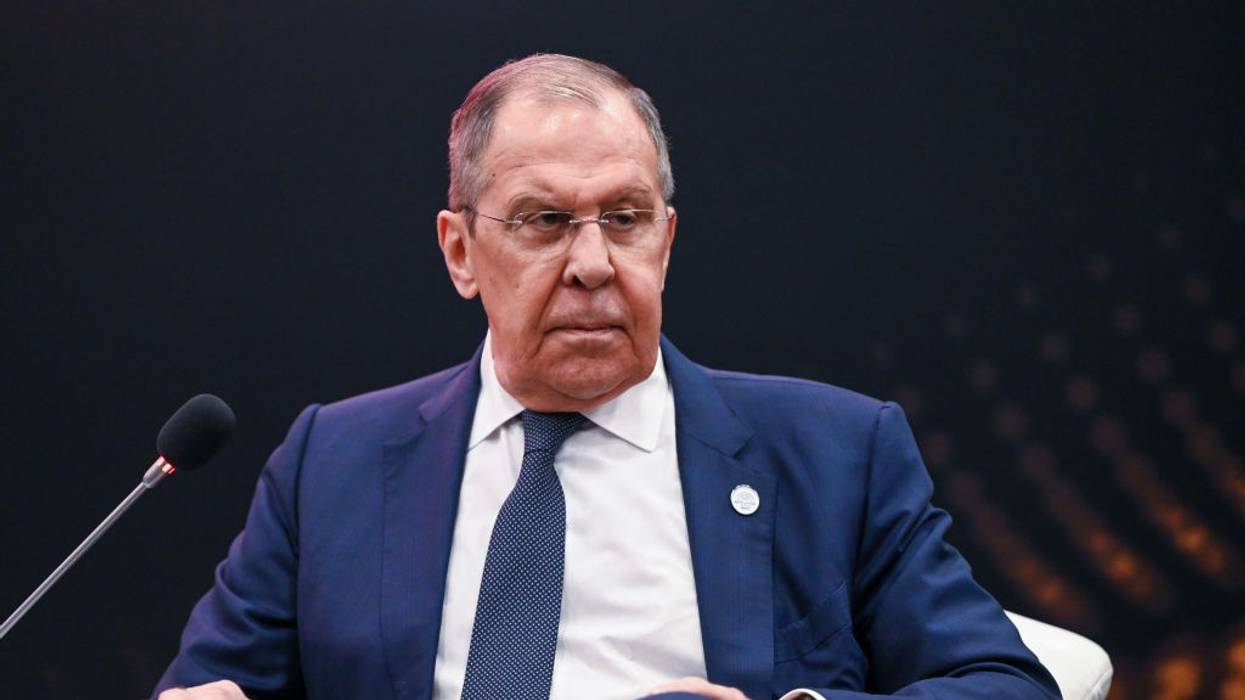
Russian Foreign Minister Sergey Lavrov on Tuesday warned the United States that if the war in Ukraine escalates into a wider military conflict, a potential World War III would not be limited to battlefields in Europe.
While taking questions from journalists two-and-a-half years after Russian President Vladimir Putin's invasion, Lavrov was asked to address recent reporting in The Guardian about Ukrainian President Volodymyr Zelenskyy wanting to use long-range Storm Shadow missiles that "threaten Moscow and St. Petersburg" to force Russia to the negotiating table.
As the British newspaper explained: "Storm Shadow missiles were developed primarily by an Anglo-French collaboration and are made by European joint venture MBDA, which also has an Italian partner. But because some of its components are supplied by the U.S., the White House also has to agree to its use inside Russia. It has so far refused to do so, fearing an escalation of the conflict."
Lavrov declared that "this is blackmail, an attempt to pretend that the West seeks to avoid any excessive escalation. In reality, they are full of mischief. Avoiding escalation is not what the West is after. To put it into plain language, they are simply picking a fight."
The longtime Russian minister also pointed to various remarks from John Kirby, the White House national security communications adviser, along the lines of what he said Friday: "We've been watching escalation risks since the beginning of this conflict, and that ain't gonna change. We're always going to be concerned about the potential for the aggression in Ukraine to lead to escalation on the European continent."
Lavrov said that "for Americans, any talk about the Third World War comes down to something that would affect Europe alone, and God forbid if it ever happened. This is quite telling, since this idea reflects the mindset of the American planners and geostrategy experts who believe that they can simply sit the whole thing out. I think that it is important to understand in this situation that we have our own doctrine, including the one governing the use of nuclear weapons. An effort to update it is underway."
"Moreover, these Americans are well aware of the provisions it sets forth. This fact transpires from the Freudian slips they make when they say that having a Third World War would be a bad thing because they do not want Europe to suffer," he continued. "This is what this American mindset comes down to. They have a mindset of a master sitting somewhere out there overseas and believing to be totally safe and secure, thinking that not only Ukrainians, but also, as it turns out, Europeans would be willing to do the dirty work and die for them."
"We have long been hearing speculation about authorizing Ukraine to use not only the Storm Shadow missiles, but also U.S.-made long-range missiles," the minister noted. "Now, all we can do is confirm once again that playing with fire is a dangerous thing for the men and women in charge of nuclear weapons across the Western world, but they are playing with matches as if they never grew up."
While there are nine nuclear-armed nations, the United States and Russia collectively have roughly 90% of the global arsenal. Since the Kremlin launched its invasion in February 2022, as the U.S. and Europe have armed Ukraine's soldiers, Putin and other Russian officials—along with NATO Secretary-General Jens Stoltenberg—have stoked fears of nuclear weapons use.
Mikhail Sheremet, who represents Crimea—which Russia invaded and annexed from Ukraine a decade ago—in Russia's State Duma, told TASS on Tuesday that the U.S. should consider the consequences of giving Ukrainian troops long-range cruise missiles.
"The ball is now in the U.S.' court but it's clearly finding it difficult to play the game because it will have to take reality into consideration and carefully weigh everything before passing the ball to Ukraine, which aims to drag the U.S. and Europe into a potential World War III," Sheremet told the Russian news agency.
"Undoubtedly, the U.S. will try to implement its far-reaching aggressive plans to provide cruise missiles to the Kyiv regime. They will probably try to do that through Europe, which they have under their thumb," he added. "But in any case, the price of this decision will be too high for them to pay, leading to the loss of their own statehood."
Earlier this month, Ukraine attacked Russia's Kursk region and "has carved out a slice of territory in the biggest foreign attack on Russia since World War II," Reuters reported Tuesday. As the outlet detailed:
Russia has said that Western weaponry, including British tanks and U.S. rocket systems, have been used by Ukraine in Kursk. Kyiv has confirmed using U.S. HIMARS missiles to take out bridges in Kursk.
Washington says it was not informed about Ukraine's plans ahead of the surprise incursion into Kursk. The United States has also said it did not take any part in the operation.
Multiple Russian government officials have made clear that they don't believe those U.S. claims.
Still, based on interviews that Anatol Lieven of the Quincy Institute for Responsible Statecraft recently conducted with "members of the Russian establishment, including former diplomats, members of think tanks, academics, and businesspeople, as well as a few members of the wider public," the majority of them want "an early cease-fire roughly along the existing battle lines."
"Most of my conversations took place before the Ukrainian invasion of the Russian province of Kursk. As far as I can make out, however, this Ukrainian success has not changed basic Russian calculations and views," Lieven wrote Tuesday for Foreign Policy.
"In the end, of course, Russia's negotiating position will be decided by Putin—with whom I did not speak," he acknowledged. "Nobody I spoke to in Moscow claimed to know for sure what Putin is thinking. However, the consensus was that while he made terrible mistakes at the start of the war, he is a pragmatist capable of taking military advice and recognizing military reality."
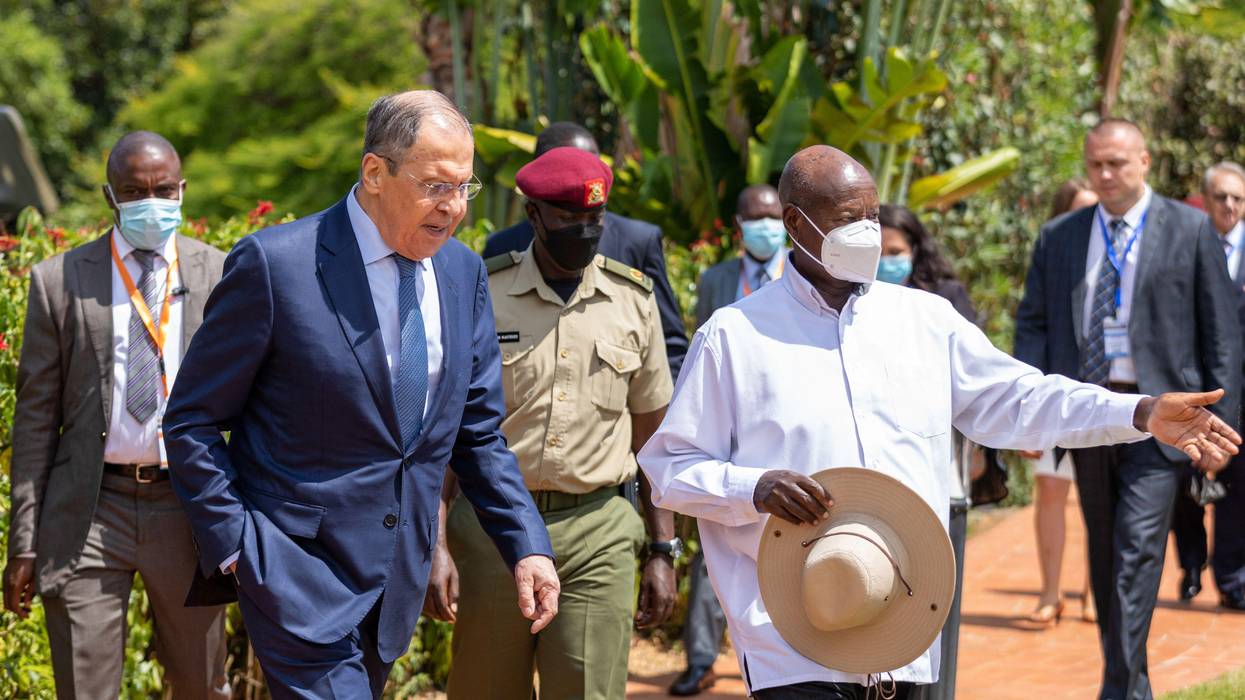
Russian Foreign Minister Sergey Lavrov's recent tour in Africa was meant to be a game changer, not only in terms of Russia's relations with the continent, but in the global power struggle involving the US, Europe, China, India, Turkey and others.
Many media reports and analyses placed Lavrov's visit to Egypt, the Republic of Congo, Uganda and Ethiopia within the obvious political context of the Russia-Ukraine war. The British Guardian's Jason Burka summed up Lavrov's visit in these words: "Lavrov is seeking to convince African leaders and, to a much lesser extent, ordinary people that Moscow cannot be blamed either for the conflict or the food crisis."
Though true, there is more at stake.
Africa's importance to the geostrategic tug of war is not a new phenomenon. Western governments, think tanks and media reports have, for long, allocated much attention to Africa due to China's and Russia's successes in altering the foreign policy map of many African countries. For years, the West has been playing catch up, but with limited success.
The Economist discussed 'the new scramble for Africa' in a May 2019 article, which reported on "governments and businesses from all around the world" who are "rushing" to the continent in search of "vast opportunities" awaiting them there. Between 2010 and 2016, 320 foreign embassies were opened in Africa which, according to the magazine, is "probably the biggest embassy-building boom, anywhere, ever."
Though China has often been portrayed as a country seeking economic opportunities only, the nature and evolution of Beijing's relations with Africa prove otherwise. Beijing is reportedly the biggest supplier of arms to sub-Saharan Africa, and its defense technology permeates almost the entire continent. In 2017, China established its first military base in Djibouti in the Horn of Africa.
Russia's military influence in Africa is also growing exponentially, and Moscow's power is challenging that of France, the US and others in various strategic spaces, mainly in the East Africa regions.
But, unlike the US and other western states, countries like China, Russia and India have been cautious as they attempt to strike the perfect balance between military engagement, economic development and political language.
'Quartz Africa' reported that trade between Africa and China "rose to a record high" in 2021. The jump was massive: 35% between 2020 and 2021, reaching a total of $254 billion.
Now that Covid-19 restrictions have been largely lifted, trade between Africa and China is likely to soar at astronomical levels in the coming years. Keeping in mind the economic slump and potential recession in the West, Beijing's economic expansion is unlikely to slow down, despite the obvious frustration of Washington, London and Brussels. It ought to be said that China is already Africa's largest trade partner, and by far.
Russia-China-Africa's strong ties are paying dividends on the international stage. Nearly half of the abstentions in the vote on United Nations Resolution ES-11/1 on March 2, condemning Russia's military action in Ukraine, came from Africa alone. Eritrea voted against it. This attests to Russia's ability to foster new alliances on the continent. It also demonstrates the influence of China - Russia's main ally in the current geopolitical tussle - as well.
Yet, there is more to Africa's position than mere interest in military hardware and trade expansion. History is most critical.
In the first 'scramble for Africa', Europe sliced up and divided the continent into colonies and areas of influence. The exploitation and brutalization that followed remain one of the most sordid chapters in modern human history.
What the Economist refers to as the 'second scramble for Africa' during the Cold War era was the Soviet Union's attempt to demolish the existing colonial and neo-colonial paradigms established by western countries throughout the centuries.
The collapse of the Soviet Union over three decades ago changed this dynamic, resulting in an inevitable Russian retreat and the return to the uncontested western dominance. That status quo did not last for long, however, as China and, eventually, Russia, India, Turkey, Arab countries and others began challenging western supremacy.
Lavrov and his African counterparts fully understand this context. Though Russia is no longer a Communist state, Lavrov was keen on referencing the Soviet era, thus the unique rapport Moscow has with Africa, in his speeches. For example, ahead of his visit to Congo, Lavrov said in an interview that Russia had "long-standing good relations with Africa since the days of the Soviet Union."
Such language cannot be simply designated as opportunistic or merely compelled by political urgency. It is part of a complex discourse and rooted superstructure, indicating that Moscow - along with Beijing - is preparing for a long-term geopolitical confrontation in Africa.
Considering the West's harrowing colonial past, and Russia's historic association with various liberation movements on the continent, many African states, intelligentsias and ordinary people are eager to break free from the grip of western hegemony.
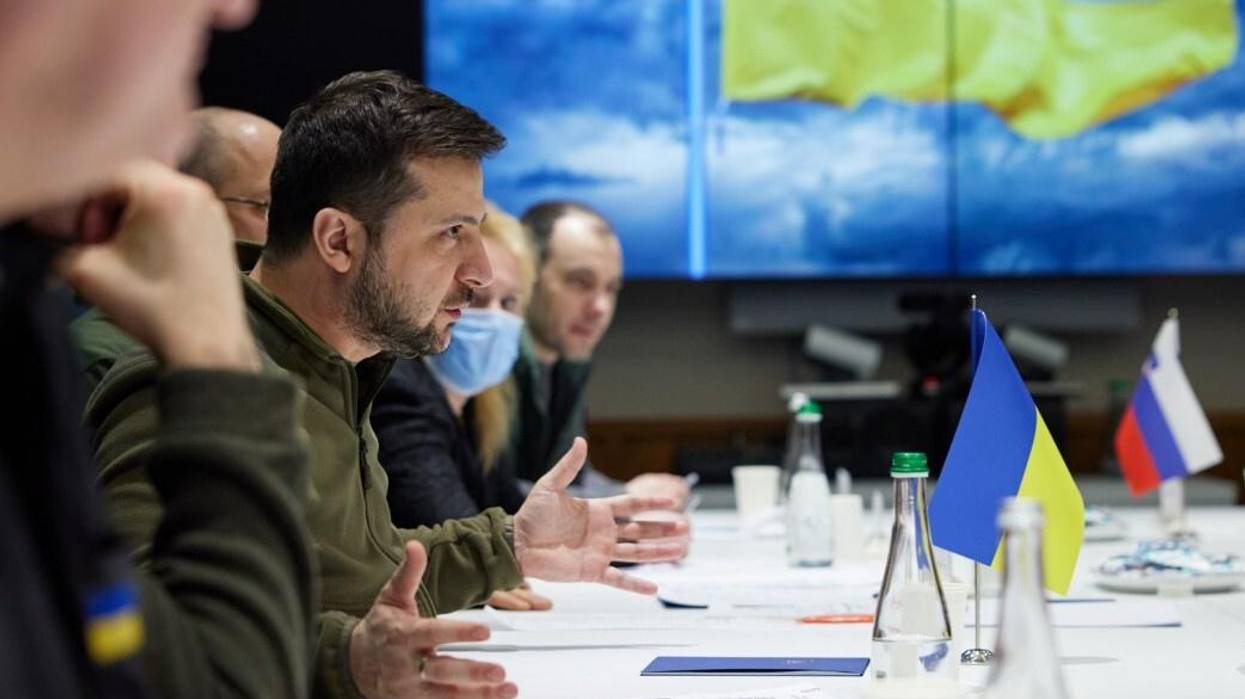
Ukrainian President Volodymyr Zelenskyy said late Tuesday that "difficult" diplomatic talks with Moscow appear to be moving in a positive direction even as Russian forces ramp up their bombing campaigns in Kyiv and other major cities, worsening an already massive humanitarian crisis.
"There are fundamental contradictions. But there is certainly room for compromise."
In a video address, Zelenskyy said that "the positions during the negotiations already sound more realistic" but did not offer details on what a potential agreement with Russia would entail. Ukraine's president has called for an immediate cease-fire and the withdrawal of all Russian troops, while Moscow is pursuing a number of demands including a commitment that Ukraine will "reject any aims to enter any bloc" such as NATO.
"All wars end in agreements," said Zelenskyy, expressing hope that the two sides can ultimately reach a deal to end Russia's deadly assault. "However, time is still needed for the decisions to be in Ukraine's interests. Our heroes, our defenders give us this time defending Ukraine everywhere."
Mykhailo Podolyak, a Zelenskyy adviser, wrote on Twitter that talks with Russia's delegation will continue on Wednesday.
"A very difficult and viscous negotiation process," Podolyak added. "There are fundamental contradictions. But there is certainly room for compromise."
Russian diplomats have also sounded optimistic notes in recent days about the state of negotiations with their Ukrainian counterparts, but President Vladimir Putin suggested in a phone conversation with the head of the European Council on Tuesday that a breakthrough is not imminent.
"Kyiv is not showing a serious commitment to finding mutually acceptable solutions," Putin said during the call, according to a readout published by the Kremlin.
However, hours later, Russian Foreign Minister Sergey Lavrov said that "absolutely specific wordings" on key issues such as Ukraine's neutrality in relation to NATO were "close to being agreed" upon. Lavrov, Russia's top diplomat, echoed Podolyak's assessment that there is "some hope of reaching a compromise."
The Financial Times characterized Lavrov's comments Wednesday as "the most upbeat yet delivered by a senior Russian figure."
Updates on the peace talks came as Russian forces continued attacking the Ukrainian capital with missiles and artillery fire. According to the Associated Press, "Shrapnel from an artillery shell slammed into a 12-story apartment building in central Kyiv on Wednesday, obliterating the top floor and igniting a fire that sent plumes of smoke over the area, according to a statement and images released by the Kyiv emergencies agency."
"The neighboring building was also damaged," AP reported. "The agency reported two victims, without saying if they were injured or killed."
The United Nations said Tuesday that more than 3 million people have fled Ukraine since Russia launched its full-scale invasion on February 24, and many civilians are still attempting to escape violence in Mariupol and other besieged cities. A senior Ukrainian official said that roughly 29,000 people were able to evacuate through humanitarian corridors on Tuesday as tenuous cease-fires held long enough for them to travel.
The U.N. Development Programme has warned that 90% of Ukraine's population could face poverty if Russia's assault continues for another year.
On Wednesday, Zelenskyy is set to deliver an address to the U.S. Congress via video link. Citing unnamed European diplomats, the New York Times reported that "Ukrainian officials plan to present the United States with a list of military equipment they need, including armed drones and mobile air-defense systems, as Mr. Zelensky addresses Congress."
Zelenskyy is also expected to repeat his call for a no-fly zone over Ukraine, a demand that the Biden administration and NATO leaders have thus far rejected, fearing it would result in a broader war with Russia.
Anatol Lieven, a senior research fellow on Russia and Europe at the Quincy Institute for Responsible Statecraft, argued in a column Tuesday that Zelenskyy's push for a no-fly zone "must be resisted."
"It would mean U.S. planes going into action against Russia--in effect, standing in as the Ukrainian air force," Lieven wrote. "They would be shot down by Russian anti-aircraft missile batteries stationed on Russian soil, which have the range to cover much of Ukraine."
"Furthermore," he added, "if the U.S. responded by attacking those batteries, Russia would most probably fire missiles at American air bases in Poland and other NATO members. Do we really want the two largest nuclear powers, with the ability to wipe out humanity, to start firing missiles at each other?"
Following Zelenskyy's speech to Congress on Wednesday, U.S. President Joe Biden is expected to approve another $800 million in "security aid" for Ukraine.
The Washington Post reported that while "the contents of the latest package have not yet been disclosed," the U.S. "has already supplied Kyiv with more than 600 Stinger antiaircraft systems, 2,600 Javelin antiarmor missiles, radar systems, and millions of ammunition and artillery rounds... The United States has also dispatched helicopters, patrol boats, other vehicles, and medical supplies."
Asked what the administration is doing to help advance diplomatic talks between Ukraine and Russia amid fears that Western arms shipments could prolong the war, White House Press Secretary Jen Psaki said Tuesday that U.S. officials continue to "engage and talk to the Ukrainians on a daily basis, and the president and his national security team has rallied the world in being unified in their opposition to the actions of President Putin."
"We also engage, often times before and after any conversations that any of these global leaders are having with both Russians and Ukrainians, and encourage them to make sure they're engaging with Ukrainians directly," Psaki added.
This story has been updated to include new comments from Russian Foreign Minister Sergey Lavrov.
A majority of Americans want the Biden administration to work with Russia toward a diplomatic solution to the Ukraine crisis in order to avert a potentially catastrophic war, according to the results of a new poll published Friday.
According to the Data for Progress survey of 1,214 likely U.S. voters, 58% of overall respondents "somewhat" or "strongly" support the Biden administration "striking a deal with Russia to avoid war over Ukraine."
Among Democrats, support for such a move was 71%, while 51% of Independents and 46% of Republicans agreed with the prospective policy.
The poll's findings echo pleas from U.S. progressives, who urge President Joe Biden to pursue a diplomatic solution to the crisis, in which the world's two foremost nuclear powers are involved.
"There is no military solution," Congressional Progressive Caucus Chair Pramila Jayapal (D-Wash.) and Rep. Barbara Lee (D-Calif.) asserted Wednesday.
The new poll comes as U.S. Defense Secretary Lloyd Austin said during a Friday press conference that conflict with Russia "is not inevitable" and that there was still time for a positive diplomatic outcome.
Common Dreams reported Friday that Russian Foreign Minister Sergey Lavrov said that there will be no war if the United States does not escalate the conflict.
"If it depends on Russia, then there will be no war," he stated. "We don't want wars. But we also won't allow our interests to be rudely trampled, to be ignored."
Related Content

Citing security concerns--including decades of U.S. provocation such as expanding NATO--Russia has reportedly amassed around 100,000 troops near the border of eastern Ukraine, where pro-Moscow separatists have been fighting the Western-backed Ukrainian government since 2014.
Russia is seeking a guarantee that Ukraine will not be admitted into the NATO alliance, which Moscow views as inherently anti-Russian. The U.S. refuses to provide such a guarantee.
Last week, U.S. Secretary of State Antony Blinken warned that any Russian invasion of Ukraine would be "met with a severe and united response" from NATO. While the Biden administration has suggested that such a response would be primarily economic in nature, the Pentagon announced earlier this week that 8,500 U.S. troops were being placed on alert, ready to quickly deploy to Eastern Europe in the event NATO activates a rapid reaction force.
According to a Kremlin official quoted by Reuters, Russian President Vladmir Putin spoke by phone with French President Emmanuel Macron Friday, telling him that "he wanted to continue dialogue and that we needed to work towards the implementation of the Minsk accords," a reference to the quadrilateral talks between France, Germany, Russia, and Ukraine on the war in eastern Ukraine.
"He said he didn't want an escalation," the Russian official said of Putin, but added that the U.S. and NATO have still failed to address Moscow's primary security concerns.
On Thursday, Biden spoke with Volodymyr Zelenskyy, his Ukrainian counterpart, and "reaffirmed the readiness of the United States along with its allies and partners to respond decisively if Russia further invades Ukraine," according to a White House readout of the conversation.
Russian Foreign Minister Sergey Lavrov asserted Friday that his government has no desire to take military action in Ukraine, contrary to what peace advocates and Ukrainian officials have denounced as the United States' overly heated rhetoric in recent weeks.
"If it depends on Russia, then there will be no war," Lavrov said on a Russian radio program. "We don't want wars. But we also won't allow our interests to be rudely trampled, to be ignored."
Lavrov's remarks came as Russian President Vladimir Putin spoke with French President Emanuel Macron in hopes of avoiding through diplomacy what French officials have said would be a "self-fulfilling" military conflict in Ukraine.
"Military solutions, as we saw with the war in Afghanistan and so many other wars--that is not the solution out of this conflict."
The U.S. has for months warned the Ukrainians that military aggression by Russia was imminent. The Pentagon said Friday that more Russian forces had been moved to the country's border with the former Soviet state in the past 24 hours, prompting Ukrainian security council leader Oleksii Danilov to demand the Biden administration dial down its warnings.
"When they start saying that tomorrow, you're going to have war, just take into consideration that the first thing we do not need in our country is panic," Danilov told the New York Times. "Why? Because panic is the sister of failure."
"That's why we are saying to our partners, 'Don't shout so much,'" he continued, adding that the U.S. should provide Ukraine with security assistance but halt its rhetoric regarding imminent violence and a potential deployment of thousands of American troops.
Lavrov suggested a diplomatic resolution could be achieved, considering the U.S. this week signaled that while it is not open to a retreat of NATO forces in Eastern Europe, it could negotiate on a Russian moratorium on deploying missiles in Europe and restrictions on military exercises near Ukraine's borders.
"All this was rejected for the past two or three years" by the U.S., Lavrov said, "and now they are offering to discuss it."
The latest remarks from Russia and Ukraine come as anti-war advocates in the U.S. have been speaking out against the White House's show of aggression and congressional Democrats' reported plan to expedite the passage of a $500 million military aid package. The bill includes new weapons for Ukraine and sweeping sanctions against Russia, both of which, as Peace Action president Kevin Martin wrote at Common Dreams Friday, could escalate the conflict rather than helping to resolve tensions:
Diplomacy and de-escalation are the urgent priorities; we can't risk putting out the fire with gasoline. While seemingly no one wants war, mis-calculations could lead to catastrophe between nuclear-armed behemoths.
Nobody should oversimplify the current situation. Russia-Ukraine relations and history, as well as post-Cold War triumphalism by the U.S. and NATO toward Russia, have contributed to the crisis. But diplomacy, via the Minsk II process or other means, needs to be the only solution on the table, not militaristic threats or increased weapons transfers. The Minsk II agreement would, if implemented, demilitarize the eastern Donbass region of Ukraine and guarantee meaningful political autonomy to the region while retaining Ukrainian sovereignty over the area and its borders.
As Common Dreams reported Wednesday, progressives in Congress are also calling on the Biden administration to approach Russia and Ukraine diplomatically.
"Diplomatic negotiations are still ongoing. We don't want to get in the way of that," Rep. Pramila Jayapal (D-Wash.) told MSNBC host Jose Diaz-Balart Friday morning. "We can always act quickly if we need to, but now is the time for diplomacy to play its role and for... us to really work with our NATO allies and show leadership in negotiations, not in war."
"Military solutions, as we saw with the war in Afghanistan and so many other wars--that is not the solution out of this conflict," the congresswoman added.
Pointing to "the map of the U.S. military bases" around the world as evidence of American imperialism, Russian Foreign Minister Sergei Lavrov said Wednesday his country has no plans to remove the small number of troops it has stationed in Venezuela despite- Trump administration demands to withdraw.
On March 24, a Russian military plane landed in Venezuela, depositing around 100 Russian soldiers in the country, as Common Dreams reported at the time. The move was "akin to tripwire" against U.S. intervention in Venezuela, said Washington Institute fellow Soner Cagaptay.
The move angered U.S. officials and, on March 29, President Donald Trump's National Security Advisor John Bolton issued a statement criticizing Russia for its presence in the Latin American country.
"We strongly caution actors external to the Western Hemisphere against deploying military assets to Venezuela, or elsewhere in the Hemisphere, with the intent of establishing or expanding military operations," said Bolton.
The rhetoric didn't stop there: Bolton also called the Russian presence in Venezuela "a direct threat to international peace and security in the region."
Bolton's comments didn't sit well with Lavrov. In an interview with Russian newspaper Moskovskij Komsomolets, Lavrov called U.S. demands Russian military personnel leave Venezuela "insolent" and asserted that America does not, in fact, have the right to tell Russia what to do--even in America's so-called "sphere of influence."
"What do they mean by insolent remarks that the countries external to the Western Hemisphere are not allowed to have any interests there?" Lavrov said.
Further, said Lavrov, a country like the U.S. isn't in the best position to throw stones about stationing troops in foreign countries.
"Take a look at the map of the U.S. military bases--the whole world is dotted with red spots and each of them poses rather serious risks," said Lavrov.
The U.S. operates around an estimated 800 bases worldwide, though that number moves even higher depending on how the term "bases" is defined.
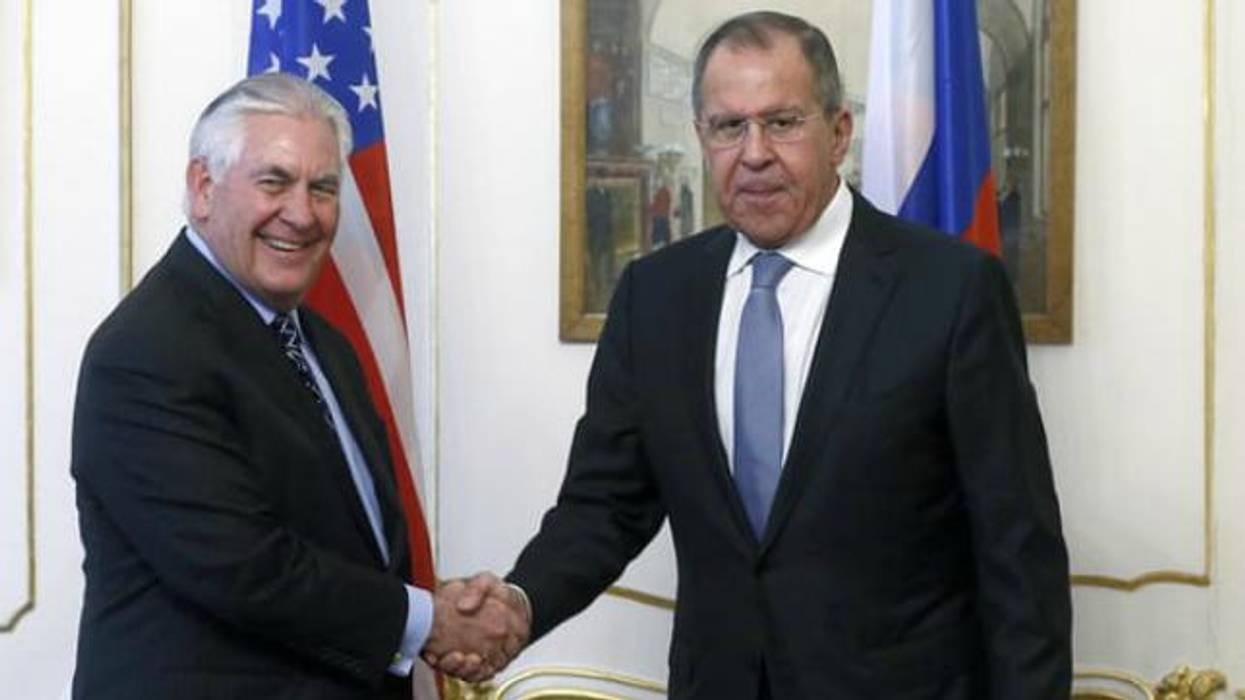
After talking with U.S. Secretary of State Rex Tillerson on the sidelines of an international summit in Vienna on Thursday, Russian Foreign Minister Sergey Lavrov said North Korea is ready for direct talks and Russia is willing to help the two nations enter diplomatic discussions in order to decrease rising nuclear tensions and the threat of war.
"We spoke about the situation on the Korean peninsula," Lavrov, told TASS, a Russian news agency, about his talks with Tillerson. "Our position on this matter is unchanged. We are confident that it the vicious spiral of confrontation and provocations must be stopped."
"We know that North Korea wants first of all to speak with the United States about its security guarantees," he added. "We are ready to support it. We are ready to help promote such talks."
The State Department, however, seems unlikely to pursue the offer, and the department's spokeswoman, Heather Nauert, told Reuters that direct talks with North Korea were "not on the table until they are willing to denuclearize."
"It is something that Russia says it agrees with; it is something China has said it agrees with, and many other nations around the world as well," Nauert claimed, adding that North Korea was "not showing any interest in sitting down and having any kind of serious conversations when they continue to fire off ballistic missiles."
A spokesperson for Chinese Foreign Ministry emphasized the costs of war, and told Reuters: "We hope all relevant parties can maintain calm and restraint and take steps to alleviate tensions and not provoke each other.... The outbreak of war is not in any side's interest. The ones that will suffer the most are ordinary people."
These comments come as peace advocates continue to say that a diplomatic settlement through direct talks is the only way to resolve the volatile situation, and as one U.S. lawmaker expressed worries this week that too few realize just "how close we are to this war."
"I think that the president is playing to a segment of the population and, I think, relying on the fact that most Americans don't realize how close we are to this war," said Sen. Tammy Duckworth (D-Ill.), an Iraq War veteran, in an interview with Vox published Thursday. "Look: I'm not someone who's going to avoid war at all costs. That's not me. But I want the American people to know what this will cost."
Duckworth--who lost both her legs when her Black Hawk helicopter was downed in Iraq--recalls how the Bush administration was "selling a lie" ahead of the invasion of Iraq, and warns that "we don't have the troops in the region, on the ground, to do what would need to be done to fully contain [North Korea's] nuclear capabilities," but "just ramping up--prepositioning troops, stocks, and logistics in a place where we could do it--could prompt the North Koreans to do something."
The United States continues to conduct joint military exercises with South Korean forces over the Korean peninsula, despite warnings from the North Koreans that the drills are perceived as provocations of war, as Common Dreams reported Wednesday.
"The large-scale nuclear war exercises conducted by the U.S. in succession are creating touch-and-go situation on the Korean peninsula, and series of violent war remarks coming from the U.S. high-level politicians amid such circumstances have made an outbreak of war on the Korean peninsula an established fact," a North Korean spokesperson said this week. "The remaining question now is: when will the war break out."