

SUBSCRIBE TO OUR FREE NEWSLETTER
Daily news & progressive opinion—funded by the people, not the corporations—delivered straight to your inbox.
5
#000000
#FFFFFF
To donate by check, phone, or other method, see our More Ways to Give page.
Daily news & progressive opinion—funded by the people, not the corporations—delivered straight to your inbox.
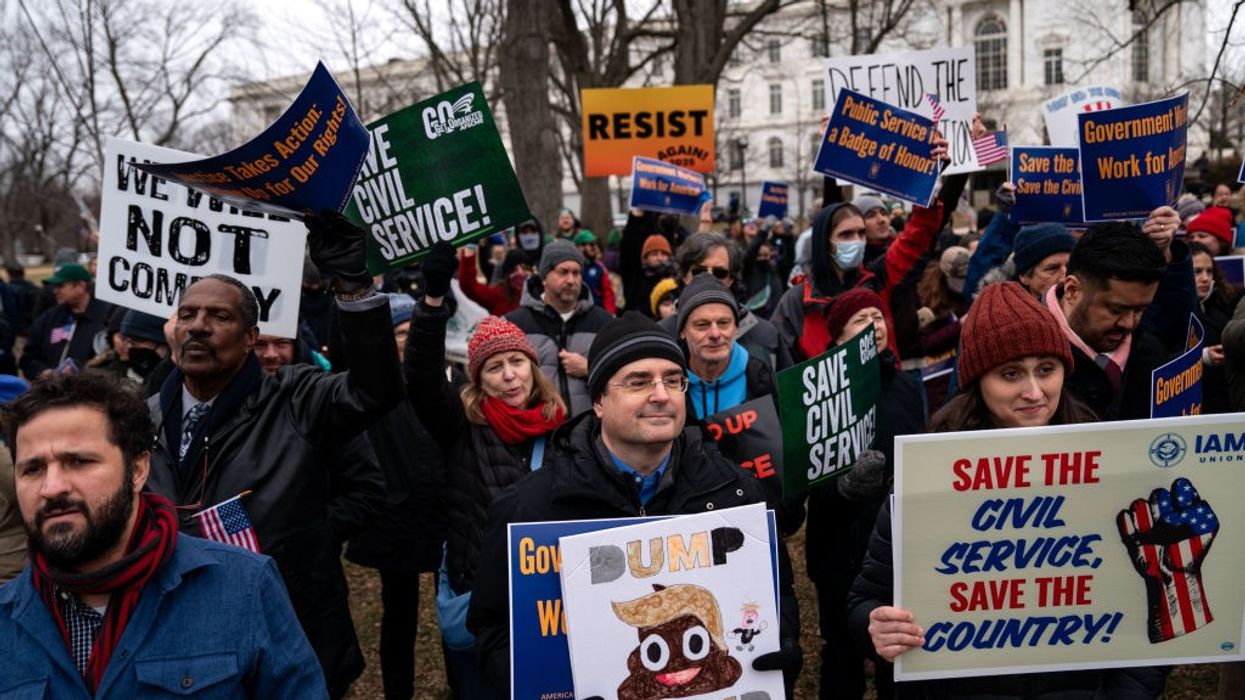
Trump’s latest moves can be viewed as a massive speedup of a decades-long trend, rather than a break from the past.
Since returning to office, President Donald Trump has aggressively moved to shrink the federal government. His administration has frozen federal grants, issued executive orders aligned with the Heritage Foundation’s Project 2025, and, most prominently, created what he calls the Department of Government Efficiency, or DOGE.
DOGE has been billed as a cost-cutting initiative, although the actual amount of money being saved remains unclear. To lead DOGE, Trump appointed Elon Musk, a megadonor whose companies hold federal contracts worth billions. Musk has already moved forward with major cuts, including sweeping workforce reductions, the curtailment of government operations, and purges of entire agencies. Thousands of federal workers have lost their jobs.
While certainly dramatic, these actions reflect a longer trend of privatizing government. Indeed, my sociological research shows that the government has steadily withdrawn from economic production for decades, outsourcing many responsibilities to the private sector.
At first glance, total government spending appears stable over time. In 2024, federal, state, and local expenditures made up 35% of the U.S. economy, the same as in 1982. However, my analysis of Bureau of Economic Analysis data offers a new perspective, recasting privatization as a macroeconomic phenomenon. I find that U.S. economic activity has become increasingly more privatized over the past 50 years. This shift happened in three key ways.
First, government involvement in economic production has declined. Historically, public institutions have played a major role in sectors such as electric power, water delivery, waste management, space equipment, naval shipbuilding, construction, and infrastructure investments. In 1970, government spending on production accounted for 23% of the economy. By 2024, that figure had fallen to 17%, leaving the private sector to fill the gaps. This means a growing share of overall government spending has been used to fund the private sector economy.
The privatization trend risks eroding democratic accountability and worsening racial and gender inequalities.
Second, government’s overall ability to produce goods and services—what economists call “productive capacity”—has fallen relative to the private sector, both in terms of labor and capital. Since 1970, public employment has lagged behind private sector job growth, and government-owned capital assets have trailed those of the private sector. Although public sector capital investments briefly rebounded in the 2000s, employment did not, signaling a shift toward outsourcing rather than direct hiring. This has significant implications for wages, working conditions, and unionization.
Third, and relatedly, government increasingly contracts work to private companies, opting to buy goods and services instead of making them. In 1977, private contractors accounted for one-third of government production costs. By 2023, that had risen to over half. Government contracting—now 7% of the total economy—reached $1.98 trillion in 2023. Key beneficiaries in 2023 included professional services at $317 billion, petroleum and coal industries at $194 billion, and construction at $130 billion. Other examples include private charter schools, private prisons, hospitals, and defense contractors.
Privatization can be understood as two interconnected processes: the retreat of government from economic production, and the rise of contracting. The government remains a major economic actor in the U.S., although now as more of a procurer of goods and services than a provider or employer.
The government’s shift away from production largely stems from mainstreamed austerity politics—a “starve the beast” approach to government—and backlash against the New Deal’s expansion of federal economic involvement. In 1971, the controversial “Powell Memo,” written by future Supreme Court Justice Lewis Powell, mobilized business leaders around the goal of expanding private sector power over public policy. This fueled the rise of conservative think tanks, including the Heritage Foundation, the eventual architect of the Project 2025 privatization agenda.
While government production shrank, government contracting expanded on promises of cost savings and efficiency. These contracting decisions are usually made by local administrators managing budgets under fiscal stress and interest group pressure, including from businesses and public sector unions.
Yet research shows that contracting frequently fails to reduce costs, while risking monopolies, weakening accountability and public input, and sometimes locking governments into rigid contracts. In many cases, ineffective outsourcing forces a return to public employment.
Trump’s latest moves can be viewed as a massive acceleration of a decades-long trend, rather than a break from the past. The 50-year shift away from robust public sector employment has already privatized a lot of U.S. employment. Trump and Musk’s plan to cut the federal workforce follows the same blueprint.
This could have major consequences.
First, drastic job cuts likely mean more privatization and fewer government workers. Trump’s federal workforce cuts echo President Ronald Reagan’s 1981 mass firing of more than 11,000 air traffic controllers, a source of prolonged financial struggles and family instability for many fired workers. Trump’s firings and layoffs are already reaching far beyond Reagan’s.
As Trump’s administration aggressively restructures federal agencies, these changes will likely proceed without public input, further entrenching private sector dominance.
In addition, since federal spending directly contributes to gross domestic product, cuts of this magnitude risk slowing the economy. The Trump administration has even floated the idea of changing GDP calculations, potentially masking any reality of economic decline.
Rapid privatization is also likely to trigger significant economic disruptions, especially in industries that depend on federal support. For example, USAID cuts have already sent shock waves through the private sector agricultural economy.
Finally, the privatization trend risks eroding democratic accountability and worsening racial and gender inequalities. That’s because, as my prior research finds, public sector unions uniquely shape American society by equalizing wages while increasing transparency and civic participation. Given that the public sector is highly unionized and disproportionately provides employment opportunities for women and Black workers, privatization risks undoing these gains.
As Trump’s administration aggressively restructures federal agencies, these changes will likely proceed without public input, further entrenching private sector dominance. This stands to undermine government functioning and democratic accountability. While often framed as inevitable, the American public should know that privatization remains a policy choice—one that can be reversed.
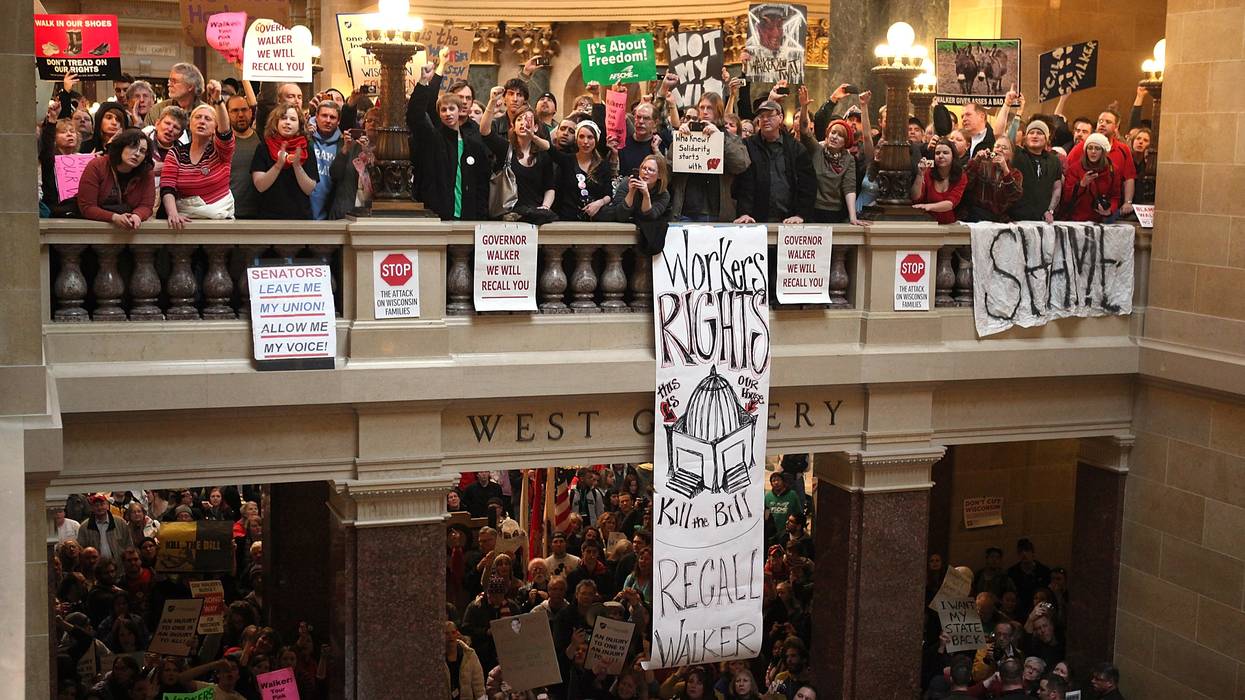
"All Wisconsinites deserve the opportunity to live in a state that treats all workers with respect and dignity," one state representative said.
More than a decade after it sparked massive protests in the state capital, a Wisconsin judge on Monday struck down a controversial law that effectively ended public sector collective bargaining in the state.
In his final judgement, Dane County Circuit Judge Jacob Frost crossed out 85 sections of the 2011 law known as Act 10, which was championed by then-Republican Gov. Scott Walker. Frost's ruling restored the union rights of teachers, sanitation workers, nurses, and other public sector employees.
"After 14 years of battling for our collective bargaining rights, we are thrilled to take this step forward," Rocco DeMark, a building service worker and SEIU Wisconsin worksite leader, said in a statement. "This victory brings us immense joy. Our fight has been long, but we are excited to continue building a Wisconsin where we can all thrive."
"We realize there may still be a fight ahead of us in the courts, but make no mistake, we're ready to keep fighting until we all have a seat at the table again."
Act 10 severely weakened the power of public sector unions in Wisconsin by only permitting them to bargain for wage increases that did not surpass inflation. It also raised what public employees paid for healthcare and retirement, ended the automatic withdrawal of union dues, and required workers to recertify their union votes every year.
The law has had a major impact on the Wisconsin workforce. Between 2000 and 2022, no state saw a steeper decline in its proportion of unionized employees, a drop that the nonpartisan Wisconsin Policy Forum partly attributed to Law 10. Unions say that the law has caused a "crisis" for the state's education workforce, as 40% of new teachers leave within six years due to low pay and an unequal wage system. There is also a 32% vacancy rate for state correction officers.
Act 10 had one exception, however: Certain "public safety" employees such as police and firefighters were exempt from the collective bargaining restrictions imposed on "general" employees. It was this division that unions used to challenge the law in November 2023, arguing that it violated the equal protection clause of the Wisconsin Constitution. In July, Frost affirmed that the law was unconstitutional when he struck down an attempt to dismiss the suit. Then, on Monday, he specified exactly which parts of the law would be struck down.
"Judge Frost's ruling is a monumental victory for Wisconsin's working class," Democratic Wisconsin State Assembly Member Darrion Madison told Courthouse News Service. "All Wisconsinites deserve the opportunity to live in a state that treats all workers with respect and dignity."
The lawsuit was brought by Ben Gruber, Matthew Ziebarth, the Abbotsford Education Association (WEAC/NEA), AFSCME Local 47, AFSCME Local 1215, Beaver Dam Education Association (WEAC/NEA), SEIU Wisconsin, Teaching Assistants Association (TAA/AFT) Local 3220, and Teamsters Local 695.
"Today's decision is personal for me and my coworkers," said Gruber, who serves as president of AFSCME Local 1215. "As a conservation warden, having full collective bargaining rights means we will again have a voice on the job to improve our workplace and make sure that Wisconsin is a safe place for everyone."
The news was also celebrated by state›wide advocacy groups and national leaders.
"We applaud today's ruling as a win for workers' rights and as proof that when we come together to ensure our courts and elected leaders are working on behalf of our rights and freedoms instead of partisan antics, we can accomplish great things," said A Better Wisconsin Together deputy director Mike Browne.
American Federation of Teachers president Randi Weingarten said: "This decision is a big deal. Act 10 stripped workers of the freedom and power to have a voice on the job to bargain wages, benefits, and working conditions. It's about the dignity of work. And when workers have a voice, they have a vehicle to improve the quality of the services they provide to students, patients, and communities."
"Former Gov. Scott Walker tried to eliminate all of that, and it hurt Wisconsin," she continued. "Now, many years later, the courts have found his actions unconstitutional."
Rep. Mark Pocan (D-Wis.) wrote on social media, "I voted against Act 10 more than 13 years ago, and am thrilled our public servants are able to once again organize and make their voices heard."
This is not the first time that Act 10 has been challenged in court, but it is the first time since the state's Supreme Court switched from a conservative to a liberal majority in 2023. Since Republican lawmakers have promised to appeal Frost's ruling, the law's ultimate fate could depend on elections in April 2025, which will determine whether the court maintains its liberal majority, according to The Associated Press.
As they celebrated, the plaintiffs acknowledged the legal fight was not yet over.
"We realize there may still be a fight ahead of us in the courts, but make no mistake, we're ready to keep fighting until we all have a seat at the table again," Gruber said.
WEAC President Peggy Wirtz-Olsen said: "Today's news is a win and, while there will likely be more legal legwork coming, WEAC and our allies will not stop until free, fair, and full collective bargaining rights are restored."
Betsy Ramsdale, a union leader who teaches in the Beaver Dam Unified School District, said that public sector collective bargaining rights ultimately helped the state.
"We're confident that, in the end, the rghts of all Wisconsin public sector employees will be restored," she said. "Educators' working conditions are students' learning conditions, and everyone benefits when we have a say in the workplace."

A Miami-Dade school teachers’ vote is a test case for a novel experiment: whether a group dedicated to dismantling public sector unions can successfully seed a competing union.
Starting Tuesday, public school teachers in one of the country’s largest school districts began voting on whether to keep their current union—a longstanding local affiliate of a national teachers union—or join a newly formed employee organization that has the financial backing of a notorious anti-union advocacy group.
The vote is a test case for a novel experiment: whether a group dedicated to dismantling public sector unions can successfully seed a competing union. If it works, some worry that existing unions may be forced to ward off expensive and time-consuming copycat efforts elsewhere.
The Freedom Foundation, a right-wing group based in Washington state, is financing and promoting the new employee organization in Florida. Called the Miami-Dade Education Coalition (MDEC), it was founded to compete with the longstanding teachers’ labor union, United Teachers of Dade (UTD), an affiliate of the American Federation of Teachers (AFT).
The Freedom Foundation’s latest effort in Florida is tied to the right’s goal of busting unions throughout the country as a way of defunding progressive political campaigns, starting with those representing public sector employees.
The story began in spring 2023 with SB 256, a bill passed by the Florida legislature that raised the membership threshold for certain public sector unions to 60%. Under the new law, if less than 60% of eligible members have signed up for the union, it is vulnerable to automatic decertification.
Notably, the unions that were exempted from this new, higher membership threshold—representing corrections officers, police, and firefighters—all support Republican Gov. Ron DeSantis, who fought for the anti-union legislation.
“Tallahassee didn’t have a problem with unions playing politics as long as the politics were in favor of the governor and Republicans,” said Jim DeFede of CBS News Miami in an interview with an MDEC representative. “The unions that endorsed DeSantis got exempted from this bill.”
In the year since the law passed, more than 50,000 public employees have already lost union representation. Just this summer, all eight adjunct faculty unions at Florida’s public universities have been decertified.
The Miami-Dade teachers’ union avoided outright decertification by demonstrating a threshold of at least 30% interest from eligible members. However, their failure to reach the 60% threshold triggered the current election asking members to vote on which organization they want to represent them.
That’s where the Freedom Foundation comes in. After lobbying for the bill, the organization has been working for the past year and a half to get teachers in Miami-Dade County to choose its own pet organization, MDEC, over the UTD.
Ballots started to be mailed out Tuesday, according to the Public Employees Relations Commission (PERC). Teachers have until September 24 to cast their votes.
“Unlike UTD, MDEC’s founding principles protect our independence from outside affiliations,” the organization contends. “MDEC is its own legal entity, and no outside organization has control over our local union.”
According to an FAQ on its website, MDEC insists that it is accepting “outside resources” from the Freedom Foundation “solely for the duration of the campaign.”
Last month, the Freedom Foundation brought together public school teachers from across the country to teach them how to decertify their unions and keep “the socialist dogma of their leadership [out of] our children’s classrooms.”
MDEC filed for registration with the state labor board last October, and received approval in February; one of the signatories on behalf of MDEC was Allison Beattie, the Freedom Foundation’s director of labor relations.
Another signatory was Matthew Hargraves, who previously served as an attorney for an unaffiliated teachers union in Florida—Santa Rosa Professional Educators, which broke away from the Florida Education Association.
In January, MDEC held a press conference to reiterate that it’s a legitimate union.
The president and co-founder is Brent Urbanik. In an interview with CBS News Miami, he agreed that the Freedom Foundation is “bankrolling” MDEC but did not disclose how much money the foundation has spent on the effort. Instead, he confirmed that it is paying for all of the mailings, canvassers, and legal expenses involved in getting the alternative “local union” off the ground.
Urbanik insisted that “Freedom Foundation is not necessarily anti-union.”
The other co-founder is Shawn Beightol, who ran for UTD president twice. Media reports have claimed that the Freedom Foundation proposed the idea of an alternative union, which has been corroborated by CBS News Miami.
“The think tank proposed replacing these entrenched, agenda-driven unions with local-only ones that focused on local issues [and] Miami-Dade educators were ‘elated’ with the idea,” according to The Lion.
The Freedom Foundation’s latest effort in Florida is tied to the right’s goal of busting unions throughout the country as a way of defunding progressive political campaigns, starting with those representing public sector employees. These coordinated attacks—bankrolled by billionaires—largely culminated in the 2018 Janus Supreme Court decision, which ruled that public employees are not required to pay for the costs of union representation.
Since the Janus decision, the Freedom Foundation has pushed state-level legislation that makes it harder for teachers to pay union dues, used what some union leaders have called “federal mail fraud” to trick members into leaving their unions, and aggressively pursued access to personal information in order to contact union members directly with anti-union campaign materials.
The Chicago Teachers Union lost an important skirmish with Mayor Rahm Emanuel last year when the state legislature passed Emanuel-backed legislation requiring a 75 percent vote to authorize a strike - a high number seen as a blow for teachers unions in Illinois.

But the attack apparently helped energize and mobilize the Chicago Teachers Union (CTU), as a whopping 89 percent of teachers voted on June 11 to authorize a strike come fall (actually late summer) as highly contentious contract negotiations stretch on. Chicago teachers last went on strike in 1987.
Emanuel acknowledged the overwhelming vote but tried to minimize its significance by asking the public and media to focus on other numbers - the increased hours he wants kids in school. Teachers have repeatedly said they are not against a longer school day or school year, but demand appropriate pay raises in return. Emanuel rescinded a contractually obligated 4 percent raise for teachers during his first year in office, and now his administration is proposing a contract with a 2 percent raise while lengthening the work day from seven hours to seven hours and 40 minutes.
Many parents have pushed for a compromise, with more time in school but not as much as Emanuel and Chicago Public Schools CEO Jean-Claude Brizard are demanding. Critics of the longer day cite oppressive heat in many non-air conditioned buildings, other demands on students' time and the inescapable fact that Chicago schools' problems go much deeper than the number of hours in class.
At five hours and 45 minutes, Chicago students have one of the nation's shortest days. But teachers say the actual amount of instruction in Chicago schools is on par with other schools nationwide. There is no easy fix for the systematic economic and social problems that impact Chicago students, but more resources and smaller class sizes would likely do more than extended days to improve student engagement and performance.
The union says the administration's contract proposal will result in larger class sizes. Jackson Potter blogged on the union website:
Like Republican candidate Mitt Romney, they make the argument that class size doesn't matter...The Board has reserved the right to change class size policy at any time and merely notify the union and it has eliminated any funding of positions to lower class size in the district; the previous contract committed $2.25 million to lower class sizes. These changes will concretely increase our class sizes throughout the district, even though many kindergarten and primary grade classrooms throughout the city have class sizes that approach 50 students in a room.
It turns out that Obama strategist David Axelrod's former public relations firm AKPD Media and Messaging is behind ads attacking the teachers unionThe union blasts the administration's proposal for increasing the focus on standardized test-based student performance in evaluating teachers, including an emphasis on "merit pay." Nationwide, teachers have long complained that evaluating their performance based heavily on standardized testing is unfair to dedicated teachers in under-funded, low-income and immigrant-heavy schools and curbs their ability to teach creatively.
Potter summarizes other reasons the union opposes the administration's proposal: eliminating teachers' ability to bank sick days, increasing health insurance costs and requiring teachers to work 10-hour-days during report card pickup.
In the wake of the strike vote Emanuel also touted the fact that 60.6 percent of Chicago Public Schools students who were freshmen four years ago graduated this year - the highest rate since at least 1999. But the insinuation that this improvement is because of measures pushed by his administration comes off as disingenuous when one considers that these measures have only been rolled out in recent months and not in all schools.
Emanuel said the strike vote does not affect ongoing contract negotiations with the teachers union, but the union has noted that taking the vote several months before they might strike was meant to provide leverage in the negotiations and allow 1,500 retiring teachers to vote. With more than 25,000 unionized teachers, CPS is the third-largest school district in the country and the CTU is the largest member of the American Federation of Teachers.
Emanuel has portrayed teachers as putting their interests before students' well-being, and professed his dedication to Chicago students - framing his battle with the teachers as a fight for opportunity and equality for low-income students. But many parents and students have spoken out in support of teachers, who often already put in many unpaid hours and often spent money out of their own pockets to buy supplies.
There has been much intrigue around efforts to generate community support (or the appearance of it) for the Emanuel administration's reform policies, including revelations last year that politically connected ministers had paid church members to show up at community meetings in support of administration proposals to close so-called failing schools. Around the strike vote, many parents received robocalls attacking the teachers' decision to hold an early strike vote. The calls and other efforts against the teachers have been linked to national astroturf "education reform" groups also active in California and other states where public sector unions have squared off with city and state officials.
Meanwhile, it turns out that Obama strategist David Axelrod's former public relations firm AKPD Media and Messaging is behind ads attacking the teachers union. Long-time progressive school reformer and small schools advocate Mike Klonsky noted in a blog post about this revelation that Emanuel "seems hell-bent on destroying the city's public employee unions." Klonsky also questioned the motivations of American Federation of Teachers president Randi Weingarten sharing the podium with Emanuel in support of his massive new infrastructure plan - with a heavy focus on privatization - just weeks after she marched with Chicago teachers calling for a strike vote. (The infrastructure plan's marketing is spearheaded by another of Axelrod's former outfits, ASGK Public Strategies.)
Chicago Sun-Times columnist - and former teacher - Carol Marin noted:
Teachers in this town have been demonized, demoralized, and disrespected. No profession is beyond criticism and no public school system is without significant problems. But taking a sledgehammer approach to CPS teachers and their union has backfired on the Emanuel administration and his schools CEO, Jean-Claude Brizard. And all the radio ads and robo calls funded by out of town, union-busting billionaires doesn't alter that fact.
While longer days and closing schools are the prominent issues in Emanuel's battle with union teachers, the conflict has much deeper significance in terms of ongoing battles for the future of public employees unions. And while Emanuel and others who figure into the administration's plans are considered far to the left of Wisconsin Gov. Scott Walker, the battle promises to continue nearly as polarized and hard-fought. Stay tuned.
My theme for today: Whose children have been left behind?

Let me tell you a little bit about myself. For many years, I was a strong advocate of testing, accountability, and choice. I worked in three conservative think tanks where these ideas were held sacred. In 1998, I went to Albany, New York, to testify on behalf of charter legislation. At the time I was connected to the conservative Manhattan Institute. I thought that testing would help diagnose the problems that children had and enable teachers to identify their needs. I thought that charters would enroll the kids who had failed in regular public schools or who were not well served by regular public schools. I thought that charters would collaborate with the public schools.
In a book published last year, I said that I was wrong. I was wrong on every count. Testing should be used for diagnostic purposes, to help students and teachers, but it has turned into a blunt instrument that is used to reward and punish teachers and schools. Charters should serve the neediest, but, with some notable exceptions, they have become aggressive and entrepreneurial. Instead of seeking out the neediest students, many of them exclude the neediest students and skim the best. In some states, like Michigan, most of the charters are for-profit, with big dividends to the investors; their profits come right out of the public school budget and into the pockets of shareholders. In some states, like Ohio, Colorado, and Pennsylvania, virtual charter schools are making millions of dollars for their owners, while children sit home alone in front of a computer. These cyber charters get full state tuition, but they have no buildings, no playgrounds, no library, no custodian, no nurse, and few teachers. They often have one teacher to monitor 100 screens. For investors, it's a great business, but the educational results are awful. In Colorado, for example, only 12% graduate from the Virtual Academy, compared to a statewide graduation rate of 78%.
We have had a full decade of No Child Left Behind, and we now know that the law has been a disaster. True, it has documented the shocking gaps in passing rates between different groups of children, but it has done nothing to change the conditions that cause those gaps. We know the gaps are there; actually, we knew about the gaps long before NCLB was passed. Yet Congress is still patting itself on the back for identifying a problem and doing nothing meaningful to solve it.
Many children are still left behind. We know who they are.
In the year 2000, during the Presidential campaign, candidate George W. Bush told the nation about the Texas miracle. He said that there was a simple way to reduce the gaps: Just test every child every year, he said; reward the teachers and schools where the scores went up; and humiliate the teachers and schools where the scores went down. Texas did this, he said, and the gaps were closing; test scores were rising; graduation rates were going up; dropout rates were going down. He said that we had to end the "soft bigotry of low expectations" and set the same standards for all children, rich and poor, black and white, advantaged and disadvantaged.
After his election, Congress bought this story and passed No Child Left Behind. This law mandated that all children would be proficient by 2014 in grades 3-8. All children without exception. Bear in mind that no nation in the world has ever achieved 100% proficiency.
Now we know the results of this absurd law. More than 80% of our schools have been labeled failing schools. By the year 2014, nearly 100% of our schools will be considered failures. Has any other national legislature in history ever passed a law guaranteed to label every single one of its schools a failure? I don't know of any.
We now know that NCLB was based on a phony claim. On national tests, Texas does not lead the pack; it's right in the middle. We now know that the achievement gap did not close in Texas, and that dropout rates went up. But the whole nation is stuck with this testing regime.
Let's be clear about what NCLB has really accomplished: It has convinced the media and major philanthropies and Wall Street hedge fund managers that American public education is a failure and that radical solutions are required. The philanthropists and Wall Street hedge fund managers and Republicans and the Obama administration and assorted rightwing billionaires have some ideas about how to change American education. They aren't teachers but they think they know how to fix the schools.
Their ideas boil down to this strategy: NCLB failed because we didn't use enough carrots and sticks. They say that schools should operate like businesses, because the free market is more efficient than government. So these reformers--I call them corporate reformers--advocate market-based reforms. They say that states must hand public schools over to private management because the private sector will be more successful than the public sector. They say that teachers will work harder if they get bonuses when test scores go up. They say that teachers should have no job protections because workers in the private sector don't have job protections, not even the right to a hearing. They say that if schools have low scores, they should be closed and replaced by new schools, just like a chain store--a burger franchise or a shoe store--would be closed if it didn't make a profit; or the entire staff should be fired and replaced by new staff. They say that the quality of teachers should be judged based on whether their students' scores go up or down.
The Tea Party governors embraced this narrative and took it to the next level. They used their sweeping victories in 2010 to eliminate collective bargaining rights for public workers and to slash spending on public education, even as they demanded more funding for charters and vouchers. The mayor of New York City said a week ago that if he had the power to do it, he would fire half the city's teachers, double the pay of those that remained, and double class size. He said when he went to school, he was in a large class and he turned out OK. He didn't mention that his daughters went to schools where the class size was 12. My youngest grandchild attends kindergarten in a Brooklyn public school. He has a class size of 24. Under the mayor's plan, his teacher would have a class of 48. None of them would get any individual attention. I don't see this as progress, particularly because the evidence is clear and strong that minority children benefit most when class sizes are reduced below 20 in a classroom.
So which children would be left behind?
We have now had ten years of No Child Left Behind, and we now know that there has been very little change in the gaps between the children of the rich and the children of the poor, between black children and white children, between Hispanic children and white children. Meanwhile our policymakers say we need higher standards, more rigorous standards, and more testing. How exactly will that help children who are struggling to read and do math? Or, in some cases, struggling to read and speak English? Or in the case of children with disabilities, how are they helped by harder tests? This is like saying, "if these children can't jump over a four-foot bar, let's lift the bar to six feet and see how they do." Do you know how they will do? It seems obvious to me.
Just this week, the federal government released the urban district test results and we could see that the gap remained as large as ever. After ten years of NCLB, the children at the bottom were still at the bottom. Those districts where poverty and racial segregation--such as Detroit and Washington, D.C.--are most concentrated had the lowest scores.
But wait, some of the districts tested by the federal government have been actually implementing the market-based reforms advocated by the corporate reformers: New York City, which has had mayoral control since 2002; Washington, D.C., which has had mayoral control since 2007; Chicago, where Arne Duncan launched market-based reforms in 2001; and Milwaukee, which has had vouchers since 1990.
Since the mayor took charge in 2002, New York City has enthusiastically imposed market-style reforms. It has more choice than any other major city--parents and students get to choose among 400 high schools, as well as more than 100 charter schools. All schools are given letter grades based on test scores. NYC spent $56 million on merit pay, then abandoned the program when it showed zero results. After nine years of market-based reforms, however, the achievement gap between black and white students is unchanged. On the federal tests, math scores are up but no more than in districts without market reforms. Eighth grade reading scores have been flat since 2003.
Which children do you think were left behind?
In Washington, D.C., there have been many claims in the media about sensational test score gains, but that's not what you see on the latest federal tests. In fourth grade reading, the scores have been rising steadily since 2003, but not for all students. The scores of high-income students have gone up but the scores of black students, Hispanic students, and low-income students remain unchanged for the past four years. In eighth grade reading, scores are down for the past four years for black students, Hispanic students, and low-income students. And most importantly, the District of Columbia public school system has the largest achievement gap of any city in the nation between white and black students, a staggering 64 points in 4th grade, compared to an average of 30 points for all urban districts; and an equally staggering 58 points in eighth grade, compared to 28 points for all urban districts.
So whose children were left behind?
In Chicago, where Secretary Duncan's reform program led to the closing of 100 neighborhood schools, only 18% of the new schools were judged successful by the state of Illinois. On the NAEP for cities, Chicago continues to be one of the lowest performing in the nation. Since 2003, black and Hispanic students have seen no improvement in their reading scores in fourth grade. In eighth grade reading, there have been no gains whatever for black students or low income students since federal testing began in 2002, and no gains for Hispanic students since 2005. According to the latest research, the black-white achievement gap is larger now in Chicago than when the reforms began.
In Milwaukee, after 21 years of vouchers, black students have among the lowest scores of any city tested, ranked at the bottom along with Detroit, Fresno, and Cleveland. Independent research has shown that the black and low-income students in Milwaukee's voucher schools have the same low scores as the black students in the public schools. Their scores are about the same as those of poor black kids in the Deep South. Vouchers and competition did nothing for the children of Milwaukee. These children were left behind.
And consider this: Tea-party governors know that vouchers do nothing to improve education, but they are pushing them anyway. The Governor of Indiana, Mitch Daniels, pushed through the first statewide voucher program in the nation. Governor Scott Walker in Wisconsin got his conservative legislature to expand the Milwaukee program, to raise the income eligibility cap, so that more children could go to voucher schools, despite the evidence that vouchers don't improve education. The whole point seems to be to decimate the public sector.
And here is the latest voucher scandal. When Jeb Bush was governor of Florida, he pushed through a voucher program. The state courts struck down one part of the voucher program, the part for students in failing schools. But the courts did not eliminate the McKay Scholarships, which enabled students with disabilities to get vouchers to attend any school. Just this week, the Florida press revealed that some of the deregulated voucher schools are fly-by-night operations, conducted in storefronts, churches, and dingy homes, staffed by administrators and teachers with criminal records. They found students who spent their entire day filling out workbooks or hanging around a gymnasium watching television. One school had a class, described as "business management," which consisted of shaking cans on street corners. Florida has pumped over $1 billion into this voucher program and Governor Scott wants to expand it to more deregulated schools.
Whose children are left behind by these policies?
From all the developments, experiences, and research of the past decade, here is what I have learned:
First, charter schools have been portrayed as a silver bullet that will raise up every child, especially poor and minority children, but they are not. By their very nature, charters vary. Some are excellent, some get high scores but are boot camps where children are taught to obey without question, some are terrible. On the whole--and study after study shows this--charters don't get different results from regular public schools. When I was active a decade ago with the Manhattan Institute, which is led by conservative business leaders, it was decided that the best way to market charter schools was to present them as a way to save minority children. This strategy, it was believed, would win liberal support for a very conservative idea. They were right. Liberals could not resist this narrative.
So today we see Wall Street hedge funders and billionaires saying that they are leading the civil rights movement of our time. I have trouble imagining Dr. Martin Luther King, Jr., walking arm in arm with billionaires in a crusade to privatize control of public education. Dr. King understood that social movements need a mass base, and that they are not based in Wall Street. He knew that the civil rights movement depended on its moral authority as well as its ability to mobilize poor and working people in coalition with labor unions. He had no desire to privatize. He wanted to make private interests bow to the demands of the public interest. As I watch rightwing politicians doing their best to destroy the public sector unions, I recall that Dr. King was assassinated at the very time that he was fighting to organize the sanitation workers of Memphis. How dare they invoke his legacy to attack public education and public sector workers!
We know--or we should know--that poor and minority children should not have to depend on the good will and beneficence of the private sector to get a good education. The free market works very well in producing goods and services, but it works through competition. In competition, the weakest fall behind. The market does not produce equity. In the free market, there are a few winners and a lot of losers. Some corporate reformers today advocate that schools should be run like a stock portfolio: Keep the winners and sell the losers. Close schools where the students have low scores and open new ones. But this doesn't help the students who are struggling. No student learns better because his school was closed; closing schools does not reduce the achievement gap. Poor kids get bounced from school to school. No one wants the ones with low scores because they threaten the reputation and survival of the school.
The goal of our education system should not be competition but equality of educational opportunity. There should not be a Race to the Top. What is the Top? Who will get there first? Will it be poor and minority students? Don't count on it. The Top is already occupied by the children of the 1%.
To be a healthy society, we must improve our public schools. We must provide better schools in every neighborhood. We must help the children who need help. We must treat our teachers and principals and administrators with respect. If they need support, they should get it.
With all the talk about the achievement gap, it is important for you to know that there are two different achievement gaps. One is the gap between the children of the wealthy and the children of the poor. This gap has doubled in the past half century, as poverty and income inequality have increased. The racial achievement gap was actually cut in half in the 1970s and 1980s. Paul Barton of the Educational Testing Service attributed the shrinking of the racial achievement gap to the creation of federal assistance programs for the neediest children, such as Title I; to desegregation; to reduced class sizes; to early childhood education; and to increased economic opportunities for African-American families. He pointed out, however, that the racial achievement gap has remained almost unchanged since the 1980s.
We now know that none of the current carrot-and-stick policies will shrink the gap. We know it because they have been tried for 10 years and they haven't worked. Structural changes like charters and vouchers overall will not make a difference. Merit pay makes no difference. Judging teachers by test scores demoralizes teachers and will lead to narrowing of the curriculum--so that the districts where children have the lowest scores will have more time for test preparation and less time for the arts, less time for history or civics, less time for science, less time for physical education. The children who need a great education the most will get the least.
And many more children will be left behind.
The entire current reform movement rests on a fanatical belief in standardized testing. Yet testing experts warn us that the tests should be used for diagnostic purposes, not to fire teachers and close schools. The basic rule of testing is that a test should be used only for the purpose for which it was designed. A test of fifth grade reading tests whether students can read at a fifth grade level; it is not a test of teacher quality. Testing experts warn that tests are subject to statistical error, measurement error, and human error. Sometimes the answer is wrong. Sometimes the question is wrong. Sometimes a thoughtful child will pick the wrong answer because it sounds plausible.
One thing we know for certain about standardized testing. Poor and minority kids consistently get lower test scores than white and privileged kids. So why would we make testing the most important measure of education? Why would we take the technology that is most discouraging to children in the bottom half and then insist that it matters more than anything else? Why would we give more credibility to standardized tests than to teachers' and parents' judgments about children's potential?
In September, I visited Finland and I want to share with you what this tiny nation has accomplished. It regularly scores at the top of international tests in reading, mathematics, and science. It has the least variance from school to school, meaning that almost every school is a good school. Students in Finland never take a standardized test until they complete high school. Teachers in Finland are required to have a master's degree. Teaching is a highly respected profession. Parents trust teachers. Teachers have autonomy to exercise professionalism.
Every child has regular medical checkups and healthcare, at no cost. Schools have health clinics. Whereas more than 20% of our children live in poverty, less than 4% of Finnish children do. Higher education is tuition-free.
Finland has no charter schools, no vouchers, no merit pay, no standardized testing. Instead, every teacher is trained to take care of the needs of individual children. If children are having learning problems, there are specialists and social workers in every school to take care of them early and provide whatever assistance is needed. Nearly half of all Finnish students get extra attention and services in the early years of schooling.
Finland has no tracking. All children get the education and support they need to succeed in school. Finland does not have a longer school day or a longer school year. Finnish schools emphasize creativity, ingenuity, problem-solving, the arts, projects, activities, physical education, and risk-taking.
By the way, Finnish teachers and principals belong to the same union. It doesn't seem to be a problem.
So what can we do? First, we should speak out when politicians say "there is no more money." There is money to do what we want to do. There is money to fight wars in the Middle East. There is enough money to give big corporate cuts. There is enough money for 1% of this nation to live lives of splendor. Why is there not enough money to provide the basic public services that every child needs?
Do we want to be a decent society or a decadent society? Do we want to nurture, protect and inspire all of our children? Do we want children who are leaders or followers? Do we want to make sure that this generation of young people is prepared to sustain our democracy? Do we want citizens prepared to ask questions or just to answer questions posed by authorities?
We must stop the trash talk about our public schools and dedicate ourselves to making every one of them a school that is just right for all our children. Yes, it will cost more, but ignorance and neglect are much more expensive.
Surely the greatest nation in the world can mobilize the will to do what is right for the children. It won't be easy, it won't be cheap, and it won't be fast. Doing the right thing never is. The only simple part is to recognize that what we are doing now is not working and will never work. What we need is a vision of a good education for every child. We should start now. Today.