

SUBSCRIBE TO OUR FREE NEWSLETTER
Daily news & progressive opinion—funded by the people, not the corporations—delivered straight to your inbox.
5
#000000
#FFFFFF
To donate by check, phone, or other method, see our More Ways to Give page.
Daily news & progressive opinion—funded by the people, not the corporations—delivered straight to your inbox.
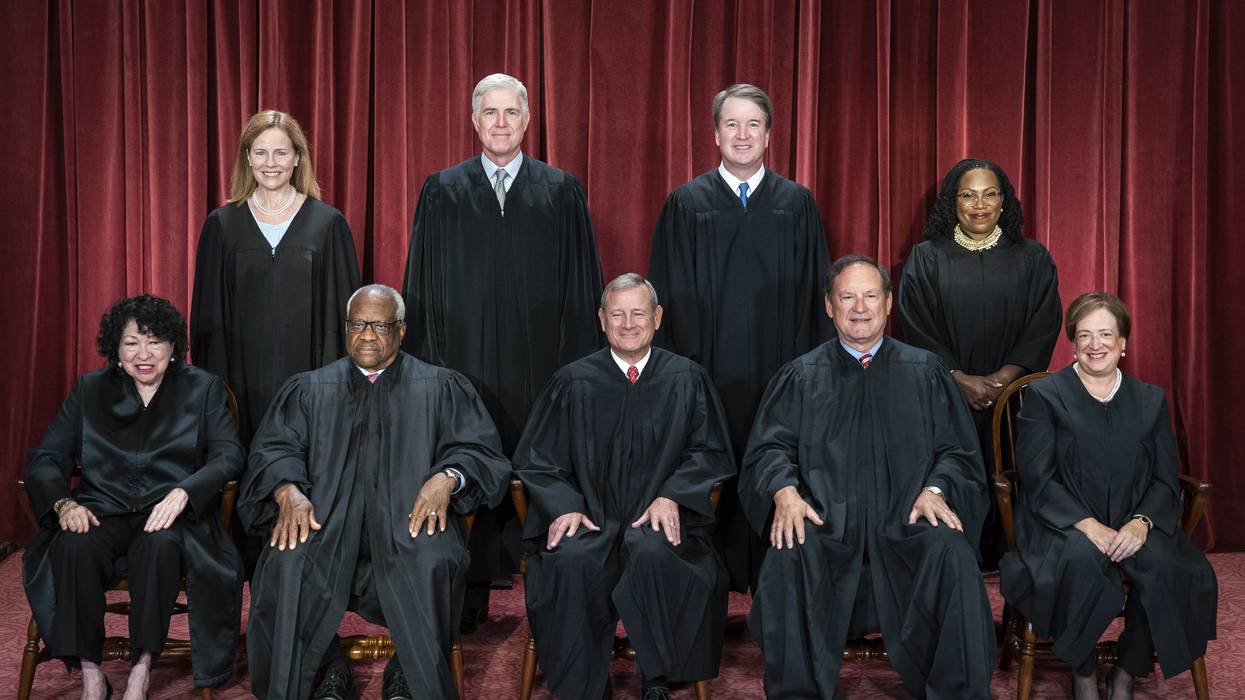
The term may be remembered most as a time when the supermajority of very conservative, very pro-business justices bent the shape of American government to empower the president at the expense of Congress.
How will we remember this Supreme Court term?
For Louisiana v. Callais, which demolished the 1965 Voting Rights Act. For near misses, too, as when the Constitution’s plain-language guarantee of birthright citizenship was recognized by only a bare majority of the justices. (As JD Vance crowed, that core protection is now “hanging by a thread.”)
I think the term may be remembered most as a time when the supermajority of very conservative, very pro-business justices bent the shape of American government. It was a power grab in legal garb, undermining Congress, granting presidents more authority, but with key decisions ultimately in the hands of the nine unelected officials now redesigning government.
In 2005, The New York Times Magazine published a story about a cadre of intense anti-government legal activists. They bemoaned “the Constitution in exile,” what they saw as an epic wrong turn in the 20th century. That was the era when Congress and presidents created expert independent agencies, such as the Securities and Exchange Commission, to police Wall Street, and the Federal Trade Commission, to protect consumers. To most Americans, that was how we grew a modern, fair, prosperous economy. To those activists, it was all a terrible mistake.
A future president may be a populist progressive, now with new levers of power to address climate change or boost union power. To quote Justice Brett Kavanaugh, “What goes around comes around.”
One of the few adherents of this eccentric theory, the Times reported, was an unknown young federal judge named John Roberts. Soon he would become chief justice.
Trump v. Slaughter, announced on Monday, marked a key moment in Roberts’s long drive to write pro-business dogma into the Constitution. On this, Roberts is far from a Midwestern country club Republican cheerfully calling “balls and strikes.” This is not about wins or losses for Donald Trump. These justices have wanted to do this since Trump was cavorting at Studio 54.
Congress established the first independent agency, the Interstate Commerce Commission, to set railroad rates in the 1880s. Since then, laws created nearly 60 agencies to police the economy or serve as watchdogs over the government, and tried to wall them off a bit from political pressure and partisan politics.
Congress has now been blocked from imposing removal protections for the heads of most federal agencies, a critical bulwark against presidential meddling. Consider a consequential, complex current question: Could an effective new agency regulate artificial intelligence? The Slaughter ruling could make it considerably harder to insulate such a powerful body from political interference.
Of course, independent agencies are not a purely partisan issue. Over the course of American history, they have frustrated presidents of both parties, who want control of the sprawling federal bureaucracy.
The Slaughter ruling overturned a 1935 case, Humphrey’s Executor. William Humphrey was a reactionary and thoroughly unpleasant Federal Trade Commission member whom President Franklin D. Roosevelt wanted to fire. Humphrey kept going to work even after he was dismissed, then died while the legal challenge to pry him from his office was being heard. His heirs sued for his back pay.
The Supreme Court ruled that even FDR, at the peak of his power, could not fire grumpy old Mr. Humphrey. “That damn little case,” recalled FDR aide Robert Jackson (later a justice himself), “made Roosevelt madder at the court than any other decision... [He] thought they went out of their way to spite him personally.”
Slaughter is one of the most significant expressions of the pretentiously named “unitary executive theory.” This is the idea that because a single individual, the president, is elected to lead the executive branch, that means the whole executive branch serves at his whim. Of note, this case revolved around one aspect of it, firing of agency officials.
Indeed, the justices seemed to recognize the havoc their new doctrine would cause. On the same day, a different lineup of justices blocked Trump from firing Federal Reserve governor Lisa Cook. The Fed, too, is an independent agency, signed into law by President Woodrow Wilson in the Progressive Era, but the rationale for independent central banking is well known. The Cook ruling mumbles about tradition and history, but the real answer for the divergent outcomes seemed to be, well, the Fed is just... different. (Of course, business interests revere the Fed and often loathe the FTC.)
A limited version of the unitary executive theory is not entirely crazy. We want a strong president able to guide the balky executive branch. But advocates have taken this idea to a dangerous extreme, turning it into a fancy cloak for an authoritarian executive. By their logic, if all federal employees work personally for a president, as if they were gardeners at Mar-a-Lago, that could demolish civil service protections and other rules that can keep government from being the instrument of executive whim.
Who knows how far this rhetoric of presidential power will go? Russell Vought, the White House budget director, says we live in a “post-constitutional time.” And in Trump v. United States, Roberts wrote that the president is “the only person who alone composes a branch of government.”
Policymakers now must grapple with the justices’ handiwork. How can we have strong inspectors general or independent military lawyers if a president can bark “you’re fired” at will? Can Congress step up by, say, giving the Government Accountability Office greater responsibility to police the executive branch? Such obscure questions will determine how government can work going forward. Necessary reforms can follow abuse and scandal. That’s what happened after Watergate. Now such safeguards must be designed in a world where the Supreme Court has supercharged presidential power.
Let’s not forget Donald Trump is a lame duck. (He is! Really!) A future president may be a populist progressive, now with new levers of power to address climate change or boost union power. To quote Justice Brett Kavanaugh, “What goes around comes around.” Of course, this court has also invented tools to stop policies it doesn’t like, such as the “major questions” doctrine it used to block Biden-era climate change rules. Stay tuned.
But it’s hard to escape the conclusion that this ruling will make government less effective, more chaotic, and more driven by politics and personality—steered there by a Supreme Court with too much power, now in thrall to an obscure and dangerous philosophy.
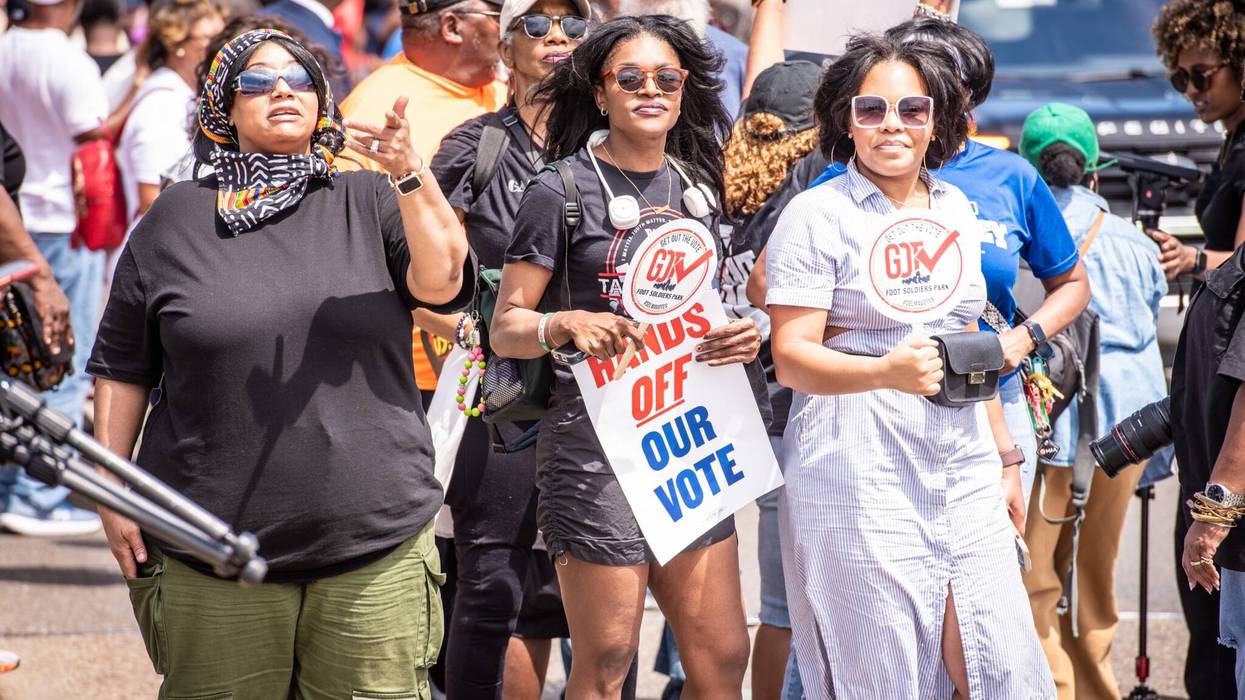
“We reject in the strongest possible terms the state’s attempt to finish its intentional decision to dilute minority votes with a veneer of legislative regularity," said the panel of three judges—two of them Trump appointees.
A three-judge panel on Tuesday temporarily blocked Alabama from using a Republican-drawn congressional map created to effectively disenfranchise Black people, who make up more than one-quarter of the population of a state that, by GOP design, has just one majority-Black House district.
United States Circuit Judge Stanley Marcus, a nominee of former President Bill Clinton, and District Judges Anna Manasco and Terry Moorer—both of whom were nominated by President Donald Trump—granted a motion by Alabama state Sen. Bobby Singleton (D-24); Black voters, and groups including the national and state ACLU, the Alabama State Conference of the NAACP, Legal Defense Fund, and Southern Poverty Law Center to block the state from using a racially rigged congressional map approved by the GOP-led Legislature in 2023.
The panel unanimously found that Alabama could not use the map because it “represents an intentional effort to crack the Black population in Alabama.”
“Ultimately, we cannot see our way clear to requiring Alabamians to cast their votes in the 2026 elections under a districting plan tainted by intentional race-based discrimination,” the judges wrote.
🧵 The Supreme Court's Callais ruling made it harder to prove in court that a legislative map dilutes minority voting strength.But a three-judge panel today confirmed that intentional racial gerrymanders can still be struck down by federal courts.Here’s what you need to know about Alabama 👇
[image or embed]
— Democracy Docket (@democracydocket.com) May 26, 2026 at 10:31 AM
“Cracking” is the splitting of communities of color to dilute their power in a given district. The related practice of "packing" refers to placing people of color in the same district in order to prevent them from having greater political power in surrounding districts.
The same three-judge panel had blocked a previous attempt by Alabama Republicans to implement a congressional map lacking a second Black opportunity district in defiance of a US Supreme Court ruling affirming a lower court's order to create such a district.
"We do not lightly intrude in state affairs, but our previous review of the undisputed evidence left us in no doubt that Alabama’s legislatively enacted plan (the “2023 Plan”) intentionally discriminated based on race in violation of the Constitution," the three judges wrote in Tuesday's decision. "Our re-examination in light of Callais yields the same conclusion."
Last month, the US Supreme Court ruled 6-3 along ideological lines in Louisiana v. Callais that the Southern state's congressional map is “an unconstitutional racial gerrymander" because race—specifically, ensuring representation for Black voters—was the predominant factor in redistricting. The decision ironically voided the last remaining provision of Section 2 of the Voting Rights Act, which allows voters of color to challenge racially discriminatory electoral maps in court.
Citing Callais, Alabama and other Southern states rushed to redraw their congressional maps to dilute Black voting power and satisfy requests from President Donald Trump for GOP-controlled state legislatures to rig districts for partisan gain ahead of the 2026 midterm elections.
Callais was followed by another 6-3 US Supreme Court ruling earlier this month, which found that Alabama could use the 2023 map, prompting liberal Justice Sonia Sotomayor to dissent and point out that the high court previously found that “Alabama violated the 14th Amendment by intentionally diluting the votes of Black voters.”
That ruling came two days after Republican Alabama Gov. Kay Ivey had signed legislation authorizing new primary elections if federal courts agreed to rescind the creation of the second Black opportunity district. Ivey's signature came despite ongoing primaries in Alabama.
Black voters sought a temporary restraining order against the 2023 map, arguing that the 14th Amendment still banned redistricting that was deliberately discriminatory, regardless of Callais.
“Alabama cannot use Callais to legitimize its pre-Callais decision to double down on the discriminatory vote dilution that we and the Supreme Court found,” the three judges wrote Tuesday. “And it cannot use Callais to legitimize the series of specific and unusual decisions it made to entrench that dilution."
Republican Alabama Attorney General Steve Marshall said the state would immediately appeal the decision to the US Supreme Court.
“Know this—in my mind, it is not a matter of whether we win this case, only when," he asserted.
US Rep. Shomari Figures (D-Ala.), whose House seat would almost certainly be usurped by a Republican under the GOP-redrawn map, said in a social media post following Tuesday's ruling that "this is a significant step in the right direction, but there is still a long way to go before this fight is settled."
NAACP Legal Defense Fund litigation director Deuel Ross told The Associated Press that Tuesday's ruling “again vindicated the constitutional rights of voters in the Black Belt, and our clients look forward to voting under a fair map this fall.”
Marina Jenkins, executive director of the National Redistricting Foundation—an advocacy group supporting fair maps—said in a statement, "Justice prevailed today; Alabama must use its 2023 court-adopted map—a map with two Black opportunity districts—in this year's elections."
"Make no mistake, the fight for justice is far from over in states across the country where politicians are enacting gerrymanders on top of gerrymanders to erase equal representation for communities of color," she continued. "The message from this panel is clear: Courts must fulfill their independent duty to protect voters’ rights, not just rubber-stamp state officials’ efforts to use the Supreme Court’s Callais decision as an excuse to draw Black voters out of a say in our democracy."
"Politicians aiming to enact new gerrymanders in South Carolina, Georgia, and elsewhere should take note," Jenkins added.