

SUBSCRIBE TO OUR FREE NEWSLETTER
Daily news & progressive opinion—funded by the people, not the corporations—delivered straight to your inbox.
5
#000000
#FFFFFF
To donate by check, phone, or other method, see our More Ways to Give page.
Daily news & progressive opinion—funded by the people, not the corporations—delivered straight to your inbox.
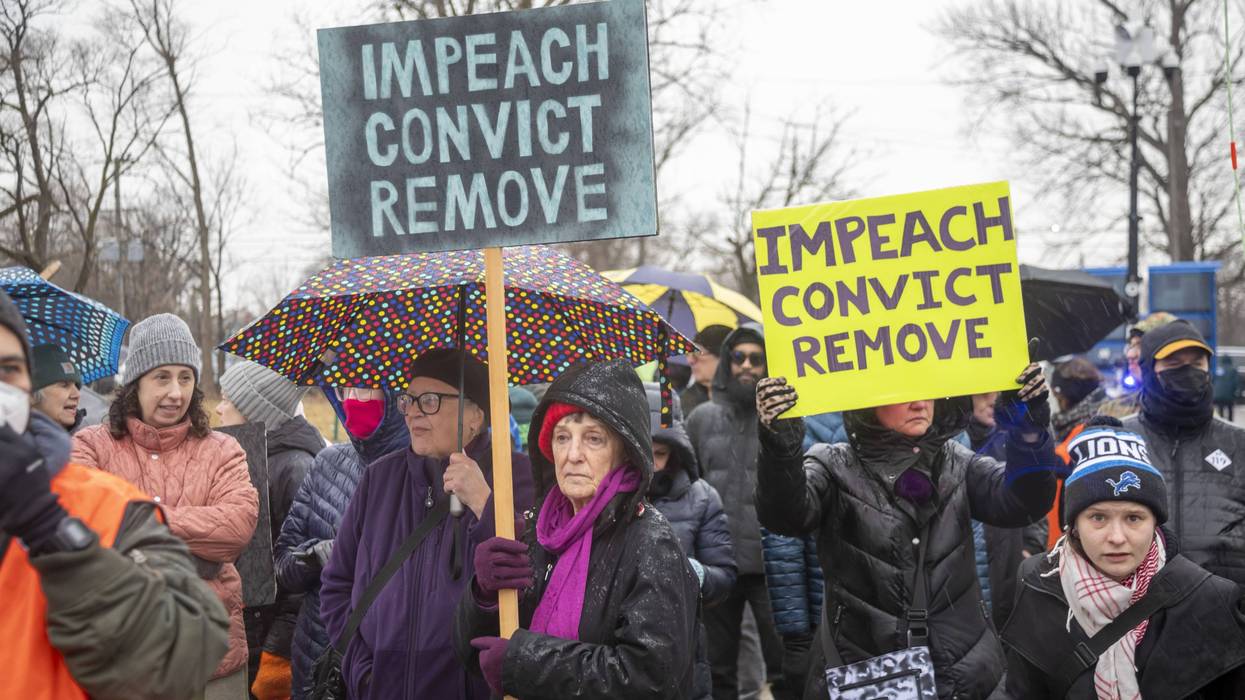
No Kings is an historical descriptive designed to engage our intellect, but it asks nothing. It demands nothing. It, like media editorials, sounds an alarm but an alarm is endless without a call. What’s missing is a bold call for removal.
We’re nearly two years into President Donald Trump’s second term in office—his first where his fascist dreams took flight—and I’m not the only one to notice. Millions of people in groups as large as city blocks, and as tiny as a corner in a village without a traffic light, have gathered to protest under the banner, No Kings.
Its success was in bringing together disparate groups of people. At some I had the impression that out of thousands of people, no two had a similar political orientation. That’s the good part. It’s also a weakness.
At the same time, and now with increasing regularity, respected media (from The New York Times down to those that take their lead from it) editorialize in stark terms against the administration. Editorials read like a list of grievances, not unlike the Declaration of Independence. But unlike the Declaration, they lack a political message.
Fascism is not a throwaway word. Trump told people he was returning the nation to its “rightful place,” and pretty soon hastily organized federal police ganged up on people and shot them in the streets.
No Kings is an historical descriptive designed to engage our intellect, but it asks nothing. It demands nothing. It, like media editorials, sounds an alarm but an alarm is endless without a call. What’s missing is a bold call for removal. Remove him!
By what mechanism? Do I mean by impeachment? No, I do not. Do I mean by the 25th Amendment? No, I do not. Do I mean by the Democratic Party? No, I do not.
It is not up to those that call for removal to state or provide a mechanism. The call signifies itself. If the causes are alarming enough—and I suggest we are presently living under a fascist regime—there is nothing left to be done but what was once done.
The Declaration of Independence keenly notes that people “are more disposed to suffer, while evils are sufferable, than to right themselves by abolishing the forms to which they are accustomed.” Before enumerating the greatness of the causes for separation, the Declaration expresses a sentiment that Washington’s gatekeepers would have us forget: that it is the right and the duty of the people to throw off such government as is reducing them to despotism.
The gulf must be acknowledged between what the leaders of a country in 1776 declared and did, and what, not the leaders, but the followers of a country in 2026 are prepared and able to do. The situations cannot be compared, but they can be instructive.
The Declaration is a radical document. It did not wait for the government of the mother country to have a change of heart, as we wait for the midterm elections. Suffering what we must.
What is our cause for alarm? And should it mark the time for a call for removal? Even if it only articulates what we want?
Fascism is not a throwaway word. Trump told people he was returning the nation to its “rightful place,” and pretty soon hastily organized federal police ganged up on people and shot them in the streets. They’re coming for people. They may not have come yet for you and me.
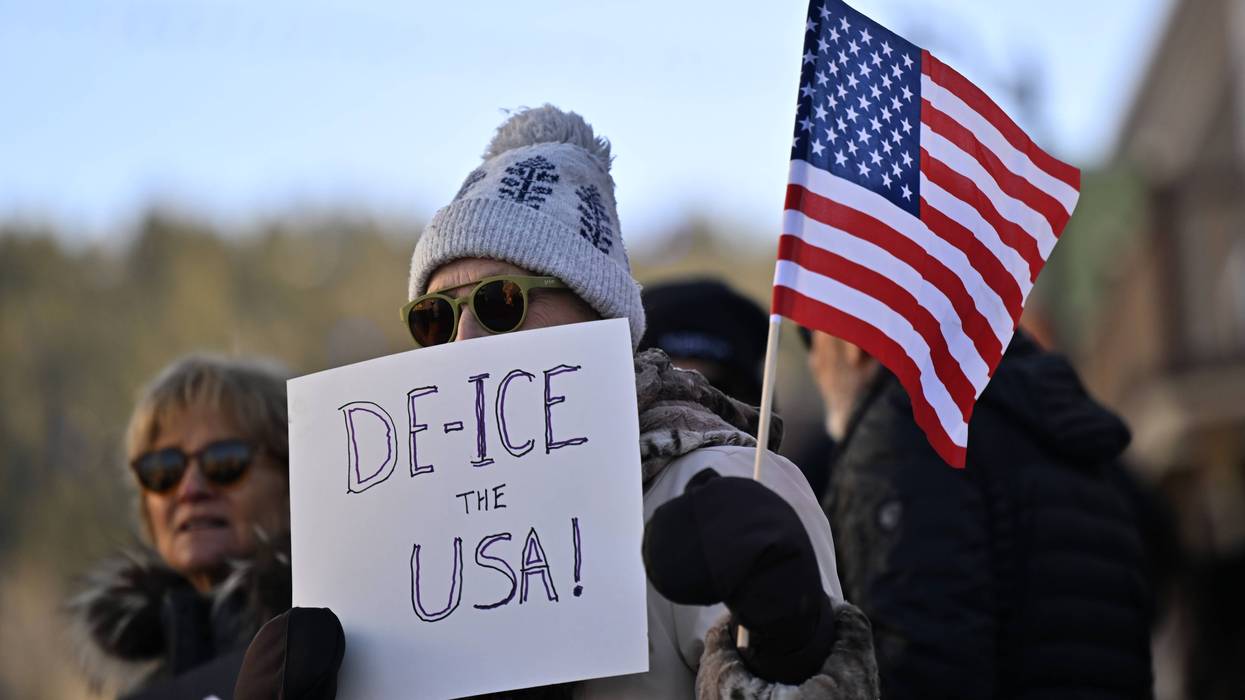
Meditations and incantations on America's 250th anniversary.
Note: I wrote this poem as a way of reflecting on and grappling with this country's 250th anniversary and the time of existential crisis we are in, both as a nation and a species. It is a poem of rage but also of love and aspiration. It is an offering and a declaration about this country's history, our present moment, and our potential. I offer this poem-essay as part of what I hope will become a new declaration of independence and interdependence.
On your two hundred and fiftieth birthday, let us speak openly.
Oh, say something nice, you say.
Don’t rain on this flash-bang parade.
Some things nice:
You contain multitudes of fine, decent people.
Folks who will pick you up when you’re broken down.
Who’ll rescue you from a flood or a fire.
Who’ll give you a buck or the shirt off their back.
They’ll welcome you into their homes, share their food.
They’ll help you raise a barn or put out a fire.
Friendly, good-hearted folk.
Then there’s this land, our land, erupting in soul-stirring beauty.
Towering mountain crags thrusting into horizon-splitting skies.
Canyons painted in sediments of red, orange, sienna, and crimson.
Ancient ridges hued in purple and blue, sloping and slouching into infinity.
Oceans of grain prairies, their amber waves swaying.
A resplendent and bountiful terrain fruiting more than enough for everyone.
Come to America, its vast cornucopias will seed and feed you.
Give us your tired, your poor, and we will raise them from the floor.
You told us to stand up, take off our hats, put our little right hands on our chests, and “pledge allegiance to the flag of the United States of America… one nation, under God, indivisible, with liberty and justice for all.”
You commanded us to love the flag, the God, the country.
Broad stripes, bright stars, and perilous fights.
You insisted we are free and brave, uniquely blessed with happiness and liberty.
Bombs bursting in air from dawn’s early light to twilight’s last gleaming.
We are the best, the greatest, the most exceptional, you said.
We are blessed and fortunate to be Americans, you said.
Nobody is like us. Everybody wants to be like us.
You speak of freedom. Of liberty.
Are we free yet?
Are we free of wars, of racism, of sexism, and homophobia?
Are we freed by your bombs bursting across the world’s airs?
Does that star-spangled flag wave proudly for all your global slaying?
Did America become free and brave by decimating Vietnam?
Did we become liberated by eviscerating Iraq, Afghanistan, and Iran?
Have your unrivaled invasions and coups set us free?
Or maybe liberty arrived back in 1776 like you keep reminding us,
When we were free at last, thank god almighty, from kings and colonizers,
All those liberating muskets, canons, and armies powered by genocide and slavery.
America, your gold and your flag are soaked in centuries of blood.
In 1852, Frederick Douglass asked, “What, to the American slave, is your 4th of July?” He answered: “a day that reveals to him, more than all other days in the year, the gross injustice and cruelty to which he is the constant victim.”
America, how many victims will you claim in your fraudulent name?
How many victims does it take to purchase our “freedom”?
Did your endless wars buy freedom for all of us?
This truth is self-evident: Not all freedoms are created equal.
Our freedoms are separate and unequal.
Our ballots and dollars germinated by bullets and bombs.
We are free to speak, shout, howl, or wail into the wind.
We are free to buy whatever we can afford.
We are free to vote at the polls and with your dollars.
Billionaires and millionaires are free to buy the votes.
Dollars are people, too, they say.
Those dollars have purchased our democracy and sold it
down the river flowing with ancestral bones and tears.
The "America" I love is the land of dissenters, resisters, and persisters
The nation I love is in a perilous fight for justice and equality.
The America I love is the country of Martin Luther King, Jr., country of Malcolm X, of Shirley Chisolm, Fannie Lou Hamer, and Jesse Jackson; country of farmworkers marching, of Chicano rights and Brown Power; nation of women’s liberation and rights and rising power; of queer rights and queer love and queer existence; I love the land of Black Power, Black Joy, and Black resilience; country of the American Indian Movement, Indigenous rights and justice; land of all the unnamed nurses, teachers, farmers, janitors, garbage workers, tenants’ rights activists, all the unnamed soldiers for peace who never fired a bullet, all the unnamed marchers and masses of protesters, all the unnamed, unaccounted lovers and tenders of beauty, all the stewards and shepherds of this land, our land.
I love all the unnamed, unaccounted souls who are brave enough to care for other souls.
America, this misnamed and misguided land, contains multitudes of soulful, spirited love in spite of itself.
On your 250th birthday, it is long past time
For a new declaration of independence and interdependence.
A declaration of love and mutual care and respect over hatred, fear, and division.
Maybe it begins, simply:
We declare our steadfast and fierce independence
From racism, sexism, homophobia, transphobia, xenophobia, imperialism, colonialism, settler colonialism, neoliberalism, and endlessly voracious and avaricious capitalism.
We declare our loving, passionate, unwavering commitment to a society based on care, mutual aid, and interdependence.
We declare that all living beings have those inalienable rights you spoke of so long ago—every living thing.
We have the right to freedom and liberation.
We have the right to housing, food, water, education, and healthcare.
We have the right to a decent and dignified existence in a world defined by humanity and mutual respect.
We declare our steadfast and unapologetic love for diversity, equity, and inclusion.
We have the right to not be replaced, displaced, or eradicated by deified digitized beasts and virtual machines.
We declare the right to be and love whomever we damn well please.
We declare the right to love and care for and tend the Earth, this planet that makes us and everything possible.
At last, we declare, simply:
We will love and care for one another.
We will put love and care before everything else.
We will empower joy and beauty across this land, our land.
We will build a society based on love, care, and respect for all living beings.
We will not stop loving. And love will win. And you, America, will love it.

President Trump has long seemed fascinated by notions of “central casting.” Well, Donald Trump seems a more natural fit for the role of King George III than that of a framer of the Declaration of Independence.
For months President Donald Trump has been funneling money and interest toward the semi-private Freedom 250, and away from America 250, the congressionally created nonpartisan commission that has spent years preparing for the 250th anniversary of the Declaration of Independence on July 4, 2026. As a result, staggering sums of money have been contributed to Freedom 250, much of it by private companies that do business with the government or are in heavily regulated industries. It’s unsurprising that large corporations might want to seek favor from the Trump administration by opening their checkbooks, and it’s unsurprising that President Trump would welcome these checks with minimal transparency.
What is surprising is that President Trump would be keen to celebrate the Declaration of Independence at all. This document expresses the people’s desire to be free from the rule of a king, a hunger for the rule of law, and respect for an independent judiciary. Nothing could be less Trumpy.
While the Declaration announces liberation from the tyranny of monarchy, Trump seems fairly obsessed with framing himself as a king. Examples abound. In lauding his own efforts to kill a congestion pricing plan in Manhattan, Trump ended his social media post with the self-congratulatory, “LONG LIVE THE KING.” In response to historic nationwide peaceful protests, Trump posted an AI-generated video of himself wearing a crown and dumping excrement upon American demonstrators. During a recent official British state visit, the White House posted a picture of King Charles with President Trump, captioned “TWO KINGS.” And Trump’s fondness for monarchical trappings is no secret globally. For instance, while wearing a gold tie that reflected “President Trump’s taste for gold,” South Korean President Lee Jae Myung presented Trump with a golden crown that was a replica of an ancient artifact, and Trump responded by saying, “I’d like to wear it right now.”
Notably, the Declaration’s first grievance against King George III of Great Britain was his refusal to “Assent to Laws,” conveying the belief that no one—not even a nation’s highest leader—is above the law. Yet President Trump seems offended by such a notion, and he contests it regularly. Trump implies that the law does not apply to him when he posts messages like “[h]e who saves his Country does not violate any Law,” a quote often attributed to Napoleon Bonaparte, the general who declared himself emperor of France in the 1800s. And Trump has proclaimed that Article II of the Constitution grants him “the right to do whatever I want as president,” a statement that not only misreads Article II, but ignores the way presidential power operates with, and is checked by, Article I congressional power and Article III judicial power.
Thankfully, we need not look to President Trump for inspiration on how to mark the Declaration’s 250th anniversary.
Numerous high-ranking Trump administration officials, including Solicitor General John Sauer, have declined to commit to obeying court orders and the administration’s track record reflects this defiance: In just the first six months of the administration, courts in more than 12 cases determined that the administration violated court orders. More recently, a study cited hundreds of instances of administration non-compliance with court orders. The situation has become so dire that many judges have lost confidence in this administration’s representations and are reducing the deference customarily given to federal government lawyers.
Finally, further down in the Declaration’s list of grievances against King George III is that “[h]e has made Judges dependent on his Will alone.” Today, this could describe Trump’s aspirations. He has railed against judges—even those whom he appointed in his first presidential term—when they dare to rule against his administration’s policies. Trump is infuriated when judges honor their oaths of office and follow the facts and the law regardless of where this leads them. After immigration-related rulings halted Trump administration policies, US District Judge James Boasberg found himself the target of President Trump’s call for Congress to remove him from the bench. Trump railed about Boasberg on social media, calling the judge a “troublemaker and agitator,” and suggested that many other judges should be impeached as well.
Trump’s harsh rhetoric even prompted a rare statement from Chief Justice John Roberts, who explained that “[f]or more than two centuries, it has been established that impeachment is not an appropriate response to disagreement concerning a judicial decision. The normal appellate review process exists for that purpose.” And it’s not just lower court judges who find themselves targeted by Trump’s invective. After the Supreme Court struck down his administration’s tariff scheme by a 6-3 margin, Trump criticized the court and justices in strikingly personal terms, saying, “I’m ashamed of certain members of the court,” and in reference to Justices Neil Gorsuch and Amy Coney Barrett, “I think it’s an embarrassment to their families, you wanna know the truth, the two of them.”
President Trump has long seemed fascinated by notions of “central casting.” Well, Donald Trump seems a more natural fit for the role of King George III than that of a framer of the Declaration of Independence.
Thankfully, we need not look to President Trump for inspiration on how to mark the Declaration’s 250th anniversary. Inspiration can be found in the broad array of Americans who gathered nationwide to protest autocracy in peaceful No Kings demonstrations; the March 28, 2026 No Kings mobilizations drew an estimated 8 million participants in over 3,000 sites, arguably the largest single-day of protests in United States history.
We can be inspired by the bravery of Minnesotans killed while protesting the mistreatment of immigrant community members, and Minnesotan community-based efforts to help neighbors too frightened to leave their homes in the face of brutal abuses by immigration enforcement officers, ones that call to mind the Declaration’s complaint that King George had “sent hither swarms of Officers to harrass our people, and eat out their substance.” And who isn’t inspired by countless Americans who joined interfaith vigils to protest the inhumane and lawless detention of people at facilities like Florida’s infamous “Alligator Alcatraz”?
These members of the American family, true patriots, honor a Declaration that ends with the promise to “mutually pledge to each other our Lives, our Fortunes, and our sacred Honor.” They understand that embedded within our Declaration of Independence lies a Declaration of Interdependence. Now that’s something to celebrate.
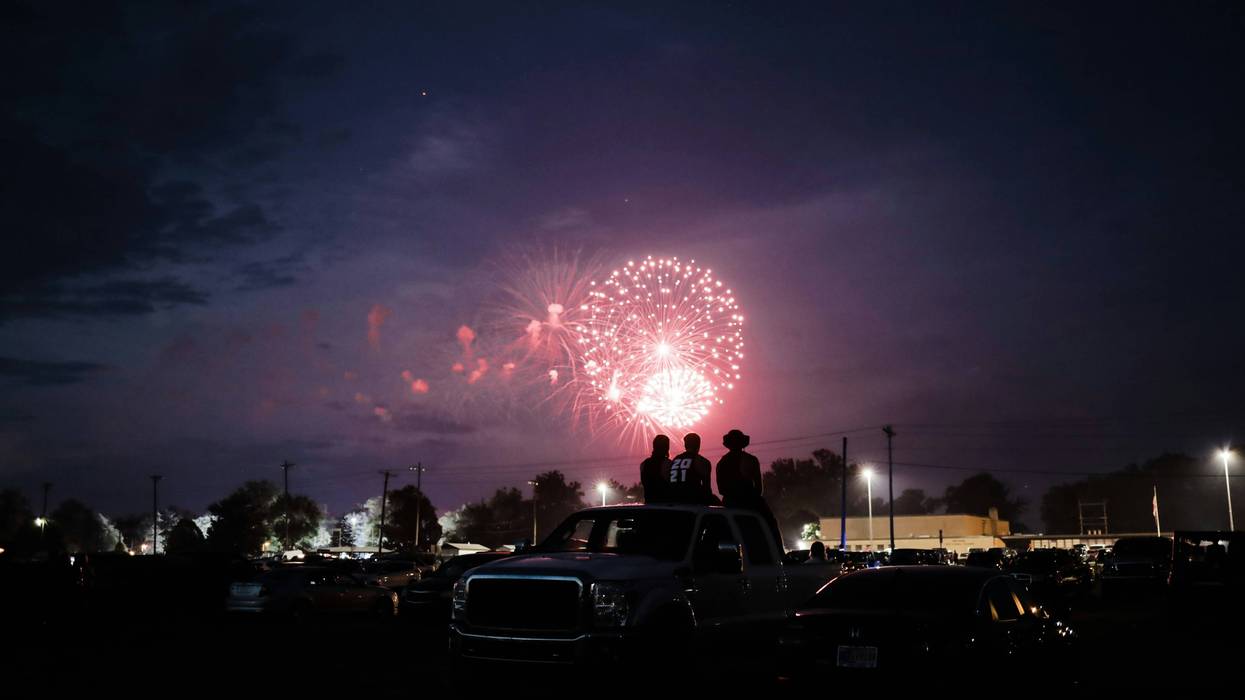
Progressive believe that the core claims of this nation—fairness, equality, freedom, and justice—are their own. And they are right.
July 4 is the big occasion for Americans to express patriotism, none more so than this year, the 250th anniversary of the nation’s founding. But the ways we do so are as diverse as the country. People and groups from right to left celebrate in conflicting ways and with conflicting views—from “love it or leave it” to “love it and fix it.”
This year, at a time when democracy itself is under serious threat, progressives are seeking ways to claim their patriotism and recapture the flag.
“America is beautiful, contradictory, unfinished,” wrote Zohran Mamdani last July 4 before he had been elected mayor of New York City. “I am proud of our country even as we constantly strive to make it better, to protect and deepen our democracy, to fulfill its promise for each and every person who calls it home. Happy Independence Day. No Kings in America.”
Since the American Revolution, each generation of progressives has expressed an American patriotism rooted in democratic values that challenged jingoism and “my country—right or wrong” thinking, rejecting blind nationalism, militaristic drum beating, and sheep-like conformism. Democratic movements—abolition of slavery, farmers’ populism, women’s suffrage, workers’ rights, civil rights, environmentalism, gay rights, and others—sought to overturn the established order while claiming to fulfill America’s promise. They believed that America’s core claims—fairness, equality, freedom, justice—were their own.
Even the founders would be aghast at how far Trump, and his courtiers, as well as most Republican politicians, have gone to establish an authoritarian state.
As Rev. Dr. Martin Luther King, Jr., declared in a speech during the Montgomery bus boycott in 1955, “The great glory of American democracy is the right to protest for right.”
Donald Trump consciously and cynically has been re-enacting the long tradition of patriotism as jingoism, nationalism, flag waving, and “America first” sloganeering. What seems new is his systematic drive to debase major symbols of national identity—such as the White House, the reflecting pool, and Arlington Cemetery—while wrecking the entire national plan to celebrate America at 250.
Although they disagreed on many issues, the founders were adamant that they didn’t want the country to be run by an all-powerful king. Yet here we are 250 year later, governed by a president publicly claiming such power, with a Supreme Court majority acting as his enablers.
Of course, many of the founders were skeptical of a robust democracy. They created institutions, including the Supreme Court, the Senate, and the Electoral College, that were never intended to completely reflect the voice of the people.
Even the founders, however, would be aghast at how far Trump, and his courtiers, as well as most Republican politicians, have gone to establish an authoritarian state, exploiting the opportunities provided by the Constitution’s elitist features.
The Gallup poll regularly asks Americans what the founders would think of America today. This year, only 19% think the signers of the Declaration of Independence would be pleased with how the country has turned out. Over three quarters (77%) now say the founders would be disappointed. This compares with 42% in 2001.
Americans’ disappointment with the country is obviously tied to Trump’s performance and his low favorability ratings in the polls. We expect our nation’s leaders, especially our president, to express a deep loyalty to a vision bigger than one person. But Trump has no overarching vision. Besides grabbing power and wealth for himself, his major commitment appears to white nationalism—turning America into a country for the uber rich and white people only. In contrast to the patriotism expressed in Emma Lazarus’ poem at the base of the Statue of Liberty (“Give me your tired, your poor, your huddled masses yearning to breathe free”), Trump wants, to rid the nation of immigrants of color, whom, in his eugenicist view, he thinks “pollute” the country with bad genes.
Trump and his coterie have systematically acted to undermine the spirit and letter of the Constitution. One of America’s core beliefs since its founding has been that elections should determine who becomes president and that it is important to ensure the orderly transfer of power. But insurrectionists at the Capitol building on January 6, 2021—urged on by and loyal to Trump— attempted to stop that process, while. carrying American flags. Many of these were convicted and sentenced for insurrectionary crimes. Trump’s blanket pardon and embrace of the convicted was an announcement of his autocratic hopes and plans.
As the 250th anniversary approaches, Trump is intensifying his campaign to end the right to vote—the fundamental idea of the American Revolution. Abetted by the Supreme Court majority’s dismantling of the Voting Rights Act (a key victory of the 1960s), and building on the ongoing GOP campaign to maintain power as they lose their capacity to win the national popular vote, Trump is trying to undermine states’ control over the electoral process.
He’s used his powers to eviscerate other cherished rights, including free speech, a free press, and freedom of assembly and dissent. He has used the tools of government—including the FBI, the Justice Department, and the IRS—to unleash his revenge on protesters, the media, immigrants, Democrats, and all others he considers his opponents.
Right wingers have always wrapped themselves in the flag under the guise of being the true patriots. ‘”Americanism” campaigns in the early 20th century were designed to undermine the labor movement and limit immigration. Congressional and state legislative “Unamerican Activities” committees collaborated with the FBI beginning in the 1930s, to build blacklists against leftwing activists and artists,
Even American Nazis sought to be seen as patriots. On Feb. 20, 1939, 20,000 of them filled Madison Square Garden for a "Pro-America Rally." They erected a massive 30-foot banner of George Washington (it was timed to celebrate his birthday) surrounded by American flags and swastika banners.
Trump’s own MAGA rallies feel like modern-day versions of that Nazi event. He fetishizes the American flag and other patriotic symbols, even while displaying a shallow, ahistorical, and bizarre understanding of what they meant.
Once, at a campaign rally in Tampa, as his cult followers chanted, “Build that wall,” Trump interrupted his speech to give a bear hug to an American flag on the stage behind him.
“We want to make sure that anyone who seeks to join our country, shares our values and has the capacity to love our people,” Trump said at a rally at the Kennedy Center in 2017.
“We all salute the same great American flag,” Trump said in his 2017 inauguration address—a line he has repeated in many speeches since then.
To Trump and his followers, the flag is synonymous with “America First.” It was a slogan used to unite isolationists and Nazi sympathizers against involvement in the European war in 1939. For Trump, it means reporting undocumented immigrants and caging their children in detention centers, restricting visitors from Muslim countries, withdrawing from the Paris climate accord and other international agreements, and engaging in friendships with like-minded dictators.
Trump’s faux patriotism and its clownish griftiness has been providing a wide space for coalitions of resistance. The “No Kings” protests and the slogan itself help provide a very fitting frame for revitalizing a progressive, democratic, populist patriotism. Many participants waved American flags.
America now confronts a new version of the Gilded Age, brought upon by Wall Street greed and corporate malfeasance.
President Barack Obama said: “I have no doubt that, in the face of impossible odds, people who love their country can change it.” He observed that, “loving your country shouldn’t just mean watching fireworks on the Fourth of July. Loving your country must mean accepting your responsibility to do your part to change it. If you do, your life will be richer, our country will be stronger.”
President Joe Biden said that “we’re all part of a chain of patriots” who fought for democracy, freedom, fair play, peace, security, and opportunity. Patriots, he explained, seek “the right to equal justice under the law; the right to vote and have that vote counted; the right to breathe clean air, drink clean water, and know that our children and grandchildren will be safe on this planet for generations to come; the right to rise in the world as far as your God-given talent can take you, unlimited by barriers of privilege or power.”
In the Sixties, as hundreds of thousands of American youth were radicalized by the senseless Vietnam war, resistance included acts of defiance of patriotic symbols and rhetoric. Flag burnings would sometimes combine with the burning of draft cards. But other radicals took a different stance. In 1968, in a famous speech against the Vietnam war, Norman Thomas, the aging leader of the rather moribund Socialist Party, proclaimed, “I come to cleanse the American flag, not burn it.”
"It was as a Socialist, and because I was a Socialist, that I fell in love with America,” wrote Michael Harrington, the founder of Democratic Socialists of America, in his 1973 book, Fragments of a Century. “In saying that, I am not indulging in romantic nostalgia about youthful days on the road but rather underlining a crucial political truth. If the Left wants to change this country because it hates it, then the people will never listen to the Left and the people will be right. To be a Socialist is to make an act of faith, of love even, toward this land. It is to sense the seed beneath the snow; to see, beneath the veneer of corruption and meanness and the commercialization of human relationships, men and women capable of controlling their own destinies. To be a radical is, in the best and only decent sense of the word, patriotic.”
Harrington was identifying with the many radicals and progressive reformers who proudly asserted their patriotism. To them, America promised democratic fulfillment—economic and social equality, mass participation in politics, free speech, and civil liberties, elimination of the second-class citizenship of women and people of color, a welcome mat for the world’s oppressed people. The reality of corporate power, right wing xenophobia, and social injustice only fueled progressives’ allegiance to these principles and the struggle to achieve them.
It is largely underrecognized that some of the most important and popular ways all Americans experience and express patriotism were the creation of radical writers and artists. What they created continues to inspire.
Francis Bellamy, a Baptist minister and Christian socialist who lived from 1855 to 1931, wrote the Pledge of Allegiance in 1892 to express his outrage at the Gilded Age’s widening economic divide. He had been ousted from his Boston church for his sermons depicting Jesus as a socialist, and for his work among the poor in Boston's slums. The Gilded Age was marked by major political, economic, and social conflicts. Progressive reformers were outraged by the widening gap between rich and poor, and the behavior of corporate robber barons who were exploiting workers, gouging consumers, and corrupting politics with their money. Workers were organizing unions. Farmers were joining forces in the Populist movement to rein in the power of banks, railroads, and utility companies. Reformers fought for child labor laws, against slum housing, and in favor of women’s suffrage. Socialists and other leftist radicals were gaining new converts.
In foreign affairs, Americans were battling over the nation’s role in the world. America was beginning to act like an imperial power, justifying its expansion with a combination of white supremacy, manifest destiny, and the argument that it was spreading democracy. At the time, nativist groups across the country were pushing for restrictions on immigrants—Catholics, Jews, and Asians—who were cast as polluting Protestant America. In the South, the outcome of the Civil War still inflamed regional passions. Many Southerners, including Civil War veterans, swore allegiance not to the American but to the Confederate flag.
Bellamy, a cousin of Edward Bellamy, author of two bestselling socialistic books, Looking Backward and Equality, believed that unbridled capitalism, materialism, and individualism betrayed America’s promise. He hoped that the Pledge of Allegiance would promote a different moral vision to counter the rampant greed he argued was undermining the nation.
When composing the Pledge, Bellamy had initially intended to use the phrase “liberty, fraternity, and equality,” but concluded that the radical rhetoric of the French Revolution wouldn’t sit well with many Americans. So he coined the phrase, “one nation, indivisible, with liberty and justice for all,” to express his more egalitarian vision of America, and a secular patriotism aimed at helping unite a divided nation.
In 1891, Youth’s Companion, a magazine for young people published in Boston with a circulation of about 500,000, hired Bellamy to organize a public relations campaign to celebrate the 400th anniversary of Christopher Columbus’ so-called discovery of America by promoting use of the flag in public schools.
Bellamy gained the support of the National Education Association, along with President Benjamin Harrison and Congress, for a national ritual observance in the schools, and he wrote the Pledge of Allegiance as part of the program’s flag salute ceremony.
Bellamy thought such an event would be a powerful expression on behalf of free public education. Moreover, he wanted all the schoolchildren of America to recite the pledge at the same moment. He hoped the pledge would promote a moral vision to counter the individualism embodied in capitalism and expressed in the climate of the Gilded Age.
In 1923, over the objections of the aging Bellamy, the National Flag Conference, led by the American Legion and the Daughters of the American Revolution, changed the opening, “I pledge allegiance to my flag,” to “I pledge allegiance to the flag of the United States of America.” Ostensibly, it was revised to make sure that immigrant children—who might have thought that “my flag” referred to their native countries—knew that they were pledging allegiance to the American flag.
In 1954, at the height of the Cold War—when many political leaders believed that the nation was threatened by godless communism—the Knights of Columbus led a successful campaign to lobby Congress to add the words “under God.”
A year after Bellamy composed the pledge, Kathryn Lee Bates wrote the poem “America the Beautiful,” which was later set to music by Samuel Ward, the organist at Grace Episcopal Church in Newark, New Jersey
Like Bellamy, Bates was a Christian socialist. A well-respected poet and professor of English at Wellesley College, Bates (1859-1929) was also a lesbian who lived with Katharine Coman, an economics professor. They belonged to progressive circles in the Boston area that supported labor unions, advocated for immigrants, and fought for women’s suffrage. She was an ardent foe of American imperialism.
“America the Beautiful” was initially published in 1895 to commemorate the Fourth of July. The poem is usually heard as an unalloyed paean to American virtue. But a close reading of her words makes it clear that she had something more in mind. She wrote:
America! America!
God shed His grace on thee
Till selfish gain no longer stain,
The banner of the free!
Bates hoped that a progressive movement could overcome the Gilded Age’s greed. And when sung by Ray Charles and other African American artists, listeners can’t help but be inspired by the song’s plea for brotherhood – or, as the left calls it, solidarity.
Lazarus, author of the poem inscribed on the Statue of Liberty, was a Jewish poet of considerable reputation in her day, who was a strong supporter of Henry George and his “socialistic” single-tax program, and a friend of William Morris, a leading British socialist. Her welcome to the “wretched refuse” of the Earth, written in 1883, was an effort to project an inclusive and egalitarian definition of the American Dream.
In the Depression years and during World War II, the fusion of populist, egalitarian, and anti-racist values with patriotic expression reached full flower. The rise of fascism was countered in the US with efforts to build a center-left coalition in critical support of the New Deal and a parallel cultural upsurge.
Langston Hughes’ poem, “Let America Be America Again,” written in 1936, contrasted the nation’s promise with its mistreatment of his fellow African-Americans, the poor, Native Americans, workers, farmers, and immigrants:
O, let my land be a land where Liberty
Is crowned with no false patriotic wreath
But opportunity is real, and life is free
Equality is in the air we breathe.
It’s a poem that encapsulates the anger and the hope integral to the American experience.
In 1939, composer Earl Robinson teamed with lyricist John La Touche to write “Ballad for Americans,” which was performed on the CBS radio network by Paul Robeson, at the time one of the best-known performers on the world stage, accompanied by chorus and orchestra. This 11-minute cantata provided a musical review of American history, depicted as a struggle between the “nobody who’s everybody” and an elite that fails to understand the real, democratic essence of America.
Broadcasts and recordings of “Ballad for Americans,” (by Bing Crosby as well as Robeson) were immensely popular. In the summer of 1940, it was performed at the national conventions of both the Republican and Communist parties. The work soon became a staple in school choral performances, but it was literally ripped out of many public school songbooks after Robinson and Robeson were identified with the radical left and blacklisted during the McCarthy period. Since then, “Ballad for Americans” has been periodically revived, notably during the bicentennial celebration in 1976, when a number of pop and country singers performed it in concerts and on TV. This might be the year to revive and revise it.
Earl Robinson wrote the melody for another important patriotic song of the World War 2 era -- “The House I Live In.” The lyric was written by Lewis Allen, the pen-name of a New York teacher, activist and poet named Abel Meeropol, who had, a few years earlier, written the anti-lynching anthem “Strange Fruit” for Billie Holiday.
The song was the centerpiece of an Oscar winning short film starring Frank Sinatra in 1945. In the film, Sinatra uses the song to instruct a group of kids who were bullying a Jewish classmate. Sinatra made the song a hit. Other versions were recorded by Robeson and by Josh White. Sinatra kept it in his repertoire for his whole career, even though he later abandoned his left-wing sympathies and associated with the Republican right. In 1985, Sinatra performed the song as the finale to a nationally broadcast celebration of the Statue of Liberty centenary, addressing it to Ronald and Nancy Reagan on the platform with him. Only a few watching were aware of the song’s origins.
Composer Aaron Copland’s “Fanfare for the Common Man” and “A Lincoln Portrait,” both written in 1942, are now patriotic musical standards, regularly performed at major civic events. Copland was a member of a radical composers’ group as well as a gay man.
Many Americans consider Woody Guthrie’s song “This Land Is Your Land,” penned in 1940, to be our unofficial national anthem. Guthrie, a radical, was inspired to write the song as an answer to Irving Berlin’s popular “God Bless America,” which he thought failed to recognize that it was the “people” to whom America belonged.
The song reflects Guthrie’s belief that patriotism and support for the underdog were interconnected. He celebrated America’s natural beauty and bounty, but criticized the country for its failure to share its riches. This is revealed in the song’s last and least-known verse, which Pete Seeger and Bruce Springsteen performed at Obama’s pre-inaugural concert in 2009 in front of the Lincoln Memorial, with Obama in the audience:
One bright sunny morning;
In the shadow of the steeple;
By the relief office;
I saw my people.
As they stood hungry;
I stood there wondering;
If this land was made for you and me.
You can find Spanish and Native American versions of the song. Guthrie would have approved. Both he and Seeger, who were part of Communist circles, helped popularize socially conscious music reflecting the country’s diversity. They are now viewed as American icons.
During the 1960s, American progressives continued to seek ways to fuse their love of country with their opposition to the government’s policies. The March on Washington in 1963 gathered at the Lincoln Memorial, where Martin Luther King famously quoted the words to “My Country ‘Tis of Thee,” repeating the phrase “Let freedom ring” 11 times. That 19th century song seems politically neutral, but it was a defiantly anti-monarchy anthem, written as a kind of parody of “God Save the King.” An abolitionist version soon followed its initial release. Marian Anderson, the great African American contralto, sang the song on the steps of the Lincoln Memorial in 1939 because the Daughters of the American Revolution refused to allow her to perform at its Constitution Hall due to her race.
Phil Ochs, then part of a new generation of politically conscious singer-songwriters who emerged during the 1960s, wrote an anthem in the Guthrie vein, “The Power and the Glory,” that coupled love of country with a strong plea for justice and equality. The words to the chorus echo the sentiments of the anti-Vietnam War movement:
Here is a land full of power and glory;
Beauty that words cannot recall;
Oh her power shall rest on the strength of her freedom;
Her glory shall rest on us all.
One of its stanzas updated Guthrie’s combination of outrage and patriotism:
Yet she’s only as rich as the poorest of her poor;
Only as free as the padlocked prison door;
Only as strong as our love for this land;
Only as tall as we stand.
This song later became part of the repertoire of the U.S. Army band.
In recent decades, Springsteen has closely followed in the Guthrie tradition. From “Born in the USA” to his songs about Tom Joad (the militant protagonist in John Steinbeck’s The Grapes of Wrath), to his anthem about the 9/11 tragedy (“Empty Sky”), to his album Wrecking Ball (including its opening song, “We Take Care of Our Own”), Springsteen has championed the downtrodden while challenging America to live up to its ideals. In January, Springsteen wrote “Streets of Minneapolis,” which describe how "a city aflame fought fire and ice 'neath an occupier's boots," which Springsteen calls "King Trump's private army." He wrote it in response to the second deadly shooting by federal immigration agents in Minneapolis and dedicated it to the people of that city. At the June opening of Obama’s new presidential center in Chicago, Springsteen sang his song, “Land of Hope and Dreams,” which includes lines adopted from Guthrie’s song, “This Train is Bound for Glory.” The train – a metaphor for America -- carries “saints and sinners,” “losers and winners,” and “fools and kings.”
America now confronts a new version of the Gilded Age, brought upon by Wall Street greed and corporate malfeasance. Americans are upset by the unbridled selfishness and political influence-peddling demonstrated by banks, oil companies, drug companies, insurance companies, and other large corporations. They are angry at the growing power of American-based global firms who show no loyalty to their country, outsource jobs to low-wage countries, avoid paying taxes, and pollute the environment.
During the ICE raids in Minnesota a group called “Singing Resistance” emerged to encourage singing during protests. Troubadours of multiple generations sang new and classic songs of protest on stage and via You Tube.
One fascinating moment happened at this year’s Super Bowl when Coco Jones sang “Lift Every Voice and Sing.” For 100 years that song has been the African American national anthem. It lyrics include these lines:
Sing a song full of the faith that the dark past has taught us,
Sing a song full of the hope that the present has brought us;
Facing the rising sun of our new day begun,
Let us march on 'til victory is won.
To have it performed at the Super Bowl, alongside the “Star Spangled Banner,” may have been an affront to right-wingers, , but it was an inspiring moment for many other Americans. Cong. James Clyburn (D-South Carolina) has sponsored a bill to make “Life Every Voice” the national hymn.
Throughout American history, progressive movements had won major victories and also experienced setbacks. When those setbacks occur, it is understandable that people sometimes lose hope, and even give up the fight. But our history also teaches us that we can’t give up, because we must keep the struggle alive for a new generation.
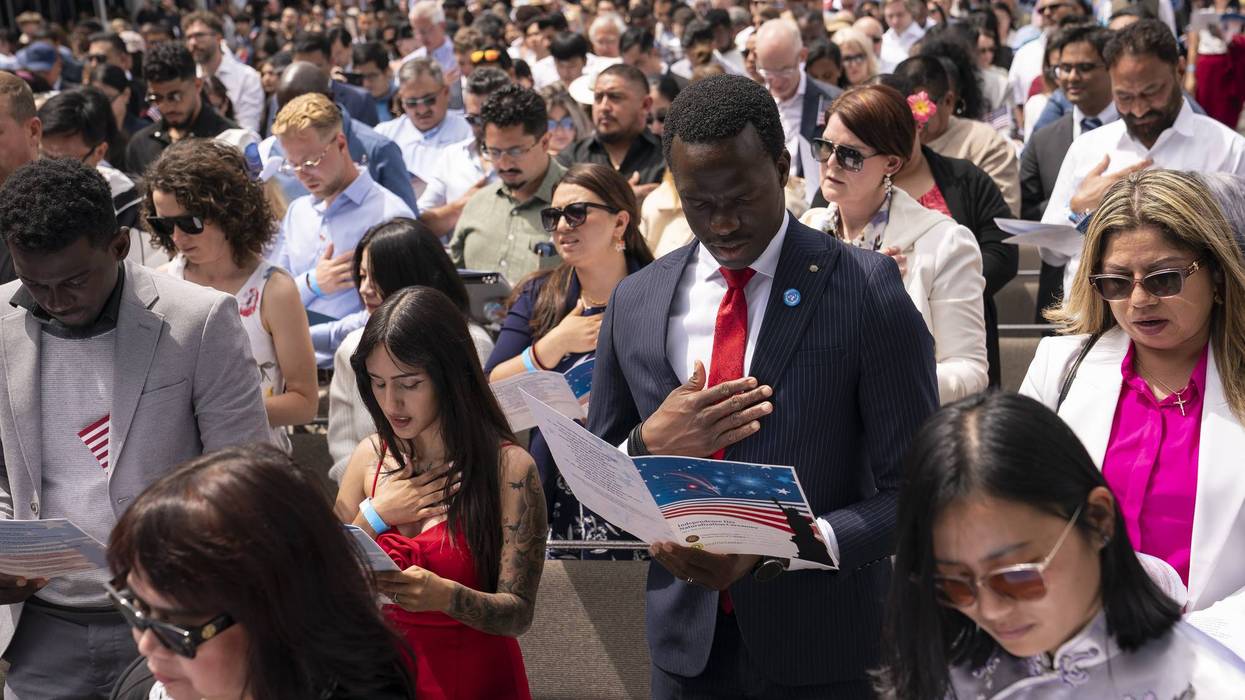
I have walked into hundreds of naturalization ceremonies with immigrants. I have always walked out with Americans.
A democracy that makes citizenship harder to reach should not pretend it is merely managing paperwork. It is deciding who gets full political voice.
I have attended naturalization ceremonies for more than three decades. I have watched courtrooms fill with nurses, engineers, truck drivers, scientists, caregivers, parents holding young children, and older immigrants who waited years to hear one sentence that would change their lives.
Before administering the Oath of Allegiance, judges often remind new citizens that American citizenship is about more than receiving a certificate or passport. It is about responsibility — to vote, serve on juries, obey the law, participate in civic life, defend the Constitution, and leave America stronger than they found it.
That reminder captures something we too often forget. Citizenship is not just a collection of rights. It is freedom joined to duty, opportunity joined to service, and belonging joined to responsibility.
A door that only the wealthy, the fluent, the well-connected, or the legally sophisticated can navigate is not truly open.
Unlike those of us fortunate enough to be born here, every person in that courtroom made a conscious decision.
They chose America.
As the United States approaches its 250th birthday, we should ask whether we still understand the power of that choice. One of America’s greatest accomplishments has not simply been welcoming immigrants. It has been making Americans.
Those are not the same thing.
The earliest naturalization laws reflected the exclusions and prejudices of their time. But America also preserved a revolutionary idea: a person born somewhere else could become fully American through allegiance to the Constitution and commitment to the Republic.
Naturalization was never just an immigration process. It was a democracy-building process.
Today, more than 9 million lawful permanent residents are already eligible to become American citizens. They are nurses, entrepreneurs, teachers, engineers, factory workers, researchers, caregivers, veterans, farmworkers, small-business owners, and neighbors. They pay taxes, raise families, volunteer, worship, organize, serve, and build communities.
They have already invested in America. Now they are asking to invest even more deeply.
But at the very moment America should be inviting eligible immigrants into full civic membership, the government is moving in the opposite direction.
The Department of Homeland Security has proposed raising the naturalization application fee from $760 to $1,330 for paper filings and from $710 to $1,280 for online filings — roughly a 75% to 80% increase. The proposal would also eliminate the reduced filing fee option and the availability of fee waivers for Form N-400.
That is not a small administrative adjustment. For many working families, it is the difference between applying now and postponing citizenship for years.
The real cost of naturalization is not just the government filing fee. It is lost wages, transportation, child care, English classes, document costs, legal help, and the anxiety of navigating a system that too often feels designed for the fluent, the wealthy, and the legally sophisticated.
For a nurse working double shifts, a home health aide caring for elders, a farmworker, a refugee parent, an elderly green-card holder, or a veteran’s spouse, the path to citizenship can become a gauntlet: higher fees, longer waits, more forms, more documentation, more scrutiny, and more fear that one mistake could derail everything.
A democracy should not celebrate citizenship in speeches while making it harder to obtain in practice.
The way we talk about naturalization matters.
For much of our history, becoming a citizen was understood as the successful completion of the immigrant journey. Today, the language too often sounds like it came from a risk-management manual: cost recovery, fraud prevention, compliance, security screening, background review, discretion.
Each of those concerns has its place. But when they become the only language we use, the future citizen slowly becomes a file, a cost, a risk, or a problem to manage instead of what he or she truly is: a future American.
A confident nation can protect the integrity of citizenship while still encouraging qualified immigrants to become citizens. A fearful nation raises costs, increases complexity, lengthens delays, narrows relief, expands suspicion, and then pretends the door is still open because it has not been formally locked.
But a door that only the wealthy, the fluent, the well-connected, or the legally sophisticated can navigate is not truly open.
When we make citizenship harder to reach, we do not just burden immigrants. We weaken democracy.
Every new citizen is a potential voter, juror, volunteer, parent advocate, union member, school-board participant, taxpayer, entrepreneur, caregiver, and community leader. Naturalization does not dilute the Republic. It strengthens it.
We should not reduce citizenship to a user fee. We should not treat qualified future citizens as customers purchasing a private benefit from government. Citizenship is different. It is the mechanism by which a democracy renews itself.
This does not mean abandoning standards. It means remembering the purpose of the standards. The goal is not to make citizenship feel like a privilege reserved for those who can survive an expensive bureaucratic maze. The goal is to welcome qualified immigrants into full participation in American civic life.
Congress and the administration should treat naturalization as civic infrastructure: protect fee waivers, invest in timely processing, expand language access, support community-based citizenship programs, simplify forms and procedures, and celebrate naturalization as one of the most important acts of democratic renewal this country performs.
At a time when Americans worry about democracy, it is remarkable that millions of people are still waiting for the chance to raise their hands, take the oath, and accept the responsibilities of American citizenship. We should not make that harder. We should honor it.
Over the years, I have watched refugees become election poll workers, veterans become citizens of the country they served, and parents beam with pride as they introduced themselves — for the very first time — as Americans.
I have walked into naturalization ceremonies with immigrants. I have always walked out with Americans.
As America turns 250, Congress should ask a larger question than how much a citizenship application should cost.
It should ask: What is a new American worth?
Every generation inherits the American experiment. Every generation decides whether to strengthen it or merely administer it. Our generation has a quieter but urgent responsibility: to remember that citizenship is not merely something government processes. It is something a great democracy cultivates.
I have never left a naturalization ceremony believing America had become less American.
I have only left believing America had become stronger.
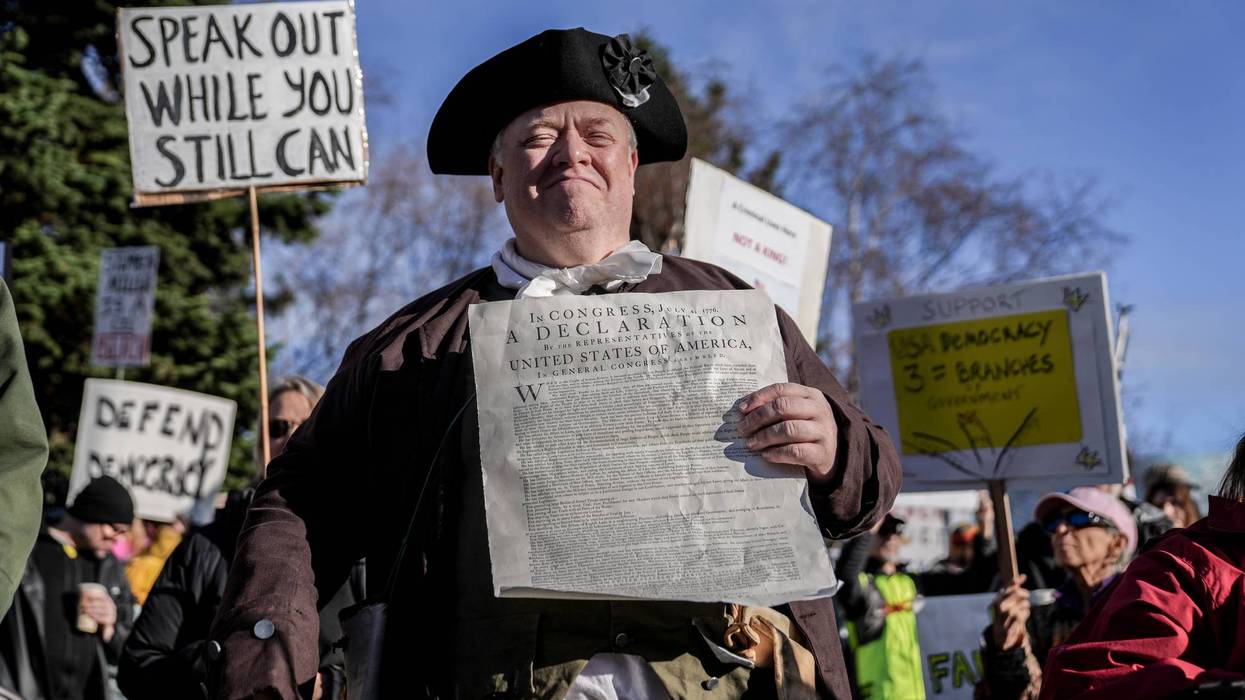
The history of the government of the United States in this century, especially under this president, is a history of repeated injuries and usurpations, all tending to the establishment of a corporate despotism over the American people.
When in the course of human events, it becomes necessary for the people to dissolve the bands which have subjected them to a government which has burdened and oppressed them, and to restore the powers and rights to which the laws of nature and nature’s God entitle them, a decent respect to the opinions of humankind requires that they should declare the causes which impel them to the separation.
We hold these truths to be self-evident: That all people are created equal, that they are endowed by their Creator with certain unalienable rights; that among these are life, liberty, and the pursuit of happiness; that to secure these rights, governments are instituted among the people, deriving their just powers from the consent of the governed; that whenever any form of government becomes destructive of these ends, it is the right of the people to alter or to abolish it, and to institute new government, laying its foundation upon such principles, and organizing its powers in such form, as to seem to them most likely to them to effect their future safety and happiness. Prudence, indeed, will dictate that governments long established should not be changed for light and transient causes: and accordingly all experience hath shown that people are more disposed to suffer, while evils are sufferable, than to right themselves by abolishing the forms to which they are accustomed. But when a long train of abuses and usurpations, pursuing the same object, evinces a design to reduce them under an absolute despotism it is their right, it is their duty, to throw off such government, and to provide new guards for their future security. Such has been the patient suffering of the American people, and such is now the necessity which constrains them to alter their present government.
The history of the government of the United States in this century, especially under this president, is a history of repeated injuries and usurpations, all tending to the establishment of a corporate despotism over the American people. To prove this, let facts be submitted to a candid world.
On repeated occasions, the current government has manipulated elections from which officials have assumed their offices.
A government whose character is thus marked by actions that exhibit such arrogance is unfit to be the government of a free people.
Its current president has allowed his subordinates to suggest a postponement of the constitutionally required date of a presidential election, a step unprecedented in United States history, even in times of war and civil rebellion. While doing so, he has suggested that no further national elections will be necessary.
The current government has repeatedly undermined access to equal voting rights, and has promoted the power of the dollar to replace the voice of the people in elections.
It has compromised the security of the people in their persons, homes, workplaces, schools, travels, papers, and effects by sponsoring actions that harass the people with both open and clandestine searches and surveillance.
It has denied immigrants their rights under asylum law and the Constitution, subjecting them to arbitrary arrest and cruel and unusual punishment.
It has refused detainees under its authority access to counsel and security from physical mistreatment, in violation of international covenant, the supreme law of the land, and the English-speaking tradition of law dating from Magna Carta.
As has been the case for nearly two generations, it has failed to erect adequate safeguards against domestic terrorism and the massacre of children and young people in our schools and colleges.
It has long evaded international covenants for the protection of the environment, the humane treatment of prisoners of war, the security of nations from invasion, and the prevention of war crimes, thereby subverting the law of nations and the supreme law of the land. The current president’s actions in this respect are especially cruel and malign.
It has acted to render the military independent of, and superior to, the civil power.
It has weakened enforcement of environmental laws most wholesome and necessary to the public good, has compromised others, and has allowed corporations to poison the environment on which the public’s health, prosperity, and well-being depend.
It has hollowed out the nation’s civil service and established bribery as standard government practice.
It has further endangered public health by weakening legislation that would remedy the people’s woefully inadequate access to essential medical care.
It has reduced benefits and medical care to veterans of current and previous wars and their families.
It has created a population that lags behind the rest of the developed world in educational attainment, life expectancy, access to decent housing, and prevention of infant and maternal mortality.
It has eaten away at the substance of ordinary people by denying them a living wage, and initiated class warfare in our nation by promulgating laws and taxes that favor the already wealthy at the expense of the people at large.
It has failed to protect the people’s hard-won savings from obscure and deceptive investments, and usurious mortgages on their homes, thereby undermining their material security and driving hard-working citizens into the street.
It has lavished financial support on failed investment banks and corporations while denying the working class, the poor, and the jobless minimal support for their existence.
It has at times deprived federal workers pledged to protect the nation’s security the right to bargain collectively to secure fair compensation for their labors.
It has promoted international trade regulations that deprive laborers of rights protected by international agreement.
Through economic policies that have extended over a generation, it has plunged one-eighth of its population and one-fourth of its children into a permanent state of poverty and hunger.
It has undermined the security of future generations and burdened them with debt by turning record federal surpluses into unprecedented deficits.
It has on occasion neglected to provide its troops at war personal equipment that is necessary to their safety and comfort in the field, and violated the terms of their original enlistments.
It has promoted the development of weapons systems beyond any rational military requirement, and equipped its armed forces with weapons dangerous to their users.
In like manner, it has evaded the obligations of international law and common decency by holding all humanity hostage to an existentially perilous nuclear arms race.
It has distracted the nation from the necessary struggle against terrorism and arms proliferation by initiating offensive war abroad without sufficient cause and has subjected civilians abroad to the horrors of combat, in violation of international covenant, its own rules of engagement, and the supreme law of the land.
In defiance of international law, it has threatened neighboring and allied nations with invasion and annexation, and misused our tax money to finance and abet genocide directed against a foreign people.
It has replaced the world’s respect for the United States of America with apprehension, contempt, and fear.
In every stage of these oppressions, which our current president has encouraged and promoted, the American people have petitioned for redress in most humble terms; our repeated petitions and supplications have been answered chiefly by repeated delays and indifference. A government whose character is thus marked by actions that exhibit such arrogance is unfit to be the government of a free people.
Nor have we been wanting in our attentions to its individual members. We have warned them, from time to time, of attempts to extend an unwarranted jurisdiction over us. We have reminded them of the circumstances of our common heritage here. We have appealed to their sense of decency; and we have conjured them, by the ties of common kindred, to disavow these usurpations, which would inevitably interrupt our connections and correspondence. More often than not, they, too, have been deaf to the voice of justice and common citizenship.
We, therefore, the people of the United States of America, appealing to the Supreme Judge of the world for the rectitude of our intentions, do solemnly publish and declare, that all political connection between ourselves and the present federal administration is hereby abandoned. And for the support of this declaration and the restoration of our liberty, with a firm reliance on the protection of Divine Providence, we mutually pledge to each other our lives, our fortunes, and our sacred honor.
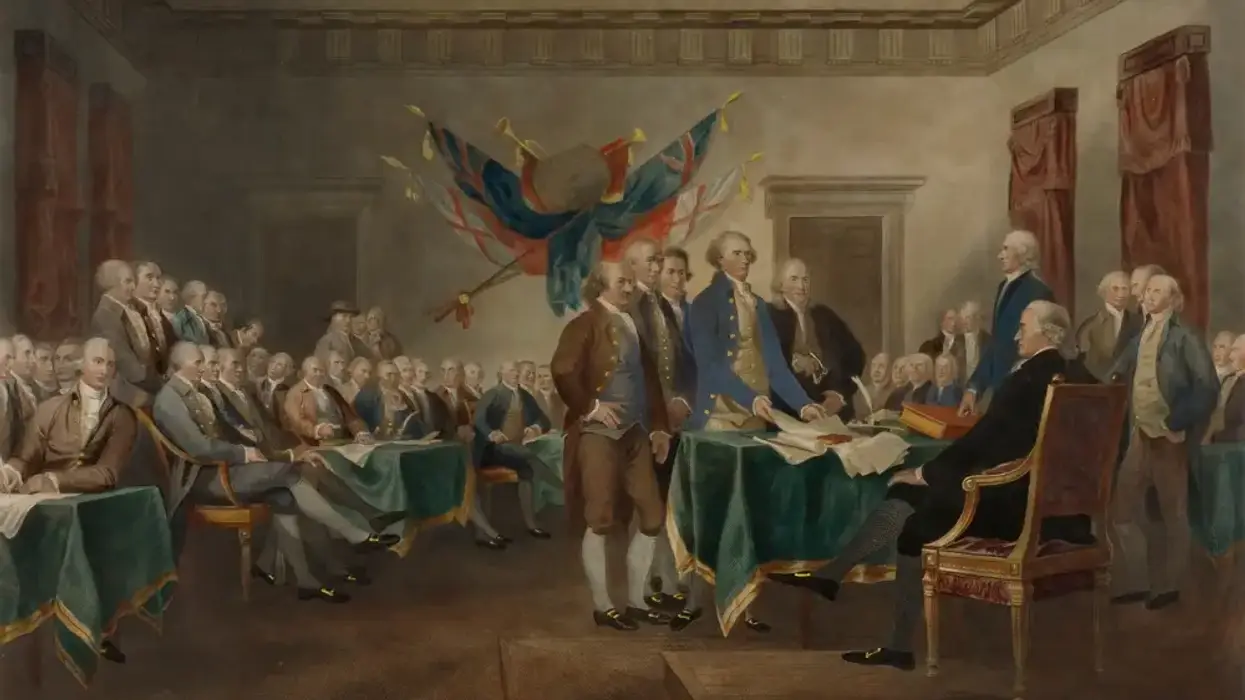
The lesson of 250 years: Democracy is hard won and may be easily lost unless we are vigilant in protecting it.
This Fourth of July marks the 250th birthday of a new kind of nation state — based not on ancestral ties to a land or on the territorial reach of monarchs, but on shared principles about the rights of citizens and the purpose of the state.
The Founding Fathers set forth those principles in the Declaration of Independence: “All men are created equal” and have “unalienable Rights [to] Life, Liberty, and the pursuit of Happiness.” To “secure these rights,” Jefferson wrote, the government must “derive just powers from the consent of the governed.”
America has come a long way over two and a half centuries, but today we face a grave challenge from within — and especially from our own leaders.
Of course, those founding ideas have always been more aspiration than reality. In a sense the Declaration of Independence was an invitation to struggle over the inequalities that marred the new nation: slavery and white supremacy, the subjugation of Native peoples, the legal subordination of women, the limitation of voting rights to the well-off.
In the course of 250 years, those struggles have achieved tremendous progress.
A bloody Civil War won what Lincoln called “a new birth of freedom.” Slavery was abolished and the Constitution amended to strengthen the government’s ability to safeguard the rights of African Americans and other people.
Women were eventually enfranchised and achieved formal legal equality. The lawless subordination and genocides of Native Americans were eventually recognized as the evils they are. The Civil Rights Movement repealed American apartheid and restored rights that had been stripped away.
But equality and democracy are openly contested today in a manner not seen in a century. Those who oppose the Founding Fathers’ fundamental values are using our government to attack equality and democracy. The good news is that tens of millions of Americans are fighting back.
America is and always has been a nation of diverse peoples — a multi-ethnic, multi-racial mix — and that is what the Framers and their successors had in mind.
Indeed, the Declaration of Independence complained that the King obstructed the “Naturalization of Foreigners” and failed to “encourage migration hither.” Enslavers brought millions of Africans to our shores, and America became their land as well. National expansion westward incorporated French, Spanish, and Mexican peoples into America, too.
But today the Trump regime seeks to erase the diversity essential to our national character. White supremacy and white nationalism are threads running through nearly every policy — from ending civil rights enforcement to discriminating against African-American military leaders, terminating refugee programs for nonwhites, slandering Haitians, and calling Hispanic migrants “the worst of the worst.”
Free elections, majority rule, and democracy itself are Trump’s targets — from his efforts to overturn the 2020 election to his unrelenting assault on voting rights and representation today.
Today, gerrymanders demanded by Trump are likely to eliminate one third of African-American members of Congress. The Supreme Court has erased the protections of the Voting Rights Act. Evidence-free voter suppression laws are making it more difficult for eligible voters to cast their ballots, while Trump seeks to outlaw voting by mail and his backers threaten to deploy ICE to intimidate midterm voters.
On this 250th anniversary of our first struggle for American freedom and democracy, Americans are fighting back against this war on what makes America America — in the voting booth, in the courts, in the streets, and in our hearts.
The lesson of 250 years: Democracy is hard won and may be easily lost unless we are vigilant in protecting it. The vision of our Founding Fathers depends on you, me, and all of us to safeguard it.
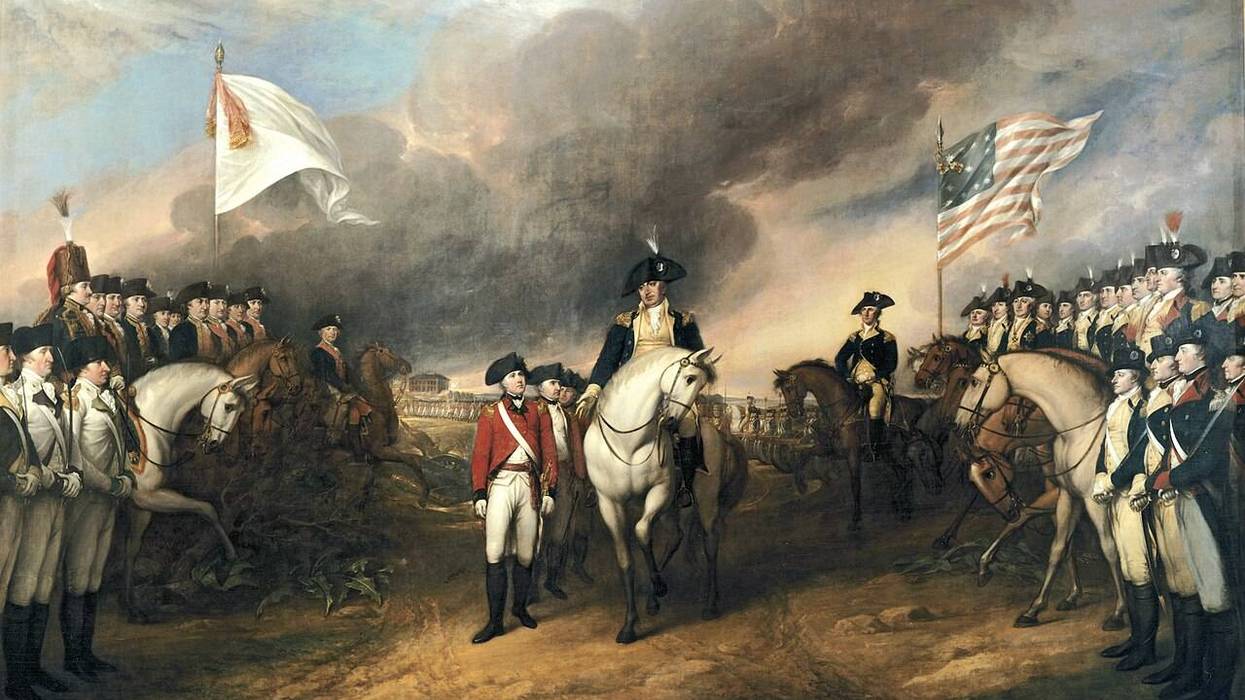
The Declaration of Independence, at its core, was a watchdog report.
Most of us associate Independence Day with celebration, from grandiose fireworks displays to backyard barbecues. The 250th anniversary of our nation’s founding, however, comes at a time when celebration alone is not enough. We have to remember what the first Independence Day was all about: refusing to accept an unaccountable monarch’s abuses of power and creating the foundation for a government that is run by and for the people.
The Declaration of Independence, at its core, was a watchdog report. Our nation was founded on a promise of accountability — and 250 years later, we must ask ourselves whether we’re keeping this promise.
After years of being subject to the whims of a singular ruler, our founders dared to ask the question: What does it look like to create a government that answers to the people it’s meant to serve? And thus, the framers signed the Declaration of Independence. Our nation’s most foundational text is literally a 27-count public accounting of one ruler’s abuses of power: taxation without consent, a military turned against civilians, obstruction of accountability institutions, and more.
We find ourselves on the precipice of returning to the very form of government Americans rebelled against 250 years ago.
Following this document, our founders then created the Constitution, outlining how the government should work and who it should work for. Rather than consolidate power in the hands of a few, it deliberately separated power across an executive branch that represents the nation as a whole, a legislative branch that represents the interests of individual communities, and a judicial branch that upholds the Constitution over any one party or politic.
Our personal freedoms, financial stability, community safety, and more depend on these accountability mechanisms working the way our founders intended. If an executive can singularly plunge our nation into a war that everyday people don’t want, we pay the price in lost family members and skyrocketing costs. If our judiciary decides to prioritize partisanship over the Constitution, we lose our ability to shape our own futures.
That is, unfortunately, exactly what we’re seeing play out today, and there is no shortage of examples. The Declaration of Independence may have centered on accountability, but in its first year alone, the Trump administration illegally fired nearly a quarter of the government’s inspectors general — the people tasked with combating waste, fraud, and abuse in federal agencies — and defunded the Council of the Inspectors General on Integrity and Efficiency (CIGIE), which ensures these federal watchdogs have the resources they need to do their jobs effectively. Meanwhile, it decimated our merit-based civil service, replacing nonpartisan federal workers with partisan lapdogs.
Just as Americans rebelled against soldiers patrolling our communities in the 1700s, we have once again had to fight back against the deployment of the military to our cities. On the eve of our 250th birthday, troops trained for war are illegally occupying our nation’s Capitol, costing us more than $1 million a day.
After years of enduring a monarch who treated the U.S. colonies as a personal piggy bank, our founders created a republic meant to prevent leaders from using their power of office to amass personal wealth. But today, we’re seeing lawmakers on both sides of the aisle benefit from insider trading; top White House advisors holding stock in companies profiting from the administration’s own policies, and major government contractors gifting massive sums to the lawmakers who oversee their work.
The challenges we face today are urgent, but they are not new. The pillars of our democracy have been tested since our nation’s founding, and they have remained standing only because regular people have risen, time and again, to hold power to account.
And it’s not just the executive branch eroding these protections. Congress, too, has abdicated its watchdog responsibilities; up until this month, it failed to exert its constitutional war powers to put an end to the president’s illegal war. It has time and again ceded the power of the purse —which belongs “the people’s branch” for a clear reason — to the administration. to the administration.
In short, we are seeing a small but powerful group of public officials use their positions to destroy the accountability mechanisms that make our government work for us so that they can rule with impunity. We find ourselves on the precipice of returning to the very form of government Americans rebelled against 250 years ago.
But just as the founders fought against the monarchy over two centuries ago, we can fight back against these latest attempts to take power away from the people. That means demanding Congress take back its constitutional powers — from its warmaking authority to its power of the purse — so that these critical, life-changing decisions don’t rest with a singular leader. It means passing legislation to restore protections for a non-partisan civil service and provide our inspectors general the independence and resources they need to make agencies accountable and effective. It means ensuring public officials institute policies based on the needs of the people and not their own bottom line.
We know that, in spite of our differences, we are united in a belief that our government should be responsive to our needs. We keep this belief alive not through sentiment alone, but with our actions.
The challenges we face today are urgent, but they are not new. The pillars of our democracy have been tested since our nation’s founding, and they have remained standing only because regular people have risen, time and again, to hold power to account. On our 250th anniversary, celebrating our nation is not enough — we must honor the founders by taking action to uphold the promise of accountability laid out in our founding documents.
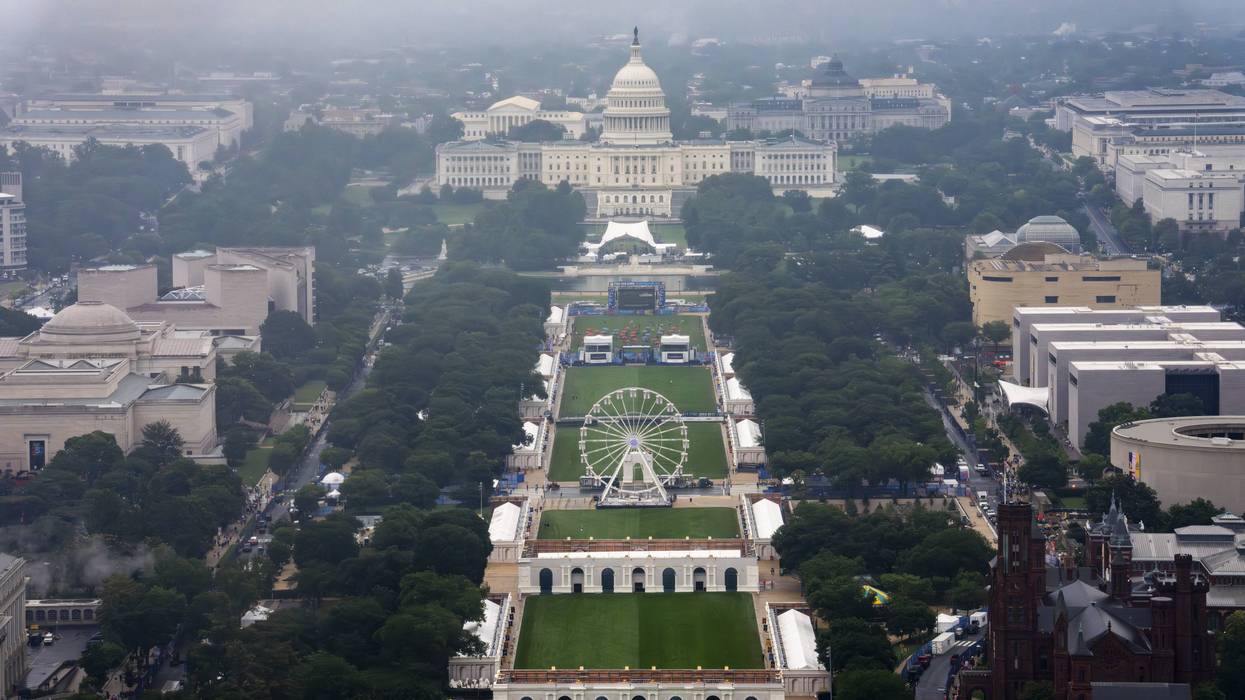
If we must, what we need to celebrate is the basic principles and ideas behind the Declaration of Independence, while being fully cognizant of the fact that we still have a long way to go to achieve equality in this country.
On July 4, 2026, the United States of America turns 250 years old. Should the Left celebrate the 250th anniversary of the founding of the United States with the signing of the Declaration of Independence? After all, this is a nation with a very dark and ugly past—with racism, genocide, and imperialism deeply embedded in its psyche.
Surely Native Americans have no reason to celebrate. The history of the United States government’s treatment of Native Americans is one of cruelty, oppression, and extermination. Leaving aside the 56 million Indigenous people that were killed by European settlers across the Americas by 1600, since its independence in 1776, the US government has launched more than 1,500 attacks against various Indigenous people, slaughtering them, and taking their lands. Native Americans in the US continue to face oppression, poverty, and discrimination, and rank near the bottom of all other groups in terms of health, education, and employment.
What about Black Americans? Do they have a reason to celebrate a nation that denied them their humanity for much of those 250 years, while they continue to experience racial discrimination to this day? Racism against Black people remains very much widespread in the Good Ol’ USA.
Should American women have a reason to celebrate the nation’s 250th birthday? They have been treated as second-class citizens until fairly recently, and while many countries around the world have or had female leaders, it is a widely shared belief that the US is still not ready for a woman president.
The Declaration of Independence should serve as a stark reminder of the need for a call to action when a government, like the one represented by Donald Trump, acts illegally and unconstitutionally to weaken democratic institutions.
If anything, a major milestone like the 250th anniversary of the signing of the Declaration of Independence should be an opportunity to confront the nation’s dark and ugly past and reflect on what has gone wrong with US democracy and what we can do about it. After all, isn’t it a tragic irony that the celebration of America’s 250th birthday, which is supposed to honor the principles of liberty and equality upon which the nation was allegedly founded, will take place with an administration in power whose own beliefs and actions embody the very tyrannical rule that the Declaration of Independence sought to overthrow?
What manner of national progress is this?
But history is not a linear progression. Nor is it guided by the realization of freedom and rationality, as Hegel thought. Human history moves in a spiral, and irrationality makes up a great part of human life and history. Moreover, not only does the value of ideals vary greatly (Nazism and imperialism were as potent ideals as those of democracy and self-determination), but there is usually a disconnect between ideals and political reality. Some of the lofty principles in the Declaration of Independence, such as “all men are created equal,” collided with the facts on the ground and, in fact, had a very narrow interpretation when they were written, as they applied only to white, propertied men.
Indeed, in 2026, we have a president who likes to govern like a king, or a dictator. As a matter of fact, the Supreme Court has given Donald J. Trump king-like powers. Thus, it is hardly surprising that Trump 2.0 has demolished democracy by initiating a new age of authoritarian rule with civil- and human-rights rollbacks, weaponizing the federal government against the president’s political rivals, and unleashing a paramilitary squad of fascist thugs into communities across the nation. It is also hardly surprising that Trump has become the most corrupt president in US history. He is exploiting shamelessly the highest office in the land to enrich himself and his family.
Trump’s enablers extend beyond today’s Supreme Court, which has moved so far rightward that it qualifies as the most reactionary in the nation’s modern history. It includes the plutocrats, media conglomerates, evangelical Christians, and pro-Israel political networks. Retail corporations, major law firms, and academic institutions capitulated with such ease to Trump’s bullying tactics that they made a mockery of liberal ideals.
All that being said, it is difficult not to appreciate the importance of the Declaration of Independence. It is indeed one of the most important documents in the history of politics and ideas for the simple but radical fact that, by articulating the intention of the American colonies to separate from British rule, it established the principles of self-government and individual rights while connecting equality and freedom.
Being profoundly influenced by the philosophical thinking of John Locke, Thomas Hobbes, and Jean-Jacques Rousseau (unlike contemporary US leaders, the likes of Thomas Jefferson, Benjamin Franklin, and John Adams were deeply learned men and had extensive knowledge of history and philosophy), the Declaration of Independence solidified the claims of social contract theory—that is, the idea that governments receive their just powers from the consent of the governed—and justified rebellion against tyranny. Within just a couple of decades, the Declaration of Independence inspired revolts across the globe. It had great impact on political and philosophical debates leading up to the French Revolution (1789) and served as a reference point behind the slave revolt against French colonial rule in Haiti in 1791 and the Irish rebellion against British rule in May 1798.
When Ho Chi Minh declared Vietnam an independent nation on September 2, 1945, he paraphrased the US Declaration of Independence. He opened his declaration of independence with the statement from the 1776 Declaration: “All men are created equal. They are endowed by their Creator with certain inalienable rights, among these are Life, Liberty, and the pursuit of Happiness.” But then he updated those words by saying, “In a broader sense, this means: All the peoples on the Earth are equal from birth, all the peoples have the right to live, to be happy and free.”
Indeed, the Declaration of Independence served as a “universal blueprint” for the anti-colonial struggles that occurred after World War II. It is indeed a radical document. One of its foundational principles is that “it is the Right of the People to alter or abolish” governments that become destructive to their fundamental rights. This principle is a cornerstone of democratic theory and should never be forgotten.
Ironically enough, all US administrations have largely abandoned the fundamental principles underpinning the Declaration of Independence—and none more so than President Donald Trump’s administration. The country is on a very slippery path under Donald Trump’s imperial proto-fascism. Democracy is dying before our very own eyes, and Trump’s desire to reshape the world order not only creates more uncertainty and instability but risks opening a Pandora’s box.
It is in this context that the Declaration of Independence should serve as a stark reminder of the need for a call to action when a government, like the one represented by Donald Trump, acts illegally and unconstitutionally to weaken democratic institutions and engages purely in self-dealing while endangering our communities. We have a monstrous, tyrannical government in power that the People must stand up to with all their might before it ruins everything.
If we must, what we need to celebrate on the 250th anniversary since the signing of the Declaration of Independence is nothing more and nothing less than the basic principles and ideas behind this document, in an updated manner, of course, à la Ho Chi Minh, while being fully cognizant of the fact that we still have a long way to go to achieve equality in this country. That was not the intention of those who drafted and signed the Declaration of Independence; nonetheless, they gave the world a political and philosophical document for the ages.

Just as the founders of the country drew inspiration from European enlightenment thinkers, we too must now renew our own democracy by demanding our students and schools be supported.
July 4th, 2026 will be the 250th anniversary of the Declaration of Independence. One of the foundational documents of the United States, the declaration has been taught many ways: as America’s break up letter, as a rallying cry for freedom and as an example of the legal assertion of a right to rebellion—derived from common law and biblical teaching. Influenced by the Protestant reformation, the Great Awakening and enlightenment thinking, the Declaration is an example of the complexity of our founding and a reminder of the important work of educating for democracy.
Yet, many teachers feel like it’s getting more difficult to teach today, on the eve of the 250th. Just like in the era that gave us the “Spirit of ‘76,” teachers, who are striving to keep the spirit alive, must both stay rooted in local life and draw inspiration from Europe.
In 1776, local life in the rebellious colonies was much more defined by geographic dispersion. It took time for word to travel between the population hubs. Reading was essential to revolutionary activity and democratic participation as the written word could travel with greater reliability to all corners of the colonies, including the backwoods of the likes of New Hampshire, my home state.
It was a sign of the times when far off places like New Hampshire joined the struggle for independence, just as it is a sign today that teachers in Granite State feel the string of modern issues that for so long have been more acutely felt closer to urban population centers. Consequently, it bears reporting that Hampshire was recently hit by a series of newly proposed legislation aimed at destroying the bedrock of our democracy, our public school system. These new developments trace their way back to 2021 when the state saw the start of a transfer of public resources to private and religious schools with the enactment of a voucher program. That program then expanded over several years, quickly eliminating a cap that limited participation based on income, becoming a universal and unregulated giveaway.
Those celebrating the special anniversary year of our state and country would be remiss to not also honor the legacy that binds education to our experiment in self governance. This can be found in the written text of New Hampshire’s constitution as a call to provide for the general diffusion of knowledge among of the citizenry (the link above from the Education Law Center identifies similar constitutional clauses in states across the country).
It is this constitutional text that the state Supreme Court relied on as it issued important rulings clarifying the state's obligation to provide adequate funding to all public school students—something the state had historically resisted. New Hampshire is consistently at the bottom of the list in terms of state contribution to public schools, forcing an overreliance on local property tax.
Determined to subvert the court's ruling, the legislature has opted instead to launch a full-on assault on the public school system. One proposed bill would push a rapid consolidation of local school districts—something that would cut against the very local control that New Hampshire has lauded since it created its own state government in 1776.
Another bill tried to replace the power of locally elected school boards by shifting decision making away to publicly unaccountable boards by converting local public schools to charter schools. Diminishing local democratic decision making through conversions also opens the door to Charter Management Organizations (CMOs), which are privately held profit motivated companies that have been notorious actors in other places, including New Orleans. The fast pace of the potential law has many concerned that the measure is truly meant to seed confusion and destabilize the existing school system.
Here, I should note that according to most measures New Hampshire's schools rank in the top quintile in the nation despite the destructive policies of several extreme legislatures.
Yet, the pressure has been especially palpable on schools that historically are already stretched thin. Administrators in these districts have tried to navigate rushed new regulations and the ensuing confusion, as well as changes to the already limited state funding formula. One district was forced to take out a $4 million private loan to cover its operating budget rather than face mass staff layoffs. The state has offered what some call predatory lending to financially distressed districts—all while threatening state takeovers of the very places that they have refused to provide adequate funding, despite the ruling of multiple courts over decades.
Most of this will sound familiar to those who have followed the broader privatization movement. Efforts to privatize the schools of New Hampshire are a collection of ideas recycled from failed “experiments” in defunding educational opportunities for students across the country from Chicago to Los Angeles (and many in between). Similar policies have been pursued nationwide, sadly. These policies based on a neoliberal theory, propose to slash taxes and reduce services, commodifying education to a good, another product to be bought and sold.
The thing is, education is more than a good, it's for the common good. By this, I mean, we all benefit when young people become better learners and it is fundamental to our continued self-governance to have the next generation experienced in the arts of democratic life. We need students to develop discernment, practice reasoning and decision making and learn to collaborate with peers from a wide variety of backgrounds and experiences.
Communities want quality public schools—and it’s time to rally around our community schools. Just as the founders of the country drew inspiration from European enlightenment thinkers, we too must now renew our own democracy by demanding our students and schools be supported.
To do so, we should redouble our investment in early childhood education, resource all schools to provide early interventions (a proven way to help students and a wise use of public funds over the long term as studies have shown the students who receive personalized support early in life are less likely to require intensive needs later in their educational lives). We must raise the status of the teaching profession; a career as a kindergarten teacher should be seen as equally as important as a doctor or lawyer. The professional status of teachers can vest us with classroom autonomy and respect for professional judgement. This contributes to school cultures of collective respect and responsibility and wellbeing.
Celebrating the 250th is about uplifting our democratic institutions—especially schools. While the private interests of a few have used dark money to fuel campaigns to defund our shared schools and shrink schools as common gathering places, too many well meaning folks have missed the point that the big money backers of school privatization grasp: providing proven policy examples at a small scale initially can be enough to grow the momentum needed to scale up and grow policy.
That’s why we need to be in touch with local educators, to support them, and to find ways to share what’s working at scale. It is that kind of resolve that makes democracy actionable and not just a wish. Don’t close your eyes to make a wish on the 250th anniversary of the Declaration, recommit to protecting our schools, the cradles of our democracy, with policies inspired to help all flourish.