SUBSCRIBE TO OUR FREE NEWSLETTER
Daily news & progressive opinion—funded by the people, not the corporations—delivered straight to your inbox.
5
#000000
#FFFFFF
To donate by check, phone, or other method, see our More Ways to Give page.
Daily news & progressive opinion—funded by the people, not the corporations—delivered straight to your inbox.
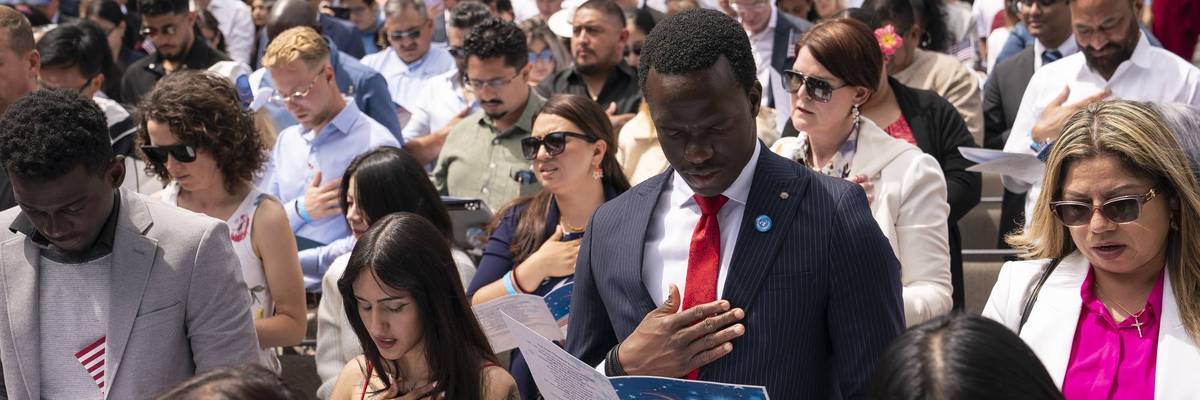
Participants recite the Pledge of Allegiance during a naturalization ceremony for new U.S. citizens at Seattle Center on July 4, 2025 in Seattle, Washington. The annual event drew hundreds of participants from approximately 80 countries.
I have walked into hundreds of naturalization ceremonies with immigrants. I have always walked out with Americans.
A democracy that makes citizenship harder to reach should not pretend it is merely managing paperwork. It is deciding who gets full political voice.
I have attended naturalization ceremonies for more than three decades. I have watched courtrooms fill with nurses, engineers, truck drivers, scientists, caregivers, parents holding young children, and older immigrants who waited years to hear one sentence that would change their lives.
Before administering the Oath of Allegiance, judges often remind new citizens that American citizenship is about more than receiving a certificate or passport. It is about responsibility — to vote, serve on juries, obey the law, participate in civic life, defend the Constitution, and leave America stronger than they found it.
That reminder captures something we too often forget. Citizenship is not just a collection of rights. It is freedom joined to duty, opportunity joined to service, and belonging joined to responsibility.
A door that only the wealthy, the fluent, the well-connected, or the legally sophisticated can navigate is not truly open.
Unlike those of us fortunate enough to be born here, every person in that courtroom made a conscious decision.
They chose America.
As the United States approaches its 250th birthday, we should ask whether we still understand the power of that choice. One of America’s greatest accomplishments has not simply been welcoming immigrants. It has been making Americans.
Those are not the same thing.
The earliest naturalization laws reflected the exclusions and prejudices of their time. But America also preserved a revolutionary idea: a person born somewhere else could become fully American through allegiance to the Constitution and commitment to the Republic.
Naturalization was never just an immigration process. It was a democracy-building process.
Today, more than 9 million lawful permanent residents are already eligible to become American citizens. They are nurses, entrepreneurs, teachers, engineers, factory workers, researchers, caregivers, veterans, farmworkers, small-business owners, and neighbors. They pay taxes, raise families, volunteer, worship, organize, serve, and build communities.
They have already invested in America. Now they are asking to invest even more deeply.
But at the very moment America should be inviting eligible immigrants into full civic membership, the government is moving in the opposite direction.
The Department of Homeland Security has proposed raising the naturalization application fee from $760 to $1,330 for paper filings and from $710 to $1,280 for online filings — roughly a 75% to 80% increase. The proposal would also eliminate the reduced filing fee option and the availability of fee waivers for Form N-400.
That is not a small administrative adjustment. For many working families, it is the difference between applying now and postponing citizenship for years.
The real cost of naturalization is not just the government filing fee. It is lost wages, transportation, child care, English classes, document costs, legal help, and the anxiety of navigating a system that too often feels designed for the fluent, the wealthy, and the legally sophisticated.
For a nurse working double shifts, a home health aide caring for elders, a farmworker, a refugee parent, an elderly green-card holder, or a veteran’s spouse, the path to citizenship can become a gauntlet: higher fees, longer waits, more forms, more documentation, more scrutiny, and more fear that one mistake could derail everything.
A democracy should not celebrate citizenship in speeches while making it harder to obtain in practice.
The way we talk about naturalization matters.
For much of our history, becoming a citizen was understood as the successful completion of the immigrant journey. Today, the language too often sounds like it came from a risk-management manual: cost recovery, fraud prevention, compliance, security screening, background review, discretion.
Each of those concerns has its place. But when they become the only language we use, the future citizen slowly becomes a file, a cost, a risk, or a problem to manage instead of what he or she truly is: a future American.
A confident nation can protect the integrity of citizenship while still encouraging qualified immigrants to become citizens. A fearful nation raises costs, increases complexity, lengthens delays, narrows relief, expands suspicion, and then pretends the door is still open because it has not been formally locked.
But a door that only the wealthy, the fluent, the well-connected, or the legally sophisticated can navigate is not truly open.
When we make citizenship harder to reach, we do not just burden immigrants. We weaken democracy.
Every new citizen is a potential voter, juror, volunteer, parent advocate, union member, school-board participant, taxpayer, entrepreneur, caregiver, and community leader. Naturalization does not dilute the Republic. It strengthens it.
We should not reduce citizenship to a user fee. We should not treat qualified future citizens as customers purchasing a private benefit from government. Citizenship is different. It is the mechanism by which a democracy renews itself.
This does not mean abandoning standards. It means remembering the purpose of the standards. The goal is not to make citizenship feel like a privilege reserved for those who can survive an expensive bureaucratic maze. The goal is to welcome qualified immigrants into full participation in American civic life.
Congress and the administration should treat naturalization as civic infrastructure: protect fee waivers, invest in timely processing, expand language access, support community-based citizenship programs, simplify forms and procedures, and celebrate naturalization as one of the most important acts of democratic renewal this country performs.
At a time when Americans worry about democracy, it is remarkable that millions of people are still waiting for the chance to raise their hands, take the oath, and accept the responsibilities of American citizenship. We should not make that harder. We should honor it.
Over the years, I have watched refugees become election poll workers, veterans become citizens of the country they served, and parents beam with pride as they introduced themselves — for the very first time — as Americans.
I have walked into naturalization ceremonies with immigrants. I have always walked out with Americans.
As America turns 250, Congress should ask a larger question than how much a citizenship application should cost.
It should ask: What is a new American worth?
Every generation inherits the American experiment. Every generation decides whether to strengthen it or merely administer it. Our generation has a quieter but urgent responsibility: to remember that citizenship is not merely something government processes. It is something a great democracy cultivates.
I have never left a naturalization ceremony believing America had become less American.
I have only left believing America had become stronger.
Dear Common Dreams reader, It’s been nearly 30 years since I co-founded Common Dreams with my late wife, Lina Newhouser. We had the radical notion that journalism should serve the public good, not corporate profits. It was clear to us from the outset what it would take to build such a project. No paid advertisements. No corporate sponsors. No millionaire publisher telling us what to think or do. Many people said we wouldn't last a year, but we proved those doubters wrong. Together with a tremendous team of journalists and dedicated staff, we built an independent media outlet free from the constraints of profits and corporate control. Our mission has always been simple: To inform. To inspire. To ignite change for the common good. Building Common Dreams was not easy. Our survival was never guaranteed. When you take on the most powerful forces—Wall Street greed, fossil fuel industry destruction, Big Tech lobbyists, and uber-rich oligarchs who have spent billions upon billions rigging the economy and democracy in their favor—the only bulwark you have is supporters who believe in your work. But here’s the urgent message from me today. It's never been this bad out there. And it's never been this hard to keep us going. At the very moment Common Dreams is most needed, the threats we face are intensifying. We need your support now more than ever. We don't accept corporate advertising and never will. We don't have a paywall because we don't think people should be blocked from critical news based on their ability to pay. Everything we do is funded by the donations of readers like you. When everyone does the little they can afford, we are strong. But if that support retreats or dries up, so do we. Will you donate now to make sure Common Dreams not only survives but thrives? —Craig Brown, Co-founder |
A democracy that makes citizenship harder to reach should not pretend it is merely managing paperwork. It is deciding who gets full political voice.
I have attended naturalization ceremonies for more than three decades. I have watched courtrooms fill with nurses, engineers, truck drivers, scientists, caregivers, parents holding young children, and older immigrants who waited years to hear one sentence that would change their lives.
Before administering the Oath of Allegiance, judges often remind new citizens that American citizenship is about more than receiving a certificate or passport. It is about responsibility — to vote, serve on juries, obey the law, participate in civic life, defend the Constitution, and leave America stronger than they found it.
That reminder captures something we too often forget. Citizenship is not just a collection of rights. It is freedom joined to duty, opportunity joined to service, and belonging joined to responsibility.
A door that only the wealthy, the fluent, the well-connected, or the legally sophisticated can navigate is not truly open.
Unlike those of us fortunate enough to be born here, every person in that courtroom made a conscious decision.
They chose America.
As the United States approaches its 250th birthday, we should ask whether we still understand the power of that choice. One of America’s greatest accomplishments has not simply been welcoming immigrants. It has been making Americans.
Those are not the same thing.
The earliest naturalization laws reflected the exclusions and prejudices of their time. But America also preserved a revolutionary idea: a person born somewhere else could become fully American through allegiance to the Constitution and commitment to the Republic.
Naturalization was never just an immigration process. It was a democracy-building process.
Today, more than 9 million lawful permanent residents are already eligible to become American citizens. They are nurses, entrepreneurs, teachers, engineers, factory workers, researchers, caregivers, veterans, farmworkers, small-business owners, and neighbors. They pay taxes, raise families, volunteer, worship, organize, serve, and build communities.
They have already invested in America. Now they are asking to invest even more deeply.
But at the very moment America should be inviting eligible immigrants into full civic membership, the government is moving in the opposite direction.
The Department of Homeland Security has proposed raising the naturalization application fee from $760 to $1,330 for paper filings and from $710 to $1,280 for online filings — roughly a 75% to 80% increase. The proposal would also eliminate the reduced filing fee option and the availability of fee waivers for Form N-400.
That is not a small administrative adjustment. For many working families, it is the difference between applying now and postponing citizenship for years.
The real cost of naturalization is not just the government filing fee. It is lost wages, transportation, child care, English classes, document costs, legal help, and the anxiety of navigating a system that too often feels designed for the fluent, the wealthy, and the legally sophisticated.
For a nurse working double shifts, a home health aide caring for elders, a farmworker, a refugee parent, an elderly green-card holder, or a veteran’s spouse, the path to citizenship can become a gauntlet: higher fees, longer waits, more forms, more documentation, more scrutiny, and more fear that one mistake could derail everything.
A democracy should not celebrate citizenship in speeches while making it harder to obtain in practice.
The way we talk about naturalization matters.
For much of our history, becoming a citizen was understood as the successful completion of the immigrant journey. Today, the language too often sounds like it came from a risk-management manual: cost recovery, fraud prevention, compliance, security screening, background review, discretion.
Each of those concerns has its place. But when they become the only language we use, the future citizen slowly becomes a file, a cost, a risk, or a problem to manage instead of what he or she truly is: a future American.
A confident nation can protect the integrity of citizenship while still encouraging qualified immigrants to become citizens. A fearful nation raises costs, increases complexity, lengthens delays, narrows relief, expands suspicion, and then pretends the door is still open because it has not been formally locked.
But a door that only the wealthy, the fluent, the well-connected, or the legally sophisticated can navigate is not truly open.
When we make citizenship harder to reach, we do not just burden immigrants. We weaken democracy.
Every new citizen is a potential voter, juror, volunteer, parent advocate, union member, school-board participant, taxpayer, entrepreneur, caregiver, and community leader. Naturalization does not dilute the Republic. It strengthens it.
We should not reduce citizenship to a user fee. We should not treat qualified future citizens as customers purchasing a private benefit from government. Citizenship is different. It is the mechanism by which a democracy renews itself.
This does not mean abandoning standards. It means remembering the purpose of the standards. The goal is not to make citizenship feel like a privilege reserved for those who can survive an expensive bureaucratic maze. The goal is to welcome qualified immigrants into full participation in American civic life.
Congress and the administration should treat naturalization as civic infrastructure: protect fee waivers, invest in timely processing, expand language access, support community-based citizenship programs, simplify forms and procedures, and celebrate naturalization as one of the most important acts of democratic renewal this country performs.
At a time when Americans worry about democracy, it is remarkable that millions of people are still waiting for the chance to raise their hands, take the oath, and accept the responsibilities of American citizenship. We should not make that harder. We should honor it.
Over the years, I have watched refugees become election poll workers, veterans become citizens of the country they served, and parents beam with pride as they introduced themselves — for the very first time — as Americans.
I have walked into naturalization ceremonies with immigrants. I have always walked out with Americans.
As America turns 250, Congress should ask a larger question than how much a citizenship application should cost.
It should ask: What is a new American worth?
Every generation inherits the American experiment. Every generation decides whether to strengthen it or merely administer it. Our generation has a quieter but urgent responsibility: to remember that citizenship is not merely something government processes. It is something a great democracy cultivates.
I have never left a naturalization ceremony believing America had become less American.
I have only left believing America had become stronger.
A democracy that makes citizenship harder to reach should not pretend it is merely managing paperwork. It is deciding who gets full political voice.
I have attended naturalization ceremonies for more than three decades. I have watched courtrooms fill with nurses, engineers, truck drivers, scientists, caregivers, parents holding young children, and older immigrants who waited years to hear one sentence that would change their lives.
Before administering the Oath of Allegiance, judges often remind new citizens that American citizenship is about more than receiving a certificate or passport. It is about responsibility — to vote, serve on juries, obey the law, participate in civic life, defend the Constitution, and leave America stronger than they found it.
That reminder captures something we too often forget. Citizenship is not just a collection of rights. It is freedom joined to duty, opportunity joined to service, and belonging joined to responsibility.
A door that only the wealthy, the fluent, the well-connected, or the legally sophisticated can navigate is not truly open.
Unlike those of us fortunate enough to be born here, every person in that courtroom made a conscious decision.
They chose America.
As the United States approaches its 250th birthday, we should ask whether we still understand the power of that choice. One of America’s greatest accomplishments has not simply been welcoming immigrants. It has been making Americans.
Those are not the same thing.
The earliest naturalization laws reflected the exclusions and prejudices of their time. But America also preserved a revolutionary idea: a person born somewhere else could become fully American through allegiance to the Constitution and commitment to the Republic.
Naturalization was never just an immigration process. It was a democracy-building process.
Today, more than 9 million lawful permanent residents are already eligible to become American citizens. They are nurses, entrepreneurs, teachers, engineers, factory workers, researchers, caregivers, veterans, farmworkers, small-business owners, and neighbors. They pay taxes, raise families, volunteer, worship, organize, serve, and build communities.
They have already invested in America. Now they are asking to invest even more deeply.
But at the very moment America should be inviting eligible immigrants into full civic membership, the government is moving in the opposite direction.
The Department of Homeland Security has proposed raising the naturalization application fee from $760 to $1,330 for paper filings and from $710 to $1,280 for online filings — roughly a 75% to 80% increase. The proposal would also eliminate the reduced filing fee option and the availability of fee waivers for Form N-400.
That is not a small administrative adjustment. For many working families, it is the difference between applying now and postponing citizenship for years.
The real cost of naturalization is not just the government filing fee. It is lost wages, transportation, child care, English classes, document costs, legal help, and the anxiety of navigating a system that too often feels designed for the fluent, the wealthy, and the legally sophisticated.
For a nurse working double shifts, a home health aide caring for elders, a farmworker, a refugee parent, an elderly green-card holder, or a veteran’s spouse, the path to citizenship can become a gauntlet: higher fees, longer waits, more forms, more documentation, more scrutiny, and more fear that one mistake could derail everything.
A democracy should not celebrate citizenship in speeches while making it harder to obtain in practice.
The way we talk about naturalization matters.
For much of our history, becoming a citizen was understood as the successful completion of the immigrant journey. Today, the language too often sounds like it came from a risk-management manual: cost recovery, fraud prevention, compliance, security screening, background review, discretion.
Each of those concerns has its place. But when they become the only language we use, the future citizen slowly becomes a file, a cost, a risk, or a problem to manage instead of what he or she truly is: a future American.
A confident nation can protect the integrity of citizenship while still encouraging qualified immigrants to become citizens. A fearful nation raises costs, increases complexity, lengthens delays, narrows relief, expands suspicion, and then pretends the door is still open because it has not been formally locked.
But a door that only the wealthy, the fluent, the well-connected, or the legally sophisticated can navigate is not truly open.
When we make citizenship harder to reach, we do not just burden immigrants. We weaken democracy.
Every new citizen is a potential voter, juror, volunteer, parent advocate, union member, school-board participant, taxpayer, entrepreneur, caregiver, and community leader. Naturalization does not dilute the Republic. It strengthens it.
We should not reduce citizenship to a user fee. We should not treat qualified future citizens as customers purchasing a private benefit from government. Citizenship is different. It is the mechanism by which a democracy renews itself.
This does not mean abandoning standards. It means remembering the purpose of the standards. The goal is not to make citizenship feel like a privilege reserved for those who can survive an expensive bureaucratic maze. The goal is to welcome qualified immigrants into full participation in American civic life.
Congress and the administration should treat naturalization as civic infrastructure: protect fee waivers, invest in timely processing, expand language access, support community-based citizenship programs, simplify forms and procedures, and celebrate naturalization as one of the most important acts of democratic renewal this country performs.
At a time when Americans worry about democracy, it is remarkable that millions of people are still waiting for the chance to raise their hands, take the oath, and accept the responsibilities of American citizenship. We should not make that harder. We should honor it.
Over the years, I have watched refugees become election poll workers, veterans become citizens of the country they served, and parents beam with pride as they introduced themselves — for the very first time — as Americans.
I have walked into naturalization ceremonies with immigrants. I have always walked out with Americans.
As America turns 250, Congress should ask a larger question than how much a citizenship application should cost.
It should ask: What is a new American worth?
Every generation inherits the American experiment. Every generation decides whether to strengthen it or merely administer it. Our generation has a quieter but urgent responsibility: to remember that citizenship is not merely something government processes. It is something a great democracy cultivates.
I have never left a naturalization ceremony believing America had become less American.
I have only left believing America had become stronger.