"We've had 30 years of free trade agreements and bilateral investment treaties," points out Luciana Ghiotto, a researcher at CONICET-Argentina and associate researcher with the Transnational Institute. "They've created this enormous legal architecture, what one friend of ours calls the ‘corporate architecture of impunity,' which has spread like grass and gives legal security and certainty to capital. It has nothing to do with the protection of human rights or environmental rights."
Indeed, among the many problems associated with the expansion of world trade has been environmental degradation in the form of land, air, and water pollution. More recently, however, attention has turned to the more specific problem of carbon emissions, which are largely responsible for climate change. According to the World Trade Organization, the production and transport of goods for export and import account for 20-30% of global carbon emissions.
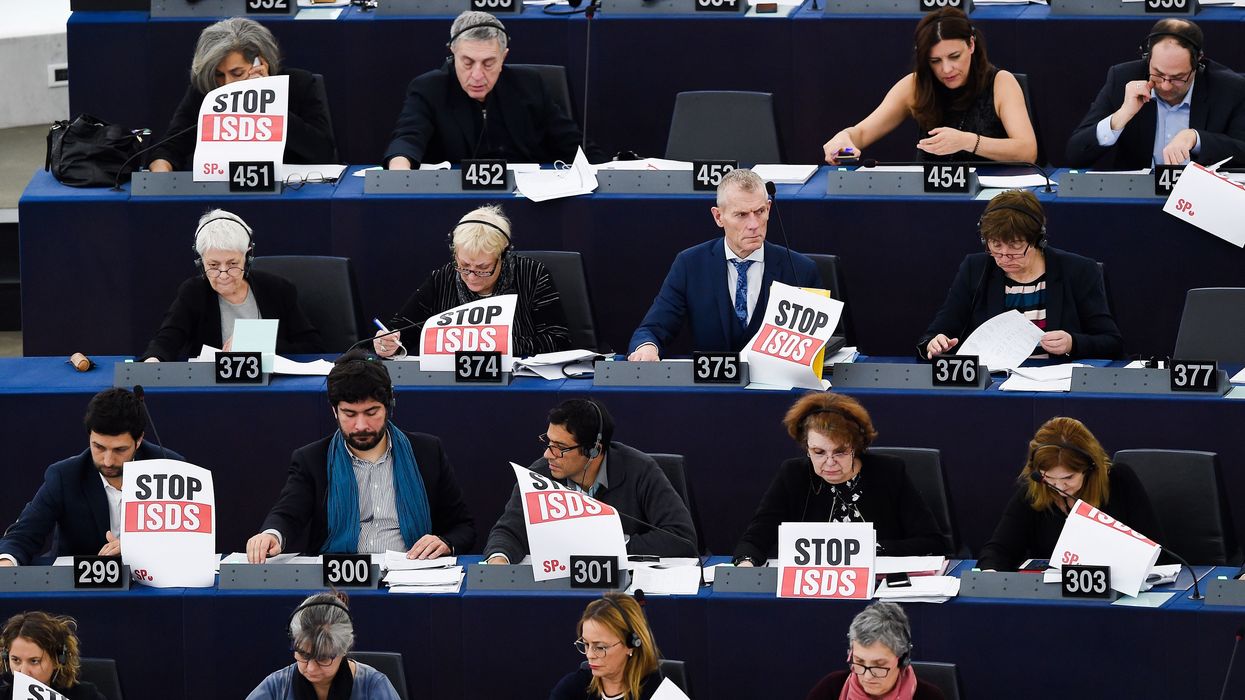
Embedded in many of the treaties governing trade and investment are clauses that give corporations the right to sue governments over regulations, particularly those addressing the environment and climate change, that adversely affect the expected profit margins of those businesses. These investor-state dispute settlement (ISDS) provisions have a "chilling effect on the regulatory system because governments, worried that they will be sued, decide to delay reforms related to climate change," points out Manuel Perez Rocha, an associate fellow of the Institute for Policy Studies in Washington. "There have been several cases around the world where companies were able to defeat regulatory changes that favor the climate."
Trade rules that privilege corporations over the environment are particularly influential in the realm of agriculture, which is an extractive industry no less powerful than mining.
"The global system of trade and investment contributes to the monopoly control by just a few transnational corporations over fossil fuel-guzzling agribusiness, whose products are often transported thousands of miles before they reach a dinner table," relates Jen Moore, an associate fellow at the Institute for Policy Studies. "At the same time. the system has been decisive in making the lives of millions of small-scale farmers more precarious, undermining their role as a better alternative to mass monoculture operations."
Carbon emissions are not the only byproduct of the agribusiness that global trade sustains. "There's also methane emissions," adds Karen Hansen-Kuhn, program director at the Institute for Agriculture & Trade Policy. "A lot of methane comes from meat production. Nitrous oxide, which is 265 times more potent than carbon and stays in the atmosphere over 100 years, results from chemical fertilizers."
These perspectives on global trade—and more environmentally sound alternatives to the "free trade" model—were presented at a December 2022 webinar sponsored by Global Just Transition project of the Institute for Policy Studies and the Ecosocial and Intercultural Pact of the South.
The Rise of "Free Trade"
Throughout the modern era, states throughout the world protected their domestic economies through tariffs on foreign goods and restrictions on foreign investment. Behind these protective walls, states helped local farmers and businesses compete against cheaper imports and deep-pocketed investors.
But states that depended increasingly on exports of cheap industrial goods and surplus food—aided by transnational companies eager to boost their profits—lobbied for the reduction of these barriers. Arguments for "free trade," traditionally linked to the presumed benefits of globalization, emerged within the most powerful economies in the nineteenth century, but it was more recently, in the 1970s, that states and international institutions dramatically revived this discourse under the banner of "neoliberalism."
"When we talk about the circulation of capital, we're talking about trade," explains Luciana Ghiotto. "That is, import and export for states and the circulation of thousands of vessels and planes for the transport of commodities all around the world. One of the aims of capital is to make that circulation faster, simpler, and easier. Who would not want to make trade easier or faster? Well, the state."
Faster and more efficient trade, while more profitable for corporations, also has meant a number of negative consequences for states such as job loss among domestic producers. Because of the wide array of free trade agreements and bilateral investment treaties now in force—and the power invested in international bodies to enforce these agreements—states have lost many of the tools they once used to protect or develop national industries.
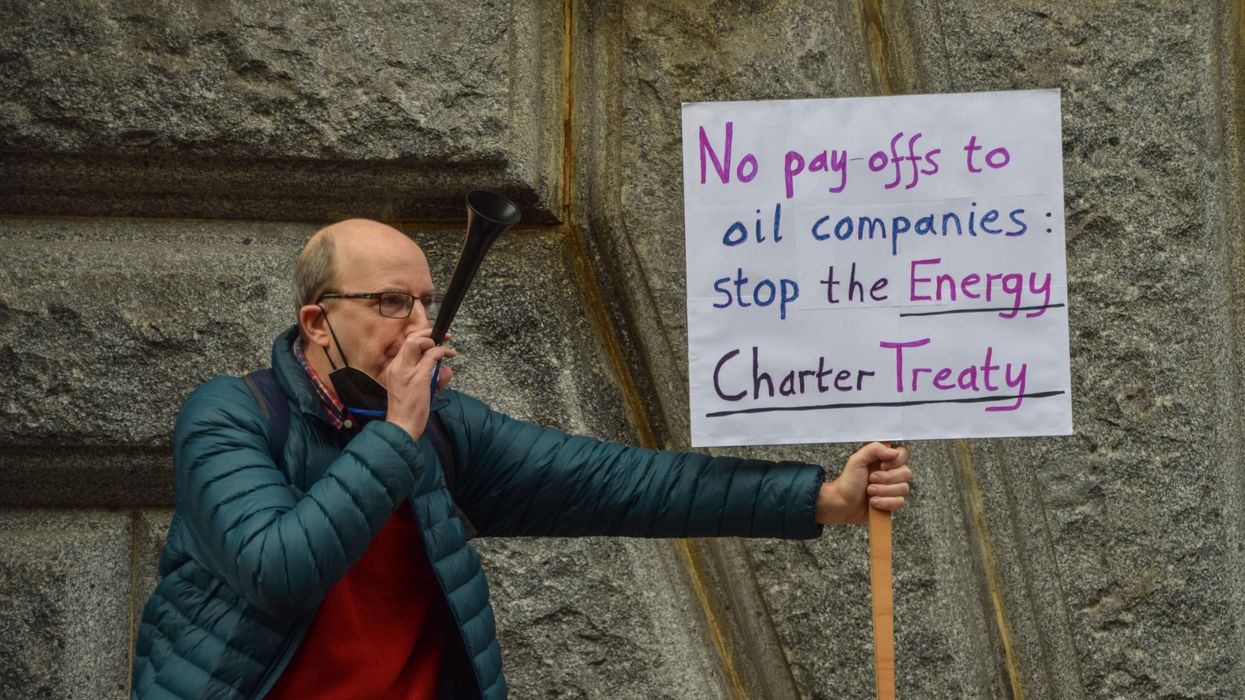
The spread of the free-trade orthodoxy has had a major impact on the energy industry, which has in turn pushed up carbon emissions. Ghiotto points to the efforts of fossil-fuel corporations to protect their investments in Russia after the collapse of the Soviet Union as a primary motivation to negotiate an Energy Charter Treaty (ECT) in the early 1990s, which guaranteed a free trade in global energy markets. The ECT was originally signed by 53 European and Central Asian countries. Today, another 30 countries from Burundi to Pakistan are in the queue for membership.
"The ECT is actually a treaty made specially to protect fossil fuel Industries," Ghiotto continues. "It's already been used by investors to protect their investments in the face of state policies. But that was 30 years ago. Now, because of the global climate crisis, states are pushing for other kinds of regulations that are jeopardizing the investments of these corporations."
Energy companies have taken states to dispute settlement in 124 cases, with around 50 against Spain alone because of its reforms in the renewable energy sector. Companies "have used the ECT as a legal umbrella in order to increase business and profits, or simply to protect their investments against state regulation," Ghiotto adds. Italy, for instance, instituted a ban on offshore drilling only to be hit by a suit from the U.K. energy company Rockhopper. In November 2022, the ECT arbitration panel ordered the Italian government to pay the company 190 million Euros plus interest.
"Investors in the mining and oil sector have launched 22% of the claims against Latin American states," she reports. "There was the big case of Chevron against Ecuador. But there have been others. For instance, Ecuador had to pay a $374 million penalty to the French oil company Parenco after the state changed some clauses regarding the amount of taxes the company had to pay in order to give back some of the revenues to the Ecuadorian people."
Agriculture and Climate Change
Global food production generates 17 billion tons of greenhouse gasses every year. That's about a third of the 50 billion tons of such gasses emitted annually. The production of beef and cow milk are the worst offenders, largely because of the methane that's released by the animals themselves. But other major contributors include soil tillage, manure management, transportation, and fertilizer.
"Along with Greenpeace and Grain, our institute has been working with scientists to think about how increased fertilizer use is affecting climate change," Karen Hansen-Kuhn reports. "Fertilizer use has been increasing all over the world. It's a key part of Green Revolution practices. The scientists we worked with found that the use of nitrogen fertilizer, bringing together the natural gas and the energy used in production along with transportation and the impacts in the field, amounts to more than 21% of emissions from agriculture, and it's been growing."
According to a map of excess nitrogen per hectare of cropland, countries like China, Netherlands, Saudi Arabia, Pakistan, Egypt, and Venezuela are using more nitrogen for fertilizers than the crops can even absorb. "This excess contributes to more emissions and causes other problems, for instance with run-off into waterways," she continues. "The incentives right now in the agricultural system are for extreme overproduction, especially around commodity crops, like corn, soybeans, and wheat, which require these cheap chemical inputs."
Many of these commodity crops are produced for export. Netherlands is the world's second-largest exporter of food; China is the second-largest importer of food but also the sixth larger exporter. The challenge is to continue to feed the world while reducing the use of so much fertilizer. "Many countries are advancing important agroecological solutions like crop rotation, using plants that fix nitrogen in the soil, and doing more composting," Hansen-Kuhn adds. "These techniques are under the control of farmers, so they don't rely on imports or trade in these chemical inputs."
Another strategy, embraced by the European Union, has been to use trade rules to reduce the carbon content of imports and exports. "In Europe, they are currently in the process of finalizing a Carbon Border Adjustment Mechanism," she reports. "The CBAM mostly applies to things like aluminum, steel, and cement, but fertilizer is part of it as well. A lot of firms in Europe are modernizing their plants so they'll be more energy efficient. And they say they need protection in order to do that. Under this plan, fertilizer imports coming from other countries that don't have the same environmental standards would be subject to a fee tied to the price of carbon."
In theory, the CBAM would push exporting countries to raise their environmental standards and/or make their fertilizer production more efficient. "Maybe these plants will become more efficient," she adds. "But maybe some firms will just decide to produce fertilizer in other countries. Or maybe in cases where a country has two factories, it will just export from the efficient factory, and there's no change in emissions."
On top of that, the CBAM will affect countries very differently. "Most of the fertilizer imports into the E.U. come from nearby countries like Russia or Egypt," she continues. "But some imports come from countries like Senegal, where the fertilizer exports to Europe amount to 2-5% of their entire GDP. So, the CBAM would be a huge problem for such countries. And there's nothing in this initiative that would give countries the technology they need to make changes. In fact, there are strong incentives against that in the trade deals. The CBAM provision specifically says that all of the resources generated by the carbon fee will be kept internally to foster the transition within Europe."
Although CBAM may make European trade greener, it may also widen the "green gap" between Europe and the rest of the world. "We need a transition to agroecology, but what we're getting in the trade deals lock in new incentives to continue with business as usual," Hansen-Kuhn concludes. "If we look at the renegotiated NAFTA, there's a new chapter on agricultural biotechnology that streamlines the process for approving both GMOs and products of gene editing. There are also restrictions on seed saving and sharing. And this new NAFTA will probably be the model for other agreements like the Indo-Pacific Economic Framework."
Action at the Global Level
Civil society organizations have been pushing for a legally binding treaty at the U.N. level to make business responsible for human rights violations and environmental crimes connected to their operations.
"Since the U.N. is made up of states, the more industrialized countries who can invest in the world are opposed to such a binding treaty," Luciana Ghiotto points out. "In the United States, Canada, and Japan, we've seen debates about holding companies responsible for human rights violations throughout the production chain. It's a relatively new political process. But it's an example of civil society organizations putting a question of human rights and environmental rights at the center of discussion."
Efforts at the international level are very complicated, Manuel Perez Rocha concedes: "For instance, the World Bank has the International Centre for the Settlement of Investment Disputes (ICSID) through which corporations can sue states." He recommends a more regional approach. "We have proposed a dispute resolution center for Latin America that countries could use after pulling out of ICSID. "Unfortunately, most progressive countries have not embraced this," he reports.
One of the challenges to persuading governments to embrace these alternatives is corruption. "There's a tremendous circle of corruption," he adds. "We're talking here about the revolving door where public officials who negotiate these treaties then become private lawyers or counselors or board members of the corporations who are lobbying for their adoption. This corruption helps explain why governments sign these treaties even if they're going to be sued."
He points as well to the issue of access to critical minerals needed in the green energy transition. "The Biden administration is trying to combat fossil fuels at the cost of communities that live around the deposits of critical minerals like lithium and cobalt," Perez Rocha explains. "There are a lot of concerns among native populations about how to make this transition to a so-called clean economy without violating human rights and destroying the environment."
Trade has been a mechanism to make deals around these minerals. "These efforts at near-shoring and friend-shoring have been ways to control the supply chains around minerals and metals," notes Jen Moore. "The United States in particular but also Canada have made themselves clear: to be identified as a 'friend' is to have an FTA or a bilateral investment treaty."
There have been other actions at the global level related to climate issues and jobs. For instance, the United States brought action against India in the WTO in 2014 over domestic content provisions in its effort to boost solar energy. India returned the favor two years later over similar domestic content provisions in state-level solar policy. "The WTO deemed both rules illegal," Karen Hansen-Kuhn recalls. "In the United States, the programs continued, I don't think any changes were made. But when we think of a just transition, it has to be about not just reducing emissions but about creating jobs."
Resistance to Business as Usual
Resistance to the corporate-friendly trade architecture has come from many corners of the globe. "From the perspective of my work with mining-affected people," Jen Moore reports, "there's been a rise in resistance from farmers, indigenous peoples, and other communities facing the detrimental Impacts of this highly destructive model of capitalist development that's been accompanied by violent repression and militarization and often targeted violence against land and environment defenders."
For example, after buttressing the fossil fuel status quo for three decades, the Energy Charter Treaty is no longer unassailable. In November, the German cabinet announced that the country would withdraw from the ECT. It joins a number of European countries—Italy, France, the Netherlands, Poland, Spain, Slovenia, and Luxembourg—that have made similar announcements. "In times of climate crisis, it is absurd that companies can sue for lost profits from fossil investments and compensation for coal and nuclear phase-outs," points out the deputy leader of the parliamentary group of the Greens in the German parliament.
The treaty has a surprise for countries that want out: signatories withdrawing from the ECT are still bound by the treaty for 20 years. There's also a related problem involving the provisions of other trade treaties.
"European countries are pushing to update treaties with Mexico, Chile, and others to include clauses like the investor-state dispute mechanism, which also allow energy corporations to sue governments," notes Manuel Perez Rocha. "This is nothing short of neocolonialism being exercised against countries on the periphery." In response, he urges the "strengthening of national judicial systems so that companies will feel more protected by national systems and not pursue options at the supranational level."
The backlash to the ECT is nothing new. "The system has created a lot of resistance and critiques since practically day one," Luciana Ghiotto adds. "I was raised in the spotlight of the battle of Seattle in 1999 against the WTO and the struggles against the Free Trade Area of the Americas."
Karen Hansen-Kuhn agrees that it's necessary to claim victories. "Civil society helped weaken the ISDS system," she notes. "With the Transatlantic Trade and Investment Partnership, massive opposition to ISDS was a major reason it fell apart.."
Another form of pushback comes from the field itself. "On our website, we've started tracking the adoption of agroecological approaches, which are not just about the inputs but instead look at the fuller picture including food sovereignty, namely each community's right to choose the food systems it wants," Hansen-Kuhn continues. She points to Mexico phasing out GMO corn, which relies heavily on the pesticide glyphosate. The government made that decision because of input from civic movements. After objections from the U.S. government, Mexico backtracked somewhat on that commitment by applying the phase-out only to corn for human consumption.
"Mexico is making some concessions, for example allowing GMO for animal feed, but otherwise it's standing firm despite enormous pressure," she concludes. "That's not a complete transition to agroecology, but here's a country deciding that it will make a change in a food system regardless of what the trade deals say."
"It's important to recall the totality of the system supporting corporate control around the world," Jen Moore says. "Sometimes it feels like we make only piecemeal attempts to go after it."
Manuel Perez Rocha agrees. "We need to discuss alternatives from different perspectives, which would put an end to the patriarchal, neocolonial capitalist system," he suggests. "But while we strive for a utopian vision, we also should discuss more realistic, more feasible, and more concrete alternatives. For instance, companies can sue states. Why shouldn't states have the right to sue companies? Affected communities should also have access to dispute resolutions. We should eliminate the privileges of foreign investors, like the 'national treatment' clause, that tie governments down in their efforts to promote local, regional, and national development."
The Global South has begun to develop a unified voice in the debate on a just energy transition. "In Latin America, we have said that there is no new green deal with FTAs and bilateral investment treaties," Luciana Ghiotto reports. The region has seen the rise of a number of dynamic organizations from the rural activists in Via Campesina to various indigenous movements and feminist movements articulating a feminist economy. Meanwhile, certain countries have taken the lead. "In its constitution, Ecuador prohibited entry into any international agreements that include international arbitration that compromises the country's sovereignty," she adds. "The new neoliberal government is struggling with dozens of lawyers to find a way around it, but they still can't."
Another example of successful resistance is the growth of the climate justice movement, which goes well beyond environmental protection and has linked activists across struggles from economic justice and human rights to agroecology and post-growth economics.
"After the disruptions of the last couple years, we can come together more in person," Karen Hansen-Kuhn notes. "Movements require building relationships in person. We need to come together to build these alternatives."