SUBSCRIBE TO OUR FREE NEWSLETTER
Daily news & progressive opinion—funded by the people, not the corporations—delivered straight to your inbox.
5
#000000
#FFFFFF
To donate by check, phone, or other method, see our More Ways to Give page.
Daily news & progressive opinion—funded by the people, not the corporations—delivered straight to your inbox.
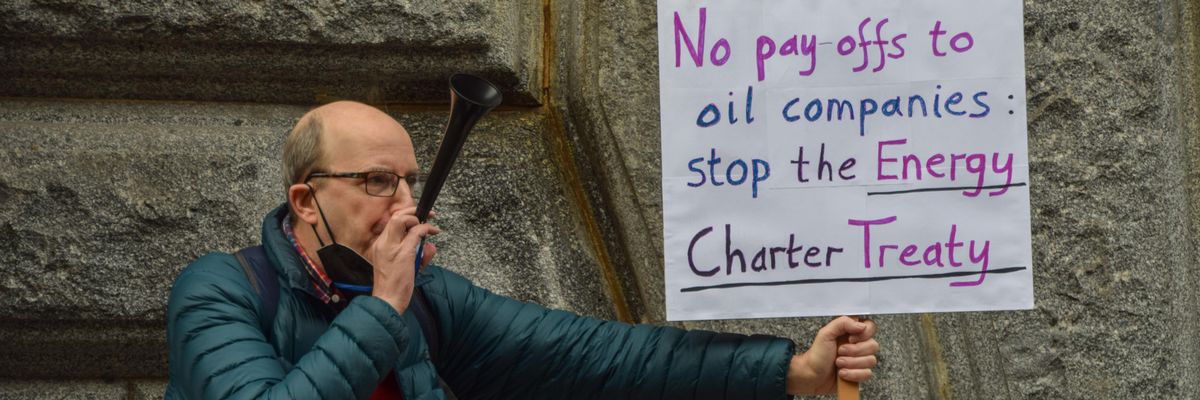
A protester holds a placard calling for the abolition of the Energy Charter Treaty during a Global Day of Action for Climate Justice demonstration in London on November 6, 2021.
"The Energy Charter Treaty was a major barrier to the progress of a just transition," said one climate action group. "Good riddance!"
The United Kingdom's decision to exit a 30-year-old fossil fuel-friendly treaty will "untie a straitjacket" on the country's ability to ensure a just transition toward renewable energy, said one campaign group on Thursday.
Officials announced that after two years of negotiations regarding a modernization of the 1994 Energy Charter Treaty (ECT)—which allows fossil fuel companies to sue governments over profits lost due to climate policies that reduce the use of coal, oil, and gas—the U.K. will leave the treaty due to a stalemate.
The U.K., which plans to achieve net-zero fossil fuel emissions by 2050, helped broker a deal in 2022 that would have included protections for a transition to renewable energy sources while maintaining the ECT's investor-state dispute settlement (ISDS) mechanism, which permits the fossil fuel lawsuits.
"The Energy Charter Treaty is outdated and in urgent need of reform, but talks have stalled and sensible renewal looks increasingly unlikely," said Graham Stuart, the energy security and net zero minister for the U.K. "Remaining a member would not support our transition to cleaner, cheaper energy, and could even penalize us for our world-leading efforts to deliver net zero."
Social justice group Global Justice Now noted that Britons "up and down the country have campaigned tirelessly" to end the U.K.'s participation in the treaty.
"Huge congratulations to all the campaigners who have pushed so hard for this for so long," added Fossil Free Parliament. "The Energy Charter Treaty was a major barrier to the progress of a just transition. Good riddance!"
An estimated 60% of decisions by tribunals set up by the ECT favor fossil fuel companies, and the treaty has allowed energy companies to sue the Netherlands for $2.6 billion to compensate for their losses stemming from the Dutch government's planned coal phaseout. A U.K. company also sued Italy for $237 million for banning it from drilling an oil field in the Adriatic Sea.
"The ECT is now a dead man walking, and only those profiting from the destruction of our planet will mourn its passing," said Cleodie Rickard, trade campaigns manager for Global Justice Now. "However, the mechanism in the ECT which made it so deadly—the investor-state dispute settlement provisions—lives on in a number of other treaties... With ISDS's legitimacy crumbling, now is the time to scrap this system."
The U.K.'s decision comes three months after more than 200 civil society groups called on U.S. President Joe Biden to dismantle the ISDS mechanism within the Americas Partnership for Economic Prosperity (APEP), a trade agreement between the U.S. and 11 countries in Central and South America and the Caribbean.
Nine E.U. member states have recently withdrawn from the ECT, including France, Spain, and the Netherlands.
On Tuesday, E.U. energy ministers held a technical meeting on a proposal for all 27 member states to exit the treaty en masse; an agreement could be reached on the plan by next month.
"As it stands, the treaty is not in line with the E.U.'s energy and climate goals and with the E.U.'s investment policy and law," a spokesperson for the European Commission told The Guardian. "Despite the commission's successful negotiating efforts with international partners to update the treaty, it was not possible for member states to find the necessary majority to approve the modernized treaty. We therefore proposed that the E.U., its member states, and Euratom withdraw from the ECT in a coordinated and orderly manner."
Dear Common Dreams reader, It’s been nearly 30 years since I co-founded Common Dreams with my late wife, Lina Newhouser. We had the radical notion that journalism should serve the public good, not corporate profits. It was clear to us from the outset what it would take to build such a project. No paid advertisements. No corporate sponsors. No millionaire publisher telling us what to think or do. Many people said we wouldn't last a year, but we proved those doubters wrong. Together with a tremendous team of journalists and dedicated staff, we built an independent media outlet free from the constraints of profits and corporate control. Our mission has always been simple: To inform. To inspire. To ignite change for the common good. Building Common Dreams was not easy. Our survival was never guaranteed. When you take on the most powerful forces—Wall Street greed, fossil fuel industry destruction, Big Tech lobbyists, and uber-rich oligarchs who have spent billions upon billions rigging the economy and democracy in their favor—the only bulwark you have is supporters who believe in your work. But here’s the urgent message from me today. It's never been this bad out there. And it's never been this hard to keep us going. At the very moment Common Dreams is most needed, the threats we face are intensifying. We need your support now more than ever. We don't accept corporate advertising and never will. We don't have a paywall because we don't think people should be blocked from critical news based on their ability to pay. Everything we do is funded by the donations of readers like you. When everyone does the little they can afford, we are strong. But if that support retreats or dries up, so do we. Will you donate now to make sure Common Dreams not only survives but thrives? —Craig Brown, Co-founder |
The United Kingdom's decision to exit a 30-year-old fossil fuel-friendly treaty will "untie a straitjacket" on the country's ability to ensure a just transition toward renewable energy, said one campaign group on Thursday.
Officials announced that after two years of negotiations regarding a modernization of the 1994 Energy Charter Treaty (ECT)—which allows fossil fuel companies to sue governments over profits lost due to climate policies that reduce the use of coal, oil, and gas—the U.K. will leave the treaty due to a stalemate.
The U.K., which plans to achieve net-zero fossil fuel emissions by 2050, helped broker a deal in 2022 that would have included protections for a transition to renewable energy sources while maintaining the ECT's investor-state dispute settlement (ISDS) mechanism, which permits the fossil fuel lawsuits.
"The Energy Charter Treaty is outdated and in urgent need of reform, but talks have stalled and sensible renewal looks increasingly unlikely," said Graham Stuart, the energy security and net zero minister for the U.K. "Remaining a member would not support our transition to cleaner, cheaper energy, and could even penalize us for our world-leading efforts to deliver net zero."
Social justice group Global Justice Now noted that Britons "up and down the country have campaigned tirelessly" to end the U.K.'s participation in the treaty.
"Huge congratulations to all the campaigners who have pushed so hard for this for so long," added Fossil Free Parliament. "The Energy Charter Treaty was a major barrier to the progress of a just transition. Good riddance!"
An estimated 60% of decisions by tribunals set up by the ECT favor fossil fuel companies, and the treaty has allowed energy companies to sue the Netherlands for $2.6 billion to compensate for their losses stemming from the Dutch government's planned coal phaseout. A U.K. company also sued Italy for $237 million for banning it from drilling an oil field in the Adriatic Sea.
"The ECT is now a dead man walking, and only those profiting from the destruction of our planet will mourn its passing," said Cleodie Rickard, trade campaigns manager for Global Justice Now. "However, the mechanism in the ECT which made it so deadly—the investor-state dispute settlement provisions—lives on in a number of other treaties... With ISDS's legitimacy crumbling, now is the time to scrap this system."
The U.K.'s decision comes three months after more than 200 civil society groups called on U.S. President Joe Biden to dismantle the ISDS mechanism within the Americas Partnership for Economic Prosperity (APEP), a trade agreement between the U.S. and 11 countries in Central and South America and the Caribbean.
Nine E.U. member states have recently withdrawn from the ECT, including France, Spain, and the Netherlands.
On Tuesday, E.U. energy ministers held a technical meeting on a proposal for all 27 member states to exit the treaty en masse; an agreement could be reached on the plan by next month.
"As it stands, the treaty is not in line with the E.U.'s energy and climate goals and with the E.U.'s investment policy and law," a spokesperson for the European Commission told The Guardian. "Despite the commission's successful negotiating efforts with international partners to update the treaty, it was not possible for member states to find the necessary majority to approve the modernized treaty. We therefore proposed that the E.U., its member states, and Euratom withdraw from the ECT in a coordinated and orderly manner."
The United Kingdom's decision to exit a 30-year-old fossil fuel-friendly treaty will "untie a straitjacket" on the country's ability to ensure a just transition toward renewable energy, said one campaign group on Thursday.
Officials announced that after two years of negotiations regarding a modernization of the 1994 Energy Charter Treaty (ECT)—which allows fossil fuel companies to sue governments over profits lost due to climate policies that reduce the use of coal, oil, and gas—the U.K. will leave the treaty due to a stalemate.
The U.K., which plans to achieve net-zero fossil fuel emissions by 2050, helped broker a deal in 2022 that would have included protections for a transition to renewable energy sources while maintaining the ECT's investor-state dispute settlement (ISDS) mechanism, which permits the fossil fuel lawsuits.
"The Energy Charter Treaty is outdated and in urgent need of reform, but talks have stalled and sensible renewal looks increasingly unlikely," said Graham Stuart, the energy security and net zero minister for the U.K. "Remaining a member would not support our transition to cleaner, cheaper energy, and could even penalize us for our world-leading efforts to deliver net zero."
Social justice group Global Justice Now noted that Britons "up and down the country have campaigned tirelessly" to end the U.K.'s participation in the treaty.
"Huge congratulations to all the campaigners who have pushed so hard for this for so long," added Fossil Free Parliament. "The Energy Charter Treaty was a major barrier to the progress of a just transition. Good riddance!"
An estimated 60% of decisions by tribunals set up by the ECT favor fossil fuel companies, and the treaty has allowed energy companies to sue the Netherlands for $2.6 billion to compensate for their losses stemming from the Dutch government's planned coal phaseout. A U.K. company also sued Italy for $237 million for banning it from drilling an oil field in the Adriatic Sea.
"The ECT is now a dead man walking, and only those profiting from the destruction of our planet will mourn its passing," said Cleodie Rickard, trade campaigns manager for Global Justice Now. "However, the mechanism in the ECT which made it so deadly—the investor-state dispute settlement provisions—lives on in a number of other treaties... With ISDS's legitimacy crumbling, now is the time to scrap this system."
The U.K.'s decision comes three months after more than 200 civil society groups called on U.S. President Joe Biden to dismantle the ISDS mechanism within the Americas Partnership for Economic Prosperity (APEP), a trade agreement between the U.S. and 11 countries in Central and South America and the Caribbean.
Nine E.U. member states have recently withdrawn from the ECT, including France, Spain, and the Netherlands.
On Tuesday, E.U. energy ministers held a technical meeting on a proposal for all 27 member states to exit the treaty en masse; an agreement could be reached on the plan by next month.
"As it stands, the treaty is not in line with the E.U.'s energy and climate goals and with the E.U.'s investment policy and law," a spokesperson for the European Commission told The Guardian. "Despite the commission's successful negotiating efforts with international partners to update the treaty, it was not possible for member states to find the necessary majority to approve the modernized treaty. We therefore proposed that the E.U., its member states, and Euratom withdraw from the ECT in a coordinated and orderly manner."