
SUBSCRIBE TO OUR FREE NEWSLETTER
Daily news & progressive opinion—funded by the people, not the corporations—delivered straight to your inbox.
5
#000000
#FFFFFF
To donate by check, phone, or other method, see our More Ways to Give page.


Daily news & progressive opinion—funded by the people, not the corporations—delivered straight to your inbox.
Democratic New York Attorney General Letitia James said her proposal "will bolster our efforts to crack down on price gouging and ensure that large corporations do not take advantage of New Yorkers during difficult times."
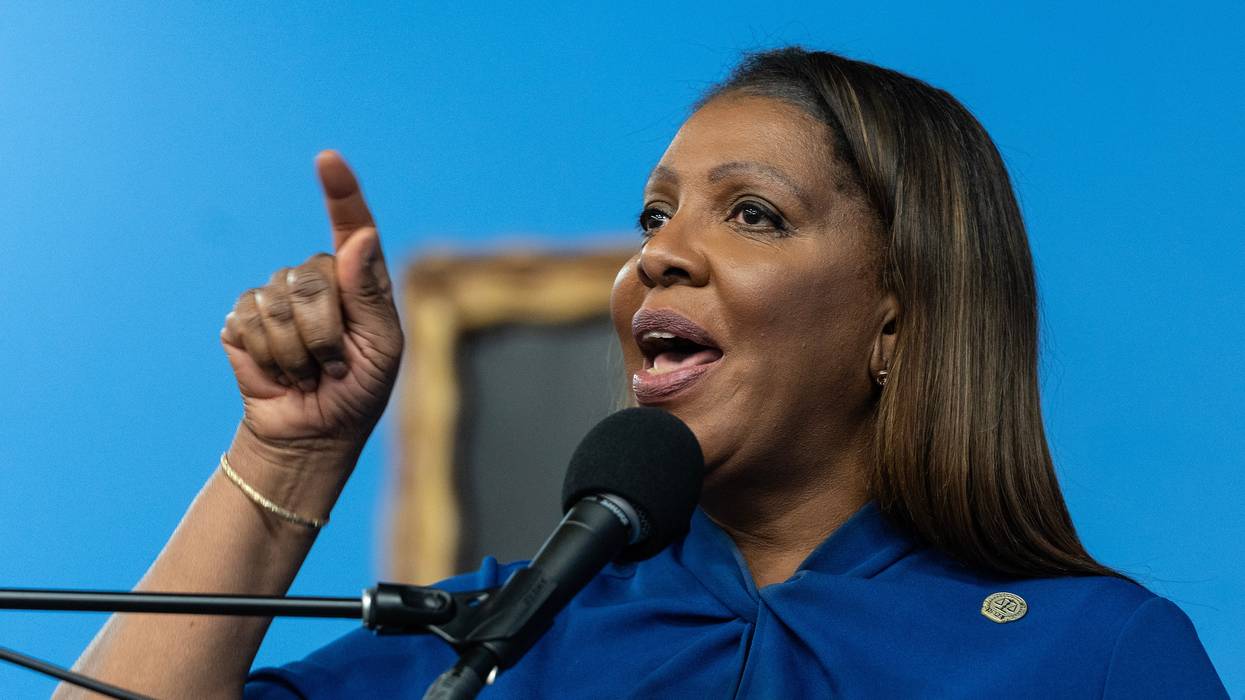
Citing the "soaring cost of essentials" that have "pushed hardworking New Yorkers to the brink," Democratic New York Attorney General Letitia James on Thursday proposed rules to strengthen enforcement of the state's anti-price gouging law.
James' office said the new rules would "make it more straightforward to investigate and combat price gouging by setting clear guardrails against price increases during emergencies."
The rules would "clarify that a price increase over 10% during an abnormal market disruption may constitute price gouging."
"When times get tough, New Yorkers can trust that my office will always have their back."
Furthermore, corporations with more than 30% market shares would be prohibited from increasing profit margins during abnormal market disruptions. Limits would be placed on dynamic pricing—when the cost of a good or service varies due to market conditions—and protections would be extended to "vital and necessary" products and services after market disruptions.
"The rules proposed by my office will bolster our efforts to crack down on price gouging and ensure that large corporations do not take advantage of New Yorkers during difficult times," explained James, who last year launched a probe into Big Oil price gouging.
"When times get tough, New Yorkers can trust that my office will always have their back," she added.
According to the Albany Times Union:
At least 10 states, including New Jersey and California, use the 10% threshold that James' office is proposing as setting the legal threshold for what qualifies as price gouging in New York. Others use higher thresholds, like Pennsylvania at 20%. (New York City has a 10% standard already on the books.)
If adopted, the 10% threshold is intended to provide clarity both from a legal lens and to business owners. It would in effect define the current standard for price gouging, which is "unconscionably excessive." Laws against price gouging in New York began in 1979, which followed a drop in production of oil after the Iranian revolution that then contributed to a spike in oil prices.
Corporations have used the Covid-19 pandemic, Russia's invasion of Ukraine, and inflation as pretexts to price gouge consumers.
"Price increases of necessary items during emergencies are unacceptable and illegal," New York state Sen. Kevin Thomas (D-6) said in a statement. "The responses to certain supply chain and market disruptions during the Covid-19 pandemic by companies made it clear that stronger enforcement of New York's price gouging statute was needed."
Rakeen Mabud, chief economist at the Groundwork Collaborative, applauded James "for protecting consumers and cracking down on the corporations that have been taking advantage of families and small businesses for far too long."
"The proposed rules will directly target big corporations that have been jacking up prices on essential goods to boost their bottom line," Mabud added. "States and policymakers across the country should take note of Attorney General James' proposal and work to protect consumers from exploitative corporate behavior."
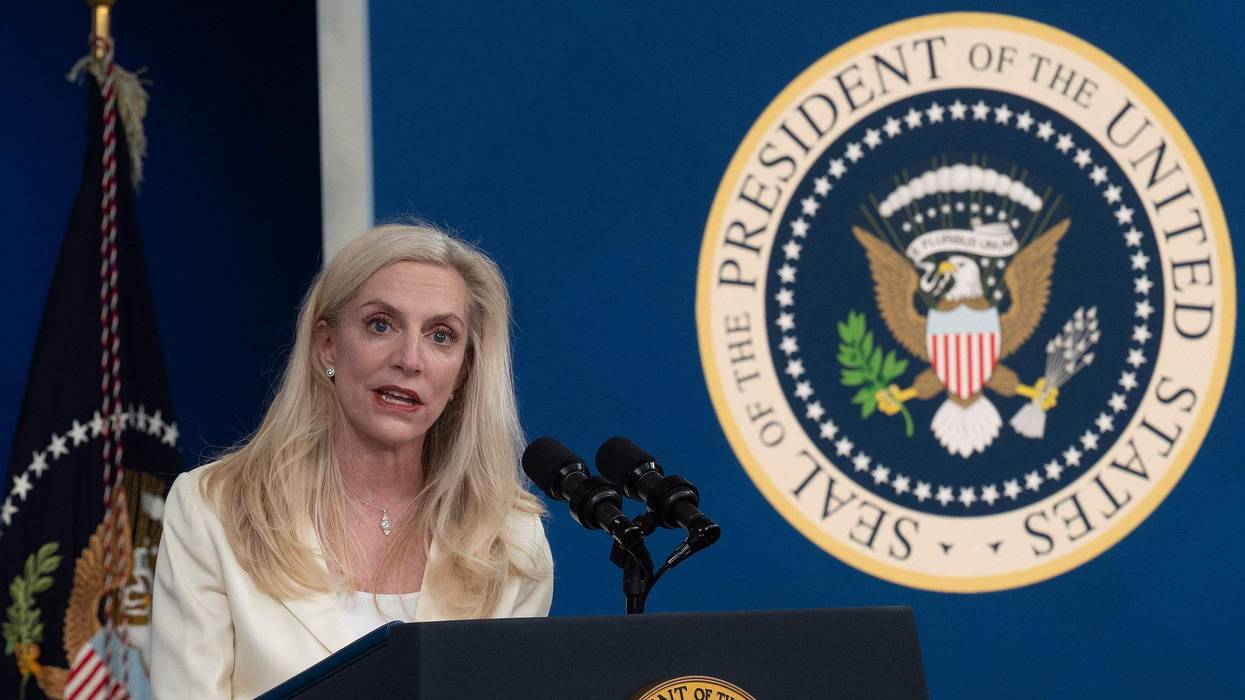
Progressives on Monday pointed to remarks by Federal Reserve Vice Chair Lael Brainard acknowledging the role of corporate profiteering in exacerbating inflation to underscore their opposition to interest rate hikes and other monetary tightening that favors Big Business over workers.
"The retail margin for motor vehicles sold at dealerships has increased by more than 180% since February 2020."
While attributing high inflation to the ongoing Covid-19 pandemic and Russia's invasion of Ukraine, Brainard--who was addressing a meeting of the National Association for Business Economics in Chicago--asserted that "there is ample room for margin recompression to help reduce goods inflation" in the retail economy.
"Retail margins have increased 20% since the onset of the pandemic, roughly double the 9% increase in average hourly earnings by employees in that sector," she noted. "In the auto sector, where the real inventory-to-sales ratio is 20% below its pre-pandemic level, the retail margin for motor vehicles sold at dealerships has increased by more than 180% since February 2020, 10 times the rise in average hourly earnings within that sector."
Brainard's nod to what one observer called "the elephant in the room" was secondary to her insistence that monetary tightening in the form of higher interest rates is the best way to tackle inflation.
"It will take time for the cumulative effect of tighter monetary policy to work through the economy broadly and to bring inflation down," she said. "In light of elevated global economic and financial uncertainty, moving forward deliberately and in a data-dependent manner will enable us to learn how economic activity, employment, and inflation are adjusting to cumulative tightening in order to inform our assessments of the path of the policy rate."
Noting that "the labor market's recovery from the pandemic-induced recession was a historic rebound," the progressive podcast "Pitchfork Economics" warned that "if the Fed keeps pursuing outdated, harmful solutions, they will push us into a longer, deeper recession with consequences that reverberate for years to come."
Meanwhile on Monday, Chicago Federal Reserve President Charles Evans said that the central bank's number one priority is reducing inflation--even if monetary tightening costs people their jobs.
"Ultimately, inflation is the most important thing to get under control. That's job one," Evans argued during an interview on MSNBC. "Price stability sets the stage for stronger growth in the future."
Members of the Fed's board of governors are widely expected to raise interest rates by 0.75% for the fourth consecutive time when they meet next month.
Last month, a trio of progressive political economists told members of the U.S. House Committee on Oversight and Reform that the most effective way to curb rising prices is to take on the corporate profiteering fueling inflation.
"Even as input costs come down, corporate executives are gleefully reporting how they plan on keeping prices high," one of the economists, Rakeen Mabud of the Groundwork Collaborative, told the lawmakers. "Megacorporations are taking advantage of recent crises to make record profits for themselves and their shareholders."
Related Content

Another one of the economists, former U.S. labor secretary and University of California, Berkeley professor Robert Reich, testified that "the inflation we are now experiencing is not due to wage gains; it is due to increases in corporate profits."
"And it's excessive profits, not wages, that need to be controlled," he added.
Reich and others have urged Congress and U.S. President Joe Biden to pass windfall profits tax legislation like the Ending Corporate Greed Act introduced in March by Sens. Bernie Sanders (I-Vt.) and Ed Markey (D-Mass.) in the Senate and Rep. Jamaal Bowman (D-N.Y.) in the House. If passed, the measure would impose a 95% tax on the windfall profits of major corporations.
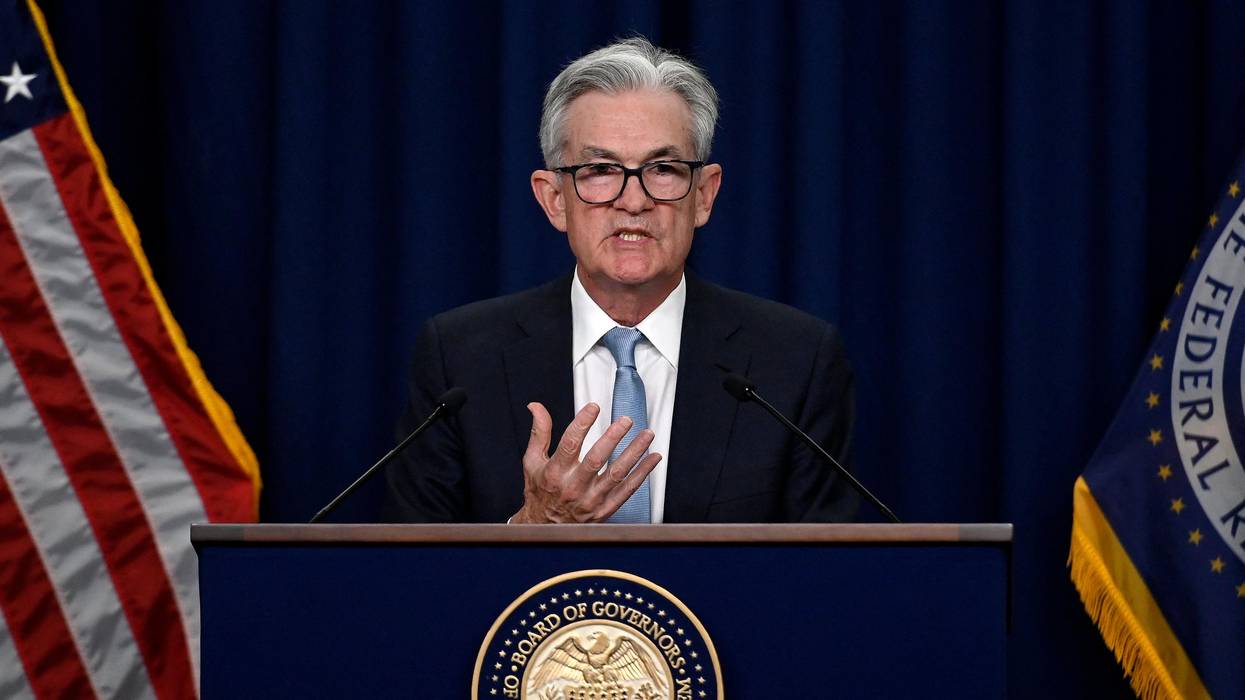
Federal Reserve Chair Jerome Powell said in a closely watched speech Friday that the U.S. central bank is ready to inflict "pain" on households as it continues to fight inflation, remarks that drew widespread backlash from experts who warned the Fed appears poised to spark a devastating recession and mass layoffs.
"The Fed apparently won't stop raising rates until millions more are unemployed."
Addressing a symposium of financial elites gathered in Jackson Hole, Wyoming, Powell said that "there will very likely be some softening of labor market conditions"--euphemistic phrasing for higher unemployment--as the Fed aggressively jacks up interest rates, slowing demand across the economy by making borrowing more expensive.
"While higher interest rates, slower growth, and softer labor market conditions will bring down inflation, they will also bring some pain to households and businesses," Powell continued.
But the Fed chief argued that such pain would be worth it because "a failure to restore price stability would mean far greater pain."
Economist Robert Reich, the former U.S. labor secretary, responded bluntly to Powell's comments: "This is nuts."
"True, inflation is near a four-decade high," Reich wrote in a blog post. "But the Fed's aggressive effort to tame it through steep interest rate hikes--the fastest series of rate hikes since the early 1980s--is raising the risk of recession. If it raises rates again in September by another three-quarters of a point, which seems likely given Powell's remarks today, the risk becomes larger."
"The pain is already being felt across the land," Reich added. "Most Americans aren't getting inflation-adjusted wage increases, which means they're becoming poorer."
"Aggressive rate hikes can't address the root causes of inflation."
Powell's speech was seen by many observers as his most hawkish message yet as the central bank attempts to rein in inflation with a blunt tool that is unlikely to mitigate the causes of price surges in the U.S. and globally, something the Fed chair has openly admitted to lawmakers.
"The Fed's problem remains that constraining demand can't do anything about the primary drivers of inflation--supply chain snarls, the war in Ukraine, and corporate profiteering," tweeted Claire Guzdar of the Groundwork Collaborative. "Our problem remains that the Fed apparently won't stop raising rates until millions more are unemployed."
Rakeen Mabud, Groundwork's chief economist, echoed that message, noting that "aggressive rate hikes can't address the root causes of inflation."
"Mass unemployment is not the path forward to a healthy and inclusive economy," Mabud added. "Let's be clear: aggressive rate hikes aim to bring down prices by increasing unemployment. Fed Chair Powell is ready to throw workers under the bus to save the 'economy.' But we are the economy."
The Fed has thus far shown no indication that it's prepared to change course despite evidence of slowing economic growth, decelerating wage increases, and cooling inflation.
As CNBC reported Friday ahead of Powell's address, the Fed's preferred inflation measure showed that price pressures eased in July, building on better-than-expected Consumer Price Index (CPI) data released earlier this month.
But in his speech Friday, Powell said he and other central bank officials are drawing on lessons learned from high inflation in the 1970s and 1980s, when then-Fed Chair Paul Volcker infamously imposed high interest rates that hurled the economy into recession and sent unemployment soaring.
"The successful Volcker disinflation in the early 1980s followed multiple failed attempts to lower inflation over the previous 15 years," Powell said. "A lengthy period of very restrictive monetary policy was ultimately needed to stem the high inflation and start the process of getting inflation down to the low and stable levels that were the norm until the spring of last year. Our aim is to avoid that outcome by acting with resolve now."
William Spriggs, chief economist at the AFL-CIO, warned in a social media post Friday that Powell's speech is "bad news."
"Two straight quarters of falling GDP, falling real disposable income, falling real wages, falling government expenditures and the Federal Reserve, in the face of these headwinds, continued global supply shocks, and weakened world growth, is seeing ghosts," Spriggs wrote.
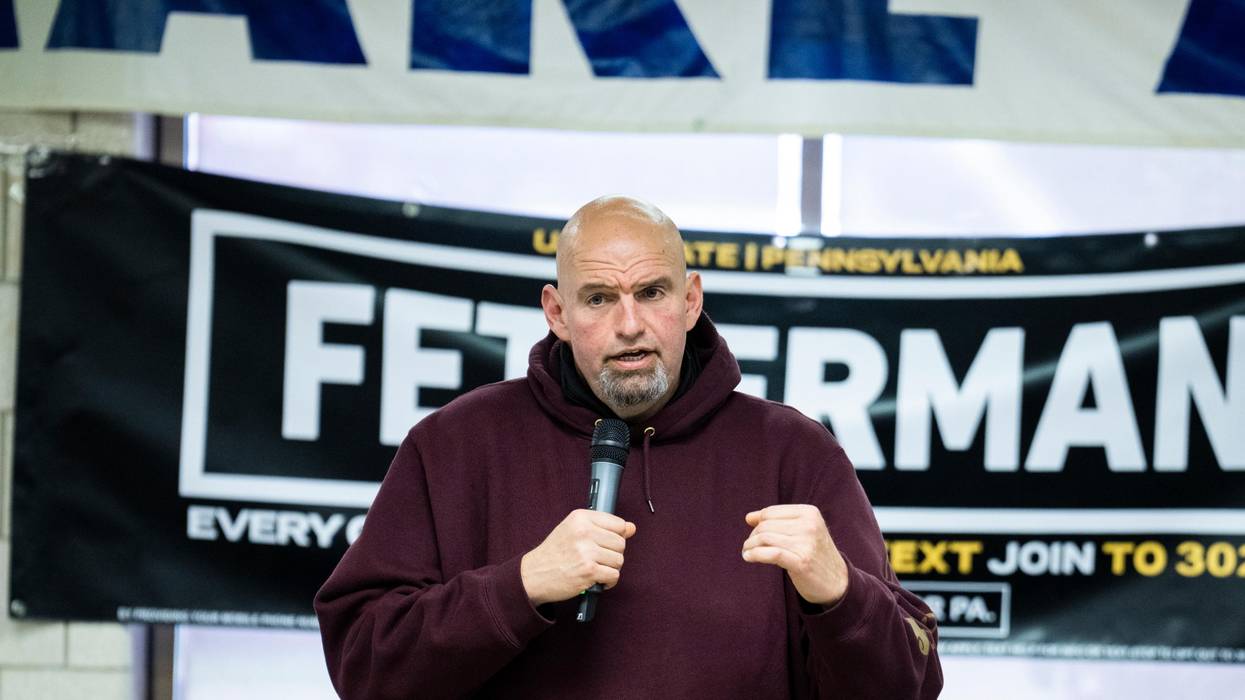
As U.S. inflation hit a new 40-year high Wednesday, Democratic Senate candidate John Fetterman took aim at the "corporate greed" exacerbating the nation's affordability crisis.
"I am going to go to Washington to fight to bring down prices," Fetterman--who is also Pennsylvania's lieutenant governor--said in response to news that the Consumer Price Index (CPI) soared 9.1% over the past year, the largest annual increase since 1981.
"We need bold action NOW to make more shit in America, fix our broken supply chains, and take on corporate greed to bring down the cost of everything, for everyone," he added.
"The price of gas, groceries, and just about everything has skyrocketed," Fetterman noted. "Working families are paying more almost everywhere. I see it every time I go to Aldi's or Giant Eagle. Things are way too expensive and it's hurting people across the commonwealth."
Fetterman accused his Republican opponent, multimillionaire celebrity doctor Mehmet Oz, of not noticing the "sky-high prices."
"When you own nine homes and have a $48 million dollar mansion, you don't have to worry about the gas or grocery bill," he said. "He probably doesn't even notice if it's more than it used to be. Paying an extra $10, $20, or $30 for gas or groceries means nothing to him. But it matters to the rest of us."
Oz responded to Wednesday's CPI figures in a statement asserting that "Pennsylvanians deserve better than more failed career politicians. It's time for change."
Fetterman's remarks echoed those of progressive activists including Groundwork Collaborative chief economist Rakeen Mabud, who said Wednesday that policymakers must address "rampant corporate profiteering."
In the wake of new federal data showing that U.S. inflation rose again in May after decelerating slightly the previous month, progressive lawmakers, economists, and union leaders on Friday tried to hammer home their argument that corporate profiteering is a major driver of the price hikes that are eroding workers' modest wage gains and heightening economic pain nationwide.
"While families are feeling the sting of soaring energy costs, oil and gas companies are cheering the nearly $100 billion in profits they've already made this year off families' pain at the pump," said Dr. Rakeen Mabud, chief economist at the Groundwork Collaborative.
"The same corporations that are making record profits while busting workers' unions are raising prices on working families."
"It's past time for Congress to pass an excess profits tax to stop the outrageous war profiteering by Big Oil," Mabud added, referring to the benefits the U.S. fossil fuel industry has reaped from Russia's assault on Ukraine.
The narrative that corporate greed is one of the key culprits behind inflation, which is now at a 40-year high, resonates greatly with the U.S. public, according to recent survey data. A poll conducted last month by Data for Progress showed that 71% of all U.S. voters blame corporate profit-seeking for rising inflation.
But despite the argument's popularity--and alignment with data showing that record-high corporate profits are a disproportionate contributor to inflation--the Biden administration has been increasingly hesitant to deploy it in recent months even as inflationary pressures persist and businesses' net incomes grow exponentially in some sectors.
During an event hosted by The New York Times on Thursday, Treasury Secretary Janet Yellen outright rejected the notion that corporate greed is to blame for inflation, saying, "Demand and supply is largely driving inflation."
Federal Reserve Chair Jerome Powell, meanwhile, has openly suggested that wage increases are part of the problem, telling reporters during a press conference last month that the country needs to "get wages down" in order to tackle inflation.
While progressive economists have acknowledged that a number of factors, from supply chain issues caused by the pandemic to the war in Ukraine, are pushing inflation to levels not seen in decades, they have nevertheless maintained that corporate profiteering is a significant culprit.
"Corporations are using inflation as an excuse to raise their prices, hurting workers and consumers while they enjoy record profits," Robert Reich, the former secretary of the U.S. Labor Department, wrote last month. "Prices are surging--but let's be clear: corporations are not raising prices simply because of the increasing costs of supplies and labor. They could easily absorb these higher costs, but instead they are passing them on to consumers and even raising prices higher than those cost increases."
Mary Kay Henry, president of the Service Employees International Union, echoed Reich on Friday.
"Make no mistake: the same corporations that are making record profits while busting workers' unions are raising prices on working families," Henry wrote on Twitter. "If our nation's leaders are serious about addressing inflation, they'll hold these big corporations accountable for their price gouging."
In recent weeks, as inflation numbers have remained stubbornly high and corporate executives have continued boasting about their profits, congressional Democrats have put forth several proposals aimed at combating price gouging and reining in excess profits via taxation.
Led by Rep. Ro Khanna (D-Calif.) in the House and Sen. Sheldon Whitehouse (D-R.I.), a group of Democrats and Sen. Bernie Sanders (I-Vt.) introduced legislation in March that would hit large and highly profitable oil companies with "a per-barrel tax equal to 50% of the difference between the current price of a barrel of oil and the pre-pandemic average price per barrel between 2015 and 2019."
While the White House has signaled it would be willing to support a windfall profits tax on Big Oil, Democrats' bill has not received a vote in the House or Senate.
Last month, Sens. Elizabeth Warren (D-Mass.) and Tammy Baldwin (D-Wis.) along with Rep. Jan Schakowsky (D-Ill.) unveiled a measure that would empower federal regulators to crack down on corporate price gouging. Warren has specifically called out the meat industry for its pricing practices throughout the pandemic.
"Giant corporations are using inflation as a cover story to jack up prices and pad profits," Warren tweeted Friday. "Let's pass my bill to crack down on corporate price gouging. And let's pass our windfall profits tax on Big Oil, which includes rebate checks for Americans struggling with gas prices."
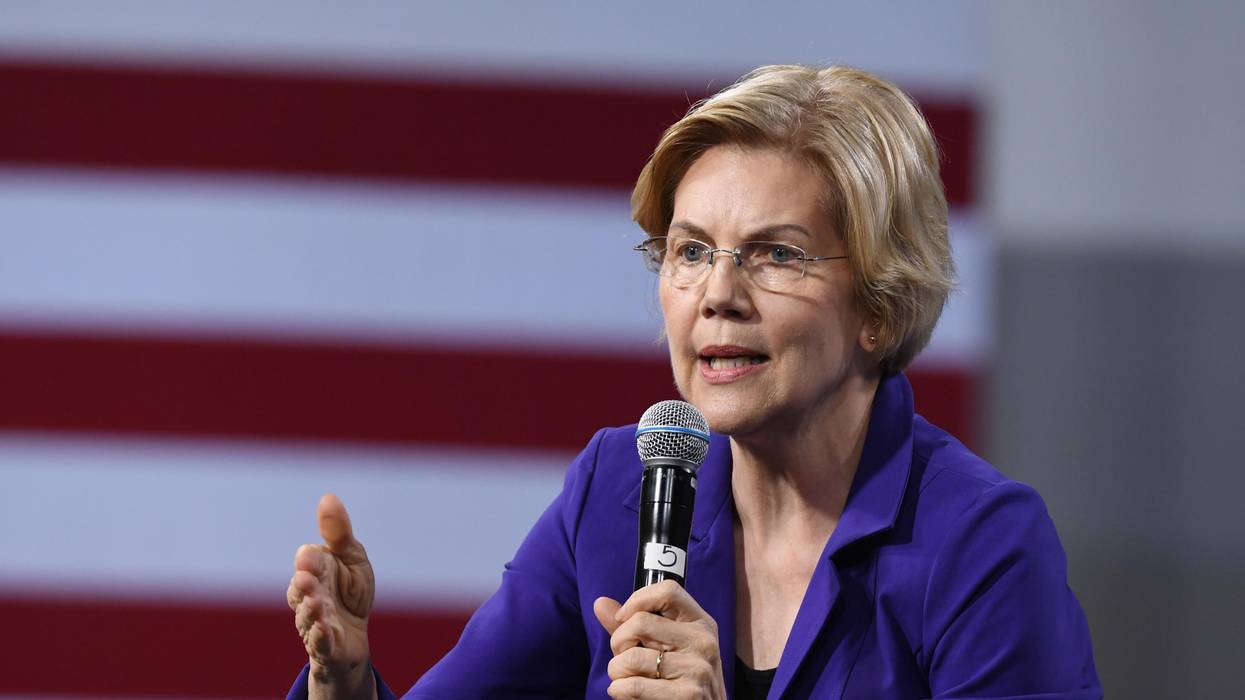
Sen. Elizabeth Warren on Thursday led the introduction of new legislation that would enable federal regulators to forcefully crack down on corporate price gouging, a practice that progressive lawmakers and economists say has played a major role in driving U.S. inflation to a 40-year high.
According to a one-page summary released by Warren's office, the Price Gouging Prevention Act of 2022 would "prohibit the practice of price gouging during all abnormal market disruptions--including the current pandemic--by authorizing the Federal Trade Commission (FTC) and state attorneys general to enforce a federal ban against unconscionably excessive price increases, regardless of a seller's position in a supply chain."
The summary notes that the bill would also "create a rebuttable presumption of price gouging against firms that exercise unfair leverage and companies that brag about increasing prices during periods of inflation" and require "public companies to transparently disclose and explain changes in their cost of goods sold, gross margins, and pricing strategies in their quarterly [Securities and Exchange Commission] filings."
"Corporations have price gouged consumers for extra profits--and gotten away with it--for too long," Warren (D-Mass.) wrote in a Twitter post on Thursday.
Warren introduced the new bill alongside Sen. Tammy Baldwin (D-Wis.), who said in a statement that the measure would "shine a light on price hikes and help prevent big corporations from exploiting a period of inflation to gouge consumers with higher costs."
Rep. Jan Schakowsky (D-Ill.) introduced companion legislation in the House.
Rakeen Mabud, chief economist at the Groundwork Collaborative, applauded the new bill as an "important" step toward reining in corporate profiteering and argued that "a federal price gouging statute would help curtail this exploitative behavior."
The legislation comes a day after federal data showed that while inflation eased slightly in April, consumer prices were up 8.3% last month compared to a year earlier.
In a recent analysis, Josh Bivens of the Economic Policy Institute argued that "the rise in inflation has not been driven by anything that looks like an overheating labor market--instead it has been driven by higher corporate profit margins and supply-chain bottlenecks."
Lindsay Owens, executive director of the Groundwork Collaborative, similarly argued in a New York Times op-ed last week that "plain old corporate profiteering" is a key culprit behind price hikes nationwide.
"Companies that historically might have kept prices low to pick up profit by gaining additional market share are instead using the cover of inflation to raise prices and increase profits," Owens wrote. "Consumers are now expecting higher prices at the checkout line, and companies are taking advantage. The poor and those on fixed incomes are hit the hardest."
U.S. Senate Budget Committee Chair Bernie Sanders announced Friday that next week he will hold a hearing to expose how corporate profiteering in the midst of multiple global crises is driving inflation.
As prices increase, corporate profits hit a record high of nearly $3 trillion in 2021, up 25% in a single year.
The event--entitled "Corporate Profits Are Soaring as Prices Rise: Are Corporate Greed and Profiteering Fueling Inflation?"--is scheduled for April 5 at 11:00 am ET and will follow his introduction last week of the Ending Corporate Greed Act.
"Let me be clear," Sanders (I-Vt.) said in a statement. "The American people are sick and tired of corporate greed. They are sick and tired of being ripped off by corporations making record-breaking profits. They are sick and tired of being forced to pay outrageously high prices for gas, rent, and food while large corporations make out like bandits.
"We cannot continue to allow large, profitable corporations to use the war in Ukraine, the Covid-19 pandemic, and the specter of inflation to make outrageous profits by price gouging Americans in every sector of our economy," he added. "It's time we discuss how corporate greed and profiteering are fueling inflation."
Sanders' statement highlighted how key sectors are behaving:
Across every major industry, prices continue to rise--this includes a 38% increase in the price of gasoline, a 44% increase in the price of heating oil, a 41% increase in the price of a used car, a 24% in the price of rental cars, and a 17% increase in the price of furniture. Further, Tyson Foods recently increased beef prices by 32%, the price of chicken by 20%, and the price of pork by 13%. As prices increase, corporate profits hit a record high of nearly $3 trillion in 2021, up 25% in a single year.
As Common Dreams reported Thursday, domestic corporate profits adjusted for inventory valuation and capital consumption hit $2.8 trillion last year, up from $2.2 trillion in 2020, according to the Commerce Department's Bureau of Economic Analysis (BEA).
"CEOs can't stop bragging on corporate earnings calls about jacking up prices on consumers to keep their profits soaring," Lindsay Owens, executive director at the Groundwork Collaborative, said in a statement about the analysis. "These megacorporations are cashing in and getting richer--and consumers are paying the price."
Owens is one of three experts set to testify at the Senate Budget Committee's Tuesday hearing. She will be joined by Robert Reich, a public policy professor at the University of California, Berkley who served as U.S. labor secretary during the Clinton administration, and Michael Faulkender, a finance professor at the University of Maryland who served as assistant secretary for economic policy at the Treasury Department under former President Donald Trump.
Both Reich and leaders from the Groundwork Collaborative, a progressive nonprofit, have praised recent proposals by Congress to curb corporate profiteering--which 82% of U.S. voters believe is fueling inflation, according to polling from last month.
Praising the Ending Corporate Greed Act--which Sanders unveiled with Sen. Ed Markey (D-Mass.) and Rep. Jamaal Bowman (D-N.Y.)--Rakeen Mabud, Groundwork Collaborative's chief economist and managing director of policy and research, said that "families, workers, and consumers expect their government to stand up against the kind of corporate abuses we're seeing today and Sen. Sanders' bill does exactly that."
If made into law, as Common Dreams reported, the proposal would impose a 95% tax on a company's profits that top its average profit level for 2015-19, adjusted for inflation. It would only impact companies with $500 million or more in annual revenue and be limited to 75% of income per year.
"A windfall corporate profits tax is badly needed to put the brakes on corporate profiteering that has run rampant over the course of the pandemic," said Mabud. "And now, the war in Ukraine is providing yet another opportunity for multinational energy giants and oil executives to drive up profit margins--while forcing families to pay more at the pump and on their energy bills."
Sanders' office estimates that the legislation, which is inspired by previous wartime measures, "would raise $31.9 billion from three of the top oil companies alone" in a single year, referring to Chevron, ExxonMobil, and ConocoPhillips.
The senator said last week that "the time has come for Congress to work for working families and demand that large, profitable corporations make a little bit less money and pay their fair share of taxes."
A new analysis released Tuesday ahead of a congressional hearing on pandemic-era price gouging shows that U.S. corporations in the food and energy sectors--from Tyson to Exxon Mobil--are pushing higher costs onto consumers while raking in ever-increasing revenues and handing executives massive pay packages.
Conducted by the advocacy group Food & Water Watch (FWW), the analysis spotlights the fact that skyrocketing food and energy--specifically gasoline--prices have been major contributors to the overall rise of inflation in the U.S. Between December 2019 and December 2021, the nation's Consumer Price Index (CPI) jumped by 8.5%.
"Many companies have subsequently fattened executive compensation while worker wages have stagnated."
According to FWW, overall energy costs rose 20% over that period while the price per gallon of unleaded gasoline increased by 31.7%.
Meanwhile, FWW found, "the cost to feed a family of four on a 'thrifty' food plan has increased by 33.5%," driven by the rising prices of ground beef (+19.2%), bacon (+31.7%), chicken breasts (+19.7%), milk (+17.4%), and eggs (+16.5%).
The analysis emphasizes that such "egregious" price increases come as leading corporations in the U.S. food and energy sectors are reporting growing revenues and huge profits. Tyson Foods--the second-largest chicken, beef, and pork processor in the world--has seen its revenue grow 11% above pre-pandemic levels.
The corporation also rewarded its top executives with higher pay in 2021 even as it raised prices for consumers, blaming supply chain issues.
Amanda Starbuck, research director at Food & Water Watch, argued in a statement Tuesday that "companies are hiding behind the pandemic and supply chain disruptions as an excuse to gouge consumers."
"In reality, 2021 revenues among the largest food and energy corporations topped pre-pandemic levels," said Starbuck. "Many companies have subsequently fattened executive compensation while worker wages have stagnated or even dropped."
FWW's analysis was published on the eve of a House Energy and Commerce Committee hearing scheduled for Wednesday titled, "Pandemic Profiteers: Legislation to Stop Corporate Price Gouging."
"We spent a half-century allowing business executives and financiers to take control of our supply chains."
One of the witnesses set to testify at the hearing is Groundwork Collaborative chief economist Rakeen Mabud, who on Monday co-authored an article in The American Prospect arguing that recent product shortages and price hikes were "brought to life through bad public policy coupled with decades of corporate greed."
"We spent a half-century allowing business executives and financiers to take control of our supply chains, enabled by leaders in both parties," wrote Mabud and David Dayen, the Prospect's executive editor. "They all hailed the transformation, cheering the advances of globalization, the efficient network that would free us from want. Motivated by greed and dismissive of the public interest, they didn't mention that their invention was supremely ill-equipped to handle inevitable supply bottlenecks."
"And the pandemic exposed this hidden risk," they added, "like a domino bringing down a system primed to topple."
Mabud is expected to reiterate that conclusion before lawmakers at Wednesday's House hearing. According to her prepared testimony, Mabud will contend that "big corporations have taken advantage of shifting demand to raise prices on essentials like Covid tests, masks, and hand sanitizer, all to generate record profits."
"Our economy works best when it works for all of us, but deeply entrenched concentrated corporate power has systematically stripped down supply chains and undermined consumers' bargaining power," Mabud plans to say. "The path towards an inclusive, resilient economy must include policies that foster competitive markets where consumers, working people, and smaller competitors all have meaningful bargaining power."
Correction: An earlier version of this story misidentified Dr. Rakeen Mabud of the Groundwork Collaborative.
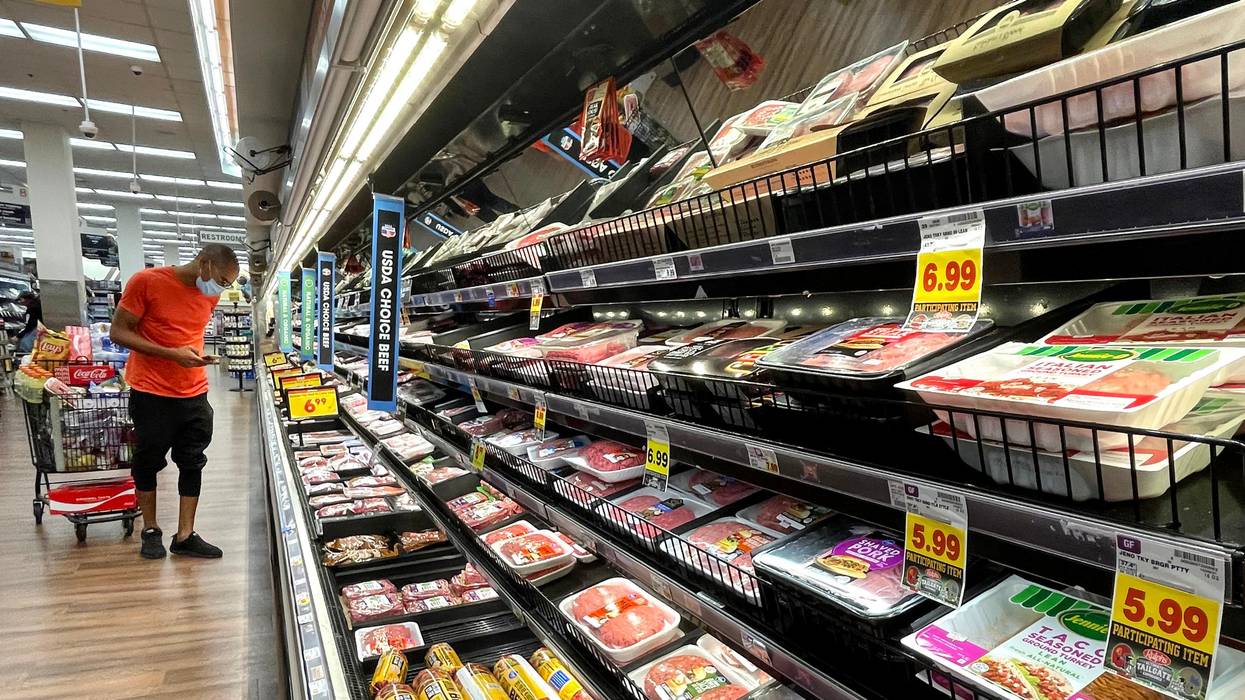
Amid mounting data showing that people are paying more for food at grocery stores around the United States, a new analysis out Wednesday reveals how corporate power is "the real culprit behind rising prices at the checkout line."
"Addressing this crisis means recognizing these price increases for what they are: the result of deeply entrenched concentrated corporate power."
After the U.S. Labor Department announced that the Consumer Price Index increased by 0.4% in September, researchers at the Groundwork Collaborative, a progressive think tank, explained the connections between "price hikes, monopoly, and corporate greed."
"The more sway mega-corporations have over our economy, the more power they have to gouge customers, squeeze Main Street, and exploit workers," Rakeen Mabud, chief economist at the Groundwork Collaborative, said in a statement.
Since September 2020, food prices overall have increased by 4.6%, with the price of meats, poultry, fish, and eggs surging the most over the past 12 months, at 10.5%.
The higher inflation rate in those industries, researchers noted, can be attributed to decades of consolidation, which has given a handful of corporations an ever-greater degree of market control and with it, the power to set prices.
According to the Groundwork Collaborative:
Just four meat processing conglomerates control more than 80% of the beef industry and more than 60% of the pork industry. This enables them to dictate prices that both flatten returns for farmers and ranchers and inflate prices for consumers at the meat counter. As a result, consumers have seen a 12% increase in the cost of beef and a nearly 10% increase in the cost of pork over the last year. Meanwhile, the four major meat processors doled out billions of dollars to their shareholders in dividends and bought back millions of dollars of their own stocks.
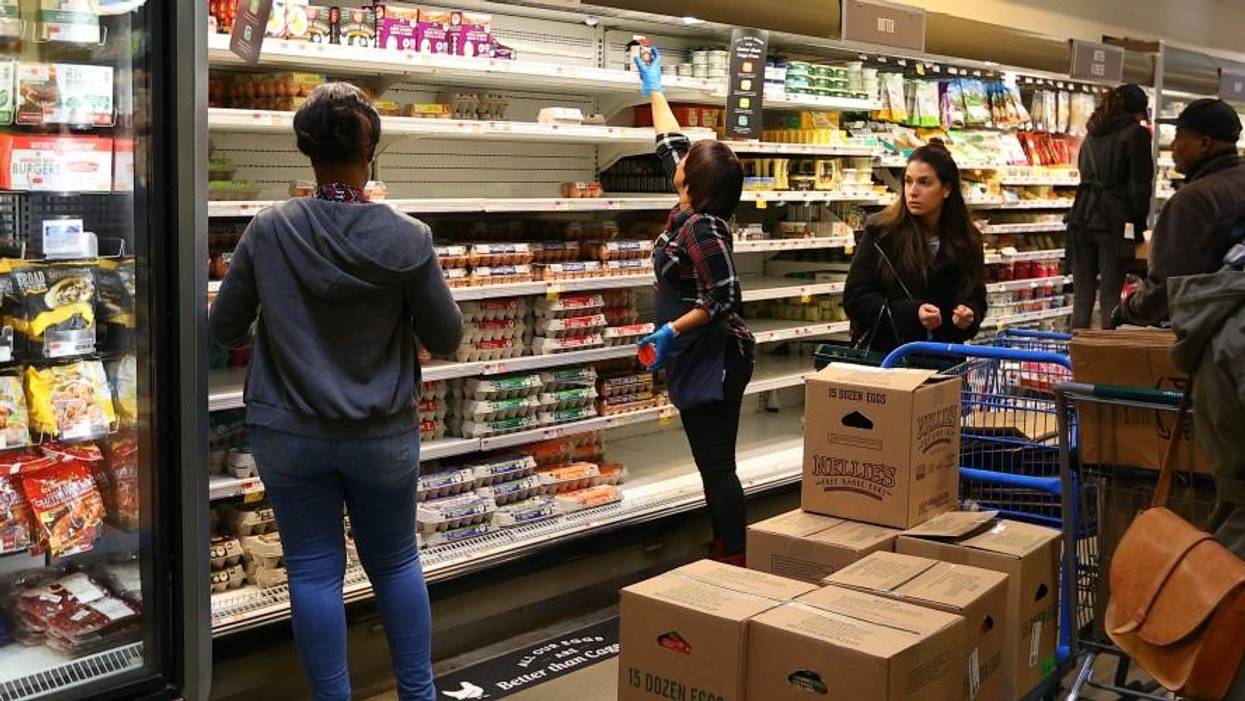
The price of eggs, meanwhile, has risen 9.9% since August 2020.
"State governments, including Minnesota, Texas, California, and New York have sued egg producers and distributors for illegally raising the price of eggs during the pandemic," the Groundwork Collaborative pointed out. "As one lawsuit put it, jacking up egg prices is allowing these companies, including some of the largest producers and wholesale distributors of eggs, to 'profit from the misery of millions.'"
The Groundwork Collaborative also spotlighted how Kroger grocery stores have charged customers more and simultaneously suppressed wages amid the Covid-19 pandemic.
Researchers explained:
Kroger, a grocery mega-chain, spent the summer of 2021 gloating that "a little bit of inflation is always good in our business" before citing inflation to justify price hikes. Kroger publicly acknowledged that they could get away with increasing prices on consumers as long as prices didn't rise by more than 3 or 4%.
Charging consumers more for supermarket staples has lined the pockets of Kroger executives and shareholders, even as median worker pay decreased by 8% in 2020. That same year, the Kroger CEO earned 909 times what the median worker earned.
While the company was publicly calling their workers heroes, they were simultaneously cutting essential hazard pay for employees during a global pandemic. Meanwhile, the company spent $1.498 billion on stock buybacks between April 2020 and July 2021 to enrich its shareholders.
"Addressing this crisis," said Mabud, "means recognizing these price increases for what they are: the result of deeply entrenched concentrated corporate power that has systematically stripped down supply chains and created room for pandemic profiteers as well as longstanding underinvestment in our economy."