SUBSCRIBE TO OUR FREE NEWSLETTER
Daily news & progressive opinion—funded by the people, not the corporations—delivered straight to your inbox.
5
#000000
#FFFFFF
To donate by check, phone, or other method, see our More Ways to Give page.
Daily news & progressive opinion—funded by the people, not the corporations—delivered straight to your inbox.
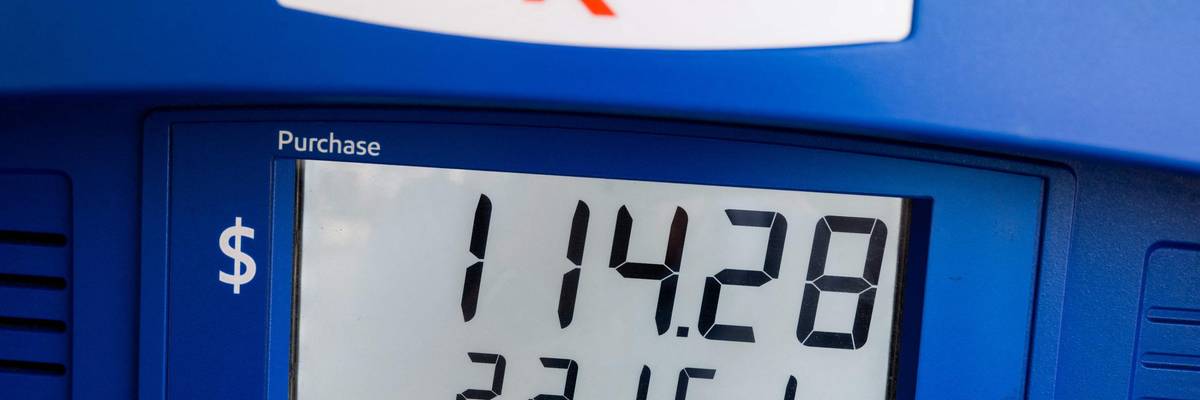
A gas pump displays the total price of a customer's fuel purchase at a gas station in McLean, Virginia on June 10, 2022.
In the wake of new federal data showing that U.S. inflation rose again in May after decelerating slightly the previous month, progressive lawmakers, economists, and union leaders on Friday tried to hammer home their argument that corporate profiteering is a major driver of the price hikes that are eroding workers' modest wage gains and heightening economic pain nationwide.
"While families are feeling the sting of soaring energy costs, oil and gas companies are cheering the nearly $100 billion in profits they've already made this year off families' pain at the pump," said Dr. Rakeen Mabud, chief economist at the Groundwork Collaborative.
"The same corporations that are making record profits while busting workers' unions are raising prices on working families."
"It's past time for Congress to pass an excess profits tax to stop the outrageous war profiteering by Big Oil," Mabud added, referring to the benefits the U.S. fossil fuel industry has reaped from Russia's assault on Ukraine.
The narrative that corporate greed is one of the key culprits behind inflation, which is now at a 40-year high, resonates greatly with the U.S. public, according to recent survey data. A poll conducted last month by Data for Progress showed that 71% of all U.S. voters blame corporate profit-seeking for rising inflation.
But despite the argument's popularity--and alignment with data showing that record-high corporate profits are a disproportionate contributor to inflation--the Biden administration has been increasingly hesitant to deploy it in recent months even as inflationary pressures persist and businesses' net incomes grow exponentially in some sectors.
During an event hosted by The New York Times on Thursday, Treasury Secretary Janet Yellen outright rejected the notion that corporate greed is to blame for inflation, saying, "Demand and supply is largely driving inflation."
Federal Reserve Chair Jerome Powell, meanwhile, has openly suggested that wage increases are part of the problem, telling reporters during a press conference last month that the country needs to "get wages down" in order to tackle inflation.
While progressive economists have acknowledged that a number of factors, from supply chain issues caused by the pandemic to the war in Ukraine, are pushing inflation to levels not seen in decades, they have nevertheless maintained that corporate profiteering is a significant culprit.
"Corporations are using inflation as an excuse to raise their prices, hurting workers and consumers while they enjoy record profits," Robert Reich, the former secretary of the U.S. Labor Department, wrote last month. "Prices are surging--but let's be clear: corporations are not raising prices simply because of the increasing costs of supplies and labor. They could easily absorb these higher costs, but instead they are passing them on to consumers and even raising prices higher than those cost increases."
Mary Kay Henry, president of the Service Employees International Union, echoed Reich on Friday.
"Make no mistake: the same corporations that are making record profits while busting workers' unions are raising prices on working families," Henry wrote on Twitter. "If our nation's leaders are serious about addressing inflation, they'll hold these big corporations accountable for their price gouging."
In recent weeks, as inflation numbers have remained stubbornly high and corporate executives have continued boasting about their profits, congressional Democrats have put forth several proposals aimed at combating price gouging and reining in excess profits via taxation.
Led by Rep. Ro Khanna (D-Calif.) in the House and Sen. Sheldon Whitehouse (D-R.I.), a group of Democrats and Sen. Bernie Sanders (I-Vt.) introduced legislation in March that would hit large and highly profitable oil companies with "a per-barrel tax equal to 50% of the difference between the current price of a barrel of oil and the pre-pandemic average price per barrel between 2015 and 2019."
While the White House has signaled it would be willing to support a windfall profits tax on Big Oil, Democrats' bill has not received a vote in the House or Senate.
Last month, Sens. Elizabeth Warren (D-Mass.) and Tammy Baldwin (D-Wis.) along with Rep. Jan Schakowsky (D-Ill.) unveiled a measure that would empower federal regulators to crack down on corporate price gouging. Warren has specifically called out the meat industry for its pricing practices throughout the pandemic.
"Giant corporations are using inflation as a cover story to jack up prices and pad profits," Warren tweeted Friday. "Let's pass my bill to crack down on corporate price gouging. And let's pass our windfall profits tax on Big Oil, which includes rebate checks for Americans struggling with gas prices."
This country and this world are at a monumental crossroads. US voters have an opportunity to beat back the forces of fascism and confront the billionaires who are rigging the economy, our media system, and our democracy, making it increasingly impossible for ordinary people to get by. We’re not just talking about the election. We’re talking about what must be done once these fascist elements are vanquished from power. We need a bolder set of solutions than what either major party has so far been willing to offer and a working-class movement ready to fight like hell for it. Trump didn't emerge from nowhere. The conditions that fueled MAGA authoritarianism were created by decades of radical neoliberal economic policies and a corrupt political system dominated by corporate interests. They slashed taxes on the super-rich, promising that the benefits would trickle down. They said giveaways to the corporate titans would make life more affordable for the rest of us. It was all bullshit. And when a bitter, betrayed populace searches for someone to blame, right-wing demagogues have little trouble finding scapegoats. People know when they're being lied to, but you won't hear any of this from the corporate media. Only independent journalism—powered and funded by people who believe in building a better world—can deliver truly trustworthy daily news. If you share our vision, please contribute whatever you can to sustain our work. |
In the wake of new federal data showing that U.S. inflation rose again in May after decelerating slightly the previous month, progressive lawmakers, economists, and union leaders on Friday tried to hammer home their argument that corporate profiteering is a major driver of the price hikes that are eroding workers' modest wage gains and heightening economic pain nationwide.
"While families are feeling the sting of soaring energy costs, oil and gas companies are cheering the nearly $100 billion in profits they've already made this year off families' pain at the pump," said Dr. Rakeen Mabud, chief economist at the Groundwork Collaborative.
"The same corporations that are making record profits while busting workers' unions are raising prices on working families."
"It's past time for Congress to pass an excess profits tax to stop the outrageous war profiteering by Big Oil," Mabud added, referring to the benefits the U.S. fossil fuel industry has reaped from Russia's assault on Ukraine.
The narrative that corporate greed is one of the key culprits behind inflation, which is now at a 40-year high, resonates greatly with the U.S. public, according to recent survey data. A poll conducted last month by Data for Progress showed that 71% of all U.S. voters blame corporate profit-seeking for rising inflation.
But despite the argument's popularity--and alignment with data showing that record-high corporate profits are a disproportionate contributor to inflation--the Biden administration has been increasingly hesitant to deploy it in recent months even as inflationary pressures persist and businesses' net incomes grow exponentially in some sectors.
During an event hosted by The New York Times on Thursday, Treasury Secretary Janet Yellen outright rejected the notion that corporate greed is to blame for inflation, saying, "Demand and supply is largely driving inflation."
Federal Reserve Chair Jerome Powell, meanwhile, has openly suggested that wage increases are part of the problem, telling reporters during a press conference last month that the country needs to "get wages down" in order to tackle inflation.
While progressive economists have acknowledged that a number of factors, from supply chain issues caused by the pandemic to the war in Ukraine, are pushing inflation to levels not seen in decades, they have nevertheless maintained that corporate profiteering is a significant culprit.
"Corporations are using inflation as an excuse to raise their prices, hurting workers and consumers while they enjoy record profits," Robert Reich, the former secretary of the U.S. Labor Department, wrote last month. "Prices are surging--but let's be clear: corporations are not raising prices simply because of the increasing costs of supplies and labor. They could easily absorb these higher costs, but instead they are passing them on to consumers and even raising prices higher than those cost increases."
Mary Kay Henry, president of the Service Employees International Union, echoed Reich on Friday.
"Make no mistake: the same corporations that are making record profits while busting workers' unions are raising prices on working families," Henry wrote on Twitter. "If our nation's leaders are serious about addressing inflation, they'll hold these big corporations accountable for their price gouging."
In recent weeks, as inflation numbers have remained stubbornly high and corporate executives have continued boasting about their profits, congressional Democrats have put forth several proposals aimed at combating price gouging and reining in excess profits via taxation.
Led by Rep. Ro Khanna (D-Calif.) in the House and Sen. Sheldon Whitehouse (D-R.I.), a group of Democrats and Sen. Bernie Sanders (I-Vt.) introduced legislation in March that would hit large and highly profitable oil companies with "a per-barrel tax equal to 50% of the difference between the current price of a barrel of oil and the pre-pandemic average price per barrel between 2015 and 2019."
While the White House has signaled it would be willing to support a windfall profits tax on Big Oil, Democrats' bill has not received a vote in the House or Senate.
Last month, Sens. Elizabeth Warren (D-Mass.) and Tammy Baldwin (D-Wis.) along with Rep. Jan Schakowsky (D-Ill.) unveiled a measure that would empower federal regulators to crack down on corporate price gouging. Warren has specifically called out the meat industry for its pricing practices throughout the pandemic.
"Giant corporations are using inflation as a cover story to jack up prices and pad profits," Warren tweeted Friday. "Let's pass my bill to crack down on corporate price gouging. And let's pass our windfall profits tax on Big Oil, which includes rebate checks for Americans struggling with gas prices."