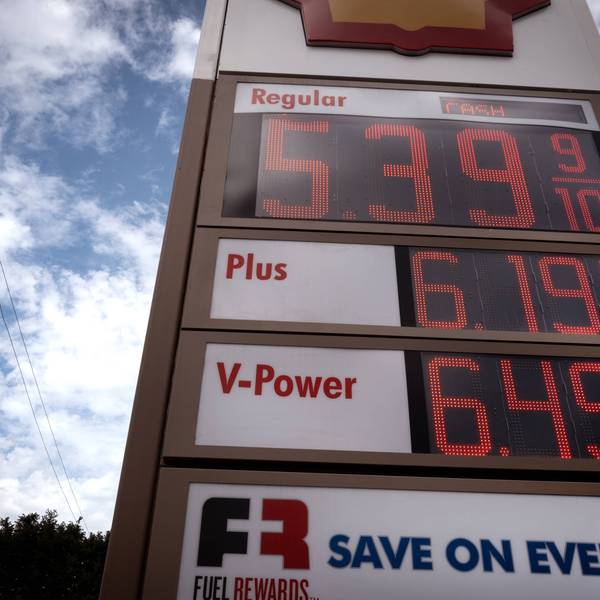
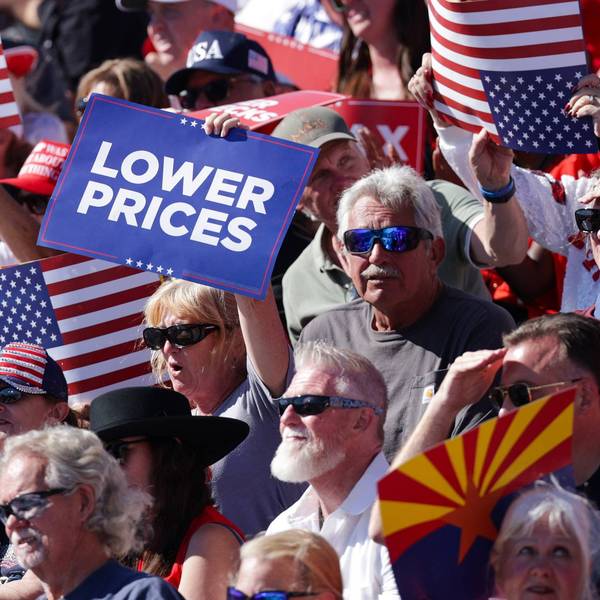

Progressives on Monday pointed to remarks by Federal Reserve Vice Chair Lael Brainard acknowledging the role of corporate profiteering in exacerbating inflation to underscore their opposition to interest rate hikes and other monetary tightening that favors Big Business over workers.
"The retail margin for motor vehicles sold at dealerships has increased by more than 180% since February 2020."
While attributing high inflation to the ongoing Covid-19 pandemic and Russia's invasion of Ukraine, Brainard--who was addressing a meeting of the National Association for Business Economics in Chicago--asserted that "there is ample room for margin recompression to help reduce goods inflation" in the retail economy.
"Retail margins have increased 20% since the onset of the pandemic, roughly double the 9% increase in average hourly earnings by employees in that sector," she noted. "In the auto sector, where the real inventory-to-sales ratio is 20% below its pre-pandemic level, the retail margin for motor vehicles sold at dealerships has increased by more than 180% since February 2020, 10 times the rise in average hourly earnings within that sector."
Brainard's nod to what one observer called "the elephant in the room" was secondary to her insistence that monetary tightening in the form of higher interest rates is the best way to tackle inflation.
"It will take time for the cumulative effect of tighter monetary policy to work through the economy broadly and to bring inflation down," she said. "In light of elevated global economic and financial uncertainty, moving forward deliberately and in a data-dependent manner will enable us to learn how economic activity, employment, and inflation are adjusting to cumulative tightening in order to inform our assessments of the path of the policy rate."
Noting that "the labor market's recovery from the pandemic-induced recession was a historic rebound," the progressive podcast "Pitchfork Economics" warned that "if the Fed keeps pursuing outdated, harmful solutions, they will push us into a longer, deeper recession with consequences that reverberate for years to come."
Meanwhile on Monday, Chicago Federal Reserve President Charles Evans said that the central bank's number one priority is reducing inflation--even if monetary tightening costs people their jobs.
"Ultimately, inflation is the most important thing to get under control. That's job one," Evans argued during an interview on MSNBC. "Price stability sets the stage for stronger growth in the future."
Members of the Fed's board of governors are widely expected to raise interest rates by 0.75% for the fourth consecutive time when they meet next month.
Last month, a trio of progressive political economists told members of the U.S. House Committee on Oversight and Reform that the most effective way to curb rising prices is to take on the corporate profiteering fueling inflation.
"Even as input costs come down, corporate executives are gleefully reporting how they plan on keeping prices high," one of the economists, Rakeen Mabud of the Groundwork Collaborative, told the lawmakers. "Megacorporations are taking advantage of recent crises to make record profits for themselves and their shareholders."
Related Content

Fed Rate Hikes Won't Tackle the Corporate Profiteering Behind Inflation, Experts Tell Congress
Another one of the economists, former U.S. labor secretary and University of California, Berkeley professor Robert Reich, testified that "the inflation we are now experiencing is not due to wage gains; it is due to increases in corporate profits."
"And it's excessive profits, not wages, that need to be controlled," he added.
Reich and others have urged Congress and U.S. President Joe Biden to pass windfall profits tax legislation like the Ending Corporate Greed Act introduced in March by Sens. Bernie Sanders (I-Vt.) and Ed Markey (D-Mass.) in the Senate and Rep. Jamaal Bowman (D-N.Y.) in the House. If passed, the measure would impose a 95% tax on the windfall profits of major corporations.
Progressives on Monday pointed to remarks by Federal Reserve Vice Chair Lael Brainard acknowledging the role of corporate profiteering in exacerbating inflation to underscore their opposition to interest rate hikes and other monetary tightening that favors Big Business over workers.
"The retail margin for motor vehicles sold at dealerships has increased by more than 180% since February 2020."
While attributing high inflation to the ongoing Covid-19 pandemic and Russia's invasion of Ukraine, Brainard--who was addressing a meeting of the National Association for Business Economics in Chicago--asserted that "there is ample room for margin recompression to help reduce goods inflation" in the retail economy.
"Retail margins have increased 20% since the onset of the pandemic, roughly double the 9% increase in average hourly earnings by employees in that sector," she noted. "In the auto sector, where the real inventory-to-sales ratio is 20% below its pre-pandemic level, the retail margin for motor vehicles sold at dealerships has increased by more than 180% since February 2020, 10 times the rise in average hourly earnings within that sector."
Brainard's nod to what one observer called "the elephant in the room" was secondary to her insistence that monetary tightening in the form of higher interest rates is the best way to tackle inflation.
"It will take time for the cumulative effect of tighter monetary policy to work through the economy broadly and to bring inflation down," she said. "In light of elevated global economic and financial uncertainty, moving forward deliberately and in a data-dependent manner will enable us to learn how economic activity, employment, and inflation are adjusting to cumulative tightening in order to inform our assessments of the path of the policy rate."
Noting that "the labor market's recovery from the pandemic-induced recession was a historic rebound," the progressive podcast "Pitchfork Economics" warned that "if the Fed keeps pursuing outdated, harmful solutions, they will push us into a longer, deeper recession with consequences that reverberate for years to come."
Meanwhile on Monday, Chicago Federal Reserve President Charles Evans said that the central bank's number one priority is reducing inflation--even if monetary tightening costs people their jobs.
"Ultimately, inflation is the most important thing to get under control. That's job one," Evans argued during an interview on MSNBC. "Price stability sets the stage for stronger growth in the future."
Members of the Fed's board of governors are widely expected to raise interest rates by 0.75% for the fourth consecutive time when they meet next month.
Last month, a trio of progressive political economists told members of the U.S. House Committee on Oversight and Reform that the most effective way to curb rising prices is to take on the corporate profiteering fueling inflation.
"Even as input costs come down, corporate executives are gleefully reporting how they plan on keeping prices high," one of the economists, Rakeen Mabud of the Groundwork Collaborative, told the lawmakers. "Megacorporations are taking advantage of recent crises to make record profits for themselves and their shareholders."
Related Content
Fed Rate Hikes Won't Tackle the Corporate Profiteering Behind Inflation, Experts Tell Congress
Another one of the economists, former U.S. labor secretary and University of California, Berkeley professor Robert Reich, testified that "the inflation we are now experiencing is not due to wage gains; it is due to increases in corporate profits."
"And it's excessive profits, not wages, that need to be controlled," he added.
Reich and others have urged Congress and U.S. President Joe Biden to pass windfall profits tax legislation like the Ending Corporate Greed Act introduced in March by Sens. Bernie Sanders (I-Vt.) and Ed Markey (D-Mass.) in the Senate and Rep. Jamaal Bowman (D-N.Y.) in the House. If passed, the measure would impose a 95% tax on the windfall profits of major corporations.