SUBSCRIBE TO OUR FREE NEWSLETTER
Daily news & progressive opinion—funded by the people, not the corporations—delivered straight to your inbox.
5
#000000
#FFFFFF
To donate by check, phone, or other method, see our More Ways to Give page.
Daily news & progressive opinion—funded by the people, not the corporations—delivered straight to your inbox.
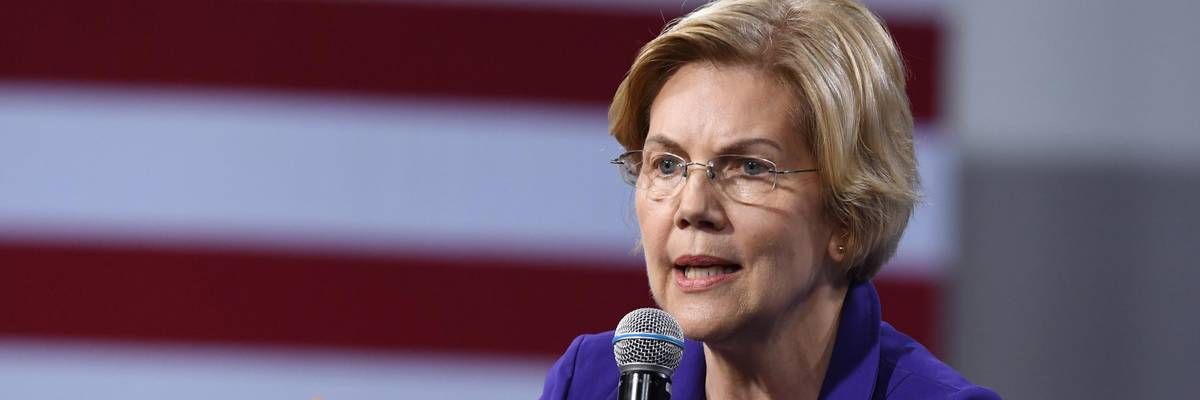
Sen. Elizabeth Warren (D-Mass.) speaks during an event in Las Vegas on April 27, 2019.
Sen. Elizabeth Warren on Thursday led the introduction of new legislation that would enable federal regulators to forcefully crack down on corporate price gouging, a practice that progressive lawmakers and economists say has played a major role in driving U.S. inflation to a 40-year high.
According to a one-page summary released by Warren's office, the Price Gouging Prevention Act of 2022 would "prohibit the practice of price gouging during all abnormal market disruptions--including the current pandemic--by authorizing the Federal Trade Commission (FTC) and state attorneys general to enforce a federal ban against unconscionably excessive price increases, regardless of a seller's position in a supply chain."
The summary notes that the bill would also "create a rebuttable presumption of price gouging against firms that exercise unfair leverage and companies that brag about increasing prices during periods of inflation" and require "public companies to transparently disclose and explain changes in their cost of goods sold, gross margins, and pricing strategies in their quarterly [Securities and Exchange Commission] filings."
"Corporations have price gouged consumers for extra profits--and gotten away with it--for too long," Warren (D-Mass.) wrote in a Twitter post on Thursday.
Warren introduced the new bill alongside Sen. Tammy Baldwin (D-Wis.), who said in a statement that the measure would "shine a light on price hikes and help prevent big corporations from exploiting a period of inflation to gouge consumers with higher costs."
Rep. Jan Schakowsky (D-Ill.) introduced companion legislation in the House.
Rakeen Mabud, chief economist at the Groundwork Collaborative, applauded the new bill as an "important" step toward reining in corporate profiteering and argued that "a federal price gouging statute would help curtail this exploitative behavior."
The legislation comes a day after federal data showed that while inflation eased slightly in April, consumer prices were up 8.3% last month compared to a year earlier.
In a recent analysis, Josh Bivens of the Economic Policy Institute argued that "the rise in inflation has not been driven by anything that looks like an overheating labor market--instead it has been driven by higher corporate profit margins and supply-chain bottlenecks."
Lindsay Owens, executive director of the Groundwork Collaborative, similarly argued in a New York Times op-ed last week that "plain old corporate profiteering" is a key culprit behind price hikes nationwide.
"Companies that historically might have kept prices low to pick up profit by gaining additional market share are instead using the cover of inflation to raise prices and increase profits," Owens wrote. "Consumers are now expecting higher prices at the checkout line, and companies are taking advantage. The poor and those on fixed incomes are hit the hardest."
Dear Common Dreams reader, It’s been nearly 30 years since I co-founded Common Dreams with my late wife, Lina Newhouser. We had the radical notion that journalism should serve the public good, not corporate profits. It was clear to us from the outset what it would take to build such a project. No paid advertisements. No corporate sponsors. No millionaire publisher telling us what to think or do. Many people said we wouldn't last a year, but we proved those doubters wrong. Together with a tremendous team of journalists and dedicated staff, we built an independent media outlet free from the constraints of profits and corporate control. Our mission has always been simple: To inform. To inspire. To ignite change for the common good. Building Common Dreams was not easy. Our survival was never guaranteed. When you take on the most powerful forces—Wall Street greed, fossil fuel industry destruction, Big Tech lobbyists, and uber-rich oligarchs who have spent billions upon billions rigging the economy and democracy in their favor—the only bulwark you have is supporters who believe in your work. But here’s the urgent message from me today. It's never been this bad out there. And it's never been this hard to keep us going. At the very moment Common Dreams is most needed, the threats we face are intensifying. We need your support now more than ever. We don't accept corporate advertising and never will. We don't have a paywall because we don't think people should be blocked from critical news based on their ability to pay. Everything we do is funded by the donations of readers like you. When everyone does the little they can afford, we are strong. But if that support retreats or dries up, so do we. Will you donate now to make sure Common Dreams not only survives but thrives? —Craig Brown, Co-founder |
Sen. Elizabeth Warren on Thursday led the introduction of new legislation that would enable federal regulators to forcefully crack down on corporate price gouging, a practice that progressive lawmakers and economists say has played a major role in driving U.S. inflation to a 40-year high.
According to a one-page summary released by Warren's office, the Price Gouging Prevention Act of 2022 would "prohibit the practice of price gouging during all abnormal market disruptions--including the current pandemic--by authorizing the Federal Trade Commission (FTC) and state attorneys general to enforce a federal ban against unconscionably excessive price increases, regardless of a seller's position in a supply chain."
The summary notes that the bill would also "create a rebuttable presumption of price gouging against firms that exercise unfair leverage and companies that brag about increasing prices during periods of inflation" and require "public companies to transparently disclose and explain changes in their cost of goods sold, gross margins, and pricing strategies in their quarterly [Securities and Exchange Commission] filings."
"Corporations have price gouged consumers for extra profits--and gotten away with it--for too long," Warren (D-Mass.) wrote in a Twitter post on Thursday.
Warren introduced the new bill alongside Sen. Tammy Baldwin (D-Wis.), who said in a statement that the measure would "shine a light on price hikes and help prevent big corporations from exploiting a period of inflation to gouge consumers with higher costs."
Rep. Jan Schakowsky (D-Ill.) introduced companion legislation in the House.
Rakeen Mabud, chief economist at the Groundwork Collaborative, applauded the new bill as an "important" step toward reining in corporate profiteering and argued that "a federal price gouging statute would help curtail this exploitative behavior."
The legislation comes a day after federal data showed that while inflation eased slightly in April, consumer prices were up 8.3% last month compared to a year earlier.
In a recent analysis, Josh Bivens of the Economic Policy Institute argued that "the rise in inflation has not been driven by anything that looks like an overheating labor market--instead it has been driven by higher corporate profit margins and supply-chain bottlenecks."
Lindsay Owens, executive director of the Groundwork Collaborative, similarly argued in a New York Times op-ed last week that "plain old corporate profiteering" is a key culprit behind price hikes nationwide.
"Companies that historically might have kept prices low to pick up profit by gaining additional market share are instead using the cover of inflation to raise prices and increase profits," Owens wrote. "Consumers are now expecting higher prices at the checkout line, and companies are taking advantage. The poor and those on fixed incomes are hit the hardest."
Sen. Elizabeth Warren on Thursday led the introduction of new legislation that would enable federal regulators to forcefully crack down on corporate price gouging, a practice that progressive lawmakers and economists say has played a major role in driving U.S. inflation to a 40-year high.
According to a one-page summary released by Warren's office, the Price Gouging Prevention Act of 2022 would "prohibit the practice of price gouging during all abnormal market disruptions--including the current pandemic--by authorizing the Federal Trade Commission (FTC) and state attorneys general to enforce a federal ban against unconscionably excessive price increases, regardless of a seller's position in a supply chain."
The summary notes that the bill would also "create a rebuttable presumption of price gouging against firms that exercise unfair leverage and companies that brag about increasing prices during periods of inflation" and require "public companies to transparently disclose and explain changes in their cost of goods sold, gross margins, and pricing strategies in their quarterly [Securities and Exchange Commission] filings."
"Corporations have price gouged consumers for extra profits--and gotten away with it--for too long," Warren (D-Mass.) wrote in a Twitter post on Thursday.
Warren introduced the new bill alongside Sen. Tammy Baldwin (D-Wis.), who said in a statement that the measure would "shine a light on price hikes and help prevent big corporations from exploiting a period of inflation to gouge consumers with higher costs."
Rep. Jan Schakowsky (D-Ill.) introduced companion legislation in the House.
Rakeen Mabud, chief economist at the Groundwork Collaborative, applauded the new bill as an "important" step toward reining in corporate profiteering and argued that "a federal price gouging statute would help curtail this exploitative behavior."
The legislation comes a day after federal data showed that while inflation eased slightly in April, consumer prices were up 8.3% last month compared to a year earlier.
In a recent analysis, Josh Bivens of the Economic Policy Institute argued that "the rise in inflation has not been driven by anything that looks like an overheating labor market--instead it has been driven by higher corporate profit margins and supply-chain bottlenecks."
Lindsay Owens, executive director of the Groundwork Collaborative, similarly argued in a New York Times op-ed last week that "plain old corporate profiteering" is a key culprit behind price hikes nationwide.
"Companies that historically might have kept prices low to pick up profit by gaining additional market share are instead using the cover of inflation to raise prices and increase profits," Owens wrote. "Consumers are now expecting higher prices at the checkout line, and companies are taking advantage. The poor and those on fixed incomes are hit the hardest."