

SUBSCRIBE TO OUR FREE NEWSLETTER
Daily news & progressive opinion—funded by the people, not the corporations—delivered straight to your inbox.
5
#000000
#FFFFFF
To donate by check, phone, or other method, see our More Ways to Give page.
Daily news & progressive opinion—funded by the people, not the corporations—delivered straight to your inbox.
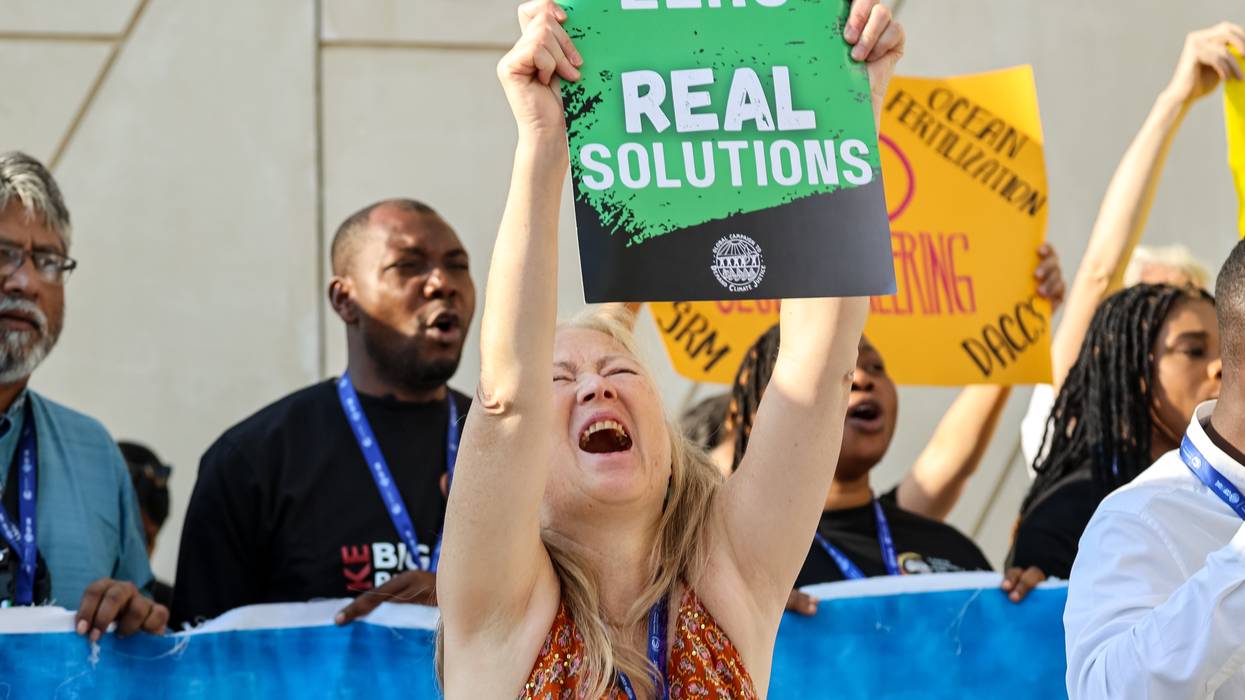
"The force with which the fossil fuel industry and their allies are coming to Dubai to sell the idea that we can 'capture' or 'manage' their carbon pollution is a sign of their desperation," said one advocate.
Leaders at the 28th United Nations Climate Change Conference in Dubai have claimed over the past week that the summit is centering issues that impact the Global South, but an analysis released Friday helped illustrate how difficult it's been for advocates from some of the most climate-impacted countries to make their case for far-reaching action—as the carbon capture and storage sector has far more representation at COP28 than many vulnerable nations.
The Center for International Environmental Law (CIEL) reported to The Guardian that at least 475 lobbyists representing carbon capture and storage (CCS) interests are attending COP28.
Many of the lobbyists represent companies that have developed CCS projects against the advice of climate and energy experts who say a phase-out of all fossil fuel emissions is needed to limit planetary heating to 1.5°C, or as close to it as possible.
More than 2,400 fossil fuel industry representatives are at the meeting, which is scheduled to end December 12. CCS has some of the most prominent representation at COP28, according to The Guardian.
"Thousands of fossil fuel lobbyists are roaming these halls alongside their peers, advancing dangerous distractions like carbon capture and storage... while communities enduring the greatest impacts from the climate crisis are having our voices silenced."
Representation for countries that are already facing climate catastrophes including prolonged drought, famine, and sea level rise has been dwarfed in comparison, with 366 people attending on behalf of Somalia, 79 representing Tonga, 56 representing the Solomon Islands, and just seven in attendance for Eritrea.
The CCS bloc also outnumbers Indigenous representatives by 50%, reported The Guardian.
"Thousands of fossil fuel lobbyists are roaming these halls alongside their peers, advancing dangerous distractions like carbon capture and storage, trying to block a fast, fair, forever fossil fuel phase-out—while communities enduring the greatest impacts from the climate crisis are having our voices silenced and our lives treated as a worthy sacrifice for profit," Blessed Chidhoni of the Global Campaign to Demand Climate Justice told the outlet.
Lili Fuhr, director of CIEL's fossil economy program, said COP28 has invited more than 470 lobbyists to speak out in favor of "the fossil fuel industry's lifeline and... their latest excuse and delay tactic."
As Common Dreams reported this week, a recent draft of the Global Stocktake that delegates are working to finalize showed how powerful fossil fuel-producing countries are pushing for an agreement that would allow "abated" emissions—those that are "captured" by CCS technology and stored underground or beneath the seabed or "utilized" to make fertilizers and other products.
"The force with which the fossil fuel industry and their allies are coming to Dubai to sell the idea that we can 'capture' or 'manage' their carbon pollution is a sign of their desperation," said Fuhr. "We must not let an army of carbon capture lobbyists blow a gigantic loophole into the energy package here at COP28."
As Common Dreams reported in May, energy-intensive carbon capture technology would increase energy consumption at fossil fuel-fired plants by 20% while also worsening environmental injustice by subjecting people in the surrounding area to increased levels of smog, benzene, and formaldehyde pollution.
Critics say CCS is far from a solution to the fossil-fueled planetary heating crisis, as policymakers at COP28 have proposed setting up infrastructure capable of capturing just 1.2 gigatonnes of carbon emissions—only 3% of global emissions in 2022.
"CCS is an unproven technology and a dangerous distraction, which enables big polluters to keep destroying communities and the environment," said Climate Action Network International.
In an analysis last month, CIEL noted that the U.S. "is the epicenter of the global push for CCS, with a long history of using captured carbon dioxide for enhanced oil recovery and extraordinary subsidies for carbon capture."
"The accelerating efforts to build ever more dangerous, unnecessary, and expensive infrastructure offshore should be abandoned, and subsidies for CCS should be eliminated," said Steven Feit, CIEL's senior attorney and legal and research manager.
One major U.S. CCS project, Petra Nova, shut down in 2020 after capturing 3.8 million tons of carbon dioxide emissions in its first three years. Developers had projected it would capture 4.6 million tons.
Another project in Western Australia—the largest carbon capture and utilization/storage endeavor in the world, missed its capture targets by about 50% in the first five years, and The Guardian reported this year that emissions have now risen by 50%.
"CCS's track record is riddled with failures and warning signs about the technology's feasibility and safety," said Nikki Reisch climate and energy program director for CIEL. "CCS is a false promise that only helps to keep fossil fuel facilities running and oil and gas fields pumping."
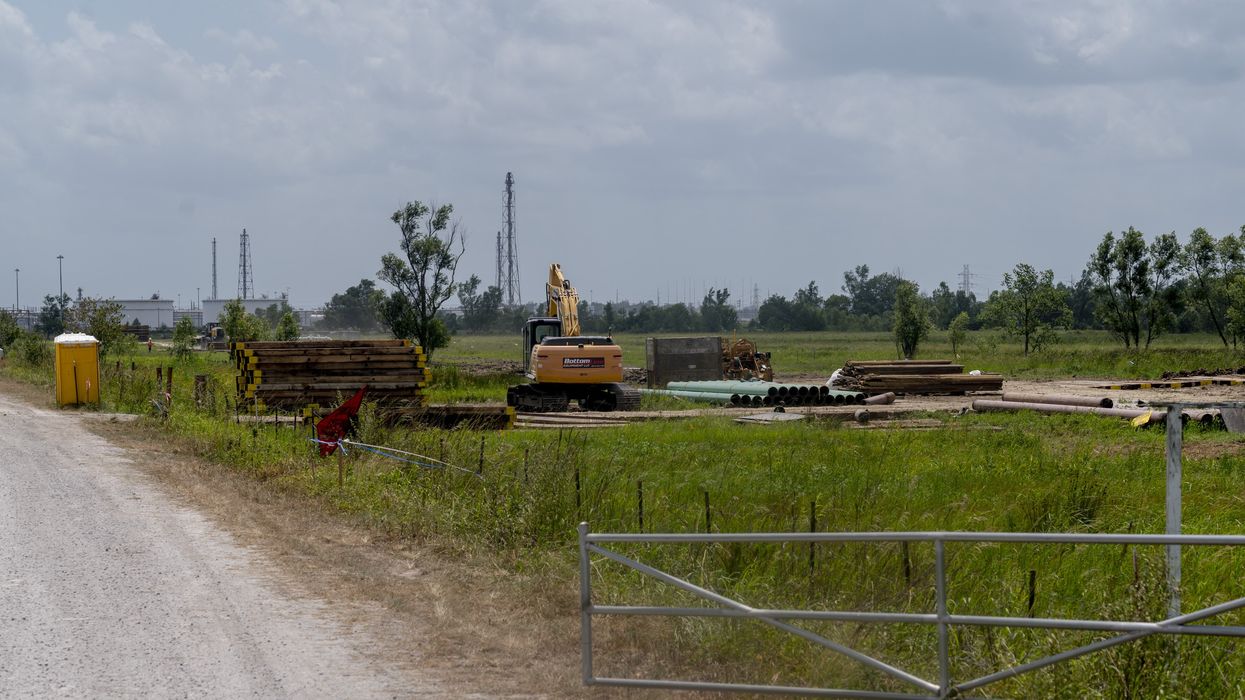
Environmental justice communities need real change—not a rebrand of the same discriminatory plans that slow the clock on fighting the climate crisis and reinforce the status quo.
There is a heightened focus on justice and equity in the Biden administration—but what does that look like for communities living with the realities of systemic and institutionalized discrimination?
For generations, environmental justice communities have borne the brunt of policies and practices that have relegated our homes, workplaces, recreational spaces, and places of worship to the shadows of fossil fuel and petrochemical infrastructure. As the administration and lawmakers advance opportunities to “decarbonize” the energy sector—the largest source of climate change-causing greenhouse gases in the U.S.—many communities are given little insight into the plans and technologies marketed as the solution. As a result, environmental justice communities—those predominantly composed of people of color and those with low income—have to navigate a maze of new federal investments in obscure policies and plans.
Specifically, carbon capture and sequestration (CCS), utilization (CCUS), hydrogen hubs, and direct air capture projects are being rolled out without transparency and our communities are targeted as development zones. It’s time for real change—not a rebrand of the same discriminatory plans that slow the clock on fighting the climate crisis and reinforce the status quo.
While CCS is being pushed as a way to cut emissions, it’s actually enabling further fossil fuel reliance.
The emergence of carbon management initiatives, including the Environmental Protection Agency’s (EPA) latest carbon rule proposal in tandem with the Department of Energy’s (DOE) regional hydrogen hub plan, are a major part of the problem. These initiatives are based on the promise of siphoning off greenhouse gas emissions from power plants and industrial facilities, but they often rely more on greenwashing and wishful thinking than on real solutions. They divert focus from the critical need to break free from fossil fuels, such as coal and natural gas, that disproportionately burden environmental justice communities.
The reality is that CCS technology remains untested at scale, is not guaranteed to work, and won’t address other harmful pollution like particulates that wreak havoc on our communities. In fact, “...more than 95% of all deployed CCS capacity has been used for enhanced oil recovery (‘EOR’), the process of taking captured carbon dioxide (CO2) and injecting it back into depleted oil wells to further extract more fossil fuels.”
While CCS is being pushed as a way to cut emissions, it’s actually enabling further fossil fuel reliance. What’s even more infuriating is that these projects are poised to reap the benefits of federal tax credits bolstered by the Inflation Reduction Act of 2022. This is a con job on the American public that will funnel funds into risky projects ultimately helping fossil fuel companies and perpetuating the systems that caused the climate crisis.
Now, CCS, CCUS, and direct air capture, along with certain types of hydrogen hubs using CCS along with natural gas, are planned for locations already overburdened by heavy industry, imposing additional risks such as leaks, pipelines blowing up, and health-harming air pollution like nitrogen oxide emissions. Unfortunately, a staggering 90% of the proposed or existing CCS/CCUS plants are located in or dangerously close to EJ communities. This means that investments in these risky schemes will inflict more damage on those already most vulnerable to pollution and climate change for years to come. Louisiana alone faces over two dozen proposals for CCS, CCUS, and hydrogen projects.
If these energy plans move forward, EJ communities will again be collateral damage.
One of these is a colossal $4.5 billion hydrogen plant and carbon capture complex in Ascension Parish by Air Products. This project includes carbon pipelines, wells, and underground storage that pose a grave threat to Lake Maurepas and contribute to air pollution from the new CCS plant, along with the real possibility of explosions. To make matters worse, project applicants may only carry liability for 10 years instead of the usual 50, leaving one of the poorest states with potential liabilities indefinitely.
Federal agencies promise new “regulatory regimes,” to protect EJ communities, but all we see in response to our concerns is an offering of community benefit agreements and public engagement processes that lack substantial, enforceable protections or the right to say “no.” In the absence of concrete federal protections, speculative industry proposals will capitalize on generous federal incentives like the 45Q and 45V tax credits, which allow upfront benefits without a clear mechanism by which governments will oversee and ensure the permanent storage of CO2. Likewise, the Inflation Reduction Act lengthened application timelines and opened up the criteria for which CCS projects qualify. And when disasters hit, we’ll all pay the price through skyrocketing healthcare and housing costs, along with other rising costs linked to pollution and the climate crisis. This approach not only rewards the industries that drive climate change and pollution in EJ communities, but it also perpetuates the big scam of oil, gas, and petrochemical giants.
It’s time we put an end to this farce.
EJ communities were given promises for real investment and involvement in a just energy transition through the administration’s Justice40 Initiative that would not mirror prejudicial policies of the past. If these energy plans move forward, EJ communities will again be collateral damage. There are sustainable solutions that desperately need our support and funding, including transitioning to truly clean, renewable energy such as wind and solar with an equitable transmission build-out.
We have what we need to do right by EJ communities nationwide, and to stave off the worst of the climate crisis before it’s too late—it’s time to move in the right direction.

"Carbon capture and storage is a scam, and as these documents show, the call is coming from inside the house," said one campaigner.
As wildfires continued to cause air pollution problems across eastern North America on Thursday, The Narwhal revealed it obtained documents showing that fossil fuel giant Suncor "provided input on the first draft" of the Canadian government's forthcoming Carbon Management Strategy and a company executive sat on an "obscure" advisory panel.
Highlighting the "important reporting" from The Narwhal's Carl Meyer, Torrance Coste—national campaign director at the Wilderness Committee, a Canadian nonprofit—tweeted that "carbon capture and storage is a scam, and as these documents show, the call is coming from inside the house."
Meyer, an investigative reporter at the nonprofit Canadian media outlet, shared details from a February 2022 briefing note prepared for Natural Resources Canada Deputy Minister John Hannaford—whom Prime Minister Justin Trudeau has just named as clerk of the Privy Council and secretary to the Cabinet, a promotion set to take effect later this month.
The briefing note was developed for a meeting with Jacquie Moore—then Suncor's vice president of external relations and now its top lawyer—and lobbyist Daniel Goodwin that "served as Hannaford's introduction to some Suncor 'key initiatives,' including the company's membership in the 'Oilsands Pathways to Net Zero alliance,' the former name of the Pathways Alliance, which was then a fledgling organization in the oilpatch," Meyer reported.
"The alliance wants to soak up at least $10 billion in public funding to build a mammoth, unprecedented system that would capture carbon from oilsands operations in Alberta and pipe it to an underground reservoir in the province's east," the journalist noted.
While serving as Suncor's vice president of regional development, Chris Grant was chosen to be on a "thought leaders' senior reference group" for the government plan—previously known as the Carbon Capture, Utilization, and Storage (CCUS) Strategy—according to the briefing note. Grant has since retired from the Calgary-based energy company.
Although Grant, Suncor, and the Pathways Alliance did not respond to requests for comment, Natural Resources Canada spokesperson Michael MacDonald told The Narwhal that "Suncor's input had no impact whatsoever on the timelines for the development of the strategy," the company was "one of nearly 1,500 organizations and individuals" who weighed in, and "input was solicited from all interested Canadians" online from July 2021 to November 2022.
MacDonald also said that members of the 13-person advisory board, including Grant, "were asked to bring their expertise and experiences to the table as individuals, not as representatives of their respective organizations."
The board included a University of Alberta professor, a clean energy consultant, a Shell Canada manager, the NRG COSIA Carbon XPrize executive director, CEOs of CarbonCure and Svante, president of Wolf Carbon, and vice presidents at BMO's Impact Investment Fund, Carbon Engineering, Cement Association of Canada, International CCS Knowledge Center, and Scotiabank.
"As the entire country burns, one has to wonder: should fossil fuel companies be weighing in on our national climate change policy?"
Meyer reported that the panel—convened by Drew Leyburne, Natural Resources Canada's assistant deputy minister for energy efficiency and technology—met three times between April and July 2021, then corresponded over email the following year. One member said they served as "a sounding board," providing "casual, nonbinding, nonconsensus advice."
The government spokesperson did not say when the plan will be released but said that "it was determined that a more holistic view of carbon management solutions was necessary in this space," given that CCUS "technology is not, on its own, a silver bullet to combat climate change," but it is "one component of an overarching strategy" that will also include nature-based solutions such as tree-planting and wetland restoration along with other technologies like direct air capture.
Some global campaigners and experts have long argued that CCUS is "a false solution" that has become "a dangerous distraction driven by the same big polluters who created the climate emergency," as Common Dreams has reported. Critics have also warned that industries promote "nature-based solutions" so they can "keep burning fossil fuels, mine more of the planet, and increase industrial meat and dairy production."
The reporting on the Canadian government's evolving carbon plan came as smoke from Canadian wildfires—intensified by global heating largely driven by fossil fuels—disrupted travel and outdoor activities across the U.S. East Coast as officials warned millions of people to stay indoors due to poor air quality.
Fatima Syed, Meyer's colleague at The Narwhal, tweeted that "this story is bonkers when you consider wildfires."
Emma McIntosh, another reporter at the outlet, similarly said that his "scoop feels like a bad joke when you read it under a layer of wildfire smoke: Suncor, a massive oil company, helped the federal government write its climate change strategy. Which is now a year late."

"Promoting the utilization of captured CO2 in petrochemicals, plastics, and fuels, as your legislation would encourage, will perpetuate environmental justice harms and subsidize the oil and gas industry to do it."
More than 100 organizations on Monday urged the congressional sponsors of a new proposal that would boost the tax credit for certain carbon capture projects to shift their focus to solutions that will actually address the fossil fuel-driven climate emergency.
The groups—including 350.org, Beyond Plastics, Center for Biological Diversity, Food & Water Watch, Indigenous Environmental Network, Michigan Environmental Justice Coalition (MEJC) Action!, Physicians for Social Responsibility, Science and Environmental Health Network (SEHN), and Waterspirit—oppose the Captured Carbon Utilization Parity Act (S. 542/H.R. 1262).
Introduced last week by Sens. Sheldon Whitehouse (D-R.I.) and Bill Cassidy (R-La.) and Reps. David Schweikert (R-Ariz.) and Terri Sewell (D-Ala.), the legislation would increase the 45Q tax credit for carbon capture and utilization (CCU) "to match the incentives for carbon capture and storage (CCS) for both direct air capture (DAC) and the power and industrial sectors."
The groups sent a letter to the four sponsors arguing that:
This bill does not advance climate solutions, but is rather a giveaway to fossil fuel companies and other corporate polluters under the guise of climate action. Promoting the utilization of captured CO2 in petrochemicals, plastics, and fuels, as your legislation would encourage, will perpetuate environmental justice harms and subsidize the oil and gas industry to do it. Rather than perpetuating these climate scams, we encourage you to support the elimination of subsidies for the fossil fuel industry instead of enriching them through carbon capture schemes.
In addition to stressing that such projects consume a lot of water while producing emissions and chemical waste—further endangering frontline communities that are disproportuantely home to people of color and low-income individuals—the organizations pointed out that "carbon capture has a long history of overpromising and under-delivering."
"The overwhelming majority of captured carbon to date has been used to increase oil production via enhanced oil recovery (EOR)," the letter highlights. "The myth of a massive carbon management paradigm that uses and re-uses carbon dioxide on any large scale serves only to greenwash the reality of how carbon dioxide is used: for oil production."
"As laid bare in an investigation from the U.S. Treasury Inspector General for Tax Administration, the 45Q tax credit is rife with abuse as credits are improperly claimed," the letter further notes. "Moreover, documents uncovered by the House Oversight Committee's investigation into major oil companies and climate disinformation revealed that the biggest proponents of CCS also understand the technology to be costly, ineffective, and requiring continued and increasing government subsidization."
"The myth of a massive carbon management paradigm that uses and re-uses carbon dioxide on any large scale serves only to greenwash the reality of how carbon dioxide is used: for oil production."
Citing a report from the United Nations' Intergovernmental Panel on Climate Change, the organizations also explained that "in contrast to things like solar power and batteries, carbon capture is not the kind of technology that gets significantly cheaper over time, and increasing public subsidies to spark a carbon management industry will not result in a self-sustaining system."
According to dozens of groups representing communities across the country, "The carbon utilization fantasy should be abandoned, with focus restored on the solutions we know will help combat the climate crisis, like renewable energy and storage, electrification, energy efficiency, real zero-waste materials systems, agroecology, and more."
SEHN executive director Carolyn Raffensperger told Common Dreams that her group is supporting the letter "because carbon capture use and sequestration (CCUS) is the fossil fuel industry's diabolical plan to line its investors' pockets with public money" and "the antithesis of a climate solution in that it delays real, tried and true solutions."
"Further, the entire 45Q tax credit program turns sound environmental policy on its head: Instead of requiring the polluter to pay for its damage, 45Q tax credits pay the polluter to pollute," Raffensperger added. Pointing to proposed CO2 pipelines in Iowa, she said:
Keenly aware of the climate crisis, we investigated the claims that industry was making that we could address climate by putting a big machine on top of various polluting facilities and transporting the CO2 across the countryside and burying it deep underground. What we discovered was that the entire enterprise would require more energy than the original facility required. It will disrupt farm land and pose grave risks in case of a pipeline rupture. Even worse, we found that this vast complex system of carbon capture, transportation, and either use or disposal is horribly under-regulated by [the Environmental Protection Agency], the Pipeline and Hazardous Materials Safety Administration, the [Internal Revenue Service], and others. The frosting on this toxic cake is that the public pays the fossil fuel industry with public money and the public gets no climate benefit. If anything, CCUS makes climate change worse.
"Heed the lessons of the recent train derailment and pipeline disasters. That is, fix the regulatory mess before pouring money into 45Q tax credits," she urged U.S. lawmakers. "The tax credits are like shoveling coal into the boiler of a runaway train."
MEJC Action! backed the letter "because of the dangers CCUS presents to environmental justice communities in Michigan," Juan Jhong-Chung, the group's climate justice director, told Common Dreams. "Our communities are already overburdened by polluted air and water because of fossil fuel power plants and other toxic industrial infrastructure. We do not want government subsidies going to technologies that will perpetuate harms and impact the health of our families."
"Most projects where CCUS can be deployed are Black, Brown, and poor communities," the campaigner added. "We don't need more respiratory issues, we deserve clean pollution-free renewable energy."
As Rachel Dawn Davis, public policy and justice organizer at Waterspirit, said Monday in an email to Common Dreams, independent science has already shown that investments in carbon capture "would be a waste of money and time," and "we are experiencing the sixth mass extinction; we have no time to continue wasting."
"If we are to provide a livable future for current and future generations of young people and all creation, we must invest solely in renewable energy, not furthering fossil fuel fallacies," she emphasized. "Subsidies going to the most heinous polluters are only continuing through this legislation; congressional representatives must know better by now."
This post has been updated with comment from MEJC Action!.

"Rather than expand subsidies for false fixes," said one critic of a new bipartisan bill, Congress should pass legislation to "phase out all fossil fuel subsidies."
Climate organizations this week are calling out new legislation that would pour even more money into the "false solution" of carbon capture technology, which they warn is just a distraction by the fossil fuel industry that does nothing to address the climate crisis.
Advocates of bold climate action are taking aim at the Captured Carbon Utilization Parity Act (S. 542/H.R. 1262), introduced by Sens. Sheldon Whitehouse (D-R.I.) and Bill Cassidy (R-La.) and Reps. David Schweikert (R-Ariz.) and Terri Sewell (D-Ala.) on Tuesday.
As a summary from the senators details, the bill would boost the 45Q tax credit for carbon capture and utilization (CCU) "to match the incentives for carbon capture and storage (CCS) for both direct air capture (DAC) and the power and industrial sectors."
Specifically, it would increase the value for DAC utilization to $180 per metric ton and for power and industrial sector utilization to $85 per metric ton—a move that the Joint Committee on Taxation estimates would cost $16 million over the next decade.
A White House Council on Environmental Quality report from 2021 explains that utilization "refers to the potential for using captured CO2 to make products, like concrete or plastics. CCU is a broad term used to describe the many different ways that captured CO2 can be used or 'recycled' to produce economically valuable products or services."
"We have real and proven solutions to address the climate crisis that don't harm communities already overburdened with pollution."
Many frontline communities and climate groups have long criticized efforts to develop and implement such operations—and the potential investment of public money into them—because of both local and global impacts, and instead demanded a swift and just transition to renewables.
"We have real and proven solutions to address the climate crisis that don't harm communities already overburdened with pollution," Friends of the Earth climate campaigner Sarah Lutz said Wednesday. "The Captured Carbon Utilization Parity Act will only undermine the needed transition away from fossil fuels."
"There is no legitimate reason to double down on subsidies for fossil fuel and petrochemical industry greenwashing scams," she continued. "Sen. Whitehouse should not work with Republicans to light taxpayer money on fire at the expense of our communities and climate."
Food & Water Watch similarly stressed that "it is time to stop wasting public money on bogus tech" while pointing out that tax credit just jumped from $50 per ton of sequestered CO2 to $85 per ton under the Inflation Reduction Act, a historic but flawed package that President Joe Biden signed last year.
"Carbon capture supporters like to talk about it as a climate fix, but the fact that it is backed by oil and gas giants tells you everything you need to know," said the group's policy director, Jim Walsh. "The fossil fuel industry has pulled off a remarkable trick by rebranding oil drilling as a form of pollution reduction."
Walsh warned that "this bill would steer more public money towards dirty energy and plastic production under the guise of reducing climate pollution, which would be better spent building genuinely clean energy sources rather than propping up the very industries that are destroying our planet."
"This is pro-polluter scam technology that serves the interests of fossil fuel companies, increases pollution in communities, and does nothing to help the climate."
"It's time for lawmakers to see the truth about carbon capture and sequestration: This is pro-polluter scam technology that serves the interests of fossil fuel companies, increases pollution in communities, and does nothing to help the climate," he said.
Collin Rees, United States program manager at Oil Change International, also piled on the CCU bill Wednesday.
"Carbon capture, utilization, and storage is a dangerous distraction from the urgent work needed to actually confront the climate crisis, including a rapid and equitable phase-out of fossil fuels," he said. "Giving more public money to prolong Big Oil’s political power and profits is the wrong approach and a poor use of public funds."
"Rather than expand subsidies for false fixes like carbon capture yet again, policymakers should support existing bills," Rees argued, pointing to a proposal from Reps. Ro Khanna (D-Calif.), Raúl Grijalva (D-Ariz.), and Mike Quigley (D-Ill.) "to end subsidies for enhanced oil recovery" as well as the End Polluter Welfare Act, introduced by Sen. Bernie Sanders (I-Vt.) and Rep. Ilhan Omar (D-Minn.) "to phase out all fossil fuel subsidies."