

SUBSCRIBE TO OUR FREE NEWSLETTER
Daily news & progressive opinion—funded by the people, not the corporations—delivered straight to your inbox.
5
#000000
#FFFFFF
To donate by check, phone, or other method, see our More Ways to Give page.
Daily news & progressive opinion—funded by the people, not the corporations—delivered straight to your inbox.
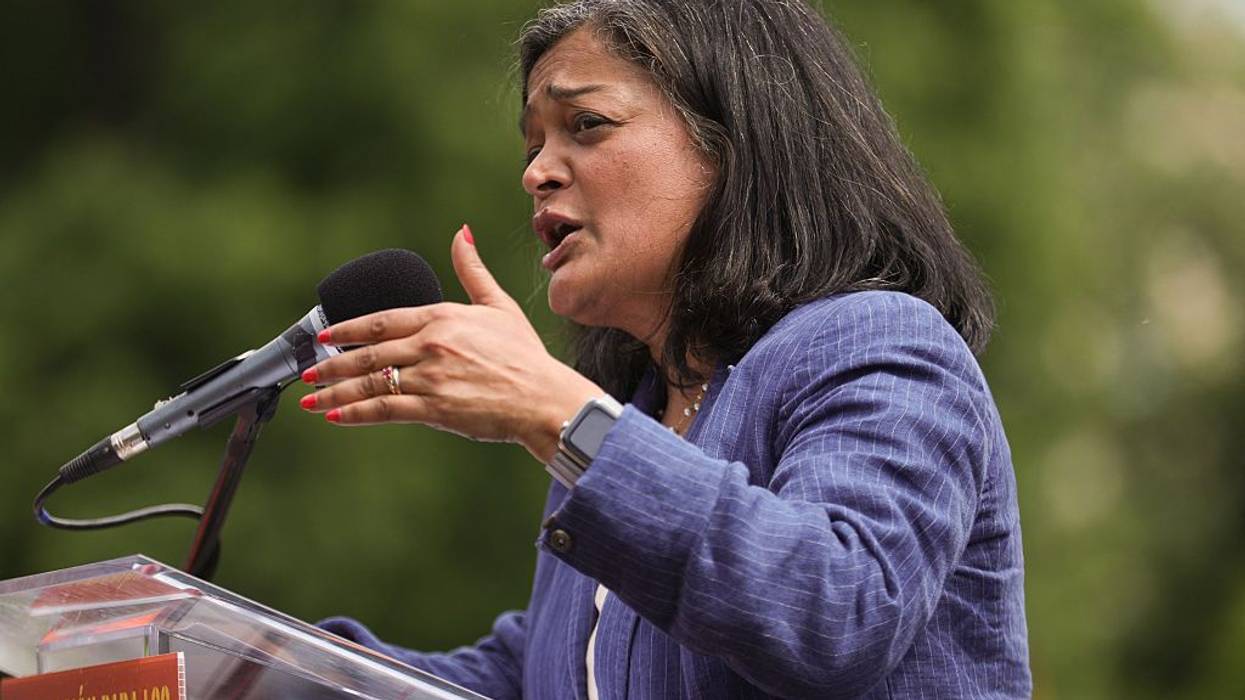
"Free speech is a constitutional right that we must all stand up and protect," the progressive congresswoman said.
US Rep. Pramila Jayapal on Wednesday joined First Amendment defenders in condemning the University of Washington’s cancellation of a planned lecture by controversial socialist streamer Hasan Piker and implored all Americans to stand up for free speech.
The University of Washington (UW) vaguely explained earlier this week that Piker's scheduled January 2027 appearance as part of the school's Speaker Series was canceled after "it was determined that the process for organizing this event did not meet the necessary level of rigor for university-hosted events."
"Going forward, procedures will be updated to ensure the standards we have for university-hosted events like the Speaker Series are met, particularly so that we can help elevate the level of dialogue on divisive topics during a polarized time in our country," the school added.
Japayal (D-Wash.), a UW alumna, said on social media: "As a member of the Judiciary Committee, I have been absolutely clear that free speech is a constitutional right that we must all stand up and protect. I have been communicating my concerns about the cancellation of the Hasan Piker event directly to the university, and they have informed me that they are doing an internal review to ensure this never happens again."
As a Member of the Judiciary Committee, I have been absolutely clear that free speech is a Constitutional right that we must all stand up and protect. I have been communicating my concerns about the cancellation of the Hasan Piker event directly to the University... (1/2)
[image or embed]
— Congresswoman Pramila Jayapal (@jayapal.house.gov) August 13, 2026 at 11:22 AM
Piker—who has millions of subscribers and followers on Twitch and other platforms—responded to the cancellation by accusing UW officials of caving to a "barrage of botted emails" from Israel supporters.
"If this had happened to Charlie Kirk or if this had happened to Ben Shapiro, this would be the number one news story on Fox News for a month," he said, referring to the assassinated Turning Point USA (TPUSA) co-founder and the co-founder of the right-wing Daily Wire.
In fact, TPUSA spokesperson and Charlie Kirk Show producer Andrew Kolvet opposed Piker's cancellation, writing on X: “Let the radical Mao-loving communist Hasan Piker speak, so long as he can resist the urge to call for the death of his political opponents. Universities do this to TPUSA often and blame some admin error etc. It’s wrong.”
The Anti-Defamation League—which has faced heavy criticism for conflating opposition to Israel's wars, illegal occupation and settler colonization, ethnic cleansing, and apartheid with hatred of Jewish people—accuses Piker of "a history of rhetoric that sanitizes violence and denigrates Jewish people."
Piker's most controversial statements include calling some ultra-Orthodox Jews "inbred psychopaths," calling Zionism a "mental illness," dismissing sexual violence perpetrated by Hamas against Israelis on and after the October 7, 2023 attack, calling Hamas "a thousand times better than Israel," and saying the United States "deserved" the al-Qaeda attacks carried out on September 11, 2001 in response to decades of US militant imperialism in Muslim nations. Piker subsequently apologized for his "inbred" comment; he also called his 9/11 remarks "inappropriate."
Piker and his uncle, The Young Turks founder Cenk Uygur, were recently banned from entering the United Kingdom, whose Labour government declared that their presence in the country “may not be conducive to the public good.”
The UW cancellation came four months after the US Department of Justice launched an investigation into the school's handling of alleged antisemitism on campus, which saw a crackdown on pro-Palestine protests during Israel's annihilation of Gaza—described by a United Nations commission of inquiry, international experts, nearly 20 national governments, and people around the world as a genocide.
Ironically, UW officials in 2024 dismantled a sukkah—a temporary outdoor hut built during the annual Sukkot festival—erected by Jewish students opposing Israel's onslaught.
The nonprofit civil liberties group Foundation for Individual Rights and Expression (FIRE) also condemned UW's decision to cancel Piker's speech, arguing on X that "if the decision was based on process—and not public backlash or criticism—UW should be transparent about what standards were not met and how they were applied."
"Public universities can set standards for events," FIRE added. "But they can’t use those standards as cover for canceling a speaker because of their views."

"There’s a chilling effect on not just my academic freedom, but that of my colleagues; anyone who dares to speak out against the war and against aggression," said UW professor Aria Fani.
The University of Washington has removed a professor from his role as director of its Middle East Center after he criticized the illegal US-Israeli war of choice on Iran and condemned Zionism, the settler-colonial movement for Jewish hegemony in Palestine.
Aria Fani, who will remain an associate professor at UW’s Jackson School of International Studies, told The Seattle Times on Friday that new interim widirector Daniel Hoffman told him last week he was fired from his leadership role at the Middle East Center.
Fani, who was born and raised in Iran and came to the US when he was 18 years old, said he was hired for his research on Iran. However, he told the Times that he now feels "profoundly hurt and betrayed" by his removal.
"There’s a chilling effect on not just my academic freedom, but that of my colleagues; anyone who dares to speak out against the war and against aggression," he said.
In a separate interview Friday with My Northwest, Fani said he was removed "for improper use" of the center's listserv, an email application.
"I sent out two memos about this atrocious war on Iran in which I offered historical analysis that’s lacking in the media,” Fani said. “I was told that my email made ‘certain constituents feel attacked.’ By certain constituents, I assume the university means Zionists who would like to keep bombing every Middle Eastern country and continue dehumanizing their people.”
Last July Fani told the The Daily UW, a student newspaper, that President Donald Trump's militaristic foreign policy—he's bombed 10 countries, more than any other US leader—is not making the world safer.
“If you tell the dozens of children that were killed in Israeli bombardment... in Iran, or the families of the nuclear scientists who were just wiped out, I hardly imagine they would say that the world is a more peaceful place," he said amid the first round of US and Israeli airstrikes on Iran.
Since then, many more Iranian children have been killed by US and Israeli bombing, including more than 100 students who were among around 175 people massacred in the February 28 US cruise missile strike on a girls' school in Minab.
“The [only] peace this secures is for weapons manufacturers, for oil companies, for drone companies," Fani said in an implicit rebuke of Trump's claim to be the "president of peace."
"It secures peace for them, fills their pockets with money, and makes them fully invincible," he added. "It’s creating a class of people that are living [on] an alternate planet."
Fani was a close friend and defender of Ayşenur Ezgi Eygi, the 26-year-old Turkish-American UW grad and International Solidarity Movement volunteer who was fatally shot in 2024 while peacefully protesting the expansion of Israel’s illegal settlements in the occupied West Bank. Witnesses said Israeli occupation forces deliberately shot Eygi in the head.
The professor also called Zionism—some of whose founders acknowledged the colonial nature of their endeavor—a "cancerous" ideology.
Fani noted that his removal from his position at the Middle East Center coincided with a recent town hall-style meeting attended by UW President Robert Jones and right-wing media personality Ari Hoffman. According to Fani, Hoffman "specifically asked Jones" about the professor's leadership at the center.
“All we can do is try to remind people of their responsibilities as members of the university community,” Jones said at meeting. “Not trying to tell them that they can’t have a discussion about Palestine or about Israel, but let’s be clear that those discussions need to be had in a way that doesn’t perpetuate an environment where people feel unsafe.”
According to its website, UW's Middle East Center seeks "to strengthen an understanding of the Middle East in all sectors of American society through training and research at the University of Washington, as well as through delivery of outreach programming across the nation."
Fani is one of dozens of US academics who have been fired, had their contracts terminated, lost job offers, or faced other punitive repercussions for advocating Palestinian rights or opposing Israeli policies and practices.
Earlier this week, Shirin Saeidi, who headed the Center for Middle East Studies at the University of Arkansas, Fayetteville, was terminated for social media posts deemed supportive of Iran's government, despite the fact that the school's Faculty Committee on Appointment, Promotion, and Tenure ruled unanimously in February that she should return to her position.
Late last month, Texas State University philosophy professor Idris Robinson sued school officials after he was fired for what he says was his 2024 off-campus lecture in North Carolina titled “Strategic Lessons from the Palestinian Resistance."
Israel's conduct in Gaza is the subject of an ongoing International Court of Justice (ICJ) genocide case filed by South Africa and formally supported by nearly 20 nations. The International Criminal Court has also issued arrest warrants for Israeli Prime Minister Benjamin Netanyahu and former Defense Minister Yoav Gallant for alleged crimes against humanity and war crimes in Gaza.
The ICJ found in 2024 that Israel's occupation of Palestine is an illegal form of apartheid.