SUBSCRIBE TO OUR FREE NEWSLETTER
Daily news & progressive opinion—funded by the people, not the corporations—delivered straight to your inbox.
5
#000000
#FFFFFF
To donate by check, phone, or other method, see our More Ways to Give page.
Daily news & progressive opinion—funded by the people, not the corporations—delivered straight to your inbox.
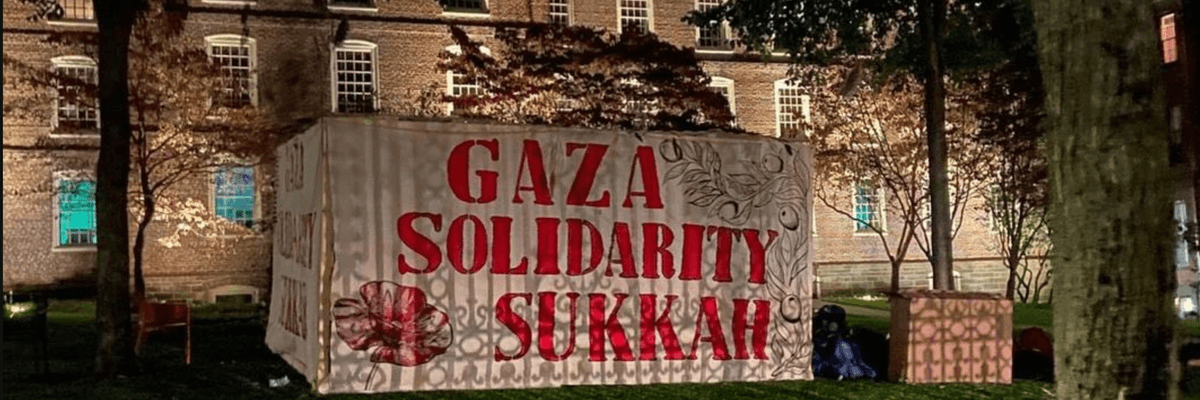
A "Gaza solidarity sukkah" is seen on the campus of Brown University in Providence, Rhode Island on October 17, 2024.
Some U.S. universities have torn down solidarity sukkahs that Jewish students opposed to Israel's war on Palestinians have built in recent days to honor the Sukkot holiday and to "protest as the Israeli military continues to invoke the Jewish tradition as fuel for the destruction of Gaza."
Sukkahs are temporary booths erected for the Jewish holiday of Sukkot, an eight-day celebration of the fall harvest and the ancient Israelites' escape from slavery in Egypt.
To honor the holiday, students from Jewish Voice for Peace (JVP) and other Jewish-led organizations constructed Gaza solidarity sukkahs on campuses including Northwestern University; University of Chicago; Brown University; Columbia University; University of Washington; University of California, Berkeley; Stanford University; Yale University; University of North Carolina; University of California, Los Angeles; Massachusetts Institute of Technology; Rutgers University; University of California, San Diego; and other schools.
"For the past year, we have witnessed the Israeli government, the U.S. government, and even administrators at our university distort our thousands of years-old Jewish tradition to justify genocide," University of Washington student Talia Braester said in a statement.
"We will not allow our tradition to be exploited by those who seek death and destruction," Braester added. "Our ancestors, many of whom endured genocide and ethnic cleansing, taught us never to be bystanders in the face of injustice. We call for an arms embargo and divestment from the Israeli military out of a commitment to life itself."
According to JVP:
In alignment with Jewish tradition, Jewish students intended to spend eight days dwelling in the sukkah—a ritual in remembrance of Jewish ancestors forced to live in temporary structures in the desert while fleeing slavery. This year, students could not separate their observance from the fact that tens of thousands of Palestinians are forced to live in temporary shelters due to the Israeli military's mass destruction of homes in Gaza. And this week the world witnessed Israeli forces bomb Al-Aqsa Hospital, burning alive Palestinian patients, including 19-year-old Sha'ban al-Dalou, who was recovering from an operation in his tent with an IV still in his arm. Jewish students across the country are observing Sukkot and hung banners from their sukkahs saying, "Stop Arming Israel" as Israeli forces murder tens of thousands of innocent people in Gaza.
According to the Gaza Ministry of Health and United Nations agencies, Israel's 382-day assault and siege of the enclave has left more than 152,000 Palestinians dead, injured, or missing, and millions more forcibly displaced, starved, and sickened. Israel's conduct in the war is the subject of an International Court of Justice genocide case. Meanwhile, thousands more Palestinians have been killed or wounded in the illegally occupied West Bank. Thousands of Lebanese have been killed or maimed by the Israeli bombardment and invasion of Lebanon, according to officials there.
The U.S. supports Israel's war effort with tens of billions of dollars in
military aid and diplomatic backing including vetoes of multiple United Nations Security Council cease-fire resolutions.
On several of the campuses where sukkahs were built, university administrators destroyed the sacred structures—in some cases, throwing them in dumpsters. Some students said they now face disciplinary action, even though in years past they were allowed to sleep in their sukkahs.
"Many of the sukkahs were adorned with plants and gourds from local farms as a way to honor the harvest," said JVP. "In a callous display, the administrators discarded these as well."
"Many administrators cited draconian policies passed in the wake of the Gaza solidarity encampments that forbid students from camping overnight," the group noted, referring to protests during the last academic year. "The students explained that sleeping in sukkahs is an essential part of this holiday and part of their religious rights, but administrators choose to disregard the students' pleas."
Another University of Washington student, Roza Fernandez, said that "I think it's despicable, cowardly, and highly hypocritical—after all the U.W. administration's efforts to supposedly address antisemitism on campus... just to tear down our sukkah?"
"It shows the truth: Admin does not care about antisemitism and is not afraid to wield it to silence criticism of Zionism and their complicity in genocide," Fernandez added.
JVP media coordinator Liv Kunins-Berkowitz said that "these universities desecrate these students' Jewish practice because their faith is intertwined with their solidarity with the Palestinian people."
"A university has no right to dictate what types of Jewish practice are legitimate," Kunins-Berkowitz added. "Anti-Zionist Judaism is a long-standing and rapidly growing expression of being Jewish."
The U.S. students' campaign of solidarity sukkahs stood in stark contrast with the sukkahs erected by far-right Israeli settlers during this week's "Preparing to Settle Gaza" conference, which was backed by Israeli Prime Minister Benjamin's ruling Likud party and featured speakers including Cabinet ministers and several members of the Knesset, Israel's parliament.
"Each of you will witness how Jews go to Gaza and Arabs will disappear from Gaza," one prominent settler and advocate for the ethnic cleansing of Palestinians told the audience at the event.
Dear Common Dreams reader, It’s been nearly 30 years since I co-founded Common Dreams with my late wife, Lina Newhouser. We had the radical notion that journalism should serve the public good, not corporate profits. It was clear to us from the outset what it would take to build such a project. No paid advertisements. No corporate sponsors. No millionaire publisher telling us what to think or do. Many people said we wouldn't last a year, but we proved those doubters wrong. Together with a tremendous team of journalists and dedicated staff, we built an independent media outlet free from the constraints of profits and corporate control. Our mission has always been simple: To inform. To inspire. To ignite change for the common good. Building Common Dreams was not easy. Our survival was never guaranteed. When you take on the most powerful forces—Wall Street greed, fossil fuel industry destruction, Big Tech lobbyists, and uber-rich oligarchs who have spent billions upon billions rigging the economy and democracy in their favor—the only bulwark you have is supporters who believe in your work. But here’s the urgent message from me today. It's never been this bad out there. And it's never been this hard to keep us going. At the very moment Common Dreams is most needed, the threats we face are intensifying. We need your support now more than ever. We don't accept corporate advertising and never will. We don't have a paywall because we don't think people should be blocked from critical news based on their ability to pay. Everything we do is funded by the donations of readers like you. When everyone does the little they can afford, we are strong. But if that support retreats or dries up, so do we. Will you donate now to make sure Common Dreams not only survives but thrives? —Craig Brown, Co-founder |
Some U.S. universities have torn down solidarity sukkahs that Jewish students opposed to Israel's war on Palestinians have built in recent days to honor the Sukkot holiday and to "protest as the Israeli military continues to invoke the Jewish tradition as fuel for the destruction of Gaza."
Sukkahs are temporary booths erected for the Jewish holiday of Sukkot, an eight-day celebration of the fall harvest and the ancient Israelites' escape from slavery in Egypt.
To honor the holiday, students from Jewish Voice for Peace (JVP) and other Jewish-led organizations constructed Gaza solidarity sukkahs on campuses including Northwestern University; University of Chicago; Brown University; Columbia University; University of Washington; University of California, Berkeley; Stanford University; Yale University; University of North Carolina; University of California, Los Angeles; Massachusetts Institute of Technology; Rutgers University; University of California, San Diego; and other schools.
"For the past year, we have witnessed the Israeli government, the U.S. government, and even administrators at our university distort our thousands of years-old Jewish tradition to justify genocide," University of Washington student Talia Braester said in a statement.
"We will not allow our tradition to be exploited by those who seek death and destruction," Braester added. "Our ancestors, many of whom endured genocide and ethnic cleansing, taught us never to be bystanders in the face of injustice. We call for an arms embargo and divestment from the Israeli military out of a commitment to life itself."
According to JVP:
In alignment with Jewish tradition, Jewish students intended to spend eight days dwelling in the sukkah—a ritual in remembrance of Jewish ancestors forced to live in temporary structures in the desert while fleeing slavery. This year, students could not separate their observance from the fact that tens of thousands of Palestinians are forced to live in temporary shelters due to the Israeli military's mass destruction of homes in Gaza. And this week the world witnessed Israeli forces bomb Al-Aqsa Hospital, burning alive Palestinian patients, including 19-year-old Sha'ban al-Dalou, who was recovering from an operation in his tent with an IV still in his arm. Jewish students across the country are observing Sukkot and hung banners from their sukkahs saying, "Stop Arming Israel" as Israeli forces murder tens of thousands of innocent people in Gaza.
According to the Gaza Ministry of Health and United Nations agencies, Israel's 382-day assault and siege of the enclave has left more than 152,000 Palestinians dead, injured, or missing, and millions more forcibly displaced, starved, and sickened. Israel's conduct in the war is the subject of an International Court of Justice genocide case. Meanwhile, thousands more Palestinians have been killed or wounded in the illegally occupied West Bank. Thousands of Lebanese have been killed or maimed by the Israeli bombardment and invasion of Lebanon, according to officials there.
The U.S. supports Israel's war effort with tens of billions of dollars in
military aid and diplomatic backing including vetoes of multiple United Nations Security Council cease-fire resolutions.
On several of the campuses where sukkahs were built, university administrators destroyed the sacred structures—in some cases, throwing them in dumpsters. Some students said they now face disciplinary action, even though in years past they were allowed to sleep in their sukkahs.
"Many of the sukkahs were adorned with plants and gourds from local farms as a way to honor the harvest," said JVP. "In a callous display, the administrators discarded these as well."
"Many administrators cited draconian policies passed in the wake of the Gaza solidarity encampments that forbid students from camping overnight," the group noted, referring to protests during the last academic year. "The students explained that sleeping in sukkahs is an essential part of this holiday and part of their religious rights, but administrators choose to disregard the students' pleas."
Another University of Washington student, Roza Fernandez, said that "I think it's despicable, cowardly, and highly hypocritical—after all the U.W. administration's efforts to supposedly address antisemitism on campus... just to tear down our sukkah?"
"It shows the truth: Admin does not care about antisemitism and is not afraid to wield it to silence criticism of Zionism and their complicity in genocide," Fernandez added.
JVP media coordinator Liv Kunins-Berkowitz said that "these universities desecrate these students' Jewish practice because their faith is intertwined with their solidarity with the Palestinian people."
"A university has no right to dictate what types of Jewish practice are legitimate," Kunins-Berkowitz added. "Anti-Zionist Judaism is a long-standing and rapidly growing expression of being Jewish."
The U.S. students' campaign of solidarity sukkahs stood in stark contrast with the sukkahs erected by far-right Israeli settlers during this week's "Preparing to Settle Gaza" conference, which was backed by Israeli Prime Minister Benjamin's ruling Likud party and featured speakers including Cabinet ministers and several members of the Knesset, Israel's parliament.
"Each of you will witness how Jews go to Gaza and Arabs will disappear from Gaza," one prominent settler and advocate for the ethnic cleansing of Palestinians told the audience at the event.
Some U.S. universities have torn down solidarity sukkahs that Jewish students opposed to Israel's war on Palestinians have built in recent days to honor the Sukkot holiday and to "protest as the Israeli military continues to invoke the Jewish tradition as fuel for the destruction of Gaza."
Sukkahs are temporary booths erected for the Jewish holiday of Sukkot, an eight-day celebration of the fall harvest and the ancient Israelites' escape from slavery in Egypt.
To honor the holiday, students from Jewish Voice for Peace (JVP) and other Jewish-led organizations constructed Gaza solidarity sukkahs on campuses including Northwestern University; University of Chicago; Brown University; Columbia University; University of Washington; University of California, Berkeley; Stanford University; Yale University; University of North Carolina; University of California, Los Angeles; Massachusetts Institute of Technology; Rutgers University; University of California, San Diego; and other schools.
"For the past year, we have witnessed the Israeli government, the U.S. government, and even administrators at our university distort our thousands of years-old Jewish tradition to justify genocide," University of Washington student Talia Braester said in a statement.
"We will not allow our tradition to be exploited by those who seek death and destruction," Braester added. "Our ancestors, many of whom endured genocide and ethnic cleansing, taught us never to be bystanders in the face of injustice. We call for an arms embargo and divestment from the Israeli military out of a commitment to life itself."
According to JVP:
In alignment with Jewish tradition, Jewish students intended to spend eight days dwelling in the sukkah—a ritual in remembrance of Jewish ancestors forced to live in temporary structures in the desert while fleeing slavery. This year, students could not separate their observance from the fact that tens of thousands of Palestinians are forced to live in temporary shelters due to the Israeli military's mass destruction of homes in Gaza. And this week the world witnessed Israeli forces bomb Al-Aqsa Hospital, burning alive Palestinian patients, including 19-year-old Sha'ban al-Dalou, who was recovering from an operation in his tent with an IV still in his arm. Jewish students across the country are observing Sukkot and hung banners from their sukkahs saying, "Stop Arming Israel" as Israeli forces murder tens of thousands of innocent people in Gaza.
According to the Gaza Ministry of Health and United Nations agencies, Israel's 382-day assault and siege of the enclave has left more than 152,000 Palestinians dead, injured, or missing, and millions more forcibly displaced, starved, and sickened. Israel's conduct in the war is the subject of an International Court of Justice genocide case. Meanwhile, thousands more Palestinians have been killed or wounded in the illegally occupied West Bank. Thousands of Lebanese have been killed or maimed by the Israeli bombardment and invasion of Lebanon, according to officials there.
The U.S. supports Israel's war effort with tens of billions of dollars in
military aid and diplomatic backing including vetoes of multiple United Nations Security Council cease-fire resolutions.
On several of the campuses where sukkahs were built, university administrators destroyed the sacred structures—in some cases, throwing them in dumpsters. Some students said they now face disciplinary action, even though in years past they were allowed to sleep in their sukkahs.
"Many of the sukkahs were adorned with plants and gourds from local farms as a way to honor the harvest," said JVP. "In a callous display, the administrators discarded these as well."
"Many administrators cited draconian policies passed in the wake of the Gaza solidarity encampments that forbid students from camping overnight," the group noted, referring to protests during the last academic year. "The students explained that sleeping in sukkahs is an essential part of this holiday and part of their religious rights, but administrators choose to disregard the students' pleas."
Another University of Washington student, Roza Fernandez, said that "I think it's despicable, cowardly, and highly hypocritical—after all the U.W. administration's efforts to supposedly address antisemitism on campus... just to tear down our sukkah?"
"It shows the truth: Admin does not care about antisemitism and is not afraid to wield it to silence criticism of Zionism and their complicity in genocide," Fernandez added.
JVP media coordinator Liv Kunins-Berkowitz said that "these universities desecrate these students' Jewish practice because their faith is intertwined with their solidarity with the Palestinian people."
"A university has no right to dictate what types of Jewish practice are legitimate," Kunins-Berkowitz added. "Anti-Zionist Judaism is a long-standing and rapidly growing expression of being Jewish."
The U.S. students' campaign of solidarity sukkahs stood in stark contrast with the sukkahs erected by far-right Israeli settlers during this week's "Preparing to Settle Gaza" conference, which was backed by Israeli Prime Minister Benjamin's ruling Likud party and featured speakers including Cabinet ministers and several members of the Knesset, Israel's parliament.
"Each of you will witness how Jews go to Gaza and Arabs will disappear from Gaza," one prominent settler and advocate for the ethnic cleansing of Palestinians told the audience at the event.