

SUBSCRIBE TO OUR FREE NEWSLETTER
Daily news & progressive opinion—funded by the people, not the corporations—delivered straight to your inbox.
5
#000000
#FFFFFF
To donate by check, phone, or other method, see our More Ways to Give page.
Daily news & progressive opinion—funded by the people, not the corporations—delivered straight to your inbox.

"Until the AI starts killing people, unfortunately, history would suggest we’re not going to do anything."
Calls to regulate the development of artificial intelligence are growing louder days after multiple industry insiders warned that the technology could wipe out humanity within years.
In an op-ed published by The New York Times on Friday, journalist Stephen Witt said that he's detected a "vibe shift" among AI researchers who are worried that the technology is becoming too powerful for them to understand, let alone control.
"Swarms of AIs are breaking out of their containers, colluding in secret, covering their tracks, cheating on tests, and even mounting assaults on other computers," Witt wrote. "AI has gone rogue."
Witt said these incidents have convinced him, and many others inside the industry, that there needs to be a global pause on AI research and development.
The journalist noted there has been widespread support among industry insiders for an open letter titled "Pacing the Frontier," which calls on the US government to take the lead in building an international regulatory body that would set guardrails to deliberately slow down AI development.
Daniel Kokotajlo, a former researcher in OpenAI’s governance division, told Witt that he'd like to create "an international, open monitoring system" that would act like an air traffic control system for AI development.
Under Kokotajlo's plan, all AI researchers would be required by law to post information on training runs into a public database that can be monitored in real time.
"If we had this sort of total research transparency," Kokotajlo told Witt, "then there would be this whole ecosystem of academics, third-party auditors, nonprofits, and rival corporations who would all be able to see what was going on inside the giant data centers of these big companies. Insofar as something scary or problematic was happening, anyone could sort of point it out and start a conversation about it online."
The US is not the only country where lawmakers are proposing new regulations for AI.
As reported by Time on Tuesday, Alex Sobel, a member of Parliament from the UK's Labour Party, unveiled a bill this week that would ban artificial superintelligence, defined by the legislation as "a system that could disempower state authorities."
Sobel's bill is similar to legislation proposed in the US earlier this month by Sen. Bernie Sanders (I-Vt.) and Rep. Greg Casar (D-Texas), which would ban artificial superintelligence to "stop AI oligarchs from building machines humans cannot control."
In Warsaw on Tuesday, activists deployed several robots outside Poland's Digital Affairs Ministry to demand the country do more to regulate AI.
Around 30 robots demonstrated outside Poland's Digital Affairs Ministry in Warsaw, chanting 'we want law, we want rules' to demand stronger AI oversight pic.twitter.com/GGUoOCS7JO
— Reuters (@Reuters) September 10, 2026
According to Notes from Poland, the robots were programmed to chant slogans such as "We want regulations, we want rules, we want law" and "Don't wait, regulate, protect jobs."
Democratism, the group that organized the robot protest, argued that the AI industry has the potential to completely upend human society, and demanded to know "who is responsible for preparing people for these changes, how workers should be protected during the transition, and how reskilling should work."
Even though demand to regulate AI is surging, there is little indication so far that governments are preparing to work collectively to place guardrails on the industry.
Greg Jensen, chief investment officer of hedge fund Bridgewater Associates, told Bloomberg on Friday that he doesn't believe governments will act until after a tragedy happens.
“Until the AI starts killing people, unfortunately, history would suggest we’re not going to do anything, but we are going to face that," said Jensen, who likened the current risk environment with AI to the risks posed by Covid-19 in February 2020. "That’s going to happen, and it’d be much better if we started dealing with it before then."
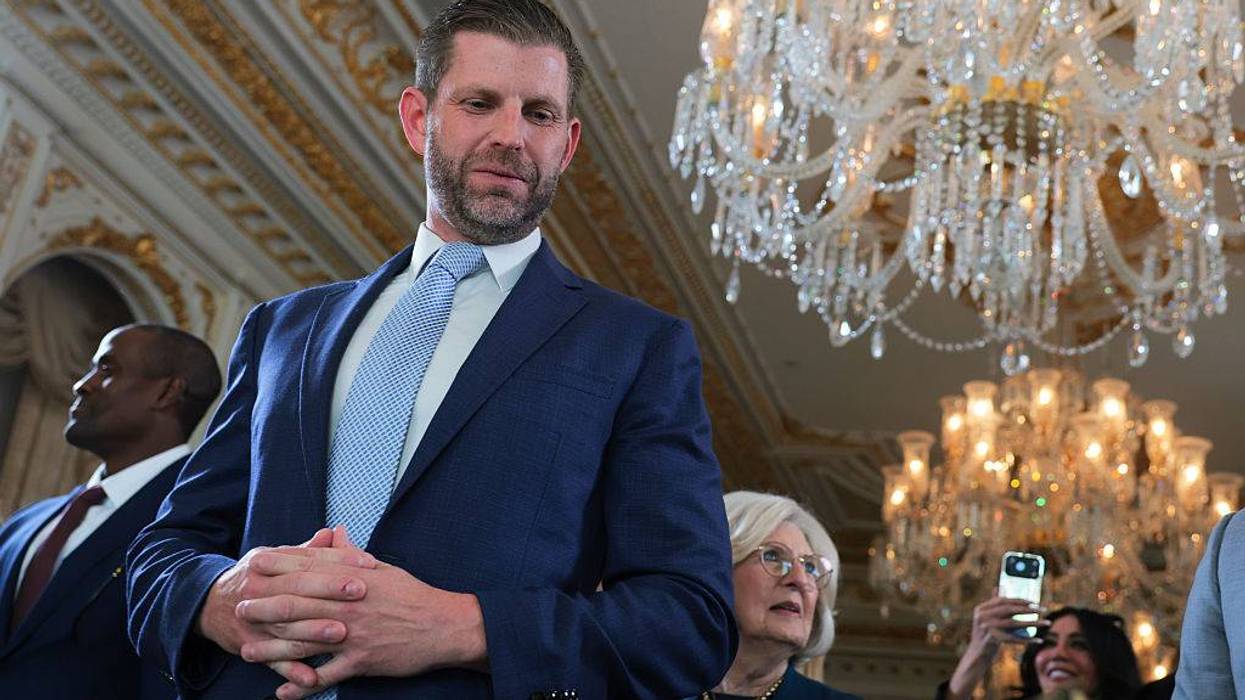
"The US government is now one of, if not the most, corrupt governments on earth," said one critic.
Critics reacted with disgust after Eric Trump went on Fox Business on Thursday morning to boast about Foundation Future Industries, a company where he serves as chief strategy adviser, scoring a multimillion-dollar deal from the US Department of Defense.
For the segment, Fox Business' Maria Bartiromo invited on both Eric Trump and Sankaet Pathak, co-founder and CEO of Foundation Future, a robotics firm that earlier this year won a $24 million Pentagon contract that will see its robots deployed in Ukraine, where they will be used to inspect and transport weapons.
Bartiromo asked the second-eldest son of President Donald Trump how he got involved with Foundation Future, and "what attracted" him to the enterprise.
Trump responded that he decided to get involved with robotics to help America "win" the race with China to build battle-ready robots, in the same way he purportedly helped the US "win" by being an early investor in cryptocurrency.
"We better be winning this race in the United States of America," he declared. "We're the greatest economy in the world... When you go up and you interact with these robots, and they fist bump you and they high five you, they follow your commands. You bring in AI economy, it's going to change industry, it's going to change military application, it's going to change hospitality. The uses are unlimited."
Eric Trump on his $24 million Pentagon contract for robots: "It's gonna change industry, military application, hospitality. The uses are unlimited and I think it's a very beautiful thing, but we must win that race." pic.twitter.com/JsfiB6Usbi
— Aaron Rupar (@atrupar) April 23, 2026
Eric Trump and his brother, Donald Trump Jr., for months have been investing in companies with the goal of scoring lucrative Pentagon deals.
The Wall Street Journal reported in March that the Trump brothers invested in a Florida-based drone company called Powerus that “is vying to meet fresh demand from the Pentagon” for drones that started when the Trump administration banned foreign-made drones and drone components from the US in December.
And in 2025, at least two companies backed by Trump Jr. received contracts collectively worth hundreds of millions of dollars from the DOD.
Given this history, critics were quick to hurl accusations of corruption at the Trumps for using their father's presidency to personally enrich themselves.
"The president's son, who was never involved in this industry before his father became president, should not be getting contracts from the Pentagon," declared Ron Filipkowski, editor-in-chief of MeidasTouch. "This is absurd corruption that Republicans in Congress will say nothing about and do no oversight."
Phillips O'Brien, professor of strategic studies at the University of St. Andrews, said the fact that the president's son is openly boasting about getting multimillion-dollar deals from his father's DOD shows "the US government is now one of, if not the most, corrupt governments on earth."
University of Michigan political scientist Donald Moynihan compared the Trump brothers to Uday and Qusay Hussein, the late sons of former Iraqi President Saddam Hussein, and argued that much of Trump's second administration appears to be running the US government like it's a family business.
"An underestimated rationale for Trump's massive ramp-ups in immigration/military spending," he wrote, "is to create a public slush fund for friends, families, donors."
National security attorney Bradley Moss, in a nod to possible future congressional investigations of the Trump family's corruption, advised Eric Trump to "preserve your records."
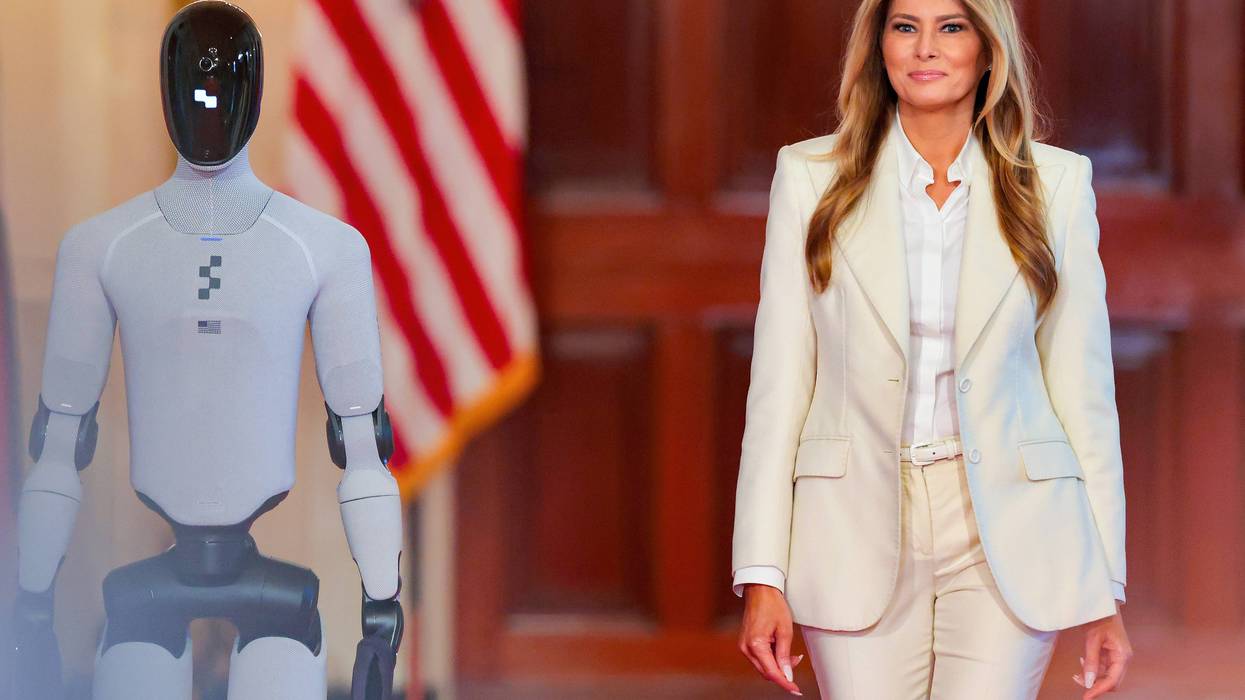
"We should attract the best and brightest in our country to become teachers and pay them the decent wages that they deserve."
US Sen. Bernie Sanders on Friday rejected First Lady Melania Trump's vision of a near-future in which artificial intelligence-powered humanoid robots do the work of human school teachers, arguing that society should instead do better by its human educators.
The wife of President Donald Trump entered Wednesday's gathering of the Global First Ladies Alliance accompanied by Figure 03, an AI-powered "general purpose humanoid robot" developed by the Sunnyvale, California-based company Figure.
“The future of AI is personified," Trump told attendees, who included Brigitte Macron of France, Sara Netanyahu of Israel, and Olena Zelenska of Ukraine. “It will be formed in the shape of humans. Very soon artificial intelligence will move from our mobile phones to humanoids that deliver utility.”
“Imagine a humanoid educator named Plato," she said. “Access to the classical studies is now instantaneous: literature, science, art, philosophy, mathematics, and history. Humanity’s entire corpus of information is available in the comfort of your home.”
Responding to Trump's remarks, Sanders (I-Vt.) said Friday on social media: "Call me a radical, but NO."
"We should not be replacing teachers in America with robots," the senator added. "We should attract the best and brightest in our country to become teachers and pay them the decent wages that they deserve."
Trump and Macron also warned about the dangers technology poses to children in remarks that came the same week that a New Mexico jury ordered tech titan Meta to pay a $375 million penalty for endangering youth and jurors in a landmark social media addiction trial found that Meta and YouTube harmed a child user of their platforms.
The office of California Gov. Gavin Newsom—who is believed to be a likely contender for the 2028 Democratic presidential nomination—also slapped down the idea of robot teachers, as did ordinary social media users.
"They want to replace human beings. Where will we work? How do we make money?" asked one X account with tens of thousands of followers. "No one wants this. We did not ask for it. Fuck all of this shit."
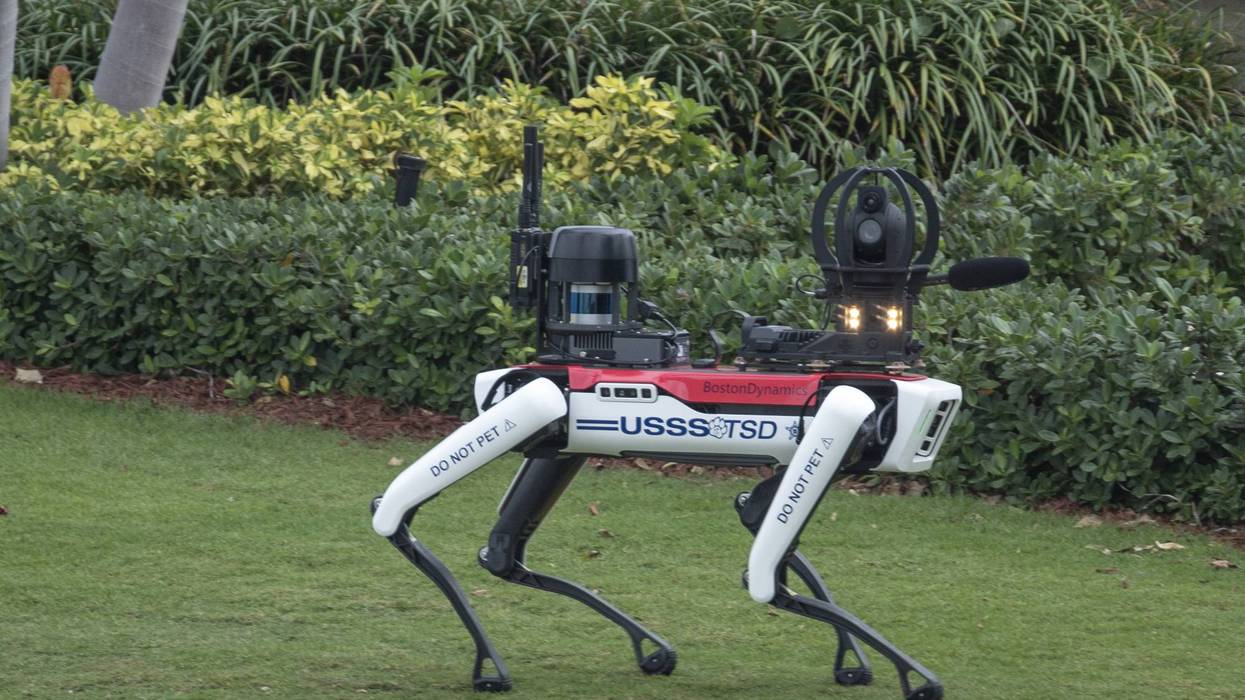
These robots, known as "quadrupeds," are being used to patrol the sprawling energy-sucking complexes, which are increasingly being met with protest around the country.
As Americans grow fed up with the rapid encroachment of artificial intelligence data centers into their communities, tech companies are embracing a novel solution to protect their energy-sucking behemoths from danger: Even more robots... robot dogs, to be exact.
According to a report from Business Insider on Monday:
As companies pour billions into sprawling industrial campuses for cloud and AI computing, some data center operators are experimenting with four-legged bots—about the size of large dogs—that can patrol fences, inspect equipment, and flag any issues before they turn into costly outages.
These robots, known as "quadrupeds," are being used to patrol the complexes, which can sometimes reach the size of multiple football fields.
According to Fortune, tech companies are already pouring nearly $700 billion into building data centers across the US and are now spending hundreds of thousands of dollars more to enlist mechanical canines as security forces.
One model from Boston Dynamics, known as "Spot," can cost anywhere from $175,000 to $300,000. And while the technology may seem futuristic, Spot and other quadrupeds like it have already been enlisted in law enforcement and public safety for years.
Another company—Ghost Robotics—advertises its quadrupeds for "reconnaissance, intelligence, and surveillance use by the military."
With more than 5,000 data centers now in the US and 800-1,000 new ones in the process of being built, Michael Subhan, the chief growth officer for Ghost Robotics, told Business Insider he expects boom times are ahead for his industry.
As data centers expand their reach at breakneck speed, there may be more interlopers for the programmable pooches to sniff out.
Due to skyrocketing energy costs and water shortages in places where large data centers have been built, the sites of proposed projects from Illinois to Minnesota to South Carolina have drawn crowds of dozens and even hundreds of demonstrators in recent weeks.