SUBSCRIBE TO OUR FREE NEWSLETTER
Daily news & progressive opinion—funded by the people, not the corporations—delivered straight to your inbox.
5
#000000
#FFFFFF
To donate by check, phone, or other method, see our More Ways to Give page.
Daily news & progressive opinion—funded by the people, not the corporations—delivered straight to your inbox.
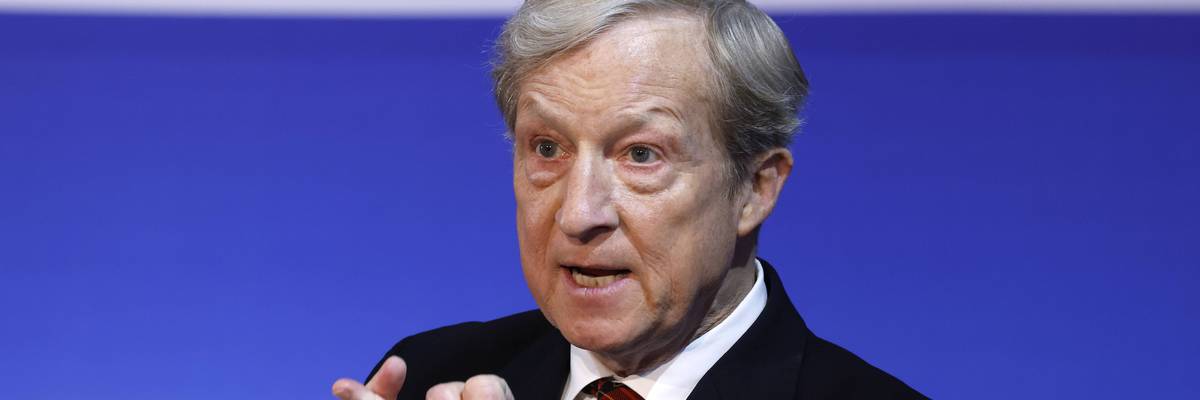
California gubernatorial candidate Democrat Tom Steyer speaks during the CBS California Gubernatorial Debate at Pomona College on April 28, 2026 in Claremont, California. California is holding its upcoming primary election, where the top two candidates regardless of party will advance to the general election, on June 2.
Make no mistake about it: Corporate lobbyists are horrified that Tom Steyer might become California’s governor. Despite myself, he may just be the class traitor we've been waiting for.
As a progressive who watches too much television, when I see a Democratic candidate dominating the TV air war with ubiquitous campaign ads, I usually know that’s a Democrat I should oppose—the one being lavishly funded by wealthy corporate interests. And the ads are usually vapid, empty.
Living in California these past months, I’ve had to adjust my normal mindset. Because the Democrat running for governor who was dominating the airwaves had put out one substantive ad after another—calling for taxing the wealthy, breaking up utility monopolies, standing up to Big Oil. Each ad could have been put out by Bernie Sanders. Like the ad featuring Rep. Ro Khanna about taking on the “big insurance companies” to pass universal “single-payer healthcare” for California.
Or the candidate’s video message denouncing AIPAC (“they’re attacking progressive Democrats every chance they get”) and the Democratic Party establishment for “not talking more forcefully” against the Iran war.
The candidate putting out all these wonderfully progressive ads is billionaire Tom Steyer, a former hedge fund manager turned environmental advocate, now self-funding his campaign to the tune of $130 million. So far.
Let me be clear: I generally loathe billionaires and hedge-funders and everyone in the financial speculation elite. I remain skeptical that someone as wealthy as Steyer who operated at the heights of amoral financialized capitalism can deeply understand and fight for working-class interests.
If Steyer is elected, will he prove to be the effective “class traitor” that most Californians need him to be—a governor who stands up to corporate greed and power?
So I was in a quandary. A month ago, after seeing Steyer’s anti-AIPAC video attacking Democratic leaders for failing to “forcefully” oppose Trump’s war, I started an intense dialogue with progressives across California, including journalists, experienced activists, organizational leaders. Almost all—somewhat surprisingly or confusedly or embarrassingly—were arriving at the same conclusion: the billionaire, Tom Steyer, is the best choice for governor.
Many had attended and been impressed by one of Steyer’s town hall forums across the state, where his introductory remarks were short while the audience Q&A went long. I started finding online memes from an activist I respect, Amar Shergill, a Steyer-supporter who formerly chaired the California Democratic Party’s Progressive Caucus—including his charts comparing the Democratic field.
Like in other Democratic one-party states, pro-corporate corruption in California’s state capital is rampant, which is why California—with a population almost as large as Canada’s—lacks universal healthcare coverage. Most Democrats in office say they support it, but profiteering insurance interests fund their campaigns. A bill to move California toward government-provided single-payer health insurance that would replace private insurance sailed through the Democrat-led state legislature in both 2006 and 2008, when it was well-known that GOP Gov. Arnold Scwharzenegger would veto the measure. Both times. Schwarzenegger called it “socialized medicine.”
But a funny thing has happened in the California legislature ever since Democrats took the governor’s office in 2011, first Jerry Brown and then Gavin Newsom: A single-payer healthcare bill never made it to their desks. In some years, thanks to medical industry lobbyists, the bill didn’t even get out of committee.
Make no mistake about it: Corporate lobbyists are horrified that Tom Steyer might become California’s governor. To stop Steyer, corporate forces and their allies in the Democratic establishment have moved from now-disgraced Rep. Eric Swalwell to Xavier Becerra, former US Secretary of Health and Human Services. Becerra, who won praise from the right-wing Murdoch press for pocketing the maximum campaign donation from Chevron, is now bending to the will of private interests on healthcare, according to KQED public radio.
Steyer’s unequivocal support of CalCare universal health coverage is one of the reasons he’s endorsed by Rep. Ro Khanna and the California Nurses Association (CNA), and why RootsAction (which I co-founded) came out in support last week.
One dividing-line issue among Democratic candidates is the California Billionaire Tax Act—a ballot initiative launched by SEIU-United Healthcare Workers that would impose a one-time emergency tax on the state’s 200 richest individuals to bolster healthcare. It’s supported by Steyer, Khanna, Bernie Sanders and opposed by Gov. Newsom and billionaire friends like Sergey Brin and Eric Schmidt of Google. (As a funder/activist, Steyer used statewide ballot initiatives to win reforms, including Prop 39 in 2012 that closed a corporate tax loophole to fund green jobs and energy-efficiency in schools.)
The TV air war has taken a bizarre turn. While Steyer’s ads dominated for many weeks, he is now facing a barrage of negative ads funded by some of California’s powerful corporate interests straight-facedly accusing him of being a corporatist—of profiting from past investments his hedge fund had made in fossil fuels and private prisons. We know who’s funding the attacks on Steyer thanks to California’s DISCLOSE Act, which requires that the top funders of campaign ads be listed in the bottom third of the TV screen.
Even though California has a strongly-Democratic electorate, it’s likely that only one of the half-dozen serious Democratic gubernatorial aspirants will make it through the June “jungle primary” into November’s general election to face a Republican—probably Steve Hilton, a former Fox News contributor endorsed by Trump.
If Steyer is elected, will he prove to be the effective “class traitor” that most Californians need him to be—a governor who stands up to corporate greed and power? Though not as rich as Steyer, President Franklin Roosevelt certainly provides a role model as someone willing to fight “the economic royalists” he knew so well in order to uplift working people.
Dear Common Dreams reader, It’s been nearly 30 years since I co-founded Common Dreams with my late wife, Lina Newhouser. We had the radical notion that journalism should serve the public good, not corporate profits. It was clear to us from the outset what it would take to build such a project. No paid advertisements. No corporate sponsors. No millionaire publisher telling us what to think or do. Many people said we wouldn't last a year, but we proved those doubters wrong. Together with a tremendous team of journalists and dedicated staff, we built an independent media outlet free from the constraints of profits and corporate control. Our mission has always been simple: To inform. To inspire. To ignite change for the common good. Building Common Dreams was not easy. Our survival was never guaranteed. When you take on the most powerful forces—Wall Street greed, fossil fuel industry destruction, Big Tech lobbyists, and uber-rich oligarchs who have spent billions upon billions rigging the economy and democracy in their favor—the only bulwark you have is supporters who believe in your work. But here’s the urgent message from me today. It's never been this bad out there. And it's never been this hard to keep us going. At the very moment Common Dreams is most needed, the threats we face are intensifying. We need your support now more than ever. We don't accept corporate advertising and never will. We don't have a paywall because we don't think people should be blocked from critical news based on their ability to pay. Everything we do is funded by the donations of readers like you. When everyone does the little they can afford, we are strong. But if that support retreats or dries up, so do we. Will you donate now to make sure Common Dreams not only survives but thrives? —Craig Brown, Co-founder |
As a progressive who watches too much television, when I see a Democratic candidate dominating the TV air war with ubiquitous campaign ads, I usually know that’s a Democrat I should oppose—the one being lavishly funded by wealthy corporate interests. And the ads are usually vapid, empty.
Living in California these past months, I’ve had to adjust my normal mindset. Because the Democrat running for governor who was dominating the airwaves had put out one substantive ad after another—calling for taxing the wealthy, breaking up utility monopolies, standing up to Big Oil. Each ad could have been put out by Bernie Sanders. Like the ad featuring Rep. Ro Khanna about taking on the “big insurance companies” to pass universal “single-payer healthcare” for California.
Or the candidate’s video message denouncing AIPAC (“they’re attacking progressive Democrats every chance they get”) and the Democratic Party establishment for “not talking more forcefully” against the Iran war.
The candidate putting out all these wonderfully progressive ads is billionaire Tom Steyer, a former hedge fund manager turned environmental advocate, now self-funding his campaign to the tune of $130 million. So far.
Let me be clear: I generally loathe billionaires and hedge-funders and everyone in the financial speculation elite. I remain skeptical that someone as wealthy as Steyer who operated at the heights of amoral financialized capitalism can deeply understand and fight for working-class interests.
If Steyer is elected, will he prove to be the effective “class traitor” that most Californians need him to be—a governor who stands up to corporate greed and power?
So I was in a quandary. A month ago, after seeing Steyer’s anti-AIPAC video attacking Democratic leaders for failing to “forcefully” oppose Trump’s war, I started an intense dialogue with progressives across California, including journalists, experienced activists, organizational leaders. Almost all—somewhat surprisingly or confusedly or embarrassingly—were arriving at the same conclusion: the billionaire, Tom Steyer, is the best choice for governor.
Many had attended and been impressed by one of Steyer’s town hall forums across the state, where his introductory remarks were short while the audience Q&A went long. I started finding online memes from an activist I respect, Amar Shergill, a Steyer-supporter who formerly chaired the California Democratic Party’s Progressive Caucus—including his charts comparing the Democratic field.
Like in other Democratic one-party states, pro-corporate corruption in California’s state capital is rampant, which is why California—with a population almost as large as Canada’s—lacks universal healthcare coverage. Most Democrats in office say they support it, but profiteering insurance interests fund their campaigns. A bill to move California toward government-provided single-payer health insurance that would replace private insurance sailed through the Democrat-led state legislature in both 2006 and 2008, when it was well-known that GOP Gov. Arnold Scwharzenegger would veto the measure. Both times. Schwarzenegger called it “socialized medicine.”
But a funny thing has happened in the California legislature ever since Democrats took the governor’s office in 2011, first Jerry Brown and then Gavin Newsom: A single-payer healthcare bill never made it to their desks. In some years, thanks to medical industry lobbyists, the bill didn’t even get out of committee.
Make no mistake about it: Corporate lobbyists are horrified that Tom Steyer might become California’s governor. To stop Steyer, corporate forces and their allies in the Democratic establishment have moved from now-disgraced Rep. Eric Swalwell to Xavier Becerra, former US Secretary of Health and Human Services. Becerra, who won praise from the right-wing Murdoch press for pocketing the maximum campaign donation from Chevron, is now bending to the will of private interests on healthcare, according to KQED public radio.
Steyer’s unequivocal support of CalCare universal health coverage is one of the reasons he’s endorsed by Rep. Ro Khanna and the California Nurses Association (CNA), and why RootsAction (which I co-founded) came out in support last week.
One dividing-line issue among Democratic candidates is the California Billionaire Tax Act—a ballot initiative launched by SEIU-United Healthcare Workers that would impose a one-time emergency tax on the state’s 200 richest individuals to bolster healthcare. It’s supported by Steyer, Khanna, Bernie Sanders and opposed by Gov. Newsom and billionaire friends like Sergey Brin and Eric Schmidt of Google. (As a funder/activist, Steyer used statewide ballot initiatives to win reforms, including Prop 39 in 2012 that closed a corporate tax loophole to fund green jobs and energy-efficiency in schools.)
The TV air war has taken a bizarre turn. While Steyer’s ads dominated for many weeks, he is now facing a barrage of negative ads funded by some of California’s powerful corporate interests straight-facedly accusing him of being a corporatist—of profiting from past investments his hedge fund had made in fossil fuels and private prisons. We know who’s funding the attacks on Steyer thanks to California’s DISCLOSE Act, which requires that the top funders of campaign ads be listed in the bottom third of the TV screen.
Even though California has a strongly-Democratic electorate, it’s likely that only one of the half-dozen serious Democratic gubernatorial aspirants will make it through the June “jungle primary” into November’s general election to face a Republican—probably Steve Hilton, a former Fox News contributor endorsed by Trump.
If Steyer is elected, will he prove to be the effective “class traitor” that most Californians need him to be—a governor who stands up to corporate greed and power? Though not as rich as Steyer, President Franklin Roosevelt certainly provides a role model as someone willing to fight “the economic royalists” he knew so well in order to uplift working people.
As a progressive who watches too much television, when I see a Democratic candidate dominating the TV air war with ubiquitous campaign ads, I usually know that’s a Democrat I should oppose—the one being lavishly funded by wealthy corporate interests. And the ads are usually vapid, empty.
Living in California these past months, I’ve had to adjust my normal mindset. Because the Democrat running for governor who was dominating the airwaves had put out one substantive ad after another—calling for taxing the wealthy, breaking up utility monopolies, standing up to Big Oil. Each ad could have been put out by Bernie Sanders. Like the ad featuring Rep. Ro Khanna about taking on the “big insurance companies” to pass universal “single-payer healthcare” for California.
Or the candidate’s video message denouncing AIPAC (“they’re attacking progressive Democrats every chance they get”) and the Democratic Party establishment for “not talking more forcefully” against the Iran war.
The candidate putting out all these wonderfully progressive ads is billionaire Tom Steyer, a former hedge fund manager turned environmental advocate, now self-funding his campaign to the tune of $130 million. So far.
Let me be clear: I generally loathe billionaires and hedge-funders and everyone in the financial speculation elite. I remain skeptical that someone as wealthy as Steyer who operated at the heights of amoral financialized capitalism can deeply understand and fight for working-class interests.
If Steyer is elected, will he prove to be the effective “class traitor” that most Californians need him to be—a governor who stands up to corporate greed and power?
So I was in a quandary. A month ago, after seeing Steyer’s anti-AIPAC video attacking Democratic leaders for failing to “forcefully” oppose Trump’s war, I started an intense dialogue with progressives across California, including journalists, experienced activists, organizational leaders. Almost all—somewhat surprisingly or confusedly or embarrassingly—were arriving at the same conclusion: the billionaire, Tom Steyer, is the best choice for governor.
Many had attended and been impressed by one of Steyer’s town hall forums across the state, where his introductory remarks were short while the audience Q&A went long. I started finding online memes from an activist I respect, Amar Shergill, a Steyer-supporter who formerly chaired the California Democratic Party’s Progressive Caucus—including his charts comparing the Democratic field.
Like in other Democratic one-party states, pro-corporate corruption in California’s state capital is rampant, which is why California—with a population almost as large as Canada’s—lacks universal healthcare coverage. Most Democrats in office say they support it, but profiteering insurance interests fund their campaigns. A bill to move California toward government-provided single-payer health insurance that would replace private insurance sailed through the Democrat-led state legislature in both 2006 and 2008, when it was well-known that GOP Gov. Arnold Scwharzenegger would veto the measure. Both times. Schwarzenegger called it “socialized medicine.”
But a funny thing has happened in the California legislature ever since Democrats took the governor’s office in 2011, first Jerry Brown and then Gavin Newsom: A single-payer healthcare bill never made it to their desks. In some years, thanks to medical industry lobbyists, the bill didn’t even get out of committee.
Make no mistake about it: Corporate lobbyists are horrified that Tom Steyer might become California’s governor. To stop Steyer, corporate forces and their allies in the Democratic establishment have moved from now-disgraced Rep. Eric Swalwell to Xavier Becerra, former US Secretary of Health and Human Services. Becerra, who won praise from the right-wing Murdoch press for pocketing the maximum campaign donation from Chevron, is now bending to the will of private interests on healthcare, according to KQED public radio.
Steyer’s unequivocal support of CalCare universal health coverage is one of the reasons he’s endorsed by Rep. Ro Khanna and the California Nurses Association (CNA), and why RootsAction (which I co-founded) came out in support last week.
One dividing-line issue among Democratic candidates is the California Billionaire Tax Act—a ballot initiative launched by SEIU-United Healthcare Workers that would impose a one-time emergency tax on the state’s 200 richest individuals to bolster healthcare. It’s supported by Steyer, Khanna, Bernie Sanders and opposed by Gov. Newsom and billionaire friends like Sergey Brin and Eric Schmidt of Google. (As a funder/activist, Steyer used statewide ballot initiatives to win reforms, including Prop 39 in 2012 that closed a corporate tax loophole to fund green jobs and energy-efficiency in schools.)
The TV air war has taken a bizarre turn. While Steyer’s ads dominated for many weeks, he is now facing a barrage of negative ads funded by some of California’s powerful corporate interests straight-facedly accusing him of being a corporatist—of profiting from past investments his hedge fund had made in fossil fuels and private prisons. We know who’s funding the attacks on Steyer thanks to California’s DISCLOSE Act, which requires that the top funders of campaign ads be listed in the bottom third of the TV screen.
Even though California has a strongly-Democratic electorate, it’s likely that only one of the half-dozen serious Democratic gubernatorial aspirants will make it through the June “jungle primary” into November’s general election to face a Republican—probably Steve Hilton, a former Fox News contributor endorsed by Trump.
If Steyer is elected, will he prove to be the effective “class traitor” that most Californians need him to be—a governor who stands up to corporate greed and power? Though not as rich as Steyer, President Franklin Roosevelt certainly provides a role model as someone willing to fight “the economic royalists” he knew so well in order to uplift working people.