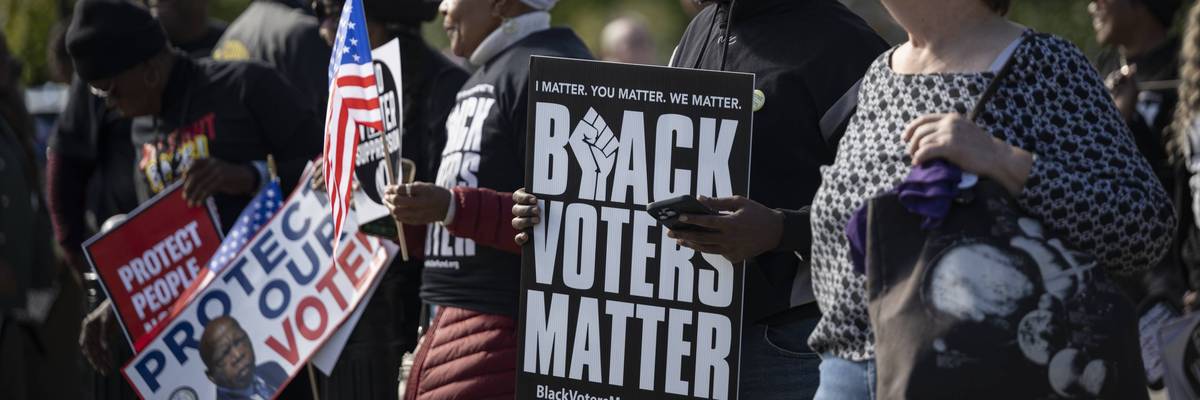
Demonstrators hold signs in support of voting rights outside the US Supreme Court in Washington, DC on October 15, 2025.
'Tragic Day for the Freedom to Vote': Supreme Court Guts Remnants of Voting Rights Act
“Make no mistake: This ruling isn’t about the law, it’s about power, and giving Republicans more US House seats they couldn’t otherwise win at the ballot box," said one critic.
The US Supreme Court ruled Wednesday that Louisiana must redraw its 2024 congressional map—which created a second majority-Black district to mitigate persistent barriers to equal representation—in a decision that further guts the already tattered Voting Rights Act.
The justices ruled 6-3 along ideological lines in Louisiana v. Callais that the state's map is "an unconstitutional racial gerrymander," effectively voiding the last remaining provision of Section 2 of the 1965 Voting Rights Act (VRA), which allows voters of color to challenge racially discriminatory electoral maps in court.
The case centers on the redrawing of Louisiana's six congressional districts to better reflect the population of a state in which one-third of the people are Black, as Section 2 states that minority voters should have the same chance as others to elect candidates of their choice.
Civil and voting rights advocates challenged Louisiana's Republican-drawn and racially rigged congressional map. In 2022, a federal judge agreed that the map likely violated Section 2, and the 5th US Circuit Court of Appeals upheld that ruling, ordering Louisiana to draw a new map by January 2024.
Louisiana complied. But a group of non-Black voters challenged the new map, claiming it was a racially rigged creation that violated the 14th Amendment. The Trump administration supported the challengers, arguing that Black voters had no right to a second majority-minority district.
The Supreme Court's right-wing justices—three of whom were nominated by Trump—agreed in Wednesday's decision.
“Allowing race to play any part in government decision-making represents a departure from the constitutional rule that applies in almost every other context,” Justice Samuel Alito wrote for the right-wing majority. “Compliance with Section 2 thus could not justify the state’s use of race-based redistricting here."
Dissenting, Justice Elena Kagan wrote that the ruling represents the "latest chapter in the majority’s now-completed demolition of the Voting Rights Act.”
Kagan said the majority "straight-facedly holds that the Voting Rights Act must be brought low to make the world safe for partisan gerrymanders."
Signed into law in 1965 by then-President Lyndon B. Johnson amid a groundswell of civil rights activism, the VRA was meant to ensure that state and local governments could not “deny or abridge the right of any citizen of the United States to vote on account of race or color.”
However, the law has been eroded in recent decades by Republican-controlled state legislatures across the country, including through racially rigged and other gerrymandered congressional maps, restrictions on voter registration, reduction in early voting options, and voter identification laws. These measures disproportionately disenfranchise minority voters, and some GOP officials have admitted that they are intended to give Republican candidates an electoral edge.
In 2013, the Supreme Court dealt a major blow to the VRA in Shelby County v. Holder, which eviscerated a key section of the law that required jurisdictions with a history of racist disenfranchisement to obtain federal approval prior to altering voting rules. In 2021, the nation’s high court voted 5-4 in Brnovich v. Democratic National Committee to uphold Arizona’s voting restrictions—even as Chief Justice John Roberts acknowledged that they disproportionately affect minorities.
Voting rights defenders decried Wednesday's ruling.
The court’s ruling in Louisiana v. Callais follows cases that have narrowed federal voter protections, like Shelby County v. Holder and Brnovich v. Democratic National Committee.Together, these cases have made it harder for voters of color to challenge discriminatory voting laws and practices.
— ACLU (@aclu.org) April 29, 2026 at 8:20 AM
"This devastating attack from the court majority destroys protections for voters of color across the country," the ACLU said on Bluesky.
"The impacts of the court’s ruling in this case will be felt across the country," the group added. "Redistricting remains ongoing in many states, and the severe weakening of Section 2 may affect future challenges to congressional, legislative, and local maps that dilute the voting strength of communities of color."
NAACP president and CEO Derrick Johnson called the decision "a devastating blow to what remains of the Voting Rights Act, and a license for corrupt politicians who want to rig the system by silencing entire communities."
Kristen Clarke, NAACP's general counsel, said:
This is one of the most consequential and devastating rulings issued by the Supreme Court in the 21st Century. The Supreme Court has put the death knell into our nation's most important federal civil rights law, one that provided Black Americans access to a democracy that they had long been excluded from. The ruling defies precedent, ignores statutory text, and will reverse decades of progress we have made as a nation. This will embolden lawmakers in former slave-holding states to target and eradicate districts that have provided Black Americans a fair opportunity to elect candidates of choice, and they will do so with the blessing of this court. It ignores the tremendous sacrifice made by Americans who bled and died for passage of the Voting Rights Act.
Demand Justice president Josh Orton said in a statement, “Today the Supreme Court gutted the remaining protections of the Voting Rights Act and handed [President] Donald Trump even more unchecked political power as he wields the presidency like a power-mad authoritarian."
“Make no mistake: This ruling isn’t about the law, it’s about power, and giving Republicans more US House seats they couldn’t otherwise win at the ballot box, all while trampling the voting rights of communities of color," Orton added. “Today’s decision is another example of why the Supreme Court has lost both its legitimacy and the trust of the American people. It must face fundamental reform if it is to once again serve our democracy.”
Nourbese Flint, president of the reproductive justice group All* Above All, lamented that "the Supreme Court yet again denies communities of color a voice in their own destiny."
"This is part of a coordinated assault on self-determination, and we have to name it as such," Flint added. "The same court that gutted the Voting Rights Act came for Roe. If we are serious about defending reproductive justice that means we have to defend democracy and reform this extremist court.”
Stand Up America managing director of policy and political affairs Brett Edkins called Wednesday "a tragic day for the freedom to vote and representative democracy."
"The Supreme Court just eviscerated the last remnants of the Voting Rights Act of 1965 and opened the door to even more extreme gerrymandering that will try to drown out the voices of Black and brown voters, particularly in the South," Edkins said.
NEW: The Supreme Court just gutted the Voting Rights Act, enabling the GOP to erase countless districts drawn to protect voters of color at the congressional, state, & local levels.We detailed each Dem VRA congressional seat that the GOP could target by 2028: www.the-downballot.com/p/with-the-v...
[image or embed]
— Stephen Wolf (@stephenwolf.bsky.social) April 29, 2026 at 8:00 AM
"The court’s decision will escalate the arms race of partisan gerrymanders across the country and could lead to Republican-controlled states redrawing election maps to add an additional 19 GOP House seats," Edkins continued. "This partisan court has handed a major election-year gift to Donald Trump and congressional Republicans who are trying to cling to power despite their growing unpopularity with voters."
“It’s time for Congress to act as a check on this rogue court through major reforms," he added, "including term limits, an enforceable code of ethics, and adding more justices who will defend our fundamental freedoms once Trump leaves office.”
We are at a crossroads
This country and this world are at a monumental crossroads. In a few short weeks, US voters will have an opportunity to beat back the forces of fascism and confront the billionaires who are rigging the economy, our media system, and our democracy, making it increasingly impossible for ordinary people to get by. We’re not just talking about the election. We’re talking about what must be done once these fascist elements are vanquished from power. We need a bolder set of solutions than what either major party has so far been willing to offer and a working-class movement ready to fight like hell for it. Trump didn't emerge from nowhere. The conditions that fueled MAGA authoritarianism were created by decades of radical neoliberal economic policies and a corrupt political system dominated by corporate interests. They slashed taxes on the super-rich, promising that the benefits would trickle down. They said giveaways to the corporate titans would make life more affordable for the rest of us. It was all bullshit. And when a bitter, betrayed populace searches for someone to blame, right-wing demagogues have little trouble finding scapegoats. People know when they're being lied to, but you won't hear any of this from the corporate media. Only independent journalism—powered and funded by people who believe in building a better world—can deliver truly trustworthy daily news. Our Fall Campaign is underway, and we need your help. To power our newsroom through the rest of the year, we need to raise $125,000 by midnight on October 31. So if you share our vision, please contribute whatever you can to sustain our work. |
The US Supreme Court ruled Wednesday that Louisiana must redraw its 2024 congressional map—which created a second majority-Black district to mitigate persistent barriers to equal representation—in a decision that further guts the already tattered Voting Rights Act.
The justices ruled 6-3 along ideological lines in Louisiana v. Callais that the state's map is "an unconstitutional racial gerrymander," effectively voiding the last remaining provision of Section 2 of the 1965 Voting Rights Act (VRA), which allows voters of color to challenge racially discriminatory electoral maps in court.
The case centers on the redrawing of Louisiana's six congressional districts to better reflect the population of a state in which one-third of the people are Black, as Section 2 states that minority voters should have the same chance as others to elect candidates of their choice.
Civil and voting rights advocates challenged Louisiana's Republican-drawn and racially rigged congressional map. In 2022, a federal judge agreed that the map likely violated Section 2, and the 5th US Circuit Court of Appeals upheld that ruling, ordering Louisiana to draw a new map by January 2024.
Louisiana complied. But a group of non-Black voters challenged the new map, claiming it was a racially rigged creation that violated the 14th Amendment. The Trump administration supported the challengers, arguing that Black voters had no right to a second majority-minority district.
The Supreme Court's right-wing justices—three of whom were nominated by Trump—agreed in Wednesday's decision.
“Allowing race to play any part in government decision-making represents a departure from the constitutional rule that applies in almost every other context,” Justice Samuel Alito wrote for the right-wing majority. “Compliance with Section 2 thus could not justify the state’s use of race-based redistricting here."
Dissenting, Justice Elena Kagan wrote that the ruling represents the "latest chapter in the majority’s now-completed demolition of the Voting Rights Act.”
Kagan said the majority "straight-facedly holds that the Voting Rights Act must be brought low to make the world safe for partisan gerrymanders."
Signed into law in 1965 by then-President Lyndon B. Johnson amid a groundswell of civil rights activism, the VRA was meant to ensure that state and local governments could not “deny or abridge the right of any citizen of the United States to vote on account of race or color.”
However, the law has been eroded in recent decades by Republican-controlled state legislatures across the country, including through racially rigged and other gerrymandered congressional maps, restrictions on voter registration, reduction in early voting options, and voter identification laws. These measures disproportionately disenfranchise minority voters, and some GOP officials have admitted that they are intended to give Republican candidates an electoral edge.
In 2013, the Supreme Court dealt a major blow to the VRA in Shelby County v. Holder, which eviscerated a key section of the law that required jurisdictions with a history of racist disenfranchisement to obtain federal approval prior to altering voting rules. In 2021, the nation’s high court voted 5-4 in Brnovich v. Democratic National Committee to uphold Arizona’s voting restrictions—even as Chief Justice John Roberts acknowledged that they disproportionately affect minorities.
Voting rights defenders decried Wednesday's ruling.
The court’s ruling in Louisiana v. Callais follows cases that have narrowed federal voter protections, like Shelby County v. Holder and Brnovich v. Democratic National Committee.Together, these cases have made it harder for voters of color to challenge discriminatory voting laws and practices.
— ACLU (@aclu.org) April 29, 2026 at 8:20 AM
"This devastating attack from the court majority destroys protections for voters of color across the country," the ACLU said on Bluesky.
"The impacts of the court’s ruling in this case will be felt across the country," the group added. "Redistricting remains ongoing in many states, and the severe weakening of Section 2 may affect future challenges to congressional, legislative, and local maps that dilute the voting strength of communities of color."
NAACP president and CEO Derrick Johnson called the decision "a devastating blow to what remains of the Voting Rights Act, and a license for corrupt politicians who want to rig the system by silencing entire communities."
Kristen Clarke, NAACP's general counsel, said:
This is one of the most consequential and devastating rulings issued by the Supreme Court in the 21st Century. The Supreme Court has put the death knell into our nation's most important federal civil rights law, one that provided Black Americans access to a democracy that they had long been excluded from. The ruling defies precedent, ignores statutory text, and will reverse decades of progress we have made as a nation. This will embolden lawmakers in former slave-holding states to target and eradicate districts that have provided Black Americans a fair opportunity to elect candidates of choice, and they will do so with the blessing of this court. It ignores the tremendous sacrifice made by Americans who bled and died for passage of the Voting Rights Act.
Demand Justice president Josh Orton said in a statement, “Today the Supreme Court gutted the remaining protections of the Voting Rights Act and handed [President] Donald Trump even more unchecked political power as he wields the presidency like a power-mad authoritarian."
“Make no mistake: This ruling isn’t about the law, it’s about power, and giving Republicans more US House seats they couldn’t otherwise win at the ballot box, all while trampling the voting rights of communities of color," Orton added. “Today’s decision is another example of why the Supreme Court has lost both its legitimacy and the trust of the American people. It must face fundamental reform if it is to once again serve our democracy.”
Nourbese Flint, president of the reproductive justice group All* Above All, lamented that "the Supreme Court yet again denies communities of color a voice in their own destiny."
"This is part of a coordinated assault on self-determination, and we have to name it as such," Flint added. "The same court that gutted the Voting Rights Act came for Roe. If we are serious about defending reproductive justice that means we have to defend democracy and reform this extremist court.”
Stand Up America managing director of policy and political affairs Brett Edkins called Wednesday "a tragic day for the freedom to vote and representative democracy."
"The Supreme Court just eviscerated the last remnants of the Voting Rights Act of 1965 and opened the door to even more extreme gerrymandering that will try to drown out the voices of Black and brown voters, particularly in the South," Edkins said.
NEW: The Supreme Court just gutted the Voting Rights Act, enabling the GOP to erase countless districts drawn to protect voters of color at the congressional, state, & local levels.We detailed each Dem VRA congressional seat that the GOP could target by 2028: www.the-downballot.com/p/with-the-v...
[image or embed]
— Stephen Wolf (@stephenwolf.bsky.social) April 29, 2026 at 8:00 AM
"The court’s decision will escalate the arms race of partisan gerrymanders across the country and could lead to Republican-controlled states redrawing election maps to add an additional 19 GOP House seats," Edkins continued. "This partisan court has handed a major election-year gift to Donald Trump and congressional Republicans who are trying to cling to power despite their growing unpopularity with voters."
“It’s time for Congress to act as a check on this rogue court through major reforms," he added, "including term limits, an enforceable code of ethics, and adding more justices who will defend our fundamental freedoms once Trump leaves office.”
- After Supreme Court Agrees to Hear First Abortion Case With Gorsuch and Kavanaugh, Warnings Right-Wingers Could 'Decimate' Access in Louisiana ›
- 'Big Win for Democracy' as SCOTUS OKs Redrawing of Rigged Louisiana Congressional Map ›
- Opinion | Dismantling the Voting Rights Act Sets American Democracy Back Decades | Common Dreams ›
- Louisiana Voters Launch Court Challenges to GOP Cancellation of In-Progress Primary | Common Dreams ›
- Justice Jackson Condemns Supreme Court's Decision to Fast-Track Louisiana Electoral Map Ruling | Common Dreams ›
- Opinion | The Supreme Court's War on Voting Rights Could Reverse Gains for Black Representation | Common Dreams ›
- Opinion | The Supreme Court’s Whites-First Reasoning on Gerrymandering | Common Dreams ›
The US Supreme Court ruled Wednesday that Louisiana must redraw its 2024 congressional map—which created a second majority-Black district to mitigate persistent barriers to equal representation—in a decision that further guts the already tattered Voting Rights Act.
The justices ruled 6-3 along ideological lines in Louisiana v. Callais that the state's map is "an unconstitutional racial gerrymander," effectively voiding the last remaining provision of Section 2 of the 1965 Voting Rights Act (VRA), which allows voters of color to challenge racially discriminatory electoral maps in court.
The case centers on the redrawing of Louisiana's six congressional districts to better reflect the population of a state in which one-third of the people are Black, as Section 2 states that minority voters should have the same chance as others to elect candidates of their choice.
Civil and voting rights advocates challenged Louisiana's Republican-drawn and racially rigged congressional map. In 2022, a federal judge agreed that the map likely violated Section 2, and the 5th US Circuit Court of Appeals upheld that ruling, ordering Louisiana to draw a new map by January 2024.
Louisiana complied. But a group of non-Black voters challenged the new map, claiming it was a racially rigged creation that violated the 14th Amendment. The Trump administration supported the challengers, arguing that Black voters had no right to a second majority-minority district.
The Supreme Court's right-wing justices—three of whom were nominated by Trump—agreed in Wednesday's decision.
“Allowing race to play any part in government decision-making represents a departure from the constitutional rule that applies in almost every other context,” Justice Samuel Alito wrote for the right-wing majority. “Compliance with Section 2 thus could not justify the state’s use of race-based redistricting here."
Dissenting, Justice Elena Kagan wrote that the ruling represents the "latest chapter in the majority’s now-completed demolition of the Voting Rights Act.”
Kagan said the majority "straight-facedly holds that the Voting Rights Act must be brought low to make the world safe for partisan gerrymanders."
Signed into law in 1965 by then-President Lyndon B. Johnson amid a groundswell of civil rights activism, the VRA was meant to ensure that state and local governments could not “deny or abridge the right of any citizen of the United States to vote on account of race or color.”
However, the law has been eroded in recent decades by Republican-controlled state legislatures across the country, including through racially rigged and other gerrymandered congressional maps, restrictions on voter registration, reduction in early voting options, and voter identification laws. These measures disproportionately disenfranchise minority voters, and some GOP officials have admitted that they are intended to give Republican candidates an electoral edge.
In 2013, the Supreme Court dealt a major blow to the VRA in Shelby County v. Holder, which eviscerated a key section of the law that required jurisdictions with a history of racist disenfranchisement to obtain federal approval prior to altering voting rules. In 2021, the nation’s high court voted 5-4 in Brnovich v. Democratic National Committee to uphold Arizona’s voting restrictions—even as Chief Justice John Roberts acknowledged that they disproportionately affect minorities.
Voting rights defenders decried Wednesday's ruling.
The court’s ruling in Louisiana v. Callais follows cases that have narrowed federal voter protections, like Shelby County v. Holder and Brnovich v. Democratic National Committee.Together, these cases have made it harder for voters of color to challenge discriminatory voting laws and practices.
— ACLU (@aclu.org) April 29, 2026 at 8:20 AM
"This devastating attack from the court majority destroys protections for voters of color across the country," the ACLU said on Bluesky.
"The impacts of the court’s ruling in this case will be felt across the country," the group added. "Redistricting remains ongoing in many states, and the severe weakening of Section 2 may affect future challenges to congressional, legislative, and local maps that dilute the voting strength of communities of color."
NAACP president and CEO Derrick Johnson called the decision "a devastating blow to what remains of the Voting Rights Act, and a license for corrupt politicians who want to rig the system by silencing entire communities."
Kristen Clarke, NAACP's general counsel, said:
This is one of the most consequential and devastating rulings issued by the Supreme Court in the 21st Century. The Supreme Court has put the death knell into our nation's most important federal civil rights law, one that provided Black Americans access to a democracy that they had long been excluded from. The ruling defies precedent, ignores statutory text, and will reverse decades of progress we have made as a nation. This will embolden lawmakers in former slave-holding states to target and eradicate districts that have provided Black Americans a fair opportunity to elect candidates of choice, and they will do so with the blessing of this court. It ignores the tremendous sacrifice made by Americans who bled and died for passage of the Voting Rights Act.
Demand Justice president Josh Orton said in a statement, “Today the Supreme Court gutted the remaining protections of the Voting Rights Act and handed [President] Donald Trump even more unchecked political power as he wields the presidency like a power-mad authoritarian."
“Make no mistake: This ruling isn’t about the law, it’s about power, and giving Republicans more US House seats they couldn’t otherwise win at the ballot box, all while trampling the voting rights of communities of color," Orton added. “Today’s decision is another example of why the Supreme Court has lost both its legitimacy and the trust of the American people. It must face fundamental reform if it is to once again serve our democracy.”
Nourbese Flint, president of the reproductive justice group All* Above All, lamented that "the Supreme Court yet again denies communities of color a voice in their own destiny."
"This is part of a coordinated assault on self-determination, and we have to name it as such," Flint added. "The same court that gutted the Voting Rights Act came for Roe. If we are serious about defending reproductive justice that means we have to defend democracy and reform this extremist court.”
Stand Up America managing director of policy and political affairs Brett Edkins called Wednesday "a tragic day for the freedom to vote and representative democracy."
"The Supreme Court just eviscerated the last remnants of the Voting Rights Act of 1965 and opened the door to even more extreme gerrymandering that will try to drown out the voices of Black and brown voters, particularly in the South," Edkins said.
NEW: The Supreme Court just gutted the Voting Rights Act, enabling the GOP to erase countless districts drawn to protect voters of color at the congressional, state, & local levels.We detailed each Dem VRA congressional seat that the GOP could target by 2028: www.the-downballot.com/p/with-the-v...
[image or embed]
— Stephen Wolf (@stephenwolf.bsky.social) April 29, 2026 at 8:00 AM
"The court’s decision will escalate the arms race of partisan gerrymanders across the country and could lead to Republican-controlled states redrawing election maps to add an additional 19 GOP House seats," Edkins continued. "This partisan court has handed a major election-year gift to Donald Trump and congressional Republicans who are trying to cling to power despite their growing unpopularity with voters."
“It’s time for Congress to act as a check on this rogue court through major reforms," he added, "including term limits, an enforceable code of ethics, and adding more justices who will defend our fundamental freedoms once Trump leaves office.”
- After Supreme Court Agrees to Hear First Abortion Case With Gorsuch and Kavanaugh, Warnings Right-Wingers Could 'Decimate' Access in Louisiana ›
- 'Big Win for Democracy' as SCOTUS OKs Redrawing of Rigged Louisiana Congressional Map ›
- Opinion | Dismantling the Voting Rights Act Sets American Democracy Back Decades | Common Dreams ›
- Louisiana Voters Launch Court Challenges to GOP Cancellation of In-Progress Primary | Common Dreams ›
- Justice Jackson Condemns Supreme Court's Decision to Fast-Track Louisiana Electoral Map Ruling | Common Dreams ›
- Opinion | The Supreme Court's War on Voting Rights Could Reverse Gains for Black Representation | Common Dreams ›
- Opinion | The Supreme Court’s Whites-First Reasoning on Gerrymandering | Common Dreams ›