SUBSCRIBE TO OUR FREE NEWSLETTER
Daily news & progressive opinion—funded by the people, not the corporations—delivered straight to your inbox.
5
#000000
#FFFFFF
To donate by check, phone, or other method, see our More Ways to Give page.
Daily news & progressive opinion—funded by the people, not the corporations—delivered straight to your inbox.
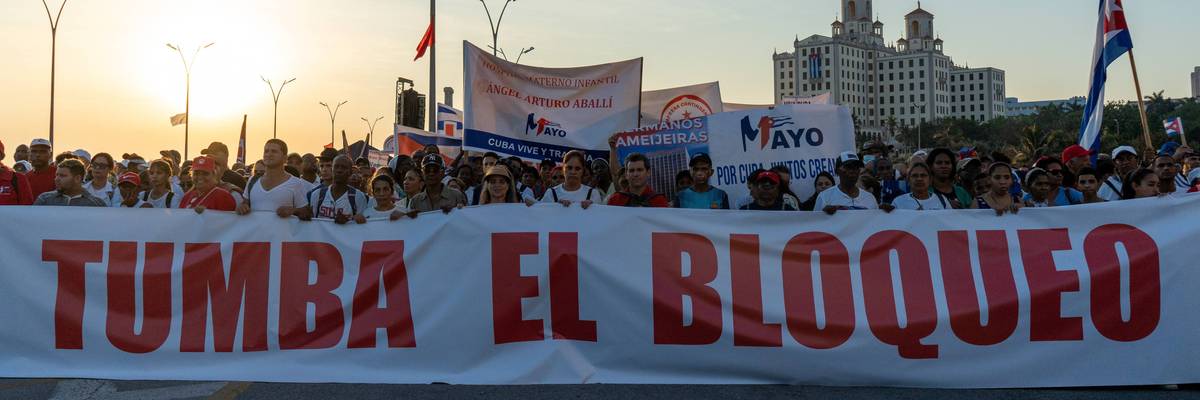
Cubans hold a banner reading, "Knock Down the Blockade" during an International Workers' Day rally near the US Embassy in Havana on May 1, 2026.
The president's latest aggression toward Cuba comes amid his repeated threats to "take" the island.
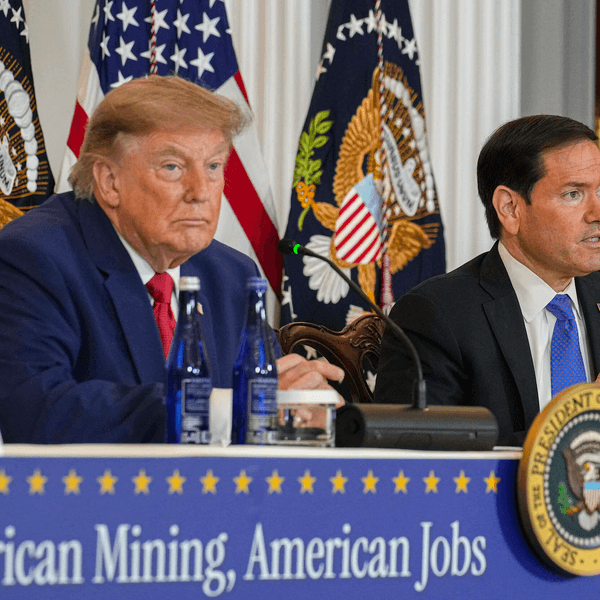
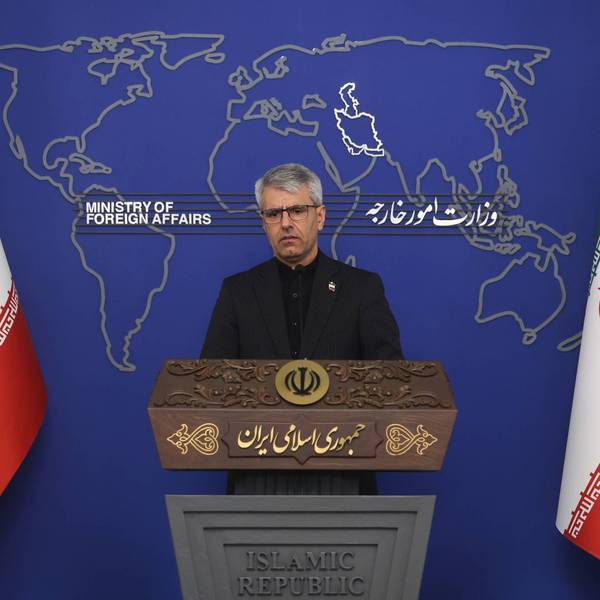
Citing Cuba's ties with its ally Iran, President Donald Trump on Friday signed an executive order expanding the already crippling US sanctions regime against Cuban officials, as the US administration has the island in its crosshairs after ousting Venezuela's socialist leader.
Trump's executive order cites highly dubious "national security threats posed by the communist Cuban regime," including Havana's alignment "with countries and malign actors hostile to the United States."
The directive "imposes new sanctions on entities, persons, or affiliates that support the Cuban regime’s security apparatus, are complicit in government corruption or serious human rights violations, or are agents, officials, or material supporters of the Cuban government," without identifying any of the affected groups or individuals.
For 65 years, the US has imposed an economic embargo on Cuba that has adversely affected all sectors of the socialist island’s economy and severely limited Cubans’ access to basic necessities including food, fuel, healthcare, and medicines—with disastrous results. The Cuban government claims the blockade cost the country’s economy nearly $5 billion in just one 11-month period in 2022-23 alone. United Nations member states have perennially—and overwhelmingly—condemned the embargo.
The Trump administration also imposed a fuel blockade and reinstated Cuba on the US State Sponsors of Terrorism list, from which former President Joe Biden removed the country before leaving office in 2021. Cuba was initially added to the list during the Reagan administration amid a decadeslong campaign of US-backed Cuban exile terrorism, failed assassination attempts, economic warfare, and covert operations large and small in a futile effort to overthrow the revolutionary government of longtime leader Fidel Castro.
Cuba says US-backed terrorism has killed or wounded more than 5,000 Cubans and cost its economy billions of dollars.
The Cuban government—which was celebrating International Workers' Day on Friday—did not immediately respond to the expanded sanctions.
Experts warned that the new sanctions are worryingly broad, with Georgetown Law visiting scholar Peter Harrell writing on X that "basically any non-US person or company doing any business in/with Cuba could be sanctioned."
Harrell noted that the edict "gives the Trump administration a fair amount of easy-to-deploy firepower to drive remaining international businesses out of Cuba."
"The questions will be in implementation," he added. "For example, will Trump sanction a Chinese firm installing renewable energy in Cuba?"
Trump's edict comes months after the president ordered the invasion of Venezuela and abduction of socialist President Nicolás Maduro and amid the ongoing US-Israeli war on Iran, the 10th country bombed during the course of Trump's two terms in office.
Trump last month declared that “we may stop by Cuba after we’re finished with this,” referring to war on Iran that’s left thousands of people dead or wounded, including hundreds of children. The president has also said that he believes he’ll “be having the honor of taking Cuba,” language echoing the 19th century US imperialists who conquered the island along with Puerto Rico, Guam, and the Philippines from Spain in another war waged on dubious pretense.
“Whether I free it, take it—I think I can do anything I want,” Trump said of the island and its 11 million inhabitants.
Dear Common Dreams reader, It’s been nearly 30 years since I co-founded Common Dreams with my late wife, Lina Newhouser. We had the radical notion that journalism should serve the public good, not corporate profits. It was clear to us from the outset what it would take to build such a project. No paid advertisements. No corporate sponsors. No millionaire publisher telling us what to think or do. Many people said we wouldn't last a year, but we proved those doubters wrong. Together with a tremendous team of journalists and dedicated staff, we built an independent media outlet free from the constraints of profits and corporate control. Our mission has always been simple: To inform. To inspire. To ignite change for the common good. Building Common Dreams was not easy. Our survival was never guaranteed. When you take on the most powerful forces—Wall Street greed, fossil fuel industry destruction, Big Tech lobbyists, and uber-rich oligarchs who have spent billions upon billions rigging the economy and democracy in their favor—the only bulwark you have is supporters who believe in your work. But here’s the urgent message from me today. It's never been this bad out there. And it's never been this hard to keep us going. At the very moment Common Dreams is most needed, the threats we face are intensifying. We need your support now more than ever. We don't accept corporate advertising and never will. We don't have a paywall because we don't think people should be blocked from critical news based on their ability to pay. Everything we do is funded by the donations of readers like you. When everyone does the little they can afford, we are strong. But if that support retreats or dries up, so do we. Will you donate now to make sure Common Dreams not only survives but thrives? —Craig Brown, Co-founder |
Citing Cuba's ties with its ally Iran, President Donald Trump on Friday signed an executive order expanding the already crippling US sanctions regime against Cuban officials, as the US administration has the island in its crosshairs after ousting Venezuela's socialist leader.
Trump's executive order cites highly dubious "national security threats posed by the communist Cuban regime," including Havana's alignment "with countries and malign actors hostile to the United States."
The directive "imposes new sanctions on entities, persons, or affiliates that support the Cuban regime’s security apparatus, are complicit in government corruption or serious human rights violations, or are agents, officials, or material supporters of the Cuban government," without identifying any of the affected groups or individuals.
For 65 years, the US has imposed an economic embargo on Cuba that has adversely affected all sectors of the socialist island’s economy and severely limited Cubans’ access to basic necessities including food, fuel, healthcare, and medicines—with disastrous results. The Cuban government claims the blockade cost the country’s economy nearly $5 billion in just one 11-month period in 2022-23 alone. United Nations member states have perennially—and overwhelmingly—condemned the embargo.
The Trump administration also imposed a fuel blockade and reinstated Cuba on the US State Sponsors of Terrorism list, from which former President Joe Biden removed the country before leaving office in 2021. Cuba was initially added to the list during the Reagan administration amid a decadeslong campaign of US-backed Cuban exile terrorism, failed assassination attempts, economic warfare, and covert operations large and small in a futile effort to overthrow the revolutionary government of longtime leader Fidel Castro.
Cuba says US-backed terrorism has killed or wounded more than 5,000 Cubans and cost its economy billions of dollars.
The Cuban government—which was celebrating International Workers' Day on Friday—did not immediately respond to the expanded sanctions.
Experts warned that the new sanctions are worryingly broad, with Georgetown Law visiting scholar Peter Harrell writing on X that "basically any non-US person or company doing any business in/with Cuba could be sanctioned."
Harrell noted that the edict "gives the Trump administration a fair amount of easy-to-deploy firepower to drive remaining international businesses out of Cuba."
"The questions will be in implementation," he added. "For example, will Trump sanction a Chinese firm installing renewable energy in Cuba?"
Trump's edict comes months after the president ordered the invasion of Venezuela and abduction of socialist President Nicolás Maduro and amid the ongoing US-Israeli war on Iran, the 10th country bombed during the course of Trump's two terms in office.
Trump last month declared that “we may stop by Cuba after we’re finished with this,” referring to war on Iran that’s left thousands of people dead or wounded, including hundreds of children. The president has also said that he believes he’ll “be having the honor of taking Cuba,” language echoing the 19th century US imperialists who conquered the island along with Puerto Rico, Guam, and the Philippines from Spain in another war waged on dubious pretense.
“Whether I free it, take it—I think I can do anything I want,” Trump said of the island and its 11 million inhabitants.
Citing Cuba's ties with its ally Iran, President Donald Trump on Friday signed an executive order expanding the already crippling US sanctions regime against Cuban officials, as the US administration has the island in its crosshairs after ousting Venezuela's socialist leader.
Trump's executive order cites highly dubious "national security threats posed by the communist Cuban regime," including Havana's alignment "with countries and malign actors hostile to the United States."
The directive "imposes new sanctions on entities, persons, or affiliates that support the Cuban regime’s security apparatus, are complicit in government corruption or serious human rights violations, or are agents, officials, or material supporters of the Cuban government," without identifying any of the affected groups or individuals.
For 65 years, the US has imposed an economic embargo on Cuba that has adversely affected all sectors of the socialist island’s economy and severely limited Cubans’ access to basic necessities including food, fuel, healthcare, and medicines—with disastrous results. The Cuban government claims the blockade cost the country’s economy nearly $5 billion in just one 11-month period in 2022-23 alone. United Nations member states have perennially—and overwhelmingly—condemned the embargo.
The Trump administration also imposed a fuel blockade and reinstated Cuba on the US State Sponsors of Terrorism list, from which former President Joe Biden removed the country before leaving office in 2021. Cuba was initially added to the list during the Reagan administration amid a decadeslong campaign of US-backed Cuban exile terrorism, failed assassination attempts, economic warfare, and covert operations large and small in a futile effort to overthrow the revolutionary government of longtime leader Fidel Castro.
Cuba says US-backed terrorism has killed or wounded more than 5,000 Cubans and cost its economy billions of dollars.
The Cuban government—which was celebrating International Workers' Day on Friday—did not immediately respond to the expanded sanctions.
Experts warned that the new sanctions are worryingly broad, with Georgetown Law visiting scholar Peter Harrell writing on X that "basically any non-US person or company doing any business in/with Cuba could be sanctioned."
Harrell noted that the edict "gives the Trump administration a fair amount of easy-to-deploy firepower to drive remaining international businesses out of Cuba."
"The questions will be in implementation," he added. "For example, will Trump sanction a Chinese firm installing renewable energy in Cuba?"
Trump's edict comes months after the president ordered the invasion of Venezuela and abduction of socialist President Nicolás Maduro and amid the ongoing US-Israeli war on Iran, the 10th country bombed during the course of Trump's two terms in office.
Trump last month declared that “we may stop by Cuba after we’re finished with this,” referring to war on Iran that’s left thousands of people dead or wounded, including hundreds of children. The president has also said that he believes he’ll “be having the honor of taking Cuba,” language echoing the 19th century US imperialists who conquered the island along with Puerto Rico, Guam, and the Philippines from Spain in another war waged on dubious pretense.
“Whether I free it, take it—I think I can do anything I want,” Trump said of the island and its 11 million inhabitants.