

SUBSCRIBE TO OUR FREE NEWSLETTER
Daily news & progressive opinion—funded by the people, not the corporations—delivered straight to your inbox.
5
#000000
#FFFFFF
To donate by check, phone, or other method, see our More Ways to Give page.
Daily news & progressive opinion—funded by the people, not the corporations—delivered straight to your inbox.
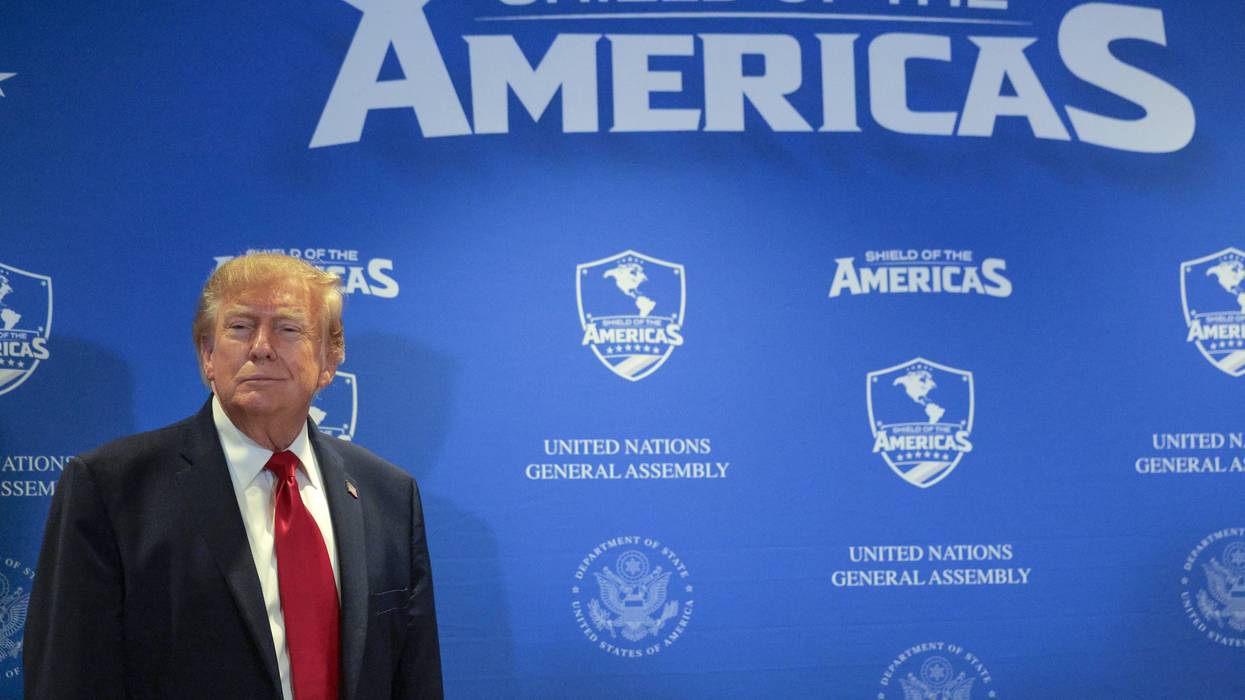
Critics have described Trump's boat strikes as extrajudicial killings that violate due process. At a meeting during this week's gathering of the UN General Assembly, he seemed to agree.
Critics have often described President Donald Trump's campaign of boat strikes in the Caribbean and Pacific—which have taken the lives of at least 234 mostly unknown people—as extrajudicial killings that flout the very basics of due process.
On Tuesday, Trump essentially described them that way too, seeming to suggest that killing people outside the law is the whole point.
"For years, administrations just played games, and they'd bring them to a court in Miami or something, and the judge would release them immediately, and they'd go back to selling drugs," Trump said. "But now, we don't waste our time doing it."
He was speaking at a meeting of the Washington-led "Shield of the Americas" coalition, an alliance of leaders and foreign ministers ostensibly dedicated to stamping out drug cartels and other criminal organizations across the Americas.
The boat strike campaign—known first by the Defense Department as “Operation Southern Spear” before it was rebranded last month as Joint Task Force Western Hemisphere—is part of this effort. The administration says the more than 70 vessels it has targeted with lethal strikes since last September were engaged in “narco-trafficking,” and that killing their operators is a justifiable form of self-defense.
The principal illicit cargo on the maritime routes targeted by Southern Spear is cocaine. But the White House rarely provides any evidence publicly to substantiate that the boats it targets are involved with drug trafficking, and members of Congress have complained that even classified briefings lacked hard evidence. Some of those killed in the strikes have later been identified as ordinary fishermen and other civilians with no known ties to the drug trade.
An investigation from the Washington Office on Latin America found in July that the military has relied on extraordinarily broad criteria to launch the strikes against anyone deemed to be "affiliated" with a secret list of designated terrorist groups. They do not require the commanders launching them to know the identities of those aboard a vessel or have any evidence that it is carrying drugs at all.
Even if the boats were engaged in drug trafficking as the administration claims, wrote Ben Saul, the United Nations special rapporteur on human rights and counterterrorism, in a report released earlier this week, there are no “international legal rights to unilaterally use military force” to counter drug cartels or other organized crime groups that have not mounted any “armed attack” against the US.
The strikes, Saul added, were not a “last resort” or “necessary or proportionate” since the US had not tried to use non-lethal means like intercepting or boarding them before resorting to bombings.
Concurring with several other UN experts, he said that the strikes were "contrary to international law, violate the human right to life, and plausibly constitute crimes against humanity," including "murder."
Trump's comments on Tuesday seemed to underscore what Saul and others critical of the boat bombings have emphasized: that rather than using lethal force as a last resort to repel an immediate threat, his administration was simply killing suspects as an alternative to avoid a cumbersome legal process.
Norman Ornstein, a political scientist and scholar at the conservative American Enterprise Institute, said in a post on social media that Trump's comments were "worthy of the International Criminal Court."
Defense Secretary Pete Hegseth has suggested the administration’s calls to “dismantle” the ICC are in part out of concern that the court, which prosecutes war crimes and other international criminality, could be used to prosecute members of the Trump administration over the boat strikes.
Trump described the ICC as “anti-American” and “evil" during a speech at the UN General Assembly earlier on Tuesday, in which he also threatened to "annihilate" Iran and celebrated that he was claiming the "spoils" of war from Venezuela.
During that same speech, he also boasted that his administration “has carried out dozens of strikes on cartel drug boats, destroying 97% of the drugs coming into the ocean and sea," a claim that his administration has not provided evidence to substantiate.
An internal analysis by the US Drug Enforcement Agency (DEA), reported on in July by the Washington Post, found the opposite, in fact, stating that the strikes “failed to affect the supply or price of cocaine in the United States.”
As Trump heralded the boat strike campaign before the eyes of the world on Tuesday, a coalition of more than 70 lawmakers across the Americas called for the US to end what it said were "hundreds of extrajudicial killings of civilians."
The statement was signed by 15 Democratic members of the US Congress, including Reps. Jesús “Chuy” García (D-Ill.), Greg Casar (D-Texas), Alexandria Ocasio-Cortez (D-NY), Ilhan Omar (D-Minn.), Rashida Tlaib (D-Mich.) and Pramila Jayapal (D-Wash.). It was also signed by lawmakers from Puerto Rico as well as 12 other countries across the Americas—Argentina, Brazil, Canada, Chile, Colombia, Ecuador, Guatemala, Honduras, Mexico, Paraguay, Peru, and Uruguay.
"The identities of nearly all the victims remain publicly unknown, and many families lack effective or safe avenues to obtain information or redress. Coastal and fishing communities face fear and uncertainty as these attacks put lives and livelihoods at risk," the lawmakers wrote.
"The rights to life, due process, and protections against the arbitrary use of force are core principles of democratic rule of law that our countries have committed to uphold," they added. "Allegations of drug trafficking, however serious, do not circumvent or override these protections, nor do they justify lethal force against people who pose no imminent threat."
“It would be one thing if the US didn’t have an overt maritime strike campaign, but they do, and they’re posting snuff films of boats going up in flames regularly,” said one expert.
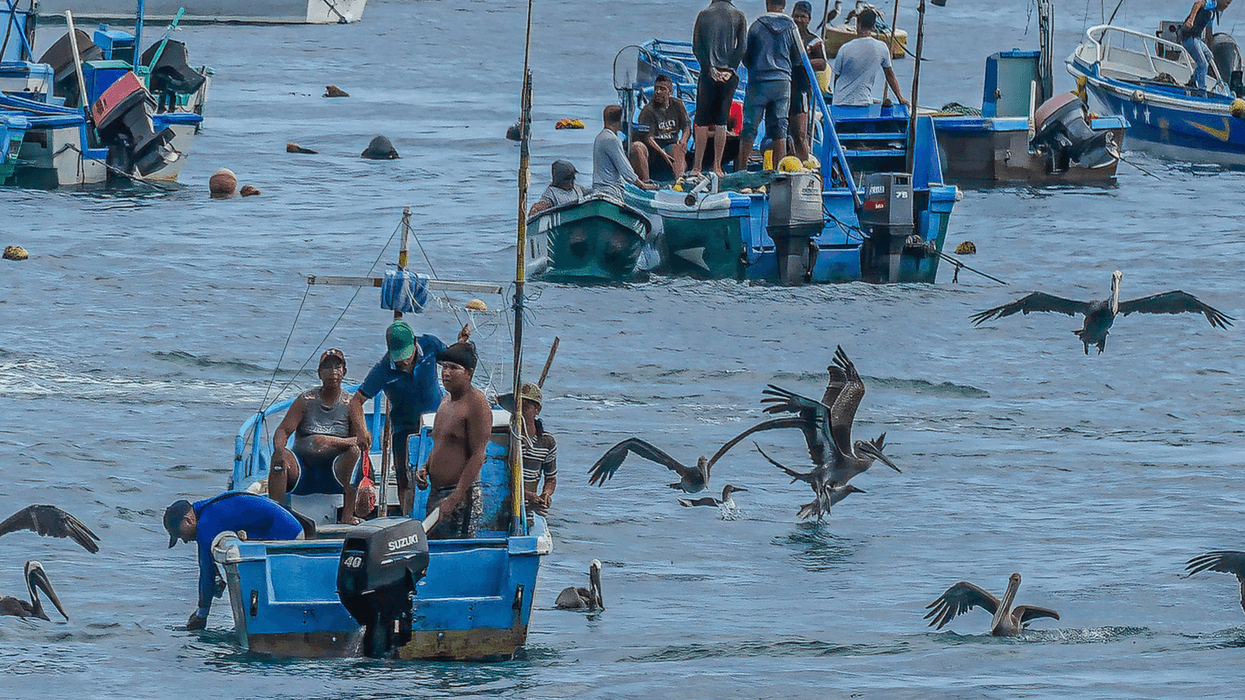
An investigation published Wednesday by The New York Times has raised fresh questions about who attacked three Ecuadorian fishing vessels in the Pacific Ocean earlier this year—but for fishers and their families in the South American nation, the mystery is hardly new.
According to the Times, Ecuadorian fishers aboard the Fiorella, Negra Francisca Duarte II, and Don Maca were separately attacked by what witnesses called unidentified "gringos" using drones. Survivors said they "came under attack by English-speaking assailants wearing matching uniforms with American flag patches, but without any clear insignia to link them to an official government force."
International rights groups have called for an investigation after the Fiorella and its crew of eight disappeared in January amid Operation Southern Spear, President Donald Trump's largely ineffective campaign of extrajudicial strikes on boats that the US administration claims, without evidence, were smuggling drugs.
By the Pentagon's own admission, more than 220 people have been killed in at least 66 such strikes since last September. The US military says no civilians were killed in the strikes, a claim that anonymous government officials called "a fucking joke" and "a total whitewash."
This is a very worrying story. Ecuadorian fishermen are being attacked and killed, and the perpetrators seem to be either the U.S. military engaged in clandestine operations or an American mercenary company working for Bukele or another Central American country.
[image or embed]
— Aaron Reichlin-Melnick (@reichlinmelnick.bsky.social) August 12, 2026 at 7:12 AM
Government officials in countries including Colombia and Venezuela, as well as victims' relatives, have contradicted the US claim. The families of two Trinidadian men killed in one strike earlier this year filed wrongful death lawsuits against the United States. Relatives of a Colombian slain in another US strike also filed a complaint at the Inter-American Commission on Human Rights.
Some of the Ecuadorian fishers featured in the new Times piece say they were seized and interrogated by the attackers before being handed over to the Salvadoran navy, which conducts long-range maritime patrols and counternarcotics operations in the Eastern Pacific and occasionally intercepts vessels.
The new Times report says that a maritime patrol aircraft based at a military facility in El Salvador repeatedly flew toward and tracked the Ecuadorian fishing boats in the days before they were attacked or disappeared. An analysis of flight data found that the aircraft's course appeared to follow the vessels over several days.
Yet the aircraft was not listed among Pentagon operational aircraft. According to the Times, it was registered to a private company whose address was a UPS store mailbox in Virginia, deepening the mystery over who was operating it—and for whom.
“It would be one thing if the US didn’t have an overt maritime strike campaign, but they do, and they’re posting snuff films of boats going up in flames regularly," Brian Finucane, a former State Department lawyer who specializes in the laws of war, told the Times.
"And that’s what makes this even more squirrelly," added Finucane, now a senior adviser in the US Program at the International Crisis Group. “Who are these people that are operating, and under what authority? And they are using a UPS store as their company address? Come on.”
The Pentagon has denied involvement, claiming that US Southern Command (SOUTHCOM) did not know about the attacks or have a role in them. But the new findings raise the possibility that the attacks could have involved a private military contractor or another force operating in coordination with Washington's expanding anti-drug campaign.
“Who are these people that are operating, and under what authority? And they are using a UPS store as their company address?"
In addition to the boat bombing campaign—which the Pentagon has replaced with the newly created Joint Task Force Western Hemisphere—SOUTHCOM has launched Operation Total Extermination, a joint counternarcotics operation with Ecuadorian forces involving the deployment of US ground troops into the Andean nation.
In one operation in the campaign, Ecuadorian soldiers raided and destroyed a dairy farm in San Martín, Sucumbíos, on March 3. Ecuador claimed the site was a traffickers’ camp, but investigations by The New York Times and, later, Human Rights Watch found substantial evidence that it was a working cattle and dairy farm with no credible evidence of a criminal connection. HRW said four workers at the farm were detained and tortured by Ecuadorian forces, and that the broader operation was carried out with US assistance.
The Times investigation published Wednesday followed months of reporting by Ecuadorian and international media and human rights groups, including HRW, on the three fishing vessels and their crews.
In April, Primicias reported growing fear among fishermen in Manabí, Ecuador's major fishing province, where crews said they had been intercepted and attacked at sea. Fishers from the Don Maca and Negra Francisca Duarte II separately described being surrounded by drones and subsequently detained by what they believed were US personnel.
Don Maca's crew told El Universo that drones bombed their boat without warning on March 26. Fishers aboard said they escaped in small boats, approached a foreign vessel for help, and were instead handcuffed and hooded before eventually being transferred to Salvadoran authorities.
El Universo also separately reported a strikingly similar account from the crew of the Negra Francisca Duarte II. Captain Hernán Flores said a drone struck the boat on March 17, setting it ablaze and forcing all 16 fishermen into the water. When they approached a nearby blue vessel seeking assistance, Flores said, armed foreign personnel pointed weapons at them, bound them, and covered their heads.
In the case of the Fiorella, Primicias and El Universo reported that two fishers who had separated from the boat in a smaller vessel saw a drone circling above shortly before they spotted smoke on the horizon. Fiorella and those aboard it have never been found.