

SUBSCRIBE TO OUR FREE NEWSLETTER
Daily news & progressive opinion—funded by the people, not the corporations—delivered straight to your inbox.
5
#000000
#FFFFFF
To donate by check, phone, or other method, see our More Ways to Give page.
Daily news & progressive opinion—funded by the people, not the corporations—delivered straight to your inbox.
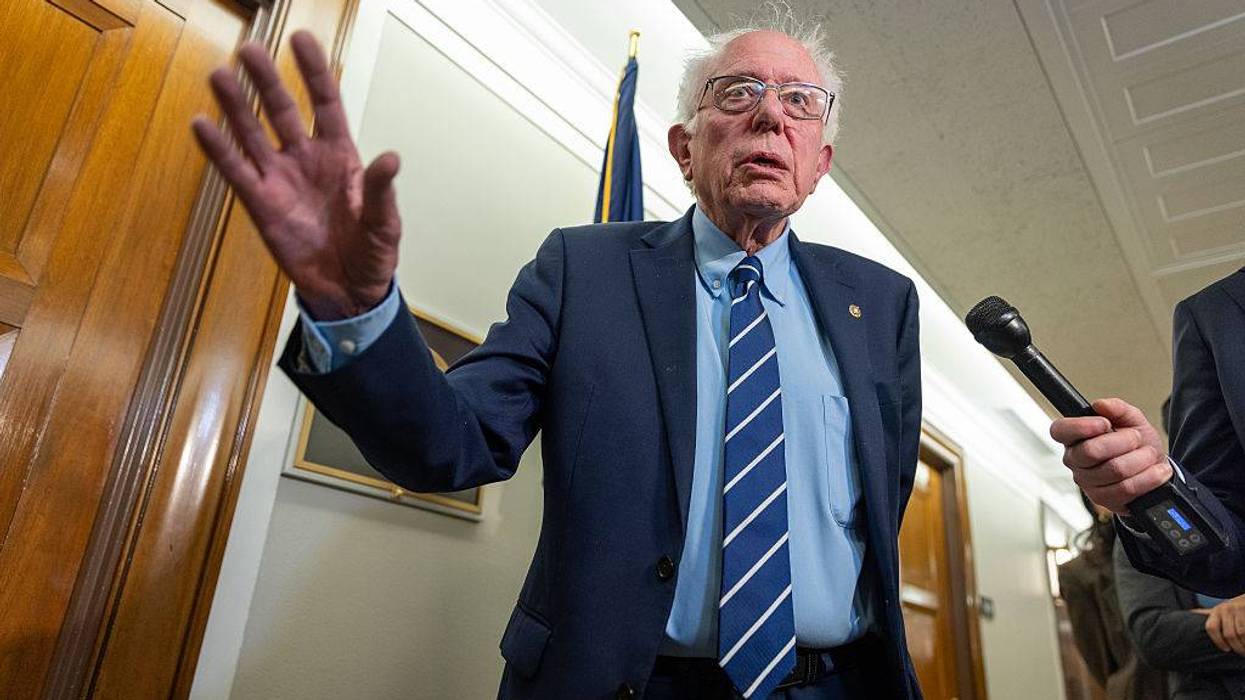
"Do I have great confidence that Trump will do that right thing? No, I don't."
With President Donald Trump seemingly open to the idea of having the federal government take a stake in major artificial intelligence firms, Sen. Bernie Sanders emphasized on Monday that he and the president have two very different visions when it comes to regulating AI.
During an interview at the National Press Club, CBS News' Robert Costa asked Sanders (I-Vt.) to comment on Trump last week showing interest in the government partially owning Big Tech firms whose AI models could potentially disrupt American society in the coming years.
Sanders credited Trump with having sharp political instincts on the matter, theorizing that he understands the deep unease and anxiety that people feel about AI, particularly the fear that it could put millions of Americans out of work while benefiting Big Tech CEOs like Elon Musk and Mark Zuckerberg.
"So as a politician, I think that's where he's coming from," Sanders said. "Do I have great confidence that Trump will do the right thing? No."
Sen. Bernie Sanders (@SenSanders): "Trump is many things, but he is a good politician." pic.twitter.com/2iGu0kXZBa
— CSPAN (@cspan) June 9, 2026
Trump so far has only hinted at plans for a public stake in AI firms and hasn't released any concrete plans.
In contrast, Sanders earlier this month wrote an editorial for The New York Times in which he proposed creating an AI-based sovereign wealth fund that would impose a one-time, 50% tax on OpenAI, Anthropic, and other AI behemoths, paid in the form of stock.
Sanders argued that the wealth fund was necessary to "give the public a direct role in determining the future of this technology” and “guarantee that the trillions of dollars potentially generated by AI are used to improve the lives of all of us—not simply to make the richest people in the world even richer."
Noting that AI companies' large language models (LLMs) were only made possible with the inputs of centuries' worth of human knowledge and writing, Sanders said that it's only reasonable that the public have a strong degree of control over how such technology is used.
"When a public resource generates wealth, the public should share in that wealth," Sanders wrote. "The future of AI and the fate of humanity must not be decided behind closed doors in Silicon Valley. It must not be dictated by billionaires seeking to maximize their power and profit."
Progressive economist Dean Baker on Tuesday pushed back on Sanders' idea for an AI sovereign wealth fund, in particular arguing that it may be unwise for the government to create a wealth fund based on what might be a wildly overvalued asset.
"Most likely the AI sector is in a massive bubble," cautioned Baker. "An AI sovereign wealth fund is likely to end up being a mechanism to shovel yet more money to Elon Musk, Mark Zuckerberg, and the rest of the right-wing billionaire gang. We have already given this crew enough money."
Instead, Baker proposed handling the potential negative consequences of AI disruption through a mix of higher corporate income taxes, stricter antitrust enforcement, and shorter average work weeks.
"We have all the tools needed deal with an AI productivity boom; we just lack the political will to use them," Baker concluded. "The sovereign wealth fund idea is a massive leap in the wrong direction."

We should all be frightened by this use of AI for death and destruction. But this is not new. Israel and the U.S. have been testing and using AI in Palestine for years.
Earlier this month, the company that brings us ChatGPT announced its partnership with California-based weapons company, Anduril, to produce AI weapons. The OpenAI-Anduril system, which was tested in California at the end of November, permits the sharing of data between external parties for decision making on the battlefield. This fits squarely within the US military and OpenAI’s plans to normalize the use of AI on the battlefield.
Anduril, based in Costa Mesa, makes AI-powered drones, missiles, and radar systems, including surveillance towers, Sentry systems, currently used at US military bases worldwide as well as the US-Mexico border and on the British coastline to detect migrants on boats. On December 3rd, they received a three-year contract with the Pentagon for a system that gives soldiers AI solutions during attacks.
In January, OpenAI deleted a direct ban in their usage policy on “activity that has high risk of physical harm” which specifically included “military and warfare” and “weapons development.” Less than one week after doing so, the company announced a partnership with the Pentagon in cybersecurity.
While they might have removed a ban on making weapons, OpenAI’s lurch into the war industry is in total antithesis to its own charter. Their own proclamation to build “safe and beneficial AGI [Artificial Generative Intelligence]” that does not “harm humanity” is laughable when they are using technology to kill. ChatGPT could feasibly, and probably soon will, write code for an automated weapon, analyze information for bombings, or assist invasions and occupations.
OpenAI’s lurch into the war industry is in total antithesis to its own charter.
We should all be frightened by this use of AI for death and destruction. But this is not new. Israel and the US have been testing and using AI in Palestine for years. In fact, Hebron has been dubbed a “smart city” as the occupation enforces its tyranny through a perforation of motion and heat sensors, facial recognition technologies, and CCTV surveillance. At the center of this oppressive surveillance is the Blue Wolf System, an AI tool that scans the faces of Palestinians, when they are photographed by Israeli occupation soldiers, and refers to a biometric database in which information about them is stored. Upon inputting the photo into the system, each person is classified by a color-coded rating based on their perceived ‘threat level’ to dictate whether the soldier should allow them to pass or arrest them. The IOF soldiers are rewarded with prizes for taking the most photographs, which they have termed “Facebook for Palestinians”, according to revelations from the Washington Post in 2021.
OpenAI’s war technology comes as the Biden administration is pushing for the US to use the technology to “fulfill national security objectives.” This was in fact part of the title of a White House memorandum released in October this year calling for rapid development of artificial intelligence “especially in the context of national security systems.” While not explicitly naming China, it is clear that a perceived ‘AI arms race’ with China is also a central motivation of the Biden administration for such a call. Not solely is this for weapons for war, but also racing for the development of technology writ large. Earlier this month, the US banned the export of HBM chips to China, a critical component of AI and high-level graphics processing units (GPU). Former Google CEO Eric Schmidt warned that China is two to three years ahead of the US when it comes to AI, a major change from his statements earlier this year where he remarked that the US is ahead of China. When he says there is a “threat escalation matrix” when there are developments in AI, he reveals that the US sees the technology only as a tool of war and a way to assert hegemony. AI is the latest in the US’ unrelenting - and dangerous - provocation and fear mongering with China, who they cannot bear to see advance them.In response to the White House memorandum, OpenAI released a statement of its own where it re-asserted many of the White House’s lines about “democratic values” and “national security.” But what is democratic about a company developing technology to better target and bomb people? Who is made secure by the collection of information to better determine war technology? This surely reveals the alignment of the company with the Biden administration’s anti-China rhetoric and imperialist justifications. As the company that has surely pushed AGI systems within general society, it is deeply alarming that they have ditched all codes and jumped right in with the Pentagon. While it’s not surprising that companies like Palantir or even Anduril itself are using AI for war, from companies like OpenAI - a supposedly mission-driven nonprofit - we should expect better.
AI is being used to streamline killing. At the US-Mexico border, in Palestine, and in US imperial outposts across the globe. While AI systems seem innocently embedded within our daily lives, from search engines to music streaming sites, we must forget these same companies are using the same technology lethally. While ChatGPT might give you ten ways to protest, it is likely being trained to kill, better and faster.
From the war machine to our planet, AI in the hands of US imperialists means only more profits for them and more devastation and destruction for us all.
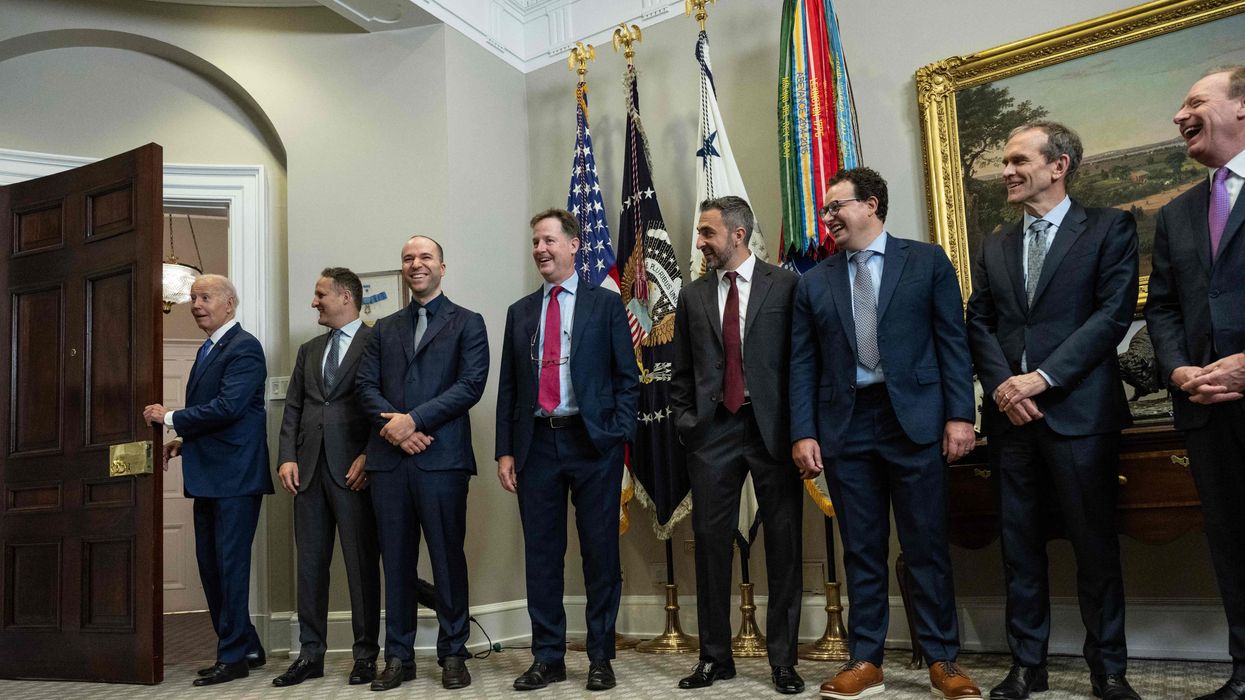
Advocacy groups and experts are pressuring Congress and federal regulators to "put meaningful, enforceable guardrails in place."
Amid rising global fears about the dangers of artificial intelligence, campaigners and experts applauded U.S. President Joe Biden's administration on Friday for securing voluntary risk management commitments from seven leading AI companies while also emphasizing the need for much more from lawmakers and regulators.
"I'm very happy to see this modest, but necessary, step on the way to proper governance of AI. It is all voluntary at this stage, yet good to get these norms agreed. Hopefully it is a step on a much longer path," said Toby Ord, a senior research fellow at the U.K.'s University of Oxford and author of The Precipice: Existential Risk and the Future of Humanity.
Rob Reich, a faculty associate director at Stanford University's Institute for Human-Centered Artificial Intelligence, tweeted that "this is a big step forward for AI governance," and it is "great to see" Amazon, Anthropic, Google, Inflection, Meta, Microsoft, and OpenAI "coordinating on baseline norms of responsible AI development."
"We need enforceable accountability measures and requirements to roll out AI responsibly and mitigate the risks and potential harms to individuals, including bias and discrimination."
Alexandra Reeve Givens, CEO of the Center for Democracy & Technology (CDT), called the announcement "a welcome step toward promoting trustworthy and secure AI systems."
"Red team testing, information sharing, and transparency around risks are all essential elements of achieving AI safety," Reeve Givens said. "The commitment to develop mechanisms to disclose to users when content is AI-generated offers the potential to reduce fraud and mis- and disinformation."
"These voluntary undertakings are only a first step. We need enforceable accountability measures and requirements to roll out AI responsibly and mitigate the risks and potential harms to individuals, including bias and discrimination," she stressed. "CDT looks forward to continuing to work with the administration and Congress in putting these safeguards in place."
Caitriona Fitzgerald, deputy director at the Electronic Privacy Information Center (EPIC), had a similar response.
"While EPIC appreciates the Biden administration's use of its authorities to place safeguards on the use of artificial intelligence, we both agree that voluntary commitments are not enough when it comes to Big Tech," she said. "Congress and federal regulators must put meaningful, enforceable guardrails in place to ensure the use of AI is fair, transparent, and protects individuals' privacy and civil rights."
Biden brought together leaders from the companies to announce eight commitments that the White House said "underscore three principles that must be fundamental to the future of AI: safety, security, and trust."
As the White House outlined, the firms are pledging to:
"There is much more work underway," according to a White House fact sheet, which says the "administration is currently developing an executive order and will pursue bipartisan legislation to help America lead the way in responsible innovation."
Brown University computer and data science professor Suresh Venkatasubramania, a former Biden tech adviser who helped co-author the administration's Blueprint for an AI Bill of Rights, said in a series of tweets about the Friday agreement that "on process, there's good stuff here," but "on content, it's a bit of a mixed bag."
While recognizing the need for additional action, Venkatasubramania also said that voluntary efforts help show that "adding guardrails in the development of public-facing systems isn't the end of the world or even the end of innovation."
The White House fact sheet says that "as we advance this agenda at home, the administration will work with allies and partners to establish a strong international framework to govern the development and use of AI. It has already consulted on the voluntary commitments with Australia, Brazil, Canada, Chile, France, Germany, India, Israel, Italy, Japan, Kenya, Mexico, the Netherlands, New Zealand, Nigeria, the Philippines, Singapore, South Korea, the UAE, and the U.K."
Gabriela Zanfir-Fortuna of the Future of Privacy Forum pointed out that the European Union was not listed as a partner.
As Common Dreams reported last month, the European Parliament passed a draft law that would strictly regulate the use of artificial intelligence, and now, members of the legislative body are negotiating a final version with the E.U.'s executive institutions.
The fact sheet adds that "the United States seeks to ensure that these commitments support and complement Japan's leadership of the G7 Hiroshima Process—as a critical forum for developing shared principles for the governance of AI—as well as the United Kingdom's leadership in hosting a Summit on AI Safety, and India's leadership as chair of the Global Partnership on AI."
Noting that portion of the document, Zanfir-Fortuna tweeted: "What is missing from the list? The Council of Europe's ongoing process to adopt an international agreement on AI."
"We cannot allow generative AI to promote a parasitic economy that diverts financial resources that should benefit the news media," said one advocate.
Warning of the ongoing expansion of artificial intelligence-generated websites that resemble legitimate news outlets and draw ad revenue away from them, Reporters Without Borders on Wednesday implored search engines and advertisers to slow the spread of automated "content farms" by denying them access to "funds that should be reserved for real journalism."
"We cannot allow generative AI to promote a parasitic economy that diverts financial resources that should benefit the news media," Vincent Berthier, head of the Tech Desk at Reporters Without Borders (RSF), said in a statement.
"As well as an overall fall in the quality of online information, there is also a real danger of a further decline in funding essential to online media," said Berthier. "We urge search engines and advertisers not to allow these AI-generated sites to become profitable."
"As well as an overall fall in the quality of online information, there is also a real danger of a further decline in funding essential to online media."
Earlier this month, NewsGuard, which evaluates the reliability of online news and information, published an analysis entitled Rise of the Newsbots: AI-Generated News Websites Proliferating Online.
The report identified at least 49 ostensible news websites "spanning seven languages—Chinese, Czech, English, French, Portuguese, Tagalog, and Thai—that appear to be entirely or mostly generated by artificial intelligence language models designed to mimic human communication."
These automated content farms, which reach millions of internet users, "churn out vast amounts of clickbait articles to optimize advertising revenue," NewsGuard noted, exacerbating the dangerous worldwide spread of misinformation in the process.
As RSF noted Wednesday:
Dressed up to look like media, some of these sites rewrite journalistic content plundered from real news sites. Others produce fake stories or mediocre content designed solely to attract traffic. One reported in April that Joe Biden had died. Another falsely reported that Ukraine had claimed that it killed 3,870 Russian soldiers in a single attack.
Generated by AI and usually run anonymously, some of these sites "publish hundreds of articles a day," according to NewsGuard. There is a real risk that the Internet will soon be flooded by many more of these sites pumping out garbage that will inevitably congest search engines, with the result that reliable news reporting will struggle to make itself visible.
The modus operandi of these sites is very simple—maximize clicks while minimizing effort in order to optimize profit. "Many of the sites are saturated with advertisements," says NewsGuard, "indicating that they were likely designed to generate revenue from programmatic ads—ads that are placed algorithmically across the web."
"Advertisers have a huge responsibility," RSF continued. "These content farms will inevitably proliferate if they can continue to make money from advertising. The ad industry must give a firm undertaking to ensure ads are placed above all with media that are reliable news sources."
The watchdog also urged the ad industry "to manage programmatic advertising mechanisms responsibly and to acquire the monitoring and control tools needed to ensure that these content farms do not become profitable."
RSF is pushing advertisers to curb the rapid spread of automated clickbait just weeks after it warned in its annual press freedom report that the fast-growing, AI-powered "fake content industry" threatens to undermine fact-based journalism around the globe, which is already at risk due to old-fashioned violence against reporters, who are being jailed and killed at alarming rates.
It "should be a global priority alongside other societal-scale risks such as pandemics and nuclear war," says a new statement signed by dozens of artificial intelligence critics and boosters.
On Tuesday, 80 artificial intelligence scientists and more than 200 "other notable figures" signed a statement that says "mitigating the risk of extinction from AI should be a global priority alongside other societal-scale risks such as pandemics and nuclear war."
The one-sentence warning from the diverse group of scientists, engineers, corporate executives, academics, and other concerned individuals doesn't go into detail about the existential threats posed by AI. Instead, it seeks to "open up discussion" and "create common knowledge of the growing number of experts and public figures who also take some of advanced AI’s most severe risks seriously," according to the Center for AI Safety, a U.S.-based nonprofit whose website hosts the statement.
Lead signatory Geoffrey Hinton, often called "the godfather of AI," has been sounding the alarm for weeks. Earlier this month, the 75-year-old professor emeritus of computer science at the University of Toronto announced that he had resigned from his job at Google in order to speak more freely about the dangers associated with AI.
Before he quit Google, Hinton told CBS News in March that the rapidly advancing technology's potential impacts are comparable to "the Industrial Revolution, or electricity, or maybe the wheel."
Asked about the chances of the technology "wiping out humanity," Hinton warned that "it's not inconceivable."
That frightening potential doesn't necessarily lie with currently existing AI tools such as ChatGPT, but rather with what is called "artificial general intelligence" (AGI), which would encompass computers developing and acting on their own ideas.
"Until quite recently, I thought it was going to be like 20 to 50 years before we have general-purpose AI," Hinton told CBS News. "Now I think it may be 20 years or less."
Pressed by the outlet if it could happen sooner, Hinton conceded that he wouldn't rule out the possibility of AGI arriving within five years, a significant change from a few years ago when he "would have said, 'No way.'"
"We have to think hard about how to control that," said Hinton. Asked if that's possible, Hinton said, "We don't know, we haven't been there yet, but we can try."
The AI pioneer is far from alone. According to the 2023 AI Index Report, an annual assessment of the fast-growing industry published last month by the Stanford Institute for Human-Centered Artificial Intelligence, 57% of computer scientists surveyed said that "recent progress is moving us toward AGI," and 58% agreed that "AGI is an important concern."
Although its findings were released in mid-April, Stanford's survey of 327 experts in natural language processing—a branch of computer science essential to the development of chatbots—was conducted last May and June, months before OpenAI's ChatGPT burst onto the scene in November.
OpenAI CEO Sam Altman, who signed the statement shared Tuesday by the Center for AI Safety, wrote in a February blog post: "The risks could be extraordinary. A misaligned superintelligent AGI could cause grievous harm to the world."
The following month, however, Altman declined to sign an open letter calling for a half-year moratorium on training AI systems beyond the level of OpenAI's latest chatbot, GPT-4.
The letter, published in March, states that "powerful AI systems should be developed only once we are confident that their effects will be positive and their risks will be manageable."
Tesla and Twitter CEO Elon Musk was among those who called for a pause two months ago, but he is "developing plans to launch a new artificial intelligence start-up to compete with" OpenAI, according to The Financial Times, begging the question of whether his stated concern about the technology's "profound risks to society and humanity" is sincere or an expression of self-interest.
That Altman and several other AI boosters signed Tuesday's statement raises the possibility that insiders with billions of dollars at stake are attempting to showcase their awareness of the risks posed by their products in a bid to persuade officials of their capacity for self-regulation.
Demands from outside the industry for robust government regulation of AI are growing. While ever-more dangerous forms of AGI may still be years away, there is already mounting evidence that existing AI tools are exacerbating the spread of disinformation, from chatbots spouting lies and face-swapping apps generating fake videos to cloned voices committing fraud. Current, untested AI is hurting people in other ways, including when automated technologies deployed by Medicare Advantage insurers unilaterally decide to end payments, resulting in the premature termination of coverage for vulnerable seniors.
Critics have warned that in the absence of swift interventions from policymakers, unregulated AI could harm additional healthcare patients, undermine fact-based journalism, hasten the destruction of democracy, and lead to an unintended nuclear war. Other common worries include widespread worker layoffs and worsening inequality as well as a massive uptick in carbon pollution.
A report published last month by Public Citizen argues that "until meaningful government safeguards are in place to protect the public from the harms of generative AI, we need a pause."
"Businesses are deploying potentially dangerous AI tools faster than their harms can be understood or mitigated," the progressive advocacy group warned in a statement.
"History offers no reason to believe that corporations can self-regulate away the known risks—especially since many of these risks are as much a part of generative AI as they are of corporate greed," the watchdog continued. "Businesses rushing to introduce these new technologies are gambling with peoples' lives and livelihoods, and arguably with the very foundations of a free society and livable world."
Earlier this month, Public Citizen president Robert Weissman welcomed the Biden administration's new plan to "promote responsible American innovation in artificial intelligence and protect people's rights and safety," but he also stressed the need for "more aggressive measures" to "address the threats of runaway corporate AI."
Echoing Public Citizen, an international group of doctors warned three weeks ago in the peer-reviewed journal BMJ Open Health that AI "could pose an existential threat to humanity" and demanded a moratorium on the development of such technology pending strong government oversight.
AI "poses a number of threats to human health and well-being," the physicians and related experts wrote. "With exponential growth in AI research and development, the window of opportunity to avoid serious and potentially existential harms is closing."

"Businesses are deploying potentially dangerous AI tools faster than their harms can be understood or mitigated," Public Citizen warns. "History offers no reason to believe that corporations can self-regulate away the known risks."
"Until meaningful government safeguards are in place to protect the public from the harms of generative AI, we need a pause."
So says a report on the dangers of artificial intelligence (AI) published Tuesday by Public Citizen. Titled Sorry in Advance! Rapid Rush to Deploy Generative AI Risks a Wide Array of Automated Harms, the analysis by researchers Rick Claypool and Cheyenne Hunt aims to "reframe the conversation around generative AI to ensure that the public and policymakers have a say in how these new technologies might upend our lives."
Following the November release of OpenAI's ChatGPT, generative AI tools have been receiving "a huge amount of buzz—especially among the Big Tech corporations best positioned to profit from them," the report notes. "The most enthusiastic boosters say AI will change the world in ways that make everyone rich—and some detractors say it could kill us all. Separate from frightening threats that may materialize as the technology evolves are real-world harms the rush to release and monetize these tools can cause—and, in many cases, is already causing."
Claypool and Hunt categorized these harms into "five broad areas of concern":
In a statement, Public Citizen warned that "businesses are deploying potentially dangerous AI tools faster than their harms can be understood or mitigated."
"History offers no reason to believe that corporations can self-regulate away the known risks—especially since many of these risks are as much a part of generative AI as they are of corporate greed," the statement continues. "Businesses rushing to introduce these new technologies are gambling with peoples' lives and livelihoods, and arguably with the very foundations of a free society and livable world."
On Thursday, April 27, Public Citizen is hosting a hybrid in-person/Zoom conference in Washington, D.C., during which U.S. Rep. Ted Lieu (D-Calif.) and 10 other panelists will discuss the threats posed by AI and how to rein in the rapidly growing yet virtually unregulated industry. People interested in participating must register by this Friday.
"Businesses rushing to introduce these new technologies are gambling with peoples' lives and livelihoods, and arguably with the very foundations of a free society and livable world."
Demands to regulate AI are mounting. Last month, Geoffrey Hinton, considered the "godfather of artificial intelligence," compared the quickly advancing technology's potential impacts to "the Industrial Revolution, or electricity, or maybe the wheel."
Asked by
CBS News' Brook Silva-Braga about the possibility of the technology "wiping out humanity," Hinton warned that "it's not inconceivable."
That frightening potential doesn't necessarily lie with existing AI tools such as ChatGPT, but rather with what is called "artificial general intelligence" (AGI), through which computers develop and act on their own ideas.
"Until quite recently, I thought it was going to be like 20 to 50 years before we have general-purpose AI," Hinton told CBS News. "Now I think it may be 20 years or less." Eventually, Hinton admitted that he wouldn't rule out the possibility of AGI arriving within five years—a major departure from a few years ago when he "would have said, 'No way.'"
"We have to think hard about how to control that," said Hinton. Asked by Silva-Braga if that's possible, Hinton said, "We don't know, we haven't been there yet, but we can try."
The AI pioneer is far from alone. In February, OpenAI CEO Sam Altman wrote in a company blog post: "The risks could be extraordinary. A misaligned superintelligent AGI could cause grievous harm to the world."
More than 26,000 people have signed a recently published open letter that calls for a six-month moratorium on training AI systems beyond the level of OpenAI's latest chatbot, GPT-4, although Altman is not among them.
"Powerful AI systems should be developed only once we are confident that their effects will be positive and their risks will be manageable," says the letter.
While AGI may still be a few years away, Public Citizen's new report makes clear that existing AI tools—including chatbots spewing lies, face-swapping apps generating fake videos, and cloned voices committing fraud—are already causing or threatening to cause serious harm, including intensifying inequality, undermining democracy, displacing workers, preying on consumers, and exacerbating the climate crisis.
These threats "are all very real and highly likely to occur if corporations are permitted to deploy generative AI without enforceable guardrails," Claypool and Hunt wrote. "But there is nothing inevitable about them."
They continued:
Government regulation can block companies from deploying the technologies too quickly (or block them altogether if they prove unsafe). It can set standards to protect people from the risks. It can impose duties on companies using generative AI to avoid identifiable harms, respect the interests of communities and creators, pretest their technologies, take responsibility, and accept liability if things go wrong. It can demand equity be built into the technologies. It can insist that if generative AI does, in fact, increase productivity and displace workers, or that the economic benefits be shared with those harmed and not be concentrated among a small circle of companies, executives, and investors.
Amid "growing regulatory interest" in an AI "accountability mechanism," the Biden administrationannounced last week that it is seeking public input on measures that could be implemented to ensure that "AI systems are legal, effective, ethical, safe, and otherwise trustworthy."
According to Axios, Senate Majority Leader Chuck Schumer (D-N.Y.) is "taking early steps toward legislation to regulate artificial intelligence technology."
In the words of Claypool and Hunt: "We need strong safeguards and government regulation—and we need them in place before corporations disseminate AI technology widely. Until then, we need a pause."

Asked about the chances of the technology "wiping out humanity," AI pioneer Geoffrey Hinton warned that "it's not inconceivable."
While nearly three-quarters of researchers believe artificial intelligence "could soon lead to revolutionary social change," 36% worry that AI decisions "could cause nuclear-level catastrophe."
Those survey findings are included in the 2023 AI Index Report, an annual assessment of the fast-growing industry assembled by the Stanford Institute for Human-Centered Artificial Intelligence and published earlier this month.
"These systems demonstrate capabilities in question answering, and the generation of text, image, and code unimagined a decade ago, and they outperform the state of the art on many benchmarks, old and new," says the report. "However, they are prone to hallucination, routinely biased, and can be tricked into serving nefarious aims, highlighting the complicated ethical challenges associated with their deployment."
As Al Jazeera reported Friday, the analysis "comes amid growing calls for regulation of AI following controversies ranging from a chatbot-linked suicide to deepfake videos of Ukrainian President Volodymyr Zelenskyy appearing to surrender to invading Russian forces."
Notably, the survey measured the opinions of 327 experts in natural language processing—a branch of computer science essential to the development of chatbots—last May and June, months before the November release of OpenAI's ChatGPT "took the tech world by storm," the news outlet reported.
"A misaligned superintelligent AGI could cause grievous harm to the world."
Just three weeks ago, Geoffrey Hinton, considered the "godfather of artificial intelligence," told CBS News' Brook Silva-Braga that the rapidly advancing technology's potential impacts are comparable to "the Industrial Revolution, or electricity, or maybe the wheel."
Asked about the chances of the technology "wiping out humanity," Hinton warned that "it's not inconceivable."
That alarming potential doesn't necessarily lie with currently existing AI tools such as ChatGPT, but rather with what is called "artificial general intelligence" (AGI), which would encompass computers developing and acting on their own ideas.
"Until quite recently, I thought it was going to be like 20 to 50 years before we have general-purpose AI," Hinton told CBS News. "Now I think it may be 20 years or less."
Pressed by Silva-Braga if it could happen sooner, Hinton conceded that he wouldn't rule out the possibility of AGI arriving within five years, a significant change from a few years ago when he "would have said, 'No way.'"
"We have to think hard about how to control that," said Hinton. Asked if that's possible, Hinton said, "We don't know, we haven't been there yet, but we can try."
The AI pioneer is far from alone. According to the survey of computer scientists conducted last year, 57% said that "recent progress is moving us toward AGI," and 58% agreed that "AGI is an important concern."
In February, OpenAI CEO Sam Altman wrote in a company blog post: "The risks could be extraordinary. A misaligned superintelligent AGI could cause grievous harm to the world."
More than 25,000 people have signed an open letter published two weeks ago that calls for a six-month moratorium on training AI systems beyond the level of OpenAI's latest chatbot, GPT-4, although Altman is not among them.
"Powerful AI systems should be developed only once we are confident that their effects will be positive and their risks will be manageable," says the letter.
The Financial Times reported Friday that Tesla and Twitter CEO Elon Musk, who signed the letter calling for a pause, is "developing plans to launch a new artificial intelligence start-up to compete with" OpenAI.
"It's very reasonable for people to be worrying about those issues now."
Regarding AGI, Hinton said: "It's very reasonable for people to be worrying about those issues now, even though it's not going to happen in the next year or two. People should be thinking about those issues."
While AGI may still be a few years away, fears are already mounting that existing AI tools—including chatbots spouting lies, face-swapping apps generating fake videos, and cloned voices committing fraud—are poised to turbocharge the spread of misinformation.
According to a 2022 IPSOS poll of the general public included in the new Stanford report, people in the U.S. are particularly wary of AI, with just 35% agreeing that "products and services using AI had more benefits than drawbacks," compared with 78% of people in China, 76% in Saudi Arabia, and 71% in India.
Amid "growing regulatory interest" in an AI "accountability mechanism," the Biden administration announced this week that it is seeking public input on measures that could be implemented to ensure that "AI systems are legal, effective, ethical, safe, and otherwise trustworthy."
Axios reported Thursday that Senate Majority Leader Chuck Schumer (D-N.Y.) is "taking early steps toward legislation to regulate artificial intelligence technology."