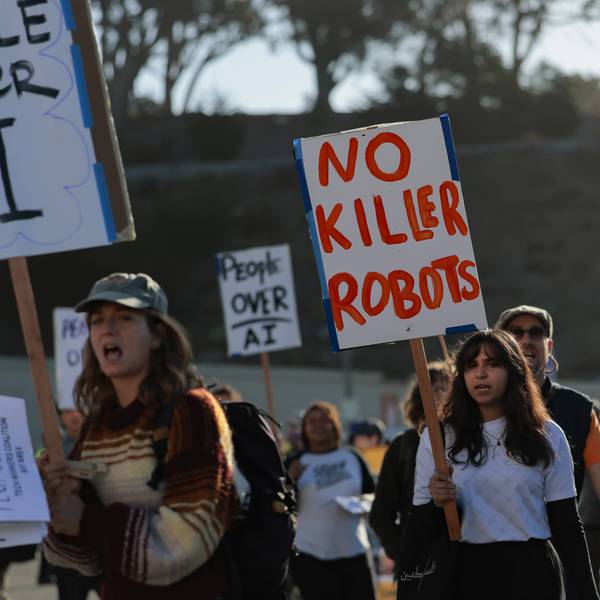

A growing number of experts are calling for a pause on advanced AI development and deployment.
Experts Urge Action to Mitigate 'Risk of Extinction From AI'
It "should be a global priority alongside other societal-scale risks such as pandemics and nuclear war," says a new statement signed by dozens of artificial intelligence critics and boosters.
On Tuesday, 80 artificial intelligence scientists and more than 200 "other notable figures" signed a statement that says "mitigating the risk of extinction from AI should be a global priority alongside other societal-scale risks such as pandemics and nuclear war."
The one-sentence warning from the diverse group of scientists, engineers, corporate executives, academics, and other concerned individuals doesn't go into detail about the existential threats posed by AI. Instead, it seeks to "open up discussion" and "create common knowledge of the growing number of experts and public figures who also take some of advanced AI’s most severe risks seriously," according to the Center for AI Safety, a U.S.-based nonprofit whose website hosts the statement.
Lead signatory Geoffrey Hinton, often called "the godfather of AI," has been sounding the alarm for weeks. Earlier this month, the 75-year-old professor emeritus of computer science at the University of Toronto announced that he had resigned from his job at Google in order to speak more freely about the dangers associated with AI.
Before he quit Google, Hinton told CBS News in March that the rapidly advancing technology's potential impacts are comparable to "the Industrial Revolution, or electricity, or maybe the wheel."
Asked about the chances of the technology "wiping out humanity," Hinton warned that "it's not inconceivable."
That frightening potential doesn't necessarily lie with currently existing AI tools such as ChatGPT, but rather with what is called "artificial general intelligence" (AGI), which would encompass computers developing and acting on their own ideas.
"Until quite recently, I thought it was going to be like 20 to 50 years before we have general-purpose AI," Hinton told CBS News. "Now I think it may be 20 years or less."
Pressed by the outlet if it could happen sooner, Hinton conceded that he wouldn't rule out the possibility of AGI arriving within five years, a significant change from a few years ago when he "would have said, 'No way.'"
"We have to think hard about how to control that," said Hinton. Asked if that's possible, Hinton said, "We don't know, we haven't been there yet, but we can try."
The AI pioneer is far from alone. According to the 2023 AI Index Report, an annual assessment of the fast-growing industry published last month by the Stanford Institute for Human-Centered Artificial Intelligence, 57% of computer scientists surveyed said that "recent progress is moving us toward AGI," and 58% agreed that "AGI is an important concern."
Although its findings were released in mid-April, Stanford's survey of 327 experts in natural language processing—a branch of computer science essential to the development of chatbots—was conducted last May and June, months before OpenAI's ChatGPT burst onto the scene in November.
OpenAI CEO Sam Altman, who signed the statement shared Tuesday by the Center for AI Safety, wrote in a February blog post: "The risks could be extraordinary. A misaligned superintelligent AGI could cause grievous harm to the world."
The following month, however, Altman declined to sign an open letter calling for a half-year moratorium on training AI systems beyond the level of OpenAI's latest chatbot, GPT-4.
The letter, published in March, states that "powerful AI systems should be developed only once we are confident that their effects will be positive and their risks will be manageable."
Tesla and Twitter CEO Elon Musk was among those who called for a pause two months ago, but he is "developing plans to launch a new artificial intelligence start-up to compete with" OpenAI, according to The Financial Times, begging the question of whether his stated concern about the technology's "profound risks to society and humanity" is sincere or an expression of self-interest.
That Altman and several other AI boosters signed Tuesday's statement raises the possibility that insiders with billions of dollars at stake are attempting to showcase their awareness of the risks posed by their products in a bid to persuade officials of their capacity for self-regulation.
Demands from outside the industry for robust government regulation of AI are growing. While ever-more dangerous forms of AGI may still be years away, there is already mounting evidence that existing AI tools are exacerbating the spread of disinformation, from chatbots spouting lies and face-swapping apps generating fake videos to cloned voices committing fraud. Current, untested AI is hurting people in other ways, including when automated technologies deployed by Medicare Advantage insurers unilaterally decide to end payments, resulting in the premature termination of coverage for vulnerable seniors.
Critics have warned that in the absence of swift interventions from policymakers, unregulated AI could harm additional healthcare patients, undermine fact-based journalism, hasten the destruction of democracy, and lead to an unintended nuclear war. Other common worries include widespread worker layoffs and worsening inequality as well as a massive uptick in carbon pollution.
A report published last month by Public Citizen argues that "until meaningful government safeguards are in place to protect the public from the harms of generative AI, we need a pause."
"Businesses are deploying potentially dangerous AI tools faster than their harms can be understood or mitigated," the progressive advocacy group warned in a statement.
"History offers no reason to believe that corporations can self-regulate away the known risks—especially since many of these risks are as much a part of generative AI as they are of corporate greed," the watchdog continued. "Businesses rushing to introduce these new technologies are gambling with peoples' lives and livelihoods, and arguably with the very foundations of a free society and livable world."
Earlier this month, Public Citizen president Robert Weissman welcomed the Biden administration's new plan to "promote responsible American innovation in artificial intelligence and protect people's rights and safety," but he also stressed the need for "more aggressive measures" to "address the threats of runaway corporate AI."
Echoing Public Citizen, an international group of doctors warned three weeks ago in the peer-reviewed journal BMJ Open Health that AI "could pose an existential threat to humanity" and demanded a moratorium on the development of such technology pending strong government oversight.
AI "poses a number of threats to human health and well-being," the physicians and related experts wrote. "With exponential growth in AI research and development, the window of opportunity to avoid serious and potentially existential harms is closing."
We are at a crossroads
This country and this world are at a monumental crossroads. In a few short weeks, US voters will have an opportunity to beat back the forces of fascism and confront the billionaires who are rigging the economy, our media system, and our democracy, making it increasingly impossible for ordinary people to get by. We’re not just talking about the election. We’re talking about what must be done once these fascist elements are vanquished from power. We need a bolder set of solutions than what either major party has so far been willing to offer and a working-class movement ready to fight like hell for it. Trump didn't emerge from nowhere. The conditions that fueled MAGA authoritarianism were created by decades of radical neoliberal economic policies and a corrupt political system dominated by corporate interests. They slashed taxes on the super-rich, promising that the benefits would trickle down. They said giveaways to the corporate titans would make life more affordable for the rest of us. It was all bullshit. And when a bitter, betrayed populace searches for someone to blame, right-wing demagogues have little trouble finding scapegoats. People know when they're being lied to, but you won't hear any of this from the corporate media. Only independent journalism—powered and funded by people who believe in building a better world—can deliver truly trustworthy daily news. Our Fall Campaign is underway, and we need your help. To power our newsroom through the rest of the year, we need to raise $125,000 by midnight on October 31. So if you share our vision, please contribute whatever you can to sustain our work. |
On Tuesday, 80 artificial intelligence scientists and more than 200 "other notable figures" signed a statement that says "mitigating the risk of extinction from AI should be a global priority alongside other societal-scale risks such as pandemics and nuclear war."
The one-sentence warning from the diverse group of scientists, engineers, corporate executives, academics, and other concerned individuals doesn't go into detail about the existential threats posed by AI. Instead, it seeks to "open up discussion" and "create common knowledge of the growing number of experts and public figures who also take some of advanced AI’s most severe risks seriously," according to the Center for AI Safety, a U.S.-based nonprofit whose website hosts the statement.
Lead signatory Geoffrey Hinton, often called "the godfather of AI," has been sounding the alarm for weeks. Earlier this month, the 75-year-old professor emeritus of computer science at the University of Toronto announced that he had resigned from his job at Google in order to speak more freely about the dangers associated with AI.
Before he quit Google, Hinton told CBS News in March that the rapidly advancing technology's potential impacts are comparable to "the Industrial Revolution, or electricity, or maybe the wheel."
Asked about the chances of the technology "wiping out humanity," Hinton warned that "it's not inconceivable."
That frightening potential doesn't necessarily lie with currently existing AI tools such as ChatGPT, but rather with what is called "artificial general intelligence" (AGI), which would encompass computers developing and acting on their own ideas.
"Until quite recently, I thought it was going to be like 20 to 50 years before we have general-purpose AI," Hinton told CBS News. "Now I think it may be 20 years or less."
Pressed by the outlet if it could happen sooner, Hinton conceded that he wouldn't rule out the possibility of AGI arriving within five years, a significant change from a few years ago when he "would have said, 'No way.'"
"We have to think hard about how to control that," said Hinton. Asked if that's possible, Hinton said, "We don't know, we haven't been there yet, but we can try."
The AI pioneer is far from alone. According to the 2023 AI Index Report, an annual assessment of the fast-growing industry published last month by the Stanford Institute for Human-Centered Artificial Intelligence, 57% of computer scientists surveyed said that "recent progress is moving us toward AGI," and 58% agreed that "AGI is an important concern."
Although its findings were released in mid-April, Stanford's survey of 327 experts in natural language processing—a branch of computer science essential to the development of chatbots—was conducted last May and June, months before OpenAI's ChatGPT burst onto the scene in November.
OpenAI CEO Sam Altman, who signed the statement shared Tuesday by the Center for AI Safety, wrote in a February blog post: "The risks could be extraordinary. A misaligned superintelligent AGI could cause grievous harm to the world."
The following month, however, Altman declined to sign an open letter calling for a half-year moratorium on training AI systems beyond the level of OpenAI's latest chatbot, GPT-4.
The letter, published in March, states that "powerful AI systems should be developed only once we are confident that their effects will be positive and their risks will be manageable."
Tesla and Twitter CEO Elon Musk was among those who called for a pause two months ago, but he is "developing plans to launch a new artificial intelligence start-up to compete with" OpenAI, according to The Financial Times, begging the question of whether his stated concern about the technology's "profound risks to society and humanity" is sincere or an expression of self-interest.
That Altman and several other AI boosters signed Tuesday's statement raises the possibility that insiders with billions of dollars at stake are attempting to showcase their awareness of the risks posed by their products in a bid to persuade officials of their capacity for self-regulation.
Demands from outside the industry for robust government regulation of AI are growing. While ever-more dangerous forms of AGI may still be years away, there is already mounting evidence that existing AI tools are exacerbating the spread of disinformation, from chatbots spouting lies and face-swapping apps generating fake videos to cloned voices committing fraud. Current, untested AI is hurting people in other ways, including when automated technologies deployed by Medicare Advantage insurers unilaterally decide to end payments, resulting in the premature termination of coverage for vulnerable seniors.
Critics have warned that in the absence of swift interventions from policymakers, unregulated AI could harm additional healthcare patients, undermine fact-based journalism, hasten the destruction of democracy, and lead to an unintended nuclear war. Other common worries include widespread worker layoffs and worsening inequality as well as a massive uptick in carbon pollution.
A report published last month by Public Citizen argues that "until meaningful government safeguards are in place to protect the public from the harms of generative AI, we need a pause."
"Businesses are deploying potentially dangerous AI tools faster than their harms can be understood or mitigated," the progressive advocacy group warned in a statement.
"History offers no reason to believe that corporations can self-regulate away the known risks—especially since many of these risks are as much a part of generative AI as they are of corporate greed," the watchdog continued. "Businesses rushing to introduce these new technologies are gambling with peoples' lives and livelihoods, and arguably with the very foundations of a free society and livable world."
Earlier this month, Public Citizen president Robert Weissman welcomed the Biden administration's new plan to "promote responsible American innovation in artificial intelligence and protect people's rights and safety," but he also stressed the need for "more aggressive measures" to "address the threats of runaway corporate AI."
Echoing Public Citizen, an international group of doctors warned three weeks ago in the peer-reviewed journal BMJ Open Health that AI "could pose an existential threat to humanity" and demanded a moratorium on the development of such technology pending strong government oversight.
AI "poses a number of threats to human health and well-being," the physicians and related experts wrote. "With exponential growth in AI research and development, the window of opportunity to avoid serious and potentially existential harms is closing."
- Experts Fear Future AI Could Cause 'Nuclear-Level Catastrophe' ›
- Experts Demand 'Pause' on Spread of Artificial Intelligence Until Regulations Imposed ›
- Opinion | Will Humanity Be the Collateral Damage When the AI Machines Go to War? | Common Dreams ›
- Opinion | Three Ways to the End-Time | Common Dreams ›
- Opinion | If This Is Artificial Intelligence, Let’s Go With Real Stupidity | Common Dreams ›
- Report Urges Curbs on Development of 'Deceptive and Dangerous' Human-Like AI ›
- Tech Experts Warn Humanity Must Act Now to Avoid 'Societal-Scale' Damage by AI ›
- OpenAI Cuts 'Military and Warfare' Ban From Permissible Use Policy ›
- 'AI Will Not Scab Us': Post-Gazette Newsroom Decries Use of Artificial Intelligence ›
- Opinion | Bearing Witness in the Age of Generative AI | Common Dreams ›
- Opinion | Facing Up to the Existential Risk of Unaligned AI | Common Dreams ›
- Opinion | We Need a Human Environmentalism to Fight AI's Assault on Meaning | Common Dreams ›
On Tuesday, 80 artificial intelligence scientists and more than 200 "other notable figures" signed a statement that says "mitigating the risk of extinction from AI should be a global priority alongside other societal-scale risks such as pandemics and nuclear war."
The one-sentence warning from the diverse group of scientists, engineers, corporate executives, academics, and other concerned individuals doesn't go into detail about the existential threats posed by AI. Instead, it seeks to "open up discussion" and "create common knowledge of the growing number of experts and public figures who also take some of advanced AI’s most severe risks seriously," according to the Center for AI Safety, a U.S.-based nonprofit whose website hosts the statement.
Lead signatory Geoffrey Hinton, often called "the godfather of AI," has been sounding the alarm for weeks. Earlier this month, the 75-year-old professor emeritus of computer science at the University of Toronto announced that he had resigned from his job at Google in order to speak more freely about the dangers associated with AI.
Before he quit Google, Hinton told CBS News in March that the rapidly advancing technology's potential impacts are comparable to "the Industrial Revolution, or electricity, or maybe the wheel."
Asked about the chances of the technology "wiping out humanity," Hinton warned that "it's not inconceivable."
That frightening potential doesn't necessarily lie with currently existing AI tools such as ChatGPT, but rather with what is called "artificial general intelligence" (AGI), which would encompass computers developing and acting on their own ideas.
"Until quite recently, I thought it was going to be like 20 to 50 years before we have general-purpose AI," Hinton told CBS News. "Now I think it may be 20 years or less."
Pressed by the outlet if it could happen sooner, Hinton conceded that he wouldn't rule out the possibility of AGI arriving within five years, a significant change from a few years ago when he "would have said, 'No way.'"
"We have to think hard about how to control that," said Hinton. Asked if that's possible, Hinton said, "We don't know, we haven't been there yet, but we can try."
The AI pioneer is far from alone. According to the 2023 AI Index Report, an annual assessment of the fast-growing industry published last month by the Stanford Institute for Human-Centered Artificial Intelligence, 57% of computer scientists surveyed said that "recent progress is moving us toward AGI," and 58% agreed that "AGI is an important concern."
Although its findings were released in mid-April, Stanford's survey of 327 experts in natural language processing—a branch of computer science essential to the development of chatbots—was conducted last May and June, months before OpenAI's ChatGPT burst onto the scene in November.
OpenAI CEO Sam Altman, who signed the statement shared Tuesday by the Center for AI Safety, wrote in a February blog post: "The risks could be extraordinary. A misaligned superintelligent AGI could cause grievous harm to the world."
The following month, however, Altman declined to sign an open letter calling for a half-year moratorium on training AI systems beyond the level of OpenAI's latest chatbot, GPT-4.
The letter, published in March, states that "powerful AI systems should be developed only once we are confident that their effects will be positive and their risks will be manageable."
Tesla and Twitter CEO Elon Musk was among those who called for a pause two months ago, but he is "developing plans to launch a new artificial intelligence start-up to compete with" OpenAI, according to The Financial Times, begging the question of whether his stated concern about the technology's "profound risks to society and humanity" is sincere or an expression of self-interest.
That Altman and several other AI boosters signed Tuesday's statement raises the possibility that insiders with billions of dollars at stake are attempting to showcase their awareness of the risks posed by their products in a bid to persuade officials of their capacity for self-regulation.
Demands from outside the industry for robust government regulation of AI are growing. While ever-more dangerous forms of AGI may still be years away, there is already mounting evidence that existing AI tools are exacerbating the spread of disinformation, from chatbots spouting lies and face-swapping apps generating fake videos to cloned voices committing fraud. Current, untested AI is hurting people in other ways, including when automated technologies deployed by Medicare Advantage insurers unilaterally decide to end payments, resulting in the premature termination of coverage for vulnerable seniors.
Critics have warned that in the absence of swift interventions from policymakers, unregulated AI could harm additional healthcare patients, undermine fact-based journalism, hasten the destruction of democracy, and lead to an unintended nuclear war. Other common worries include widespread worker layoffs and worsening inequality as well as a massive uptick in carbon pollution.
A report published last month by Public Citizen argues that "until meaningful government safeguards are in place to protect the public from the harms of generative AI, we need a pause."
"Businesses are deploying potentially dangerous AI tools faster than their harms can be understood or mitigated," the progressive advocacy group warned in a statement.
"History offers no reason to believe that corporations can self-regulate away the known risks—especially since many of these risks are as much a part of generative AI as they are of corporate greed," the watchdog continued. "Businesses rushing to introduce these new technologies are gambling with peoples' lives and livelihoods, and arguably with the very foundations of a free society and livable world."
Earlier this month, Public Citizen president Robert Weissman welcomed the Biden administration's new plan to "promote responsible American innovation in artificial intelligence and protect people's rights and safety," but he also stressed the need for "more aggressive measures" to "address the threats of runaway corporate AI."
Echoing Public Citizen, an international group of doctors warned three weeks ago in the peer-reviewed journal BMJ Open Health that AI "could pose an existential threat to humanity" and demanded a moratorium on the development of such technology pending strong government oversight.
AI "poses a number of threats to human health and well-being," the physicians and related experts wrote. "With exponential growth in AI research and development, the window of opportunity to avoid serious and potentially existential harms is closing."
- Experts Fear Future AI Could Cause 'Nuclear-Level Catastrophe' ›
- Experts Demand 'Pause' on Spread of Artificial Intelligence Until Regulations Imposed ›
- Opinion | Will Humanity Be the Collateral Damage When the AI Machines Go to War? | Common Dreams ›
- Opinion | Three Ways to the End-Time | Common Dreams ›
- Opinion | If This Is Artificial Intelligence, Let’s Go With Real Stupidity | Common Dreams ›
- Report Urges Curbs on Development of 'Deceptive and Dangerous' Human-Like AI ›
- Tech Experts Warn Humanity Must Act Now to Avoid 'Societal-Scale' Damage by AI ›
- OpenAI Cuts 'Military and Warfare' Ban From Permissible Use Policy ›
- 'AI Will Not Scab Us': Post-Gazette Newsroom Decries Use of Artificial Intelligence ›
- Opinion | Bearing Witness in the Age of Generative AI | Common Dreams ›
- Opinion | Facing Up to the Existential Risk of Unaligned AI | Common Dreams ›
- Opinion | We Need a Human Environmentalism to Fight AI's Assault on Meaning | Common Dreams ›