

SUBSCRIBE TO OUR FREE NEWSLETTER
Daily news & progressive opinion—funded by the people, not the corporations—delivered straight to your inbox.
5
#000000
#FFFFFF
To donate by check, phone, or other method, see our More Ways to Give page.
Daily news & progressive opinion—funded by the people, not the corporations—delivered straight to your inbox.
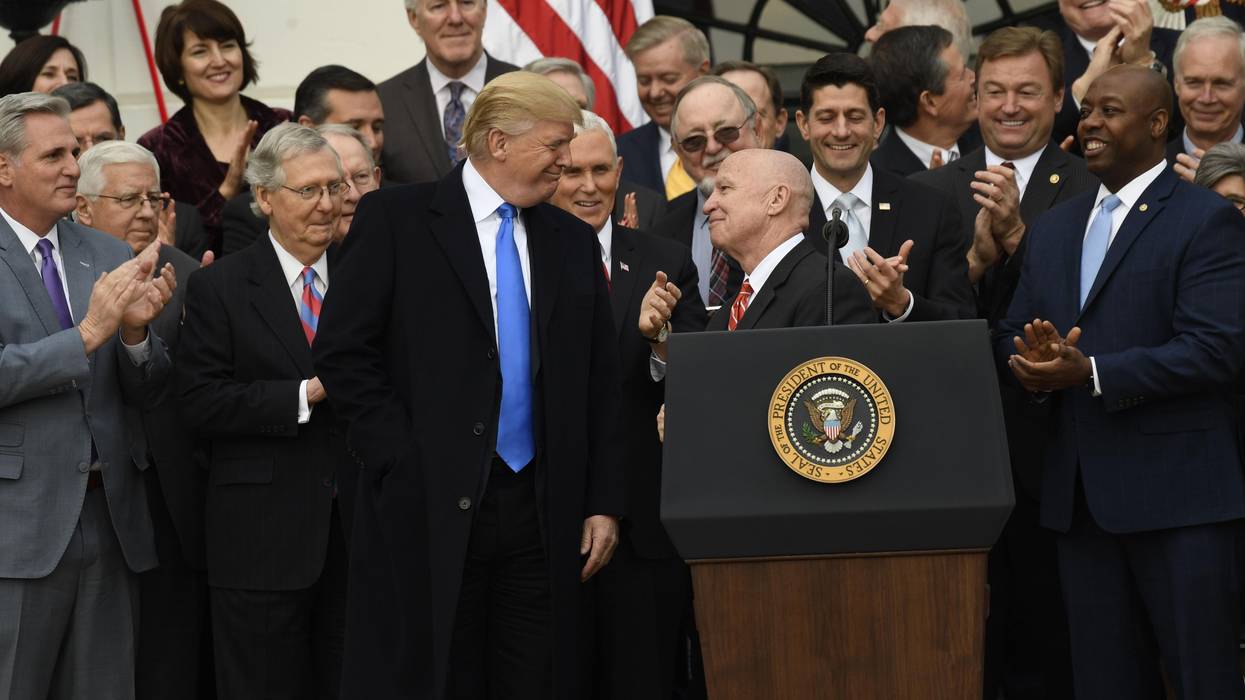
In legislatures, the courts, and our executive offices, we have a system rigged in favor of the ultra-rich, rigged by everything from acts of Congress and judicial rulings to IRS budgets and audit policies.
By all appearances, former U.S. President Donald Trump has cut a sweet deal with a dozen or two of America’s richest billionaires: Finance his campaign and he’ll keep their federal taxes super low—or even lower them—once he’s sitting back in the White House.
How much do billionaires like this deal? This much: In April, hedge fund billionaire John Paulsen held a Palm Beach fundraiser for Trump that brought in $50.5 million. Immediately after Trump’s late May conviction on 34 felony counts in Manhattan, Timothy Mellon, the grandson of the classic plutocrat Andrew Mellon, ponied up $50 million. Miriam Adelson, the billionaire widow of Las Vegas kingpin Sheldon Adelson, appears eager to kick in as much as $100 million.
This past spring, meanwhile, billionaires Elon Musk and David Sacks reportedly held a secret dinner party for Trump, with attendees including the illustrious deep pockets Peter Thiel, Rupert Murdoch, and Michael Milken.
The rich themselves have actually become more brazen about avoiding taxes. Just try to stop us, they seem to be saying.
America’s billionaires clearly see politics as one route to ensuring they pay as little as possible at tax time. But they don’t just make their presence felt at election time. America’s rich have their thumbs firmly on the scale of all three branches of government. In legislatures, the courts, and our executive offices, we have a system rigged in favor of the ultra-rich, rigged by everything from acts of Congress and judicial rulings to IRS budgets and audit policies.
Some of this rigging we can all easily see. The dividends and long-term capital gains of the ultra-rich have for decades faced a maximum tax rate barely half the maximum rate applicable to other forms of income. And the investment income of the rich, unlike the paychecks of working people, faces no Social Security tax.
In 2017, the first year of the Trump presidency, intense lobbying efforts helped rich business owners to a special tax rate for their business income. In 2018 alone, according to ProPublica, that special rate translated into a $67 million gift to Mike Bloomberg, whose personal wealth now reportedly exceeds $100 billion.
But these glaring privileges the rich enjoy at tax time only tell part of the billionaire tax story. Other parts get precious little attention. In 2004, for instance, lawmakers in Congress enacted a penalty for the failure to disclose potentially abusive tax avoidance transactions on tax returns. The penalty on the surface looked substantial: 75% of the tax sought to be avoided. But Congress capped the penalty at $100,000, a move that turned the penalty into a minor nuisance for billionaires seeking to avoid millions of dollars in taxes.
In our current rich people-friendly tax climate, IRS staff who want to do the right thing face tough going. Recently, for example, one former IRS staffer, Michael Welu, went public with his concerns that the IRS itself has both official and unofficial policies that end up treating audited rich taxpayers much more gently than small business owners.
“I was putting butchers, bakers, and candlestick makers in jail,” Welu told the International Consortium of Investigative Journalists, “but the big stuff we really wanted to go after was being ignored.”
Welu found the upper management of the IRS division tasked with auditing the super rich—and the corporations they run—distinctly uninterested in investigating America’s richest and their “most egregious, ridiculous schemes” for avoiding taxes.
IRS officials like Michael Welu do occasionally speak out. But only tax wonks truly have any real sense of how much obscure tax code penalties and IRS audit policies favor the rich. And most of those tax wonks work for the rich.
The rich themselves have actually become more brazen about avoiding taxes. Just try to stop us, they seem to be saying.
Take the recently decided Supreme Court case, Moore v. United States. Working through an array of right-wing organizations, the conservative mover-and-shaker Leonard Leo attempted to use a challenge to an obscure one-time tax as a vehicle to preempt Congress from ever taxing the wealth or unrealized gains of the ultra-rich. Ultimately, the court decided the case without ruling on whether the rich can be taxed on their wealth or unrealized gains. But the opinions that four of the nine justices handed down made it clear that they stand prepared to do the billionaire bidding should a direct challenge to a tax on the wealth or unrealized gains of billionaires come before them.
Billionaires now have at least three Supreme Court justices firmly in their pockets. Reporting by ProPublica has revealed the massive gifts that have been flowing from Harlan Crow and other billionaires to Justice Clarence Thomas as well as the generous gifts that billionaire Paul Singer has been sending Justice Samuel Alito’s way. Justice Neil Gorsuch has had his entire career, including his appointment to the court, funded by the billionaire Philip Anschutz.
Those three justices, along with Justice Amy Coney-Barret, have now made it patently obvious they will not allow billionaires to be taxed on their unrealized gains or their wealth. Does anyone really think the billionaires won’t have the crucial, majority-making fifth vote from Justice Brett Kavanaugh when they need it?
Republican members of Congress are showing even less shame than our Supreme Court justices. Last year, these GOP lawmakers held the country hostage in negotiations to increase the country’s debt limit. Their price for agreeing to raise the debt limit, thereby avoiding a default on the country’s debt? They demanded—and won—a reduction in a scheduled IRS budget increase that would been used to increase enforcement moves against rich taxpayers.
The purported motive for this legislative hostage taking—“concern” over the federal deficit—made for an absurd justification. The proposed increase in the IRS budget would have been recovered, several times over, through increased tax collections. The IRS budget reductions the Republican lawmakers extracted will, in fact, only increase the federal deficit. But those reductions will serve a political purpose. They’ll protect the GOP’s richest patrons from tax enforcement.
The mainstream media, to no one’s surprise, did a miserable job of exposing this Republican dishonesty in the debt limit negotiations. But at one point in our recent past a courageous soul did emerge to expose the rot in our tax system. What happened? The ultra-rich and their henchmen in Congress make sure that this soul faced a punishment far more severe than any punishment ever meted out to those few rich Americans who actually get caught evading their taxes due.
That courageous soul, Charles Littlejohn, worked as an IRS contractor. He leaked tax return information related to Trump and America’s billionaires to The New York Times and ProPublica. ProPublica used that leaked information to write over 50 stories about billionaire tax avoidance, embarrassing and angering many of our richest in the process. Two of them even brought lawsuits, one against the IRS and the other against Littlejohn’s employer.
Ultimately, Littlejohn pled guilty to one count of unauthorized tax return information disclosure, a crime that carries a recommended sentence of four to 10 months. But 25 Republican members of Congress, undoubtedly at the behest of their billionaire patrons, wrote the judge in the case and urged the harshest possible sentence of five years. The judge obliged, stating in her sentencing remarks that Littlejohn posed a graver threat to democracy than the January 6 rioters. As tax law professor Reuven Avi-Yonah has noted, Littlejohn is now serving a sentence far harsher than any imposed on rich Americans convicted of tax evasion.
Littlejohn’s extreme sentence did not reflect the one single count of unauthorized tax return information disclosure he pled guilty to. That sentence reflects his “crime” of exposing the tax avoidance of the billionaire class.
Try this thought experiment: Imagine if Littlejohn had released the return information of 1,000 or so taxpayers with modest incomes to ProPublica. Imagine that ProPublica had then publicly detailed all the tip income that servers and bartenders among these taxpayers had failed to report and all the social meals that small business owners in the sample had claimed as business expenses. If Littlejohn had then pled to one count of unauthorized disclosure, would 25 members of Congress have intervened? Would the judge have imposed a sentence over six times the maximum recommended in federal sentencing guidelines?
Doesn’t it become dangerous to society when the punishment for a crime depends on who the victim happens to be?
We are now living that danger. Our billionaires sit firmly in control. And they will do whatever it takes to make sure they never pay tax at an appropriate level—even if that means locking a human being up for a preposterously long time just to send a message.
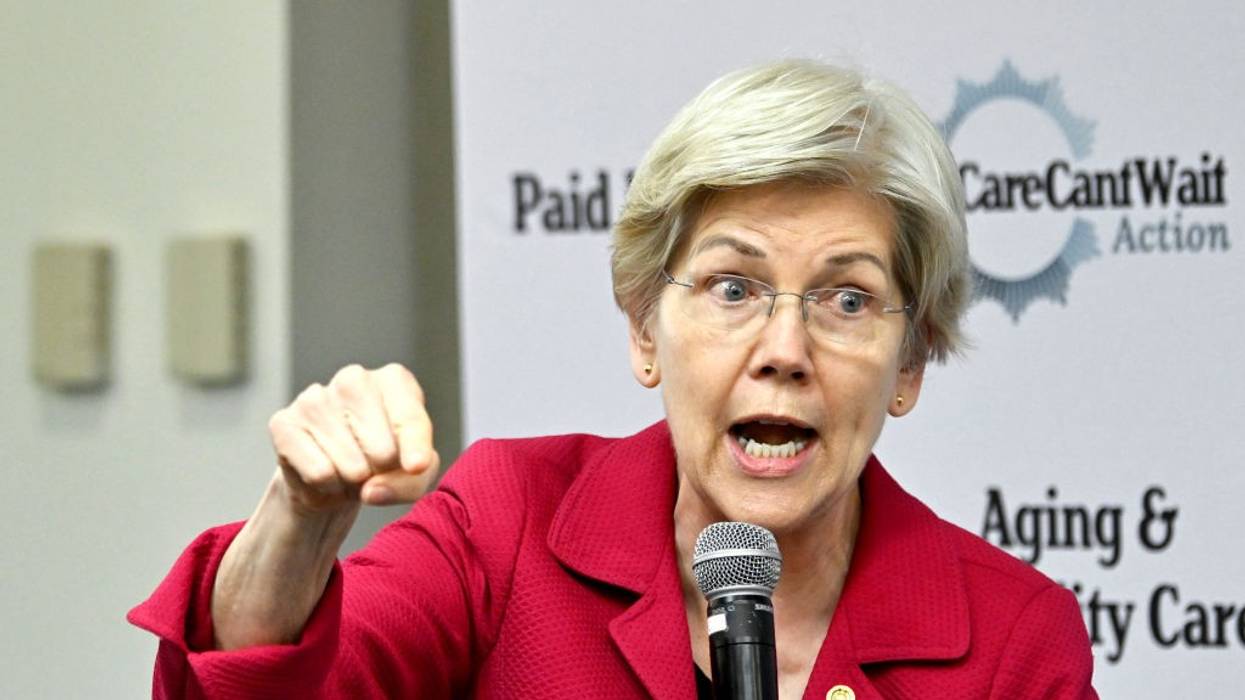
"Right-wing billionaires hoped an obscure legal case would blow up the tax code to avoid paying what they owe, but this effort failed," said the Democratic senator after the Moore v. United States decision.
Sen. Elizabeth Warren was among the economic justice advocates cheering Thursday after the U.S. Supreme Court upheld a tax on Americans with shares of certain foreign corporations—a win for the Massachusetts Democrat and other wealth tax advocates.
"Right-wing billionaires hoped an obscure legal case would blow up the tax code to avoid paying what they owe, but this effort failed at the Supreme Court," Warren said in response to the 7-2 ruling in Moore v. United States. "The fight goes on to tax the rich, pass a wealth tax on ultra-millionaires and billionaires, and make the system more fair."
Although the narrow decision doesn't explicitly affirm the constitutionality of federal wealth tax proposals from congressional progressives including Warren, court watchers had feared a ruling in favor of Charles and Kathleen Moore—a Washington couple who challenged the mandatory repatriation tax (MRT) in Republicans' 2017 tax law—would disrupt efforts to impose such policies.
The high court heard the case in December. Conservative Justice Brett Kavanaugh on Thursday delivered the majority opinion that the MRT "does not exceed Congress' constitutional authority." He was joined by Chief Justice John Roberts and the three liberals. Justice Amy Coney Barrett concurred in the judgment, joined by Justice Samuel Alito, who had faced calls to sit this case out.
Conservative Justice Clarence Thomas—who has provoked pressure to recuse himself from multiple cases or even leave the court by accepting and not reporting gifts from ultrarich Republicans—dissented, joined by Justice Neil Gorsuch. Thomas argued "the Moores are correct" that "a tax on unrealized investment gains is not a tax on 'incomes' within the meaning of the 16th Amendment, and it therefore cannot be imposed 'without apportionment among the several states.'"
The Roosevelt Institute and Institute on Taxation and Economic Policy (ITEP) warned in a September report that a decision siding with the Moores could have led nearly 400 multinational corporations to collectively receive more than $270 billion in tax relief.
"Today's ruling is a win for anyone who didn't shelter income in offshore tax havens before 2018," ITEP executive director Amy Hanauer said Thursday. "It preserves close to $300 billion of tax revenue paid by some of the biggest and most profitable corporations in human history."
"If the court had retroactively repealed this one-time tax, any other way of making up the resulting shortfall would have fallen far more heavily on middle-and-low-income families and small businesses," she added. "The Supreme Court also could have taken an activist turn of the worst kind by preemptively ruling federal wealth taxes unconstitutional today. To its credit, the court did not do so."
Groundwork Collaborative executive director Lindsay Owens similarly called the ruling "great news," adding that "next year, there is nothing standing in Congress' way to make the wealthy pay up."
Meanwhile, Morris Pearl, chair of the Patriotic Millionaires and a former managing director at BlackRock, had a more mixed response, saying that "we are relieved that the Supreme Court chose not to overreach in its Moore v. U.S. decision. The plaintiffs' patently absurd argument, based on incorrect and seemingly fabricated facts, threatened to upend the tax code and preemptively declare taxes on wealth and unrealized capital gains unconstitutional. The court chose not to do so."
"But we remain deeply alarmed for two reasons. First, it is now evident that four Supreme Court justices are enthralled by the influence of billionaires. In their concurring opinion, Justices Barrett and Alito asserted that unrealized capital gains cannot be taxed, as did Thomas and Gorsuch in their dissent, which said there is a realization requirement for income tax," Pearl said. "These justices have now signaled their intention to declare taxes on wealth and unrealized capital gains unconstitutional."
"Second, the Supreme Court should never have agreed to hear this case in the first place," he continued. "Billionaires are shamelessly buying influence on the Court. While seven Justices rejected this specific attempt by plutocrats to avoid their patriotic duty, this does not change the fact that several members of the Supreme Court have corrupt relationships with billionaire benefactors looking to purchase outcomes on the court."
This post has been updated with comment from the Patriotic Millionaires.
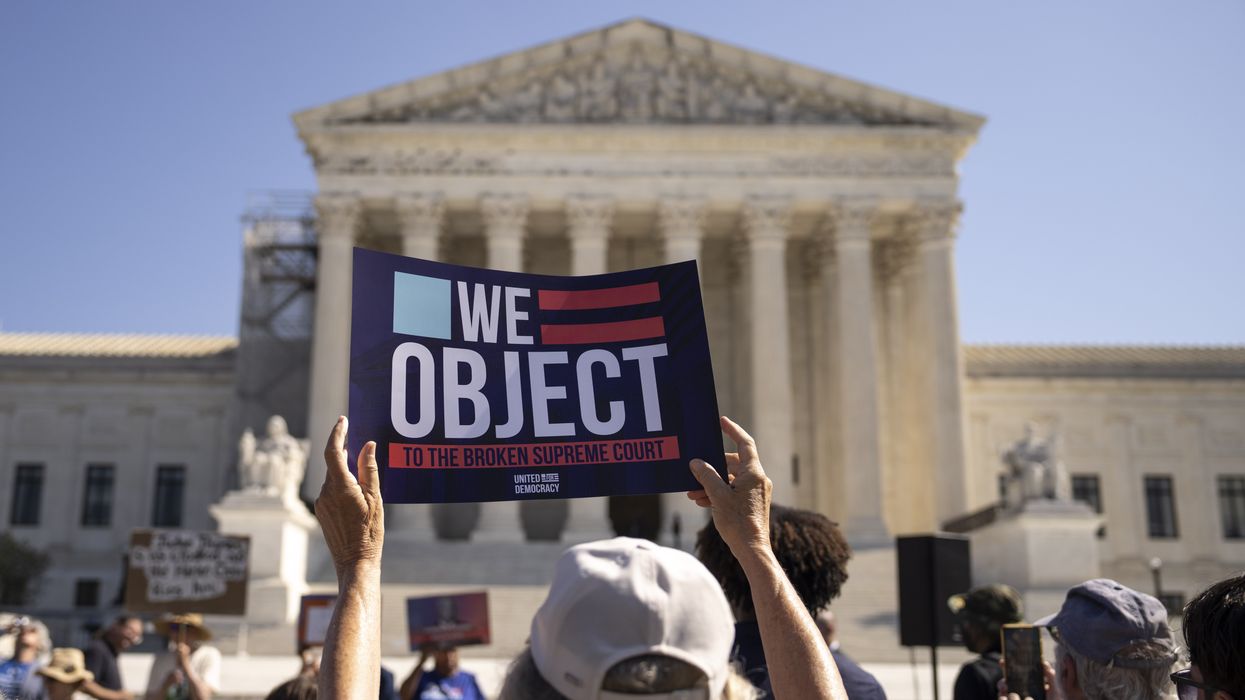
"Supreme corruption demands supreme transparency," said one campaigner behind the new effort.
A trio of progressive watchdog groups on Thursday unveiled a new database detailing the "troubling connections" between the U.S. Supreme Court's right-wing justices, the conservative organizations that have intervened in cases before the court, and the wealthy donors funding them.
Take Back the Court, Revolving Door Project, and True North Research published the database at SupremeTransparency.org, which "shines a spotlight on the complex web connecting justices to powerbrokers and the organizations that those powerbrokers fund, lead, and are otherwise linked to."
The watchdogs found that nearly 1 in 7 amicus briefs filed during the 2023-24 Supreme Court term were lodged by at least one powerbroker-affiliated organization. This affects 32 different cases before the court.
"The current U.S. Supreme Court has gone rogue."
For example, in Moore v. United States—in which the Supreme Court could preemptively ban or limit wealth taxes—half of all amicus briefs were filed by groups affiliated with right-wing powerbrokers.
In Loper Bright Enterprises v. Raimondo, groups funded by billionaire industrialist Charles Koch want to scupper the Chevron deference, a 40-year precedent under which judges defer to the legal interpretations of federal agencies if Congress has not passed any laws on an issue. Powerbroker-affiliated organizations have filed more than one-third of the amicus briefs seeking to overturn the Chevron doctrine.
"Far too often people with insidiously close ties to justices like Clarence Thomas and Samuel Alito, such as Harlan Crow and Paul Singer, signal their interest in the outcome of cases by funding, leading, or influencing organizations that file amicus briefs," Revolving Door Project executive director Jeff Hauser said in a statement.
"There is just as much of a conflict of interest when a justice hears a case involving a benefactor as a named party and one in which the person who illicitly enabled their luxurious lifestyle is 'merely' similarly situated to one of the parties," Hauser added.
According to SupremeTransparency.org:
The current U.S. Supreme Court has gone rogue. The right-wing justices that make up the court's supermajority frequently toy with precedent and the rule of law to issue opinions that not only defy the will of a majority of Americans, but also rewrite constitutional principles, overturn widely respected legal precedents, and gut longstanding rules that protect the public interest.
In just the 2021 and 2022 Supreme Court terms alone, the court overturned Roe v. Wade after 49 years; gutted both the decades-old Clean Air Act and Clean Water Act; overturned a 100+ year old gun safety law; eroded the National Labor Relations Act (adopted as part of New Deal reforms to protect workers); broke with their own procedures regarding standing to sue in order to block student debt relief; and reversed decades of precedent to end the decadeslong practice of race-conscious college admissions policies that promoted diversity and redressed discrimination. But this radically reactionary court and its radically reactionary justices aren't acting alone.
"Supreme corruption demands supreme transparency," said Take Back the Court president Sarah Lipton-Lubet. "It's no secret that the many of the rich benefactors cozying up to the conservative justices are the same people who fund right-wing organizations with business before the court."
"But too often, stories about the Supreme Court don't connect these dots—and as a result, they leave us with an incomplete picture," she continued. "The truth is right-wing powerbrokers are seemingly paying to play; they're funding groups that are weighing in on court cases even as they buy access to the justices who will rule on those cases."
"It's just one of the ways our Supreme Court is deeply, fundamentally broken," Lipton-Lubet added. "And it's a reminder of how urgent and necessary it is that we reform this corrupt court."
Last year, the Supreme Court adopted a Code of Conduct that contained few new rules, no enforcement mechanism, and was widely panned as a toothless public relations stunt. Bolder proposals for reforming the high court include term limits and increasing the number of justices.
The case before the U.S. Supreme Court, Moore vs. the United States, could increase federal debt by trillions of dollars by making it impossible to tax the rich for unrealized gains.
The U.S. Supreme Court heard oral arguments on Tuesday in Moore v. the United States, a case that could upend the tax system, raise the deficit by hundreds of billions of dollars, increase economic inequality, and prevent the enactment of a wealth tax on billionaires like Jeff Bezos or Elon Musk as proposed by Sen. Elizabeth Warren (D-Mass.), or in a modified form by Sen. Ron Wyden (D-Or.), and endorsed, at least in general principle, by President Joe Biden.
“This could have the biggest fiscal policy effects of any court decision in the modern era,” according to Matt Gardner, of the Institute on Taxation and Economic Policy (ITEP). Gardner's ITEP colleague Steve Wamhoff, wrote last week that Moore "could become the most important tax case of the century," warning that a "broad ruling could destabilize the tax system, enrich many profitable corporations and widen existing economic and racial inequalities.”
“Entire sections of the tax code are unconstitutional if this is unconstitutional,” Sen. Wyden said in a statement. “I can’t imagine the Supreme Court wants to give the wealthiest people on earth billions in tax cuts, particularly at a time when so many Americans are losing faith in the Supreme Court.”
Thanks for your optimism Sen. Wyden, but I can well imagine it. A case like this is the real reason billionaires like Harlan Crow and right-wing operatives like Leonard Leo have plied Justices like Clarence Thomas and Samuel Alito with lavish gifts. It’s not about saving the plaintiffs in this case less than $15,000 in taxes. It’s about potentially saving multi-billionaires like Jeff Bezos and Elon Musk tens of millions of dollars.
Indeed many Congress people have demanded that Alito recuse himself from the case after being interviewed by David B. Rifkin Jr., one of the lead attorneys for the Moore's, for Wall Street Journal articles published in which Alito argued that his lavish billionaire-funded gifts were just peachy.
Oral arguments do not always accurately predict how the Court will rule. But after listening to this week’s oral arguments, there seems at least a reasonable chance that the Court will issue a limited ruling on this case that does not necessarily set a precedent blocking in advance some kind of wealth tax or tax on unrealized capital gains. Some of the conservative Republican Justices like Brett Kavanaugh seemed to be searching for a middle ground that would not upset much of the existing tax code.
The case arises from Donald Trump’s 2017 tax “reform” which included a one-time “Mandatory Repatriation Tax” (“MRT”) on U.S. taxpayers’ retained earnings from their holdings in foreign corporations, to help fund Trump’s other tax cuts. Most of the estimated $338 billion in revenue from the MRT is payable by large corporations like Apple and Microsoft. But it also applies to individuals who own more than 10% of a foreign corporation.
Small investors Charles and Kathleen Moore had invested in an India-based company that could not be taxed in the U.S. but were charged $14,729 under the MRT. The Moores sued the U.S. government for a refund, claiming the MRT was unconstitutional because income must be “realized” before it can be taxed. Their suit was backed by right-wing legal organizations like the Koch’s Americans for Tax Reform and the U.S. Chamber of Commerce. If the Court finds the MRT unconstitutional, it could cost the U.S. government an estimated $338 billion in lost revenue, further increasing annual deficits and the nation's overall debt. Indeed experts estimate a sweeping ruling in the Moore's favor could cost the government trillions over the next decade.
The case is complicated and too much detail on tax law might put many readers to sleep. Suffice it to say that the issue dates back to the original 1789 Constitution which states that “direct taxes” must be “apportioned among the several states.” Historically, this was a sop to slave-owning states who could count slaves as 3/5 of a person when calculating how much money could be raised from each state. In the 19th century, The Supreme Court held that income taxes were unconstitutional unless equally apportioned among each state which was practically impossible.
In response, the 16th Amendment was enacted in 1909 providing that Congress may tax “income” from “whatever source derived.” The 16th Amendment did not define “income” or “source.” The attorneys for the Moore’s argue that money is not income until it is “realized”—i.e. the asset is sold, not just when it increases in value. A number of court decisions since passage of the 16th Amendment have undermined that theory. As one of plaintiffs’ lead lawyers, David Rifkin argued, “It’s a classic example of taxing something that is not income. Unrealized gains are not income by any stretch of the imagination.”
As Justice Sotomayor explained to the Moore’s attorney during oral arguments, “You're asking us to just announce what realization is out of context. And for the last hundred years, we've been studiously avoiding doing that because we recognize that it's dangerous to do that. To a word like "realization," we then have to come up with a working definition that applies to every piece of property and every way in which people gain wealth. It doesn't seem logical to me.”
Justice Jackson added a simple way for the Court to make a limited ruling upholding the MRT without addressing larger constitutional or philosophical questions: “The Court doesn't actually need to resolve any fundamental questions in this case about whether the Sixteenth Amendment requires realization. The MRT taxes income that was actually realized by the foreign corporations, and Congress permissibly attributed the tax on that realized income to U.S. shareholders just as it has done in any number of pass-through taxes throughout our nation's history. The Court could say only that and affirm.”
Justice Kavanaugh and perhaps Justice Barrett seemed sympathetic to a limited ruling. Perhaps Justice Jackson’s approach could command a voting majority, uphold the MRT, leave untouched prior Court rulings, and kick the can on a wealth tax and/or unrealized capital gains tax on the wealthy down the road.
The Moore’s real fight seems to be about progressive tax policies that have not even been enacted, proposals that would finally tax the unrealized capital gains of the extremely wealthy in an adequate way.
On Tuesday, the U.S. Supreme Court will begin hearing oral arguments in Moore vs. United States, which could become the most important tax case in a century. A broad ruling could destabilize our tax system, enrich many profitable corporations, and widen existing economic and racial inequalities.
The case tests whether the plaintiffs, Charles and Kathleen Moore, must pay taxes on their profits as partial owners of a multinational corporation, as required by 2017’s Tax Cuts and Jobs Act. A finding for the plaintiffs could lead the courts to strike down many tax laws that have been in place for decades. Their argument was rejected by other courts, but the Supreme Court nonetheless agreed to hear the case.
The Moores are asking for a ruling that would make it nearly impossible for Congress to tax income that is not “realized,” a term with a hazy definition that generally means a taxpayer has received money or some other type of payment through some transaction. The idea that only “realized” income should be taxed might even seem intuitive to many people who are not aware that such a rule could be used to nullify many provisions in effect today that prevent the wealthy from dodging taxes.
Most of us receive income from a job and pay taxes on that income every year while the richest among us are able shape their income into unrealized gains that are not taxed.
Since the late 1960s, special rules have declared that certain types of income that are easy to shift across borders through paper transactions are taxable when reported by American-owned foreign corporations. The logic employed by the Moores and their allies would call into question these rules, potentially opening the floodgates to offshore tax dodging on a scale never seen before.
There are many other examples of the pandemonium the Moores are inviting. The interest paid on bonds is income subject to tax annually, but what happens if someone tries to avoid this tax by purchasing a bond that pays no interest until it is redeemed after several years? Can the bondholder put off paying tax for years (possibly even forever) by choosing one type of bond over another, even when the income ultimately generated is the same? The tax code has rules that prevent this kind of tax avoidance, but if the Moores convince the Court that income cannot be taxed without realization, these rules may be eventually struck down as well on the same grounds.
Even more alarming are the consequences for “pass-through” businesses, which do not pay the corporate income tax because their profits are “passed through” to the individual owners and reported on their personal income tax returns, even when the profits are not actually paid out to the owners but retained by the business. Lawmakers reasoned that these businesses did not need to pay corporate income tax given that their profits would be subject to personal income tax, but a ruling in favor of the Moores might suggest that they often can be subject to no tax at all.
What motivates the Moores and the right-wing organizations supporting them? Their real fight seems to be about progressive tax policies that have not even been enacted, proposals that would finally tax the unrealized capital gains of the extremely wealthy in an adequate way. These proposals, from President Joe Biden and from some congressional Democrats, could potentially end the special treatment billionaires have long received under our tax system, a result the Moores and their supporters apparently find unacceptable.
A capital gain is generally an increase in the value of an asset. If the owner sells that asset and collects a profit because the asset has appreciated since it was acquired, that profit is considered a realized capital gain. If the owner does not sell the asset, that increase in its value is an unrealized capital gain.
Economists consider both to be income, but tax rules usually only consider realized gains, and not unrealized gains, to be income. As a result, billionaires like Elon Musk and Jeff Bezos can arrange to have most of their income each year in the form of unrealized gains that are not taxed.
All of this may seem mindbogglingly arcane, but the upshot is that most of us receive income from a job and pay taxes on that income every year while the richest among us are able shape their income into unrealized gains that are not taxed. Blowing apart many existing parts of a tax code is a price the plaintiffs seem willing to pay in return for preserving the system that allows the wealthiest to avoid paying taxes in the same way that ordinary Americans do.
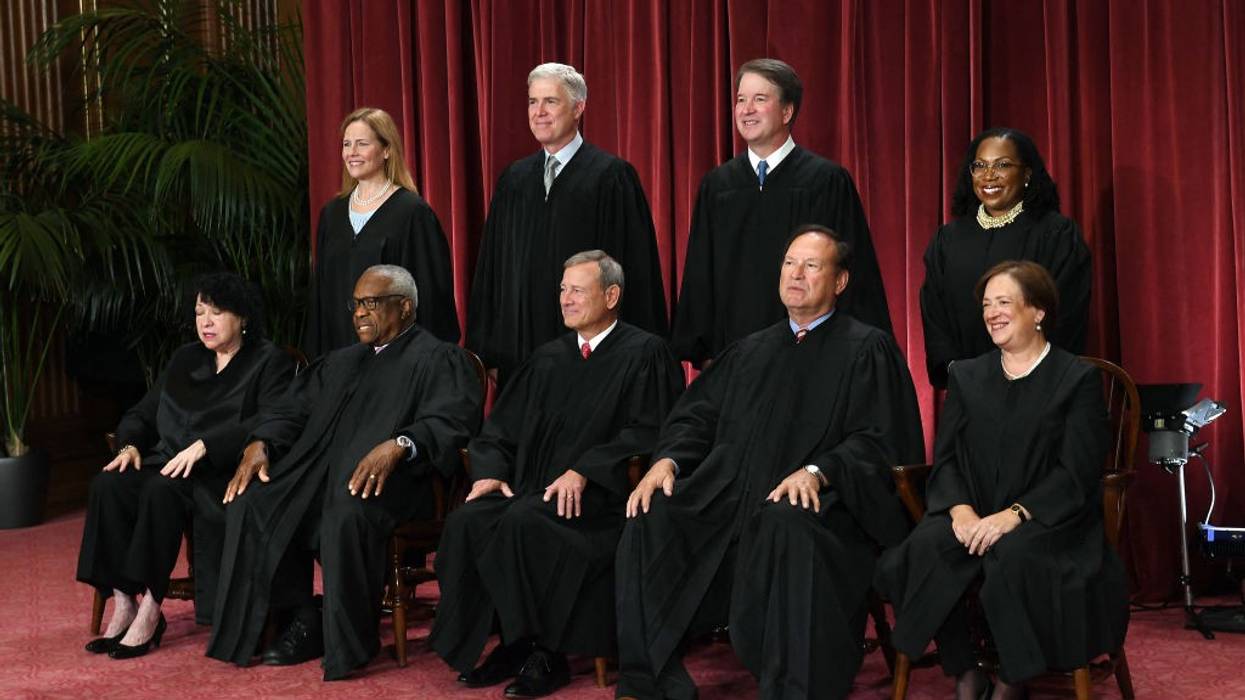
If the court finds for the Moores in Moore v. United States,, their reasoning could both invalidate existing tax law and block new proposals to tax wealth or income from wealth, further entrenching existing inequities.
Researchers predict the racial wealth gap will take hundreds of years to close—and that is if the right policies are enacted. The U.S. Supreme Court case Moore v. United States, already a cause for concern for people who care about fair taxes, could create more barriers for racial equity advocates working to improve the economic conditions for people of color.
The case tests whether the plaintiffs, Charles and Kathleen Moore, must pay taxes on their profits as partial owners of a multinational corporation, as required by the 2017 Tax Cuts and Jobs Act. The Moores claim their tax bill is unconstitutional because the federal government can only tax income when it is “realized,” which usually means when an asset is sold and the owner receives compensation. A finding for the plaintiffs could lead the courts to strike down many tax laws that have been in place for decades. Their argument was rejected by other courts, but the Supreme Court has agreed to hear the case.
Around the nation, moneyed interests are sitting on the edge of their seats waiting for the outcome of the case because if the court finds for the Moores, their reasoning could both invalidate existing law and block new proposals to tax wealth or income from wealth, further entrenching existing inequities. Today, the average net worth of white households is 4.1 and 5 times that of Black and Hispanic households, respectively. A broad ruling in Moore could stifle policies for reducing this racial wealth gap.
Given that white households own a disproportionate share of wealth, they also disproportionately benefit from tax breaks for income from wealth, which in turn worsens the wealth divide.
Each week seems to bring another revelation of how the ultrawealthy associates of Supreme Court Justices Clarence Thomas and Samuel Alito have provided lavish gifts to the justices while urging the court to take on cases that could reduce their tax liability. Chief Justice John Roberts and Justice Alito together have personal stock in 19 companies that could receive over $30 billion in tax breaks from this case, according to a recent ITEP-Roosevelt Institute report. Without ethics rules, this unrestricted (and strategic) access to the court and potential conflicts of interest continue to threaten the credibility of the court.
A ruling that Congress can generally tax income only when it is “realized” would make it particularly difficult to tax income from wealth. Under current law, income from wealth is generally taxed much less than income from work. The most obvious way is the lower tax rates that apply to most capital gains and dividends. But even more important is the ability of wealthy people to defer paying income tax on capital gains until these gains are “realized,” which usually means they have sold an asset for a profit. Often when ultrawealthy people die their assets are passed onto their heirs, at which point the increase in value disappears from the tax system entirely without anyone ever paying any taxes on the gain.
Given that white households own a disproportionate share of wealth, they also disproportionately benefit from tax breaks for income from wealth, which in turn worsens the wealth divide.
Policies to tax unrealized gains, like those the Biden administration and some states have proposed, can help reverse the unfair treatment of income from wealth. And stronger taxes on realized gains at the federal or state level are a fitting policy option for lawmakers to address the racial wealth gap. The capital gains tax in Washington state survived a legal challenge and was ratified by the state’s Supreme Court, but brewing in the background is a broader disagreement over the constitutionality of state wealth taxes. The Moore case has the potential to add to the discord.
This year the Supreme Court has weighed in on many facets of government that deeply affect people of color, from recently making Alabama redraw its congressional map to striking down the Biden administration’s student loan forgiveness plan.
With the Moore case, the Supreme Court could—powered by reams of dark money—add to that by eliminating solutions that would shrink the racial wealth gap. We know the tax code is not race neutral. And we know the potential outcomes of this case are not either.
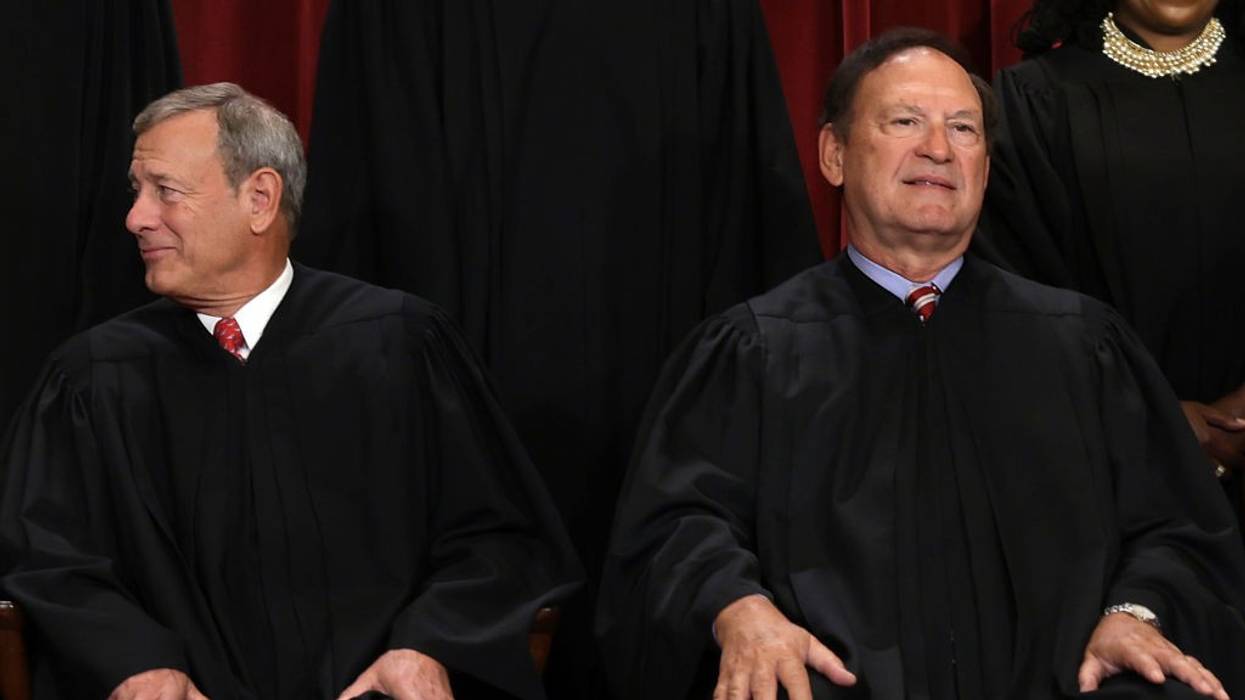
Justices John Roberts and Samuel Alito stand to benefit personally from the Court's ruling in Moore vs. United States because they own stock in companies that could enjoy billions of dollars in tax cuts as a direct consequence of the decision.
The Moore v. United States case that will soon be heard by the U.S. Supreme Court may take the concept of “collateral damage” to a new level. The case will decide whether a couple (the Moores) must pay a $15,000 tax bill associated with the 2017 Trump tax law’s “transition tax” on offshore profits. But the decision could jeopardize a far greater amount of tax revenue—at least $270 billion, according to a new ITEP-Roosevelt Institute report—if SCOTUS finds the entire transition tax to be unconstitutional. The decision could also invalidate other important parts of the current tax system while preempting progressive wealth tax proposals. Such an outcome would represent one of the costliest—and most ethically questionable – Supreme Court decisions in U.S. history.
The transition tax was a one-time levy on the offshore profits of multinational businesses, enacted as part of 2017’s Tax Cuts and Jobs Act. Under the pre-2017 tax rules, companies were supposed to pay a 35 percent tax rate on their worldwide income but could indefinitely avoid the U.S. tax by stashing income offshore and stating their intention to keep it there. Big multinationals did so en masse, accumulating over $2.6 trillion of profits offshore and beyond the reach of the US tax system.
When the Trump tax law moved to a system that generally exempts offshore profits after 2017, Congress had to decide what to do about the mountain of untaxed pre-2018 profits these companies were still holding offshore. The companies should have paid the 35 percent tax rate the existing law prescribed, but Congress chose instead to apply a special lower rate (8 percent and 15.5 percent for non-cash and cash foreign holdings, respectively). This generous giveaway was counterintuitively scored as a revenue raiser because 15.5 percent is bigger than the 0 percent rate these companies had been aiming for.
While the transition tax was initially forecast to yield $340 billion, that estimate was speculative. But in the years that followed, hundreds of corporations disclosed their estimated transition tax payments in their annual financial reports (because SEC rules generally require them to do so). ITEP’s new report with the Roosevelt Institute is the first effort to analyze these disclosures for the largest companies in the U.S.
The report identifies more than 370 companies disclosing an estimated tax bill of over $270 billion. Just five of the largest tech and pharma firms (Apple, Pfizer, Microsoft, Johnson & Johnson, and Google) were responsible for one-third of this tax bill due to their concerted efforts to send pre-2018 income offshore. Dozens of other companies with large offshore holdings, including IBM, fail to disclose their transition tax liability, and companies that aren’t publicly traded aren’t required to disclose these amounts, so the total transition tax yield is likely much larger. If the Moore case invalidates the transition tax, these tax bills could be completely forgiven, and Apple alone could see a tax break of $37 billion.

The Moores claim that their $15,000 transition tax bill is unconstitutional because the federal government can only tax income when it’s realized - for example, when stock is sold or dividends are paid out to shareholders. This argument was rejected emphatically by lower courts and has been debunked by constitutional law experts, but will nonetheless be considered by the Supreme Court next month.
Five years after the passage of the Trump corporate tax cuts, seeking to overturn the transition tax represents one of the great tax policy injustices of recent years.
The fiscal hole dug by the Moore case could extend well beyond the transition tax, ensnaring dozens of long-standing provisions in the tax law that allow taxation without realization. The costs to the public of enabling these evasions of current law are bad enough. Even worse would be to withhold from the public the potential revenues that the lawsuit’s well-heeled backers seek to prevent going forward: the plaintiffs’ lawyers argued in the pages of the Wall Street Journal that the case “could slam shut the door on a federal wealth tax like the one Sen. Elizabeth Warren wants to enact.”
The Moore case could also have repercussions that go far beyond its fiscal policy effects. The case raises troubling ethical questions for certain Supreme Court justices at a time when the Court already faces a tidal wave of disclosures of ethical lapses by its members. As the report finds, a decision to invalidate the transition tax would likely be made by at least two justices—John Roberts and Samuel Alito—who would stand to benefit personally from such a decision because they own stock in companies that could enjoy billions of dollars in tax cuts as a direct consequence of the decision. The specter of the highest justices in the land personally enriching themselves through their decisions could further delegitimize an already-unpopular institution.
Five years after the passage of the Trump corporate tax cuts, seeking to overturn the transition tax represents one of the great tax policy injustices of recent years. The companies that benefited most from the special low rates of the transition tax were precisely those that had taken the most aggressive steps to artificially shift income out of the U.S. and into low-rate tax havens. If the Supreme Court chooses to invalidate the tax, these tax-avoiding multinationals will be doubly rewarded by the forgiveness of even this reduced-rate tax. At a time when the federal government faces profound fiscal challenges, middle-income families and small businesses will be left to pick up the slack if these companies and their shareholders (including SCOTUS justices) are given a $270 billion windfall.

"Come on Neal, you can't be against a wealth tax? Are you?"
California Congressman Ro Khanna on Friday said he would like to debate Neal Katyal, a prominent liberal pundit and former acting solicitor general under the Obama administration, over a proposed wealth tax that is now at the heart of a case before the U.S. Supreme Court.
The case in question, Moore v. United States, focuses on the authority of Congress to tax unrealized financial gains of wealthy individuals.
As reported earlier this month by The Lever's Julia Rock, Katyal filed an amicus brief in the case on behalf of Saving America's Family Enterprises (SAFE), "an anonymously funded group—whose board includes corporate lobbyist," opposing the wealth tax.
In a tweet on Friday, Khanna, a progressive Democrat who served as national co-chair of the Bernie Sanders 2020 presidential campaign, suggested he and Katyal have a public debate on Mehdi Hasan's MSNBC show about the need for a wealth tax.
"I really was surprised by this," said Khanna, referencing the revelations about Katyal's involvement in the case, "as anyone who cares deeply about threats to our democracy as you do should recognize the problem of massive income inequality and the concentration of wealth." Both Khanna and Katyal graduated from Yale Law School.
If the Supreme Court rules in favor of the plaintiffs in Moore, experts have said it could have far-reaching implications for how certain kinds of wealth are taxed and could put significant federal revenue at risk.
Khanna said: "Come on Neal, you can't be against a wealth tax? Are you? Massive income inequality is adding flames to threats to democracy."
While many Americans likely know him from his frequent appearances on MSNBC, where he is a paid contributor weighing in on legal and judicial matters, Katyal has also had a long career as a corporate lawyer representing the interests of some of the world's most profitable and powerful companies. As Rock noted in her reporting:
In recent years, Katyal has helped Nestlé defend itself in a child slavery case before the Supreme Court and represented Johnson & Johnson in its bid to use bankruptcy to block lawsuits from cancer victims.
Listed on the Katyal-authored amicus brief alongside SAFE is the group's senior adviser, former Louisiana Democratic senator John Breaux, who also lobbies for ExxonMobil, Norfolk Southern, and Boeing—corporations whose top executives could have a financial interest in the outcome of the case. Breaux also lobbies for billionaire financial magnate and Democratic megadonor James Simons.
SAFE is organized as a so-called social welfare nonprofit, which allows it to hide the identity of its donors and avoid taxes while spending money to influence policy decisions.
Responding to Rock's reporting earlier this week, Aeon senior editor Sam Haselby said: "You'd think a lawyer arguing on behalf of child slavery in Africa and against the billionaire tax would be a far-right figure. But he's an MSNBC fixture, Yale Law alum, and Obama Democrat."
Common Dreams reached out to Katyal for comment about Khanna's invitation to debate, but did not receive a response by publication time.