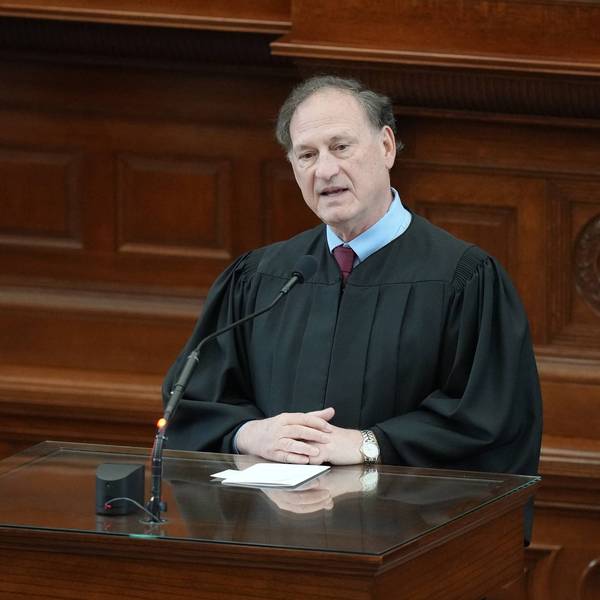
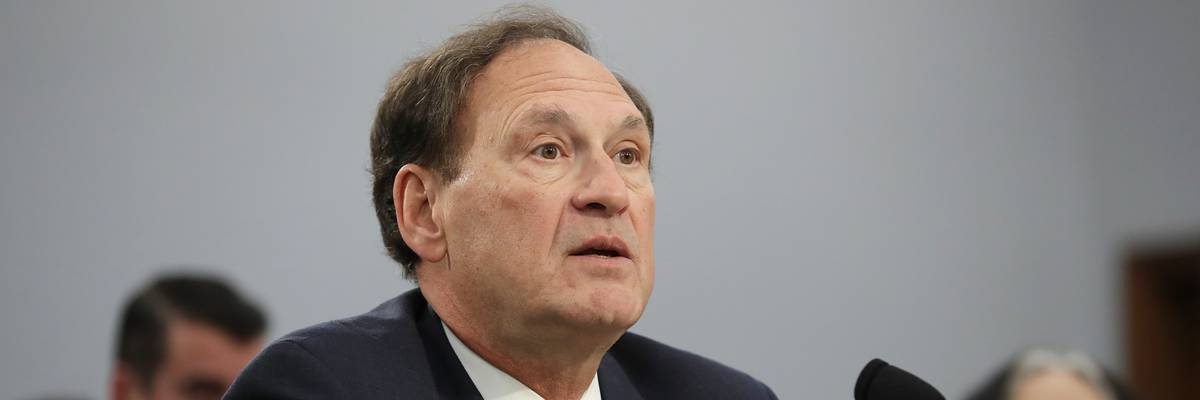
U.S. Supreme Court Justice Samuel Alito testifies at a House hearing on March 7, 2019 in Washington, D.C.
Alito Urged to Recuse From Case That Could Preemptively Ban Federal Wealth Tax
"First he accepted lavish gifts from billionaires and failed to disclose them. Then he gave a buddy-buddy interview to one of the case's anti-wealth tax lawyers. Enough."
U.S. Supreme Court Justice Samuel Alito is facing growing calls to recuse himself from a case that could hamstring Congress' ability to enact a federal wealth tax, a policy that progressive lawmakers and economists say is needed to rein in out-of-control inequality.
Late last week, Democrats on the Senate Judiciary Committee sent a letter urging Chief Justice John Roberts to "take appropriate steps to ensure that Justice Alito will recuse himself" from Moore v. United States, which the Supreme Court recently agreed to take up.
The lawmakers' demand was prompted by a friendly interview that Alito gave to The Wall Street Journal's opinion section, which in June allowed the right-wing justice to get out in front of a ProPublica story on his luxury trip with billionaire hedge fund titan Paul Singer.
The interview late last month was conducted in part by David Rivkin Jr., an attorney who is representing the plaintiffs in Moore v. United States. The case, which is mentioned in passing in the Journal's write-up of the Alito interview, concerns whether unrealized gains such as stock appreciation can be subject to federal taxation.
Unrealized gains are currently untaxed in the U.S., allowing billionaires such as Tesla CEO Elon Musk to accumulate massive fortunes while paying little to nothing in federal income taxes.
Supporters of the Moore plaintiffs, who are specifically challenging an obscure foreign earnings provision in the 2017 Republican tax law, have encouraged the Supreme Court to explicitly address the constitutionality of wealth taxes in its ruling.
"This case presents the court with an ideal opportunity to clarify that taxes on unrealized gains, such as wealth taxes, are direct taxes that are unconstitutional if not apportioned among the states," the right-wing Manhattan Institute argued in a May amicus brief. (Proponents of a tax on unrealized gains, such as Sen. Ron Wyden (D-Ore.), have expressed confidence that such a tax is constitutional.)
The Manhattan Institute is chaired by Singer, whose private jet flew Alito to an Alaska fishing trip that the justice did not disclose.
"Alito needs to recuse himself from the case deciding the constitutionality of a wealth tax," Americans for Tax Fairness, a progressive advocacy group, said Wednesday. "First he accepted lavish gifts from billionaires and failed to disclose them. Then he gave a buddy-buddy interview to one of the case's anti-wealth tax lawyers. Enough."
In their letter last week, Senate Democrats argued that Alito violated the Supreme Court's narrow ethical principles by agreeing to sit for an interview with an attorney with business before the court.
"Mr. Rivkin's access to Justice Alito and efforts to help Justice Alito air his personal grievances could cast doubt on Justice Alito's ability to fairly discharge his duties in a case in which Mr. Rivkin represents one of the parties," the senators wrote. "Recusal in these matters is the only reasonable way for Justice Alito to prevent further damage to public confidence in the court."
It is unlikely that Roberts or Alito will agree to the lawmakers' demands, given that both justices have cast doubt on Congress' power to oversee and regulate the Supreme Court.
"This episode again illustrates why legislation establishing stronger, enforceable ethics standards for the court is of paramount importance," the senators' letter concludes. "The court is mired in an ethical crisis of its own making, yet its only response has been a weak statement on ethics that Justice Alito has apparently ignored. It is unacceptable for the highest court in the land to have the lowest ethical standards, and because the court has abdicated its responsibility to establish its own standards, Congress must act."
We are at a crossroads
This country and this world are at a monumental crossroads. In a few short weeks, US voters will have an opportunity to beat back the forces of fascism and confront the billionaires who are rigging the economy, our media system, and our democracy, making it increasingly impossible for ordinary people to get by. We’re not just talking about the election. We’re talking about what must be done once these fascist elements are vanquished from power. We need a bolder set of solutions than what either major party has so far been willing to offer and a working-class movement ready to fight like hell for it. Trump didn't emerge from nowhere. The conditions that fueled MAGA authoritarianism were created by decades of radical neoliberal economic policies and a corrupt political system dominated by corporate interests. They slashed taxes on the super-rich, promising that the benefits would trickle down. They said giveaways to the corporate titans would make life more affordable for the rest of us. It was all bullshit. And when a bitter, betrayed populace searches for someone to blame, right-wing demagogues have little trouble finding scapegoats. People know when they're being lied to, but you won't hear any of this from the corporate media. Only independent journalism—powered and funded by people who believe in building a better world—can deliver truly trustworthy daily news. Our Fall Campaign is underway, and we need your help. To power our newsroom through the rest of the year, we need to raise $125,000 by midnight on October 31. So if you share our vision, please contribute whatever you can to sustain our work. |
U.S. Supreme Court Justice Samuel Alito is facing growing calls to recuse himself from a case that could hamstring Congress' ability to enact a federal wealth tax, a policy that progressive lawmakers and economists say is needed to rein in out-of-control inequality.
Late last week, Democrats on the Senate Judiciary Committee sent a letter urging Chief Justice John Roberts to "take appropriate steps to ensure that Justice Alito will recuse himself" from Moore v. United States, which the Supreme Court recently agreed to take up.
The lawmakers' demand was prompted by a friendly interview that Alito gave to The Wall Street Journal's opinion section, which in June allowed the right-wing justice to get out in front of a ProPublica story on his luxury trip with billionaire hedge fund titan Paul Singer.
The interview late last month was conducted in part by David Rivkin Jr., an attorney who is representing the plaintiffs in Moore v. United States. The case, which is mentioned in passing in the Journal's write-up of the Alito interview, concerns whether unrealized gains such as stock appreciation can be subject to federal taxation.
Unrealized gains are currently untaxed in the U.S., allowing billionaires such as Tesla CEO Elon Musk to accumulate massive fortunes while paying little to nothing in federal income taxes.
Supporters of the Moore plaintiffs, who are specifically challenging an obscure foreign earnings provision in the 2017 Republican tax law, have encouraged the Supreme Court to explicitly address the constitutionality of wealth taxes in its ruling.
"This case presents the court with an ideal opportunity to clarify that taxes on unrealized gains, such as wealth taxes, are direct taxes that are unconstitutional if not apportioned among the states," the right-wing Manhattan Institute argued in a May amicus brief. (Proponents of a tax on unrealized gains, such as Sen. Ron Wyden (D-Ore.), have expressed confidence that such a tax is constitutional.)
The Manhattan Institute is chaired by Singer, whose private jet flew Alito to an Alaska fishing trip that the justice did not disclose.
"Alito needs to recuse himself from the case deciding the constitutionality of a wealth tax," Americans for Tax Fairness, a progressive advocacy group, said Wednesday. "First he accepted lavish gifts from billionaires and failed to disclose them. Then he gave a buddy-buddy interview to one of the case's anti-wealth tax lawyers. Enough."
In their letter last week, Senate Democrats argued that Alito violated the Supreme Court's narrow ethical principles by agreeing to sit for an interview with an attorney with business before the court.
"Mr. Rivkin's access to Justice Alito and efforts to help Justice Alito air his personal grievances could cast doubt on Justice Alito's ability to fairly discharge his duties in a case in which Mr. Rivkin represents one of the parties," the senators wrote. "Recusal in these matters is the only reasonable way for Justice Alito to prevent further damage to public confidence in the court."
It is unlikely that Roberts or Alito will agree to the lawmakers' demands, given that both justices have cast doubt on Congress' power to oversee and regulate the Supreme Court.
"This episode again illustrates why legislation establishing stronger, enforceable ethics standards for the court is of paramount importance," the senators' letter concludes. "The court is mired in an ethical crisis of its own making, yet its only response has been a weak statement on ethics that Justice Alito has apparently ignored. It is unacceptable for the highest court in the land to have the lowest ethical standards, and because the court has abdicated its responsibility to establish its own standards, Congress must act."
- With Alito's Billionaire Patron Holding $90 Million in Finance Firms, Watchdog Demands Recusal From CFPB Case ›
- Opinion | These Supreme Court Justices Have Personal Investments in Companies That Could Reap Billions in Upcoming Ruling | Common Dreams ›
- Opinion | Could the Supreme Court Rule a Wealth Tax Unconstitutional? | Common Dreams ›
- Opinion | The Supreme Court Could Blow Up the Tax Code With Moore vs US | Common Dreams ›
U.S. Supreme Court Justice Samuel Alito is facing growing calls to recuse himself from a case that could hamstring Congress' ability to enact a federal wealth tax, a policy that progressive lawmakers and economists say is needed to rein in out-of-control inequality.
Late last week, Democrats on the Senate Judiciary Committee sent a letter urging Chief Justice John Roberts to "take appropriate steps to ensure that Justice Alito will recuse himself" from Moore v. United States, which the Supreme Court recently agreed to take up.
The lawmakers' demand was prompted by a friendly interview that Alito gave to The Wall Street Journal's opinion section, which in June allowed the right-wing justice to get out in front of a ProPublica story on his luxury trip with billionaire hedge fund titan Paul Singer.
The interview late last month was conducted in part by David Rivkin Jr., an attorney who is representing the plaintiffs in Moore v. United States. The case, which is mentioned in passing in the Journal's write-up of the Alito interview, concerns whether unrealized gains such as stock appreciation can be subject to federal taxation.
Unrealized gains are currently untaxed in the U.S., allowing billionaires such as Tesla CEO Elon Musk to accumulate massive fortunes while paying little to nothing in federal income taxes.
Supporters of the Moore plaintiffs, who are specifically challenging an obscure foreign earnings provision in the 2017 Republican tax law, have encouraged the Supreme Court to explicitly address the constitutionality of wealth taxes in its ruling.
"This case presents the court with an ideal opportunity to clarify that taxes on unrealized gains, such as wealth taxes, are direct taxes that are unconstitutional if not apportioned among the states," the right-wing Manhattan Institute argued in a May amicus brief. (Proponents of a tax on unrealized gains, such as Sen. Ron Wyden (D-Ore.), have expressed confidence that such a tax is constitutional.)
The Manhattan Institute is chaired by Singer, whose private jet flew Alito to an Alaska fishing trip that the justice did not disclose.
"Alito needs to recuse himself from the case deciding the constitutionality of a wealth tax," Americans for Tax Fairness, a progressive advocacy group, said Wednesday. "First he accepted lavish gifts from billionaires and failed to disclose them. Then he gave a buddy-buddy interview to one of the case's anti-wealth tax lawyers. Enough."
In their letter last week, Senate Democrats argued that Alito violated the Supreme Court's narrow ethical principles by agreeing to sit for an interview with an attorney with business before the court.
"Mr. Rivkin's access to Justice Alito and efforts to help Justice Alito air his personal grievances could cast doubt on Justice Alito's ability to fairly discharge his duties in a case in which Mr. Rivkin represents one of the parties," the senators wrote. "Recusal in these matters is the only reasonable way for Justice Alito to prevent further damage to public confidence in the court."
It is unlikely that Roberts or Alito will agree to the lawmakers' demands, given that both justices have cast doubt on Congress' power to oversee and regulate the Supreme Court.
"This episode again illustrates why legislation establishing stronger, enforceable ethics standards for the court is of paramount importance," the senators' letter concludes. "The court is mired in an ethical crisis of its own making, yet its only response has been a weak statement on ethics that Justice Alito has apparently ignored. It is unacceptable for the highest court in the land to have the lowest ethical standards, and because the court has abdicated its responsibility to establish its own standards, Congress must act."
- With Alito's Billionaire Patron Holding $90 Million in Finance Firms, Watchdog Demands Recusal From CFPB Case ›
- Opinion | These Supreme Court Justices Have Personal Investments in Companies That Could Reap Billions in Upcoming Ruling | Common Dreams ›
- Opinion | Could the Supreme Court Rule a Wealth Tax Unconstitutional? | Common Dreams ›
- Opinion | The Supreme Court Could Blow Up the Tax Code With Moore vs US | Common Dreams ›